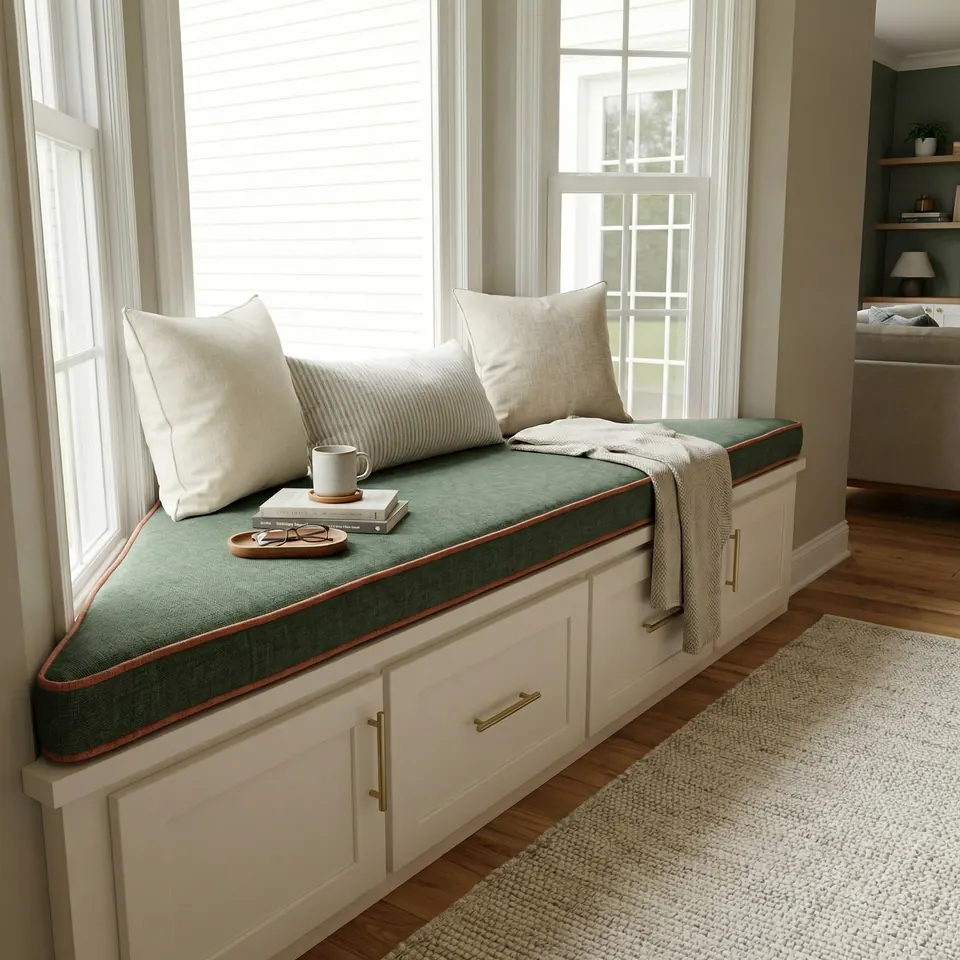
The Cushion Atlas · Benches, window seats & banquettes
Trapezoid and angled cushions, drawn edge by edge
One angled end turns a bench cushion into a trapezoid, and a trapezoid into a drawing. Four numbers are rarely enough, and the unit matters more than you'd think.
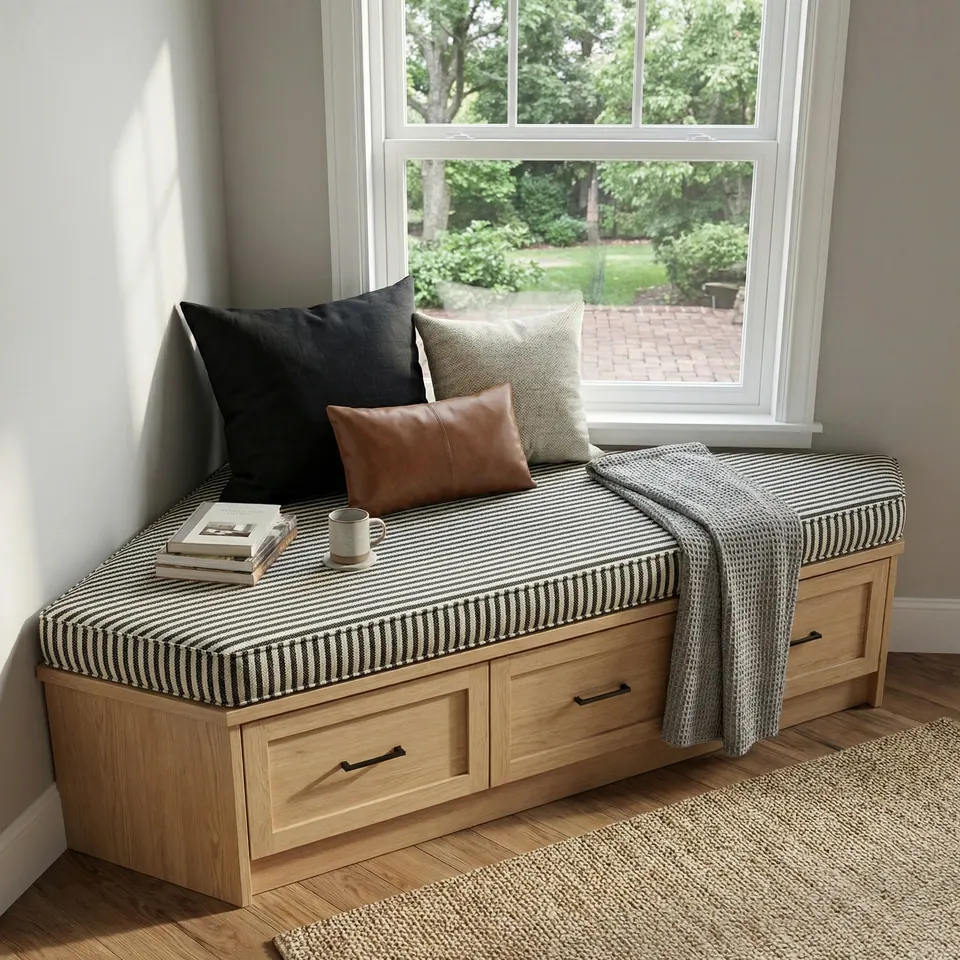
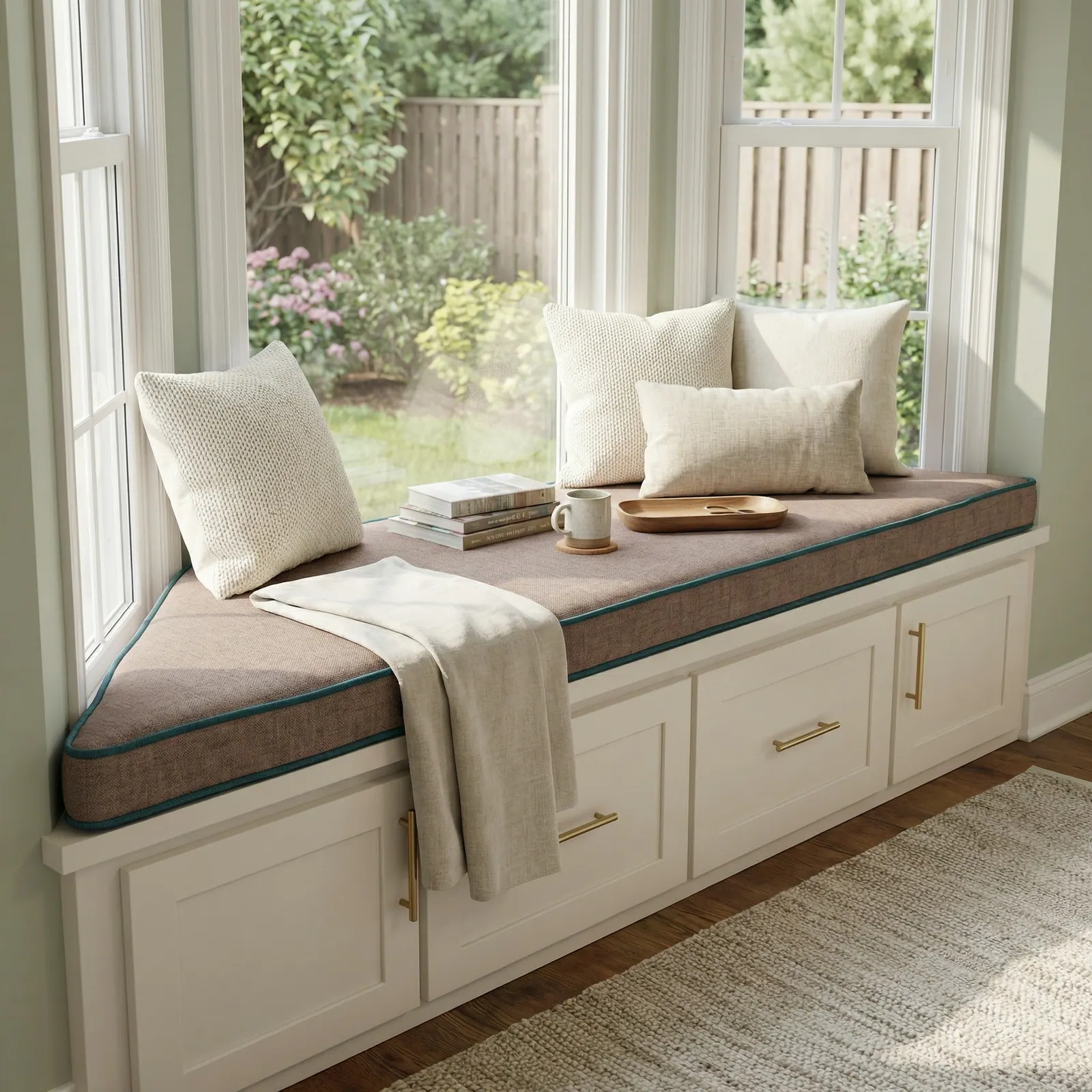
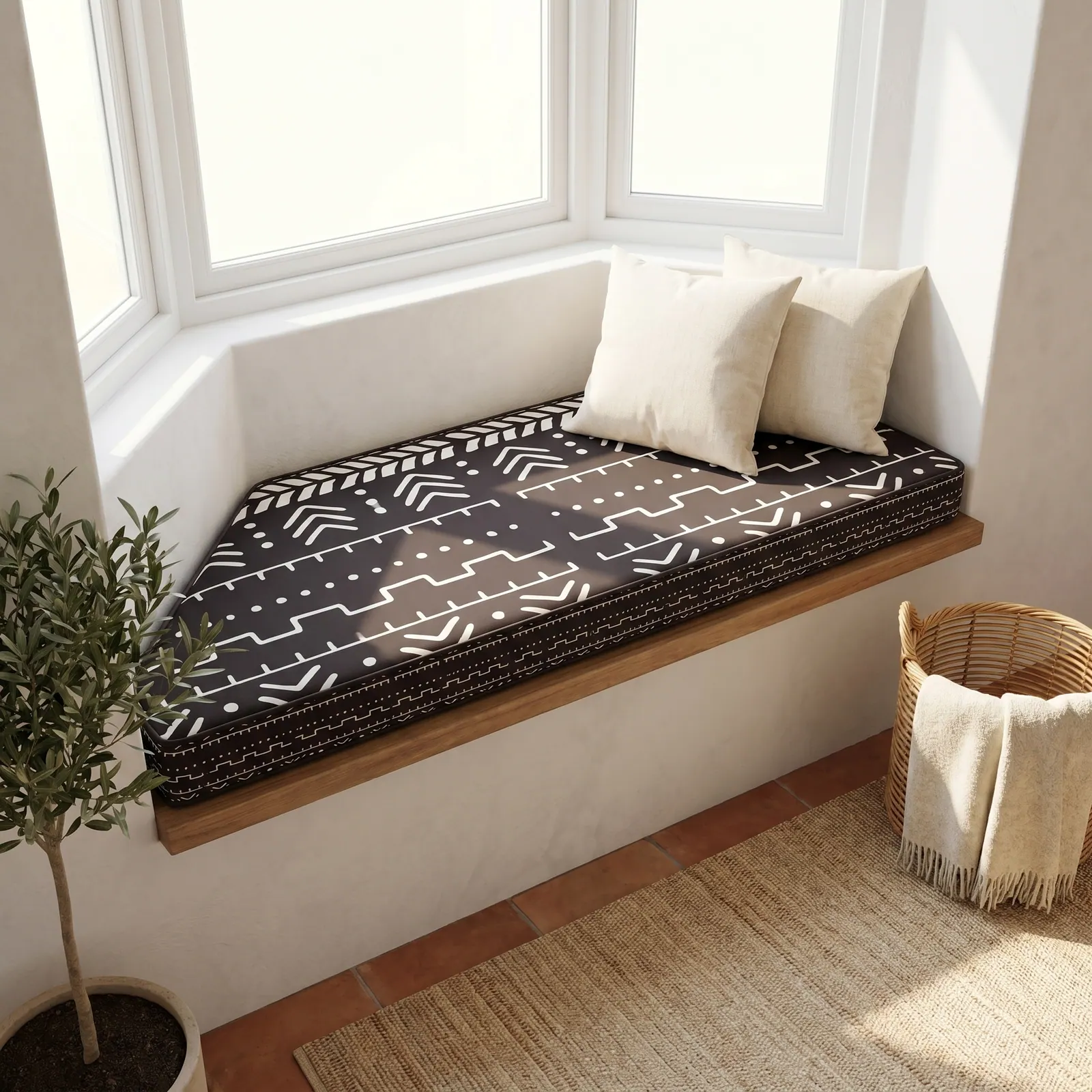
SaveTeal piping on mocha is an unexpected pairing that keeps a brown cushion from looking heavy.
The quick answer
A trapezoid bench cushion is a seat with one or both ends angled, so its front and back edges are different lengths. Order it on the custom-shape route with a drawing that gives every edge, the straight depth and your units. It is cut to the drawing, not to the size range, 4 in (10 cm) thick as standard, with piping included.
Every one is cut to your measurements. The number is how many readings the atelier has published for that shape.
One missing word: inches
Three trapezoid window seats were drawn in inches and first read as centimeters, and the first quote was badly off before anyone caught it. Units go on the drawing, once and clearly.
A trapezoid bench cushion is any seat whose front and back edges differ in length: a bench against an angled wall, a stair-landing seat, a dining bench with one clipped end, a bay seat. If front and back differ, or there's a notch or a curve, it goes on the custom-shape route. One angled end is enough.
Letters differ between charts, so write each length on the edge itself. This is a real angled-top trapezoid, lettered the way the buyer lettered it.
Letter
Edge
Length
How to measure
A, B
Short straight end sides
6 in (15 cm) each
Corner to corner, each one separately
C
Long edge
68 in (173 cm)
End to end at the widest point
D
Short edge
34 in (86 cm)
Corner to corner, opposite the long edge
E, F
Angled sides
23 in (58 cm) each
Each on its own; never copy one to the other
Depth
Front to back
22 in (56 cm)
Straight, at 90° to the long edge, in the middle
Thickness
Foam height
4 in (10 cm)
Standard; 2, 3 or 5 in on request
Four shapes, and the check that closes them
Most angled cushions are one of four shapes:
Plain trapezoid: long front, short back, two angled sides.
Angled-top or clipped: short straight ends before the angle starts, like the drawing above.
Notched or cut-out: a bite taken out for a window handle, post or casing, drawn with its size and position.
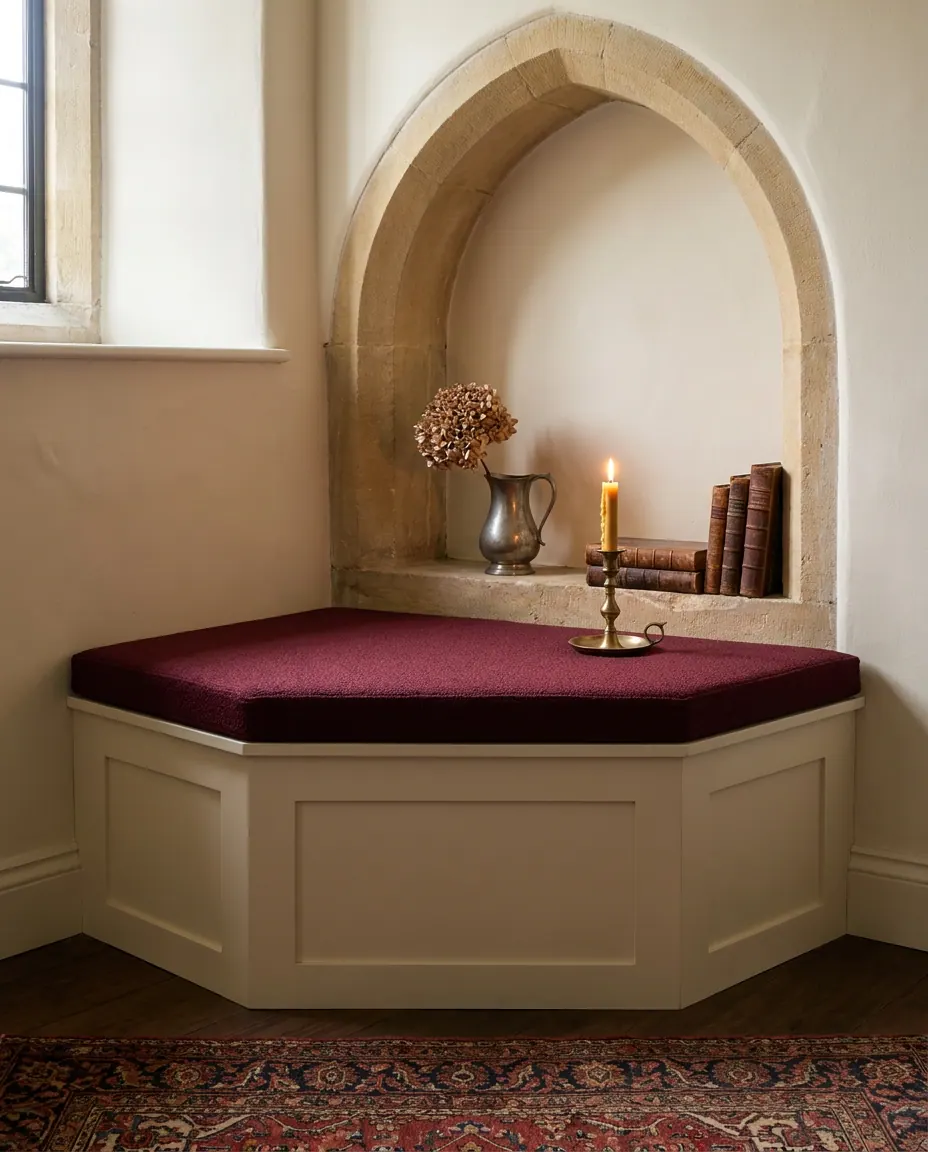
Stepped or half-hexagon: like the burgundy bouclé corner seat in the gallery. Every step gets a length.
Now the check. The long and short edges differ by 68 − 34 = 34 in, so each angled side covers 17 in across. Its rise is √(23² − 17²) ≈ 15.5 in. Add the 6 in end and you get 21.5 in, against 22 in measured. Closes within 1/2 in.
The box edge with piping is standard, and the piping follows every facet. Weigh it against the alternative with box edge vs knife edge.
Fabric and piping on an angled seat
Any fabric in the charts works on a trapezoid, but patterns and piping deserve a moment.
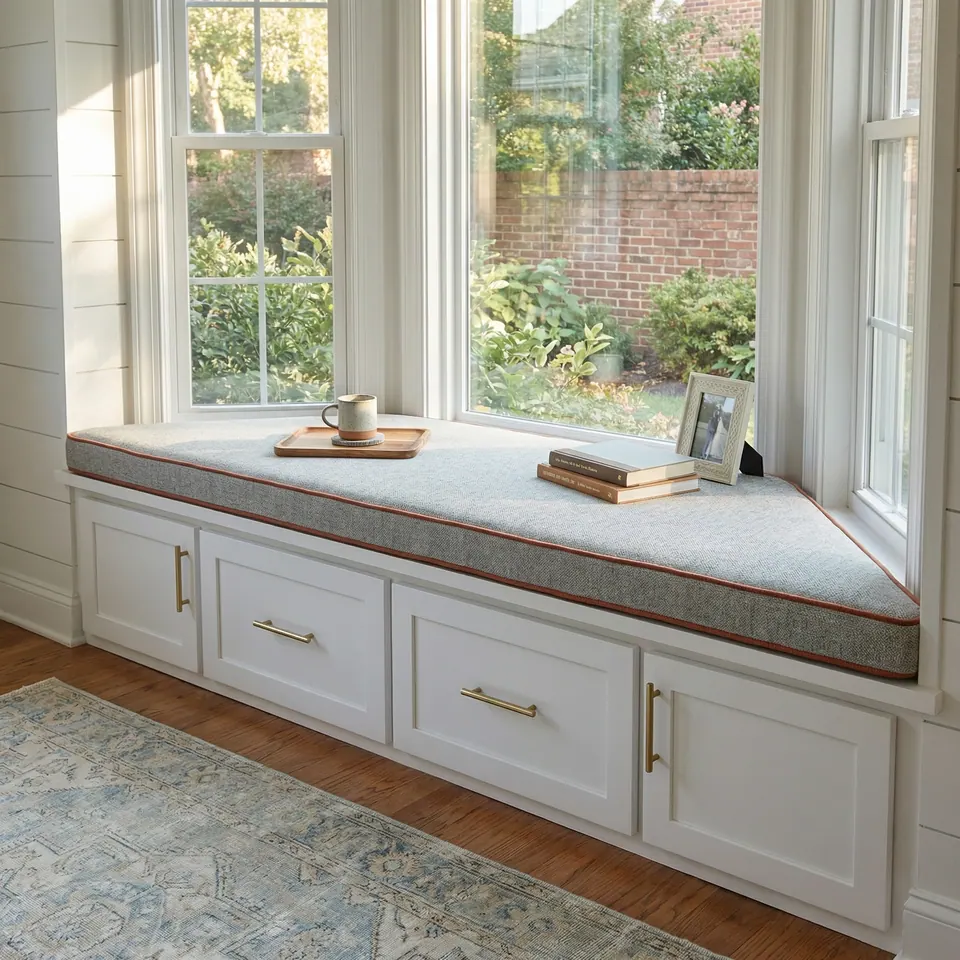
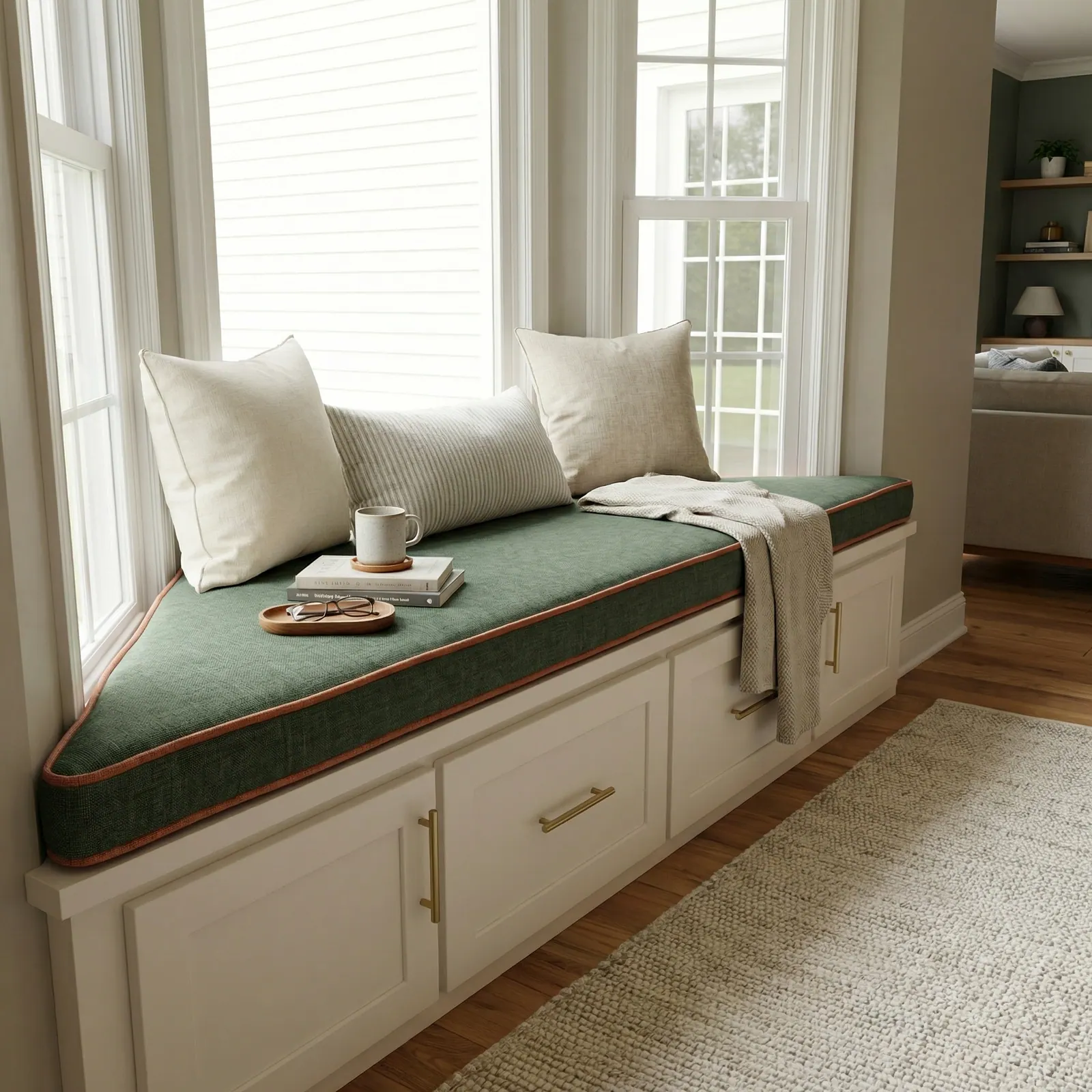
Linen-look weaves: the mocha seat with teal piping in the lead photo, forest green with copper, light gray with olive.
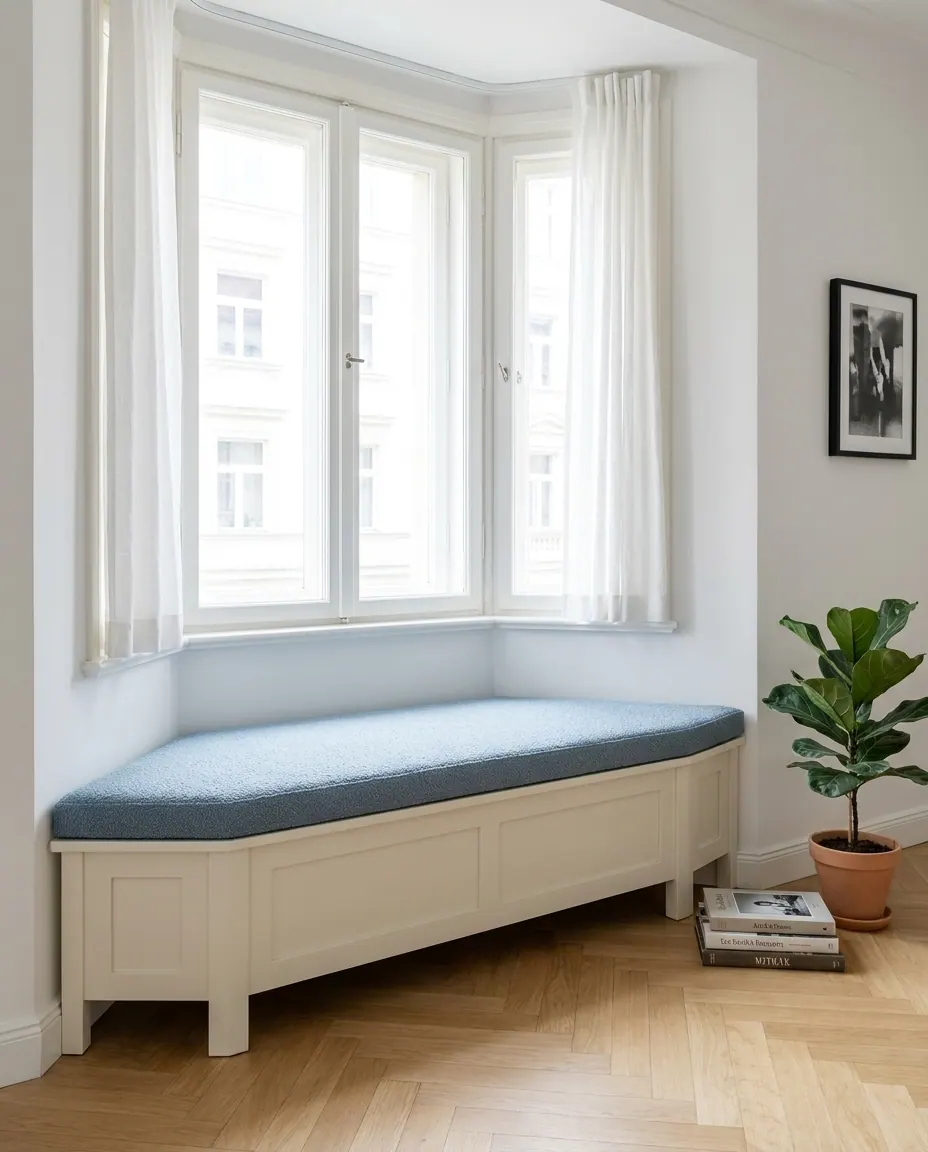
Bouclé and teddy: the dusty blue corner bay and the burgundy half-hexagon; the loops soften hard angles.
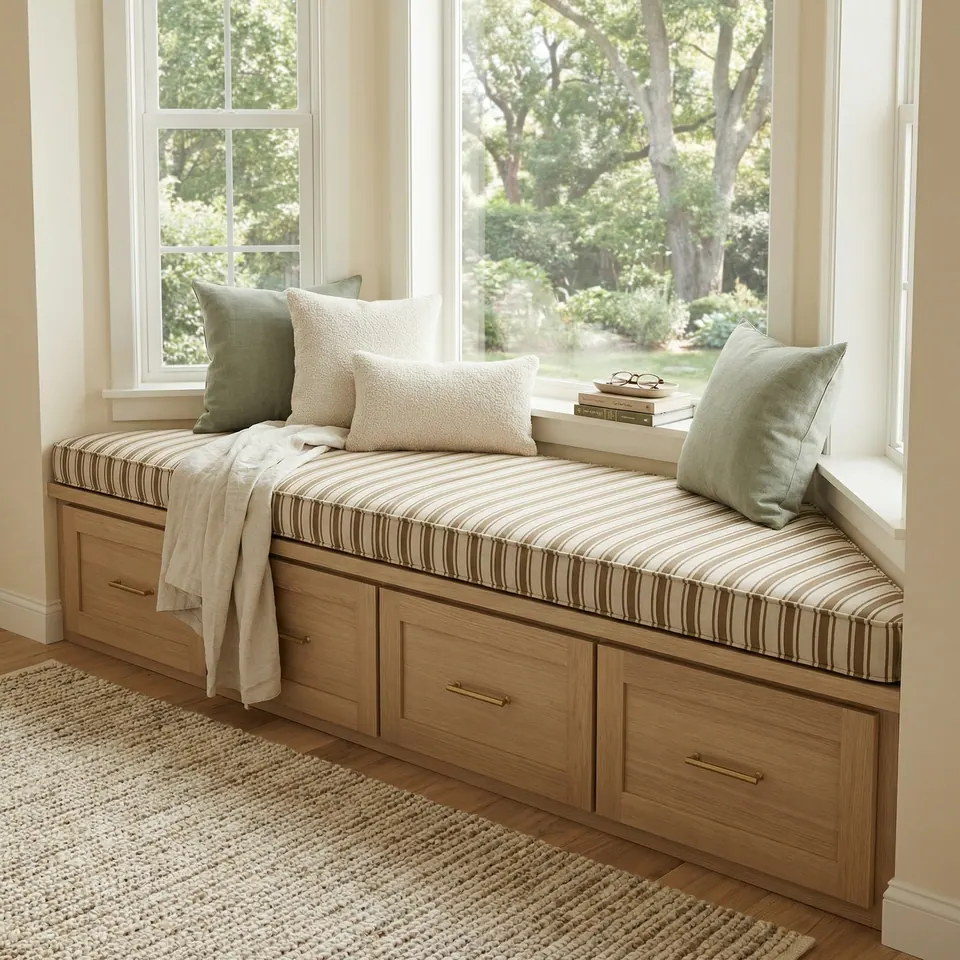
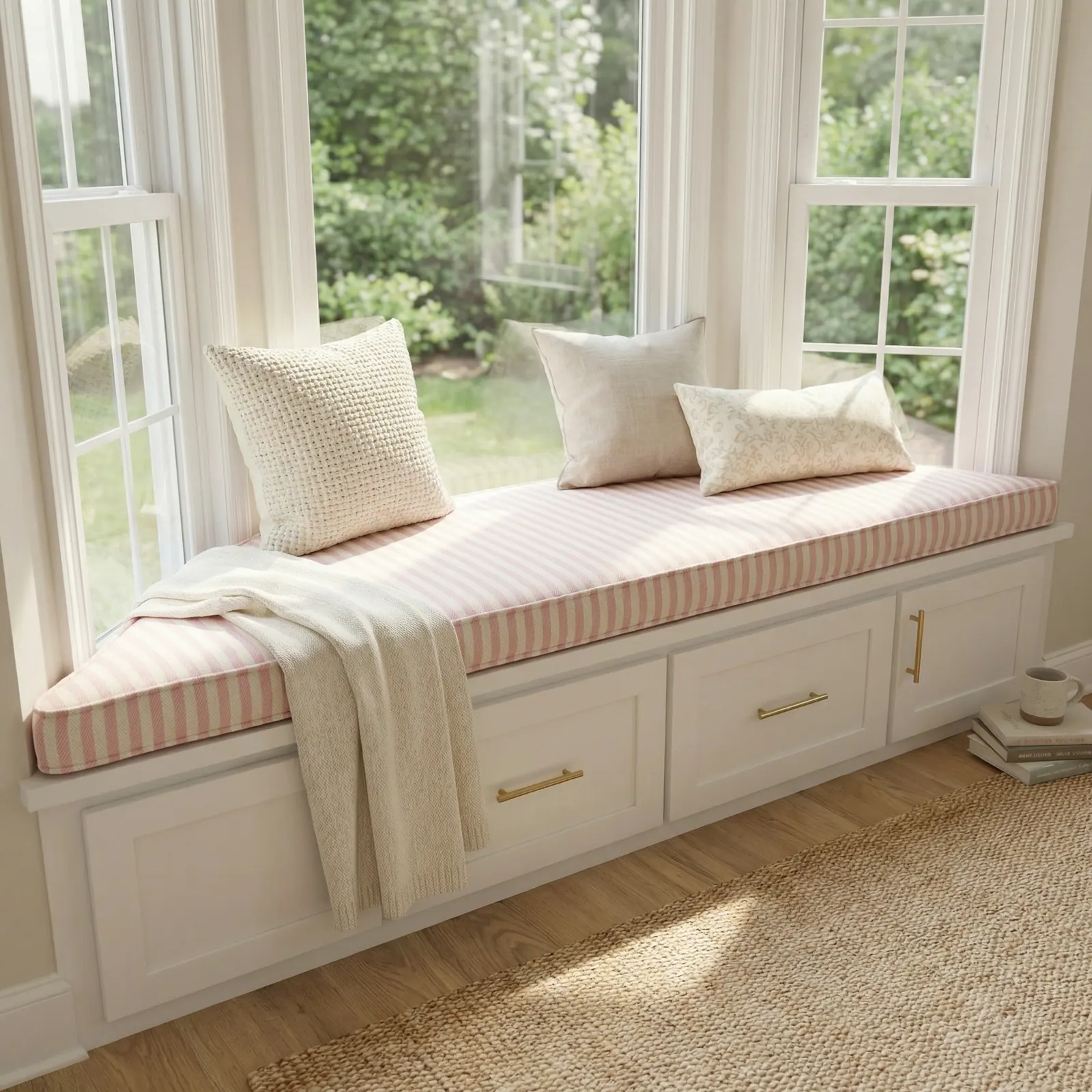
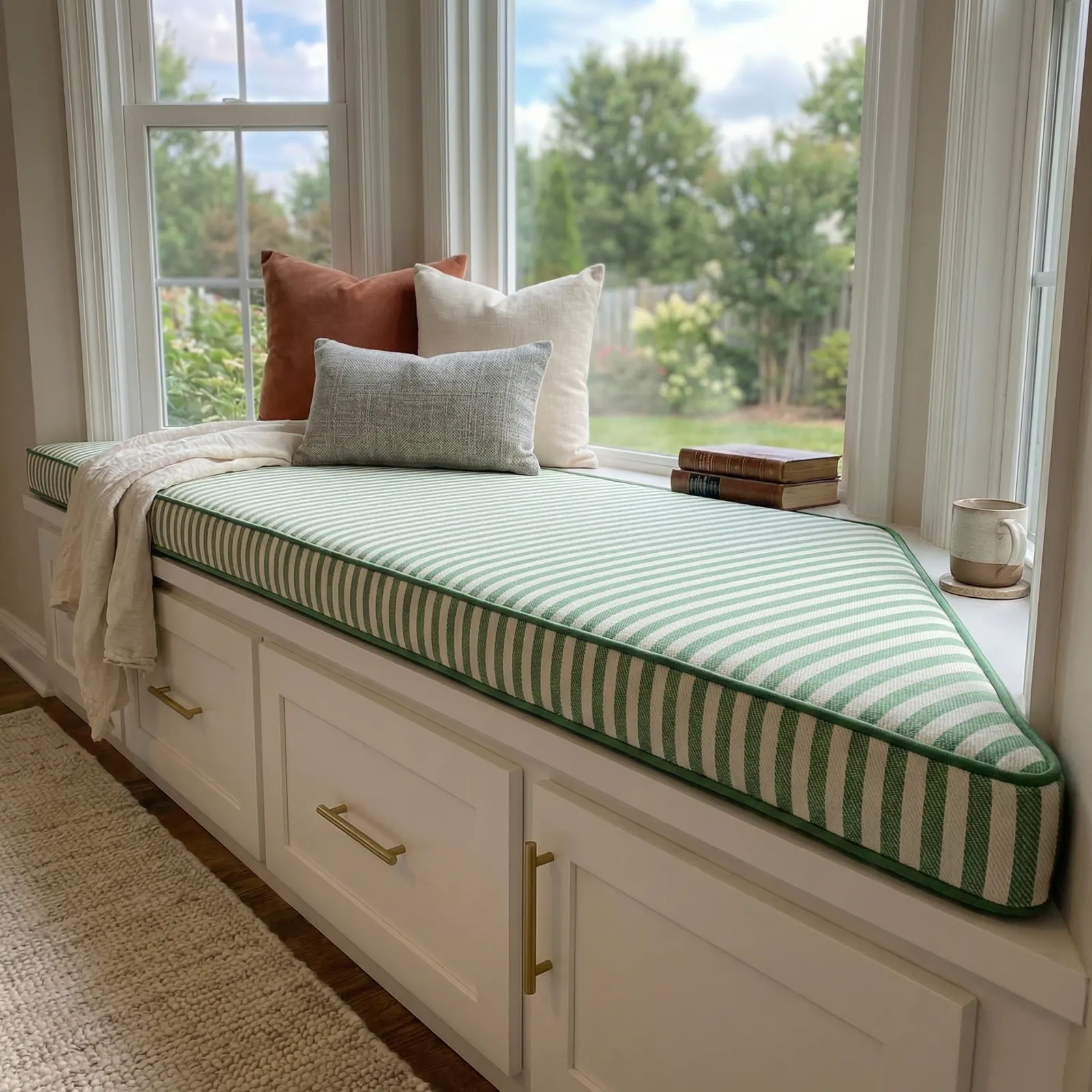
Striped cotton and ticking: stripes run front to back by default. Solid piping to match a stripe isn't always possible; self piping cut from the stripe is the guaranteed match.
Velvet and corduroy: both work, and trapezoids can be tufted with center buttons.
The workshop will photograph your fabric and piping swatches side by side on request. Close-ups look a little darker than daylight, so real fabric swatches remain the safest judge.
The count is how many published readings use each family. Open a family for its swatch book, care notes and neighbors.
Thickness, piece by piece
Trapezoids come 2, 3, 4 or 5 in (5, 7.5, 10 or 13 cm) thick, with 4 in standard, in the same high-density foam as every seat cushion. It gives a structured, flat top that keeps the angles crisp.
In a set, list the thickness separately for each piece. One thickness applied to every cushion in a mixed order is a known cause of remakes. Measure twice; the fabric remembers.
Six edges, a pillow backrest and four square pillows
A buyer in the US ordered an angled-top trapezoid floor cushion for a reading nook: A 6, B 6, C 68, D 34, E 23 and F 23 in, 22 in (56 cm) deep in the middle, in linen with matching piping. She added a backrest and four 18 in (46 cm) square pillows.
The workshop confirmed 4 in (10 cm) thickness and offered the backrest two ways, firm foam or pillow-filled. She chose pillow. It fit perfectly.
One small surprise: the 18 in pillows measured just under 16 in (41 cm) edge to edge once stuffed. That's normal. A pillow's nominal size is the cut fabric, and plumpness pulls the edges in.
Measured
A 6, B 6, C 68, D 34, E 23, F 23 in; 22 in deep; 4 in thick
What it taught
A pillow's nominal size is the cut fabric; a plump pillow measures smaller edge to edge.
Photographs from the workbench
Open any photograph large; each one has its own link and a Save button.
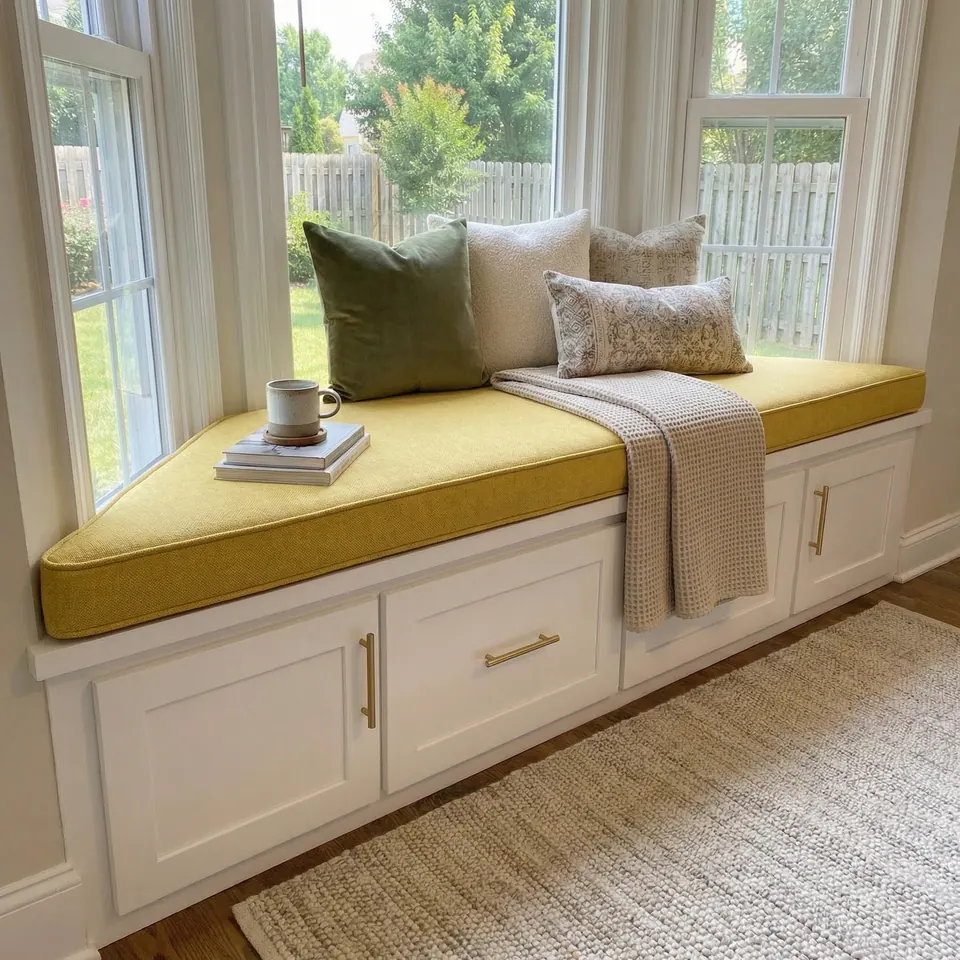
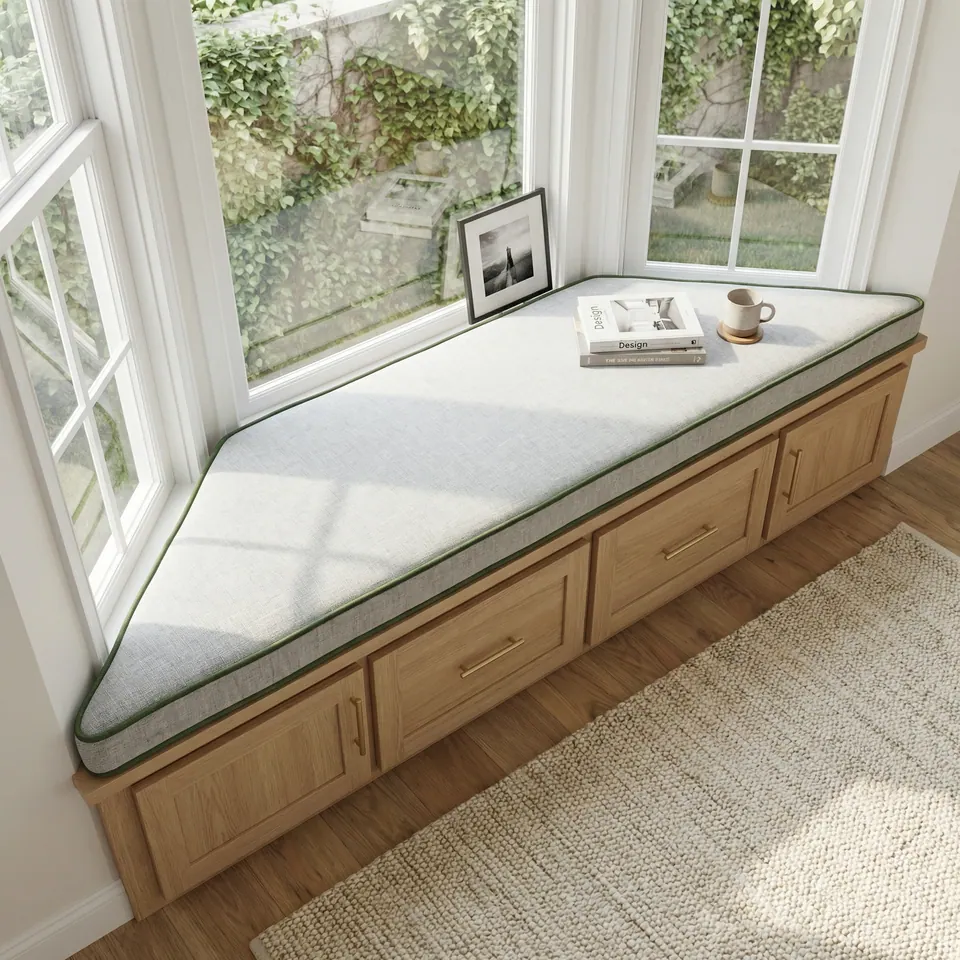
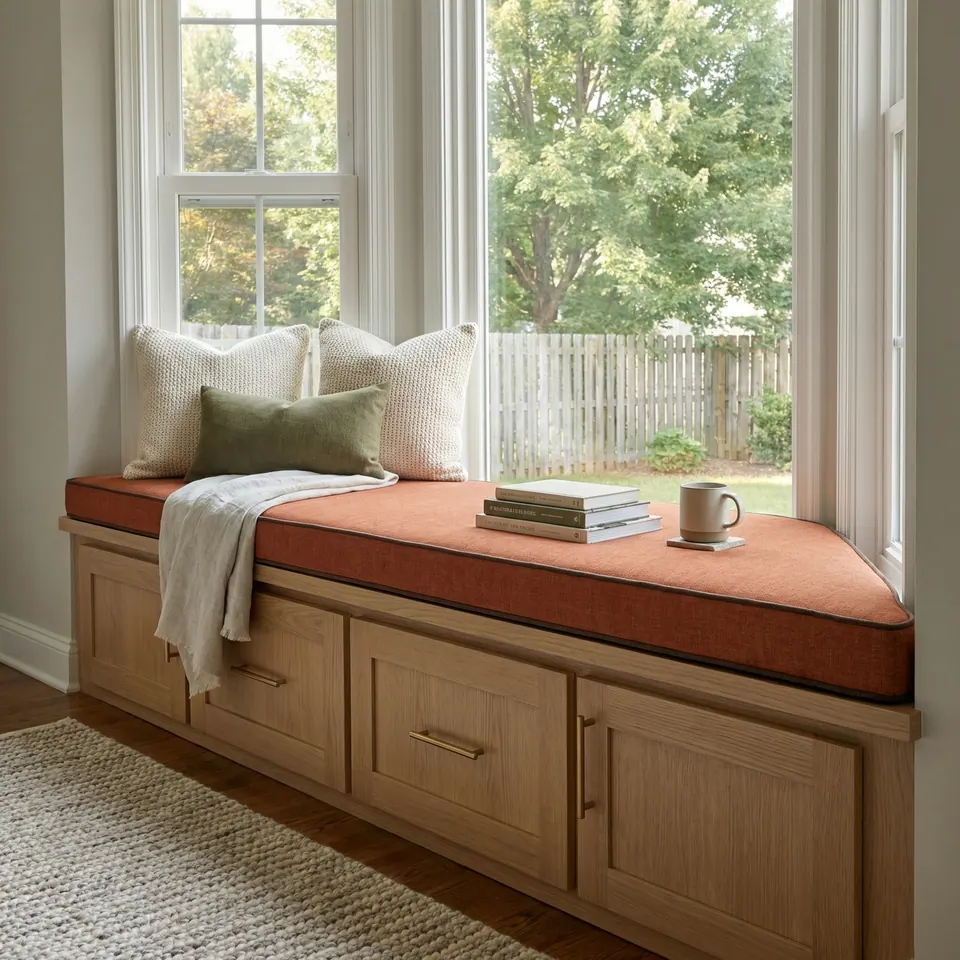
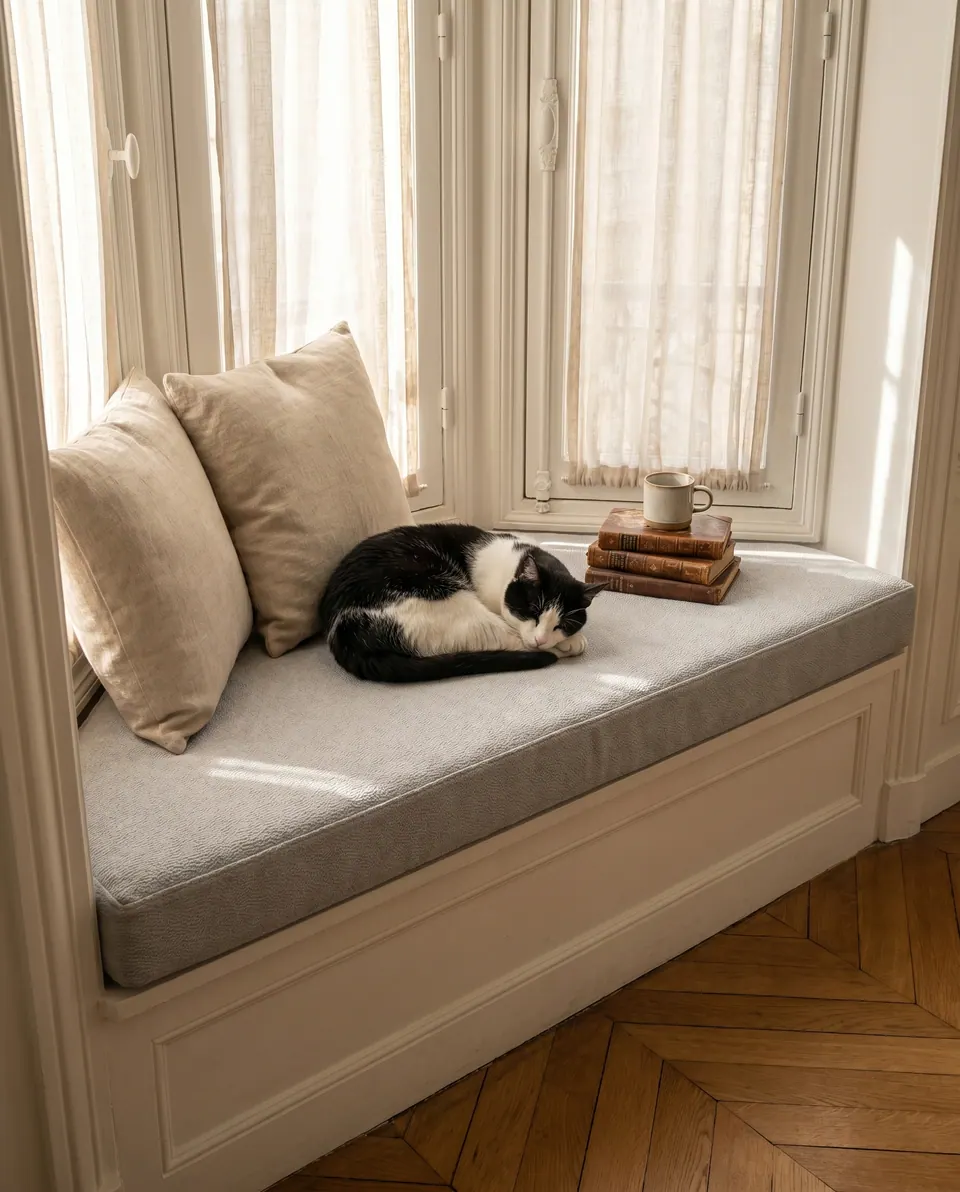
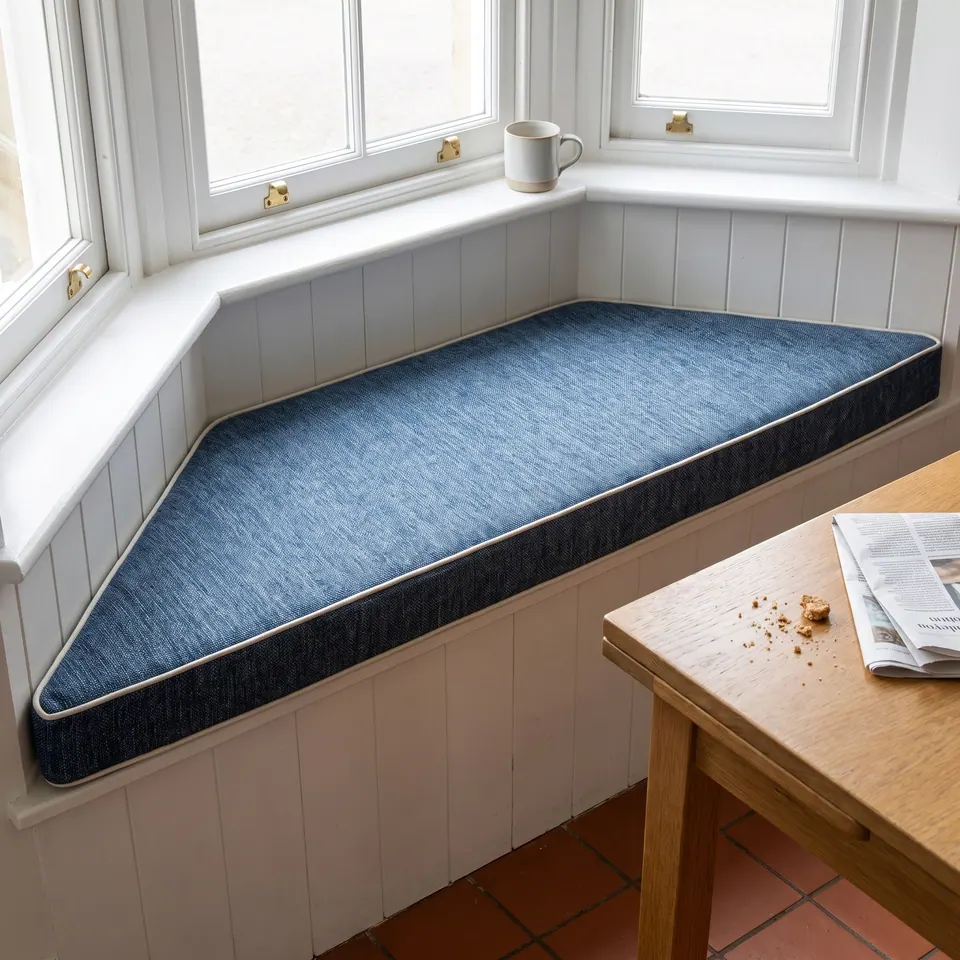
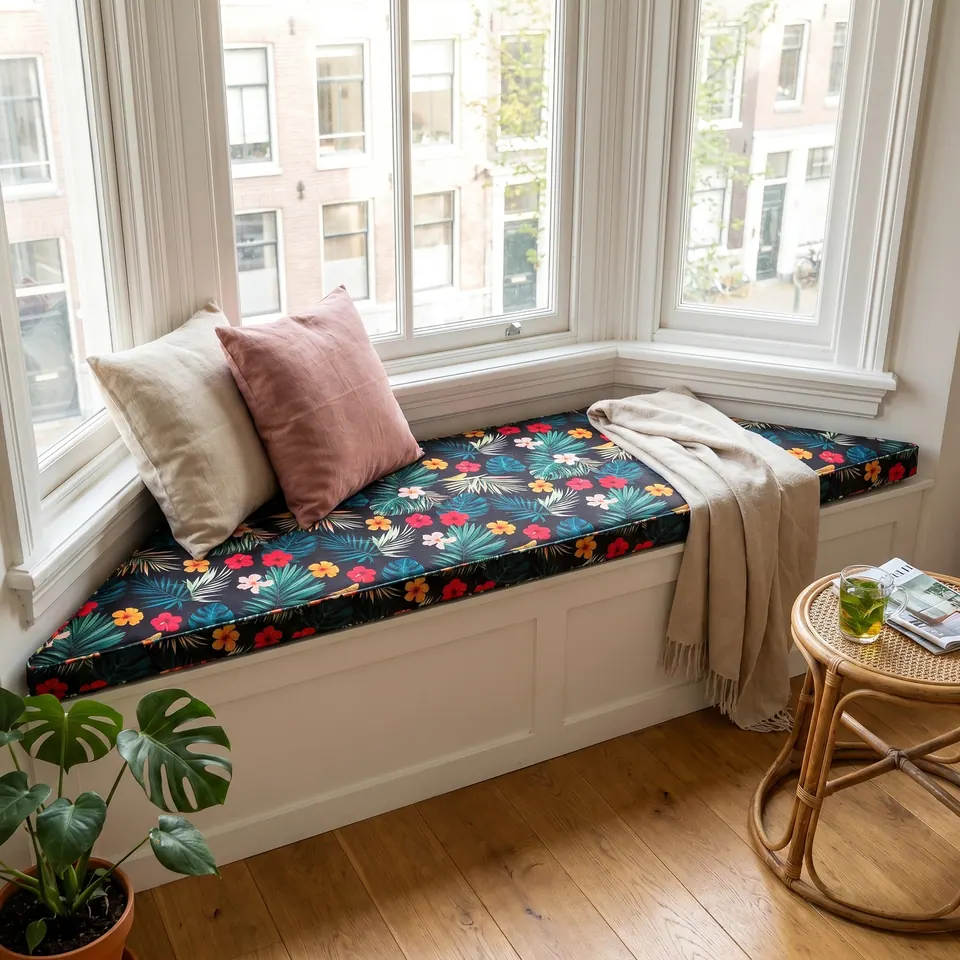
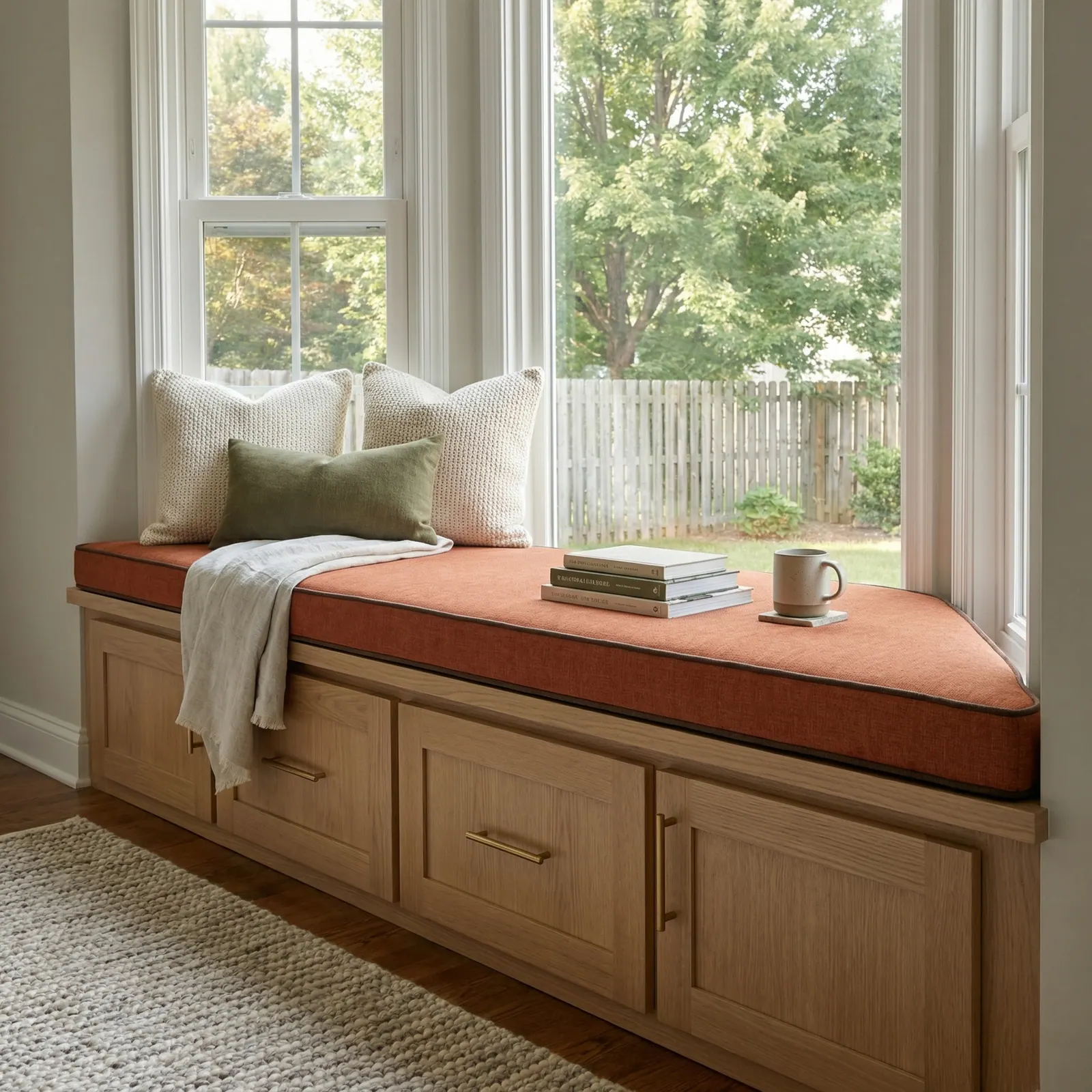
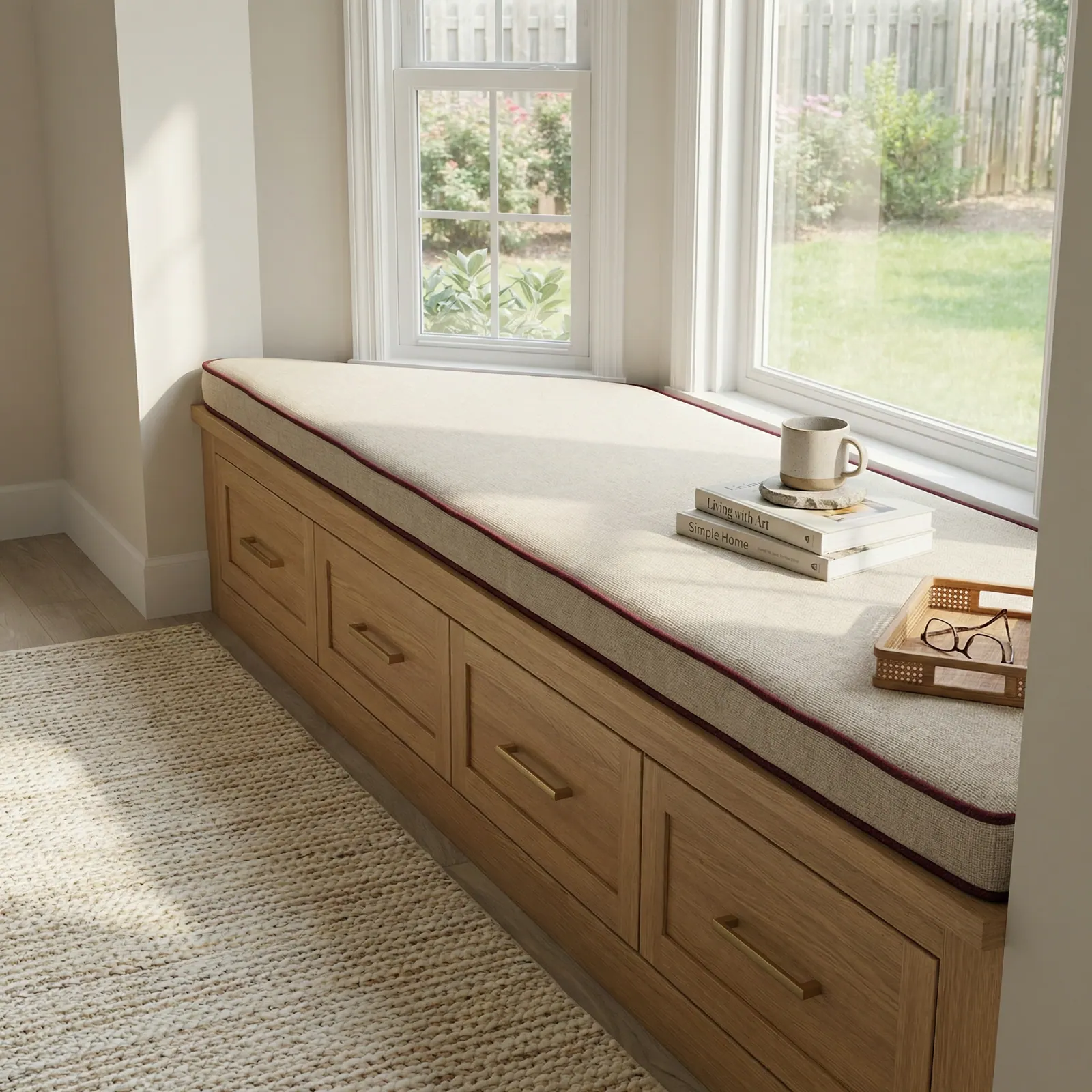
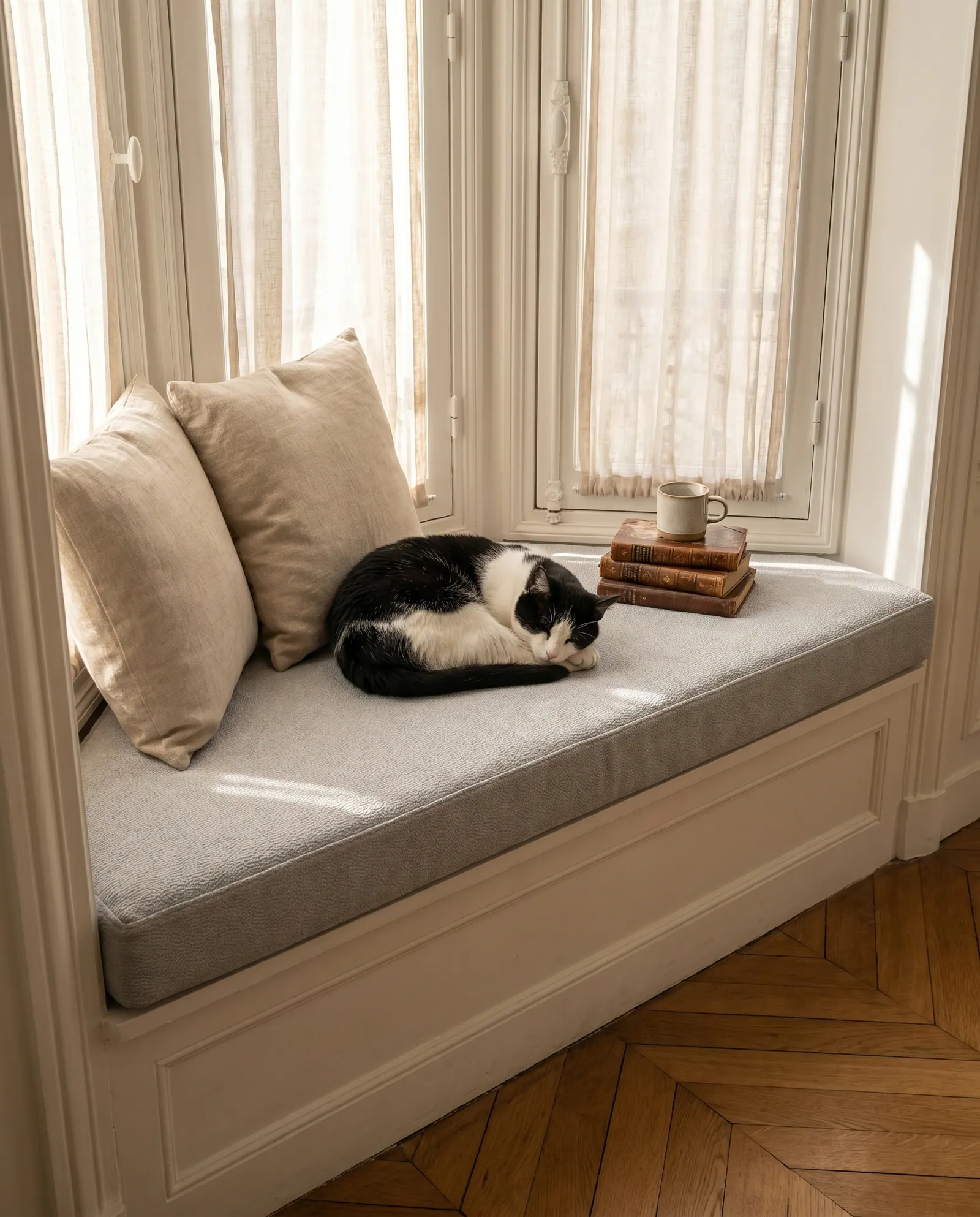
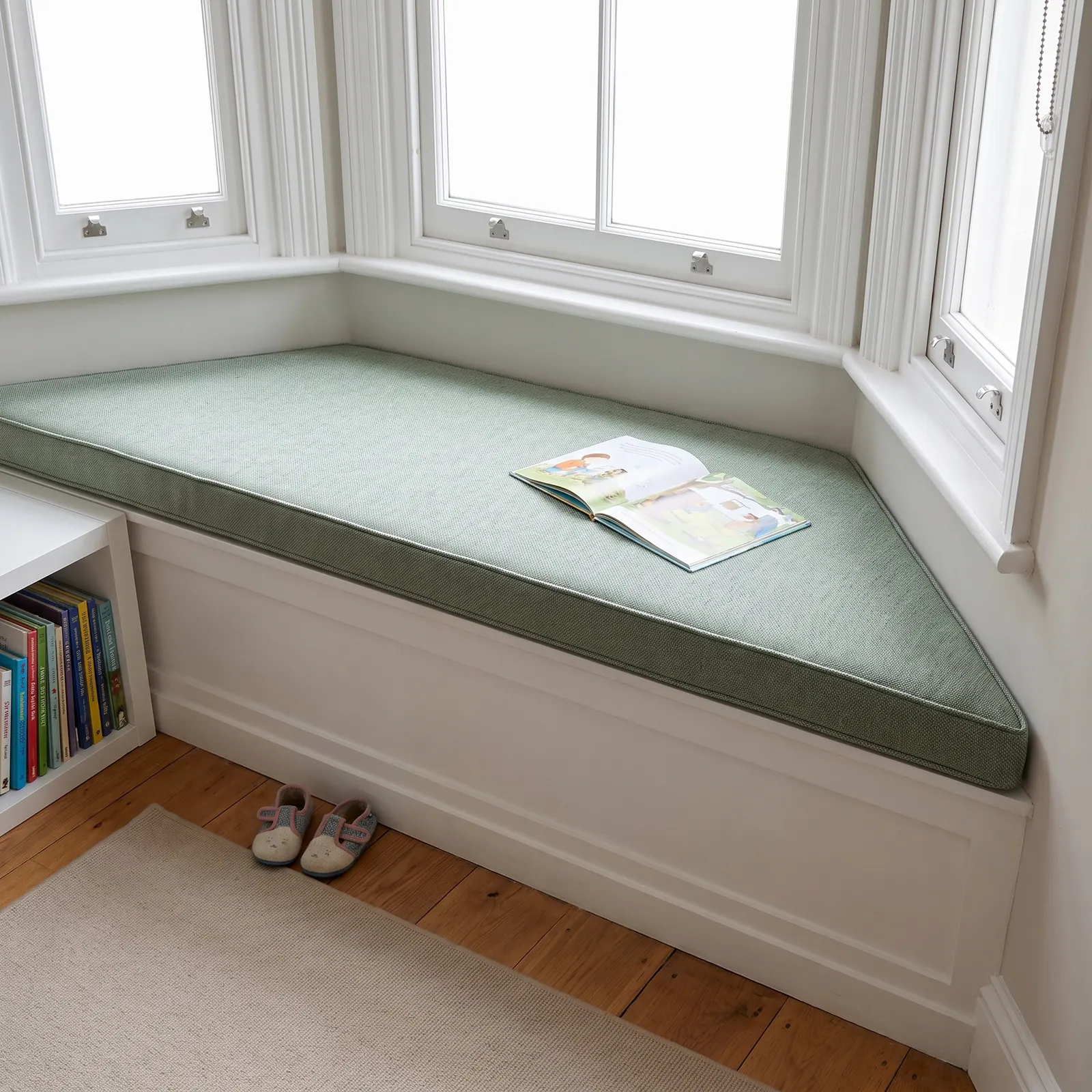
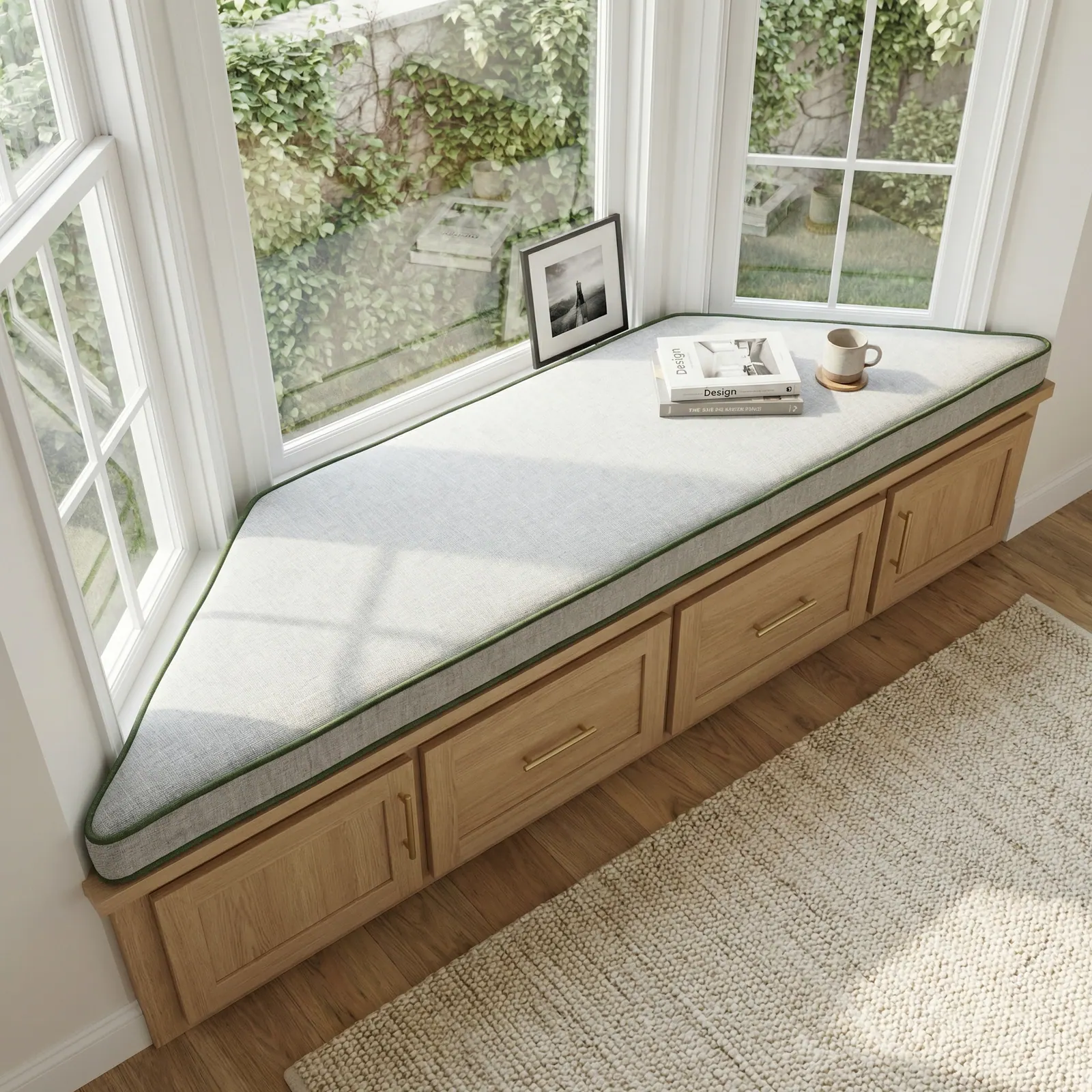
SaveA warm clay color makes the bay glow even under a gray sky, and the dark welt keeps its angled end sharp.SaveA burgundy bouclé cushion cut to a half-hexagon sits beneath a stone arch lit by a single candle.SaveThe seat angles in at the far corner of the bay and the cushion follows it. Burgundy piping gives a pale fabric a crisp outline against honey oak.SaveStripes run front to back so the eye reads depth, and the self-piped edge keeps the pattern unbroken.SaveThe angled left end follows the window reveal, so the gray seat fills the alcove with no gap at the corner.SaveA sage cushion cut to the bay angle makes a reading perch in a child's room, with books kept low and within reach.SaveA thick trapezoid cushion turns a floating oak ledge in a plaster bay into a proper seat.SaveA long taper runs from the wide back to a sharp tip at the side window, a shape only a template can capture. The olive welt echoes the ivy beyond the glass.SaveCopper piping on deep green recalls classic library upholstery and matches the brass hardware below.SaveOne dusty blue trapezoid cushion follows a corner bay, square at one end and angled at the other.SaveSolid green piping frames the stripe and keeps the long taper at the right end crisp.
Trapezoid mistakes that cost a remake
Leaving units off the drawing. Inches read as centimeters changes everything, the quote included.
Giving four numbers for a six-edged shape. Short ends and clipped corners need their own lengths.
Assuming left and right match. One wide seat measured 33.75 in on the left and 33 in on the right.
Forgetting the window handle. Draw it as a cut-out with its position.
Ordering on the rectangle listing because it's cheaper. The order gets held and redone with a drawing.
Shaving half an inch off to be safe. Give the true size; the workshop handles the fit allowance.
A trapezoid bench cushion with front and back edges of different lengths belongs on the custom-shape route. If checkout never asks for a drawing, the listing is wrong.
Styling angled seats, and the tools that do the arithmetic
Angled corners swallow pillows. The terracotta seat in the gallery answers with knit squares in the corners and one olive lumbar along the front; the green pinstripe seat does it with rust velvet and gray.
Contrast piping on a trapezoid works like a drafting pen: teal on mocha, burgundy on oatmeal, copper on forest green. It traces every angle, so walls that wander out of square will show. Matching piping is more forgiving.
How do I order a custom cushion that isn't a rectangle?
The workshop's answer
Use the custom-shape (trapezoid) listing. Pick the size range by the longest length and the deepest depth; those totals only set the price bracket. At checkout, upload a drawing with a measurement on every edge plus a photo of the seat, and put the thickness and fabric code in personalization. The cushion is cut to the drawing, not the totals.
A common question
How should I label the sides on my trapezoid drawing?
The workshop's answer
Write a length on every edge, A, B, C and D, plus E and F for clipped corners or short end sides, and the depth in the middle. A photographed paper sketch is fine. Choose the nearest size range and send the lettered drawing; the workshop checks the geometry closes, works out any unlabeled edge and sends a full list back for you to confirm.
A common question
Should I make my measurements a little smaller so the cushion fits?
The workshop's answer
No. Give the true, exact size of the space, end to end, and don't subtract anything, not even half an inch. The workshop produces to the numbers you write, and its team reviews your diagram and handles any fitting allowance. Centimeters avoid rounding from inch conversion.
A common question
How close to my numbers will a handmade cushion come out?
The workshop's answer
Cushions are cut to the exact figures you give, not rounded; 22 x 99.5 in was made as 22 x 99.5 in. Handmade foam cushions can still vary by about 1/2 in (1 cm), and fully tufted ones by 1 to 2 in. Measure the cushion body, not the outer edge of the piping.
A common question
Is a non-slip bottom included on a trapezoid cushion?
The workshop's answer
It isn't standard; it's an optional add-on available on any shape, trapezoids included, and it scales with the cushion's size. Note 'non-slip base' with your exact size in personalization, and it is either included in your quote or sent as a separate payment link for the difference. You can choose it for some cushions in a set and not others.
A common question
Do you have patterned fabrics, or only solids?
The workshop's answer
The core range is mostly solid colors, but there are stripes, plaids and tartans in brown, green, blue and red, oriental designs and patterned velvets, with extra charts on request. House fabrics all cost the same. A specific print from elsewhere usually isn't stocked, but the workshop will try to source it at a higher price.
Have it made
Have your trapezoid bench cushion made — ask Nate’s workshop
Every edge and both diagonals, to the nearest 1/4 in. If the numbers do not close, the workshop will say so on the call. — Nate
Leave your details and the workshop will call you to confirm measurements, fabric, foam and piping. No prices, dates or payment on this page: it is a request, not an order.
Fabric · Foam · Pipingwhat the workshop will confirm with you
Can a long trapezoid cushion be made in two pieces?
Yes. For very long trapezoids, around 79 in (2 m) or more on the long side, the workshop may suggest two pieces, which are easier to make and handle. You decide where the join falls, and one continuous piece is still possible if you ask.
Is there a charge for my drawing or template?
No template charge. Shaped pieces do cost more than rectangles because cutting and sewing take longer. On the custom-shape listing a simple notch adds nothing by itself, while cut-outs around obstacles cost a little more.
Can I see my fabric and piping together before the cushion is cut?
Yes. The workshop photographs the chosen swatches side by side, as many combinations as you need, and can reshoot in different light. It doesn't send AI mockups, since they misstate real tones. For certainty, order physical samples.
Does piping add to the finished size?
The cushion is cut to your size and the piping sits on the seams, so you don't allow for it. Piping does add a touch to the outer edge, so if the finished size must include the piping, say so in the order.
Can a trapezoid cushion be tufted?
Yes. Trapezoids can be tufted, for example in corduroy or with a row of center buttons. Tufted cushions vary a little more in finished size, by 1 to 2 in, so give the true size of the space and let the workshop allow for it.
My bench is only slightly narrower at one end. Do I need a trapezoid?
Probably not. When the two ends differ by only a small amount, the workshop has recommended an averaged rectangle instead of a trapezoid, because a slight taper is hard to see and a rectangle is simpler to order. Send both end measurements and the depth; if the difference matters for the fit, the drawing will show it before anything is cut.
Is a trapezoid cushion the same as an angled window seat cushion?
Mostly, yes. Shops call the same shape a trapezoid, angled or bay window cushion: a long edge, a shorter parallel edge and two slanted ends. It's ordered by the long width, the short width and the depth measured straight out at 90 degrees at the deepest point, with the slanted sides sent as a check on the math.
± 1/4 in — Nate
Share this atlas entry
Readings
Photographs read by the masters: trapezoid & angled cushions
Real cushions made for real rooms, each read for proportion, fabric and fit.

 Save
 Save
 Save
 Save
 Save
 Save
 Save
 Save
 Save
 Save
 Save
 Save