 Save
A Reading by NateTrapezoid & Angled Cushions
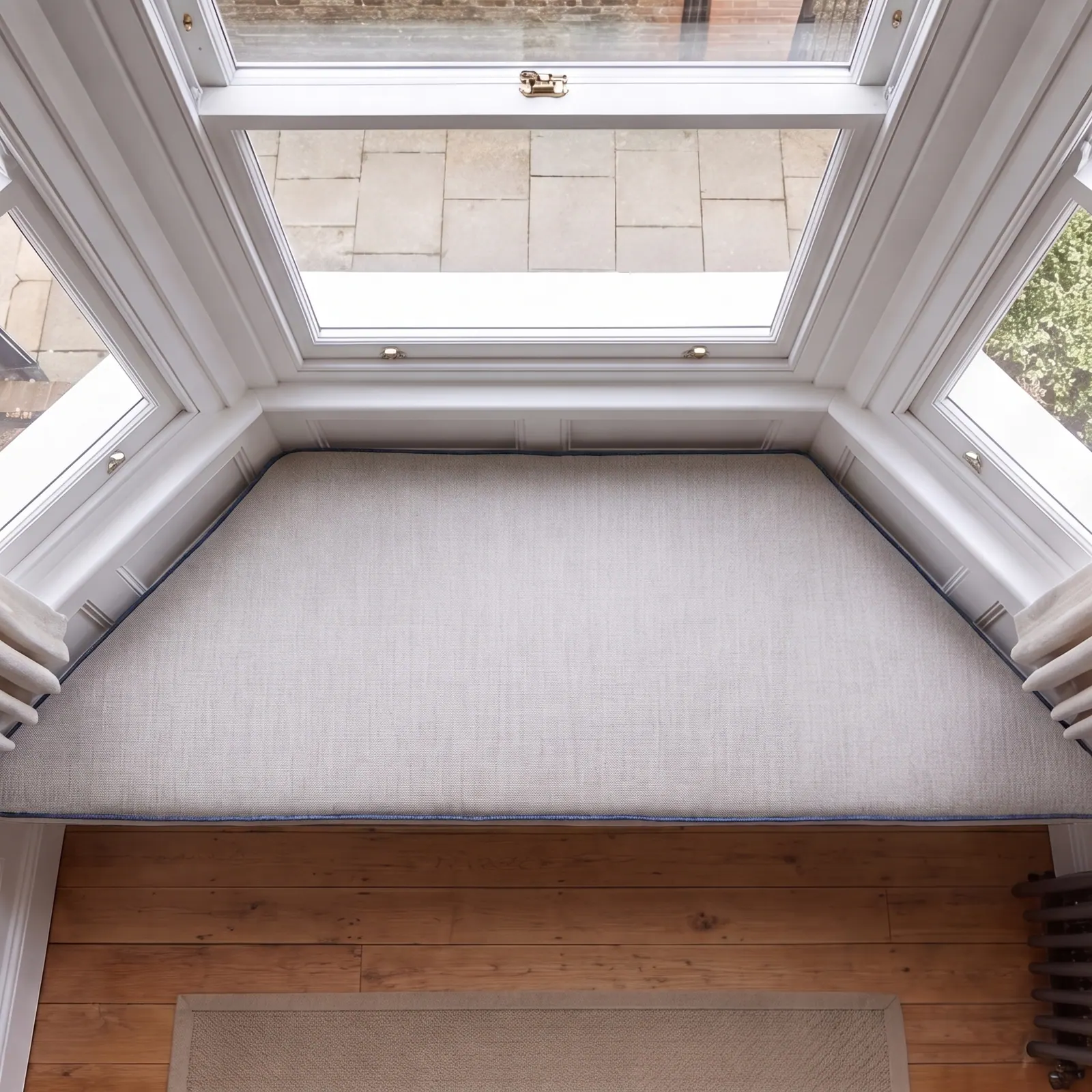
A light gray trapezoid window seat cushion, read for its finishing: the angled end, the piping line and the zipper
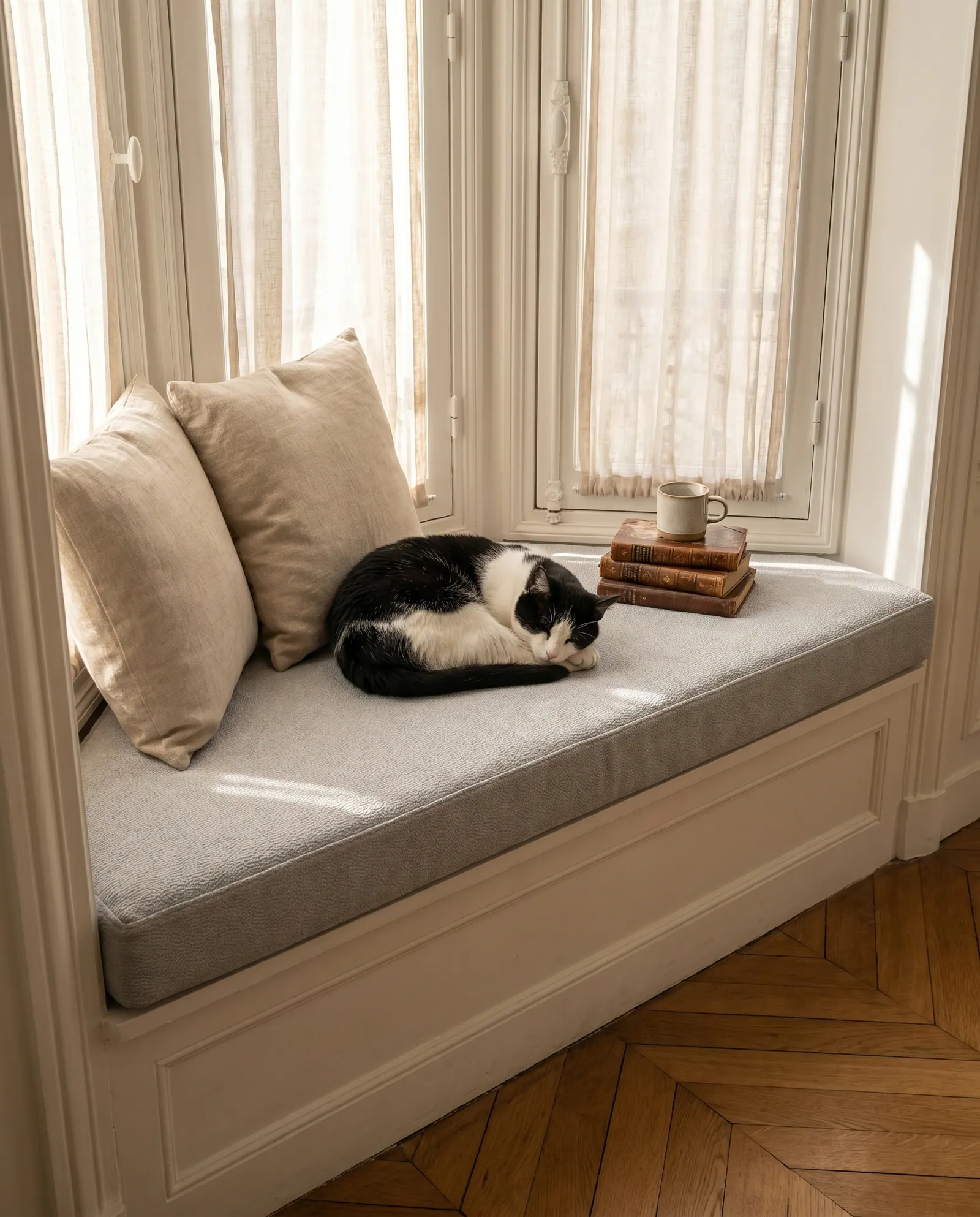
A tuxedo cat asleep on a gray angled seat in a Paris-style alcove. Look past the cat, partner. The craft is in three lines you can check with a ruler.
The angled left end follows the window reveal, so the gray seat fills the alcove with no gap at the corner.

The quick answer
A trapezoid bench cushion looks hand-finished when three details are right: the angled end matches the window reveal, the self piping runs straight along the front, and the zipper sits on the back side, facing down. Order from straight measurements (front, back and depth), not from slanted sides taped over an old cushion, which run long.
The cut end is the first thing a tailor looks at
The cat gets your eye first. The second look should go to the left end of the cushion. It is cut at an angle, so it meets the splayed window reveal with no triangle of bare wood in the corner.
That slant is what makes this a trapezoid bench cushion and not a rectangle shoved into an alcove. The front edge is longer than the back, and the end copies the wall of the reveal.
The fabric is a light gray weave from the performance and pet-friendly family. Under filtered light through linen sheers it sits between the white paneled base and the honey herringbone parquet without arguing with either. It also suits a black-and-white cat: stray white hairs vanish into dove gray.
Every prop has a job. Two oatmeal linen pillows fill the angled corner, where your back would otherwise meet a hard reveal. Three old leather books and a cream mug say reading seat. The casement windows give soft side light, the one light that shows whether a piping line is straight.
Pinned by Nate: five checkpoints on an angled seat
Five pins, from the slanted end to the sleeping cat.
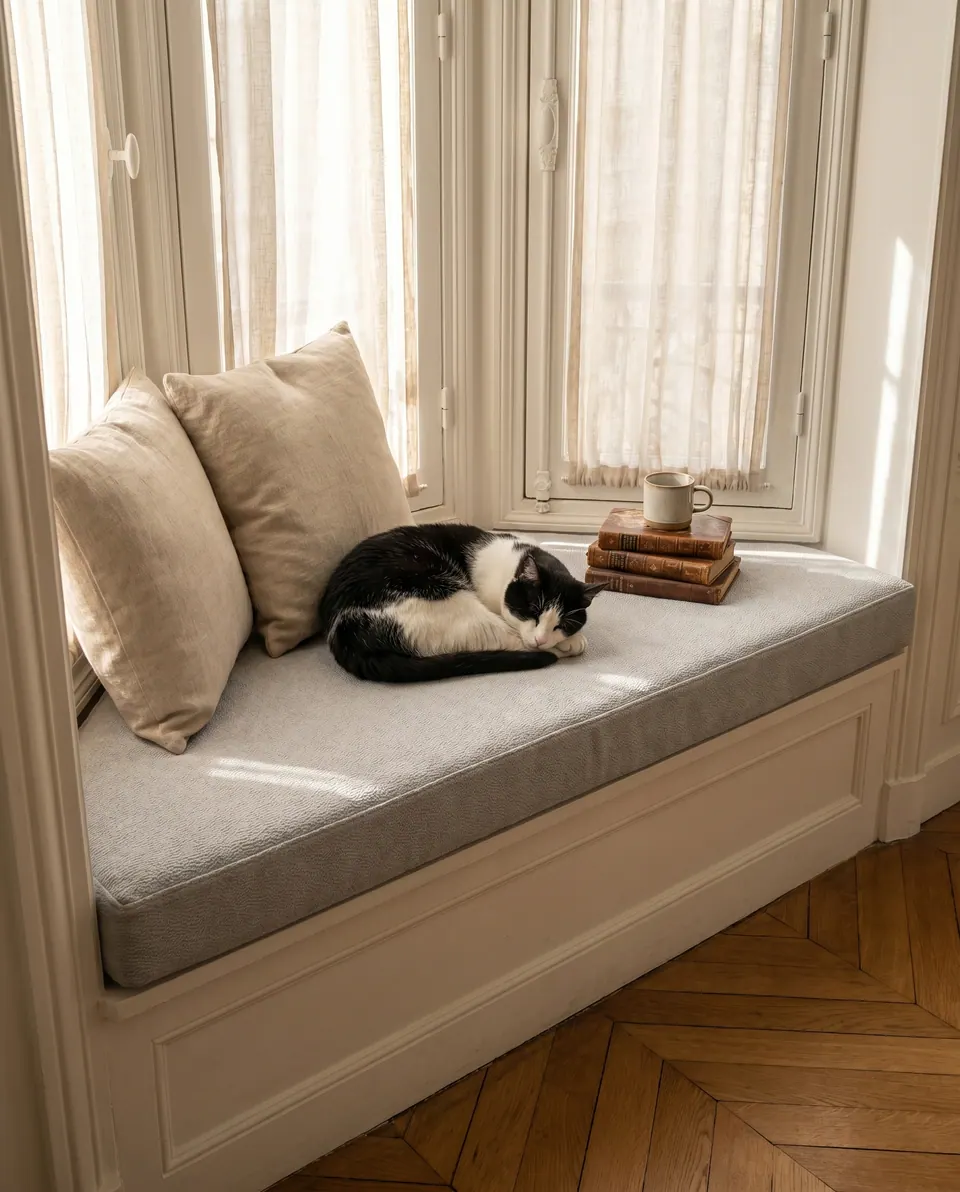
- Tuxedo cat
Light gray flatters black-and-white fur and hides stray white hairs.
- Angled trapezoid end
The end is cut to the splayed window reveal, leaving no gap in the corner.
- Piped front edge
A fine self piping gives a tailored line against the paneled base.
- Oatmeal pillows
Pillows lean into the angled end where a hard reveal would meet your back.
- Books and mug
Vintage books and a cream mug set the reading-seat story.
- Tuxedo catLight gray flatters black-and-white fur and hides stray white hairs.
- Angled trapezoid endThe end is cut to the splayed window reveal, leaving no gap in the corner.
- Piped front edgeA fine self piping gives a tailored line against the paneled base.
- Oatmeal pillowsPillows lean into the angled end where a hard reveal would meet your back.
- Books and mugVintage books and a cream mug set the reading-seat story.
Three finishing details, checked like a drawing
In my uncle's shop the templates were brown paper. I turned them into drawings with dimensions. The lesson stayed the same: on an odd shape, craft is a short list of details that either hold or wander.
- The angled end. Cut to the reveal, not to a guess. Make a paper template of each end; left and right reveals are rarely mirror images.
- The piping line. Here it is self piping, the same gray as the cushion, so it draws a line instead of a stripe. It should run straight across the front and turn cleanly at the slanted corner.
- The zipper. Every cover has one, on the back side, as hidden as it can be. That side goes down and toward the wall. If you can see the zipper, the cushion is upside down.
None of this rescues a bad number. Tolerance is kindness to your future self: send the real measurements and let the workshop handle fit allowance.
A 77 in storage bench and two sides that measured long
A buyer in the US had an angled storage bench with a hinged lid, against a wall rather than a window, and wanted a seat cushion plus back cushions. The paper drawing read: bottom 77 in (196 cm), top 34.5 in (88 cm), depth 25 in (64 cm), slanted sides 33 in and 33.5 in (84 and 85 cm).
The slanted sides ran long. The tape had followed the rounded edge of the old cushion, and a curve adds length. The workshop cut from the straight numbers instead. Half of the 42.5 in difference is 21.25 in; with 25 in of depth, each side works out to 32.8 in, about 33 in (84 cm). The trapezoid cushion calculator does that arithmetic for you. Three matching foam backrests went into the same order.
- Sizes
- bottom 77 in, top 34.5 in, depth 25 in, sides approx. 33 in
The lesson: Trust the straight measurements (front, back, depth) over slanted ones taken along an old cushion.
On the cutting table: the gray trapezoid
| Cushion | Trapezoid window seat cushion, one angled end |
|---|---|
| Fabric | Light gray performance weave |
| Piping | Self piping in the same gray |
| Edge | Box edge with a straight side band |
| Zipper | Back side, facing down and toward the wall |
| Measure | Front, back and depth as straight lines; a template for each angled end |
| Back cushions | Can be thinner than the seat, such as 2 in (5 cm) on a 4 in (10 cm) seat |
| Best for | Window alcoves with splayed reveals, and a resident cat |

Have it made
Have this made — ask Nate’s workshop
Send the numbers in inches: length × depth × thickness, plus any angle. The workshop checks them with you, because foam has no undo button. — Nate
Leave your details and the workshop will call you to confirm measurements, fabric, foam and piping. No prices, dates or payment on this page: it is a request, not an order.
Buyer questions: thinner backs, snug fits and hidden zippers
- A common question
Can my back cushions be thinner than the seat cushion?
The workshop's answerYes. Order each piece at its own size and write each thickness in the personalization note, for example a 4 in (10 cm) seat with a 2 in (5 cm) back, or a 4 in seat with a 3 in (7.5 cm) back.
- A common question
Should I order the cushion a little smaller than my window nook so it slides in?
The workshop's answerOrder your real measurements and subtract nothing; fit allowance is handled in production. A few buyers still take about 3/8 in (1 cm) off each dimension for a snug fit with piping. If you measured in centimeters, send centimeters, so nothing gets rounded in conversion.
- A common question
Where does the zipper go, and will I see it?
The workshop's answerEvery cover has a zipper and comes off. The zipper sits on the back side, as hidden as possible, and that side faces down and back against the seat so only the clean face shows. If the zipper is showing, the cushion is probably upside down.
On a trapezoid bench cushion, measure the front, back and depth as straight lines; a tape laid over an old cushion's rounded edge reads long.
Nate
Questions buyers ask next
Why does an angled window seat need a template for each end?
Because the two ends of a window reveal are rarely identical. A paper template of each end records its true angle, so the cushion is cut to the wall you have instead of assuming the alcove is symmetrical.
What does self piping add to a gray window seat cushion?
Self piping is cord covered in the cushion's own fabric and sewn into the seam. It gives a crisp, tailored edge without a second color, which suits a quiet gray against white paneling.
How are the slanted sides of a trapezoid cushion worked out?
Subtract the back length from the front, halve it, and combine that with the depth using the right-triangle rule. A 77 in front, 34.5 in back and 25 in depth give sides of about 33 in (84 cm).
Is light gray a sensible color for a window seat with a cat?
It can be. Light gray hides stray white hairs from a black-and-white cat and sits calmly between white paint and a warm wood floor. Choose it in a performance weave from the pet-friendly family.
± 1/4 in — Nate
More photographs to read
 Save
 Save
 Save
 Save
 Save
 Save