The Cushion Atlas · Benches, window seats & banquettes
Bay window cushions made to measure: every edge, every break, one drawing
A bay window seat is a polygon pretending to be a bench. Give the workshop every edge and the depth at every break, and there is nothing left to guess.
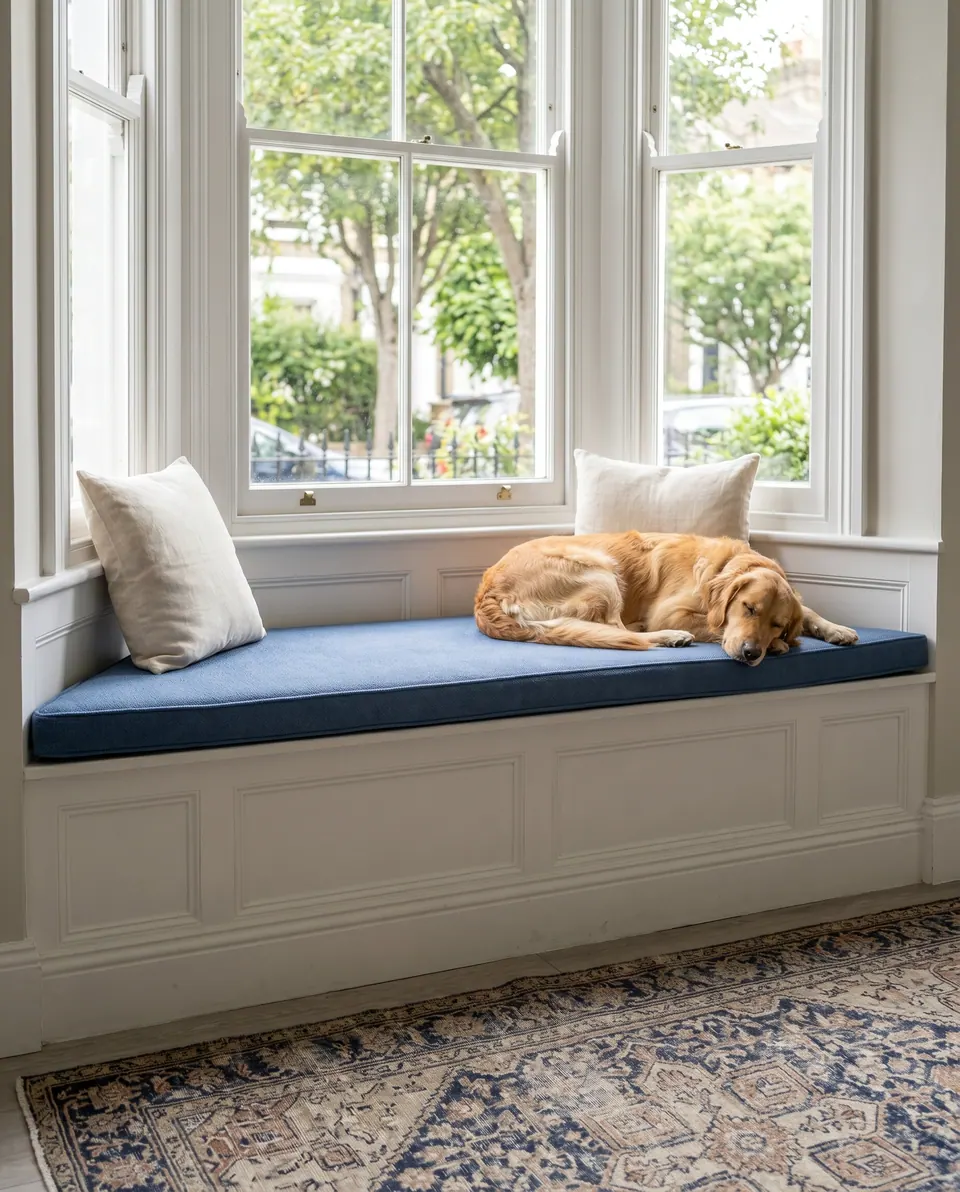
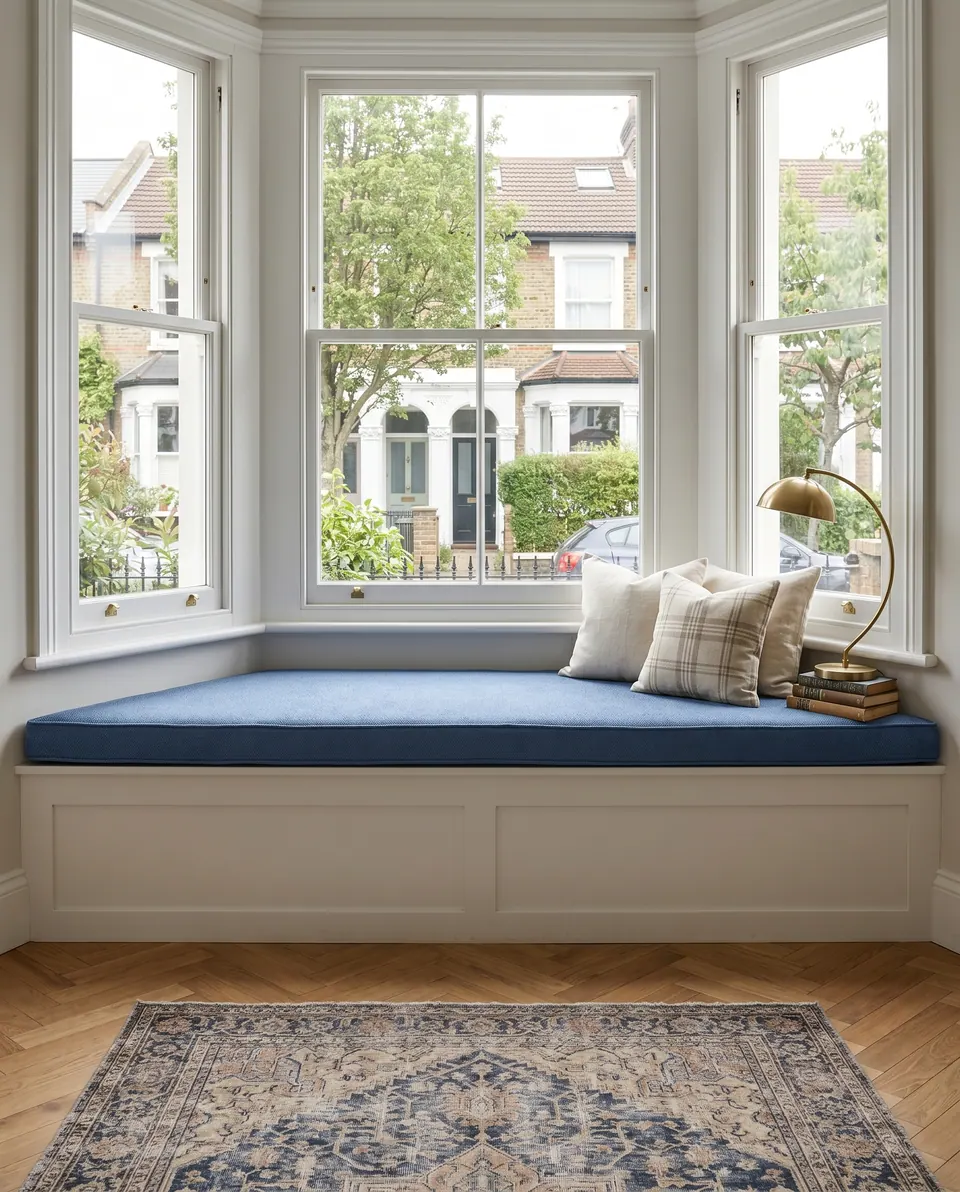
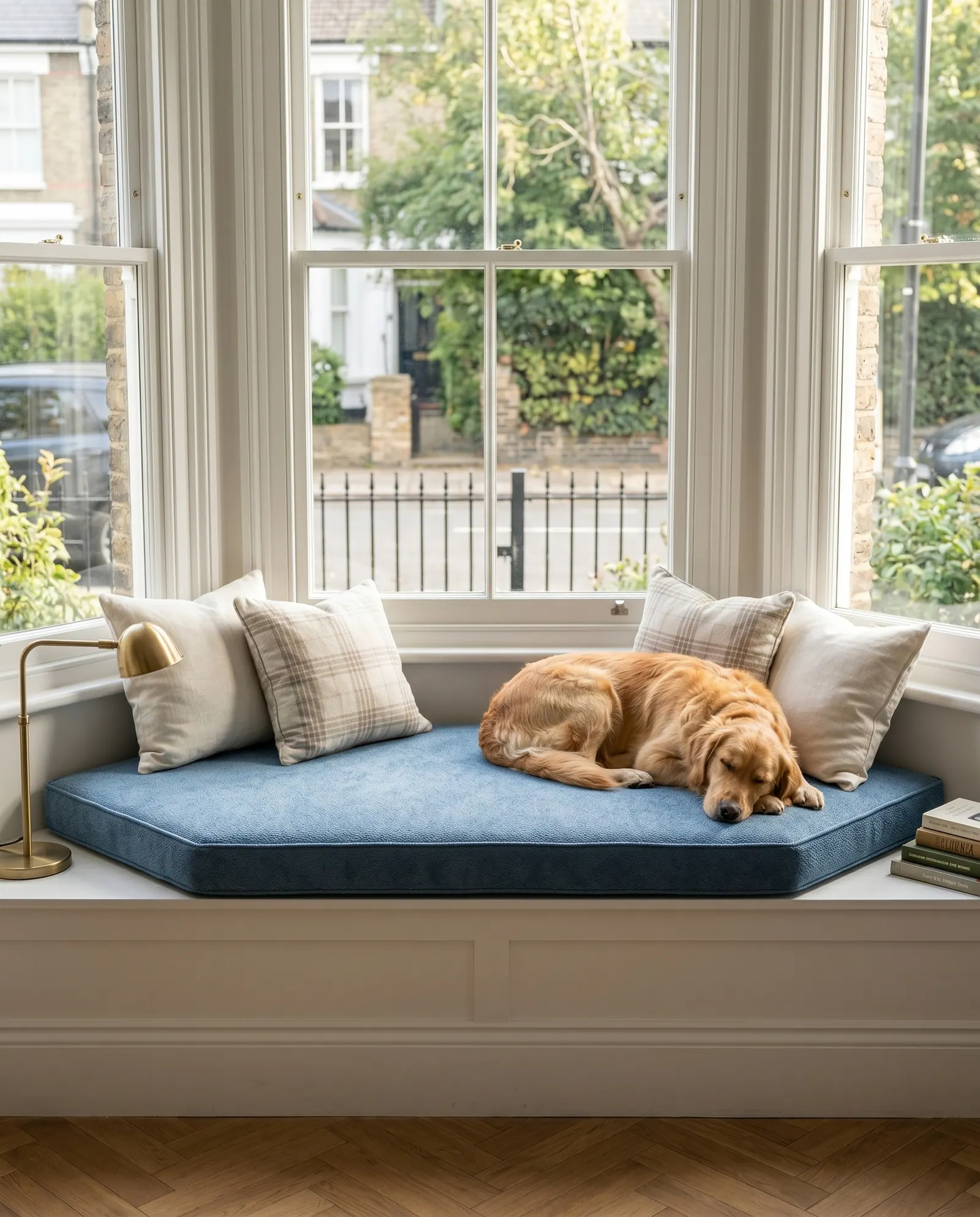
SaveA denim blue cushion cut to a six-faceted bay gives a golden retriever the best seat in the house.
The quick answer
A bay window cushion is a custom-shaped seat, usually a trapezoid or multi-angled piece, cut from a drawing that shows every edge and the depth. Measure the back edge, front edge, each angled side and the straight depth separately, label them, and order on the custom-shape route. Standard thickness is 4 in (10 cm); bays over about 14 ft go in two pieces.
One 5-window bay the workshop made was 115 7/8 in (294 cm) long and only 16 in (41 cm) deep at its deepest. That ratio is the whole story: a bay window cushion is mostly length, broken by angles.
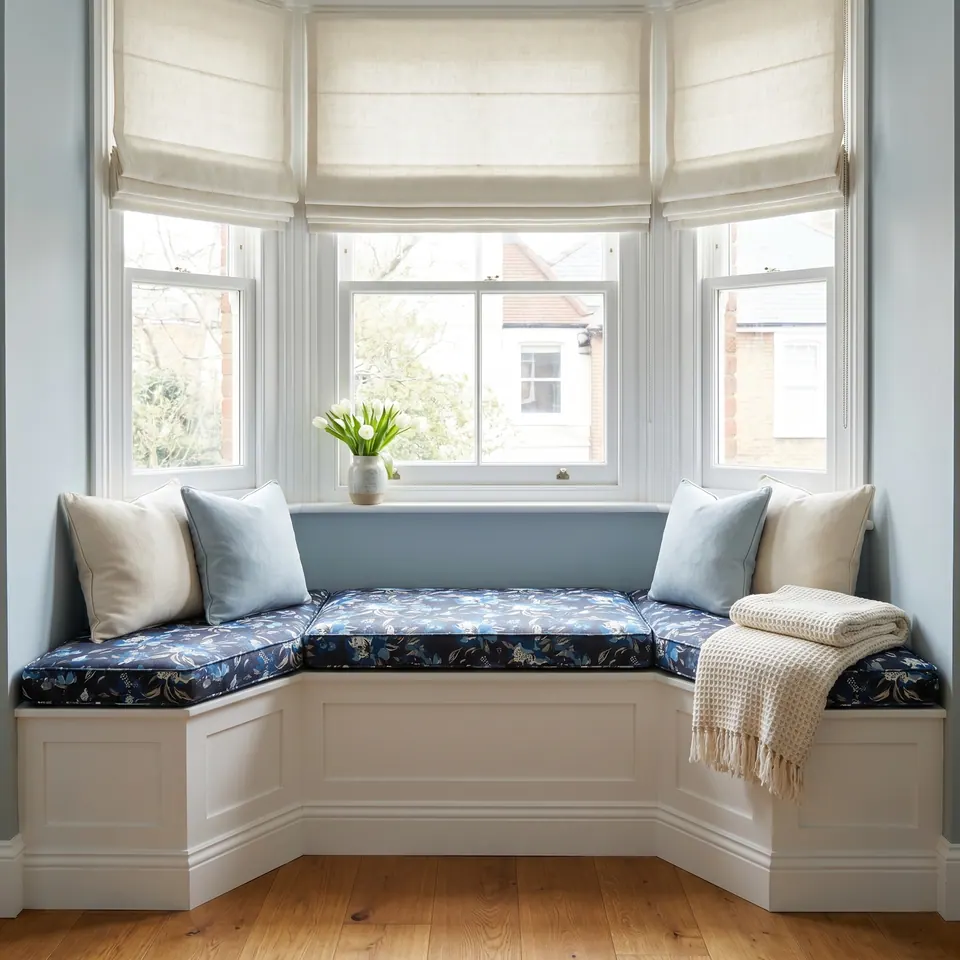
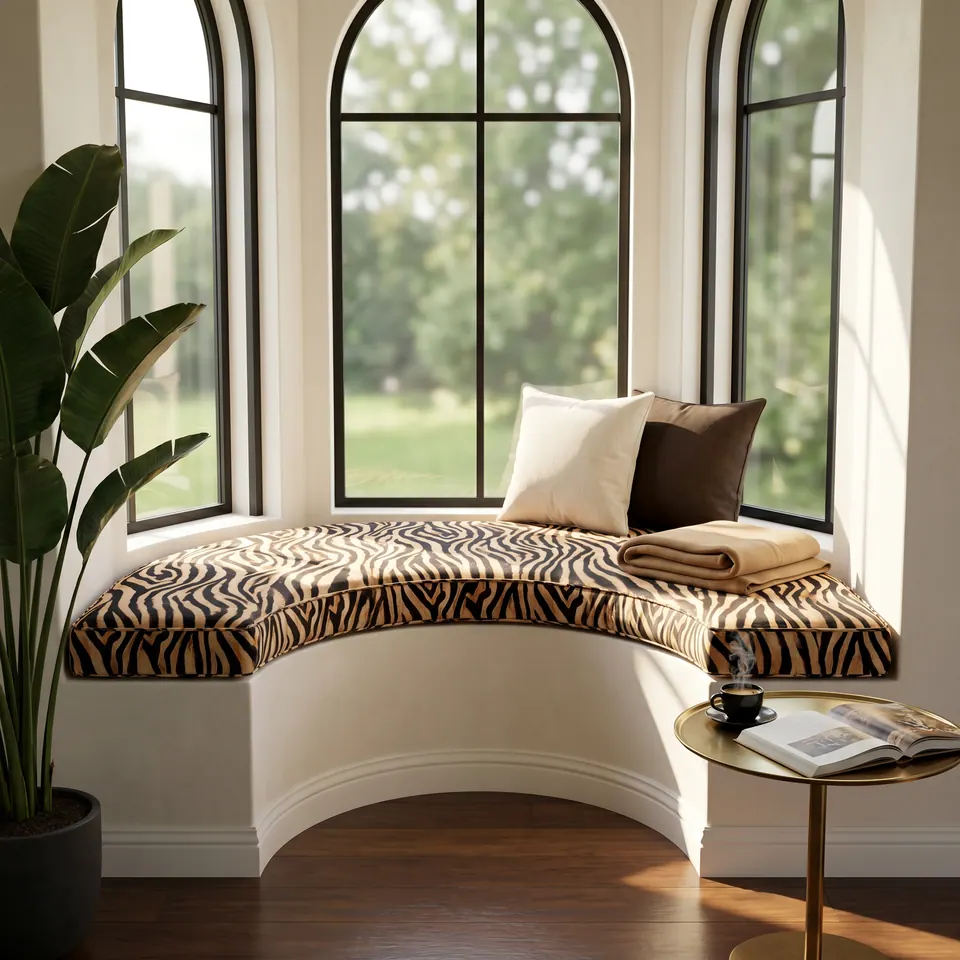
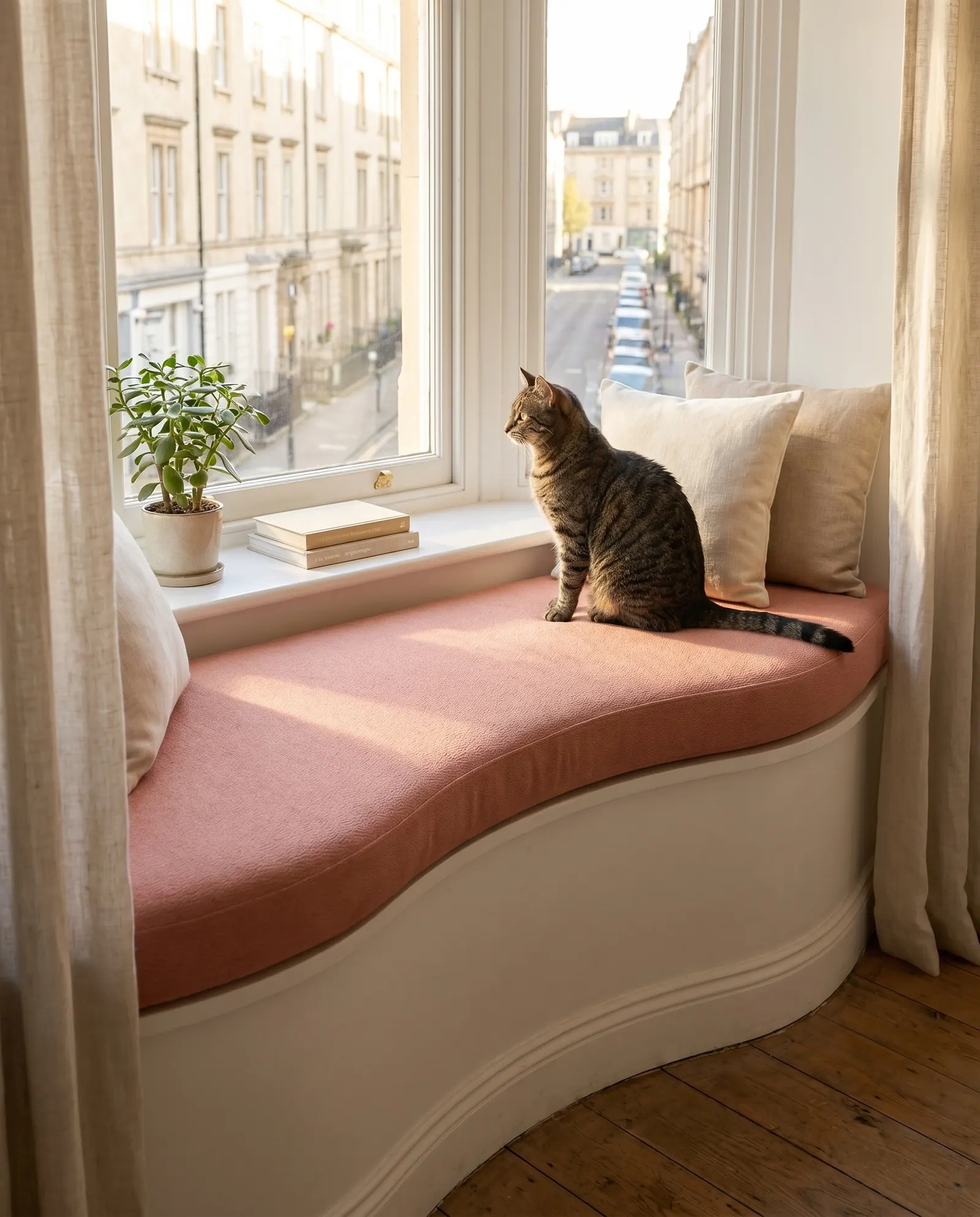
The shapes fall into three families. A three-sided, or canted, bay gives a trapezoid: long front, shorter back, two angled sides. A five- or seven-window bay gives a multi-angled seat with a break at every mullion. A serpentine or bow bay gives an arc. All three are routine custom work.
Measure angled corners edge by edge instead of rounding them off. A curved cushion in a faceted bay leaves a gap at every break.
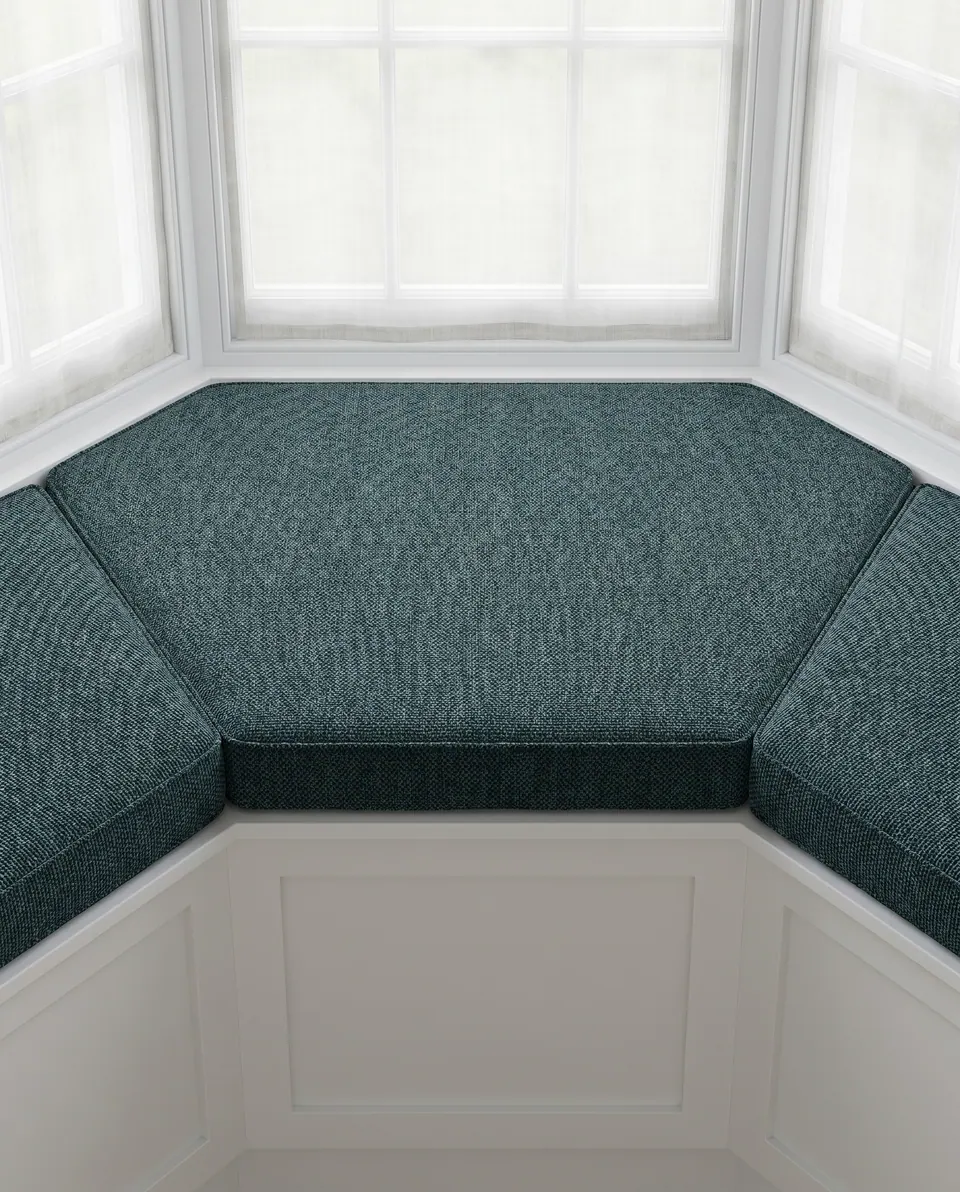
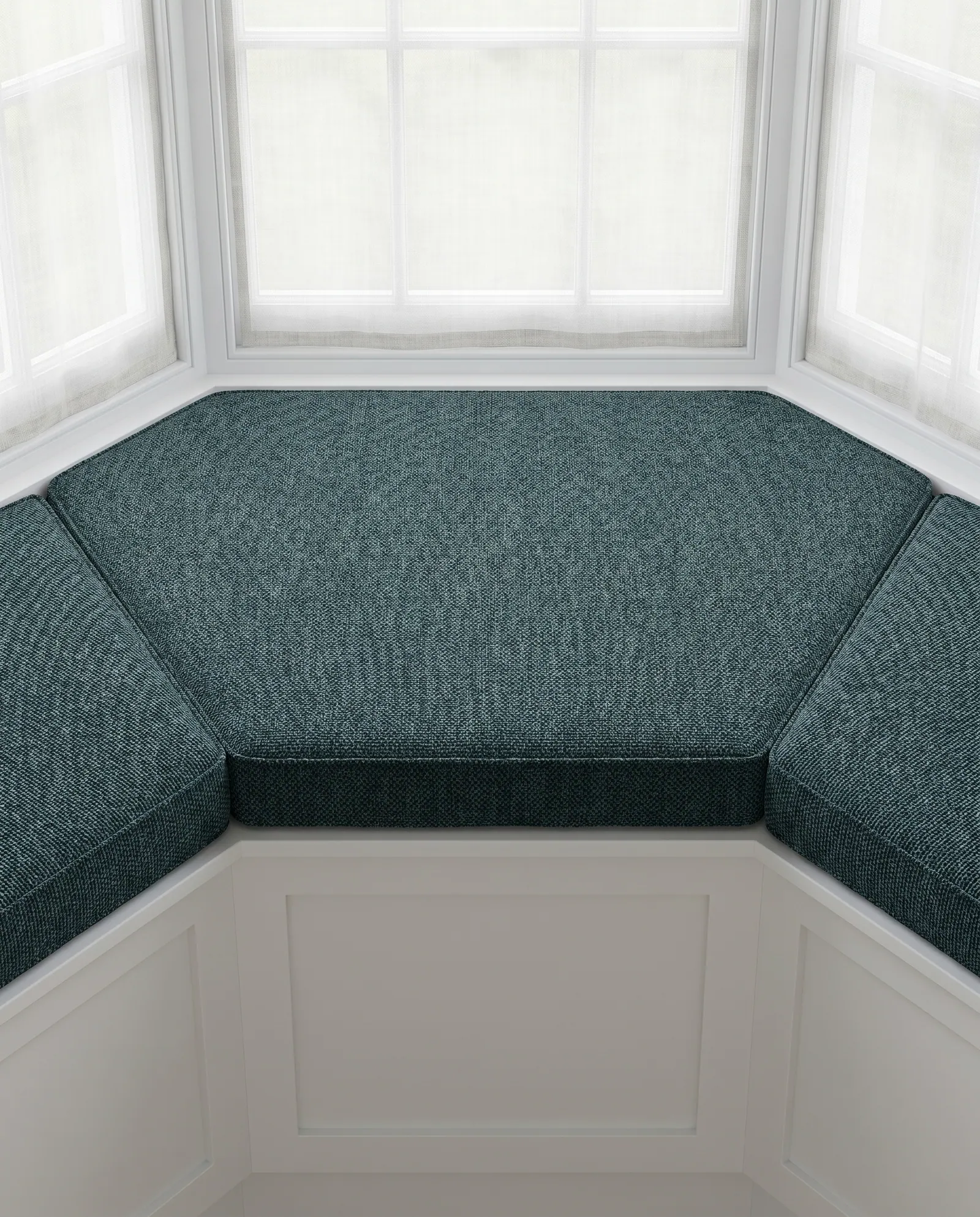
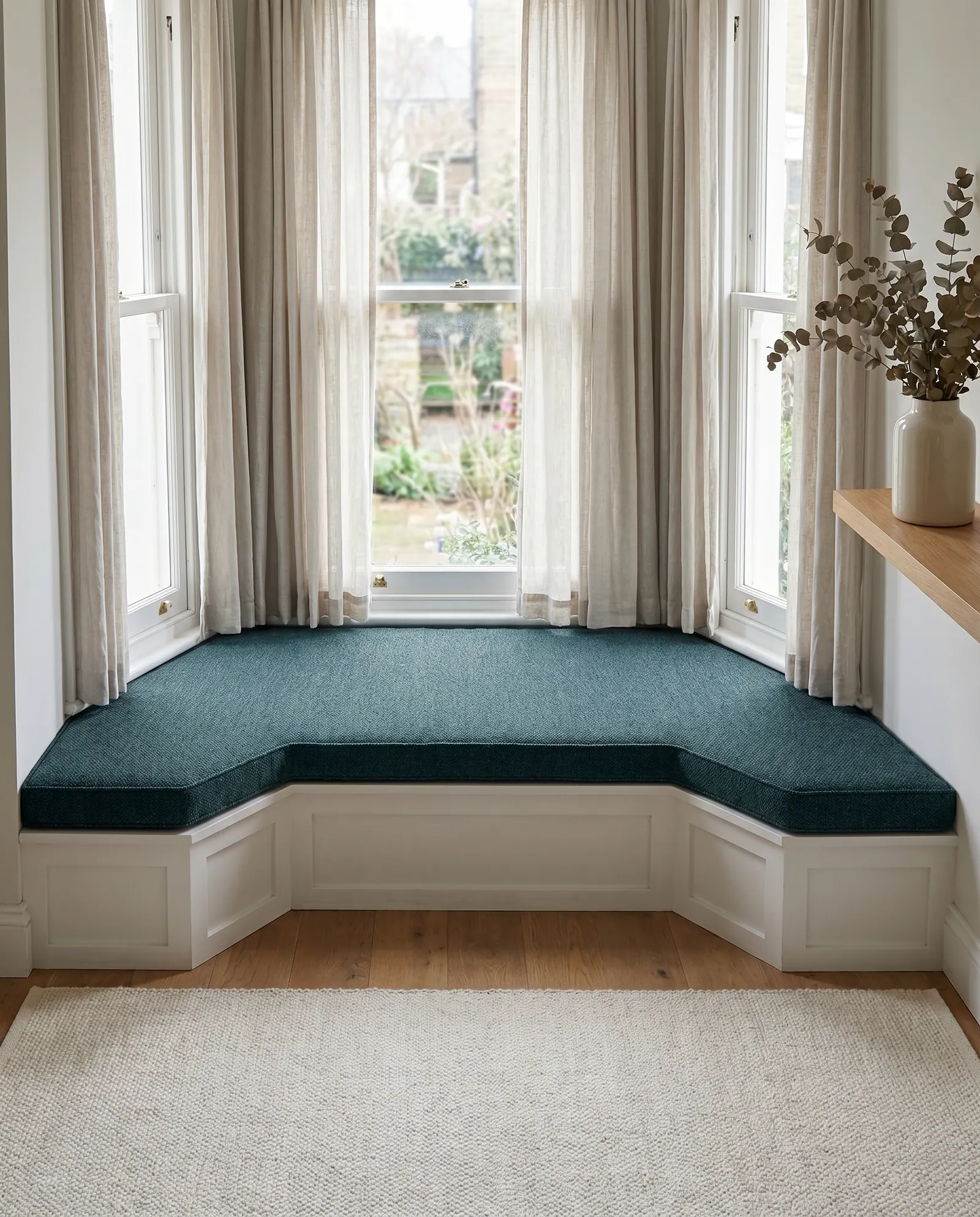
A continuous one-piece cushion reads cleanest, and even large multi-angle bays have been made that way: 98 in (250 cm) along the front, 63 in (159 cm) at the back, 23 in (58 cm) deep. Pieces that meet at the angles, like the deep teal three-piece set in the gallery, are easier to make and handle.
A bay takes light from three directions, so fabric is partly a sun question. One buyer in the US wanted a black cushion about 160 in (406 cm) long and 24 in (61 cm) deep for a very sunny trapezoid bay, specifically not velvet or corduroy. The workshop stocks sun-resistant fabrics for exactly that, and suggested two pieces because of the length. Outdoor acrylic is where that search starts.
For a bay with gentler light:
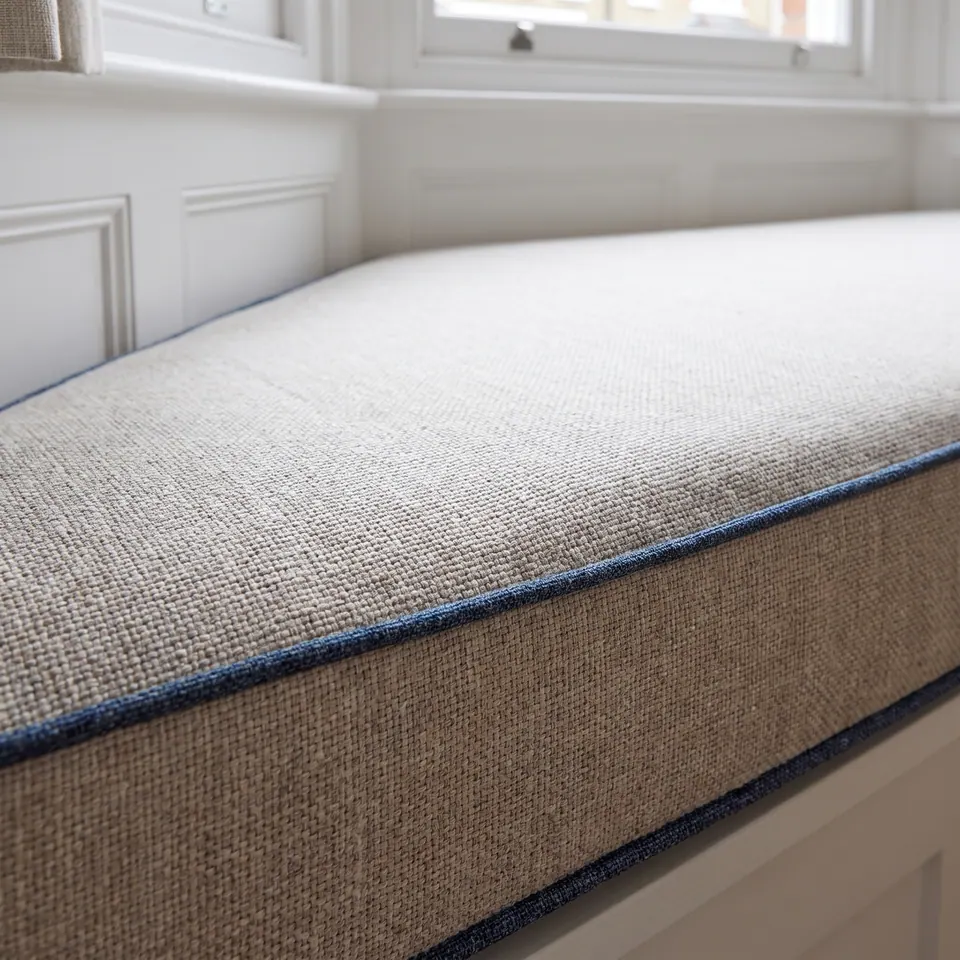
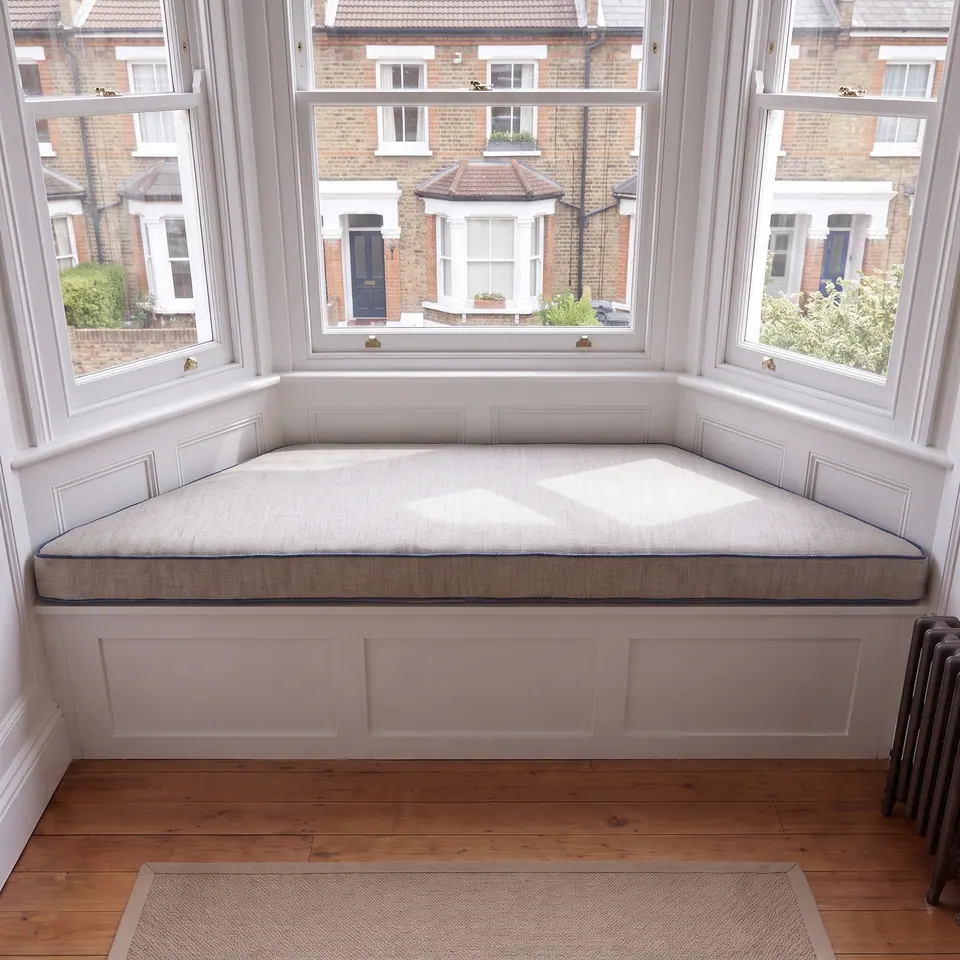
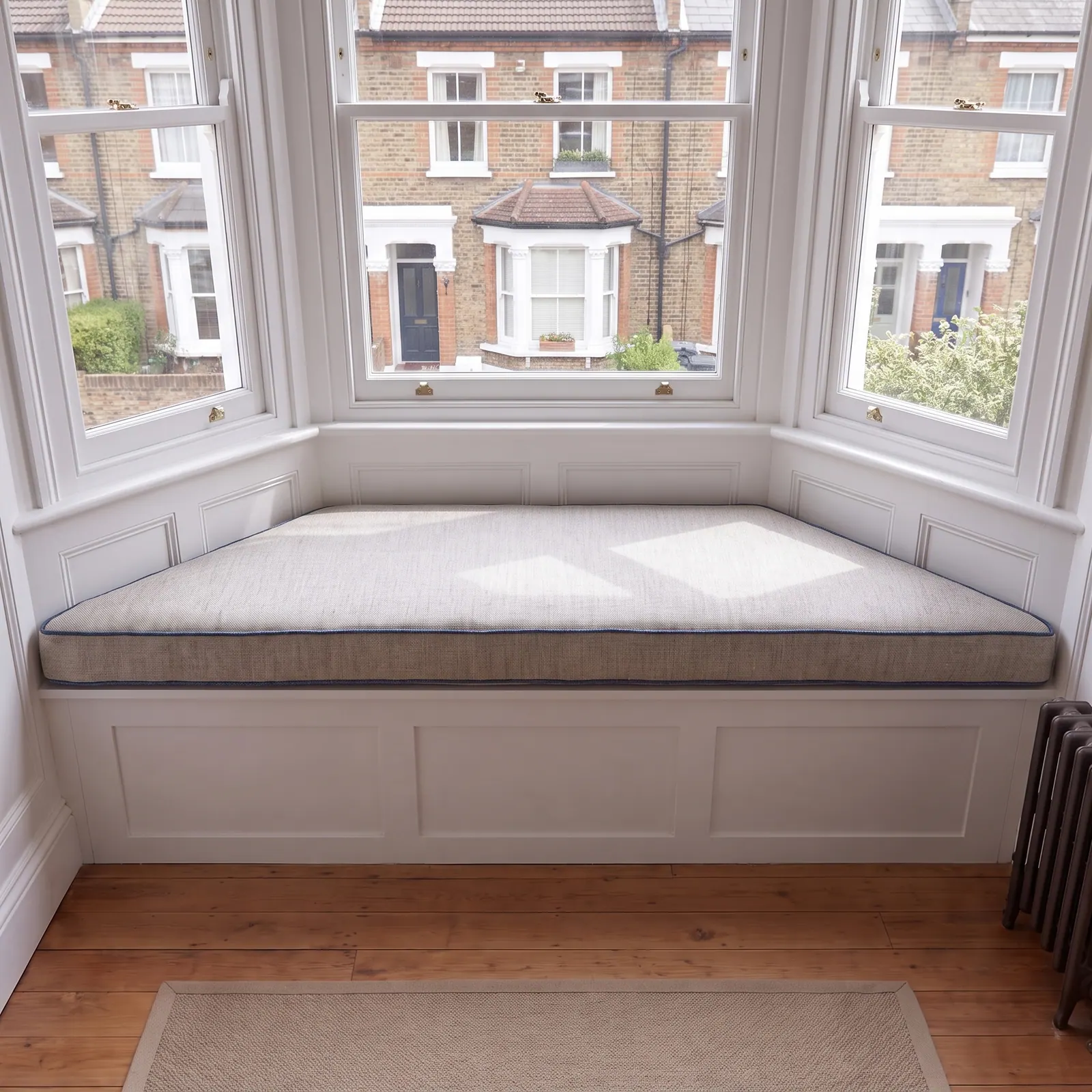
Linen-look weaves: oatmeal with thin indigo piping on a paneled Victorian bay.
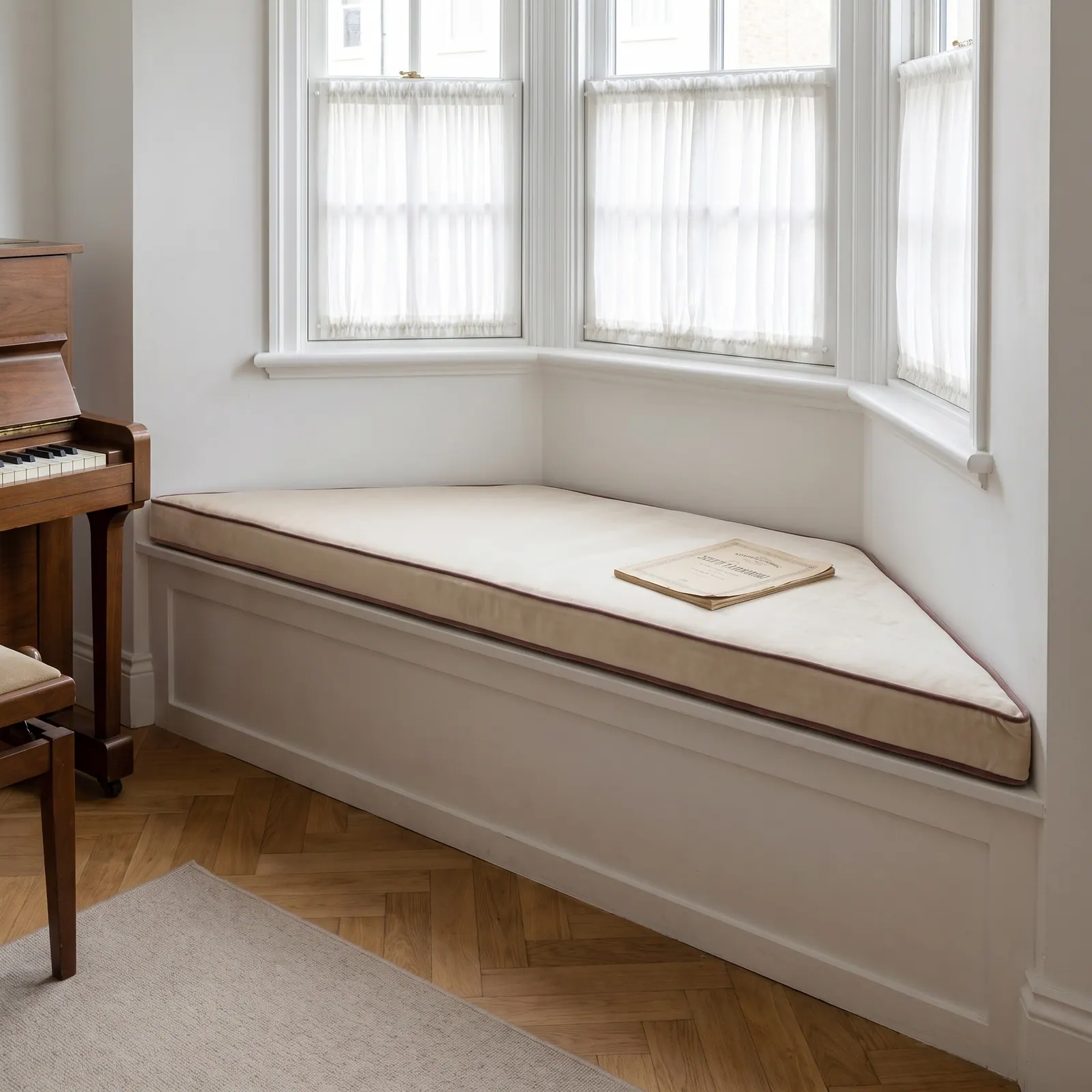
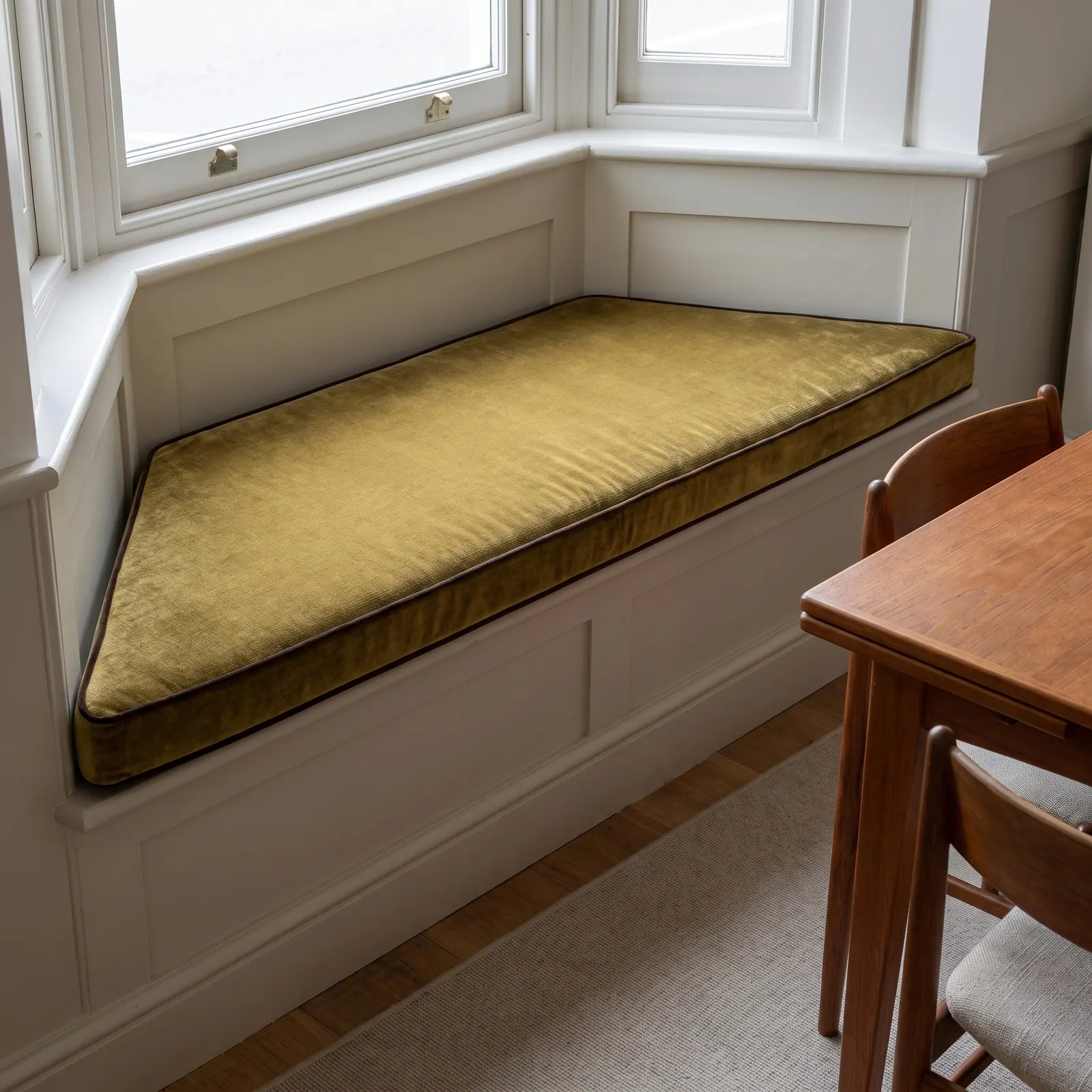
Velvet: cream with dusty mauve piping beside a piano, olive gold in a dining bay.
The count is how many published readings use each family. Open a family for its swatch book, care notes and neighbors.
Foam, thickness and the 72-hour wait
The seat is 4 in (10 cm) of high-density foam as standard, with 2, 3 and 5 in on request.
Long bay cushions travel vacuum-compressed. Foam needs 48 to 72 hours, sometimes up to a week, to recover, and a long cushion can measure short at first: one grew from 92.5 in (235 cm) to its ordered 95 in (241 cm). Unpack at once, lay it flat, don't sit on it for 48 hours, and wait 3 to 4 days before you measure with the tape flush to a wall. Details in unpacking a vacuum-packed cushion.
A real project
A 105.5 in bay, checked with one square root
A buyer in the US sent a trapezoid bay: 105.5 in (268 cm) on the long side, 51 in (130 cm) on the short side, two 30 in (76 cm) angled sides, 6 in (15 cm) cut-ins and 21 in (53 cm) deep. The workshop asked for a paper drawing, handed it to the tailor, then sent a custom order link.
Here's the check I run on numbers like that, partner. Each angled side covers √(30² − 21²) ≈ 21.4 in of length. So 51 + 21.4 + 21.4 + 6 + 6 = 105.8 in, against 105.5 in measured. That closes within 3/8 in, which in an old house is a good day.
If your sum misses by whole inches, one edge is wrong. Re-measure before you order, not after.
Measured
105.5 in long side, 51 in short side, 30 in angled sides, 6 in cut-ins, 21 in deep
What it taught
For a bay window, give every edge and cut-in plus a drawing, because the tailor cuts from the sketch.
Six ways bay measurements go sideways
Writing an angled side shorter than the depth. An angled side is always longer than the straight depth.
Leaving out the front-to-back depth. One sketch for a dog-friendly velvet bay had every edge but that one.
Skipping short returns and cut-ins because they look too small to matter.
Ordering an angled bay on the rectangle listing. It gets cancelled and refunded so you can reorder with a drawing.
Rounding a faceted bay into a curve. Measure edge by edge; a curve leaves gaps.
Measuring a vacuum-packed cushion on day one. Give the foam 3 to 4 days.
Photographs from the workbench
Open any photograph large; each one has its own link and a Save button.
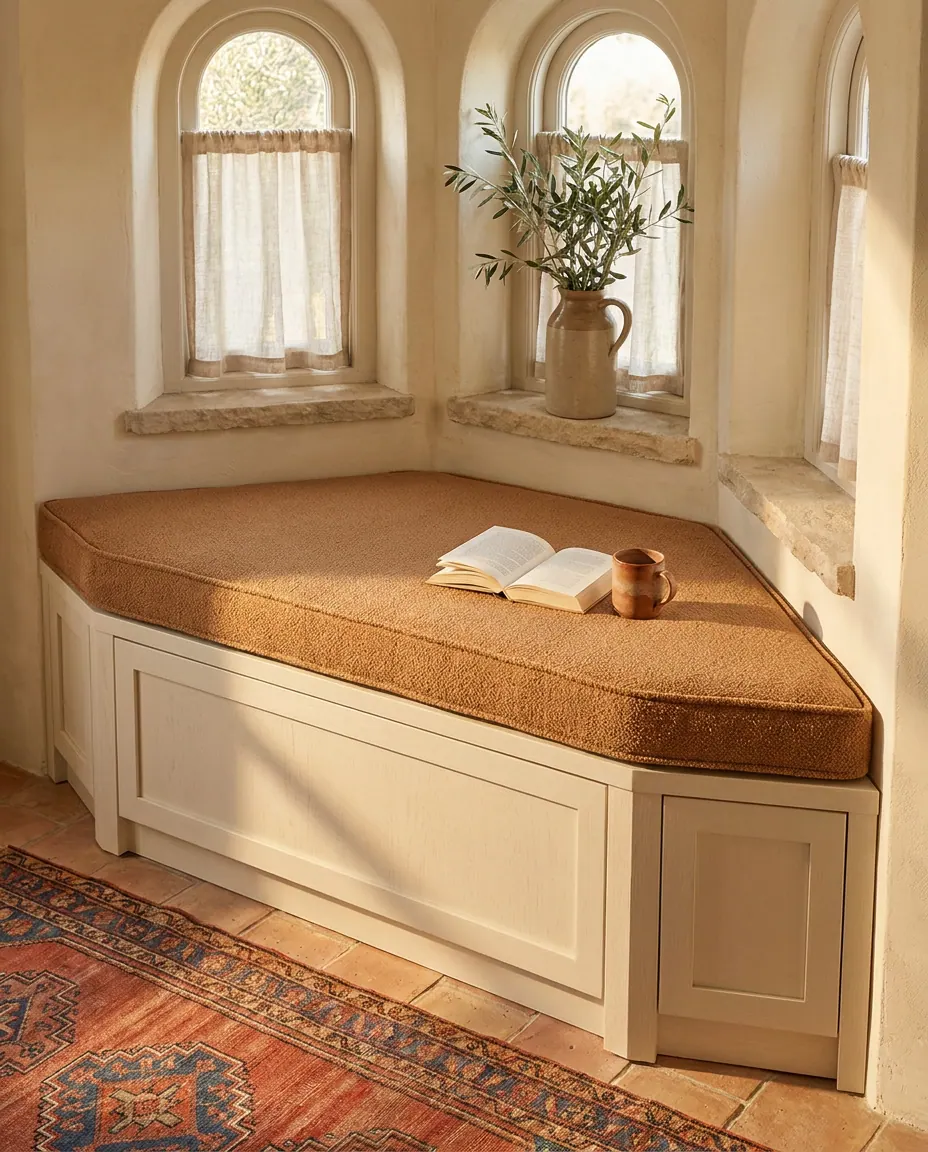
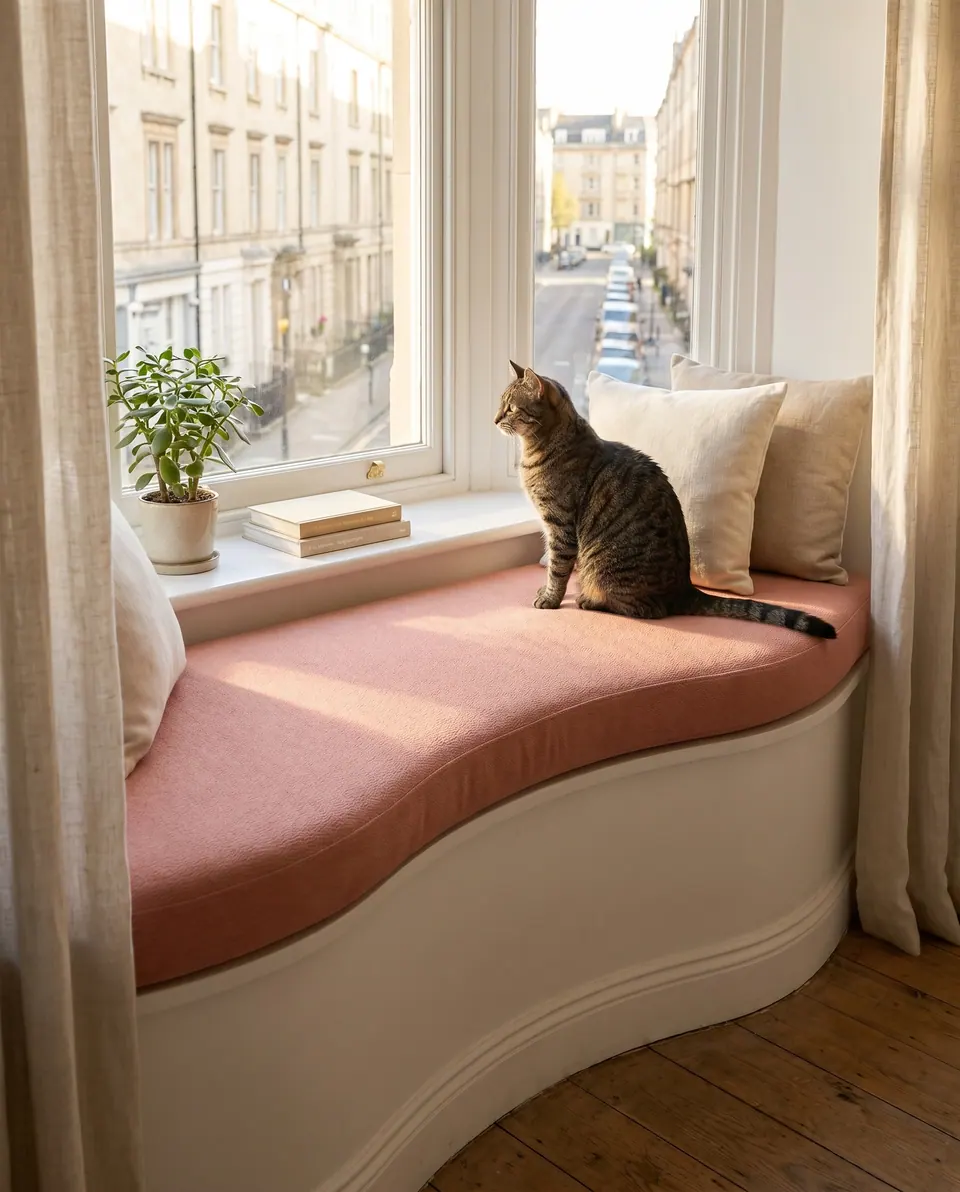
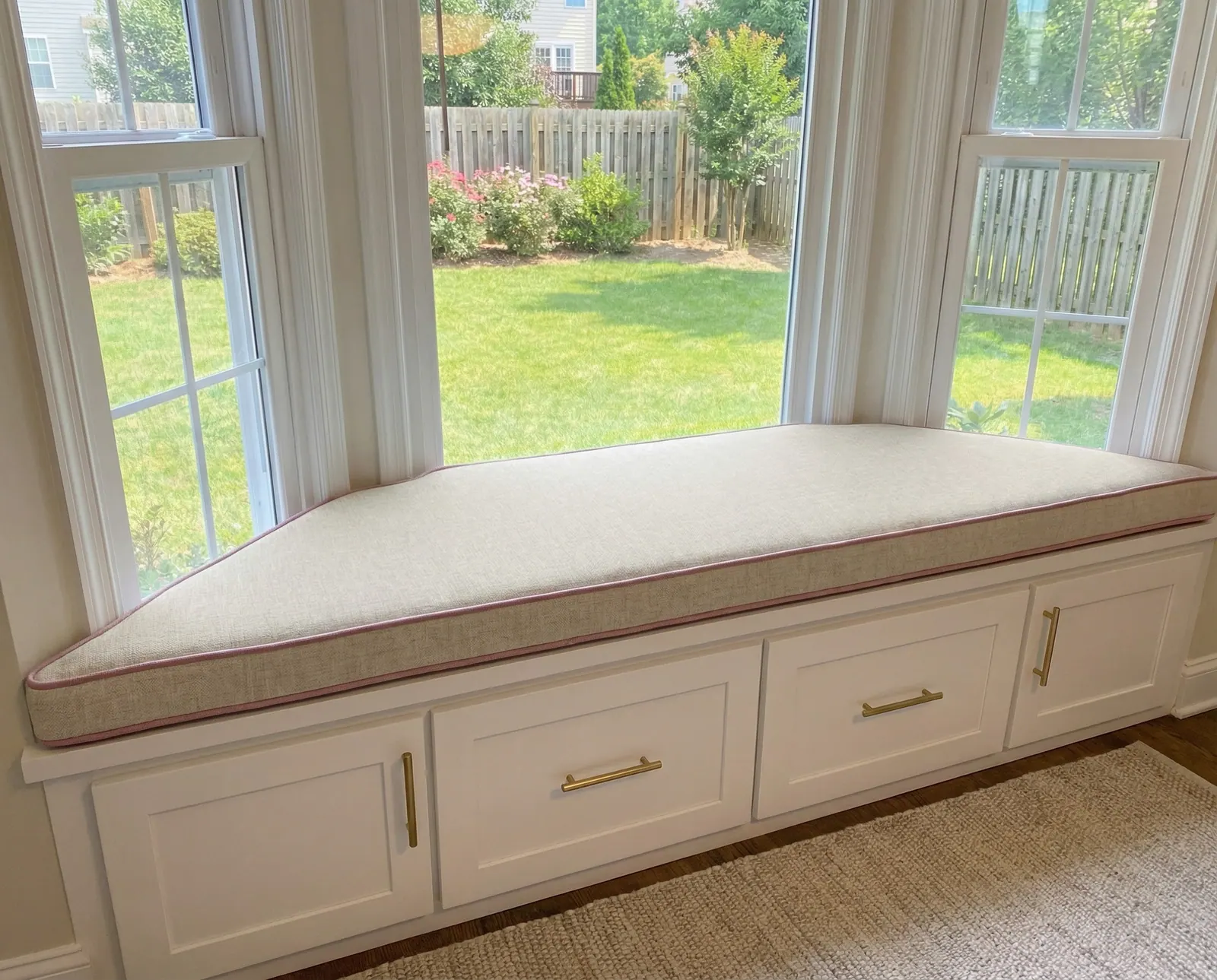
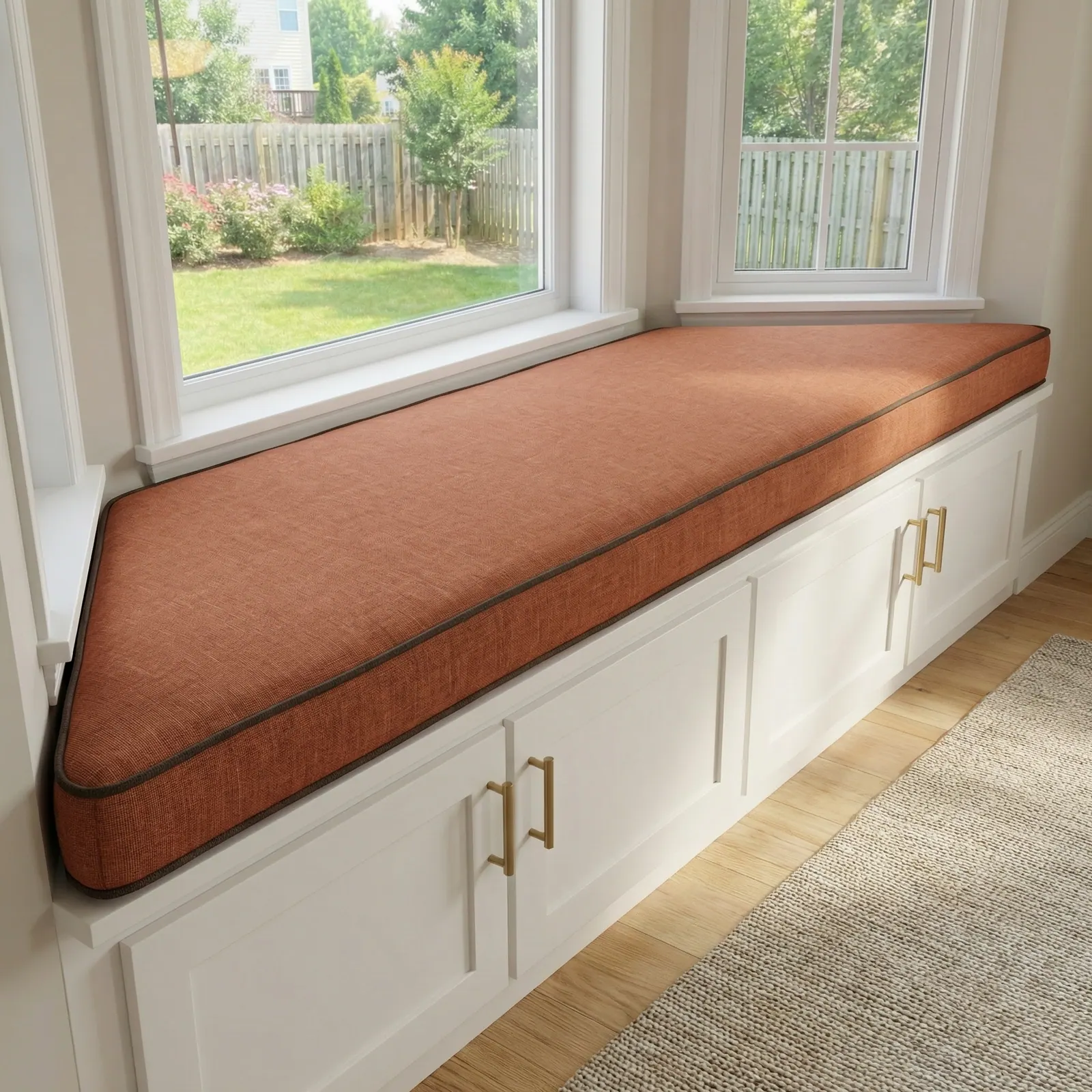
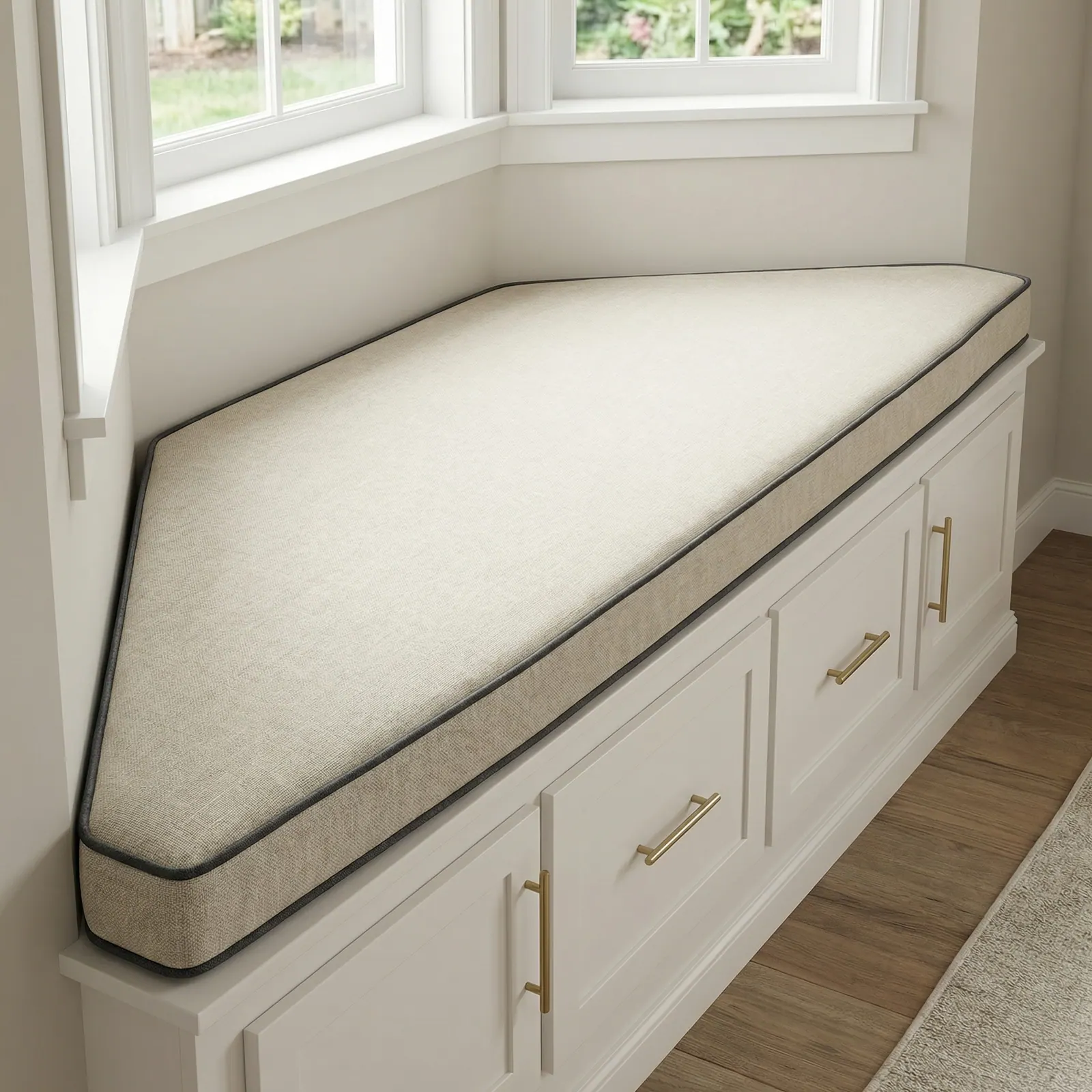
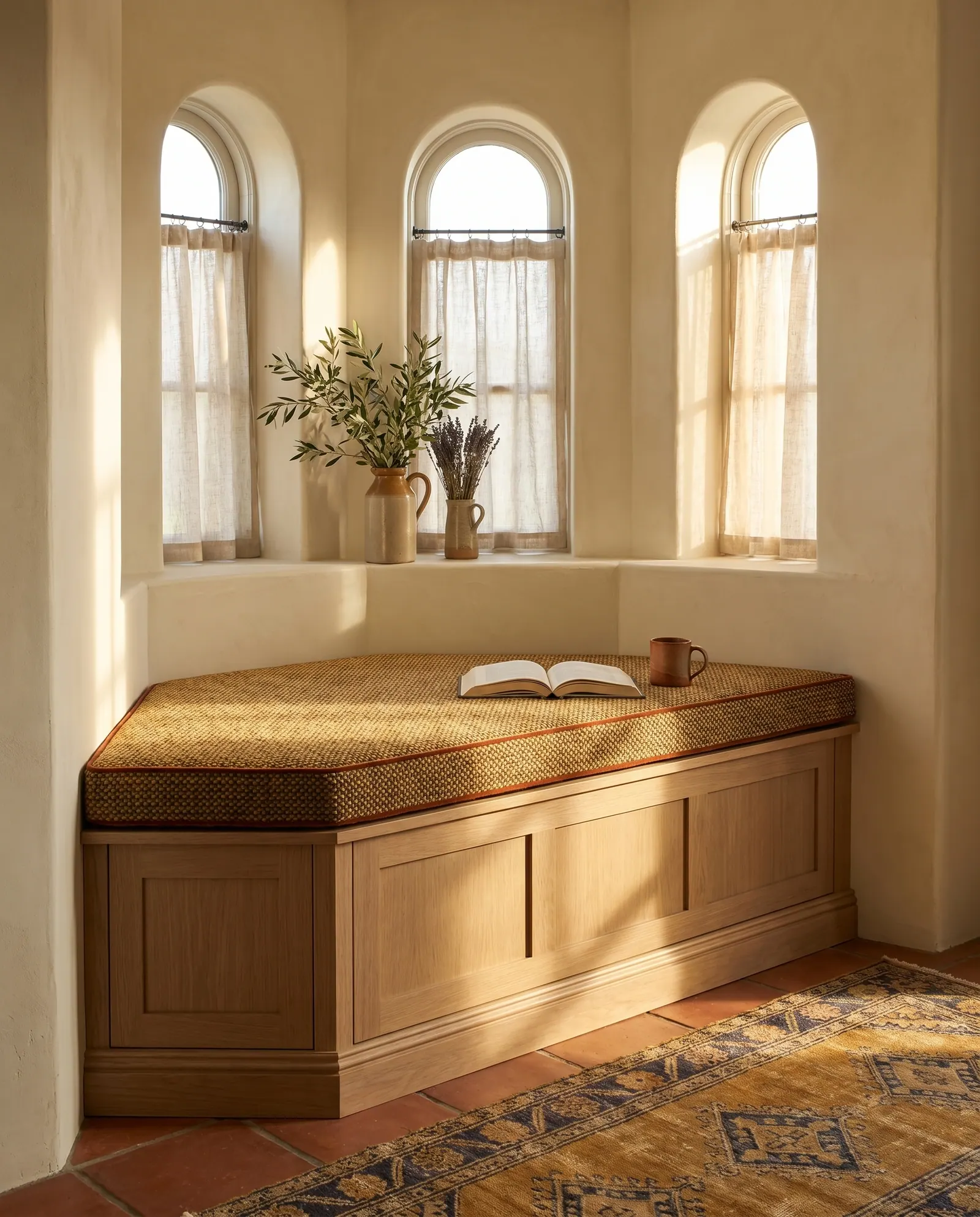
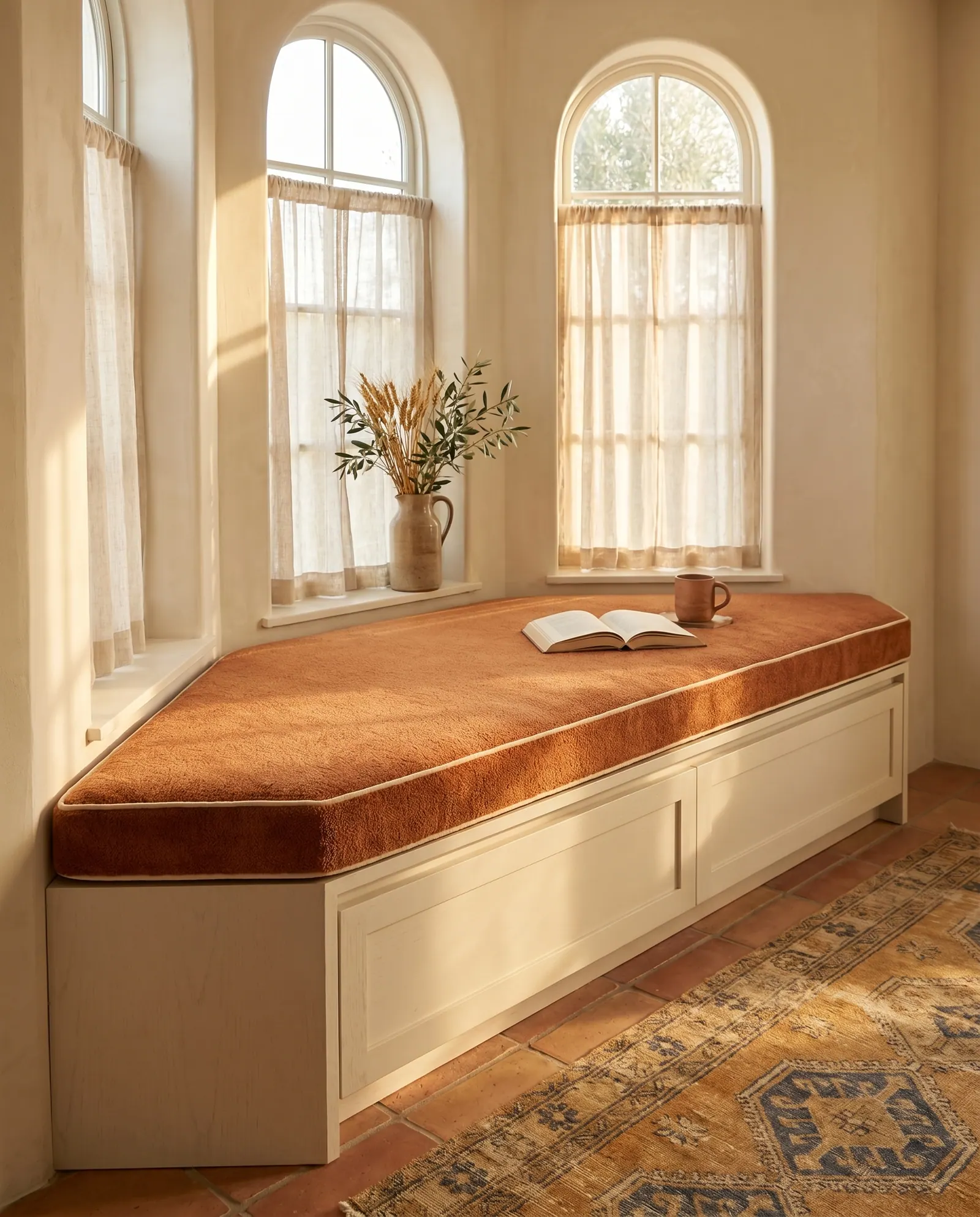
SaveCut to follow the angled bay, the cushion fills the seat edge to edge, with a fine indigo piping line as its only accent.SaveA peach cushion cut to a serpentine curve follows this bay window seat exactly. The tabby has already claimed the sunny spot.SaveAngled ends follow the bay walls, and a fine pink piping lifts an otherwise plain oatmeal linen.SaveA clay-colored cushion on white cabinetry makes the bay window the warmest spot in the room.SaveOatmeal linen with charcoal piping is the classic contrast, and this low angle shows how the end turns into the bay.SaveSeen from above, three teal pieces meet at the bay's angles with neat butt joints. It shows how a shaped bay cushion is actually built.SaveA soft cream seat in a piano room bay, with sheet music resting on it and cafe curtains filtering the light.SaveTerracotta velvet piping traces the angled ends of the mustard seat and ties it to the tiled floor.SaveA bay seat that doubles as dining seating, in olive gold velvet with a brown welt to match the teak furniture.SaveCream piping draws the long angled outline of this caramel bay cushion, making the custom shape clear at a glance.SaveA shaped teal cushion follows all three sides of a period bay window. White paneling and sheer linen keep the look crisp.
An angled side on a bay window cushion is always longer than the straight depth. If a sketch says otherwise, one number on it is wrong.
A bay is a stage with footlights on three sides. Keep the cushion one quiet color and let the pillows talk: the denim blue seat in the lead photo carries one plaid and one linen pillow, and that's plenty. Contrast piping traces every facet and shows off the geometry, as indigo does on oatmeal; matching piping lets the angles go quiet.
Back cushions are ordered separately, each at its own size. How many breaks does your bay have, three or five?
A bay window gives you three or more short walls instead of one long one, so back cushions are planned panel by panel. Give each wall its own back, sized to that panel's length at the seat line, and shorten the backs where two meet so the corners don't double up. Keep every back below the sill and any window hardware, and remember that backs take a few inches of seat depth, which matters on a shallow bay. On short wing walls, a flat back or a bolster reads better than a plump square pillow, or skip the wing backs and use bolsters as armrests. The workshop's standard back cushion is about 16 in (40 cm) tall and 4 in (10 cm) thick, and shorter backs are made for low sills.
Buyer questions
A common question
How do I order a cushion for an angled bay window seat?
The workshop's answer
Order it on the custom-shape (trapezoid) listing, not the rectangle one. Pick the size by depth and overall length, then upload a drawing showing every edge, any cut-ins and the depth, plus a photo of the seat; a hand sketch on paper is fine. Asymmetric bays work the same way, and the workshop may ask for a few extra measurements before quoting.
A common question
Can you make a cushion for a bay with five windows and lots of angles?
The workshop's answer
Yes, regularly, including bays where every window sits at a slightly different angle. Send a rough sketch with the length of every side, the angles if you know them and the depth at each break point. The workshop turns it into a template for you to check. That 115 7/8 in, 5-window bay was made at the standard 4 in with contrast piping.
A common question
What's the right way to measure my bay window seat?
The workshop's answer
Draw the seat as seen from above and write every edge on it in order: the back edge against the window, the front edge, each angled side and the depth. On multi-window bays, measure every line between break points plus the depth at each one. Type every side length in the order note too, in case the sketch is hard to read.
A common question
Should I make a paper template and mail it to you?
The workshop's answer
No need to mail anything. A drawing with every edge measured is usually enough; if you do make a full-size template, send clear photos of it with the measurements marked, especially where curves begin. The workshop checks that your numbers reconcile: 106 in front, 56 in back and two 35 in sides give about 24.5 in of depth.
A common question
Why does an angled cushion cost more than a rectangle in the same fabric?
The workshop's answer
Labor, not fabric, drives the price. Every piece is handmade, and angled sides and rounded corners take noticeably longer to cut and sew, even when they use less fabric. A simple notch or cut-out is different: it has been charged the same as the rectangle, with a note that you sent a drawing.
A common question
Can a very long bay cushion still be one piece?
The workshop's answer
Very long pieces can exceed the maximum single-piece length, so they're often made in sections, and you choose where the joins fall. The foam is flexible, so a long cushion can also be rolled or folded for storage without creasing or damage.
Have it made
Have your bay window cushion made — ask Nate’s workshop
Send the numbers in inches: length × depth × thickness, plus any angle. The workshop checks them with you, because foam has no undo button. — Nate
Leave your details and the workshop will call you to confirm measurements, fabric, foam and piping. No prices, dates or payment on this page: it is a request, not an order.
Fabric · Foam · Pipingwhat the workshop will confirm with you
Can a bay window cushion have ties or a non-slip base?
Yes. Ties can be sewn into the seams at the corners or the back edge, in any position, and a non-slip base that replaces the bottom panel is available on angled shapes too, at extra cost. Say which pieces get which in your order note.
How does the workshop confirm my bay shape before cutting?
It draws the shape to scale from your numbers, checks that the geometry closes, flags any edge that can't be right and sends a lettered diagram for approval. When corners are out of square, it cuts from the edges against the walls and lets the diagonals follow.
Can I order only a cover for bay window foam I already have?
Yes. A cover-only version can be made if you supply the foam. Measure the foam itself on every edge rather than the old cover, and send the same labeled drawing you would for a full cushion.
Can I wash a bay window cushion cover?
Yes. The cover is zippered and removable, and it washes on a gentle cycle at 86°F (30°C). Skip the tumble dryer and let it air dry before zipping it back over the foam.
Which fabric holds up when a dog sleeps in the bay?
Ask for the pet-friendly fabric chart. A buyer in the US whose dogs jump onto an irregular bay chose olive velvet with taupe piping, and was told velvet and a smooth, leather-like weave are equally durable. A tight weave in a mid-tone hides the most.
Is it better to split a bay window cushion at the angles?
Often, yes. Separate pieces for each panel are easier to flip, clean and store, and they ship more safely; a single long piece has no joins but is heavy to handle, and very long seats get split anyway. Sections that meet at the bay's corners still look continuous when they're cut from one fabric and piped the same.
How do back cushions work on a bay window with angled walls?
Give each panel its own back cushion, sized to that panel's length at the seat line and shortened where it meets a neighbor so the corners don't double up. Keep the backs lower than the sill and any hardware. Expect them to take a few inches of seat depth; where the wall is short, a flat, thin back works better than a plump pillow.
± 1/4 in — Nate
Share this atlas entry
Readings
Photographs read by the masters: bay window cushions
Real cushions made for real rooms, each read for proportion, fabric and fit.

 Save
 Save
 Save
 Save
 Save
 Save
 Save
 Save
 Save
 Save
 Save
 Save