The Pattern Room · a measuring pattern
Measuring a 3-sided bay window seat cushion, panel by panel
A 3-sided bay is a trapezoid with a view. Measure it as a center panel and two wings, write every number down, and let the arithmetic catch the one that's wrong.

 Save
The quick answer
Measure a 3-sided bay window seat cushion as a center panel plus two angled wings, taking every number from the trim face: the back edge of each panel, the full front edge, the depth at both ends of every section (use the smaller), any short straight ends, and both diagonals. Then check that the angled sides close before anything is cut.
A bay is a trapezoid wearing window trim
On a bay window seat, the slant you write down is usually the number that's wrong. A tape bent around an inside corner reads short, and sketches get drawn from memory.
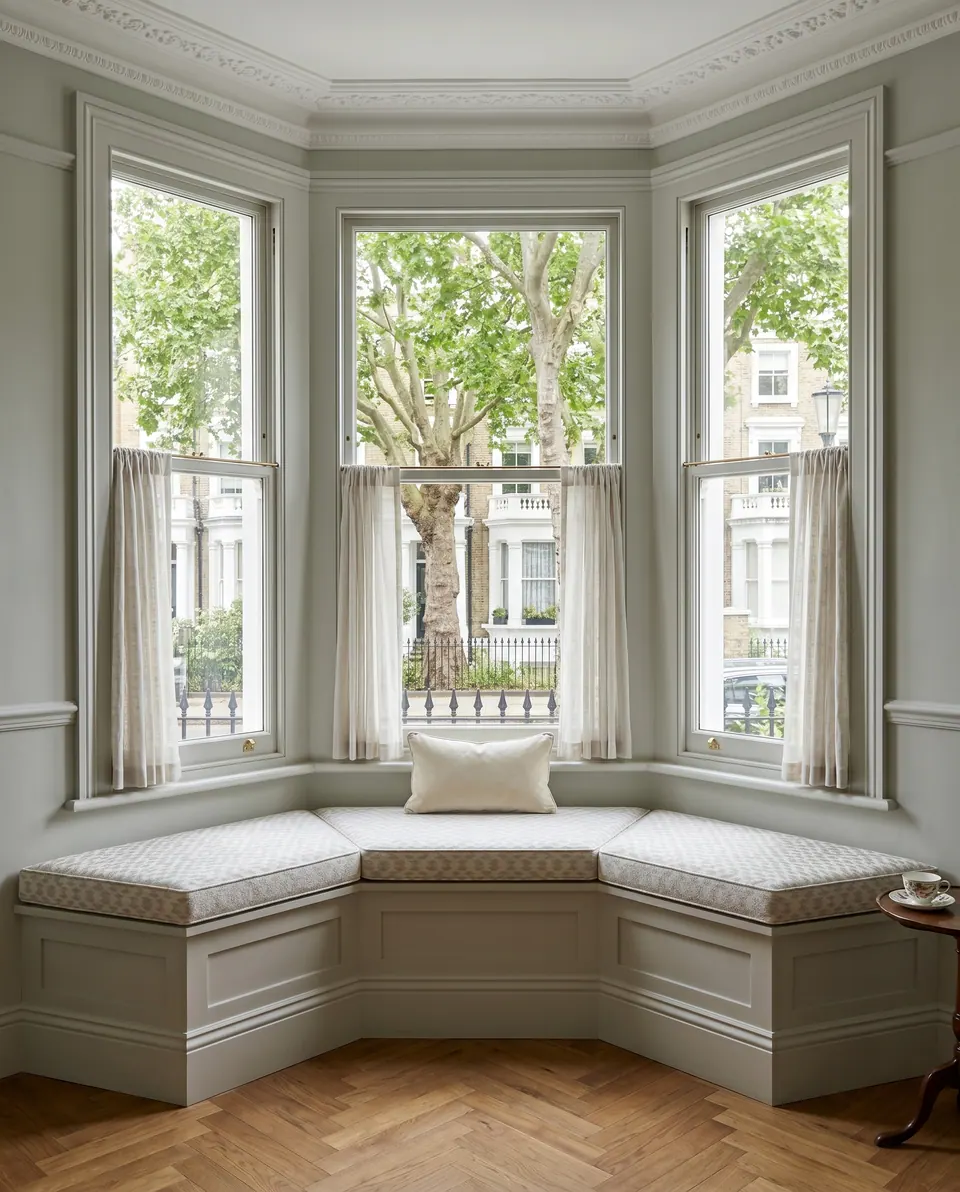
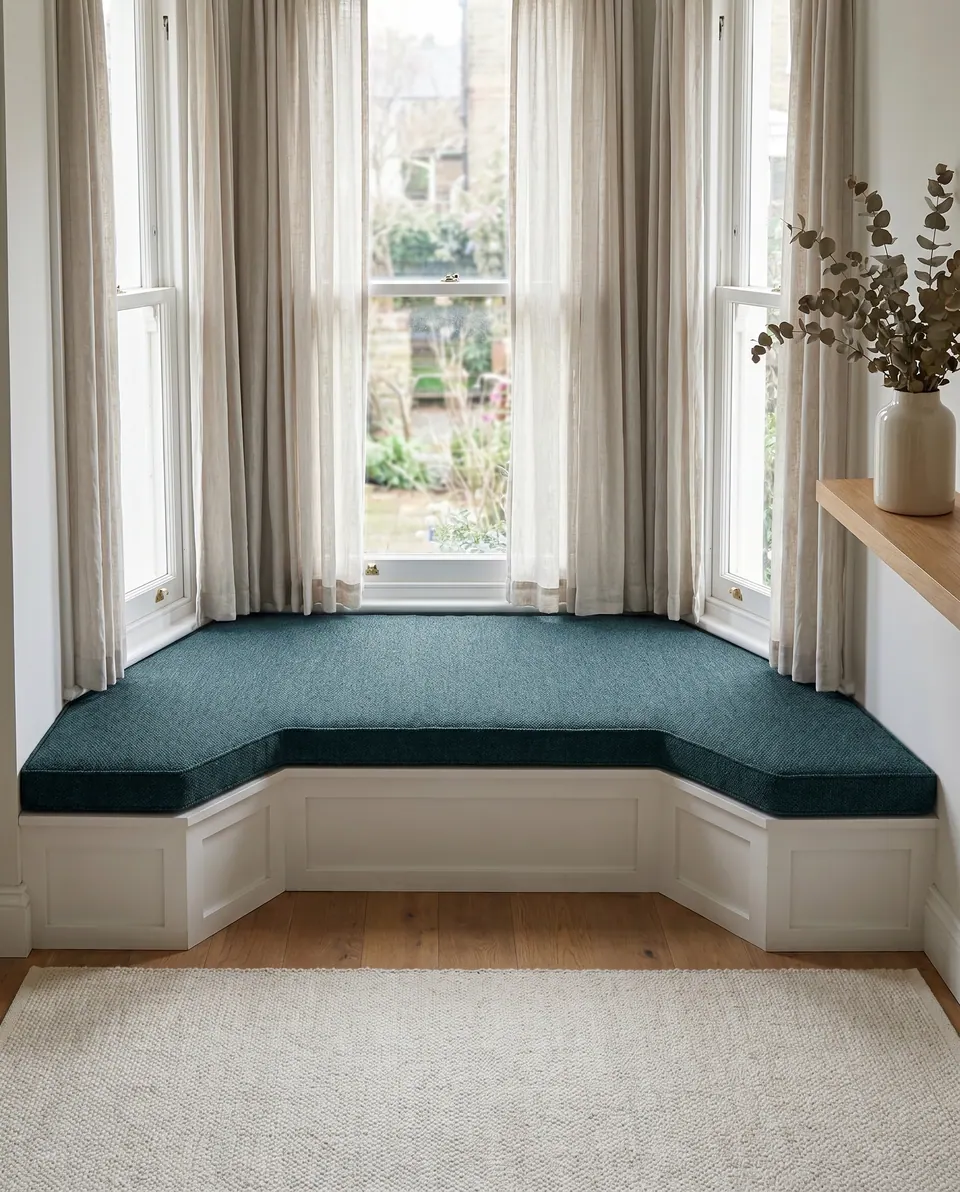
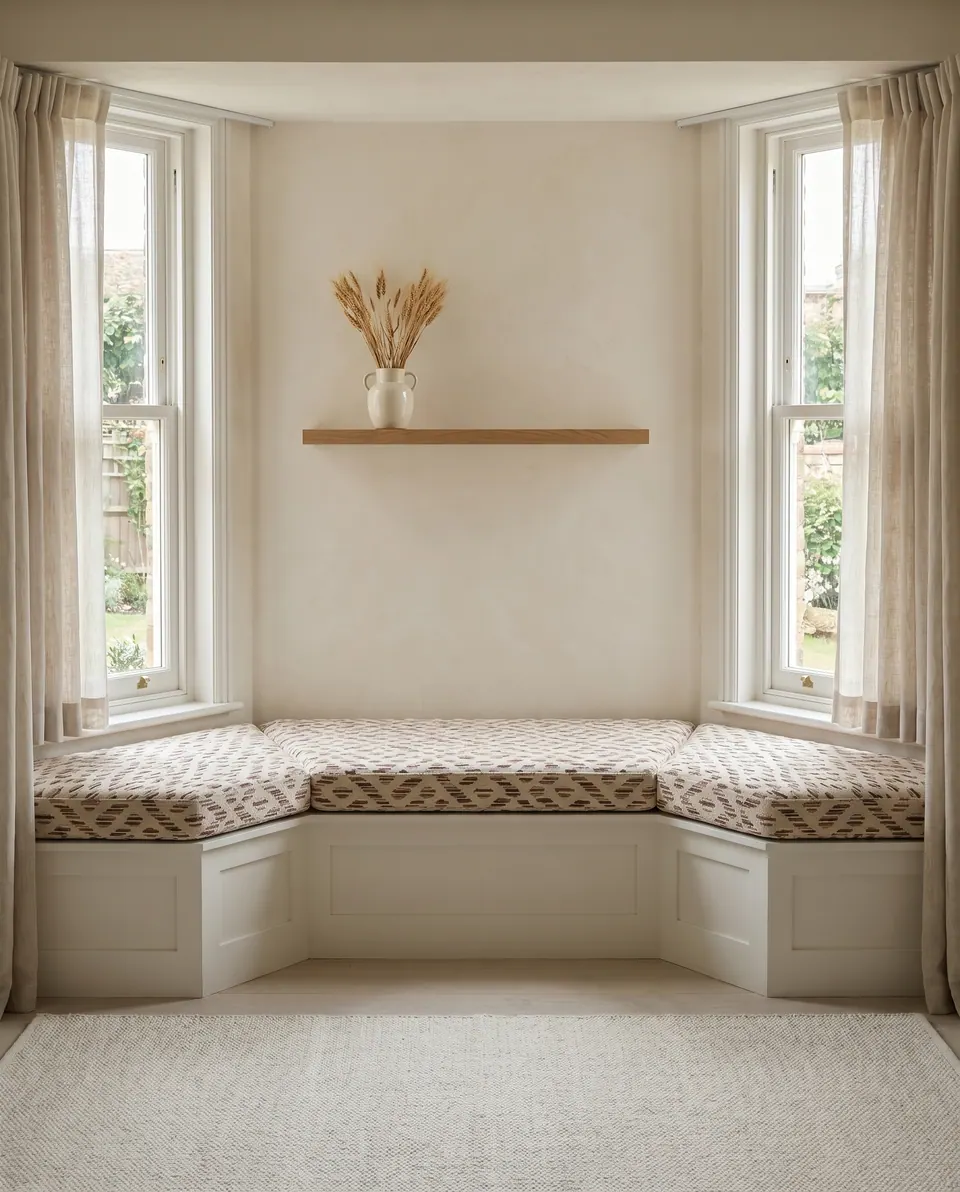
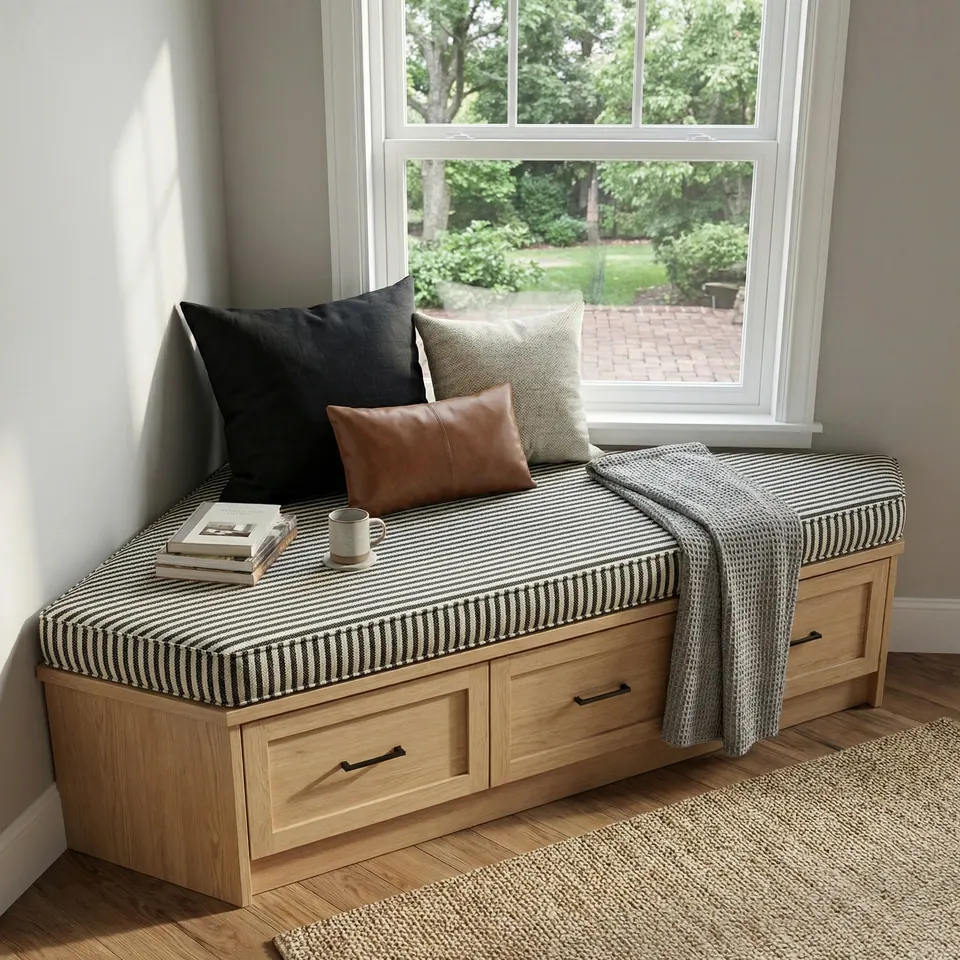
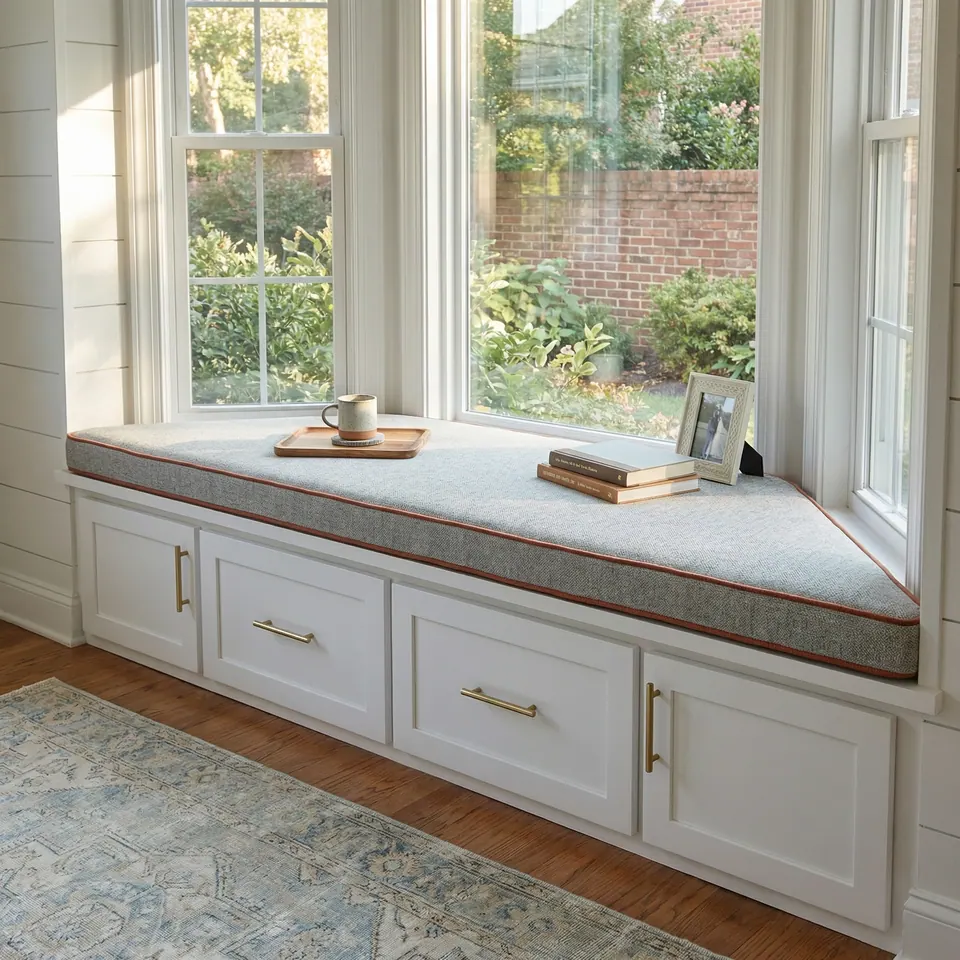
Seen from above, a 3-sided bay seat is a center section parallel to the room plus two angled wings. Together they make a trapezoid, sometimes with a short straight end where each wing meets a side wall. The room side is the long front edge. The window side is shorter.
Most bay returns sit near 135°, so each wing turns about 45° off the line of the center window. Most is not all. Houses settle, builders improvise, and the left wing rarely matches the right.
Good news, partner: you don't need a protractor. Angles are just lengths in disguise. Give the workshop honest lengths and the angle falls out of the arithmetic. The rest of the bay window cushions family, from five panels up, works the same way.
Measure the bay in nine steps
Sketch the seat from above, standing in the room
Draw it top side up, as you see it looking down from the room: long front edge at the bottom, center window at the top, a wing on each side. Label every edge before you measure, so the letters on your sketch point to the same edges as the workshop's diagram.
Pattern sheet Front, back and depth fix the shape; the slanted sides follow from them. Measure from the trim face, not the glass
Every number comes from the face of the window casing or the wall the cushion will touch. A cushion cut to the glass won't fit between the casings.
Take the back of each panel
Measure the center back along the trim face, corner to corner. Then each wing's back edge, from its back corner to where the wing meets the side wall or the straight end. Measure left and right separately. Never copy one number to the other side.
Run the full front edge
The front is the straight room-side edge, wall to wall or wherever the cushion should stop. Keep the tape flat and taut.
Take the depth at both ends, and use the smaller
Depth runs at 90° to the front edge, from the front to the back trim. Take it at both ends of the center panel and anywhere the seat changes, then use the smaller figure. Walls lean. The smaller number is the one that fits.
Don't lose the short straight ends
Many bays finish with a short straight return where each wing meets a side wall, sometimes only 2 in (5 cm). Measure both. Leave one off the sketch and every slant on the page stops adding up.
Add both diagonals
Measure front-left corner to back-right corner, then front-right to back-left. Two diagonals tell the workshop whether the seat is square to the room or leaning. In an older house they're the cheapest insurance you'll ever buy.
Check that the slants close
Offset = (front − back) ÷ 2. Rise = depth − straight end. Slant = √(offset² + rise²). If your measured slant and the calculated one differ by more than about 1 in, one of the numbers is wrong. Find it before anyone cuts foam.
Pattern sheet Front 86.5 in, back 39.5 in, depth 24.5 in, straight ends 2 in. The slanted sides work out at about 32.5 in. The written slant of 31 in does not match the geometry, so something needs re-measuring. Write the thickness and send everything
The standard thickness for window-seat cushions is 4 in (10 cm); 2, 3 and 5 in (5, 7.5 and 12.5 cm) are the other usual options. Order on the custom-shape listing, picking the size range by the longest edge and the deepest depth. Upload the sketch and a photo of the bay, and type every number in the message too, in one unit.

Have it made
Measured it? Have Nate’s workshop make it
Every edge and both diagonals, to the nearest 1/4 in. If the numbers do not close, the workshop will say so on the call. — Nate
Leave your details and the workshop will call you to confirm measurements, fabric, foam and piping. No prices, dates or payment on this page: it is a request, not an order.
Key facts
- Most bay returns sit near 135°, but measure lengths and let the angle follow rather than assuming it.
- An angled side is always longer than the straight depth it spans.
- Slant = √(offset² + rise²), where offset = (front − back) ÷ 2 and rise = depth − straight end.
- A gap of more than about 1 in between the measured and calculated slant means a number needs re-measuring.
- Angled bays go on the custom-shape listing with a drawing; the workshop checks the geometry and sends a diagram for approval before cutting.
Angled sides of 31 in that wouldn't close
A buyer in the US sent a clean drawing of a 3-sided bay: bottom 86.5 in, top 39.5 in, depth 24.5 in, 2 in straight ends, and angled sides of 31 in.
The workshop ran the check before cutting anything. Half the difference between front and back is 23.5 in. Take the 2 in straight end off the depth and the rise is 22.5 in. The square root of 23.5² plus 22.5² comes to about 32.5 in. The drawing said 31.
A 1.5 in disagreement isn't rounding. If the top had really been 43 in, 31 in slants would have been right, so the workshop asked the buyer to re-measure the top.
They did. The top came in just under 40 in, close to the first number, and a fresh tape on the wings showed the slants really were 32.5 in. The cushion went ahead at 4 in thick.
The arithmetic doesn't care which number you trust most. When measured and calculated slants differ by more than about 1 in, re-measure before anybody picks up the shears.
On the cutting table: the 86.5 in bay, line by line
| Front (bottom edge) | 86.5 in (220 cm) |
|---|---|
| Back (top edge) | 39.5 in (100 cm) |
| Depth | 24.5 in (62 cm) |
| Straight ends | 2 in (5 cm) each |
| Offset: (86.5 − 39.5) ÷ 2 | 23.5 in (60 cm) |
| Rise: 24.5 − 2 | 22.5 in (57 cm) |
| Calculated slant: √(23.5² + 22.5²) | about 32.5 in (83 cm) |
| Slant written on the sketch | 31 in (79 cm), re-measured to 32.5 in |
| Wing angle at each back corner | about 136° |
| Thickness | 4 in (10 cm) |
One cushion, three pieces, or a center with two wings
| Layout | Crumbs and gaps | Lids and lifting | Making and shipping | Choose it when |
|---|---|---|---|---|
| One continuous cushion | No joints to catch crumbs or open up | Lifts as one piece and covers any storage lids | The biggest piece to cut, pack and carry; pieces past about 79 in (2 m) get hard to handle | The seat has no lids and you want one clean line |
| Three pieces, split on the angles | Two angled joints, one at each back corner | Each piece lifts on its own | Smaller pieces; each joint has to mate at the bay angle | Lids or hinges sit at the panel corners |
| Center plus two wings | Two straight joints, square to the front | The center lifts alone while the wings stay put | The center is a plain rectangle; only the wings carry the slant | You want a center cushion you can turn end for end |
Whichever layout you pick, split the cushion along the hinge lines of any lift-up lids.
Common mistakes on 3-sided bays
- A slant written shorter than the depth. An angled side always runs longer than the straight depth it spans, so that number can't be right.
- Leaving off the short straight returns. A missing 2 in end throws out every slant on the sketch.
- Letters that point to different edges than the maker's diagram. Label your sketch, then approve the workshop's lettered drawing before cutting.
- Assuming 45° wings because the bay looks symmetrical.
- Ordering an angled bay on the rectangle listing. If checkout never asks for a drawing, you're on the wrong listing.
When a bay window seat's measured slant and calculated slant differ by more than 1 in, re-measure before anything is cut.
Nate Kowalski
Check it in the Studio, then send the sketch
The bay window calculator runs the slant check for you from the front, back, depth and straight ends. For a plain trapezoid with no straight ends, the trapezoid cushion calculator does the same sum.
When the numbers close, you can skip the butcher paper. A designer in the US sent a bay seat at 106 in on the main side, 56 in at the rear and two 35 in diagonal ends. The workshop worked the depth out at about 24.5 in, confirmed the numbers reconciled, and said photos and measurements were enough. A full-size paper template still earns its keep on asymmetric bays and curved trim.
Either way, the workshop checks the geometry itself before production. It calculates any missing side, converts inches to centimeters and sends a lettered diagram for your approval; nothing is cut until you say yes. Where corners are out of square, it cuts from the edges against the walls, lets the diagonals follow, and aims to land within about 1/4 in. More panels? The 5-sided bay guide and the 7-sided walkthrough pick up from here, and the window seat cushions hub covers the straight runs.
Buyer questions: bays, angles and drawings
- A common question
Our bay seat has two angled ends and a straight middle. Which listing do I order it on, and what do I upload?
The workshop's answerAngled and three-sided bays are standard custom work on the custom-shape (trapezoid) listing, not the rectangle one. Pick the size by the depth and the overall length, then upload a drawing showing every edge, any cut-ins and the depth, plus a photo of the seat. If an angled shape goes through the rectangle listing, the workshop cancels and refunds it so you can reorder on the right one.
- A common question
Which edges do you actually need for a trapezoid bay?
The workshop's answerAll of them: the front, the back against the window, both angled sides, any clipped corners or short end sides, and the depth. Take the depth straight from the deepest point to the front line, and measure each angled side on its own rather than repeating one number. Send a photo with a drawing labeled A, B, C, D, plus the thickness. Very long trapezoids, around 79 in (2 m) or more on the long side, may be suggested in two pieces.
- A common question
Should I cut a paper template and mail it to you?
The workshop's answerNo need, and please don't post it. A hand drawing with every edge measured, or photos plus measurements, is enough for angled shapes. If you do make a full-size template, photograph it with the measurements marked, especially where a curve begins. The workshop checks that the numbers reconcile: a 106 in front, 56 in back and two 35 in diagonals give about a 24.5 in depth.
- A common question
How do I measure a bay seat where the windows break at several angles?
The workshop's answerDraw the seat from above and write every edge on it in order: the back edges against the windows, the front edge, each angled side, and the depth from front to back. Measure every line between the breaking points and the depth at each one. Take angled corners edge by edge rather than curving them, since a curved cushion leaves gaps, and type the numbers in your message in case the sketch is hard to read.
- A common question
My cushion isn't a rectangle. How does the size dropdown work?
The workshop's answerOn the custom-shape listing, the size range comes from the longest length at the widest point and the deepest depth. Those totals only set the price bracket. The cushion is cut exactly to your uploaded drawing, with a measurement on every edge, and thickness and fabric code go in the personalization box. If a sketch is hard to read, the workshop asks for it larger with each edge labeled.
Bay measuring, answered at the bench
Are both wings of a 3-sided bay the same length?
Rarely exactly. One buyer's trapezoid seat measured 33.75 in on the left and 33 in on the right, which is normal for real walls. Measure each wing on its own, write both numbers on the sketch, and let the workshop's scale drawing show where they differ.
Is a protractor reading more useful than tape measurements?
No. Lengths define the angle, and a tape is easier to read accurately than a protractor in a window corner. Most bay returns sit near 135°, but with the front, back, depth, straight ends and both diagonals the workshop can work out your actual angle and check it against your slants.
What thickness do most 3-sided bay seats get?
The workshop's standard for window-seat cushions is 4 in (10 cm), and most buyers keep it; the 86.5 in bay on this page went ahead at 4 in. The other usual options are 2, 3 and 5 in (5, 7.5 and 12.5 cm), and in-between values can be written into the order.
Can I mix inches and centimeters on the drawing?
Pick one unit and stay with it. The workshop converts inches to centimeters when it checks your drawing, but a sketch carrying both invites a misread. Write fractions plainly, such as 24 1/2 in, and type the same numbers into your message as well.