The Pattern Room · a pattern with a calculator
5-sided bay window cushions: working out angles, sections and seams
A bay seat looks five-sided from the doorway and measures six or seven sides with a tape. Letter every edge, let the arithmetic check you, and decide where the seams go before anyone cuts foam.

 Save
The quick answer
Measure a 5-sided bay window cushion edge by edge: every back segment, the short end returns, the front and the depth at each break, each with its own letter. Each wing's run is √(side² − rise²), and the center back plus every run must equal the front within 1/4 in (6 mm). Long bays are often made as two or three sections.
Count the edges, not the windows
A 5 sided bay window cushion almost never has five sides. Five windows, maybe, but the cushion also meets two short end walls and runs along a straight front, and every one of those edges gets cut.
One buyer in the US asked about a trapezoid, measured two more edges of 5 in (12.7 cm) and found a hexagon. Another sent seven letters, A to G. Every multi angle bay window seat cushion starts the same way, including a 5-window bay 115 7/8 in (294 cm) long and 16 in (40.5 cm) deep.
Below is the arithmetic the workshop runs before cutting. The shapes live under bay window cushions; three-window bays have their own Pattern.
Let the bay window calculator draw it first
The bay window cushion calculator takes 3, 5 or 7 wall sections, measured left to right along the back of the seat board, plus the corner angles, the bay's projection or the opening width. Pick a straight front or a seat that follows the bay, tick 'split at the corners' for sections, and it draws the plan to scale with every piece listed.
Treat it as a second opinion, partner. If the plan doesn't look like your seat, one of your numbers is wrong, and a screen is a cheaper place to find that than foam.
From tape measure to lettered drawing in seven moves
Measure from the trim, not the glass
Measure along the seat board's back edge, from the face of the window trim. The glass sits further back and adds inches the cushion can't use.
Letter every edge, left to right
End return, each window segment, the other end return, then the front. Five windows with returns make eight edges; the depth gets its own letter too.
Pattern sheet A 5-facet bay seat. Edges A, B, C, D, E run around the window side; F is the straight front edge. The depth is measured from the front edge straight back to the deepest point. Take the depth at every break
Measure straight back from the front edge at 90 degrees to each corner where the window turns. Where a section's two ends disagree, use the smaller figure.
Measure left and right separately
One US trapezoid measured 33.75 in (85.7 cm) on the left and 33 in (83.8 cm) on the right. Never copy one side to the other.
Turn each wing into a run and a rise
The rise is how much deeper the seat gets across a wing. The run is √(side² − rise²); the wing's angle off the front is arctan(rise ÷ run). Angles are just lengths in disguise.
Check that the numbers close
With square end returns, the center back plus every run must equal the front, within 1/4 in (6 mm). One buyer's sides came out 34 in, not 40, because a 30 and a 40 had traded places. Out of square? Add both diagonals.
Pattern sheet Front 78 in, back 46.5 in, depth 22 in, straight ends 5 in. The slanted sides work out at about 23.2 in. The written slant of 23 in matches. Type the list, then approve the drawing
Send the sketch, a photo and every letter typed out: 'A 4.3, B 4.3, C 78.5 in'. Sketches blur and attachments fail. The workshop draws it to scale and holds production until you approve.

Have it made
Measured it? Have Nate’s workshop make it
Every edge and both diagonals, to the nearest 1/4 in. If the numbers do not close, the workshop will say so on the call. — Nate
Leave your details and the workshop will call you to confirm measurements, fabric, foam and piping. No prices, dates or payment on this page: it is a request, not an order.
Three real bays, run through the arithmetic
Three seats from past orders, all with short end returns. For a symmetrical seat: run = (front − back) ÷ 2, rise = depth − end, side = √(run² + rise²). The window corners come out at 133°, 129° and 139°, near the common 135° but never on it, so don't assume 45° returns.
| Bay seat | Front | Back | Ends | Depth | Sides written | Sides by the math | Wing angle |
|---|---|---|---|---|---|---|---|
| Hexagon, first called a trapezoid | 78 in (198 cm) | 46.5 in (118 cm) | 5 in (12.7 cm) | about 22 in (56 cm) | 23 in | 23.2 in | 47° |
| Angled top, A to G | 78.5 in (199.5 cm) | 48 in (122 cm) | 4.3 in (11 cm) | 23 in (58.5 cm) | 24 in | 24.1 in | 51° |
| Wide bay | 104 in (264 cm) | 57 in (145 cm) | 4 in (10 cm) | 24.5 in (62 cm) | 31 in | 31.2 in | 41° |
Sides rounded to 0.1 in, angles to the nearest degree. All three close within 1/4 in (6 mm).
The trapezoid that turned out to be a hexagon
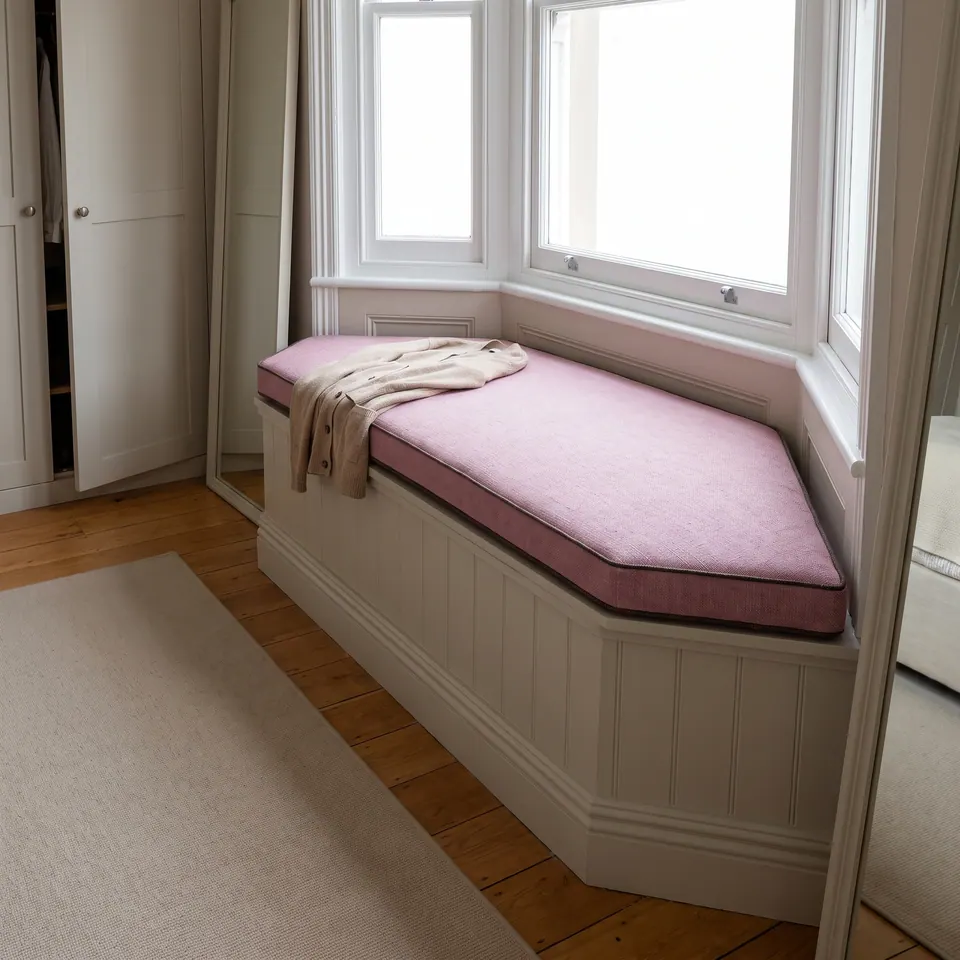
A buyer in the US asked whether corduroy would work on a trapezoid bay seat. Then, measuring properly, they found two short extra edges where the seat met the side walls. The trapezoid was a hexagonal window seat cushion.
The workshop turned the sketch into a template: 78 in (198 cm) front, 46.5 in (118 cm) back, two angled sides of 23 in (58.5 cm), two end sides of 5 in (12.7 cm), about 22 in (56 cm) deep. Order by the size ranges that fit 78 in and 22 in, it said, and write every edge into personalization. The fabric: navy corduroy.
The home check: 15.75 in of run, 17 in of rise, 23.2 in of side. The tape said 23. The shape was honest, and the corduroy question was the easy part.
- Measured
- Front 78 in, back 46.5 in, angled sides 23 in, end sides 5 in, depth about 22 in
- What it taught
- Bay seats with short end returns are hexagons; measure every edge.
One piece, or split at the angles?
Any number of angles can be one continuous cushion; a bay 98.5 in (250 cm) across the front has been. Whether yours should be decides your bay window seat cushion sections.
Split long seats and lidded ones. A trapezoid around 79 in (200 cm) long is usually made as two cushions, because angled sides can make one long piece bend or shift; a 160 in (406 cm) bay got the same advice. Lids get a cushion each; see hinged storage lids.
Split at the angles when the seat follows the bay all round: three cushions for a wrap-around bay is the easier build.
Keep it whole if a seam bothers you more than the handling, and ask before ordering.
Either way, the fabric roll is about 55 in (140 cm) wide, so oversized panels get seams toward the back, and a stripe may only run one way (stripe direction). The zipper hides on the back edge or underneath.
Why bay numbers refuse to close
- An angled side shorter than its rise. Impossible: a slanted edge is always longer than the depth it spans.
- End returns left off. A 4 or 5 in return turns a trapezoid into a hexagon.
- No depth on the sketch. One order paused for the front-to-back depth before its 91 in longest length meant anything.
- Letters pointing at different edges. Your A must be the maker's A; type 'A = left end return'.
- A bay on the rectangle listing. If checkout doesn't ask for a drawing, you're on the wrong listing.
A bay window seat with two 5 in end returns is a hexagon, not a trapezoid. Measure every edge the cushion touches, then the front.
Nate Kowalski
Buyer questions: bays with more than three sides
- A common question
Our bay has five windows and a lot of angles. Can you make a cushion for it?
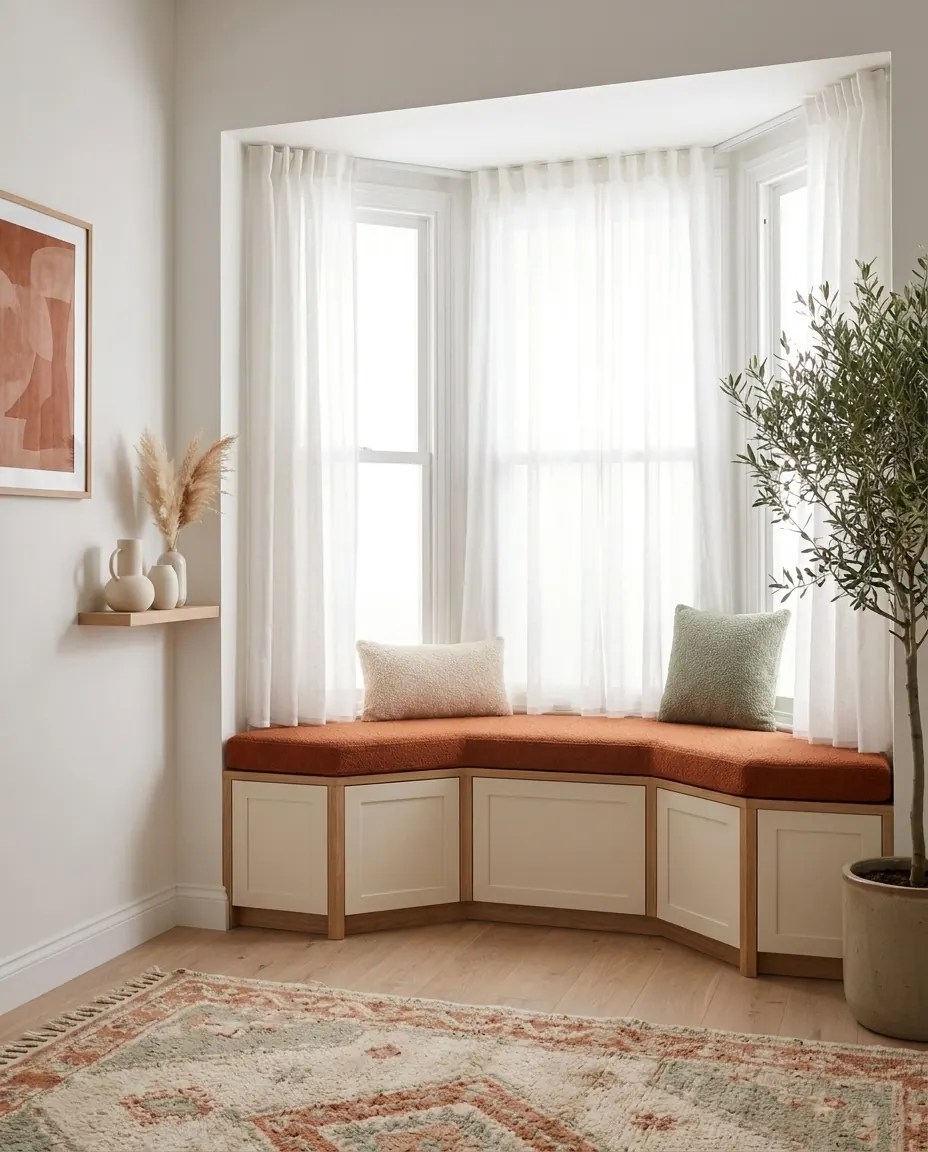
The workshop's answerYes. 5-window, pentagon and hexagon seats, and bays where each window sits at a slightly different angle, are made regularly. Send a sketch with every segment, any angles you know and the depth at each breaking point; it becomes a template for you to check before you order.
- A common question
On an angled window seat, which measurement counts as the depth?
The workshop's answerThe straight distance from front edge to back edge at 90 degrees, at the deepest point, not along the angle. It's the most important number on the template. Length is the total between the outer corners.
- A common question
My walls aren't square and my numbers don't add up. What happens now?
The workshop's answerThe seat is drawn to scale and checked for closure. If it doesn't close, you re-measure specific edges, measure both diagonals or fill in a lettered outline. A gap within 1/4 in is accepted, and nothing is cut until you confirm.
- A common question
The bay seat has lift-up lids. Should the cushion be split to match?
The workshop's answerYes. Cushions over flip-up lids are divided at the lid lines, one per lid. Over a radiator, a 106 x 15 in seat became two 53 x 15 in cushions. Sections that differ, even by about 1.5 in in depth, each need their own drawing.
Bay arithmetic, answered short
What angle is a typical bay window corner?
Many read about 135° inside the seat, a 45° bay, but real ones wander: the three seats on this page ran 129° to 139°. Measure or calculate yours.
Where does the zipper go on a bay window cushion?
Every foam cushion has a zippered, removable cover, hidden on the back edge against the window or underneath; you choose. On long covers it often wraps two corners so the foam slides out. See zipper placement.
What fabric suits a sunny bay window seat?
A sun-resistant one. A buyer with a black 160 x 24 in (406 x 61 cm) trapezoid bay asked for exactly that, and the workshop stocks them. More in window seat cushion fading.
Does a bay cushion have to be the same depth all the way round?
No. Depth can be set per section when walls are out of square, and a straight-front seat is deeper at the center than at the ends. Give the depth at every break.