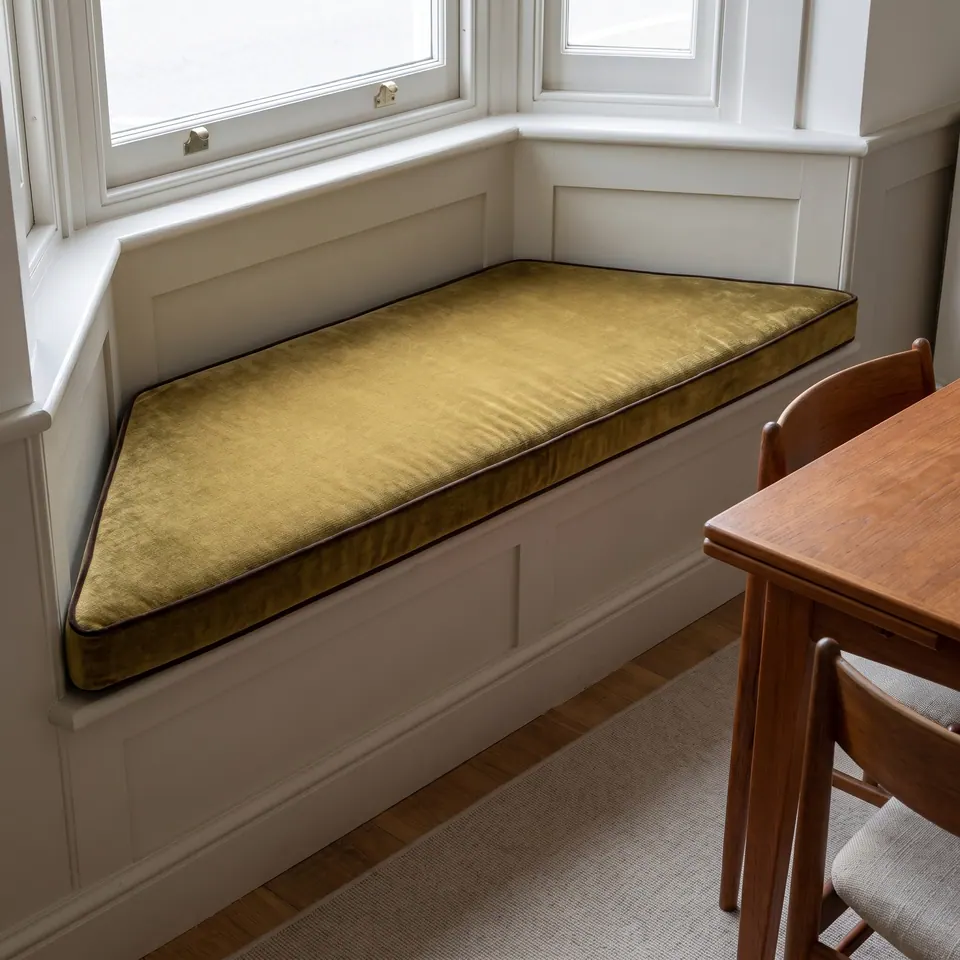
Concept Sketches · 8 scenes
Big bays, long seats: where to split a large bay window cushion
Eight of the biggest bays from past orders, ranging from a 107.5 in back edge to a 14 ft 10.5 in bottom run: where one piece still works, where the seam lands, and why nobody measures a long cushion on day one.

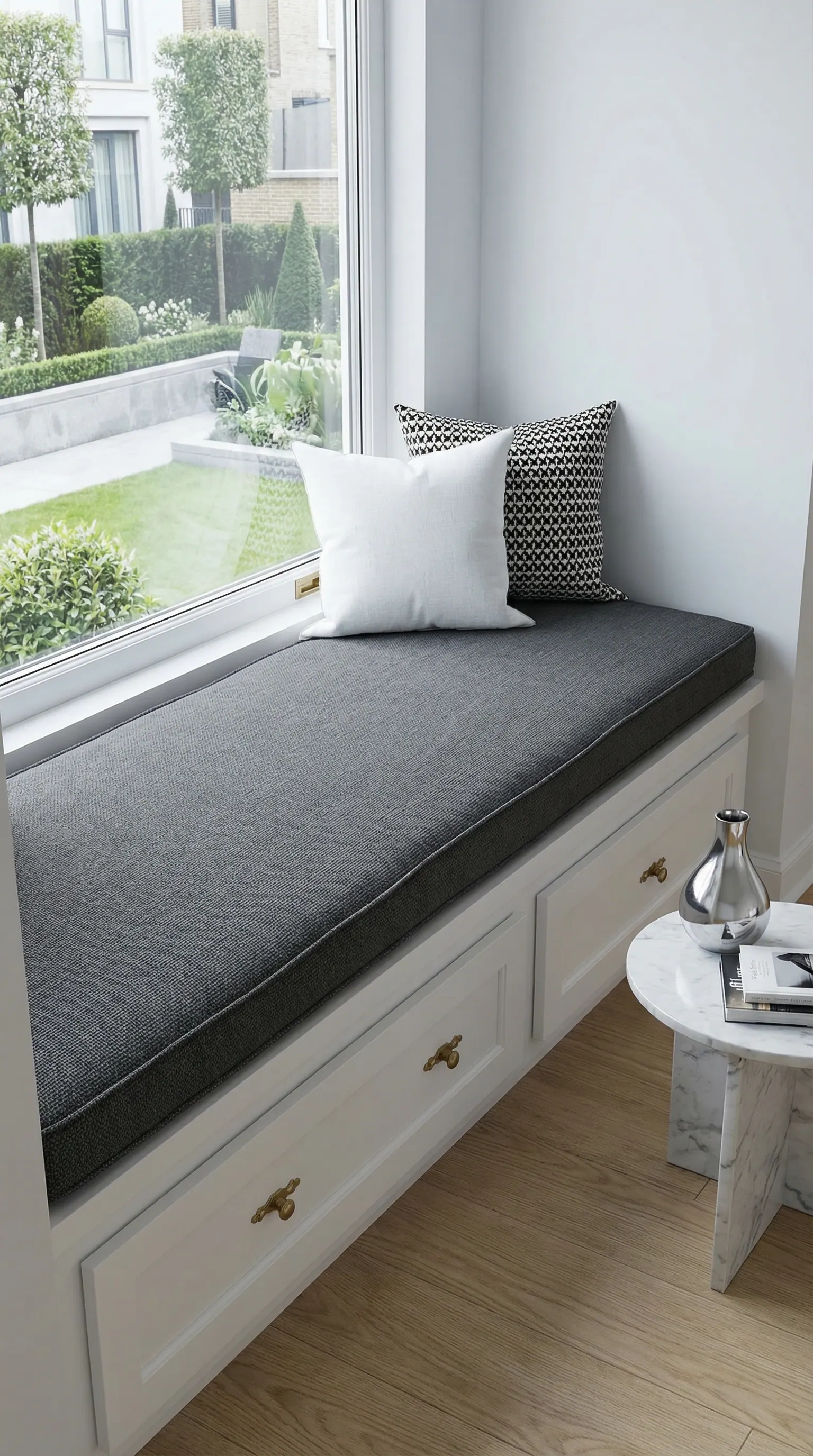 Save
The quick answer
A large bay window cushion longer than about 7.5 ft (2.3 m) is usually best made in two or more pieces, joined at a bay corner or at the midpoint. Pieces are easier to make, ship, lift out and clean. One piece is still possible on request. Measure every edge separately, and give a vacuum-packed cushion 48-72 hours to recover before checking its size.
Past 7.5 feet, the seam becomes the design
The longest bay in this series runs 14 ft 10.5 in (453 cm) along its bottom edge. Nobody should have to carry that as one cushion.
Past about 7.5 ft (2.3 m), a single large bay window cushion gets hard to make, ship and lift out for cleaning. For trapezoids around 6.5 ft (2 m) or more on the long side, the workshop may suggest two pieces; for straight seats of roughly 8 to 10 ft (2.5 to 3 m), it recommends equal pieces.
So the working question is where the seam lands: at a bay corner, where each piece follows one run of the angle, or at the midpoint, where a straight seat splits into twins. Angles are just lengths in disguise.
Eight big bays from past orders follow, sizes kept exact. Run yours through the bay window calculator or the trapezoid cushion calculator, and browse the bay window cushions and trapezoid cushions hubs. What does your longest edge measure, partner?
Eight big bays and where each one split
01A past project
14 ft 10.5 in of trapezoid, split where the bay turns
One buyer wrote in with a trapezoid bay 8 ft 7 in (262 cm) along the top, 14 ft 10.5 in (453 cm) along the bottom and 29 in (74 cm) deep, with 2 ft 6 in (76 cm) sides and angled corners of 11 in (28 cm) and 5.5 in (14 cm), in 5 in (13 cm) linen. The workshop recommended two pieces, joined at a corner or the midpoint, and asked for a sketch or photo to confirm the angles.
The takeaway: A corner seam lets each piece follow one run of the bay; a midpoint seam gives two pieces closer in size.
02A past project
154 5/16 in, kept in one piece on purpose
A buyer in the US asked whether a wide angled seat could be one piece, in a wipe-clean fabric. The lettered drawing gave a 154 5/16 in (392 cm) front, a 108 in (274 cm) back and only 15 in (38 cm) of depth. The workshop drew a template from those letters, confirmed the one-piece build and suggested velvet.
The takeaway: One piece stays an option on request; have the template drawn and confirmed before you order it.
03A past project
About 160 in of black, sun-resistant cloth
A buyer in the US wanted a trapezoid bay cushion about 160 x 24 in (406 x 61 cm) in a black, sun-resistant fabric, and specifically not corduroy or velvet. The workshop confirmed sun-resistant fabrics are in stock and suggested two pieces because of the length.
The takeaway: Choose the cloth for the sun and the split for the length.
04A past project
A 14 ft nook, still being framed
A family in the US was still building their window nook: 14 ft (4.3 m) wide in total and 36 in (91 cm) deep, with cushions in smoke. They were happy to split the run, so the full length was quoted as several sections that butt together.
The takeaway: Settle the section count while the nook is open; send final sizes from the finished build.
05A past project
154.5 in, halved into 77.25 in twins
A buyer in the US had a straight 154.5 x 22 in (392 x 56 cm) window seat and wanted corduroy. It became two identical 77.25 x 22 in (196 x 56 cm) cushions, ordered through the closest menu size with the exact size in the personalization box. They fit, but the knife that opened the tight shrink-wrap also cut the covers; the workshop offered replacements, and the buyer later came back for other benches.
The takeaway: On a straight seat, a midpoint split gives identical halves: one size, written twice.
06A past project
About 9 ft wide, four thicknesses on offer
A buyer messaged the workshop with a bay about 9 ft (2.7 m) wide: 107.5 in (273 cm) back, 55 in (140 cm) front, two 32.5 in (83 cm) sides, 23 in (58 cm) deep. Priced as a custom shape, it could be 2, 3, 4 or 5 in (5 to 13 cm) thick, with piping in any color and a removable cover washable at 86°F (30°C), no dryer. The quote came in above their budget.
The takeaway: Get the custom-shape quote before you design the room around one big piece.
07A past project
2.5 in short on arrival, full size two days later
A buyer messaged the workshop about a wide bay: 95 in (241 cm) front, 47.5 in (121 cm) back, 34 in (86 cm) angled ends, 24 in (61 cm) deep, 3 in (7.6 cm) thick. After a lettered template and one corrected edge, the geometry added up. The cushion arrived at 92.5 in (235 cm) and reached full size after 48 hours of foam recovery, no remake.
The takeaway: Give a vacuum-packed cushion 48-72 hours before the tape measure comes out; long pieces recover by inches.
08A past project
Left 33.75 in, right 33 in, both correct
A buyer in the US sent four numbers for an angled bay: 68.25 in (173 cm) at the back against the wall, 113.75 in (289 cm) at the front, 33.75 in (86 cm) on the left and 33 in (84 cm) on the right. The sides differ by 3/4 in (2 cm), which is normal for real walls, and the workshop quoted it as a custom shape.
The takeaway: Measure both slants separately, even when you expect them to match.
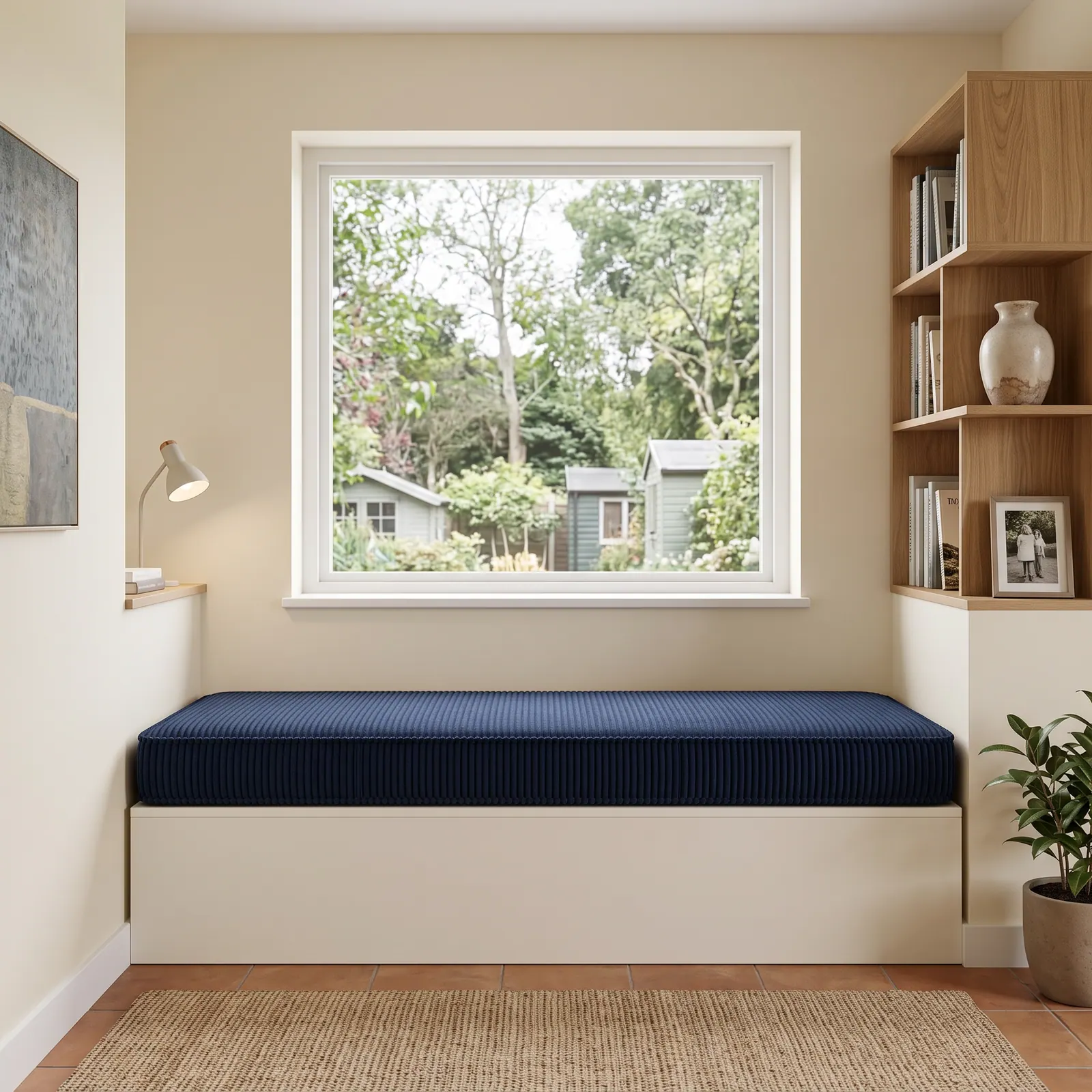
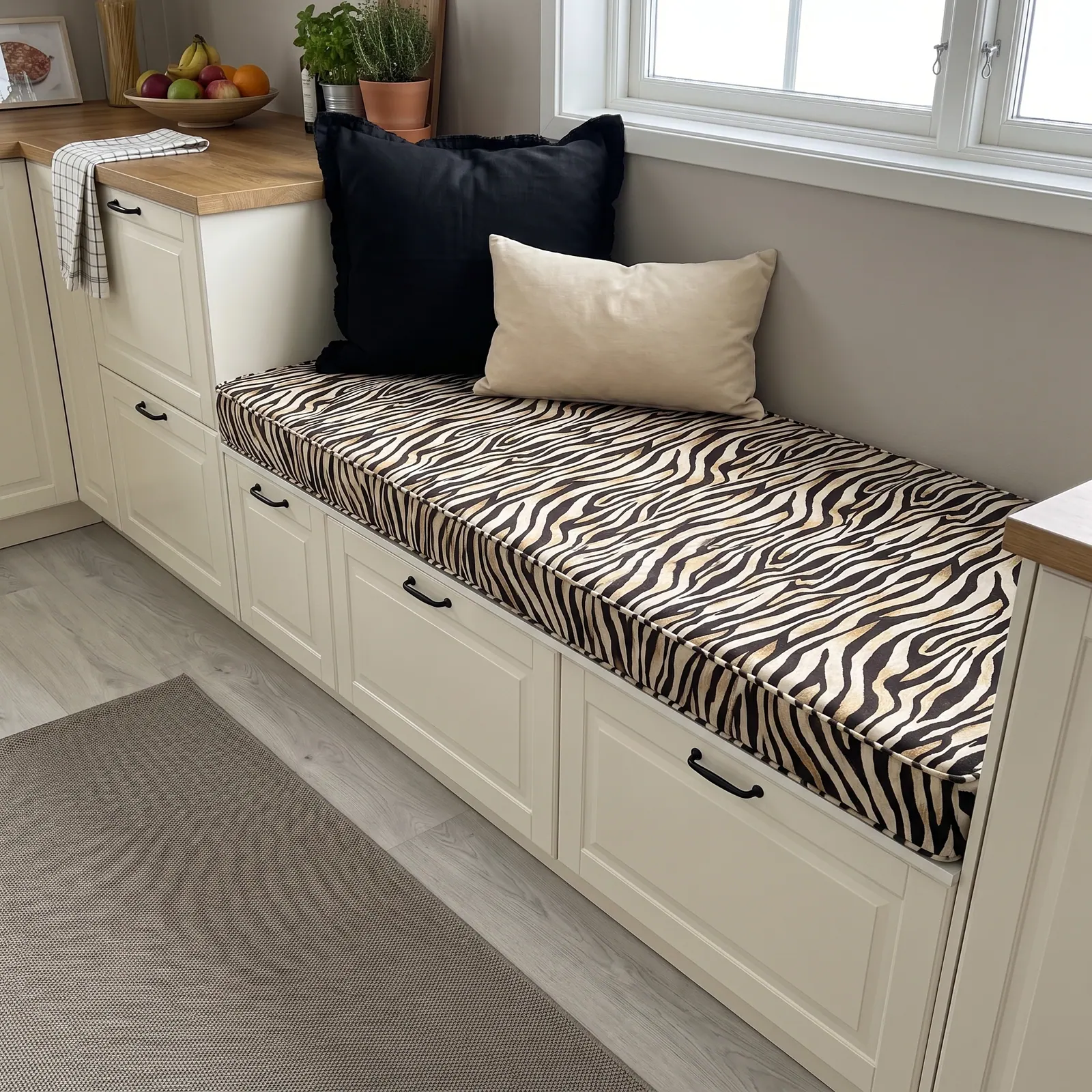
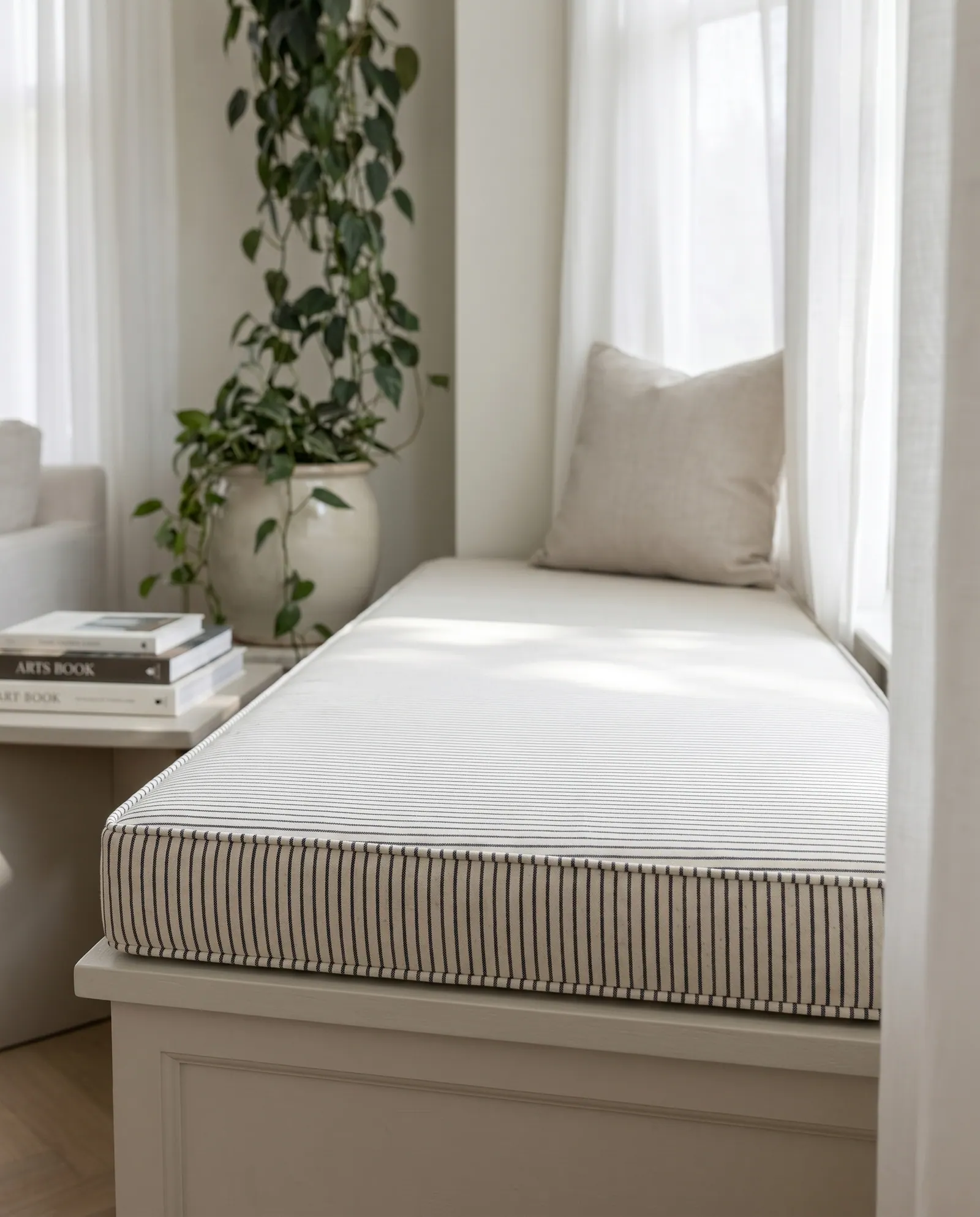
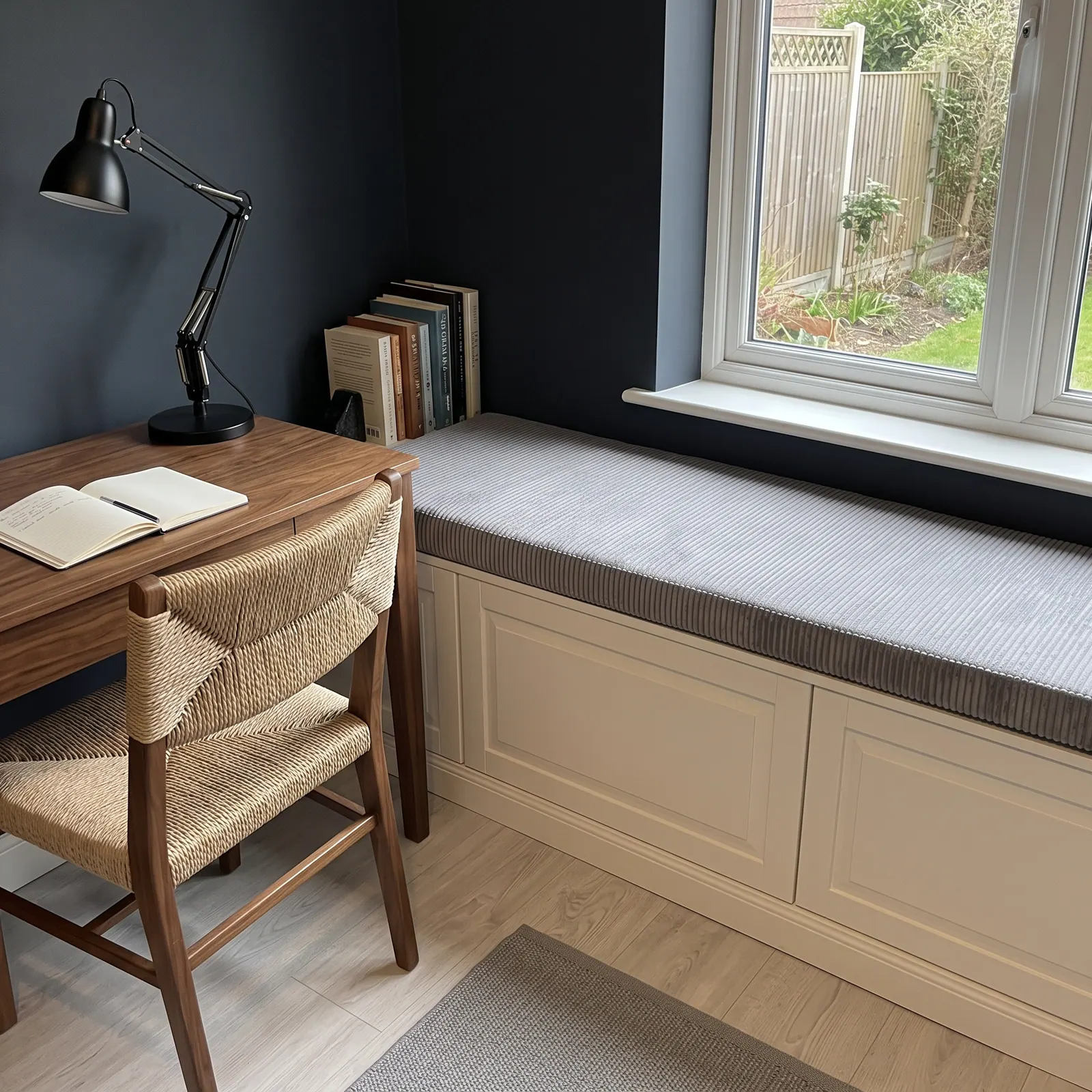
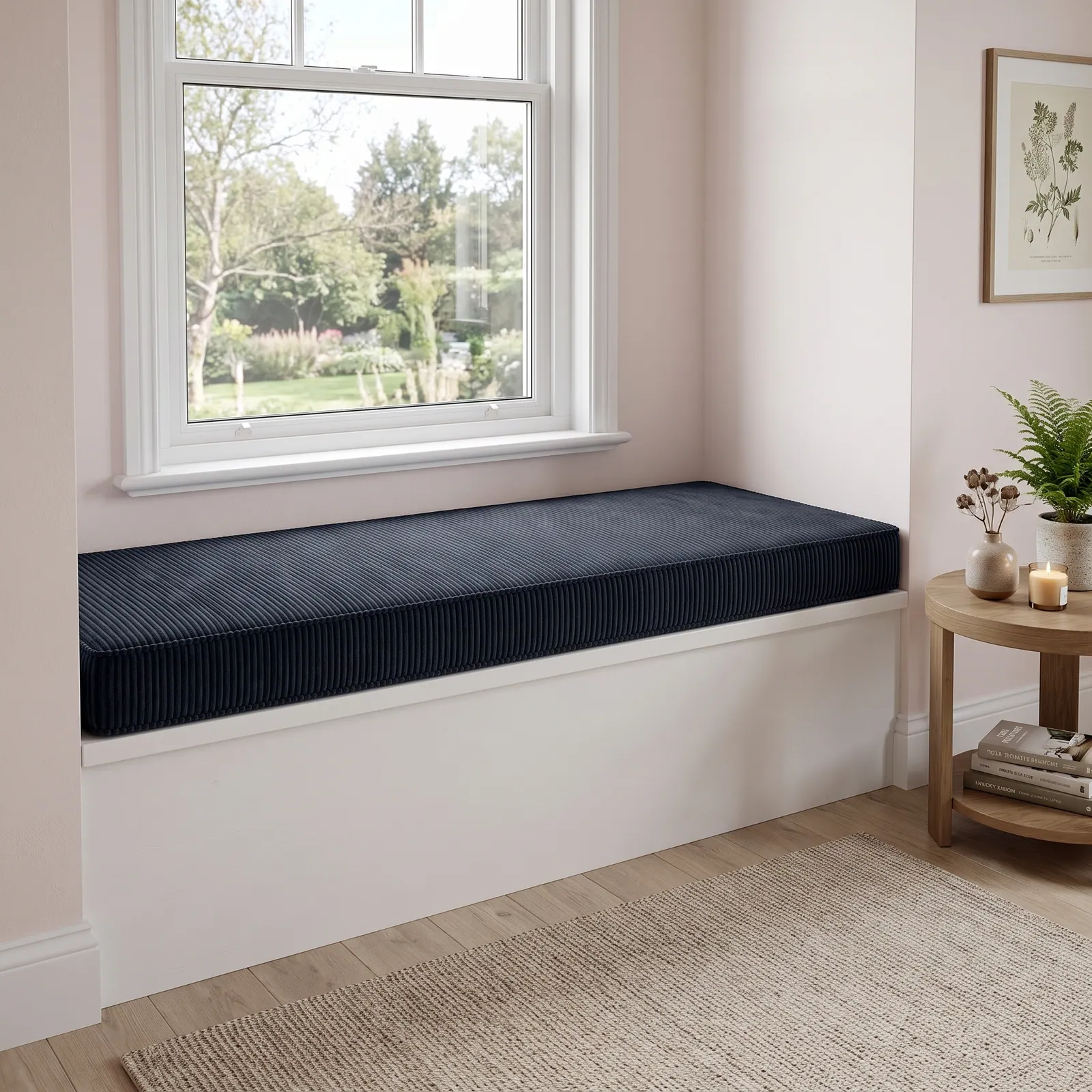
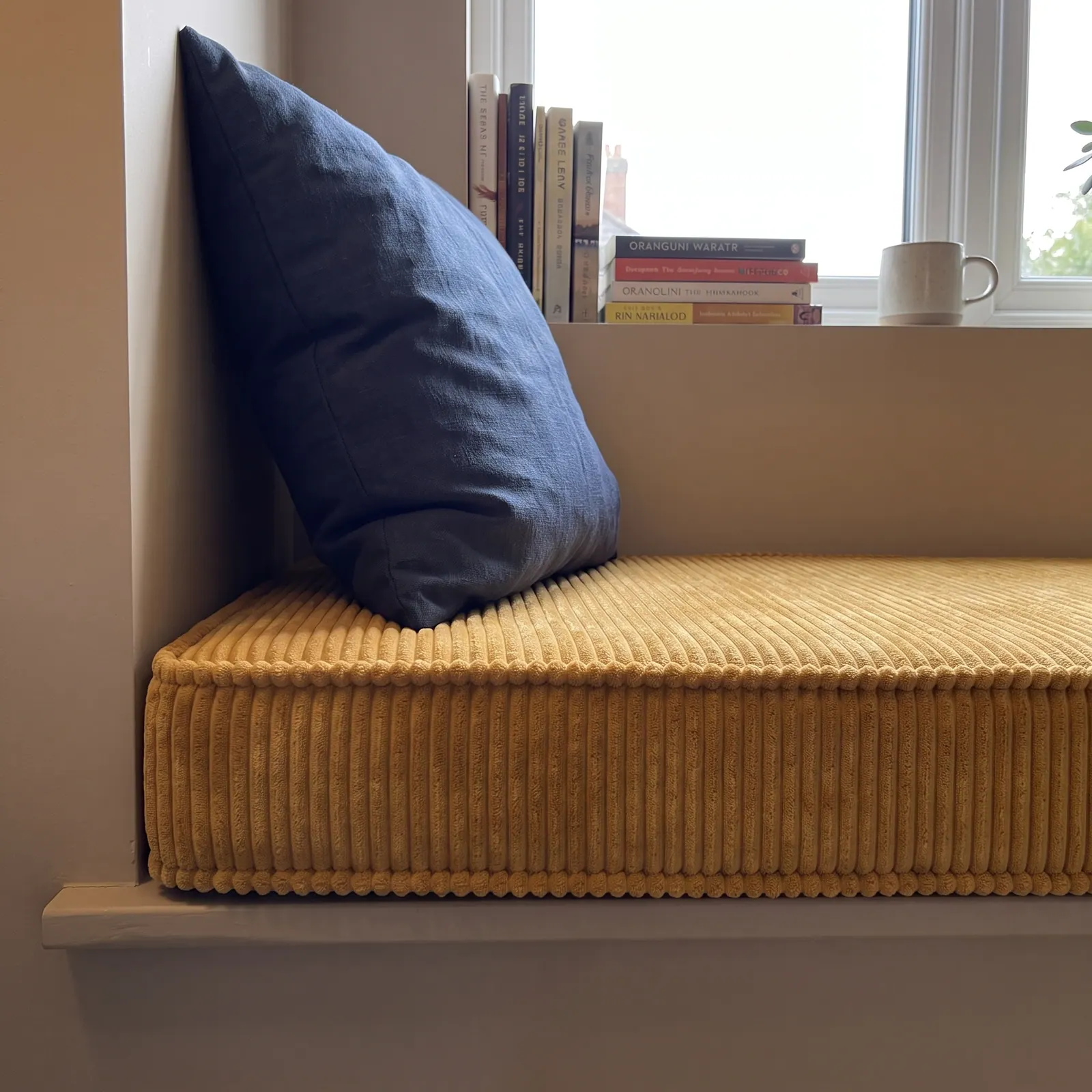
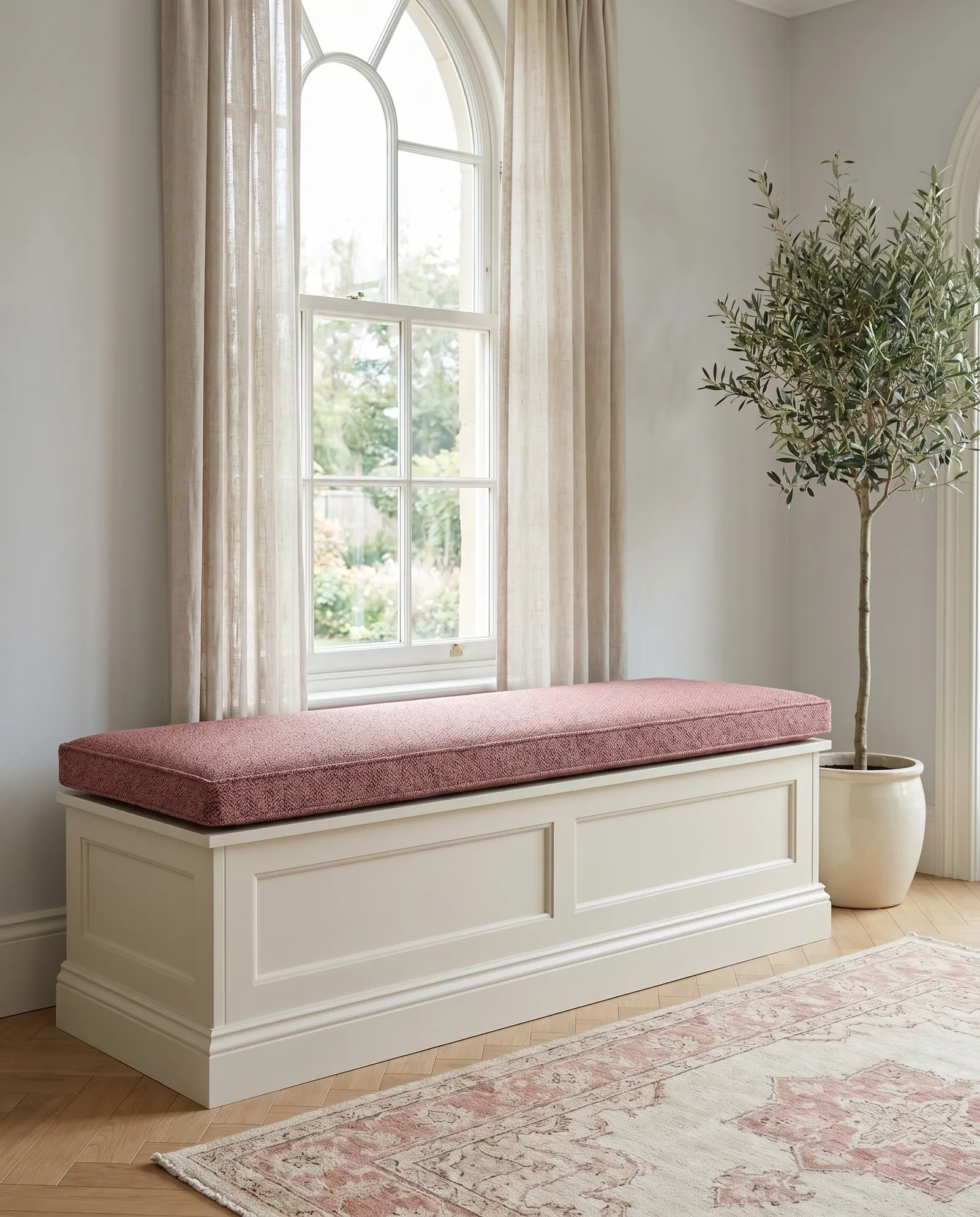
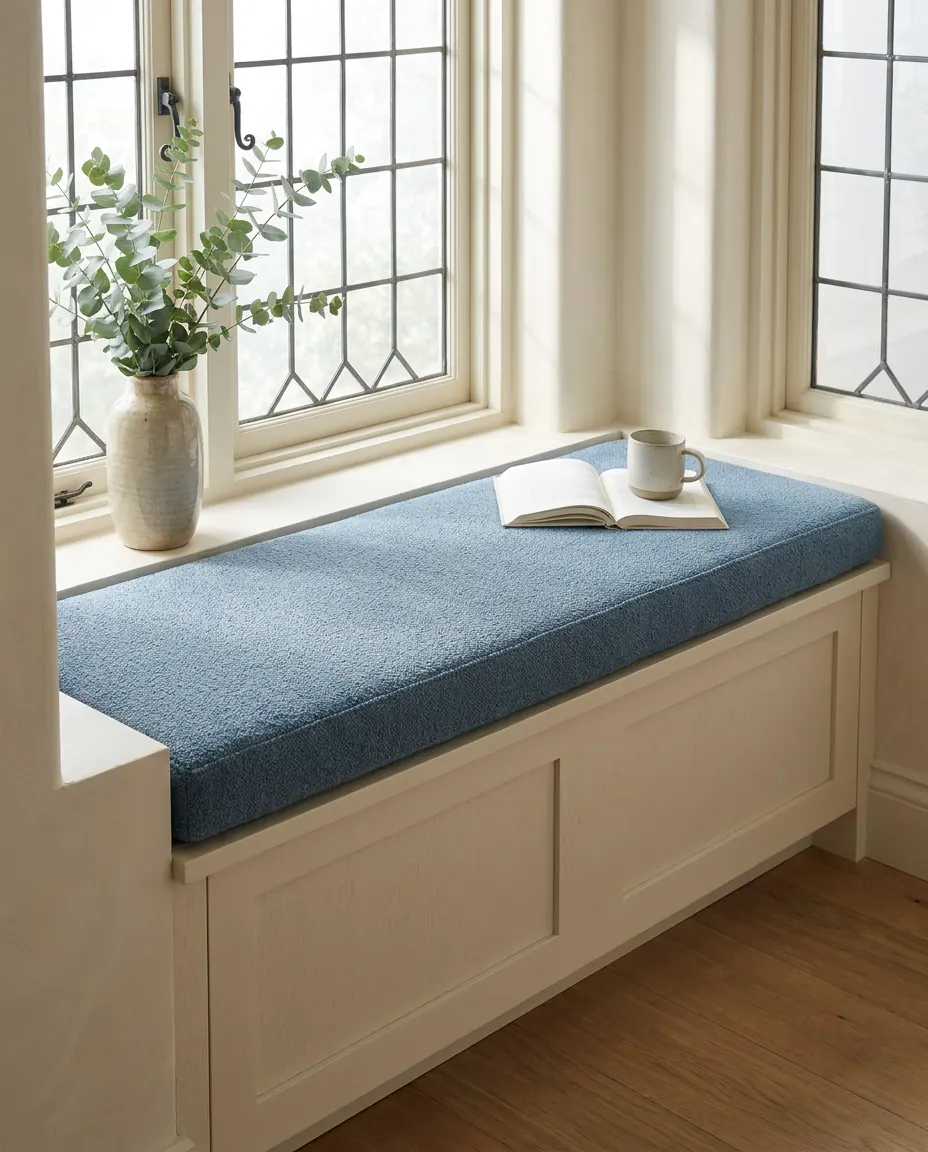
One piece, twins or segments: choosing the split for a long cushion
Pick the build first, then draw each piece. One piece or two covers straight benches, trapezoid cushion measurements covers angles, and Victorian bay window seat cushions is the sister series. Fabric comes last: the 14 ft bay chose linen, the twins corduroy.
| Build | Where the seam lands | Fits best | from past orders |
|---|---|---|---|
| One piece | Nowhere | Any length, on request, once the template is confirmed | 154 5/16 x 15 in (392 x 38 cm) angled seat; a 103.5 in (263 cm) cushion |
| Identical halves | The midpoint | Straight runs, where both pieces share one size | 154.5 x 22 in seat as two 77.25 x 22 in (196 x 56 cm) cushions |
| Segments that follow the angles | A bay corner | Trapezoids and three-sided bays | 14 ft 10.5 in trapezoid, joined at a corner or the midpoint |
| Several butting sections | Wherever you choose | Very wide nooks | 14 ft x 36 in (4.3 m x 91 cm) nook; a 197 in (500 cm) nook in three pieces |
| Two over a radiator | The midpoint | Ledges above a radiator, so heat escapes | 106 x 15 in (269 x 38 cm) ledge as two 53 x 15 in (135 x 38 cm) cushions |
Unpacking a long cushion: the first 72 hours
- Unpack within a few days. Foam shouldn't stay vacuum-packed more than 2-3 weeks, never more than a month.
- Cut only the outer plastic, blade shallow and pointed away from the cover.
- Take the cover off; shake, pull, knead or stretch the foam.
- Sit on the cushion if you like; it can be used while it finishes expanding.
- Measure at 48-72 hours, edge by edge against your drawing.
A bay window cushion longer than about 7.5 ft (2.3 m) is easier to make, ship and lift out as two pieces, joined at a corner or the midpoint.
Nate
Long-seat and bay questions
- A common question
My window seat is really long. Should the cushion be one piece or split into sections?
The workshop's answerFor seats around 8 to 10 ft (2.5-3 m) and longer, the workshop recommends equal pieces: they fit better, last longer and are easier to handle. A 92 in (234 cm) seat was suggested as two 46 in (117 cm) cushions, and a 197 in (500 cm) nook was made in three pieces. Each piece is ordered at its own size, usually by adding two or more cushions to the cart. Long soft back pillows sag, so an 88 in back works better as two 44 in pillows. It's still your call: one piece can be made on request, and a photo with measurements gets you the workshop's advice.
- A common question
What exactly do you need me to measure on a trapezoid bay seat?
The workshop's answerEvery edge: the front, the back along the window, both angled sides, any small clipped corners or short straight ends, plus the depth and thickness. Measure the depth straight from the highest point down to the base line, and measure each angled side on its own, corner to corner, because those sides are not the same as the depth. Mark every break in the bay and any cut-out, such as a window handle, and send a labeled drawing (A, B, C, D) with a photo of the space. If a side is missing, the workshop asks for it before quoting, and very long trapezoids may come back with a two-piece suggestion.
- A common question
Can I order my angled bay seat cushion on the regular rectangle listing?
The workshop's answerNo. Angled and three-sided bays go on the custom-shape (trapezoid) listing. Choose the size by the depth and overall length, then upload a drawing with every edge, any cut-ins and the depth, plus a photo of the seat; a hand sketch on paper is enough. Asymmetric bays can be sketched or traced onto a paper template, and the workshop may ask for a few extra measurements before quoting. When an angled shape landed on the rectangle listing in past orders, it was canceled and refunded so the buyer could reorder on the right one.
- A common question
Can you really make a cushion to my exact size, even something longer than 79 in?
The workshop's answerYes. Every cushion is made to order, so any length, width and thickness can be made, including lengths over 79 in (200 cm), and inches, centimeters or millimeters are all accepted. Send the length, depth and thickness, plus a drawing for anything that isn't a rectangle, and the workshop replies with a quote. You then pick the nearest listed size and write your exact size in the personalization note, or the workshop adds your size to the listing or sends a private custom order link. Trapezoids go through the custom-shape listing, with the longest edge as the length.

Have it made
Have an idea like this made — ask Nate’s workshop
Send the numbers in inches: length × depth × thickness, plus any angle. The workshop checks them with you, because foam has no undo button. — Nate
Leave your details and the workshop will call you to confirm measurements, fabric, foam and piping. No prices, dates or payment on this page: it is a request, not an order.
Questions buyers ask next
How long should I wait before measuring a vacuum-packed bay cushion?
Wait 48 to 72 hours. One 95 in (241 cm) bay cushion measured 92.5 in (235 cm) on arrival and reached full size after 48 hours, no remake needed. Unpack within a few days, take the cover off and knead the foam. The first 72 hours Pattern has the full routine, and the glossary explains foam recovery.
Why are the left and right sides of my bay seat different lengths?
Because real walls are rarely square. One buyer in the US measured 33.75 in (86 cm) on the left and 33 in (84 cm) on the right of the same bay, which is normal. Measure and label each slant separately rather than repeating one number; the cushion is cut to your drawing, not to an assumed symmetry.
What if my angled side doesn't match what the math says it should be?
Re-measure before anything is cut. If a measured slant and a calculated slant differ by more than about 1 in (2.5 cm), one number is off. On one US bay the drawing said 31 in slants and the math said 32.5 in; a re-measure confirmed 32.5 in, and the cushion went ahead at 4 in (10 cm) thick. See tolerance.
If I split a bay cushion, do I order the pieces separately?
Yes. Each piece is its own cart item at its own size. Rectangular pieces go on the normal listing, and each angled piece goes on the custom-shape listing with its own drawing, since every distinct shape is a separate order. You can ask for photos of the finished pieces, with measurements, before they ship.