A Reading by NateBay Window Cushions
Olive bay window seat cushion: why the piping is ivory, and what the line does
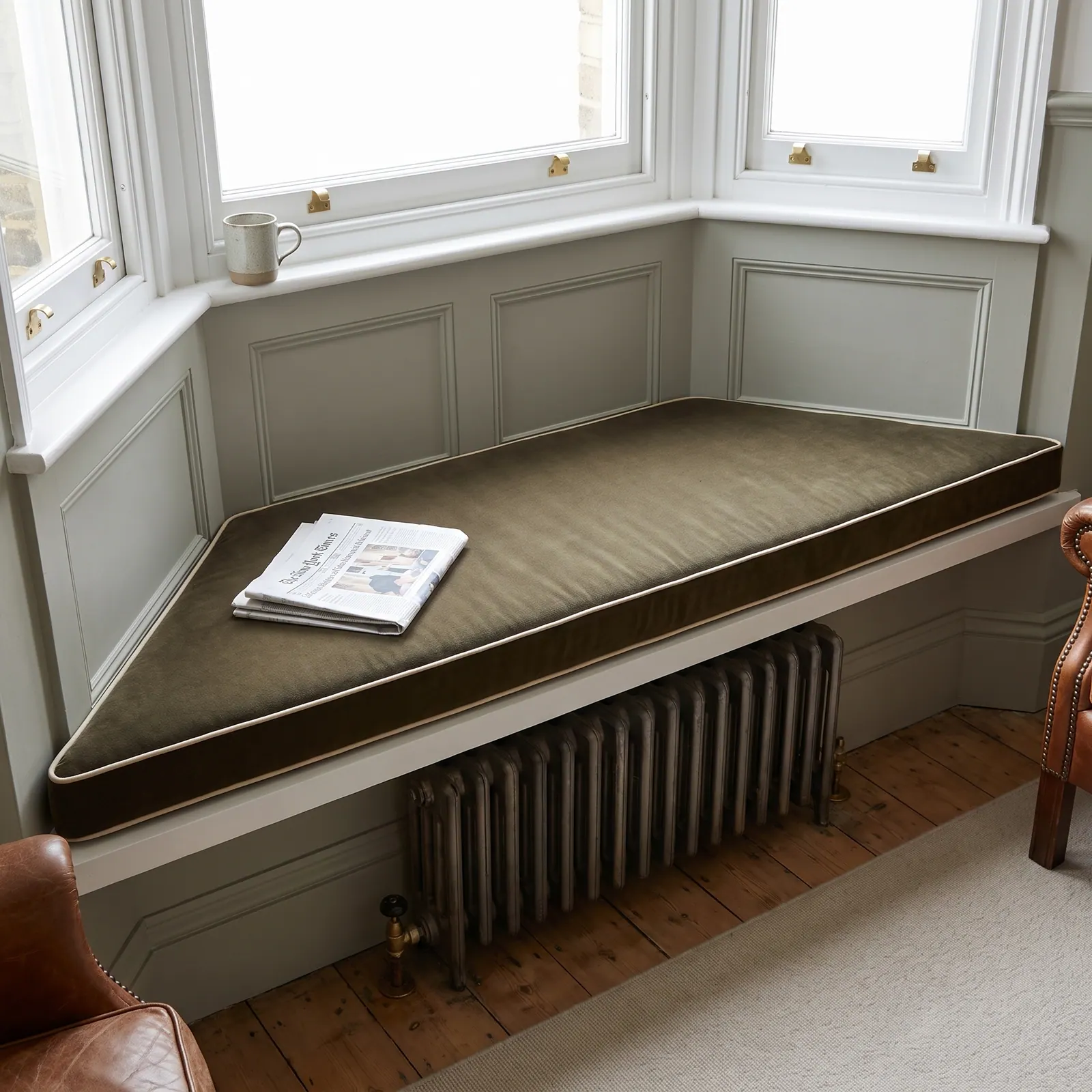
Nate takes the olive trapezoid apart the way he'd draw it, one edge at a time, and asks the welt a single question: what are you for?

 Save
The quick answer
Contrast piping is the right call on a bay window cushion when the fabric sits close in tone to the wall behind it. This olive linen-look trapezoid rests against sage paneling, so ivory piping draws edges that would otherwise disappear. Self piping would blur into the green, and no piping would soften the angled corners. Measure every edge, then decide.
The cushion, cut open
Cover fabric. A removable, zippered cover. Machine wash at 86°F (30°C) on a gentle cycle and air dry.
Piping. A fabric-covered cord sewn into the seams. It sits on the seam line, so it does not change the size.
Fiber wrap. Polyester fiber (Dacron) batting around the foam: it fills the cover out and softens the edges.
Foam core. About 2.0 lb/ft³ (32 kg/m³) high-resilience foam, firm to medium-firm, cut to the ordered size.
Zipper. Along the back band, as hidden as possible. The zipper side faces down or toward the wall.
Base panel. The underside of the cover. A non-slip fabric backing can cover the whole of it instead.
The edge in cross-section: where the ivory line lives
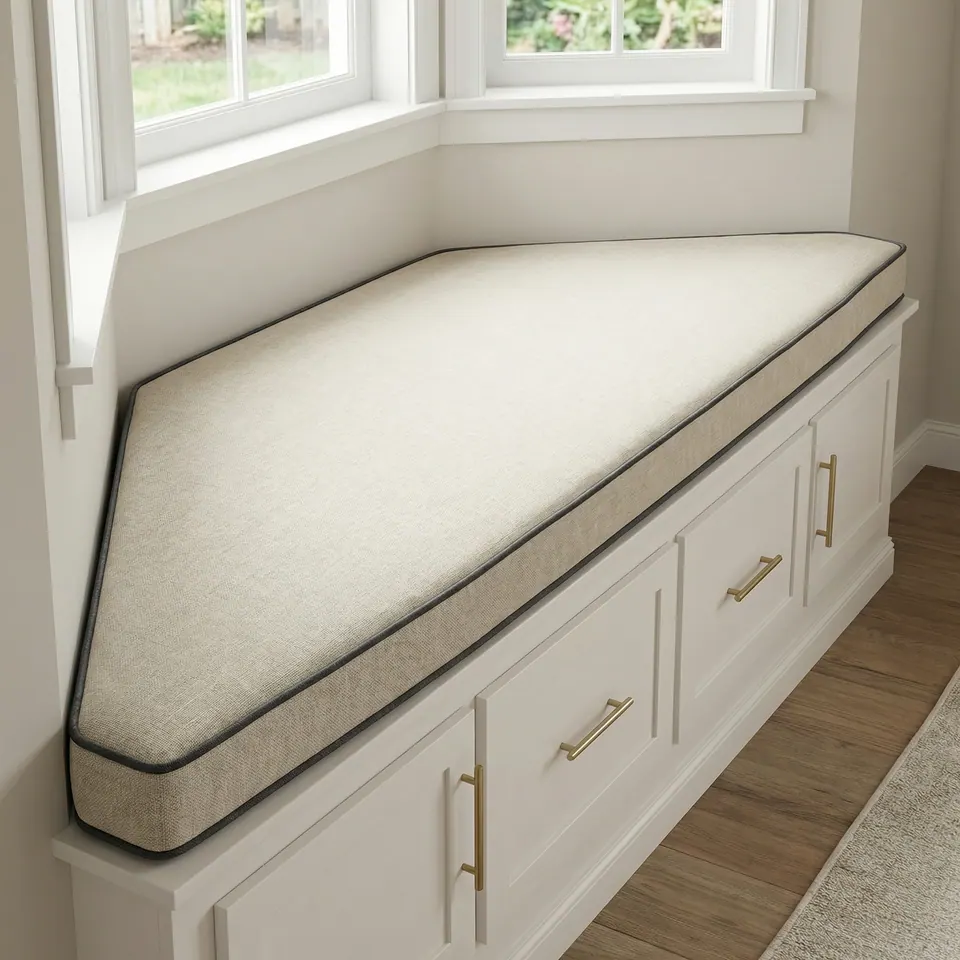
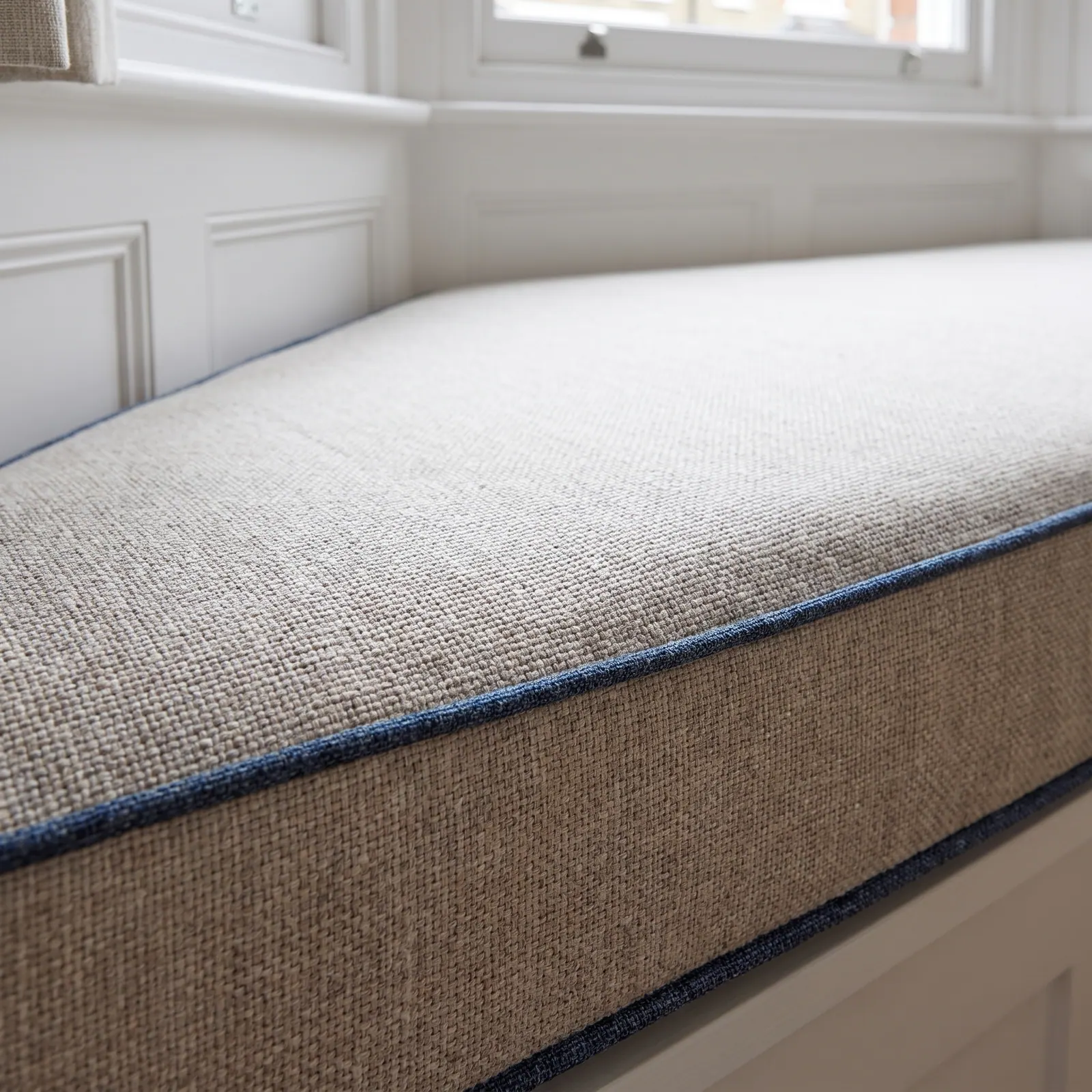
Slice this cushion across (please don't) and you'd find four parts: a top panel, a boxed side strip, a bottom panel, and at each top seam a cord wrapped in ivory fabric. That cord is the piping. On this bay window cushion it has one job, and it does it well.
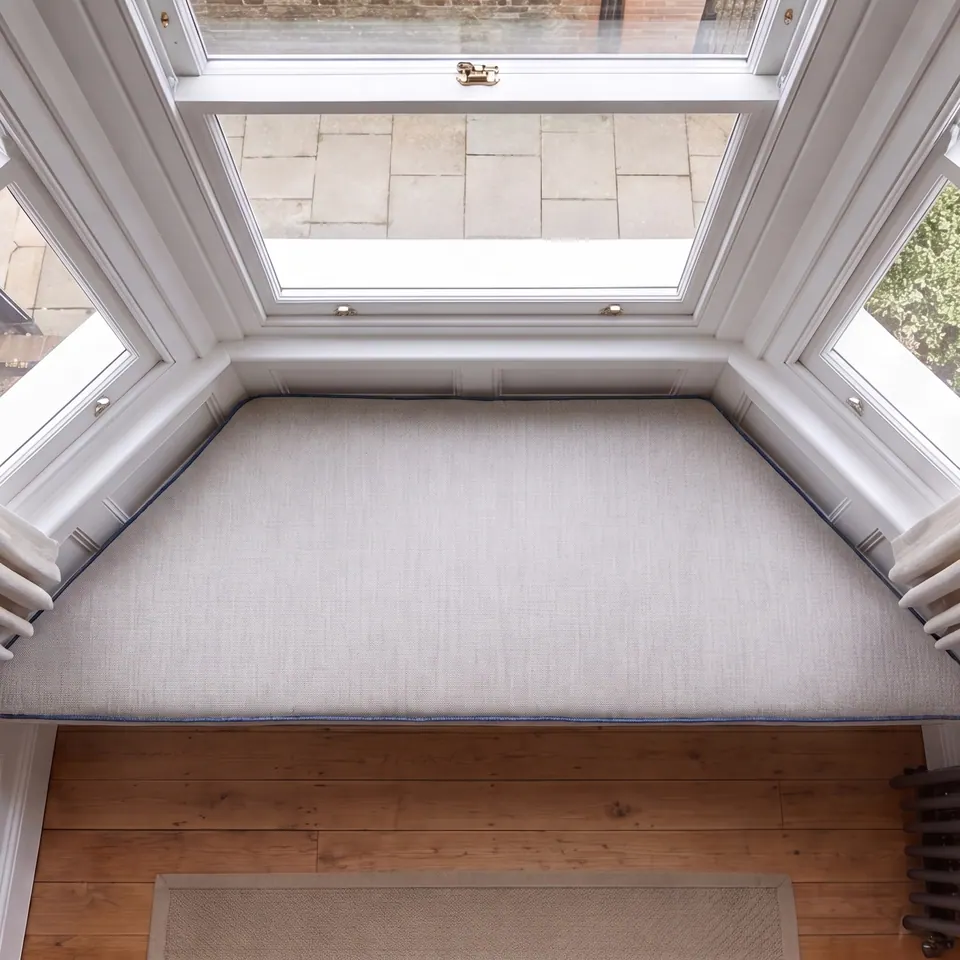
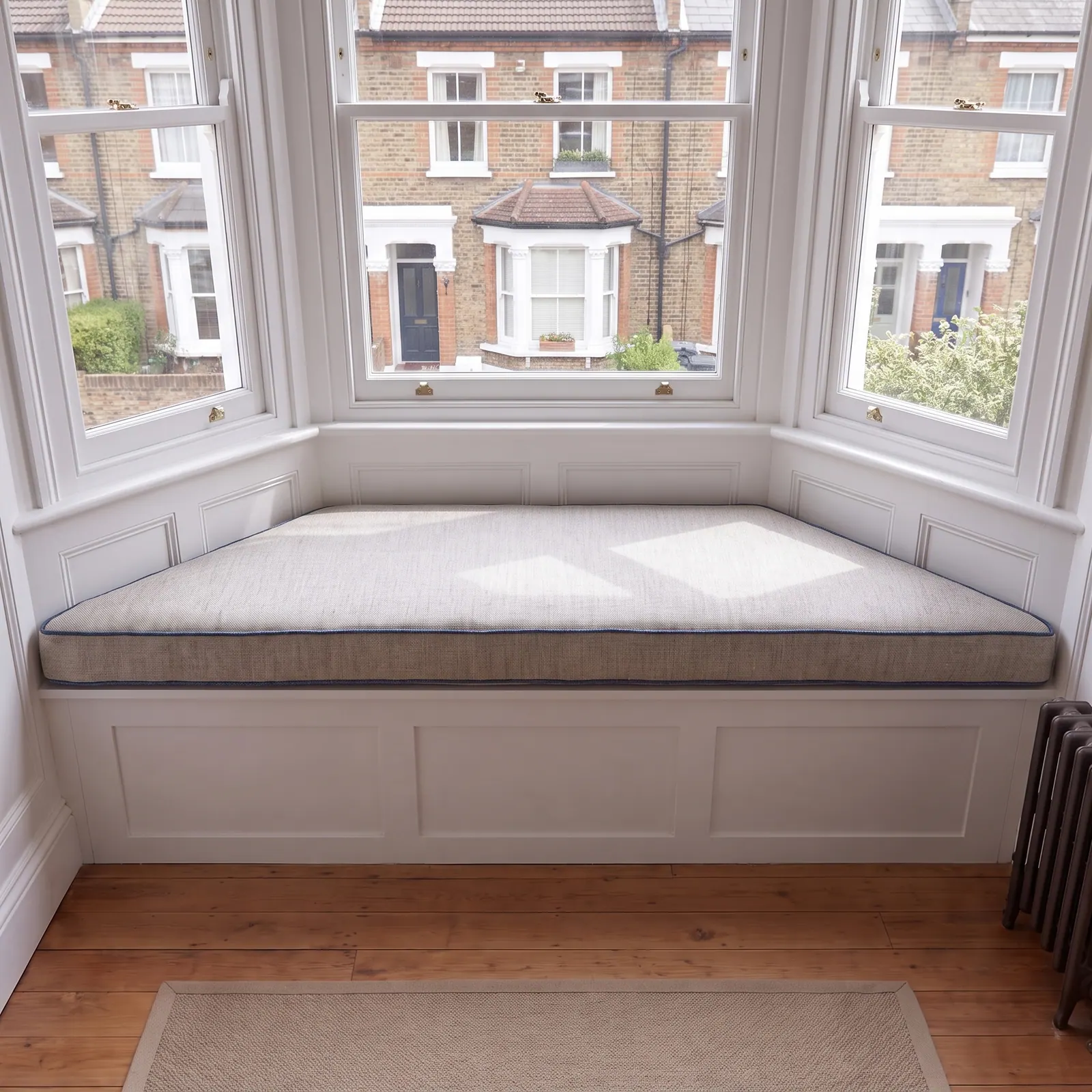
Olive is a deeper version of the sage paneling behind it. Tone on tone makes the seat look built in, which is the goal, but in soft gray daylight it also blurs the edges. The ivory welt draws a clean line along the front and around each angled corner, so the trapezoid reads from across the room. Angles are just lengths in disguise, and good piping shows you every one of them. The cloth is one of the linen-look fabrics; more seats like it sit among the bay window cushions.
The props keep the scene honest. A folded newspaper on the cushion and a white mug on the deep sill make this a morning reading ledge, with the sill doubling as a side table. Tan leather armchairs pull in the warm floorboards, and brass catches on the sash windows add a little shine.
Now the part I'd check first: the ledge sits over a cast iron column radiator. The seat stays warm all winter, but warm air still has to rise into the room, so keep the ledge shallow and let the cushion stop at its front edge. What sits under your ledge: a radiator, a vent, or plain paneling?
Pinned by Nate: five points on the bay
Five pins across the bay, from the ivory welt on the front edge to the radiator underneath.
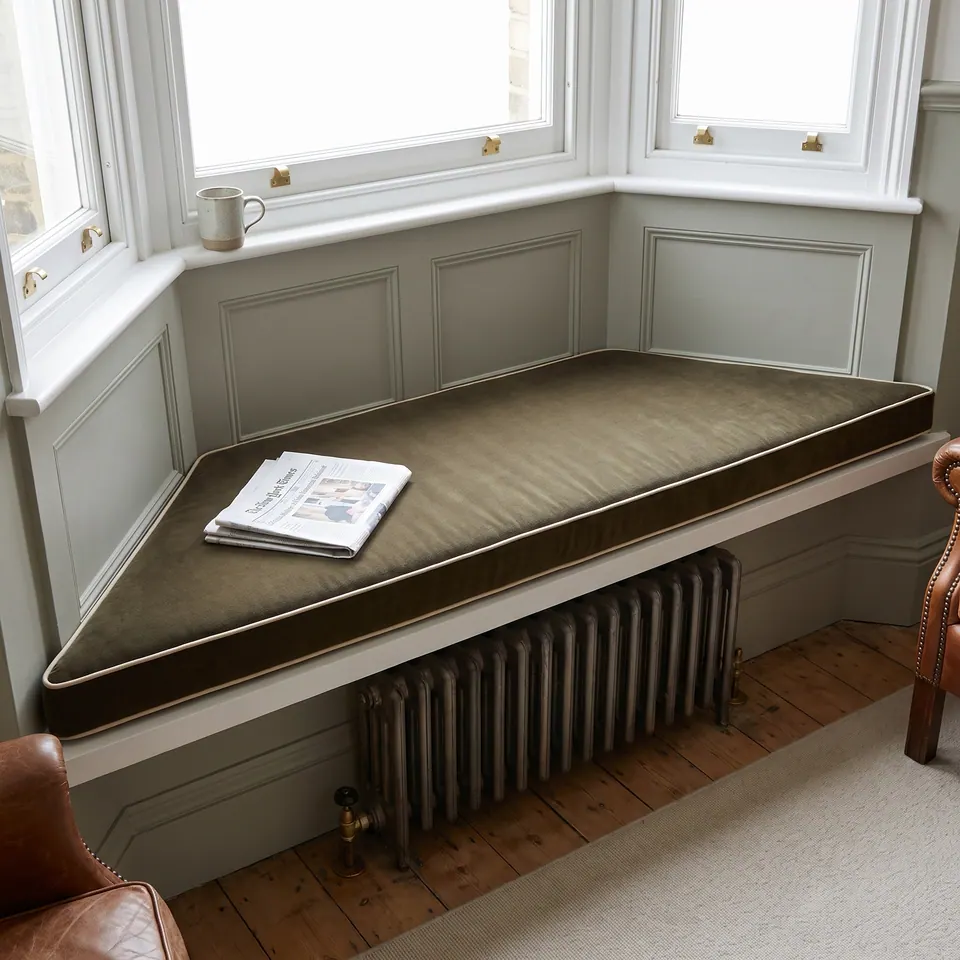
- Folded newspaper
Sets the scene as a morning reading ledge.
- Mug on the sill
A deep sill doubles as a side table for the seat.
- Radiator below
The seat stays warm in winter; leave room for heat to rise past the ledge.
- Leather armchair
Tan leather ties the olive to the floorboards.
- Ivory piping
Keeps the edge visible against the green paneling.
- Folded newspaperSets the scene as a morning reading ledge.
- Mug on the sillA deep sill doubles as a side table for the seat.
- Radiator belowThe seat stays warm in winter; leave room for heat to rise past the ledge.
- Leather armchairTan leather ties the olive to the floorboards.
- Ivory pipingKeeps the edge visible against the green paneling.
Self, contrast or none: three welts on olive
| Piping | Against sage paneling | Verdict on this bay |
|---|---|---|
| Self (olive) | The edge melts into the wall in gray light | Calm, but the angles blur |
| Contrast (ivory) | A clean line on every face and corner | The pick: the shape stays readable |
| None | The softest, most relaxed outline | Corners look rounded from across the room |
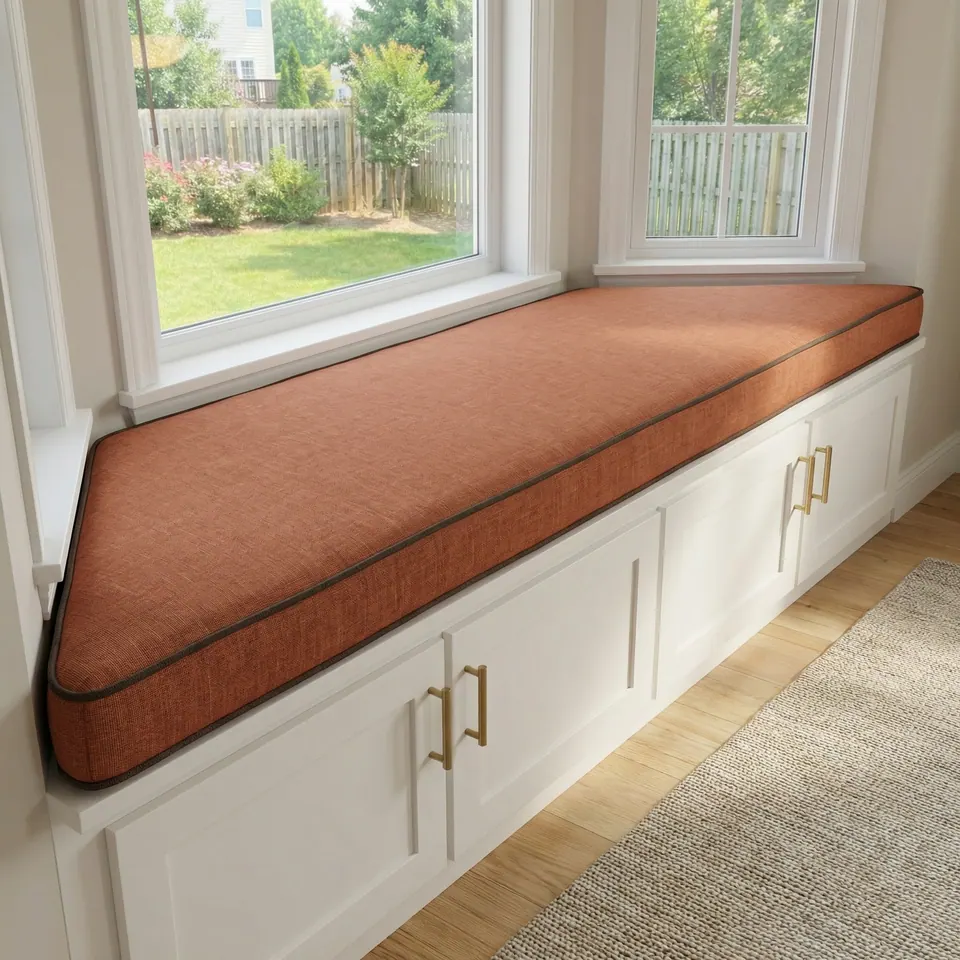
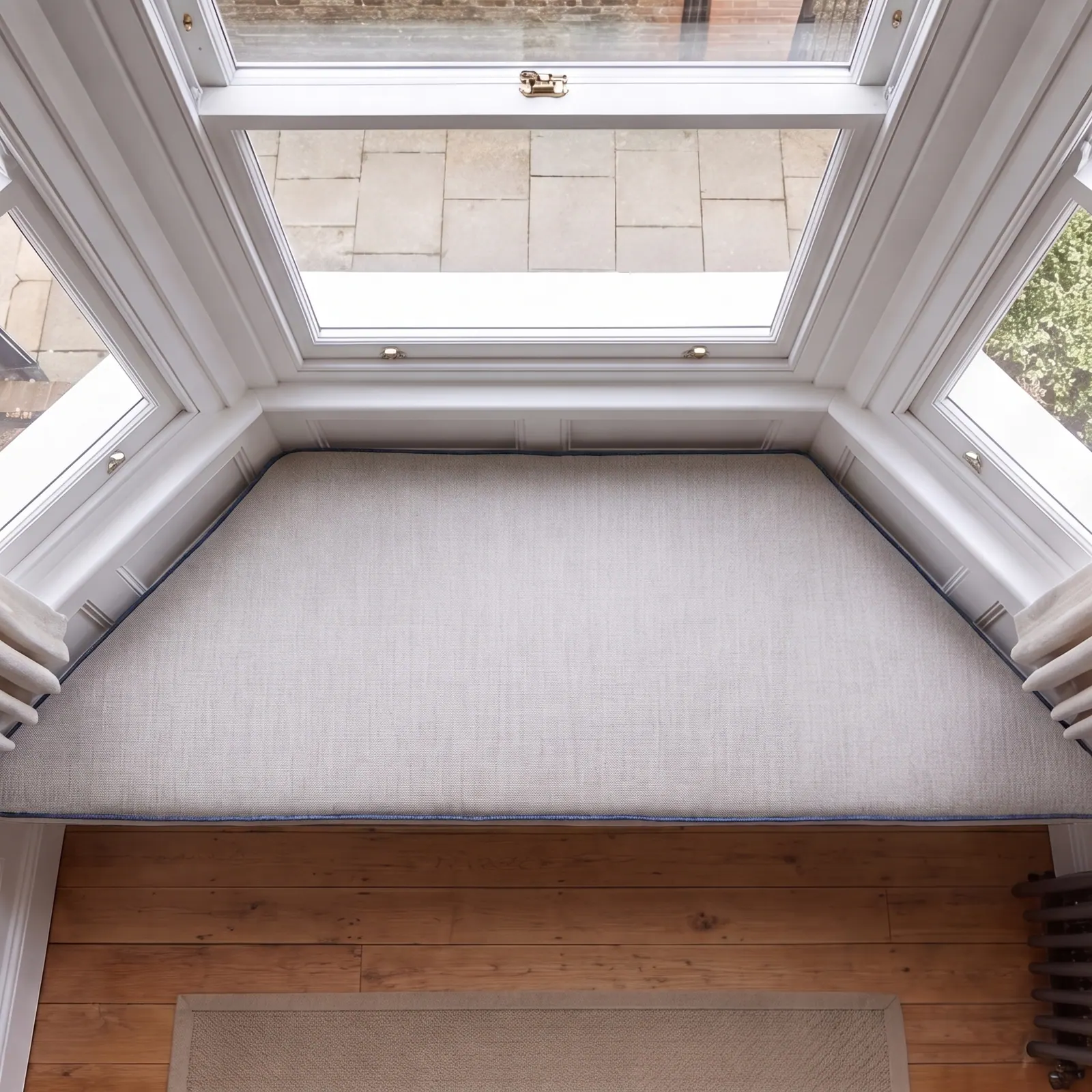
Two 45° corners and faces of 19 7/16 in
A buyer who came to the workshop on a referral had a bench that wrapped around a bay instead of running straight across. They sent a photo and the top measurements: 45° corners, with 19 7/16 in (49.4 cm) between corner points along the front.
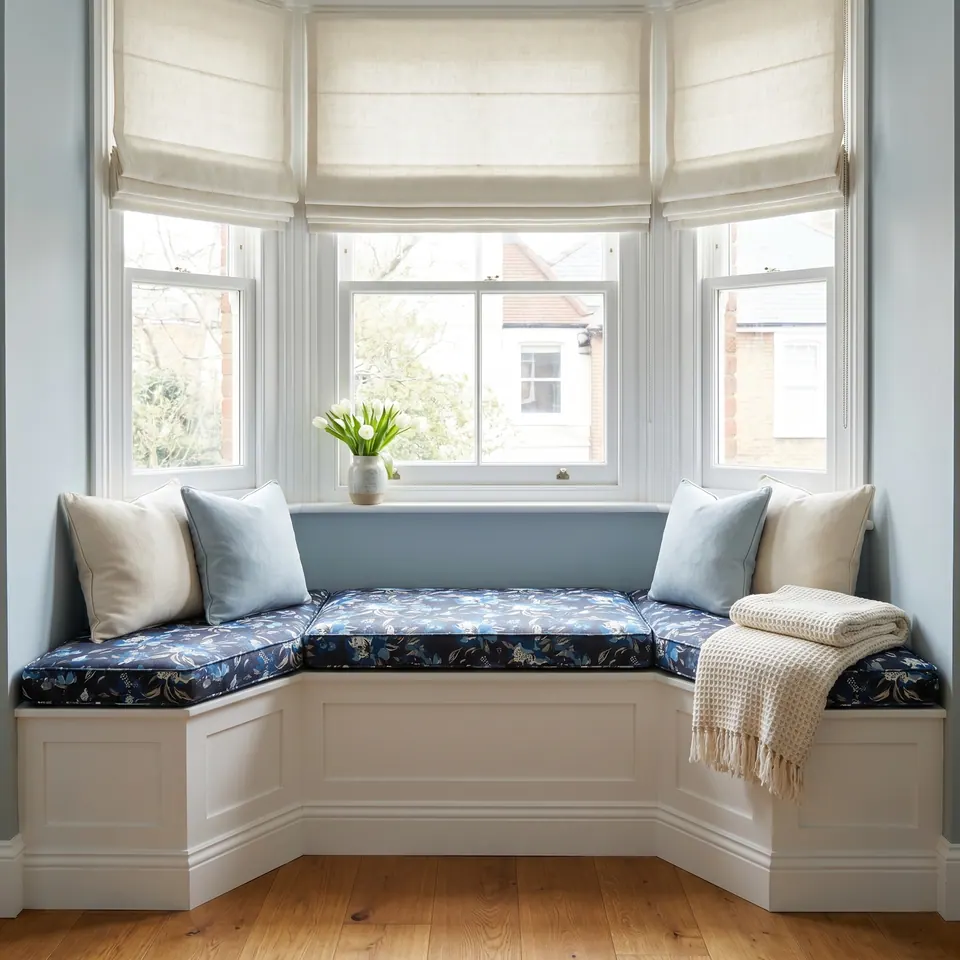
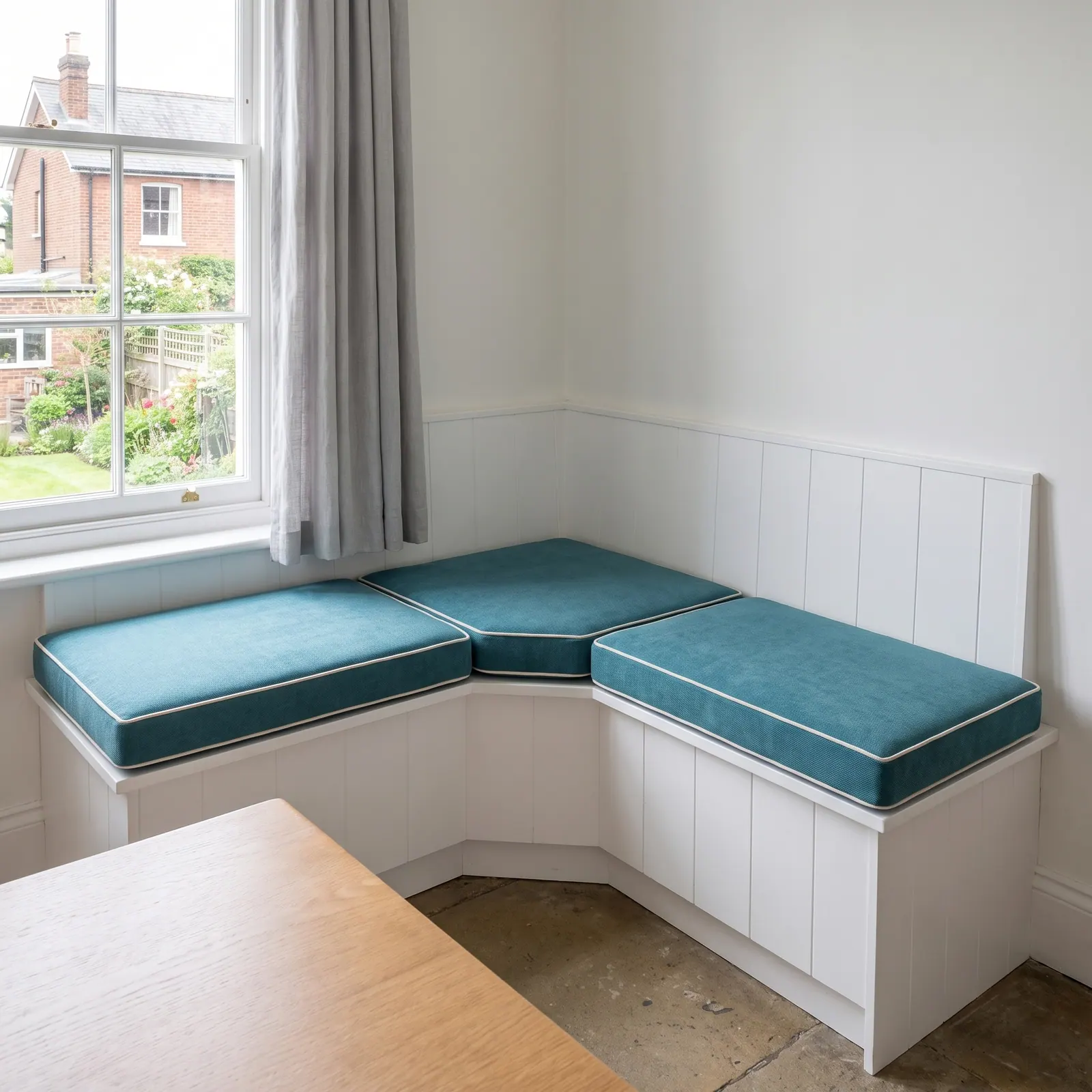
The workshop offered two builds. One continuous piece that follows every face, at a slightly higher cost for the extra work and material. Or three separate cushions that meet at the corners, cheaper and easier to fit.
The piping follows that decision. A single piece carries one unbroken welt around both corners; three pieces give you three outlines meeting at the joints, and with a contrast welt you will see them. Decide early, partner, because it changes the drawing, the cutting and the quote. Run your bay through the bay window calculator and read the joint options in our 3-sided bay Pattern.
On the cutting table: olive trapezoid
| Cushion | Trapezoid box cushion spanning a three-sided bay |
|---|---|
| Fabric | Olive linen-look with ivory, codes 924 / 910 |
| Piping | Contrast, ivory |
| Edge | Box edge |
| Setting | Slim ledge over a cast iron column radiator |
| Measure | Every edge, clipped corners included, plus straight-line depth |
| Build options | One continuous piece or separate segments |
| Best for | Sitting-room bays and morning reading ledges |

Have it made
Have this made — ask Nate’s workshop
Precision starts on the phone. Give the workshop your measurements and they will read them back to you, edge by edge. — Nate
Leave your details and the workshop will call you to confirm measurements, fabric, foam and piping. No prices, dates or payment on this page: it is a request, not an order.
Buyer questions
- A common question
I need three tufted cushions for a kitchen breakfast nook in odd sizes: 65 1/8 x 17 in, 56 1/4 x 17 in and 91 x 17 in. Can you work in fractions?
The workshop's answerYes, fractional-inch sizes are fine. All three were made as button-tufted linen cushions in Dried Rose on one custom order. Write each size exactly as you measured it, fractions and all, in the order note; the quote then carries the production and delivery times.
- A common question
What do you need from me for a trapezoid or clipped-corner bay window cushion?
The workshop's answerEvery edge: front, back, both sides and any small clipped corners, plus the depth, measured straight from the highest point down to the base line. The workshop cross-checks the depth from the sides; one buyer's 86 in top, 126 in bottom and 26 1/2 in sides gave about 17.4 in (44 cm). Mark cut-outs, like a window handle, on the drawing.
- A common question
Can I buy extra back pillows or armrests on their own?
The workshop's answerYes. Straight back pillows, extra L-shaped corner backrests and pairs of armrests are all sold separately. An L-shaped backrest can also be swapped for a straight one at the same price.
Contrast piping earns its place on a bay window cushion when fabric and wall share a tone: ivory on olive keeps every angled corner readable.
Nate
Questions buyers ask next
When does contrast piping beat self piping on a window seat?
When the fabric and the wall behind it are close in tone. Olive against sage paneling blurs in soft daylight, so an ivory welt keeps the front edge and angled corners visible. On a fabric that already stands apart from the wall, self piping is enough.
Can a window seat cushion sit over a radiator?
Yes, and the seat stays pleasantly warm in winter. Keep the ledge shallow and let the cushion stop at its front edge rather than overhang it, so warm air can still rise past the ledge into the room.
Is a wraparound bay cushion better in one piece or three?
One continuous piece has no joints at the corners and costs a little more for the extra work and fabric. Separate segments cost less and are easier to fit. Choose before you draw the template, because the piping and cutting change with it.
± 1/4 in — Nate
More photographs to read
 Save
 Save
 Save
 Save
 Save
 Save