A Reading by NateBay Window Cushions
A terracotta trapezoid bay window cushion with brown piping: the makeover, before and after
One cushion, one strong color, and a white bay that finally gets sat in. Plus a designer’s bay that proved itself on paper before a single cut.

 Save
The quick answer
One terracotta trapezoid bay window cushion can make a white bay the warmest spot in a room, as long as everything around it stays pale and dark brown piping ties it to the brass and oak. For a tailored built-in look, I'd use 4 in (10 cm) of 2 lb/ft³ (32 kg/m³) foam.
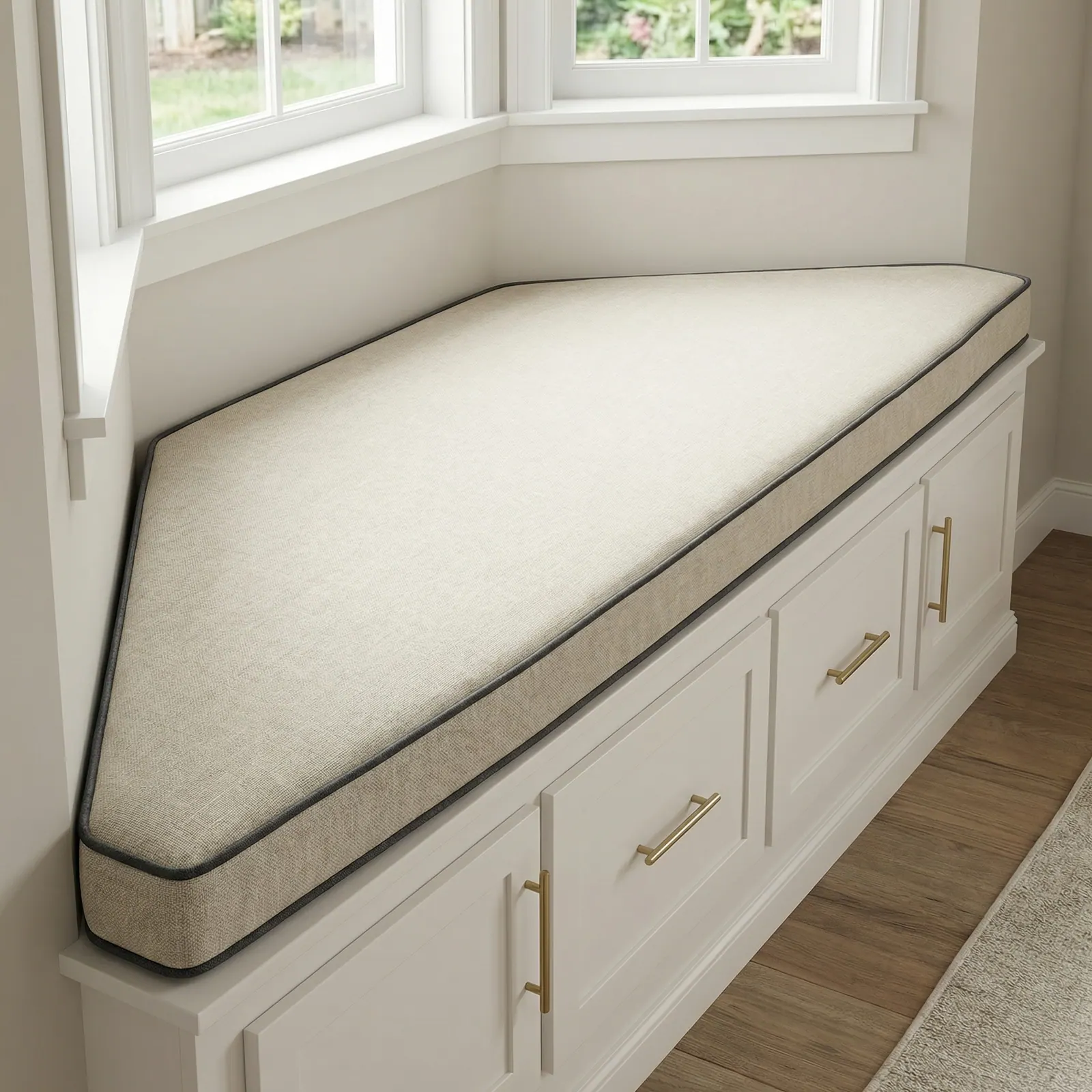
A 4 in trapezoid bay cushion, cut open
Linen-look cover. A heathered terracotta weave, flecked rather than flat. The cover zips off and washes at 86°F (30°C).
Dark brown piping. A contrast welt on the top and bottom seams: it draws the angled ends and repeats the brass and oak.
Fiber wrap. Polyester fiber (Dacron) batting around the foam: it fills the cover out and softens the edges.
Foam core. 4 in (10 cm) of about 2 lb/ft³ (32 kg/m³) foam, the thickness I'd use for a tailored built-in look.
Zipper. Along the back band, as hidden as possible. The zipper side faces down or toward the wall.
Base panel. The underside of the cover. A non-slip fabric backing can cover the whole of it instead.
One cushion, one warm corner
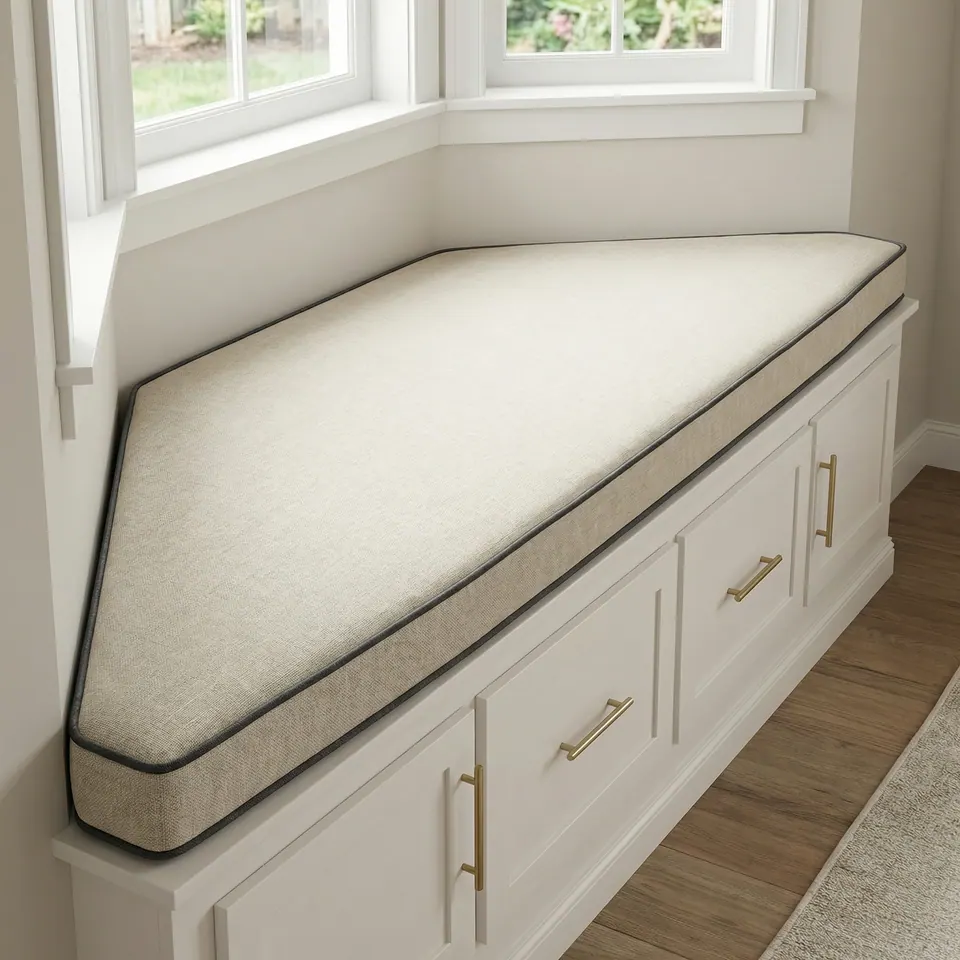
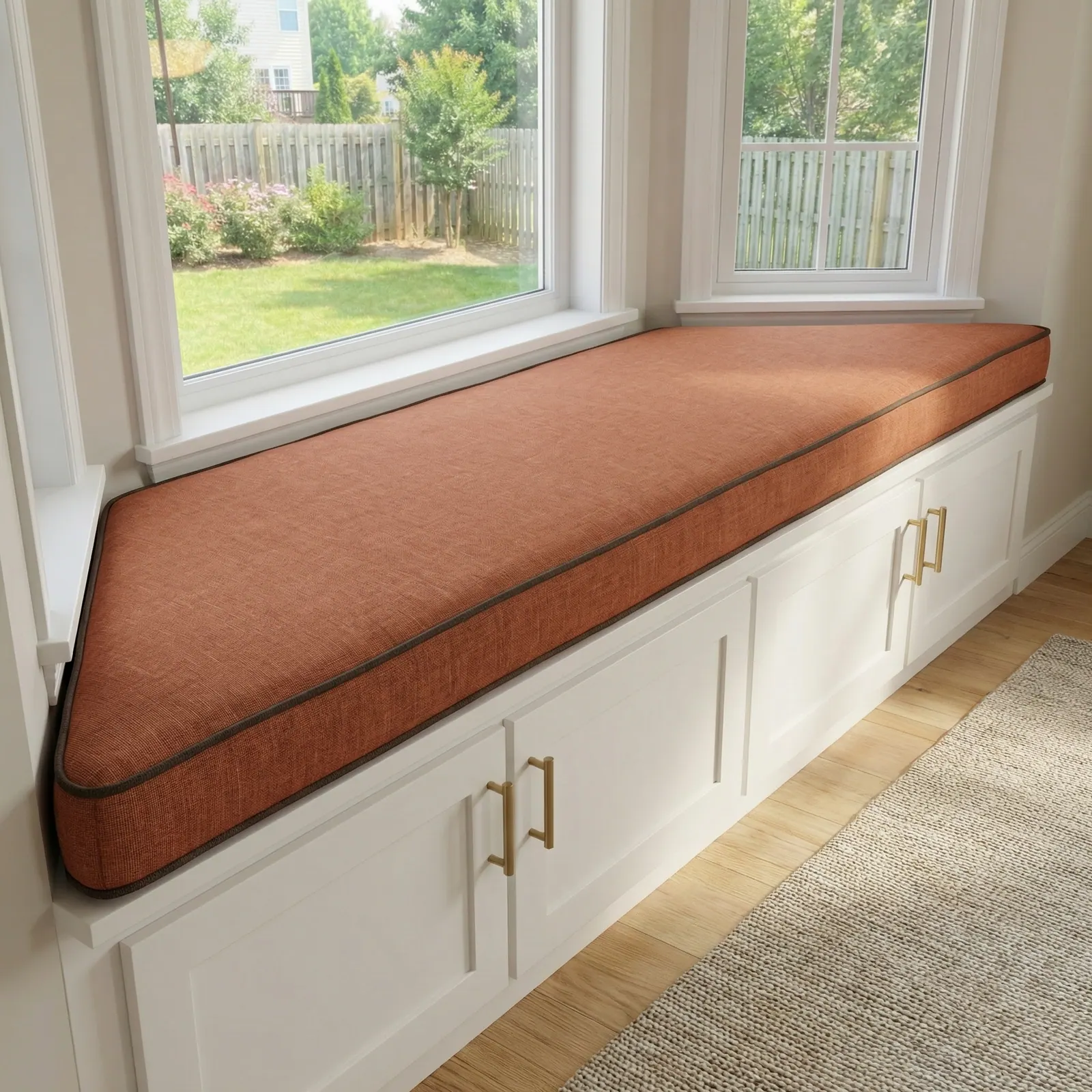
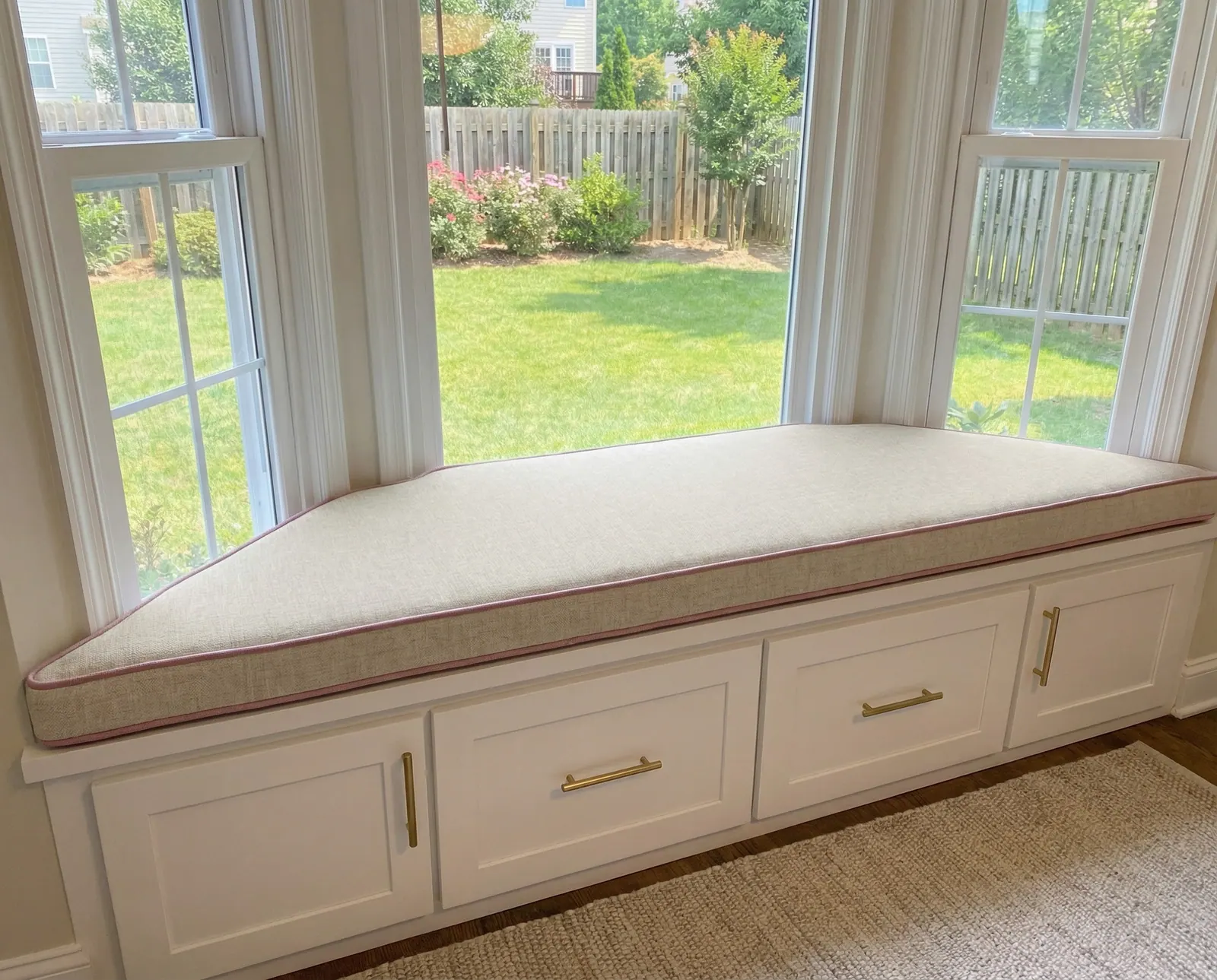
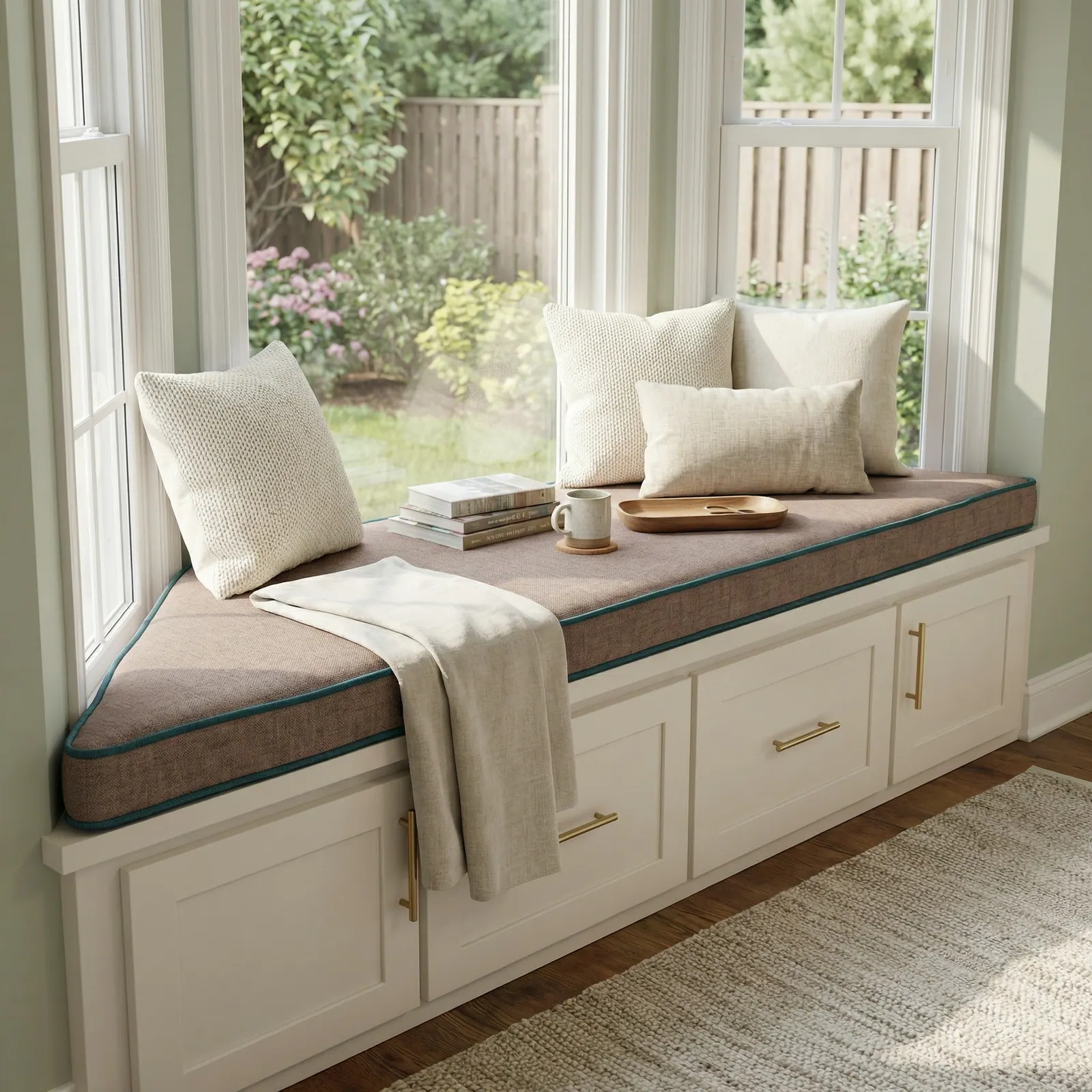
Picture this bay without its cushion. White shaker doors, brass bar pulls, white trim, two windows onto a wooden fence and flowering shrubs. Pleasant. Also a little cold, and nobody would sit there.
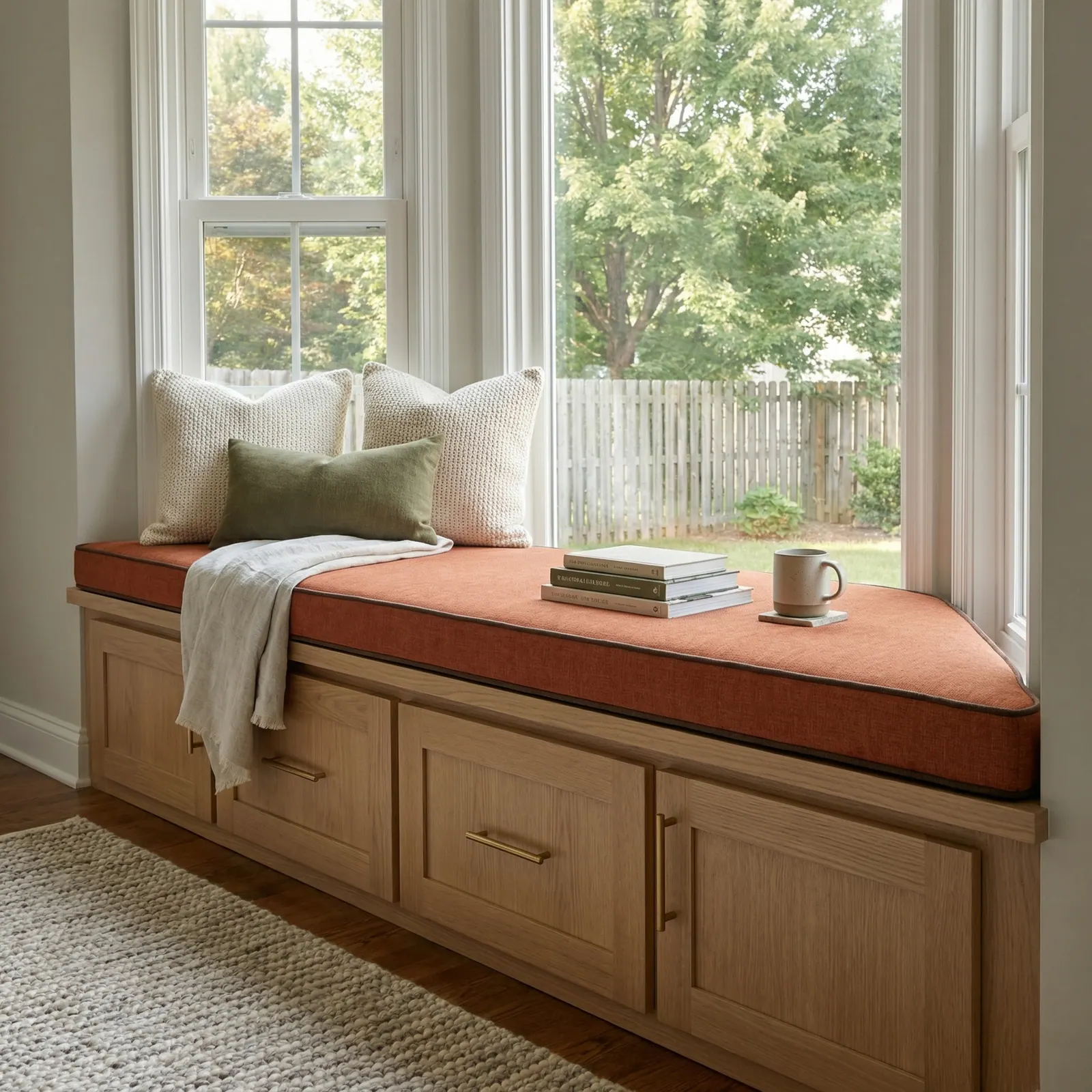
Now add one terracotta bay window cushion and the room turns toward it. That is the whole makeover: one piece, one strong color, everything else left alone. Terracotta is a lot of color over a large surface, so the cabinets, trim and window frames stay white on purpose.
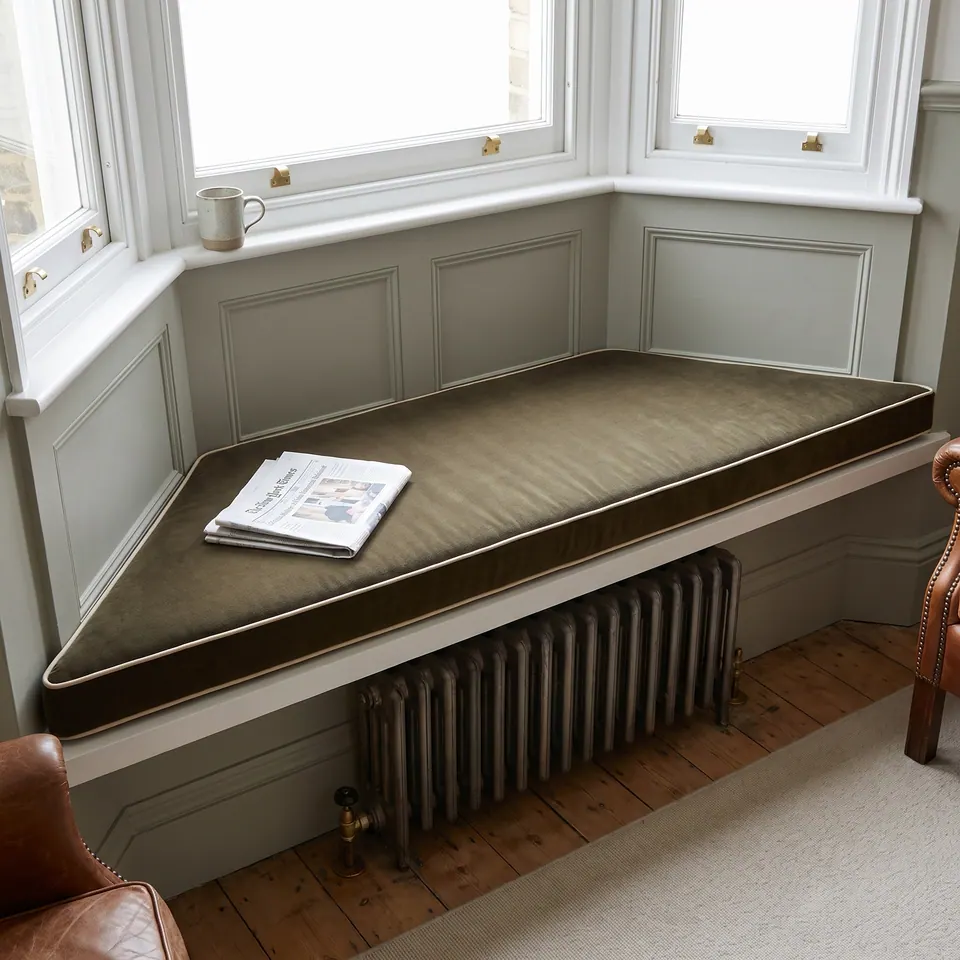
Read the edge. Dark brown piping outlines the rust top and gives it a firm line. It also links to the brass pulls and the oak floor, so the new color looks planned with the old hardware. The top is a heathered linen-look weave, flecked rather than flat, which hides small marks.
Look at the far left end. The angled corner is sharp, cut to the bay, not squared off and hoping. The gray jute rug is the one cool thing on the floor, and it stops the terracotta from overheating the scheme.
To test your own before-and-after, the bay window calculator draws the shape from your numbers. What color is your bay right now, partner?
Five places the makeover shows
Five spots where one cushion changes the bay, from the angled end to the rug.
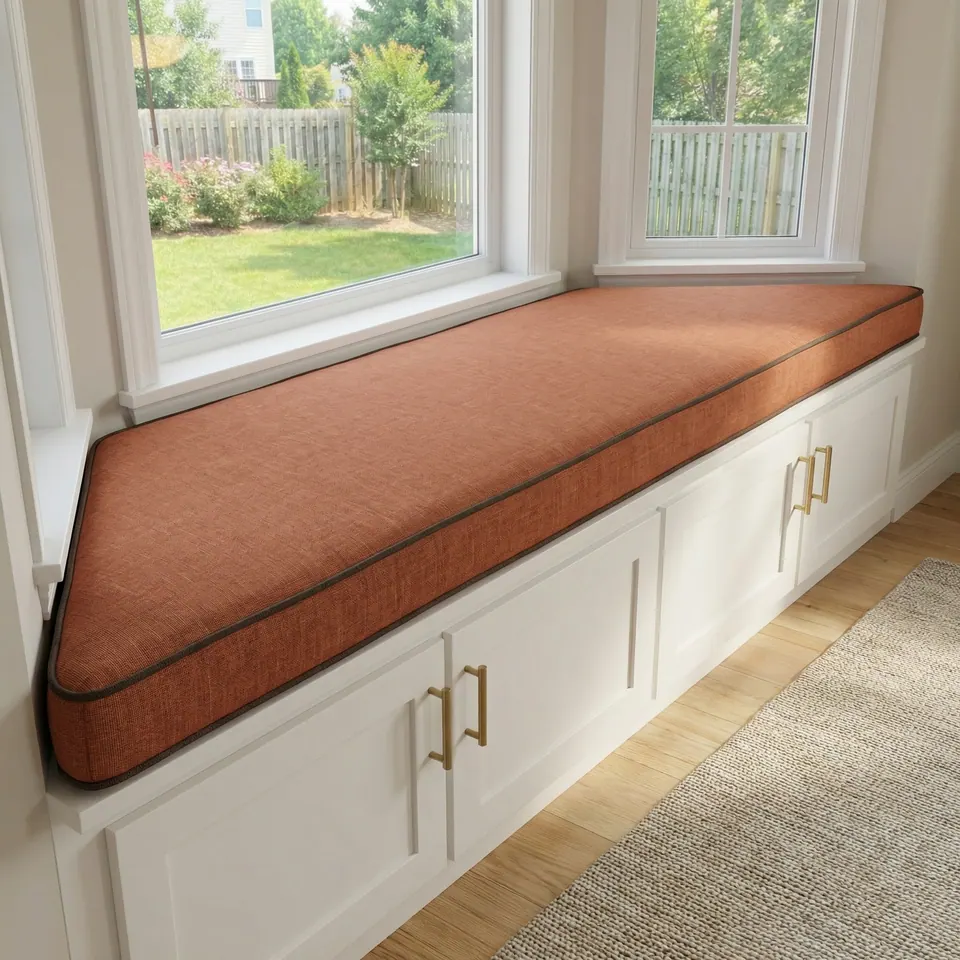
- Angled left end
The sharp angled corner shows the trapezoid is cut to the bay, not squared off.
- Dark brown piping
Brown piping on rust gives a firm edge that links to the brass and oak.
- Heathered rust top
A flecked weave hides small marks better than a flat solid color.
- Brass cabinet pulls
Warm metal hardware completes the sun-baked palette.
- Gray jute rug
A cool rug stops the terracotta from overheating the scheme.
- Angled left endThe sharp angled corner shows the trapezoid is cut to the bay, not squared off.
- Dark brown pipingBrown piping on rust gives a firm edge that links to the brass and oak.
- Heathered rust topA flecked weave hides small marks better than a flat solid color.
- Brass cabinet pullsWarm metal hardware completes the sun-baked palette.
- Gray jute rugA cool rug stops the terracotta from overheating the scheme.
Before and after, line by line
The same bench, pictured bare and then with the terracotta cushion.
| Bare bench | With the terracotta cushion | |
|---|---|---|
| Color | White cabinets, white trim, pale oak: calm but cool | The bay becomes the warmest spot in the room |
| Edge line | Shaker panels and brass bar pulls | Dark brown piping draws the seat edge and echoes brass and oak |
| Shape | An angled bench you barely notice | The crisp angled end shows the trapezoid, cut to the bay |
| Floor | Oak boards and a gray jute rug | The rug now cools the terracotta so it doesn’t overheat |
| Use | A ledge you walk past | A seat facing the garden |
The designer’s 106 in bay that closed on paper
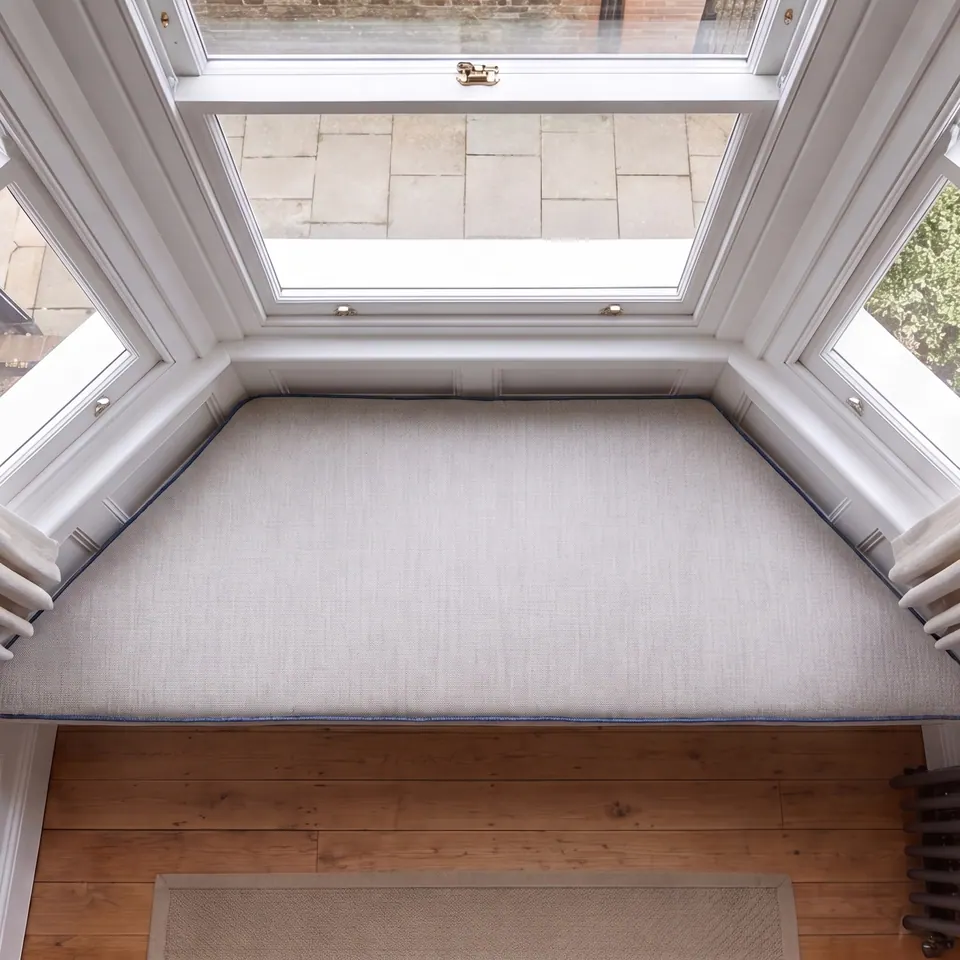
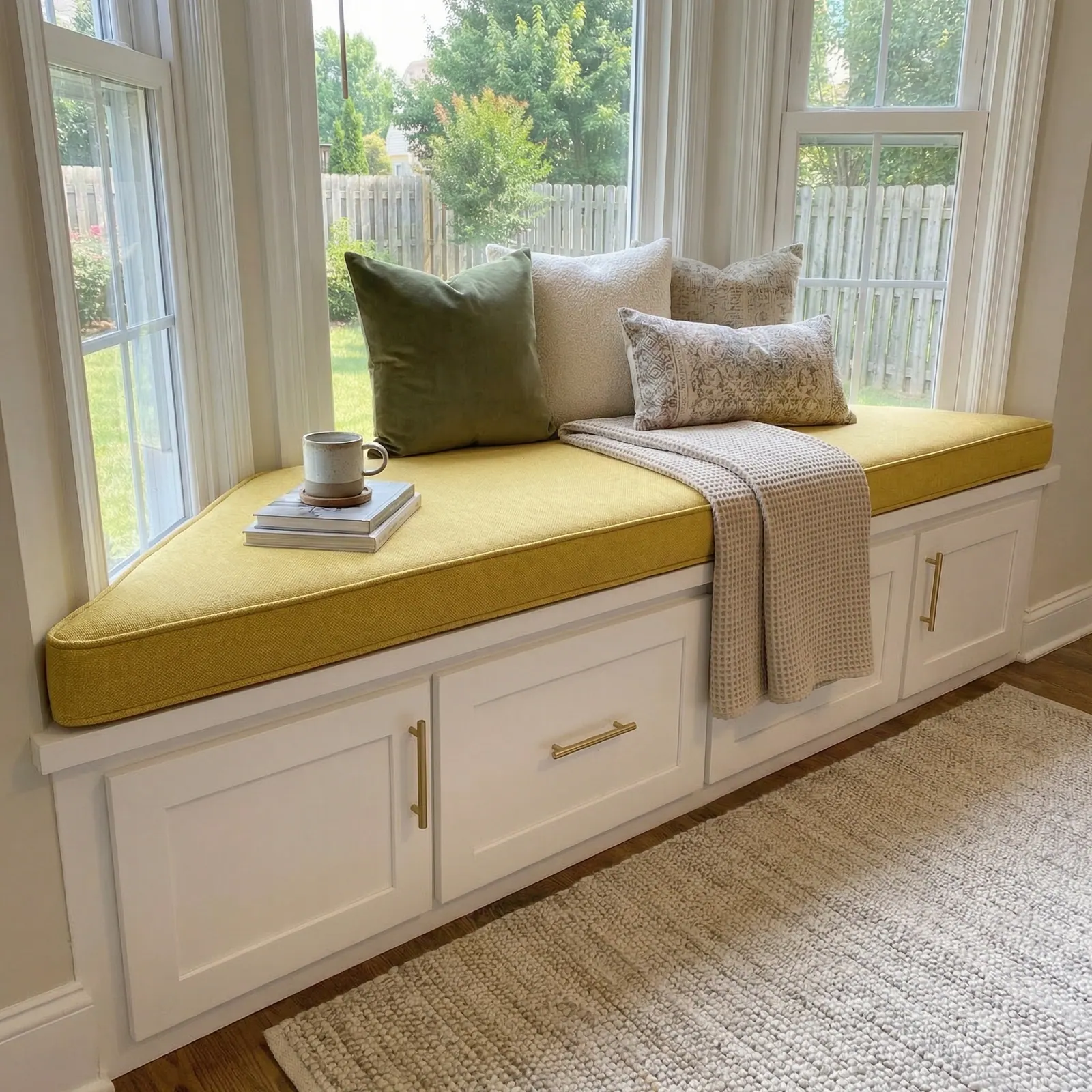
An interior designer wrote to the workshop about a client’s built-in bay seat. One professionally upholstered cushion: 106 in (269 cm) along the main side, 56 in (142 cm) along the rear, and two 35 in (89 cm) diagonal ends. They also asked about fabric certification.
First job: do the numbers close? The main side is 50 in longer than the rear, so each diagonal steps 25 in sideways. With a 35 in diagonal, the depth is the square root of 35² − 25², about 24.5 in (62 cm). A real, buildable seat. Because the shape closed, photos and measurements were enough: no paper template, no template charge.
The workshop recommended 4 in (10 cm) of about 2 lb/ft³ (32 kg/m³) foam for a tailored, built-in look, and offered warm oatmeal and natural flax linens, from a mill certified to OEKO-TEX Standard 100 (03.T.3239), with physical swatches first. The cover was removable, zippered and washable at 86°F (30°C). Production was quoted at 10 to 12 business days, plus 2 to 4 days of shipping.
- Sizes
- 106 in (269 cm) front, 56 in (142 cm) back, two 35 in (89 cm) diagonals, about 24.5 in (62 cm) deep, 4 in (10 cm) thick
- Fabric
- Warm oatmeal or natural flax linen
The lesson: Check that trapezoid measurements close geometrically before cutting; if they do, you don’t need a paper template.
Foam, curves and sketches that don’t add up
- A common question
Is foam density the same thing as firmness? Can I have high-density foam that is only medium firm?
The workshop's answerThey are different. Density is the foam’s quality and weight, which drives how long it lasts. Firmness is how it feels when you sit. High-density foam in a medium firmness is available.
- A common question
Could you make a curved cushion, say for an old church pew or a round fire-pit bench?
The workshop's answerYes. Measure the inner curve along the front edge and the outer curve along the back, with a flexible tape or a string laid along it and then measured flat. Add the seat depth at both ends and the middle, the straight end-to-end distance, and a photo. The curve is drawn for your approval, and very long curves are made as matching segments that are easier to handle and wash.
- A common question
My corners aren’t square and my sketch doesn’t quite add up. What happens then?
The workshop's answerSend a sharp, well-lit photo taken straight from above, or type the numbers. The cushion is drawn to scale and mismatches are flagged, for example slanted edges working out to 37.2 in and 35.9 in, not 35 in. With imperfect corners the cut follows the main dimensions: a 112 in long edge, 18 in depth and end sections of 32.5 in and 31 in, giving about 48.5 in on the short edge. Foam and sewing tolerance absorb the small differences.
If a trapezoid bay cushion measures 106 in at the front, 56 in at the back and 35 in on each diagonal, it must be about 24.5 in deep.
Nate
On the cutting table: the terracotta bay
| Cushion | Trapezoid bay window seat cushion, box edge |
|---|---|
| Fabric | Terracotta heathered linen-look |
| Piping | Dark brown contrast piping |
| Bench | White shaker cabinets with brass bar pulls |
| Thickness | 4 in (10 cm) recommended for a built-in look |
| Foam | About 2 lb/ft³ (32 kg/m³) |
| Care | Removable zippered cover, washes at 86°F (30°C) |
| Template | Not needed when the measurements close |
| Best for | Bay seats in white rooms with garden views |

Have it made
Have this made — ask Nate’s workshop
Every edge and both diagonals, to the nearest 1/4 in. If the numbers do not close, the workshop will say so on the call. — Nate
Leave your details and the workshop will call you to confirm measurements, fabric, foam and piping. No prices, dates or payment on this page: it is a request, not an order.
Questions buyers ask next
Do I need a paper template for a trapezoid bay cushion?
Not if your measurements close. When the front, back, both diagonals and the depth agree on paper, photos and numbers are enough. A template helps when corners are curved or the bay is irregular.
What does dark brown piping do on a terracotta cushion?
It gives the rust top a firm outline and links the cushion to nearby brass hardware and oak floors, so a new color looks planned with the room rather than added to it.
Will a heathered fabric show marks less than a solid?
Usually, yes. A flecked weave mixes lighter and darker threads, so small marks and crumbs blend in where a flat solid color would show them plainly.
How long does a custom bay window cushion take to make?
One designer’s bay cushion was quoted at 10 to 12 business days of production plus 2 to 4 days of shipping. If the color matters, ask for physical swatches before you order.
± 1/4 in — Nate
More warm colors, indoors and out
 Save
 Save
 Save
 Save
 Save
 Save