A Reading by NateBay Window Cushions
A bay window cushion seen from above, and where the budget should go
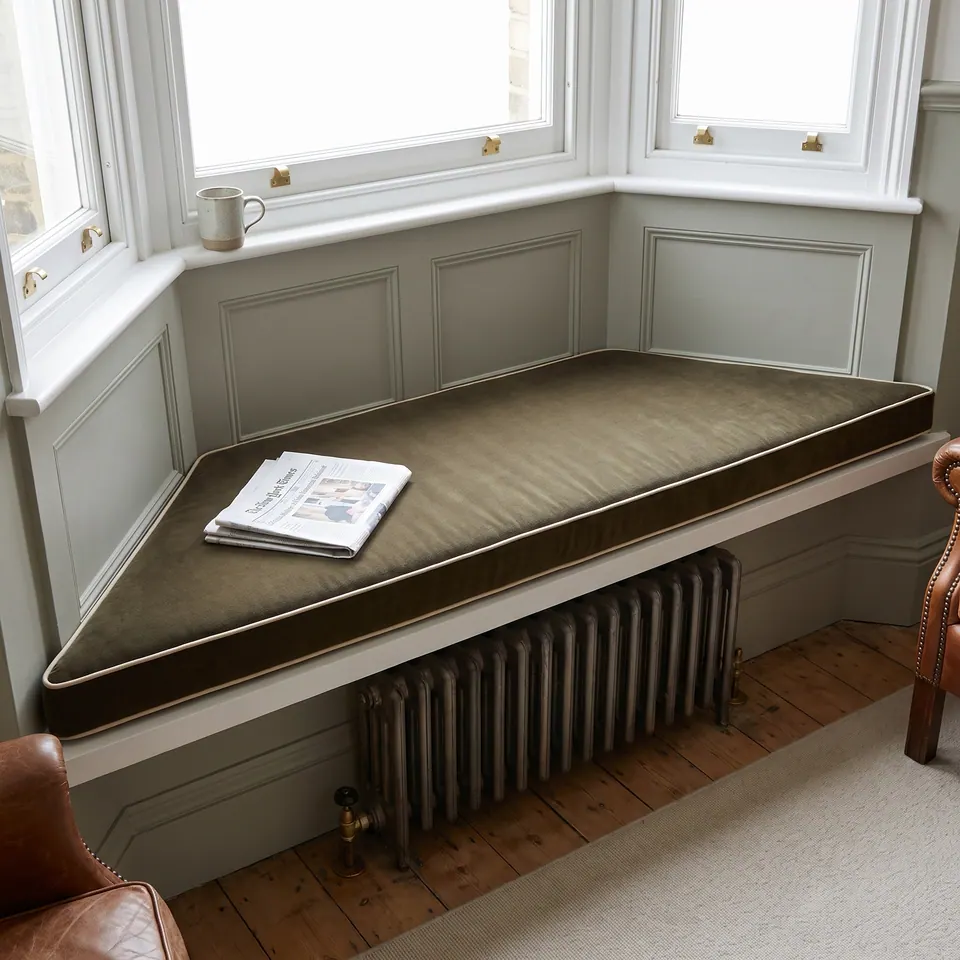
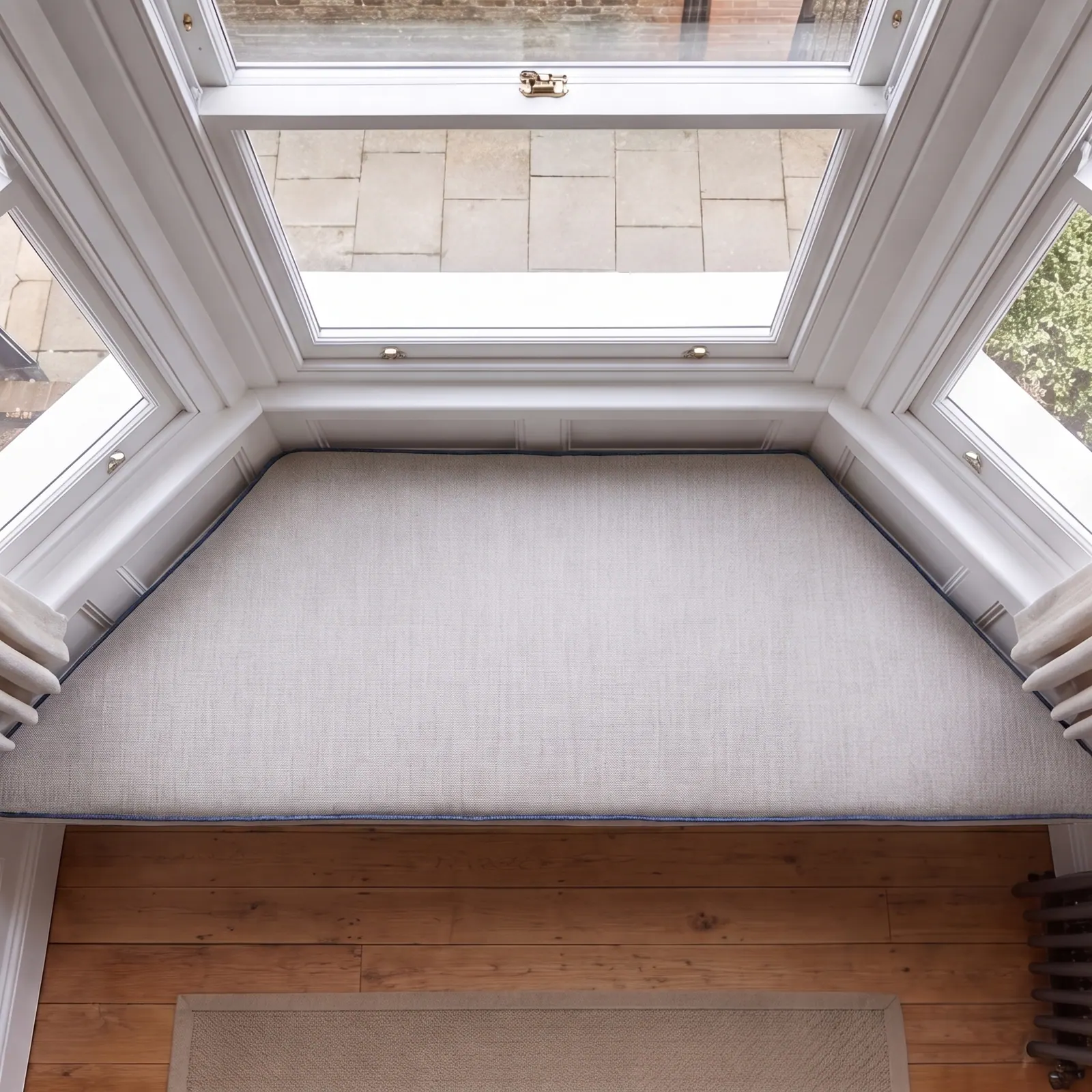
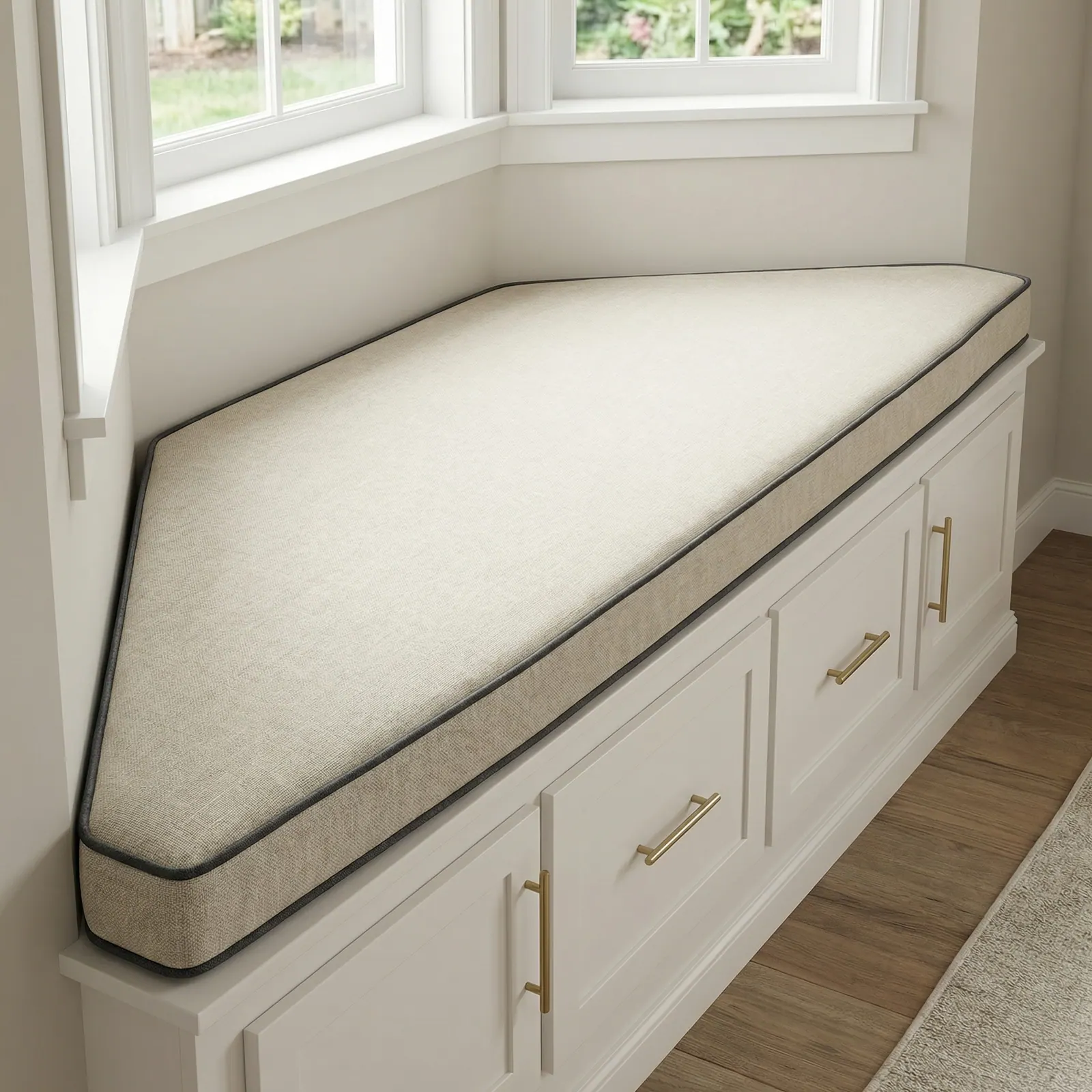
This is the photo I wish every buyer sent: straight down into a three-sided bay, every edge in view. From up here, partner, you can see where the money in a bay cushion goes, and where it only looks like it does.

 Save
The quick answer
On a bay window cushion, spend your care on the measurements and the foam, and save on decoration. Size and shape set most of a custom quote; thickness, the number of pieces, fabric type and tufting move it. Contrast piping is included at no extra charge, so a line of indigo is free, while a slant length that doesn't close is the expensive mistake.
The bay cushion, cut open, with the budget marked
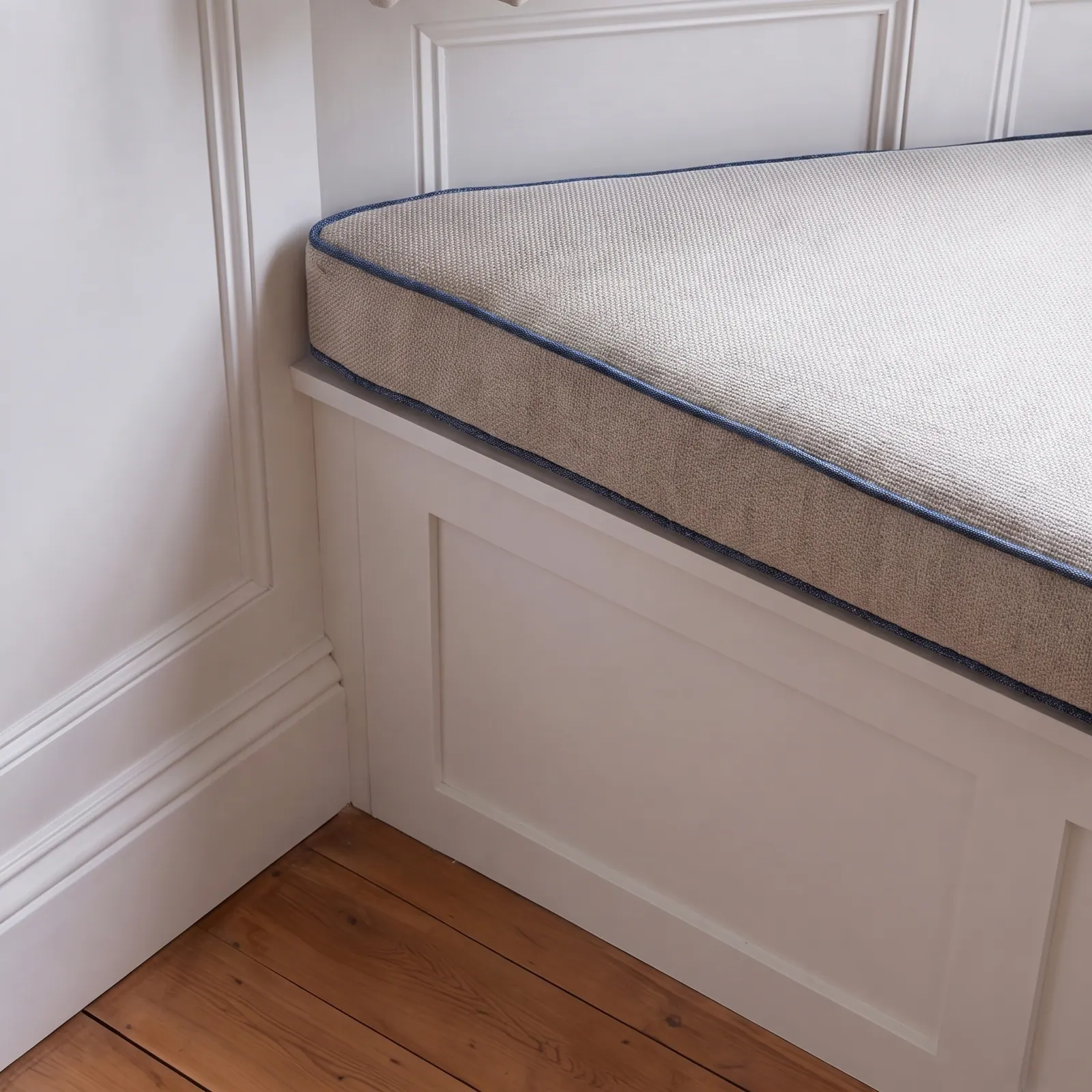
Linen-look cover. Oatmeal polyester linen-look. It wrinkles and shrinks less than pure linen, and the zippered cover comes off to wash.
Indigo piping. A contrast code at no extra charge. It sits on the seam line, so it never changes the ordered size.
Fiber wrap. Polyester fiber (Dacron) batting around the foam: it fills the cover out and softens the edges.
Foam core. About 2.0 lb/ft³ (32 kg/m³) high-resilience foam cut to the trapezoid: the layer that decides how long the seat keeps its shape.
Zipper. Along the back band, as hidden as possible. The zipper side faces down or toward the wall.
Base panel. The underside of the cover. A non-slip fabric backing can cover the whole of it instead.
Five pins on a bird's-eye bay
Five pins, read from the back window to the rug, each marked with what it costs or saves.
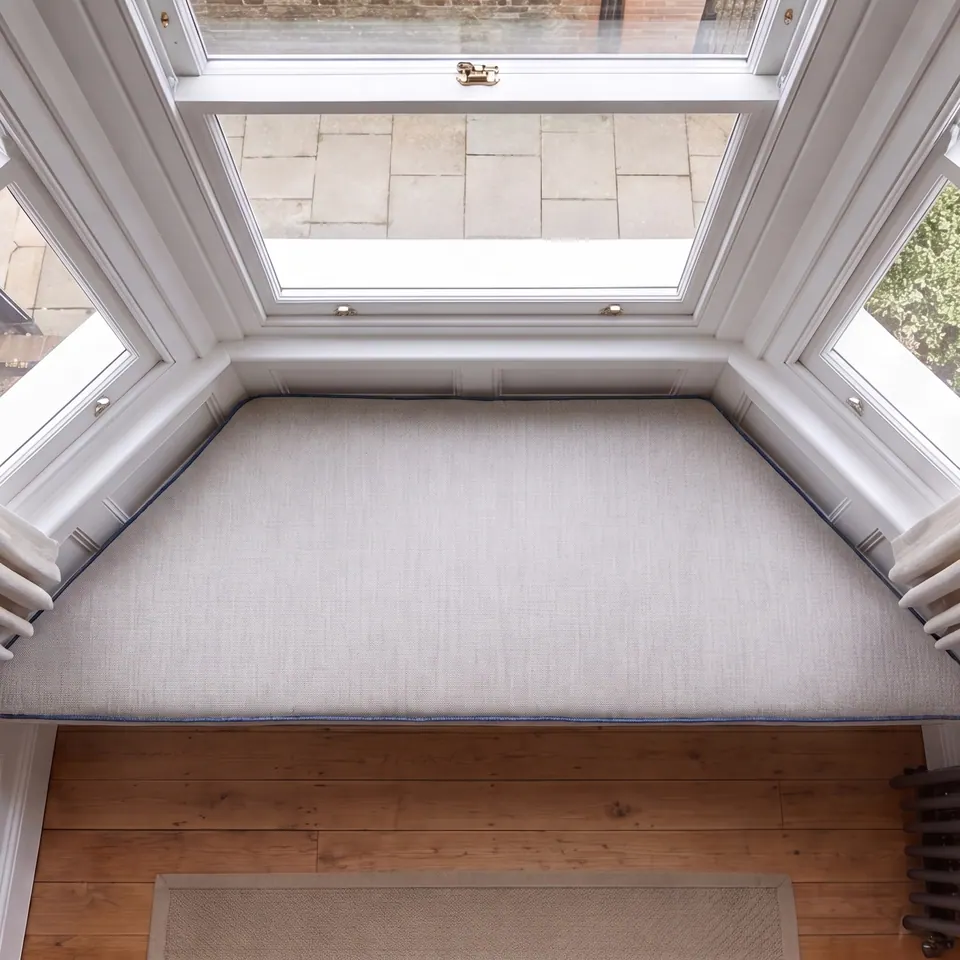
- Trapezoid template
Long front edge, shorter back and two angled ends following the bay.
- Angled end
Each end meets the side panel at the bay's own angle.
- Front edge piping
The cushion stops level with the plinth so the piping lines up with the wood.
- Radiator
Keep radiators in mind when measuring the plinth depth.
- Jute rug
Warm natural textures balance the gray-white bay.
- Trapezoid templateLong front edge, shorter back and two angled ends following the bay.
- Angled endEach end meets the side panel at the bay's own angle.
- Front edge pipingThe cushion stops level with the plinth so the piping lines up with the wood.
- RadiatorKeep radiators in mind when measuring the plinth depth.
- Jute rugWarm natural textures balance the gray-white bay.
Reading the bay from the ceiling
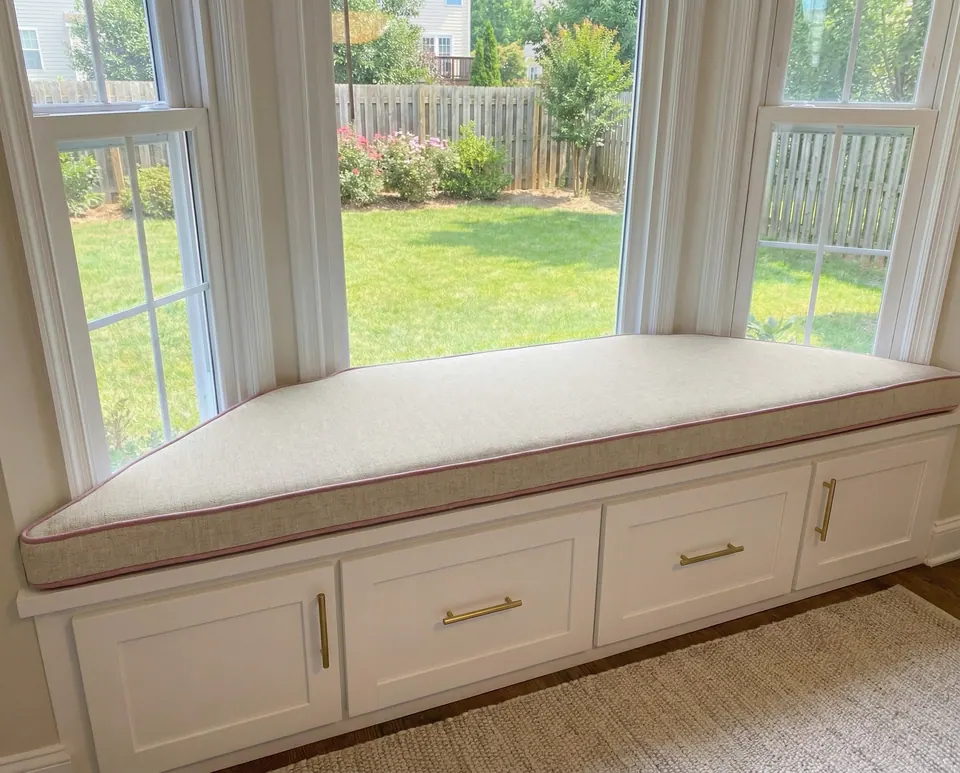
From overhead the template is plain geometry: a long front edge, a shorter back along the center window, and two angled ends meeting the side panels at the bay's own angle. Most bays turn at about 135 degrees. This one looks close, but a look is not a measurement.
The cushion stops level with the front of the white plinth, so the indigo piping lands on the same line as the painted wood below. A free design decision, doing a trim molding's work. Oatmeal linen-look reads warm against gray-white paint; pine boards and a jute rug carry that warmth down.
The cast iron radiator in the corner is the one thing to watch. Measure the plinth top itself, note the radiator on your drawing, and let the bay window calculator check that your numbers close. Do yours?
Spend here, save there
| Line item | Spend or save | Why |
|---|---|---|
| The drawing | Spend time | Front, back, depth and both slants, labeled |
| Foam density | Spend | About 2.0 lb/ft³ (32 kg/m³) keeps its shape for years |
| Contrast piping | Free | Included in any code at no extra charge |
| Tufting | Save | It raises the quote, and the cover can no longer come off |
| Pieces | Decide early | One piece or three changes the quote |
Seven letters for a 104-inch bay
A buyer in the US had a bay seat 104 in (264 cm) across its widest side, too big for the order form, so they sent a drawing with every edge lettered: A and B at 4 in, C at 104 in, D at 57 in, E and F at 31 in, G at 24 1/2 in (62 cm), and asked how the piping color gets chosen. After one failed attachment and a resend, the workshop quoted it in the linen range, code L-24, with a custom order link.
Angles are just lengths in disguise, and those letters prove it. If C is the front and D the back, each end steps in 23 1/2 in and back 20 1/2 in behind a 4 in straight return: a slant of 31.2 in against the 31 they measured. Numbers that close within 1/4 in are numbers I can cut from.
- Sizes
- A 4, B 4, C 104, D 57, E 31, F 31, G 24 1/2 in
- Fabric
- Linen range, code L-24
The lesson: Label every edge of a bay drawing with a letter and a length so the quote is exact.
Three shape questions
- A common question
Can you make a cushion for a bench that's rounded at one end, or for a half-round window seat?
The workshop's answerYes, from exact dimensions and a drawing. A 33 x 20 in (84 x 51 cm) bench cushion rounded at one end was quoted from the owner's shop drawings, and an arched seat about 67 x 47 in (170 x 120 cm) was drawn as a rectangle plus an arc.
- A common question
My window is uneven and a piece of trim sticks out. Which width do I give you?
The workshop's answerSend a rough sketch with every measurement and mark the trim or any wood that sticks out, since that throws numbers off. The workshop holds production until the shape is confirmed, and sometimes a small gap is the simplest fix.
- A common question
Can I send you my own fabric, and how much would you need?
The workshop's answerThe workshop discourages it, because sending fabric in adds delays. Send a clear photo or the fabric's details instead, and it will look for an exact or very close match.
On a bay window cushion, the free upgrade is contrast piping and the costly mistake is a slant that doesn't close. Check the drawing before the fabric.
Nate
On the cutting table: the bay seat
| Cushion | Trapezoid bay window cushion, one piece, box edge, angled ends |
|---|---|
| Fabric | Oatmeal linen-look (polyester) |
| Piping | Indigo contrast, top and bottom seams |
| Foam | About 2.0 lb/ft³ (32 kg/m³) high-resilience |
| Thickness | Drawn at the standard 4 in (10 cm) |
| Fit | Front edge level with the plinth face |
| Care | Zippered cover; machine wash, line dry |

Have it made
Have this made — ask Nate’s workshop
Precision starts on the phone. Give the workshop your measurements and they will read them back to you, edge by edge. — Nate
Leave your details and the workshop will call you to confirm measurements, fabric, foam and piping. No prices, dates or payment on this page: it is a request, not an order.
Questions buyers ask next
Is a bay window cushion better in one piece or three?
One piece keeps a single clean front edge. Three pieces, one per panel, are easier to handle and suit seats whose lids lift. The number of pieces changes the quote, so decide first.
Which bay measurement goes wrong most often?
The angled sides. A slant is always longer than the straight depth, and if front, back, depth and slants don't close as a shape, one of them is off. Take the depth at 90 degrees from the center.
Does thickness change the price of a bay cushion?
It can. Size and shape set most of a custom quote, and thickness, the number of pieces, fabric type and tufting all move it. Ask for two thicknesses in one quote if unsure.
± 1/4 in — Nate
More photographs to read
 Save
 Save
 Save
 Save
 Save
 Save