The Studio · Calculator
Bay window cushion calculator
Right, then. A bay seat is only awkward until every edge has a number on it. Give me the walls and the angles — or just how far the bay pokes out — and I'll draw the lot to scale.

The quick answer
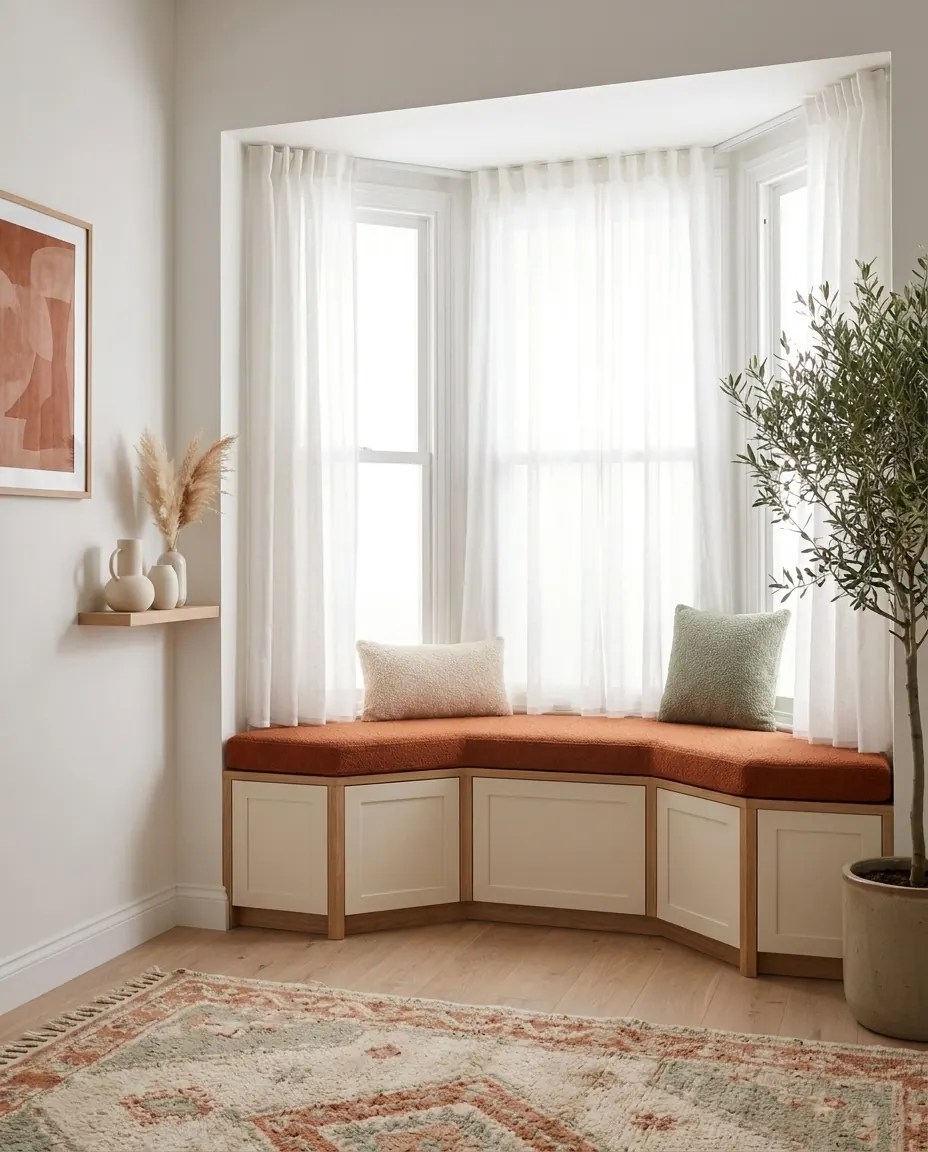
Measure each wall section along the back of the seat, plus either the corner angles, the bay's projection or the straight opening width. A three-sided bay with a straight front makes one trapezoid cushion; a seat that follows the bay makes one mitered trapezoid per wall. The calculator draws the plan to scale and lists every piece in inches and centimeters.
The bay window calculator
Every field is live. Change a number and the drawing redraws; copy the link and it opens with your numbers.
Load an example — the ones marked are past projects
Drawing…
Buyer questions
- A common question
Our bay window seat has weird angles. How do I give you the measurements?
The workshop's answerDraw the seat as seen from above. Write on it the back edge against the window, the front edge, the depth from back to front and every angled side, in order. Send a photo of the drawing and one of the window; the workshop checks the geometry and confirms before anything is cut.
- A common question
Which measurement is the depth and which is the length for a bay window cushion?
The workshop's answerDepth is the straight distance from the short angled sections to the long edge. Length is the total measured between the outer corners of the angled sections. Those two choose the size; the drawing carries everything else.
- A common question
Do you need a paper template? It's 106 inches at the front, 56 at the back and two 35-inch diagonals.
The workshop's answerNo template is needed — photos and measurements are enough, and there is no surcharge for the shape. The numbers were checked first: 106 / 56 with two 35 in diagonals gives a seat depth of about 24.5 in.
- A common question
Our bench wraps around the bay instead of going straight across, with 45° corners. One cushion or three?
The workshop's answerEither works. One continuous piece takes more custom work and material, so it costs slightly more; or it can be split into three separate cushions.
- A common question
I have a round bay window. Can you make a cushion for it?
The workshop's answerNot from photos. The curve was too pronounced to reproduce accurately from a distance, so the workshop declined rather than risk a poor fit — and offered to help with straight-edged shapes instead.
The seat that measured 27 inches deep — on paper
A buyer sent a hand sketch of a big bay seat: 95 in along the front, 61 in at the back, 22 in on each angled side and 10½ in on the two short end edges. What the sketch didn't have was the depth. The workshop redrew it as a clean diagram and worked the depth out from the other edges: about 24½ in. The buyer's tape said 27 in.
Load 95 / 61 / 22 in in the calculator above and you'll get the same 24½ in. When the edges and the depth disagree by 2½ in, dear, one of them is wrong. Here the real depth won, the drawing was revised, and production started only once the buyer had approved it.
The lesson: every angled cushion needs its front-to-back depth as well as the edges. Write both, and let the drawing argue with you before the scissors do.
How to use it
Draw it from above
Sketch the seat as a bird would see it: the window walls at the top, the room at the bottom. It needn't be pretty; it must be complete.
Measure each wall section
Rigid tape, on the seat board itself, along the back edge where the cushion will touch. Left to right. Write each number on its edge.
Get the angles — or go around them
An angle finder gives the corner inside the seat (a 45° bay reads 135°). No finder? Measure how far the bay projects from the opening, or the straight opening width, and the calculator works the angles out.
Choose the layout
Straight front if the bench runs across the bay; follows the bay if the seat keeps the same depth all the way around. Tick split at the corners if you want separate cushions.
Check against the tape
Compare the depth the calculator gives with the depth you measure. More than half an inch apart? Re-measure the one you trust least.
Label and send
Letter every edge (A, B, C…) exactly as the table does, then send the drawing with a photo of the seat. Copy the link to keep your numbers.
 Save
Questions people ask
What angle is a bay window?
Many three-sided bays are built at 45°, which reads 135° inside the seat, and some at 30° or 60°. Houses are rarely exact, so measure it: an angle finder on the seat board, or the projection and wall lengths, from which the calculator solves the angle.
Should a bay window cushion be one piece or several?
A straight-fronted three-sided bay is usually one trapezoid. A seat that wraps around the bay can be one continuous piece (more work and fabric) or one cushion per wall section, which are easier to fit, turn and wash. Very long runs are often split into sections for handling.
How do I find the bay angle without an angle finder?
Measure the side walls along the seat and either how far the bay projects from the opening line or the straight width across the opening. Choose that option in the calculator and it works out the corner angle.
What if my bay window measurements don't add up?
Corners are rarely perfectly square. Treat the edges that touch walls as the master measurements and let the diagonals follow; a good workshop cuts from the main dimensions and absorbs small differences in the foam and sewing tolerance — after telling you.
Can a curved bay window seat be calculated?
Not reliably from a few numbers. Faceted bays can; a smooth curve needs a full-size paper template traced on the seat itself.
Stitch straight — Maggie