The Studio · Calculator
Cushion fabric yardage calculator
Before the color, the quantity. List your cushions, tell me the width of the roll and how the stripe should fall, and I will lay every panel on the fabric for you — piping strips included.

The quick answer
A boxed cushion needs two panels (length and depth plus seam allowance), a boxing strip as long as the perimeter and as wide as the thickness plus seam allowance, and — with piping — strips about twice the perimeter long. Stripes, pattern repeats and narrow rolls add more. The calculator lays every piece on your roll and gives the yards and meters to buy.
The fabric yardage calculator
Every field is live. Change a number and the drawing redraws; copy the link and it opens with your numbers.
Load an example — the ones marked are past projects
Drawing…
Buyer questions
- A common question
Can we supply our own fabric for the bench cushion — and how much would you need?
The workshop's answerMaking it is easy once the fabric is in the workshop, but sending fabric in can cost more than you expect. For a 21 × 109 × 4 in tufted bench cushion, about 4⅜ yards (4 m) of fabric would be enough.
- A common question
I want to upholster three chairs to match the banquette you made. Do you sell the fabric?
The workshop's answerYes, the same fabric can be supplied. The workshop's first question back: how many yards do you need?
- A common question
Do the striped fabrics run vertically?
The workshop's answerYes — the stripes run vertically, and you can ask for the piping to be cut with vertical stripes as well.
- A common question
Where is the piping color chart? Can I pick a different piping color?
The workshop's answerThere is no separate chart: any fabric in the range can be piping — the same fabric for a seamless edge, or a different one so the edges stand out. Write both codes when you order.
- A common question
Can you make very long cushions and bolsters in one piece?
The workshop's answerVery long pieces can pass the maximum single-piece length: a 141¾ in bolster was made as two 70¾ in pieces, and the buyer chose where the joins fell.
About 4⅜ yards (4 m) for one long bench
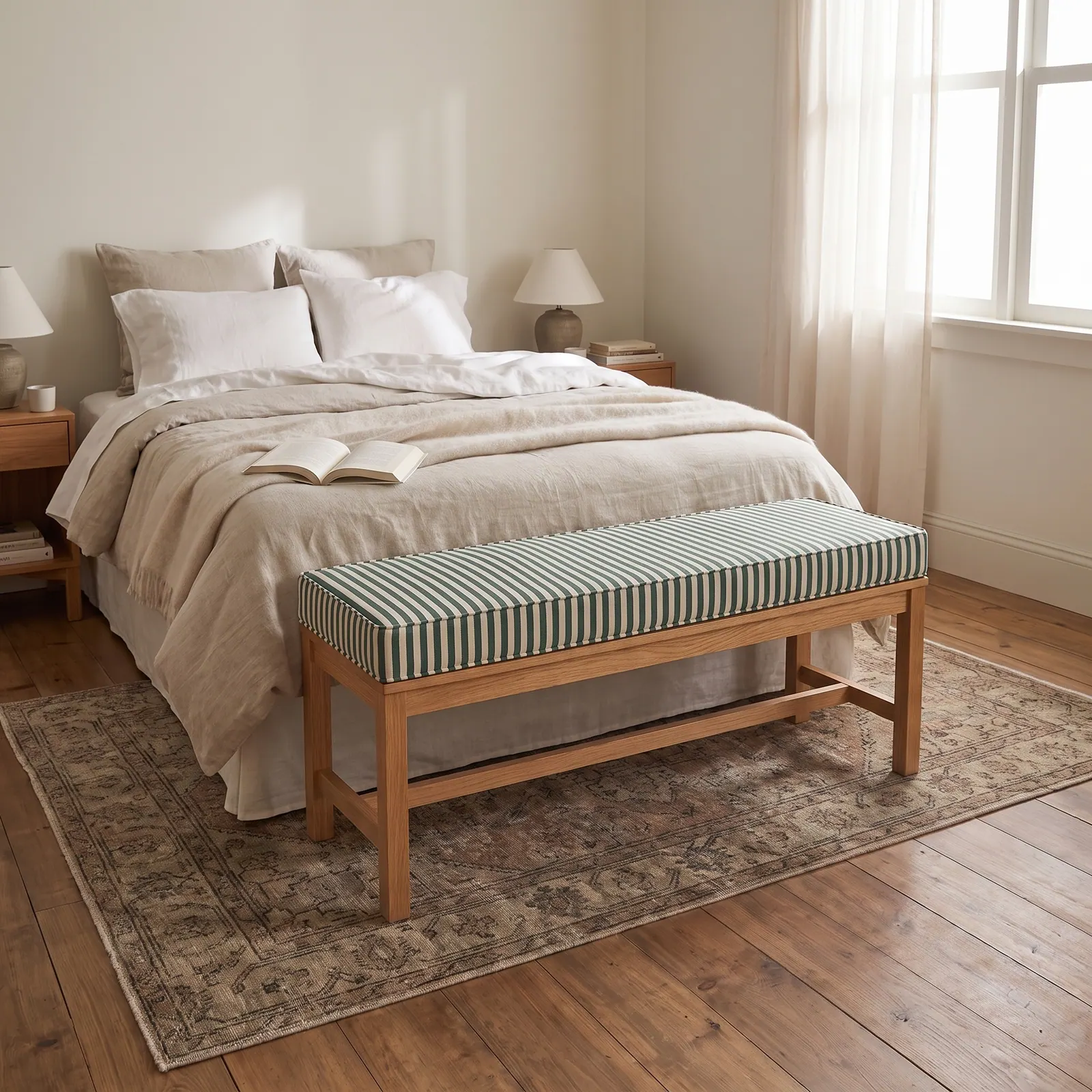
A buyer planned a long tufted bench cushion — 21 by 109 inches, 4 inches deep — and asked how much fabric it would take. The workshop's answer was plain: about 4⅜ yards (4 m) would be enough.
Load that cushion above and watch the roll. The top and bottom panels lie side by side, turned so the length runs down the fabric; the boxing strip slips into the ribbon of cloth beside them, and the piping is cut in strips across the width. It comes to about 4 yards (3.6 m) of cutting, and 4⅜ yards leaves a sensible spare.The round number was honest, my friends: it leaves room for squaring the cut end and for the one strip that always goes crooked.
The lesson: a cushion's quantity lives in its longest panel. Turn a plain fabric so the length runs down the roll, and a bench takes one length of cloth instead of two.
How to use it
List every cushion
One row per size: quantity, length, depth and thickness. For a trapezoid, add the back width; panels are cut from the longest edge.
Choose the style
Boxed cushions have a side strip (the boxing); knife-edge cushions are two panels sewn edge to edge, like a pillow.
Tell it about the roll
Most upholstery fabric is 54–59 in wide (137–150 cm). The usable width is a little less, between the selvages.
Say how the pattern falls
Plain fabric can be turned any way. Stripes that must run front to back fix the direction; railroaded turns the pattern along the cushion's length.
Add piping
Self piping is cut from the main fabric; contrast piping gets its own small quantity. Strips around 1½ in (4 cm) suit standard cord.
Buy the spare
Round up, buy everything from one roll or dye lot, and wash-test a swatch before cutting.
 Save
Questions people ask
How much fabric do I need for a bench cushion?
For a boxed bench cushion: two panels of (length + 1¼ in) × (depth + 1¼ in), a boxing strip the perimeter long and the thickness + 1¼ in wide, and piping strips about twice the perimeter. A 47 × 18 × 3 in cushion in plain 55 in fabric with self piping and a zipper panel cuts from about 1⅝ yd — buy 1¾ yd.
What does railroaded fabric mean?
The pattern runs along the length of the roll, so you can cut a long bench panel down the roll instead of across it — no seam in the middle of the seat, and stripes that run along the bench.
How much extra fabric does a pattern repeat need?
Each panel is rounded up to whole repeats so the motif can be centered, plus one repeat to place the first motif. On small cushions a large repeat can add a surprising amount — the calculator shows exactly how much.
How much fabric do I need for piping?
About twice the perimeter for a boxed cushion (top and bottom edges), once for a knife-edge cushion, cut in strips about 1½ in (4 cm) wide. Cut on the bias if the piping must follow curves.
What seam allowance should I use for cushion covers?
⅝ in (1.5 cm) is the usual upholstery allowance; ⅜ in (1 cm) works for fine, stable fabrics.
With color and care — Élodie