Ten years of car seats taught him that comfort is a list of numbers. An upholstery shop in Hamtramck taught him which numbers buyers forget to send.
At the bench since 1994 (32 years)
Detroit, Michigan
183 readings on the site
146 answers on the site
23 patterns on the site
Reads and makes
templates & odd shapes
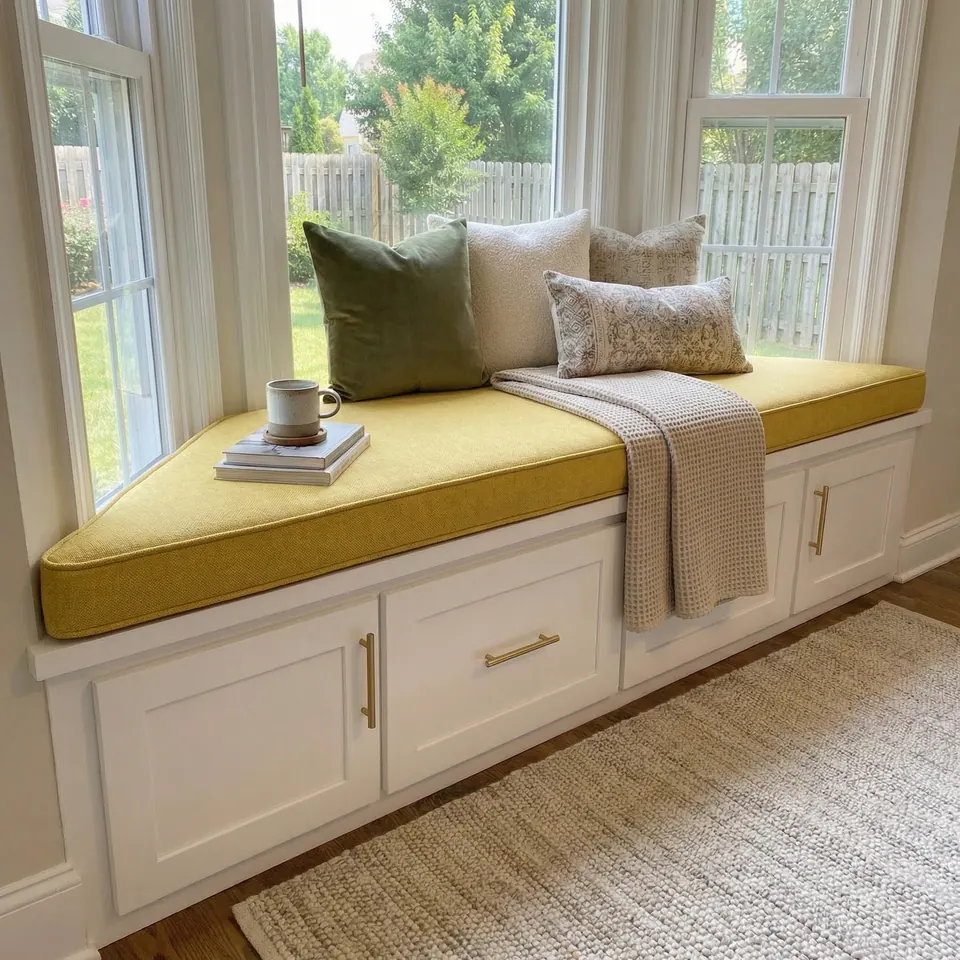
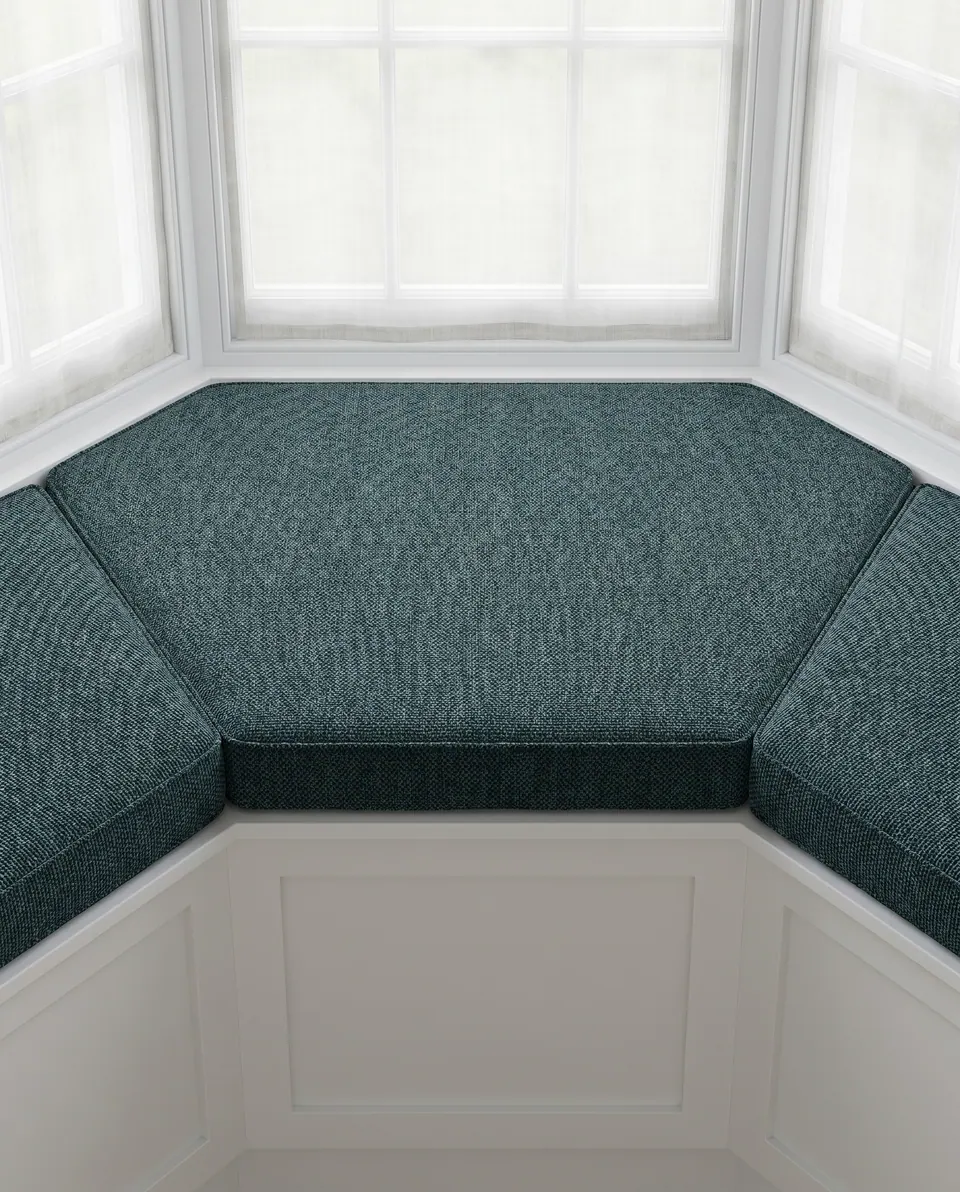
trapezoid and bay-window geometry
L and U layouts
foam density & firmness
thickness vs seat-depth ergonomics
measuring systems
Who is Nate?
Nate Kowalski is the atelier's pattern engineer, a former car-seat designer who has worked at the upholstery bench since 1994. He reads odd shapes (trapezoid and bay window seats, L- and U-shaped benches, curves), foam firmness and thickness against seat depth. He also draws the site's measuring diagrams and Studio calculators, always inches first with centimeters in parentheses.
From a minivan seat to a cutting table in Hamtramck
The first seat I ever designed for a paycheck was the second row of a minivan. I spent most of 1989 arguing over a quarter inch (6 mm) of foam at the front edge, because that quarter inch decided whether a ten-year-old's legs went numb somewhere past Toledo.
That was the work at a seat supplier outside Detroit for ten years: seat height, seat depth, the angle of the back, how far the foam gives under a 170 lb (77 kg) driver. Get the numbers right and nobody calls. Get one wrong and a warranty report lands on your desk with a photo of a split seam.
My uncle ran an upholstery shop in Hamtramck. Two rooms, one cutting table sanded so many times it dipped in the middle, and forty years of brown-paper templates hanging on nails. On Saturdays I brought paczki from the bakery down the street and watched him chalk a church pew cushion without writing a single number down. Every template was right. None of them existed anywhere but on that nail.
In 1994 the car-seat line I worked on moved out of state, and I asked him for a job. He said yes if I swept. I swept. Then I spent the winter turning his templates into drawings: sides, angles, diagonals, and a tolerance in the corner of every sheet. He called it homework. I called it version control.
That winter taught me what I still believe. People don't get custom cushions wrong because they are careless. They get them wrong because nobody told them which numbers matter. A trapezoid window seat needs all four sides and the depth. An L-shaped bench needs each leg measured end to end and a decision about which piece owns the corner. A curve needs to show where it starts, where it stops and how deep it runs; nobody can read a curve from one number.
I'm also the one who asks for the units. A drawing that says 68 with no "in" or "cm" beside it is a coin toss, partner, and I have seen what losing that toss costs.
So what does your odd corner measure? Write it all down, units included.
Measure twice; the fabric remembers.
Have it made
Have Nate’s workshop make yours
Send the numbers in inches: length × depth × thickness, plus any angle. The workshop checks them with you, because foam has no undo button. — Nate
Leave your details and the workshop will call you to confirm measurements, fabric, foam and piping. No prices, dates or payment on this page: it is a request, not an order.
Tools on my bench
A 25 ft steel tape with a true-zero hook. Most measuring mistakes live in the first 1/16 in.
A digital angle finder, because bay window corners are rarely the angle the builder's plan promised.
A roll of kraft paper and a fat marker, for tracing curves nobody can describe in numbers.
Blue painter's tape, to mark where a curve starts and where it stops before anybody measures.
A 24 in (61 cm) steel square, to prove a nook corner is 90° or to prove it isn't.
A graph-paper notebook. Every job gets a drawing with the units written in the corner.
A 1/32 in (0.5 mm) mechanical pencil, because a thick line hides a quarter inch.
What I always check
01The unit beside every number. Inches read as centimeters shrink a cushion to about 39% of its length and depth.
02All four sides of a trapezoid, measured one at a time. On real walls, left and right are rarely equal.
03Where each curve starts and ends, and how deep it runs at its deepest point.
04Each leg of an L, end to end, and whether the backrests run along one side or both.
05What sits above or below the seat. An AC unit under one window sill kept a cushion to 2 in (5 cm) thick.
06Whether a size is a hard maximum. Handmade cushions can vary about 1 in (2–3 cm) unless the note says otherwise.
A cushion drawing without units is a coin toss. Read in centimeters, a size measured in inches shrinks to about 39% of itself.
A buyer in the US sent a drawing for three trapezoid window seats, every measurement in inches. The first quote came back as if those numbers were centimeters, which would have made each cushion about 39% of its real length and depth.
The mistake surfaced at the quote, before any fabric was cut. The seats were requoted at their true size, and since everything was being redone anyway, the buyer moved from 2.5 in (6.4 cm) to 3 in (7.6 cm) of foam, with body fabric L-07 and ivory piping in L-02.
The photos that came back later, and how much the buyer loved them, are why I tell this story. Nothing clever happened. Somebody checked the units.
Measured
Three trapezoid window seats, measured in inches, 3 in (7.6 cm) thick
What it taught
Write the unit next to every number on a drawing. Inches and centimeters change both the cushion and the quote.
Measure every side of a trapezoid window seat. One real bay ran 33.75 in on the left and 33 in on the right, and both numbers went into the pattern.
The cushion came out shorter than I ordered. Will you remake it, and do I have to ship the wrong one back?
The workshop's answer
Step one: send a photo with a tape measure along the full dimension. Step two: ask the workshop to confirm in writing what it will do. In past cases where the workshop made the error, the wrong one wasn't returned and only the pieces that didn't fit were remade, so correct armrests stayed, with the piping color open to change. A partial refund was offered to buyers who'd rather keep it.
A common question
My bench has a rounded end. How do I measure the curve so the cushion follows it?
The workshop's answer
Numbers alone won't describe a curve. Either sketch the seat with its total width and depth, the straight length of each edge before the curve begins, and where each curve starts, ends and how deep it runs; or trace the seat onto wrapping paper, cut it out and photograph it flat next to a tape measure. The paper template is the safer choice for tricky curves, and each cushion needs its own drawing.
A common question
What do you need from me to quote an L-shaped nook bench with back cushions?
The workshop's answer
The end-to-end length of each leg of the L, the seat depth and thickness, a sketch or photo of the nook, and which sides, if any, need backrests. Outside and inside measurements also work, for example 90 x 55 in outside and 72.75 x 39 in inside; the shop plans the two-piece split and confirms the units and layout before quoting. Standard thickness is 4 in (10 cm).
Asking Nate
What kinds of cushions does Nate Kowalski read?
Odd shapes and the numbers behind them: trapezoid and bay window seats, L- and U-shaped benches, curved and rounded-end cushions, piano benches and foam inserts. He also covers foam firmness and thickness against seat depth, and he draws the measuring diagrams used across the site.
What floor cushion size works as a bed?
These floor cushions are firm enough to sleep on. Buyers have used 24 x 70 in or 27 x 70 in for a child's sleepover bed, about 38 x 75 in for a twin, and 30 x 73 in for someone 5 ft 9 in tall. A 6 or 8 in thickness sits higher off the floor.
What separates an open-corner floor sofa from a closed-corner one?
The backrest at the end of the run. A closed corner ends in an L-shaped backrest that wraps the end, using 3 L-shaped backrests and 1 straight. An open corner ends in a straight backrest, 2 of each, leaving that end open like a chaise. The closed corner set measures 79 x 118 in (200 x 300 cm).
Heard at Nate’s bench
Measure twice; the fabric remembers.
Angles are just lengths in disguise.
Tolerance is kindness to your future self.
A drawing without units is a coin toss.
Real walls are not square. Measure the room you have, not the one on the plan.
A curve starts somewhere. Put a piece of tape there.
Four sides and a depth. A trapezoid never needs fewer.
Pick your tolerance before the scissors pick it for you.
± 1/4 in — Nate
The rest of the bench
Six more masters read the cushions they know best. Pick the one who works on your kind of seat.


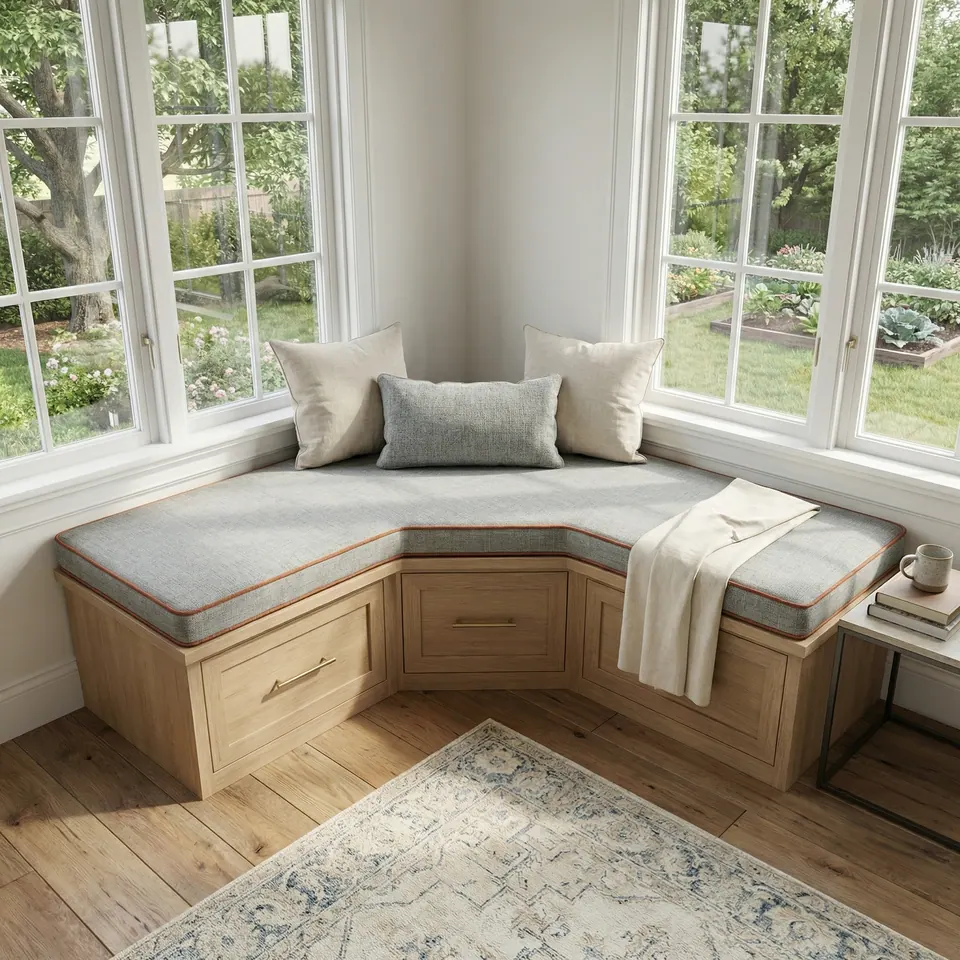
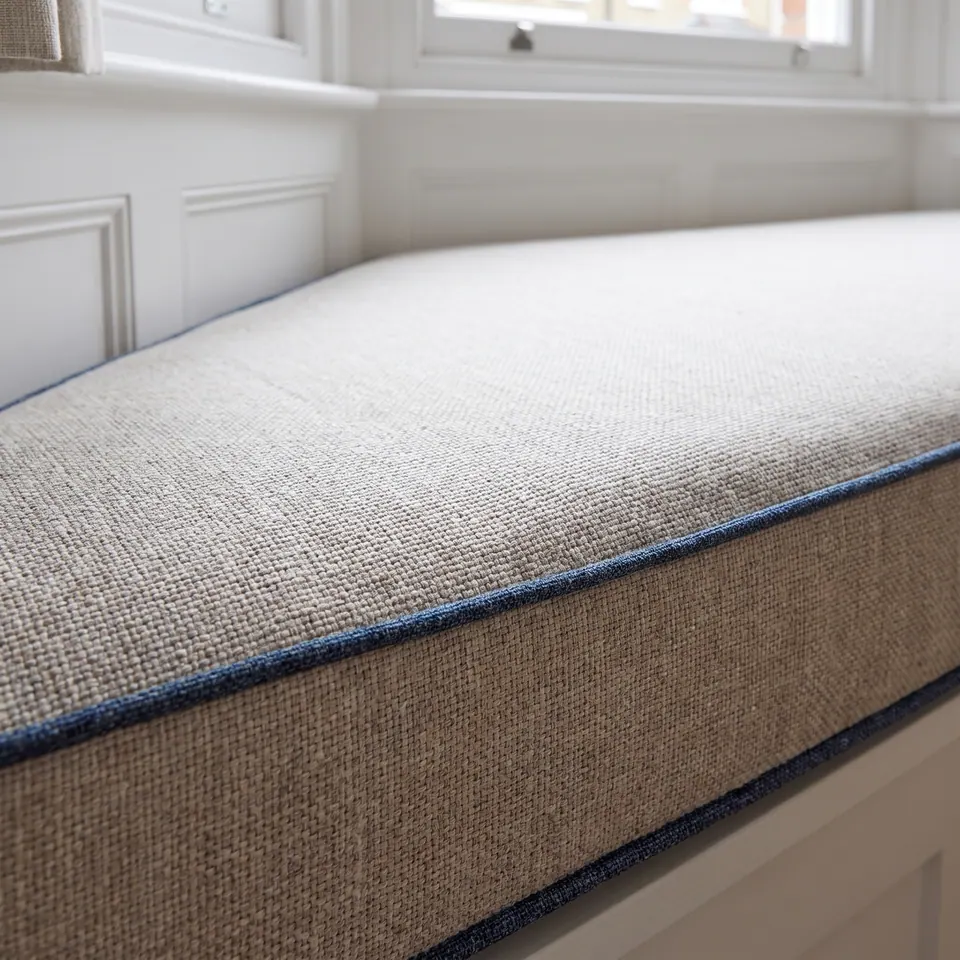
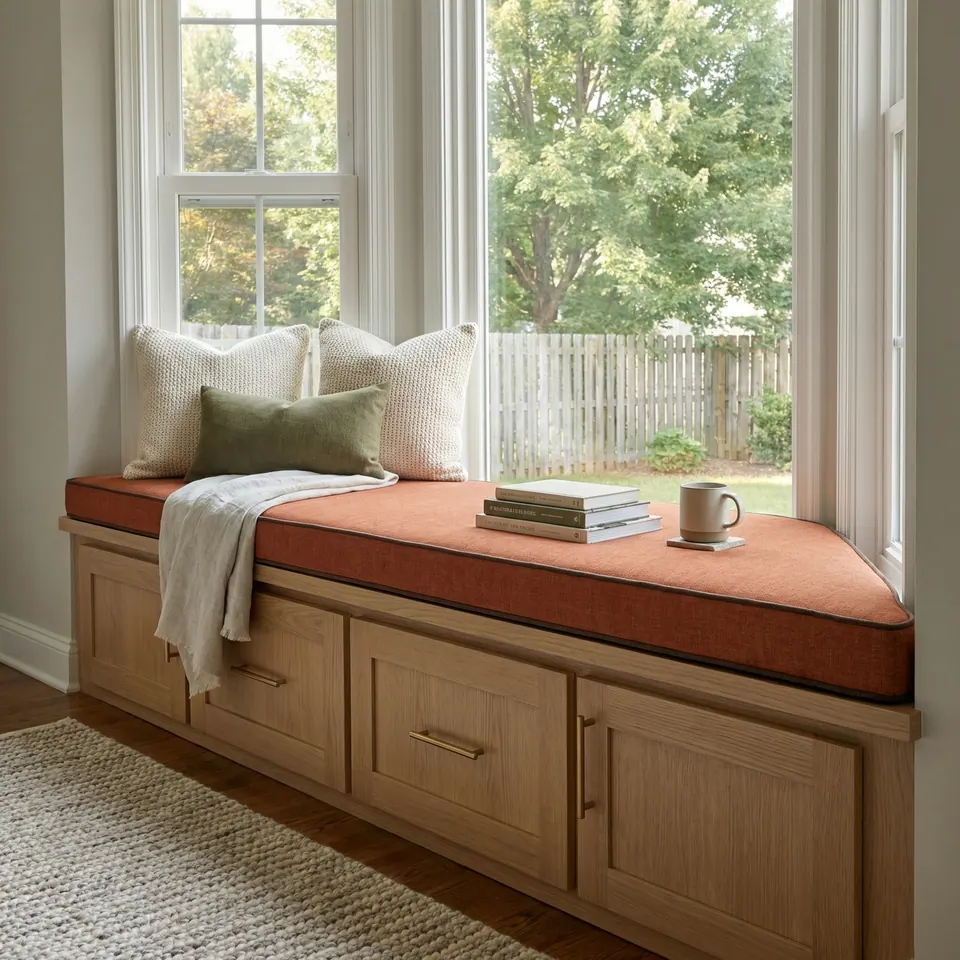
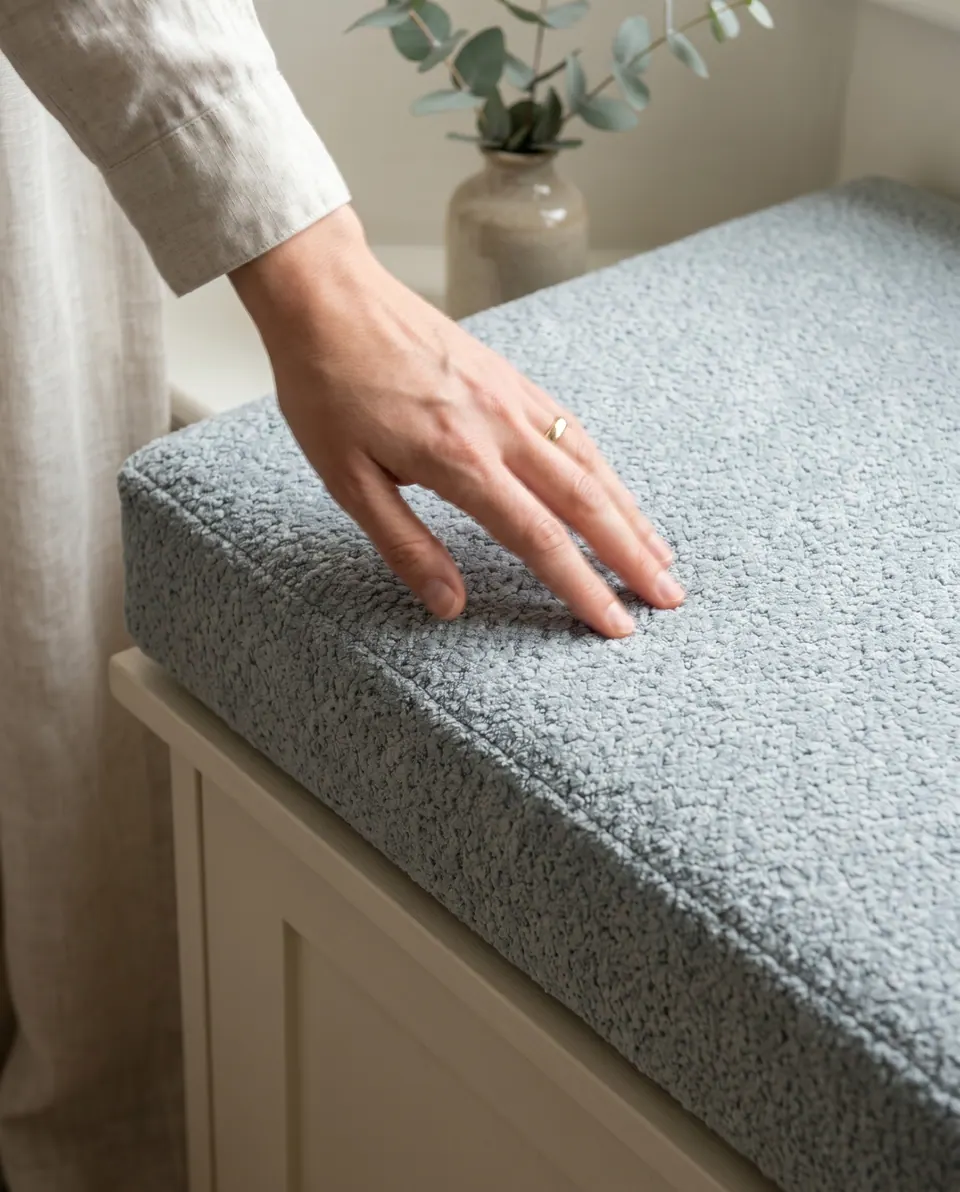
 Harlan PruittThe Elder of High PointHigh Point, North Carolina · since 1968“A cushion should outlive the chair it sits on.”
 Margaret HollowayThe Piping Queen of NewportNewport, Rhode Island · since 1981“Straight lines, honest seams, and a cushion that looks tailored rather than bought.”
 Élodie MarchandThe Colorist of New OrleansNew Orleans, Louisiana · since 1991“Color is the first comfort; the eye sits down before the body does.”
 Callum ReidThe Weather Man of Casco BayPortland, Maine · since 1984“Build it for the worst day of the season, and every other day is a gift.”
 Hana LindqvistThe Quiet Geometer of SeattleSeattle, Washington · since 1996“Less furniture, better sitting.”
 Rosa DelgadoThe Porch Keeper of SavannahSavannah, Georgia · since 1985“The best cushion is the one everybody fights over.”