Across the Map · Europe
Custom cushions for Slovenian Alpine homes, apartments and coastal terraces
Slovenia fits Alpine snow, a foggy basin and 47 km of Adriatic coast into one small country. That makes three sets of fabric rules and one set of measuring rules.
- Sun & UVModerate
- HumidityModerate
- WinterCold
- CoastSalt air nearby
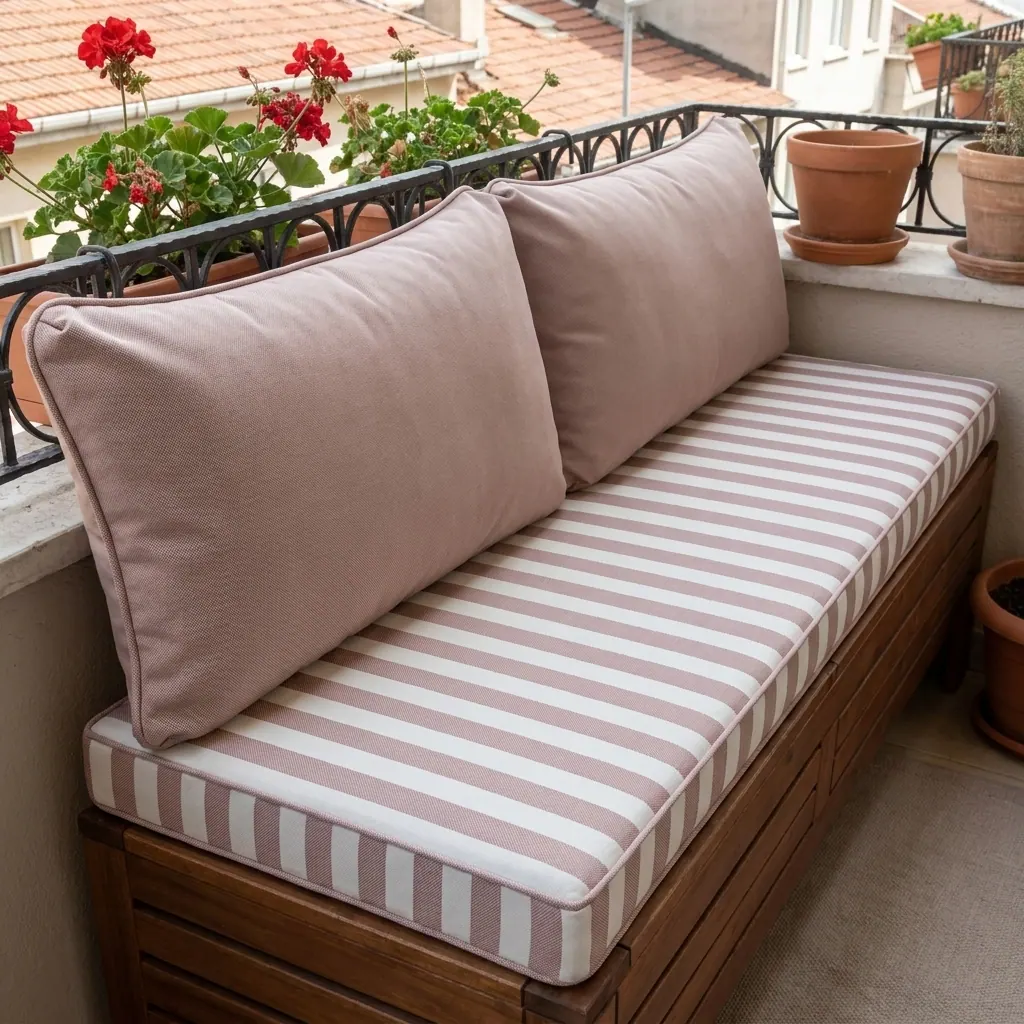
- Typical seatsKitchen corner bench (l-shaped), flower-box balcony chair pads, covered wooden balcony bench

 Save
The quick answer
Custom cushions in Slovenia follow the terrain: corner-bench L sets and warm indoor fabrics in Alpine houses and Ljubljana flats, water-repellent outdoor fabric with ties on flower-box balconies, and UV-resistant outdoor fabric on coastal terraces around Piran. Measure every side in centimeters, check the bench corner for square, and bring outdoor cushions in for winter.
Field notes
Weather and light in Slovenia
- Sun & UVStrong (level 3 of 4)About 1,960 hours a year in Ljubljana; about 2,397 at Portorož on the coast
- HumidityModerate (level 2 of 4)Ljubljana averages 60%, with fog on about 64 days a year
- Rain & stormsHeavy (level 4 of 4)About 53.9 in (1,368 mm) in Ljubljana; over 138 in (3,500 mm) in some western areas
- Snow & freezeRegular (level 3 of 4)About 50 snowy days in Ljubljana; snow in Piran only in traces
Watch for
- Watering drips from flower boxes above balcony seats
- Fog and damp in Ljubljana winters
- Strong summer sun and salt air on the coast
Plain-language levels from general climate patterns, not measurements. Your own porch, shade and window exposure matter more.
Three climates, one tape measure
Slovenia's weather changes faster than its borders. The northeast is continental, most of the country is oceanic and the coast is Mediterranean. About 90% of the territory sits about 660 ft (200 m) or more above sea level, and Triglav tops out at 9,396 ft (2,864 m).
The specs, from ARSO, the Slovenian Environment Agency: - Ljubljana (1991–2020): January nights of 28.9°F (−1.7°C), July days of 82.2°F (27.9°C), about 53.9 in (1,368 mm) of precipitation, about 50 snowy days, and fog on about 64 days a year, mostly in autumn and winter. - Portorož, on the coast (1991–2020): July days of 84.9°F (29.4°C), January nights of 34.3°F (1.3°C), about 37.8 in (959 mm) of precipitation and about 2,397 hours of sun, 334 of them in July. - The west: over 138 in (3,500 mm) of precipitation in some areas, against about 31 in (800 mm) in Prekmurje.
Read those as tolerances. Indoors in Ljubljana the variable is damp and fog, not cold. On an Alpine balcony it's snow and rain. On the coast it's sun, plus a bora that is usually cold and gusty. Same tape measure; different fabric. Croatia carries the Adriatic rules south, and Austria the Alpine ones north.
The corner bench, checked for square
Sketch it from above
Draw the L the way the bench sees it. Label both runs along the walls, the depth of each run and the open end of each leg, in centimeters. No inch rounding.
Pick the piece that owns the corner
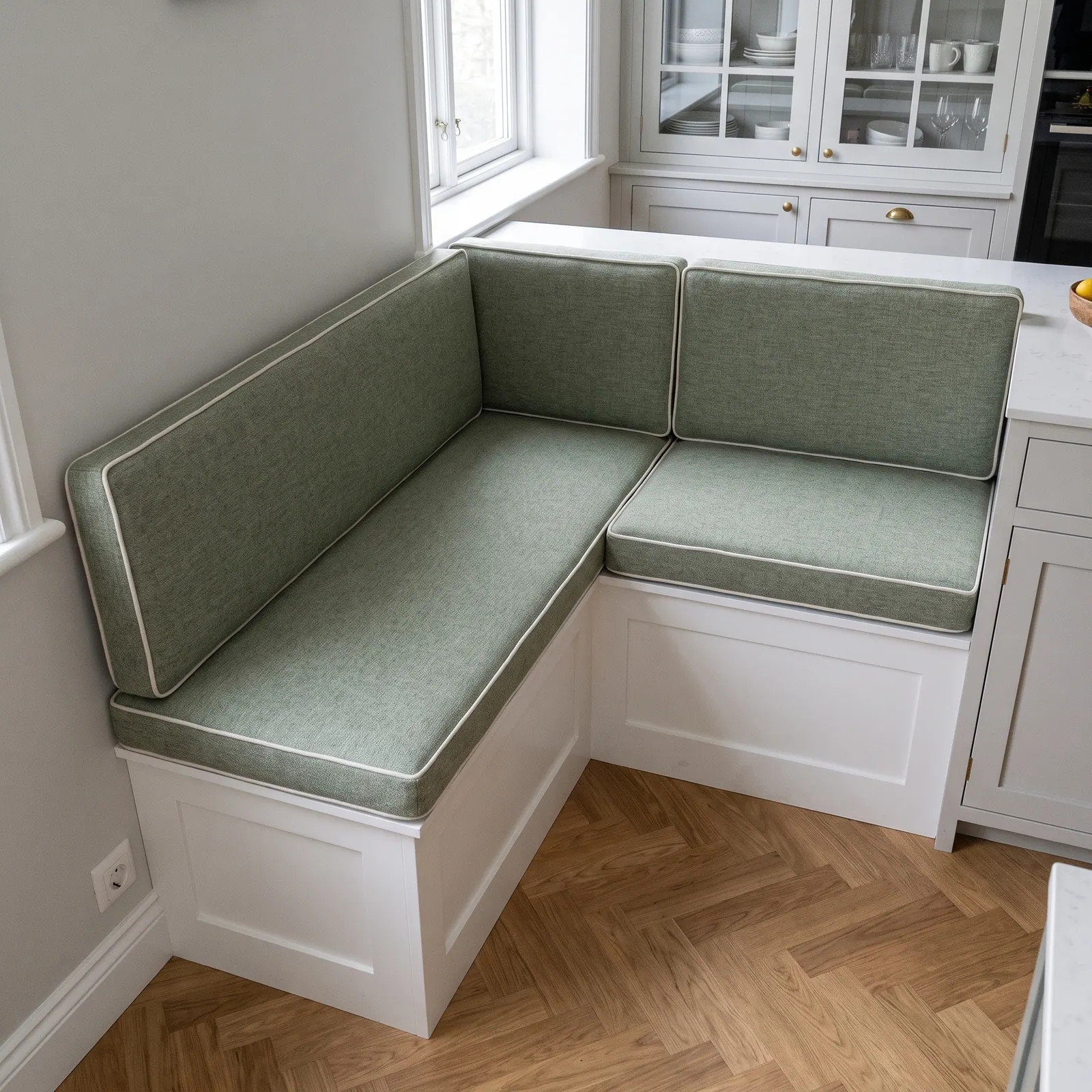
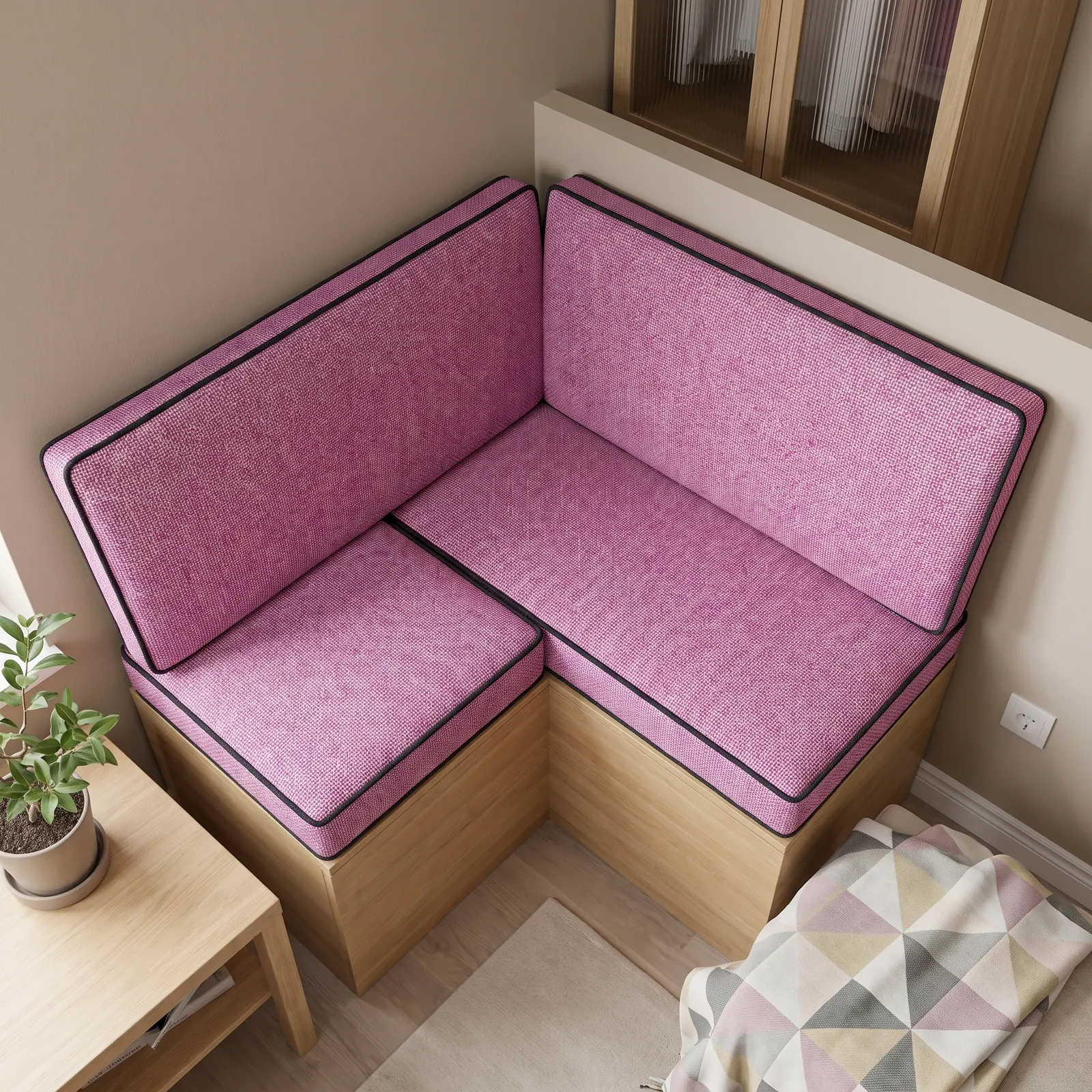
Two rectangles that butt together are the simplest build: one runs into the corner, the other is shortened by the first one's depth. On a 75 in (190 cm) run beside a 19¾ in (50 cm) deep cushion, the short piece is about 55 in (140 cm). The German Eckbank page walks the straight L through in detail.
Check the corner with a diagonal
Walls in an older house aren't always at 90°. From the corner, mark 24 in (60 cm) along one wall and 32 in (80 cm) along the other, then measure between the marks. A true right angle gives 40 in (100 cm). Anything else makes the corner piece a trapezoid.
Send four sides for every angled piece
For a trapezoid, give all four sides and the straight depth between the parallel sides. The trapezoid calculator tells you whether your numbers close.
Mind the table
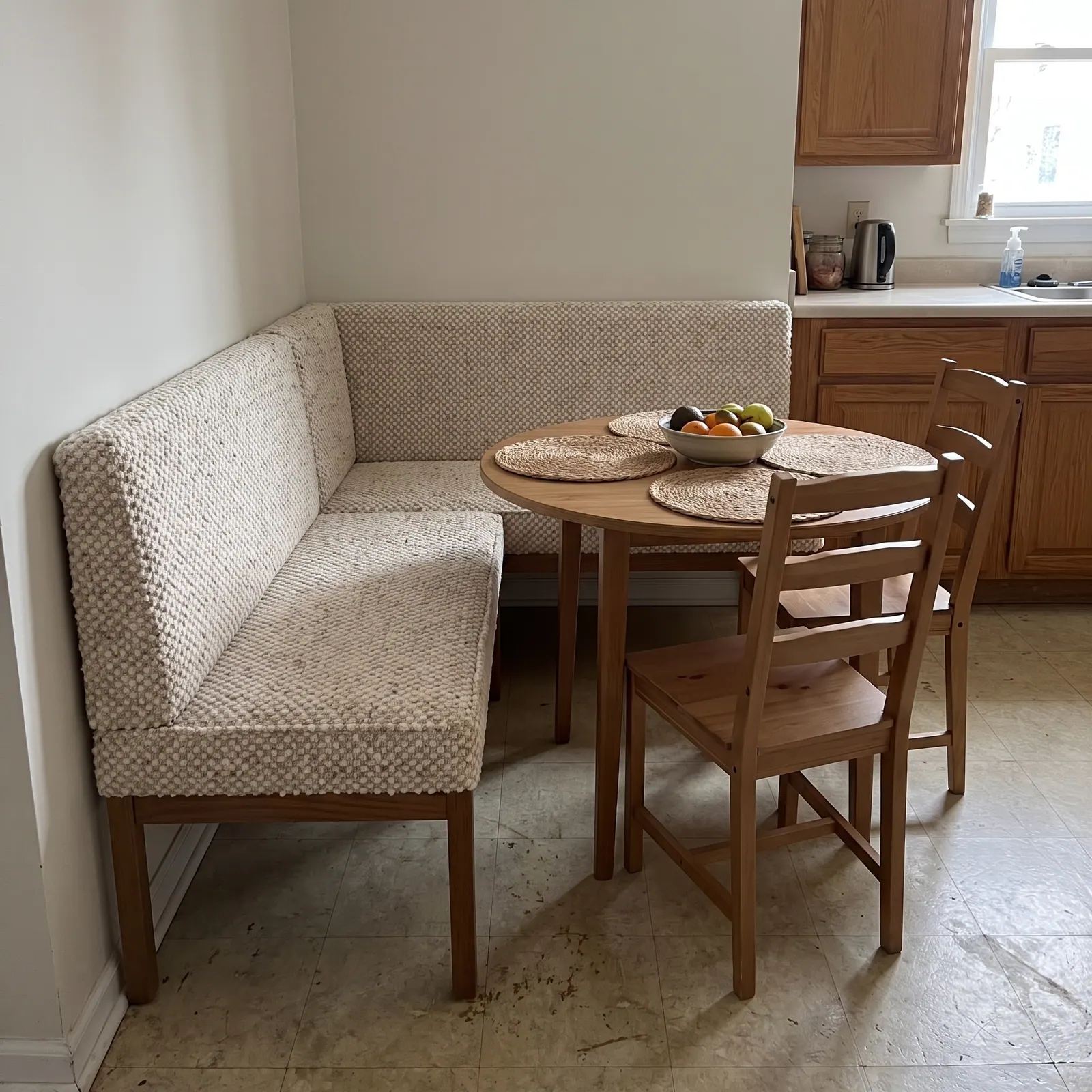
At dining height, 2 to 3 in (5 to 7.5 cm) of cushion usually keeps the seat top 10 to 12 in (25 to 30 cm) below the tabletop. The banquette thickness Pattern has the table, and the kitchen nook hub shows finished corners.
Flower boxes, wooden balconies and the drip line
If your balcony has flower boxes on the rail, the cushion below lives in the drip line. Watering day sends water, soil and petals down onto the seat. Plan for it:
- Outdoor fabric only. A water-repellent membrane weave or the workshop's outdoor fabric, both UV-resistant. Water-repellent is not waterproof: it sheds a watering can, not a week of rain.
- Plain, not tufted. Tufted cushions let water in even in outdoor fabric.
- Ties at the back corners. On a windy afternoon a loose chair pad ends up in the geraniums.
Measure the seat, not the chair: width between the arms, depth from the front edge to the back, and the back height you want. Then water the boxes and watch where the drips land. If they land on the seat, move the bench 4 in (10 cm); don't ask the fabric to do the moving, partner. The chair cushion builder turns your numbers into a drawing.
Alps, Ljubljana, coast: the build sheet
| Seat | Fabric | Thickness | Build |
|---|---|---|---|
| Kitchen corner bench | Linen-look or a wipeable performance weave | 2 to 3 in (5 to 7.5 cm) | Two butted rectangles or a trapezoid corner; non-slip base on every piece |
| Covered wooden balcony bench | Water-repellent membrane or outdoor fabric | 4 in (10 cm) | Plain, not tufted; indoors for winter |
| Flower-box balcony chair pads | Outdoor fabric | 2 in (5 cm) | Two ties at the back corners |
| Ljubljana window seat | Linen-look or velvet | 3 in (7.5 cm) | Zip-off cover; lift it on foggy weeks |
| Coastal stone-terrace bench | UV-resistant outdoor fabric in a pale tone | 4 in (10 cm) | Non-slip base on stone; rinse zippers after salty days |
Seat foam is about 2.0 lb/ft³ (32 kg/m³). Standard outdoor cushions have no quick-dry foam or mesh base, so stand them on edge after rain. Handmade pieces land within about ±½ in (1 cm) of the ordered size; very long or tufted pieces can vary more.
Picked for Slovenia
Seats to start from
Fabric families
Try it in the Studio
Three trapezoids and the short sides nobody measured
A buyer sent the workshop the construction plan of a large corner bench and asked for three trapezoid cushions, each about 26.8 in (68 cm) deep and 3.1 in (8 cm) thick, in a white-cream linen.
The plan had the long runs. It didn't have the short end sides where each trapezoid meets its neighbor at the corners, and the workshop asked for every side length, including those, before it would quote. A trapezoid with a missing side is a guess, and a guess cut in foam stays a guess.
The buyer took another offer in the end. The lesson holds for every angled bench in an old Alpine house: four sides per piece, the straight depth between the parallel sides, and a sketch showing which piece touches which. At 26.8 in (68 cm) deep, a short side that's under ½ in (1 cm) off opens a gap you'll see every time you sit down.
Measure twice; the fabric remembers.
- Measured
- Three trapezoid cushions, about 26.8 in (68 cm) deep and 3.1 in (8 cm) thick
- What it taught
- A trapezoid needs all four sides; the short end sides at the corners are the ones people forget.
Pine balconies, Piran stone, Ljubljana fog: a color for each
Color follows the same split as the weather. On an Alpine balcony of honey pine, the wood is already warm, so the cushion can run cool: sage, slate blue, stone gray, piping one shade darker. Red geraniums on the rail will do the shouting.
On the coast, Piran's compact medieval houses and narrow streets come from five centuries under Venice, 1283 to 1797, and the stone is pale. Pale stone plus 334 hours of July sun at nearby Portorož is hard on saturated colors, and dark cushions get hot to sit on. Oatmeal, sand and olive have less to lose.
Ljubljana's fog is the third case: on a gray November week a warm oat or rust brightens a window seat more than white does. Hold two or three swatches in the room, in daylight, before the code goes on the order. What color is the wood on your balcony?
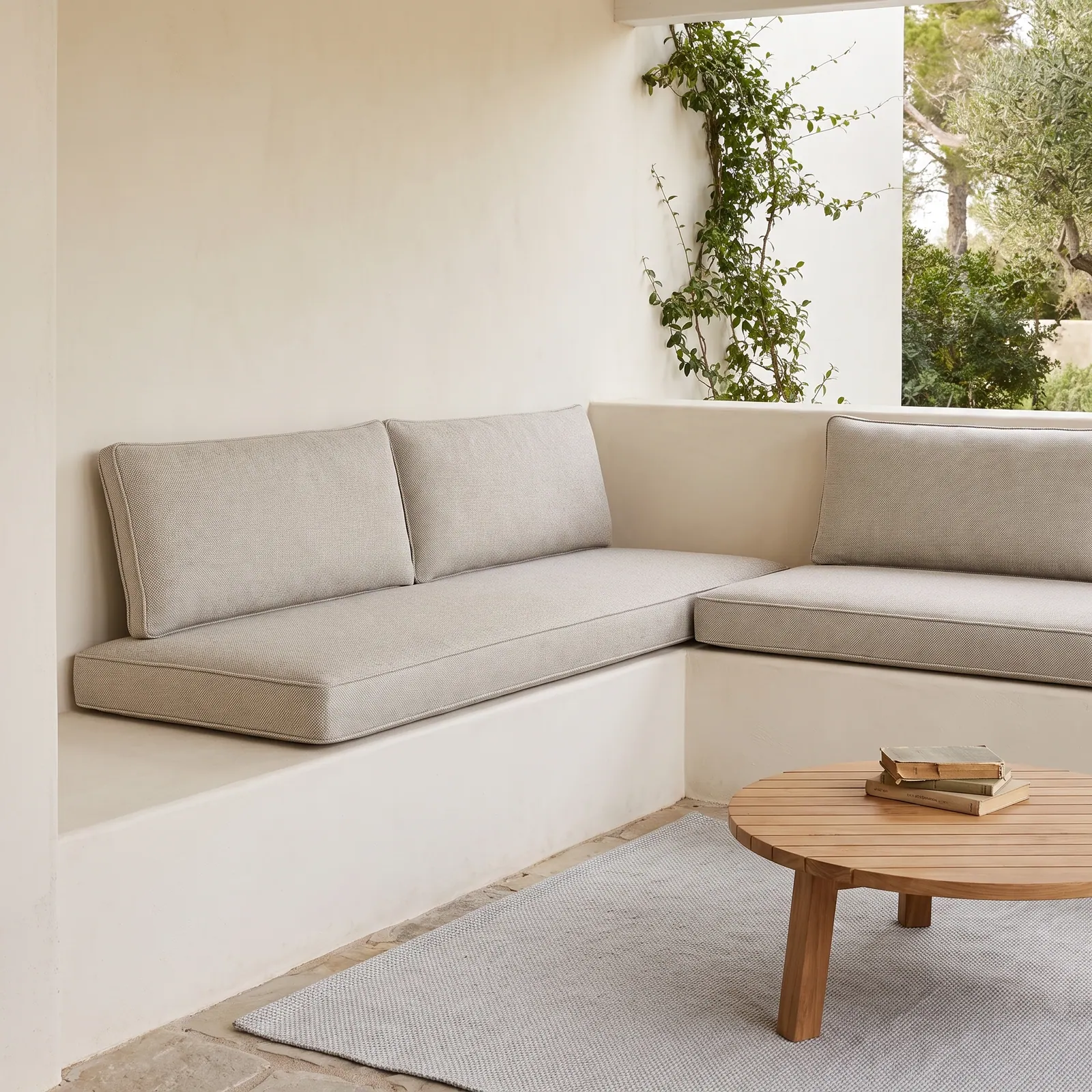
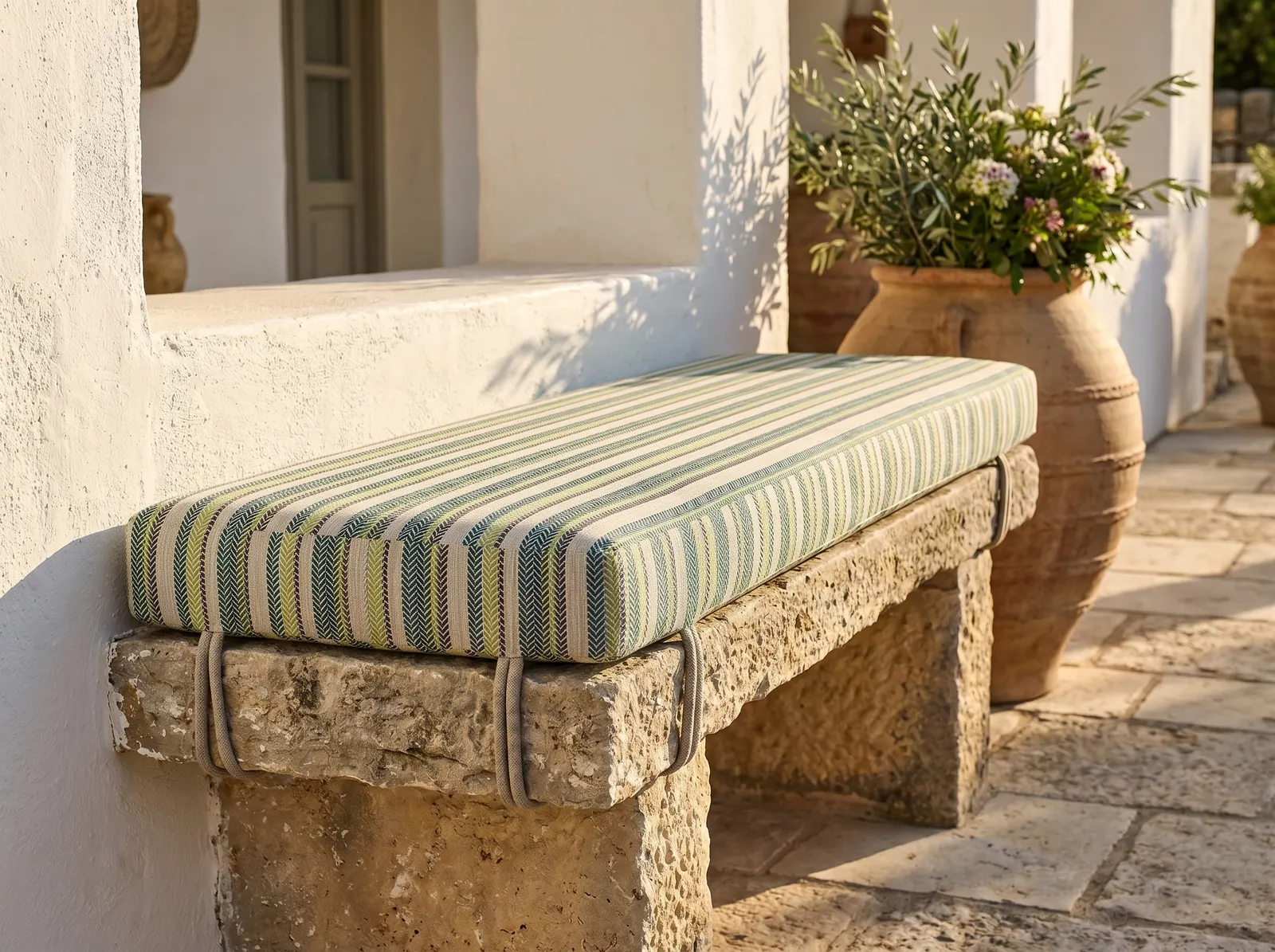
Photographs for homes like these
Open any photograph large; each one has its own link and a Save button.
 Save
 Save
 Save
 Save
 Save
A Slovenian cushion year, by altitude
- May in the Alps: balcony cushions come out once the nights stop freezing.
- All summer: water the flower boxes before the cushions go out, not after.
- July on the coast: turn and rotate terrace cushions; Portorož averages about 334 hours of sun this month.
- After a windy, salty day: rinse zippers with fresh water and let everything dry.
- Autumn in Ljubljana: lift window seat cushions on foggy weeks so the underside can breathe.
- October to November: wash covers at 86°F (30°C), gentle, no bleach, air dry; dry the foam fully and store it on edge, never in a sealed bag.
From Triglav to Piran the tape measure doesn't change. The fabric does.
Nate
Buyer questions: trapezoids, covered terraces and tolerances
- A common question
What's the most important measurement for a trapezoid or odd-shaped cushion?
The workshop's answerThe total depth, measured in a straight line from the front edge to the back at the deepest point, plus the exact long base and short back edge. For a trapezoid, give every edge and the straight height between the parallel sides; for several pieces, list each as length x width x thickness, for example 19¾ x 47¼ x 4 in (50 x 120 x 10 cm).
- A common question
Is the regular fabric all right on a covered terrace?
The workshop's answerYes, if the area is truly covered, but the standard fabric has no water-repellent coating. Water-repellent outdoor fabrics are available, and one buyer with a covered terrace chose a cream one. If you don't need water resistance, the workshop says the soft fabric is the nicer choice.
- A common question
What exactly is the non-slip base?
The workshop's answerThe underside of the cover is made from a grippy non-slip fabric instead of the regular fabric, which stops the cushion sliding on a bench or chair. It's built into the cover, not a separate pad, and you select it in the personalization when ordering.
- A common question
How exact will the finished size be?
The workshop's answerCustom handmade cushions can vary by about ±½ in (1 cm) in the final dimensions. Fully handmade tufted cushions can differ by 1 to 2 inches.
- A common question
Can I choose which side the zipper goes on?
The workshop's answerYes. The workshop asks which side you want and puts the zipper on a long side or wherever you specify, such as the long edge that faces the wall.

Have it made
Have it made for your home — ask Nate’s workshop
Send the numbers in inches: length × depth × thickness, plus any angle. The workshop checks them with you, because foam has no undo button. — Nate
Leave your details and the workshop will call you to confirm measurements, fabric, foam and piping. No prices, dates or payment on this page: it is a request, not an order.
Questions buyers ask next
Do Alpine and coastal cushions in Slovenia need different fabrics?
Yes. Indoors, linen-look, velvet and performance weaves all work. On an Alpine balcony or a coastal terrace, use outdoor fabric that is water-repellent and UV-resistant, built plain rather than tufted. The coast adds long summer sun and salt air, so rinse zippers after windy days.
How can I tell whether my corner bench needs a trapezoid cushion?
From the corner, mark 24 in (60 cm) along one wall and 32 in (80 cm) along the other, then measure between the marks. A square corner gives 40 in (100 cm). If you get anything else, order the corner piece as a trapezoid and send all four of its sides plus its depth.
Can balcony cushions stay out through a Ljubljana winter?
Better not. Ljubljana averages about 50 snowy days a year, and water trapped in foam freezes, thaws and never dries. Wash the covers at 86°F (30°C), dry the foam completely and store both indoors, on edge, where air moves.
What thickness suits a kitchen corner bench at a dining table?
Usually 2 to 3 in (5 to 7.5 cm), so the cushion top sits about 10 to 12 in (25 to 30 cm) below the tabletop with room for knees. Keep 4 in (10 cm) for a low bench or for lounging, and add a non-slip base on every piece.
± 1/4 in — Nate
Concept Sketches
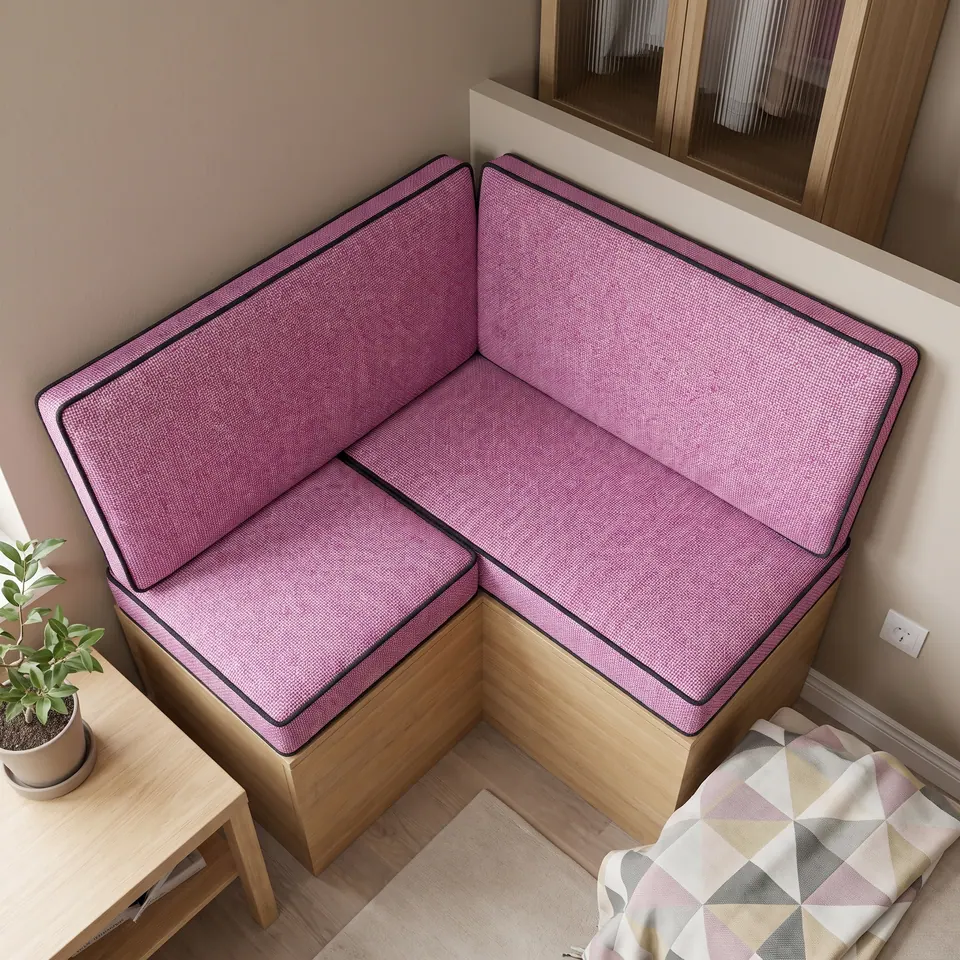
Sketches for homes like these
Real projects, drawn up as ideas you can borrow.
The atelier
Keep going
- A Reading by NateL-Shaped Bench Cushion for a Kitchen Nook: Box Edges That Butt
- A Reading by NateL-Shaped Bench Cushion Orders: a Slate Blue Nook From Above
- A Reading by NateL-Shaped Bench Cushion Piping: Greige Seats on an Oak Corner
- The Cutting TableWhat measurements do you need for an L-shaped bench with back cushions?
Across the Map
Nearby places
Close by on the map