Kitchen nook and dining bench cushions, measured run by run
A breakfast nook is two benches pretending to be one. Get the corner right and everything else follows; get it wrong and someone sits on a seam every morning.
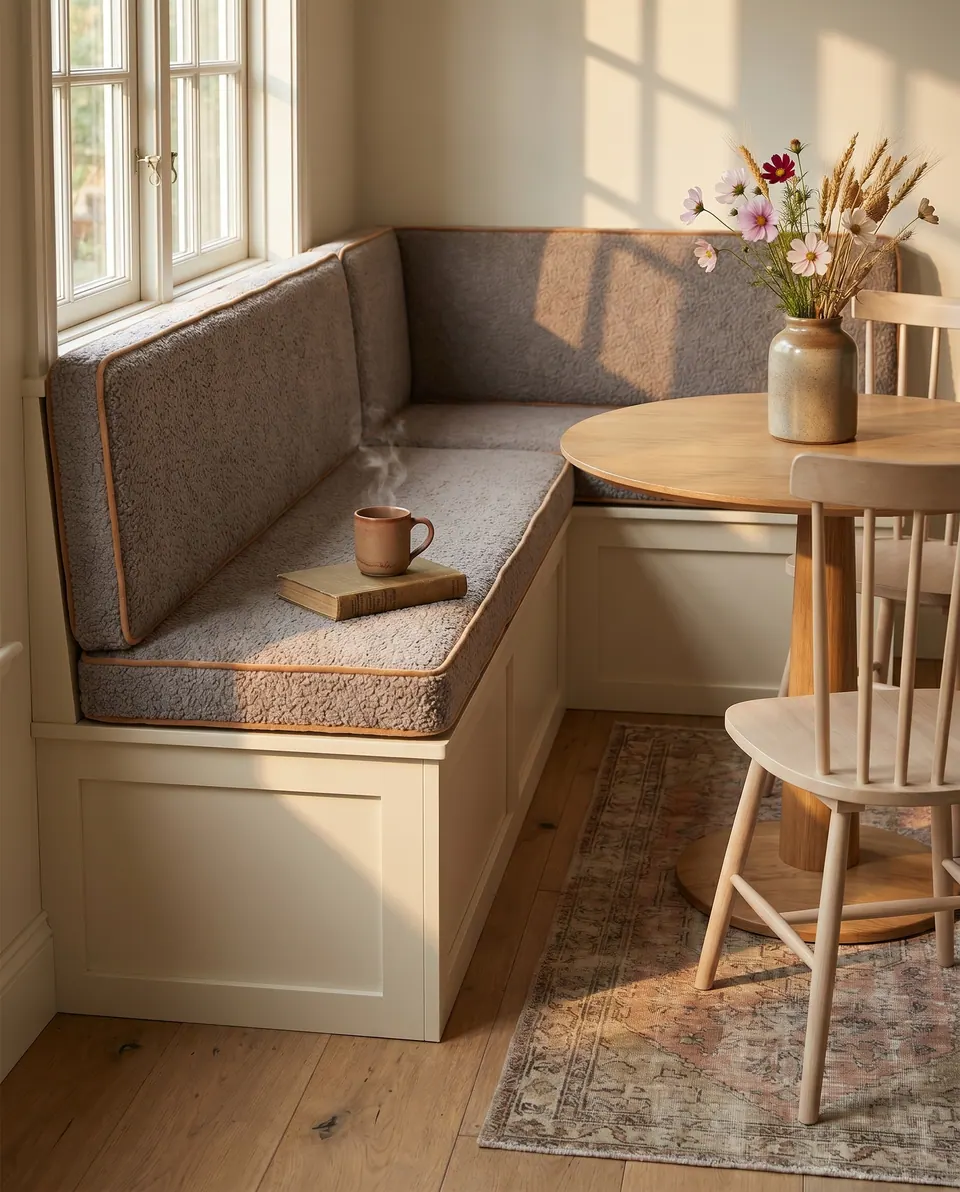
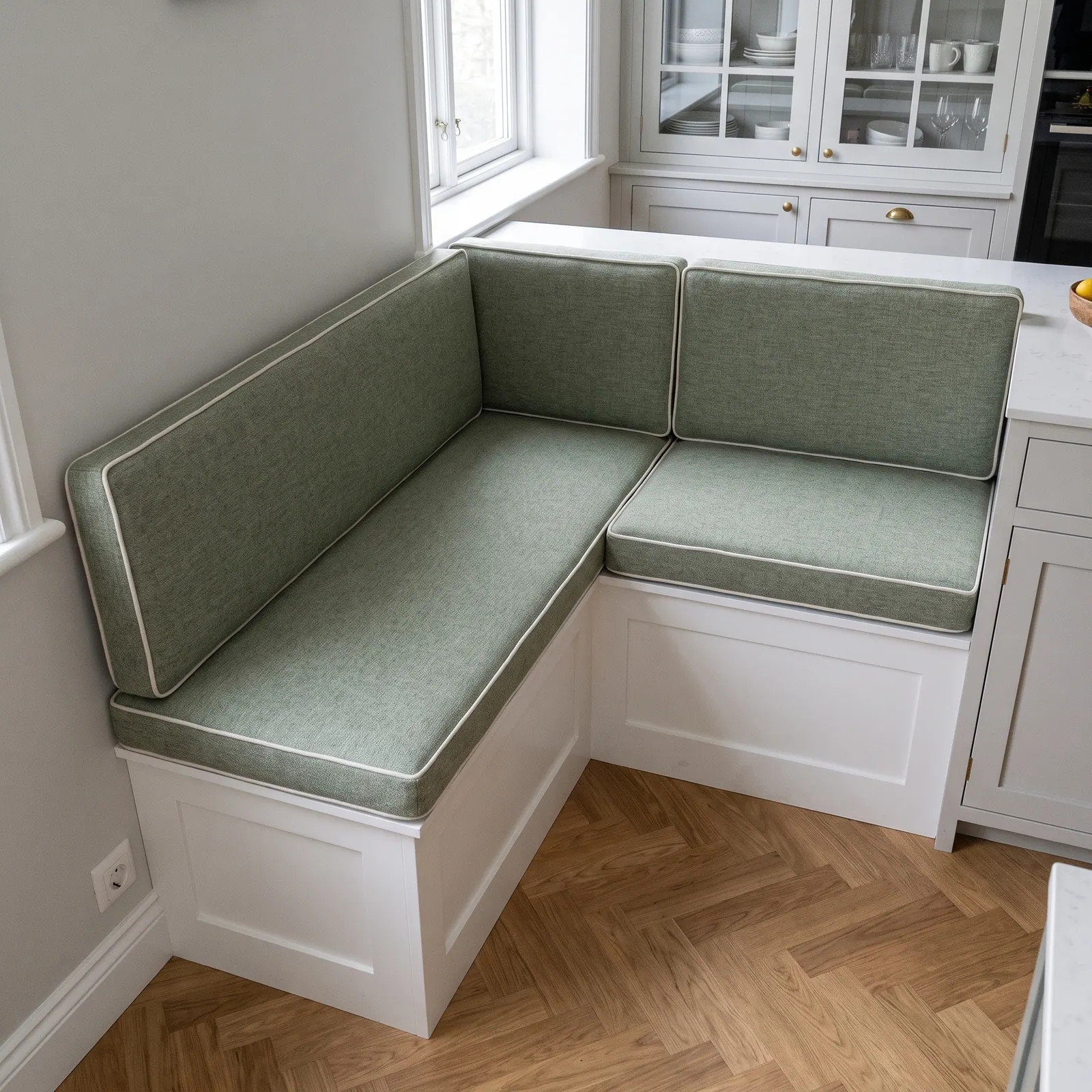
SaveSage cushions echo gray shaker cabinetry so the corner bench looks like part of the kitchen joinery.
The quick answer
A kitchen nook cushion is a made-to-measure seat, often with back cushions, for a breakfast banquette, corner bench or kitchen window seat. Most are 4 in (10 cm) foam in zippered covers. For an L-shaped nook, send the end-to-end length of each leg, the depth and a sketch, and the workshop plans and confirms the two-piece split.
Plenty of houses have a dining table nobody uses and a corner bench where everybody sits. The kitchen nook cushion is for that corner: the built-in banquette, the L-shaped bench around a round pedestal table, the storage bench at the end of an island, the window seat beside the sink.
It is a hard-working seat. Crumbs, coffee, homework, a small person standing up to reach the syrup. It needs covers that come off, foam that holds its edge, and a corner that doesn't leave a gap where two runs meet.
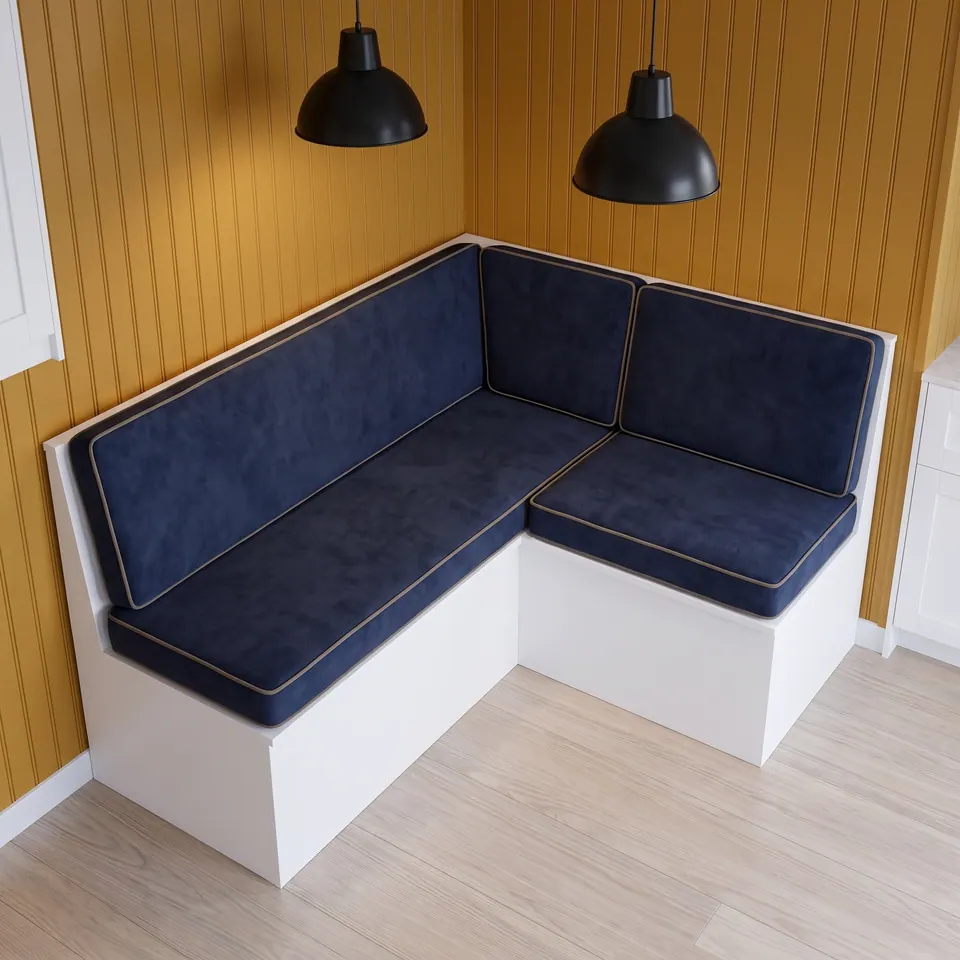
An L-shaped nook is made in two pieces, and one of them has to own the corner. The workshop plans that split from your measurements and confirms it before cutting; which piece owns the corner explains the choices.
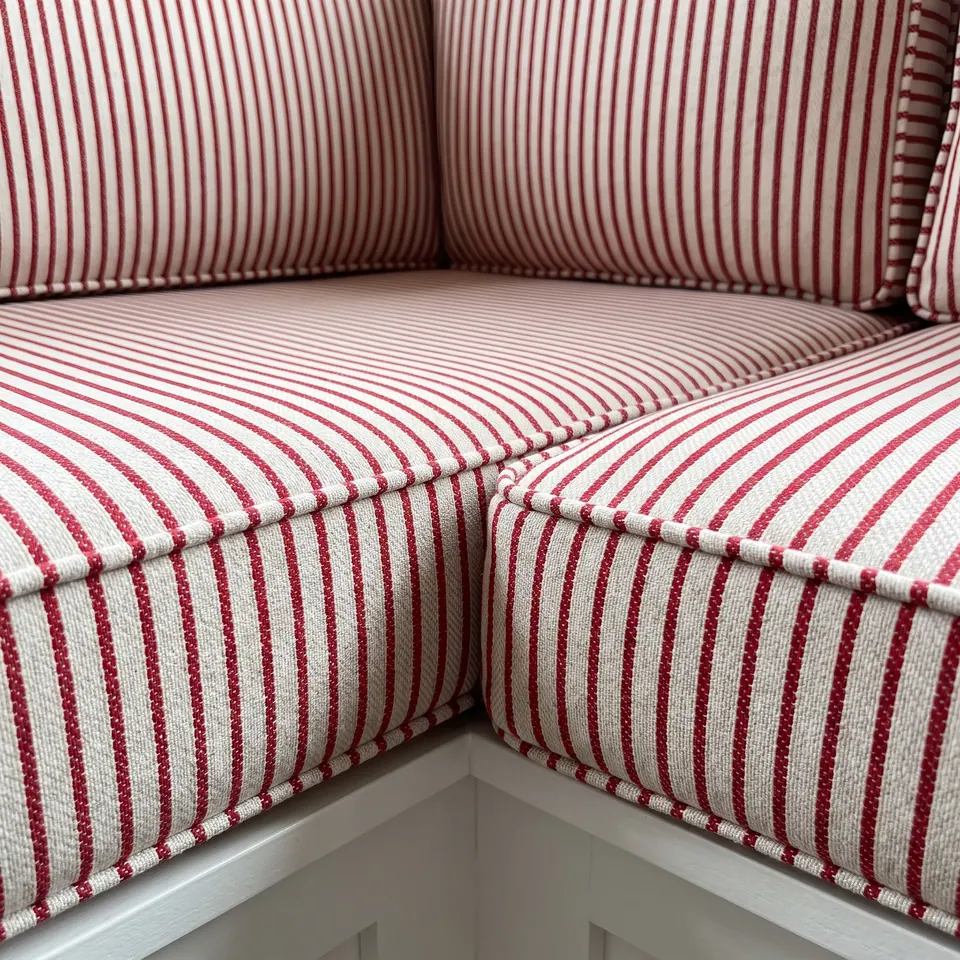
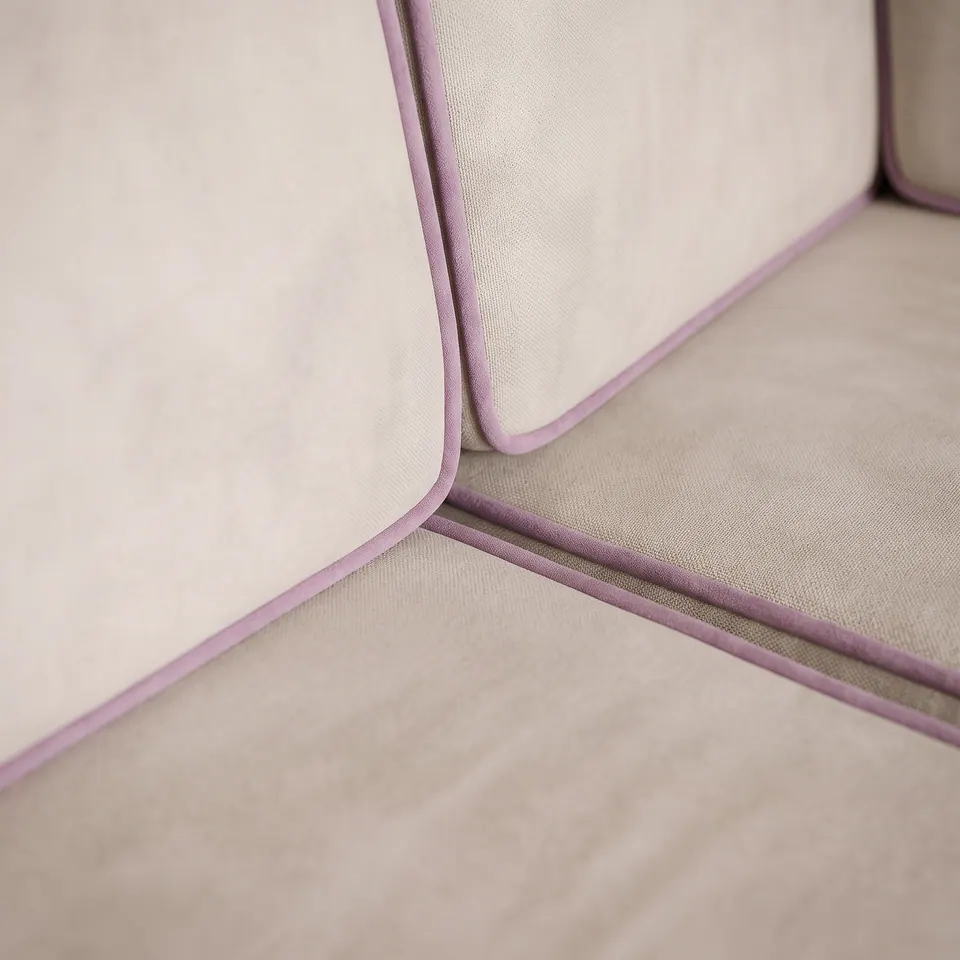
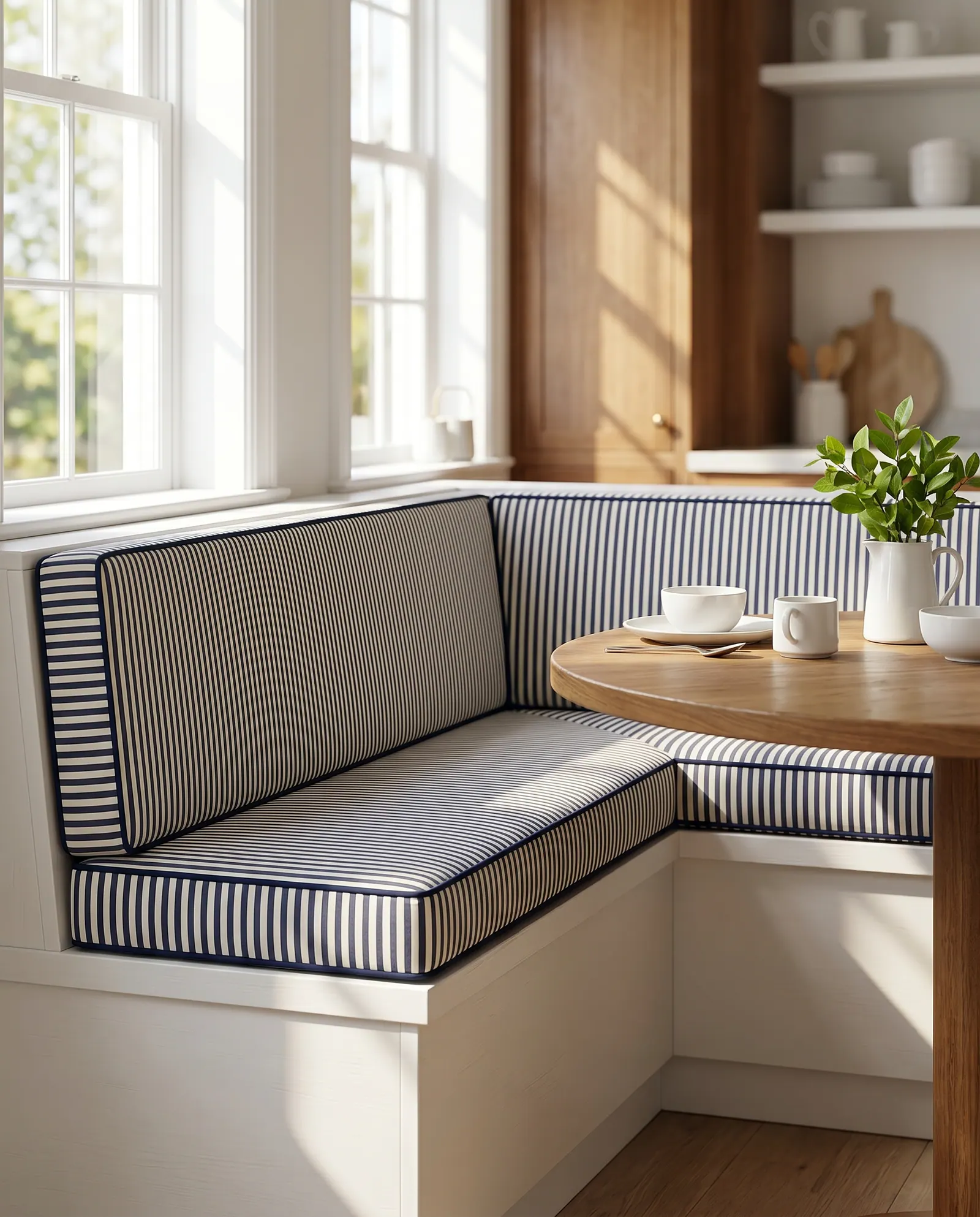
A straight welt is a kind of honesty. On a nook the piping runs along two long fronts and meets at the corner, so a wandering line shows from the stove. Ivory piping on sage green, navy piping on navy-and-ivory ticking: both draw the L clean and make a built-in look built, not bought.
Angled and curved nooks are made too. The angled ones are sketched in angled breakfast nook cushions; a curved end needs a drawing or a paper template, because numbers alone won't describe it. One sofa base with curved ends measured 68 in along the back and 63 in along the front, and the drawing did the rest.
Fabric for syrup, crayons and Sunday coffee
A kitchen seat is a spill waiting to happen, so choose a fabric you won't mind washing and a color that forgives.
Linen-look weaves: sage green with ivory piping on a white corner bench by the island.
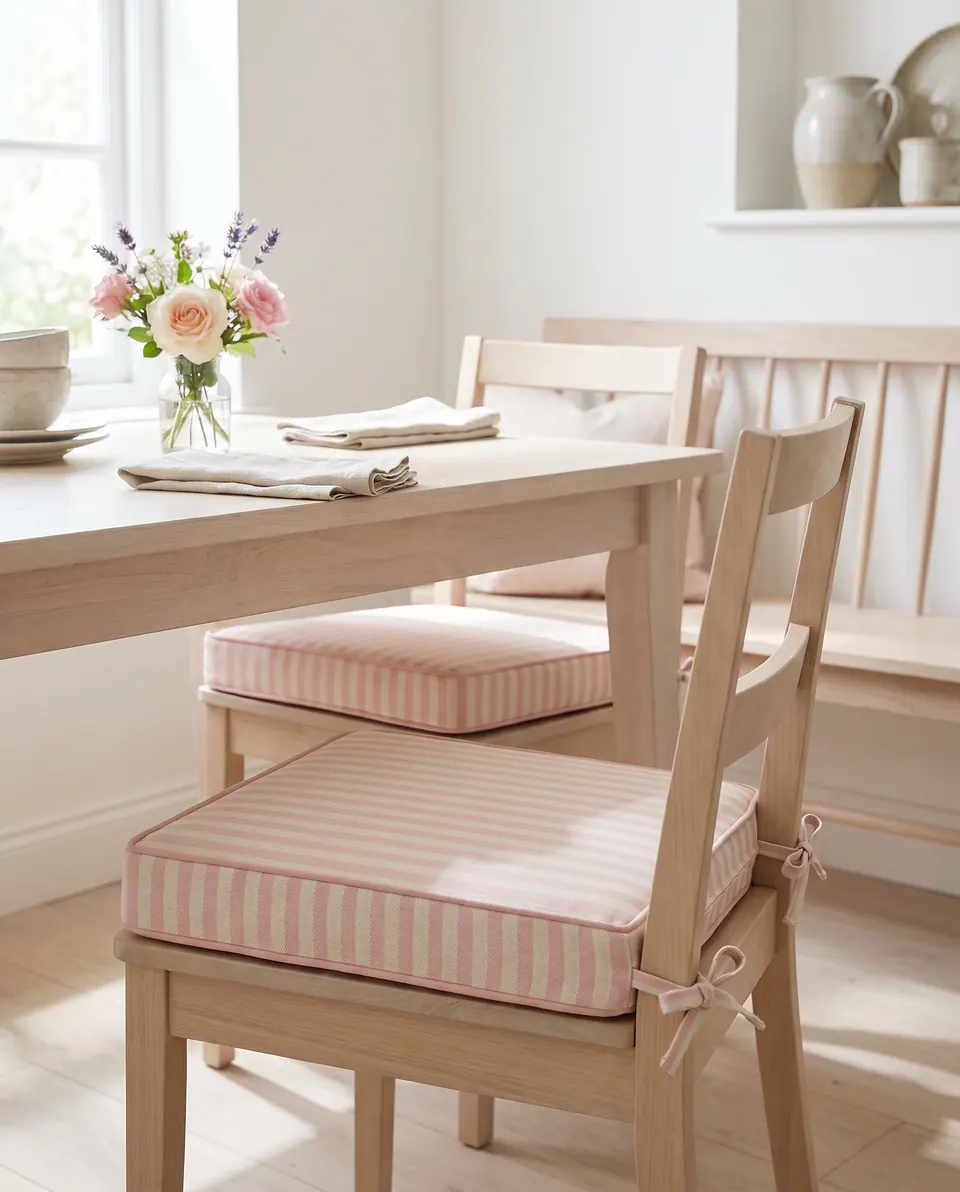
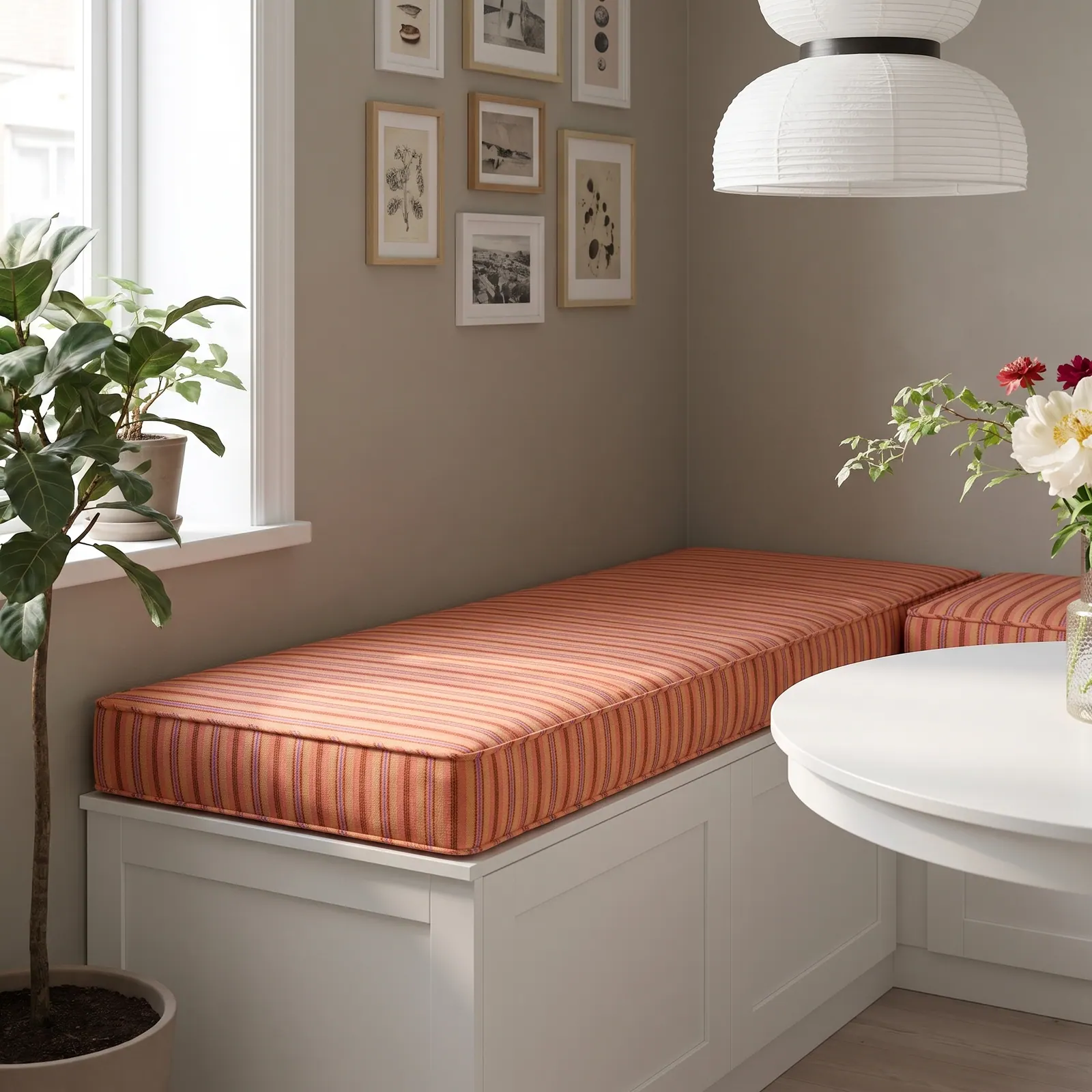
Striped cotton and ticking: navy ticking around a round oak table, powder blue on a kitchen window seat, apricot stripes on a shaker banquette. The roll is about 55 in (140 cm) wide, so stripes run front to back on a long seat and are matched on one face only.
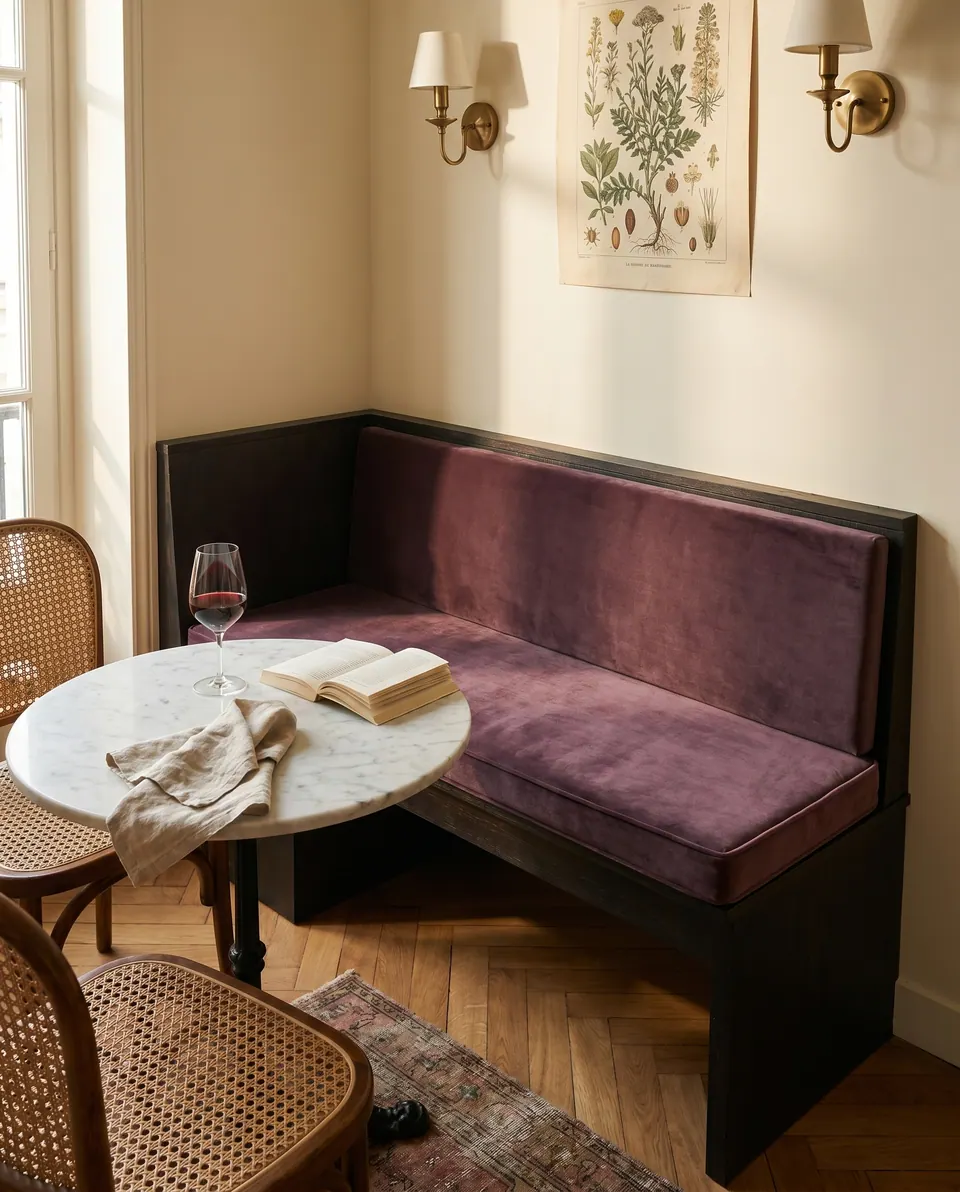
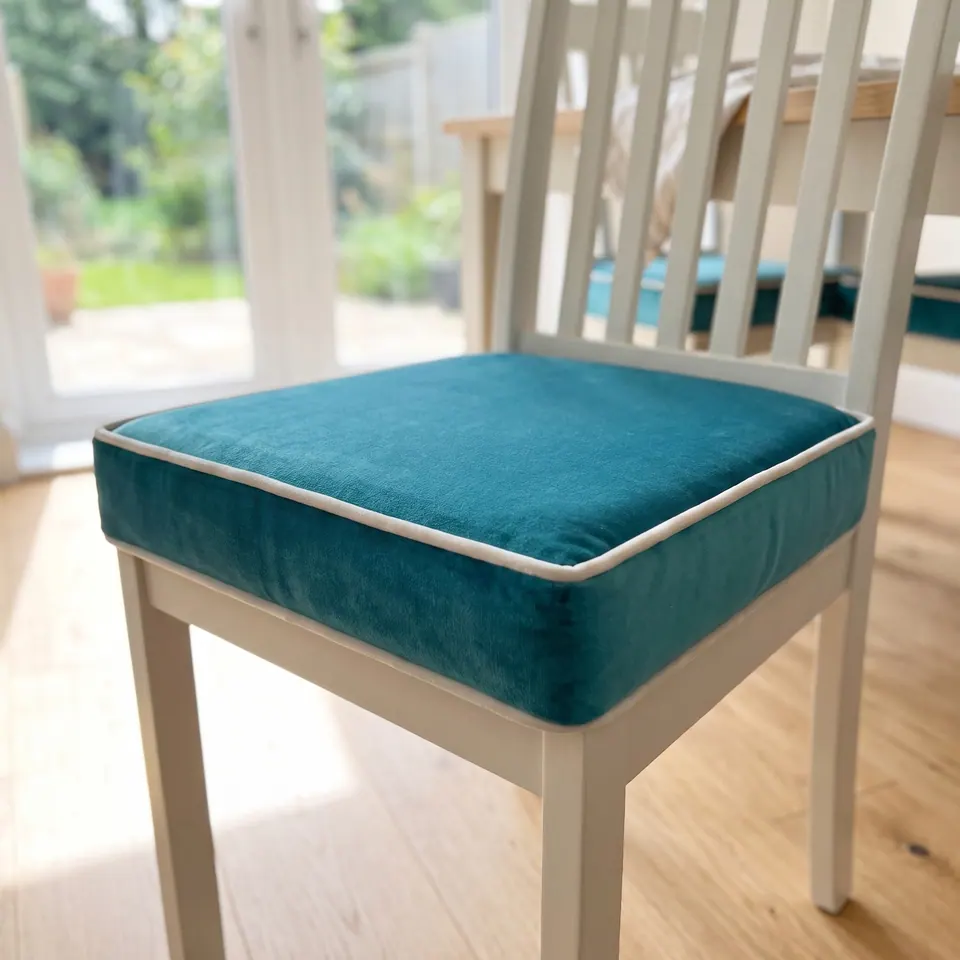
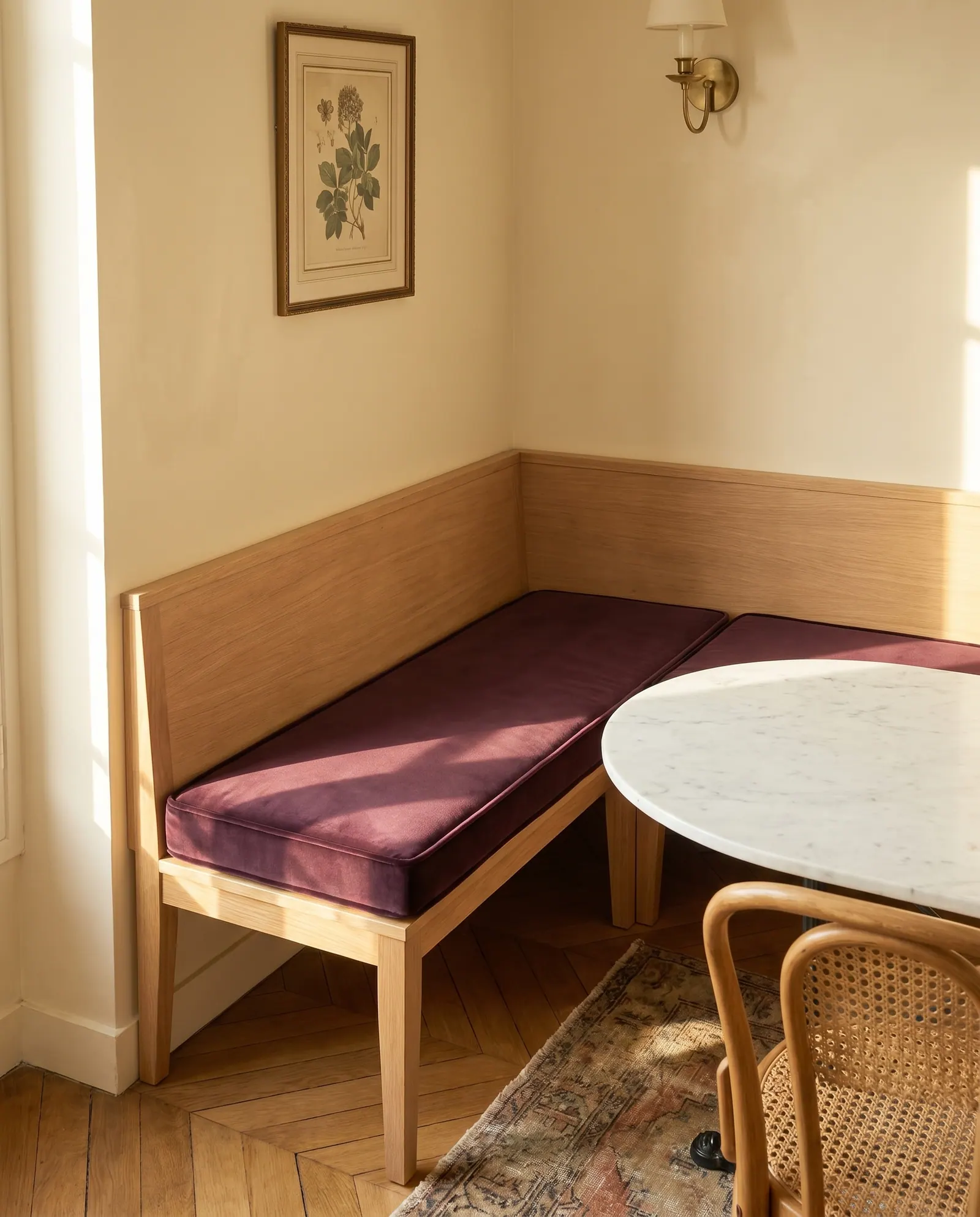
Velvet: mulberry on an oak corner banquette with a marble table. Lovely; think twice if there are toddlers.
The count is how many published readings use each family. Open a family for its swatch book, care notes and neighbors.
Foam height against a table that doesn't move
The standard is 4 in (10 cm), and most buyers keep it. At a nook the thickness matters more than anywhere else, because the table stays where it is: add foam and your knees rise toward the apron. Work it out in the seat height calculator and read banquette cushion thickness: table height and knee room before you settle.
Firmness runs about 6 to 7 on a 1 to 10 scale; backs are softer than seats by default and can be made equally firm. High-density foam keeps the flat, tailored look of a built-in. Every foam cushion has a zippered, fully removable cover at no extra cost, with the zipper on the back edge or underside, and on bench covers it often wraps two corners so the foam slides out.
A real project
Ninety by fifty-five, split in two
A buyer got in touch wanting an L-shaped bench cushion with backs, and did the sensible thing: measured both the outside and the inside of the L. Outside it ran 90 x 55 in (229 x 140 cm); inside, 72.75 x 39 in (185 x 99 cm).
From those four numbers the workshop planned the seat in two pieces, 82 x 18 in (208 x 46 cm) and 29.25 x 18 in (74 x 46 cm), and confirmed the split, and the units, before quoting. Backs don't have to follow both runs; a foam wedge along the longer run alone is a tidy option.
Four honest numbers and one sketch, and nobody had to guess.
Measured
Outside 90 x 55 in, inside 72.75 x 39 in; pieces 82 x 18 in and 29.25 x 18 in
What it taught
Outside and inside L measurements are enough; let the workshop plan and confirm the two-piece split.
Kitchen nook orders that come back
Measuring only one run of the L. Send both legs end to end, or the outside and inside dimensions.
Assuming the back cushions are included. A seat and its backrest are separate items, each added at its own size.
Leaving a shallow bench cushion loose on painted wood. Order a non-slip base or ties.
Writing ties into the size box. Give their position, length and color in the order note, then confirm by message.
Choosing stripes for a long run without knowing the roll is about 55 in (140 cm) wide. A long striped piece needs a seam.
Mixing inches and centimeters on one sketch. Label every number.
Photographs from the workbench
Open any photograph large; each one has its own link and a Save button.
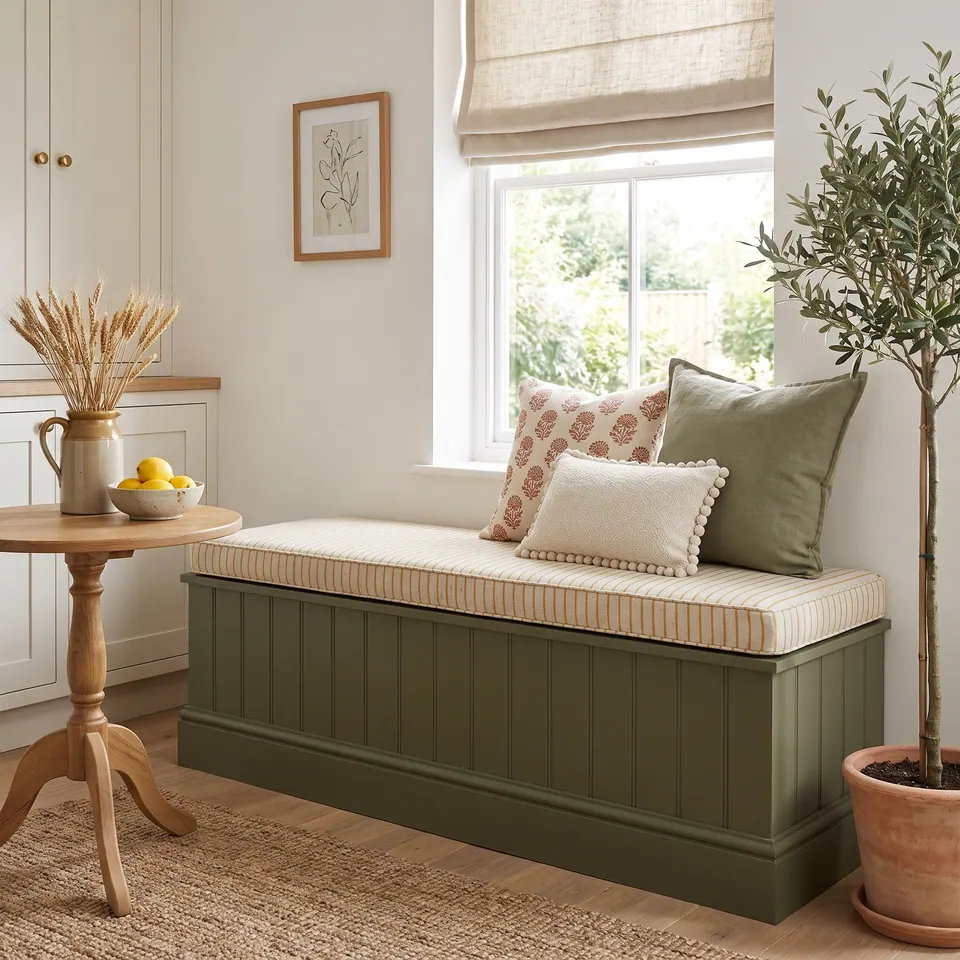
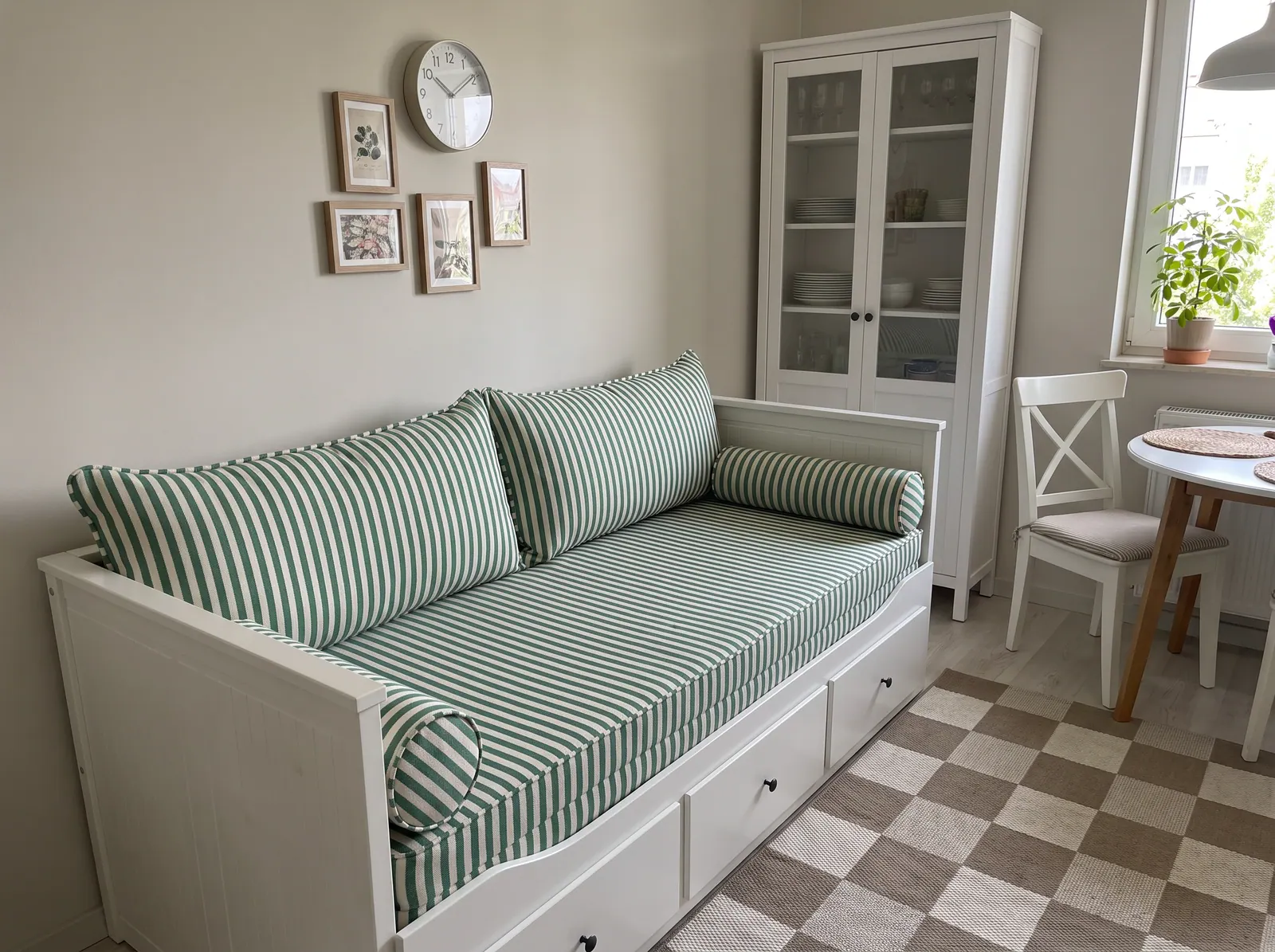
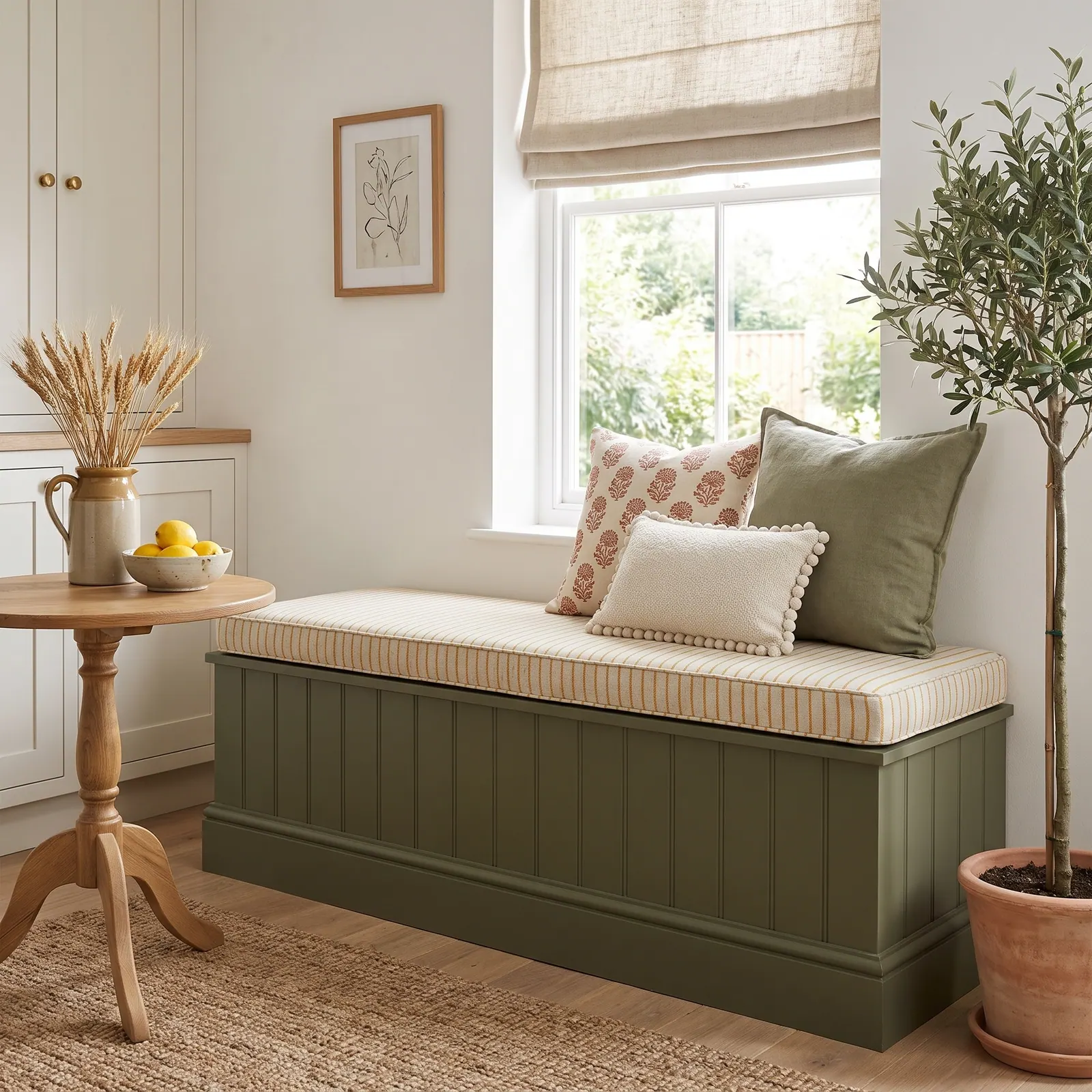
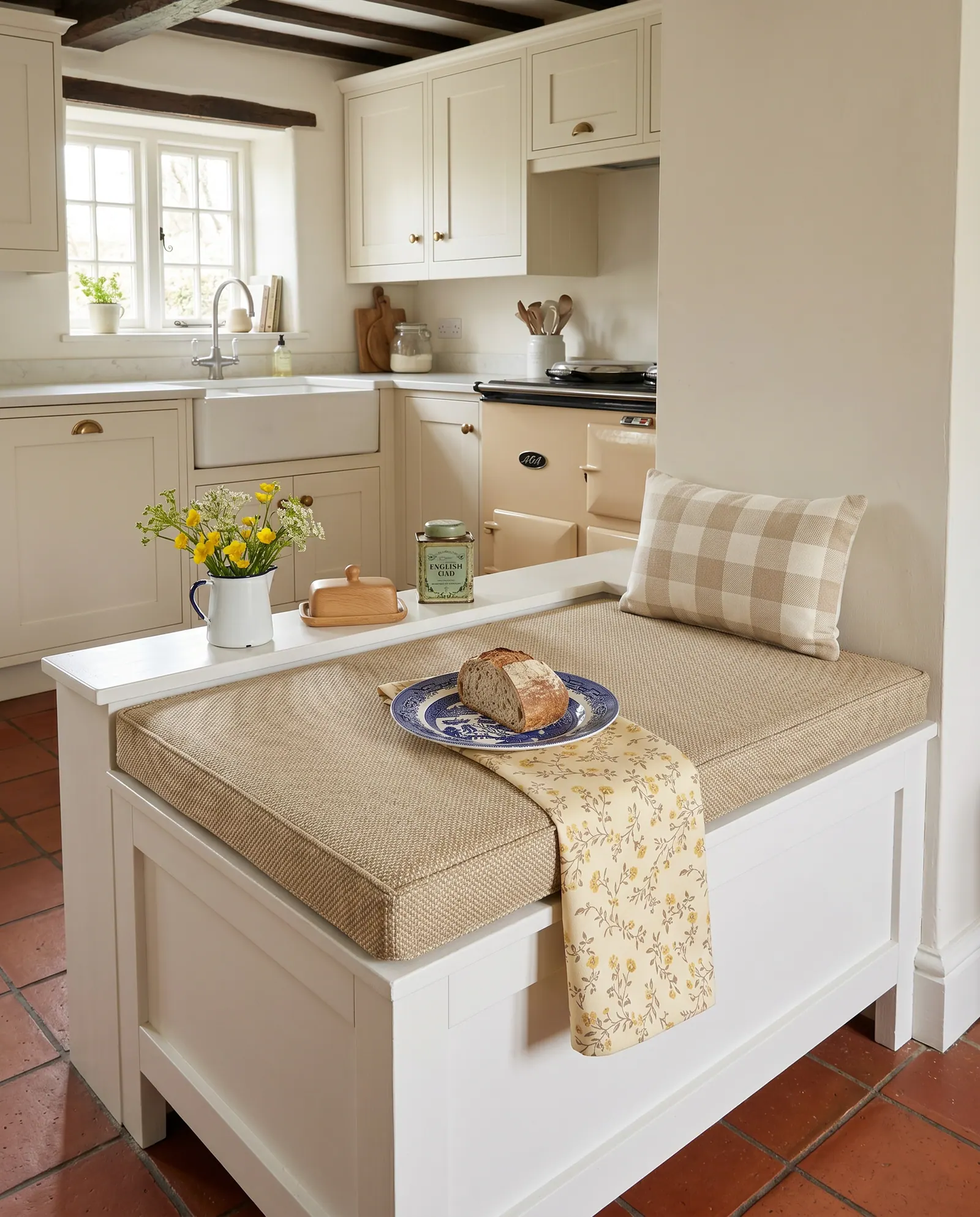
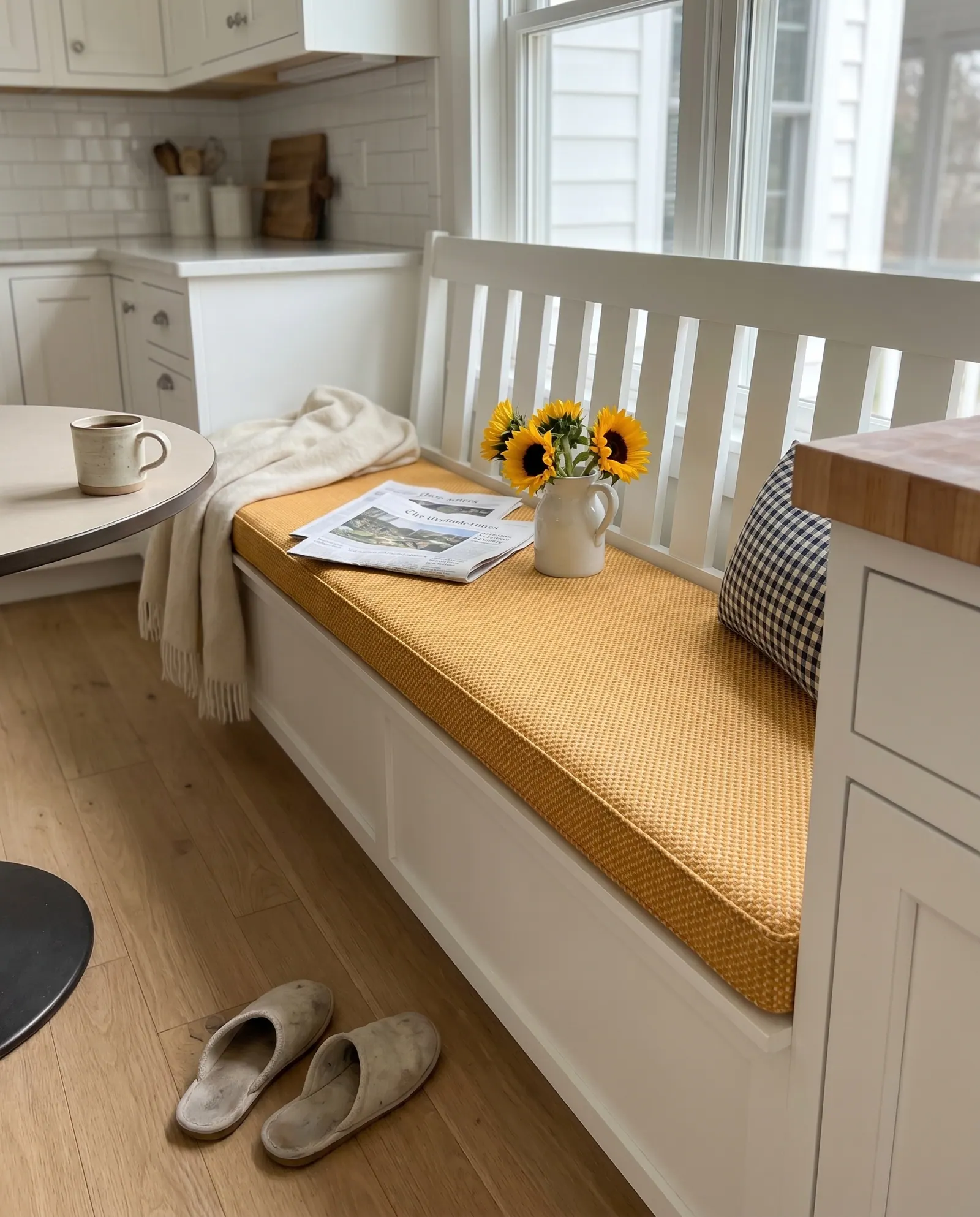
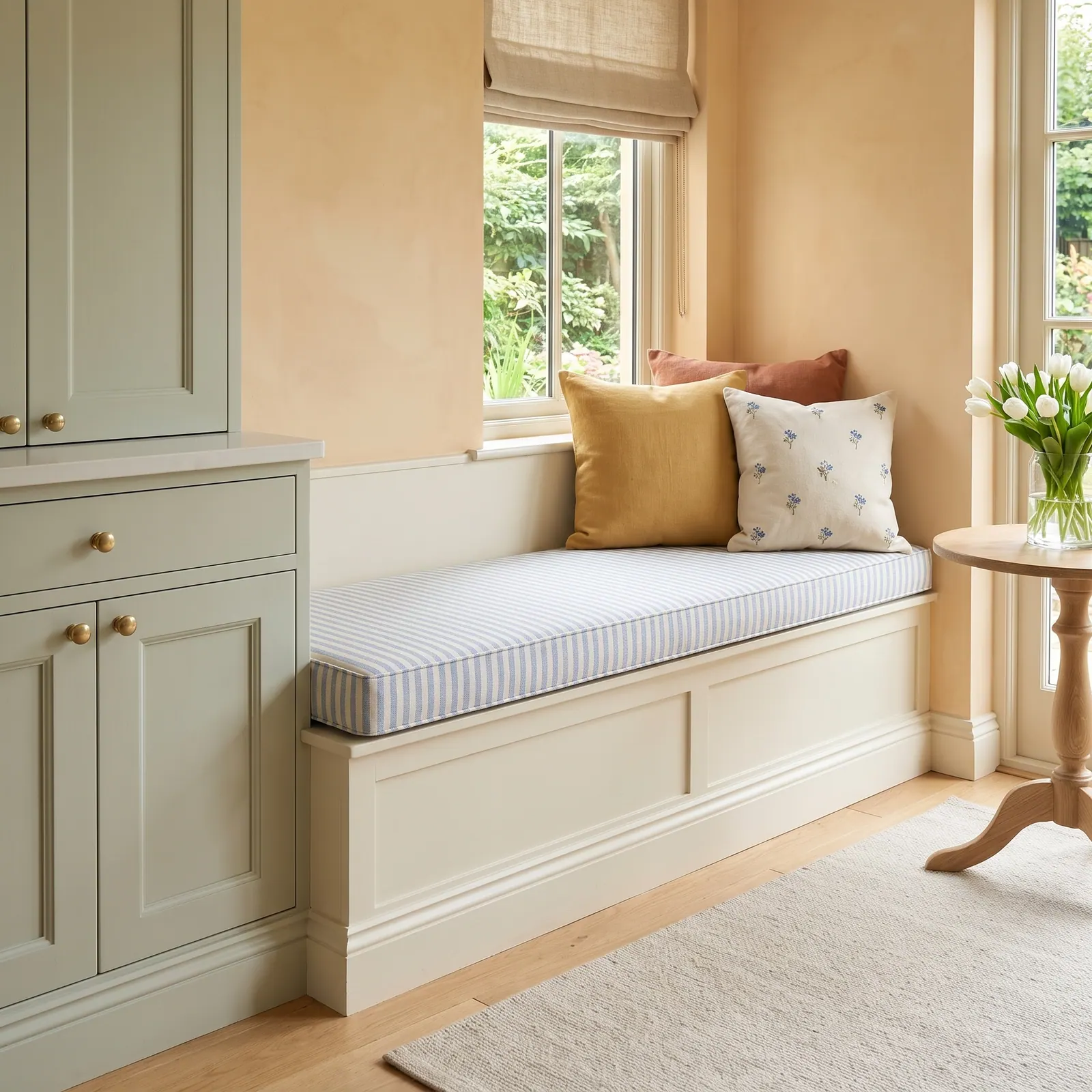
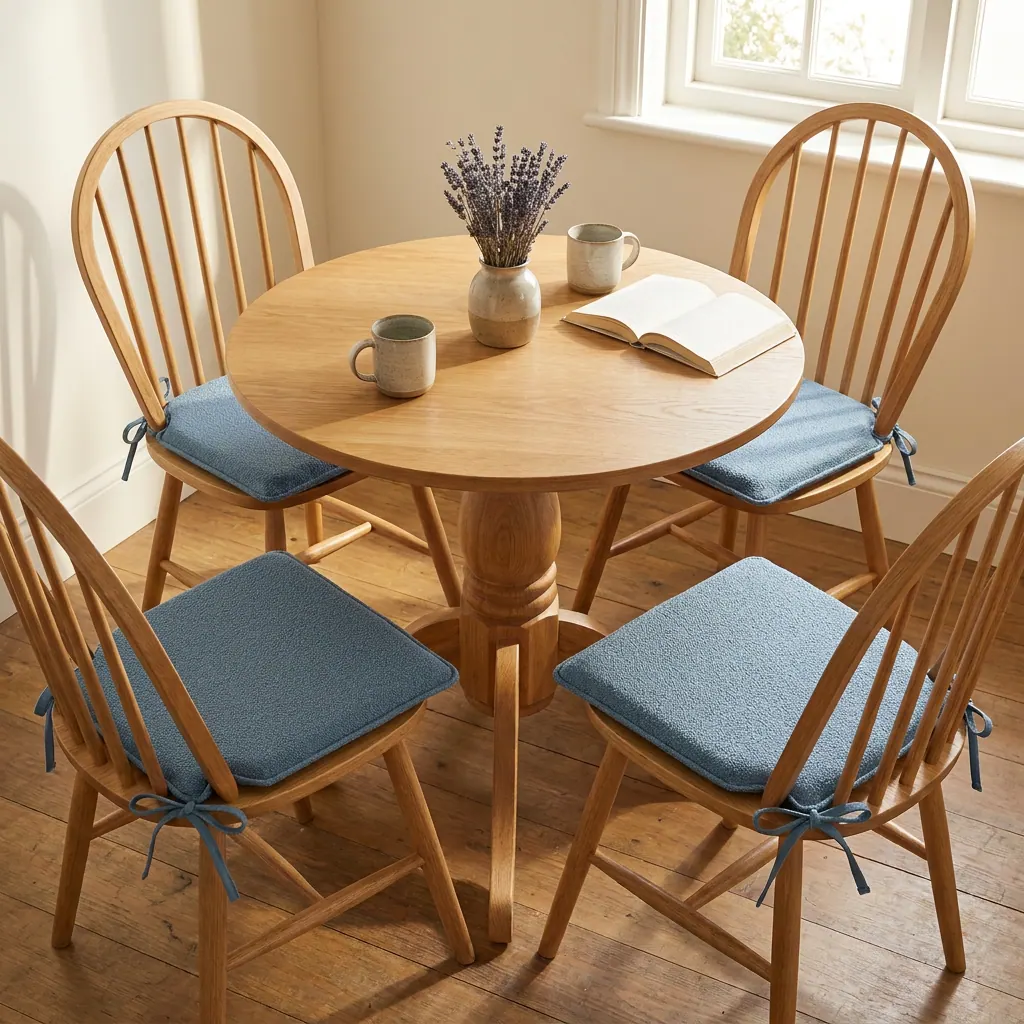
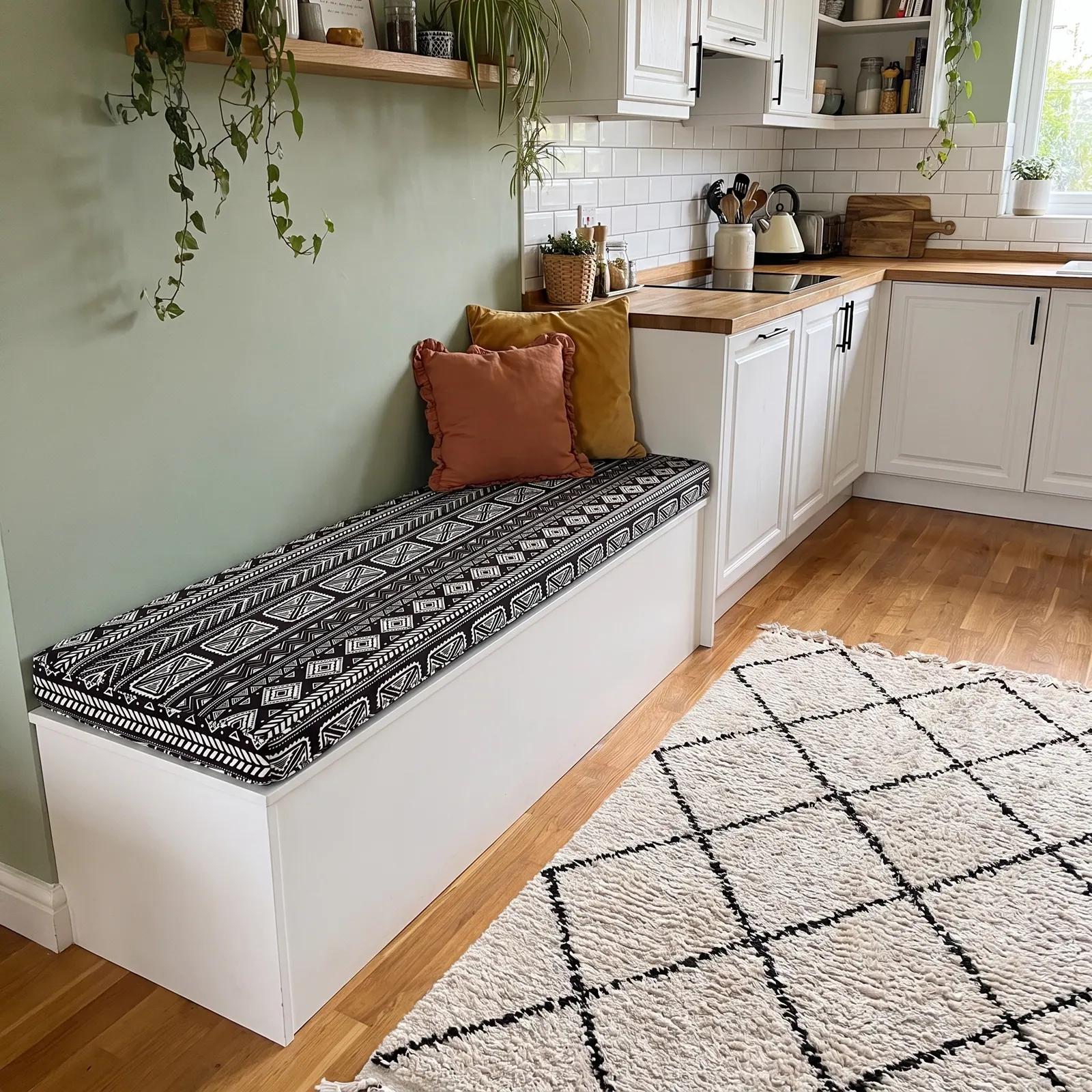
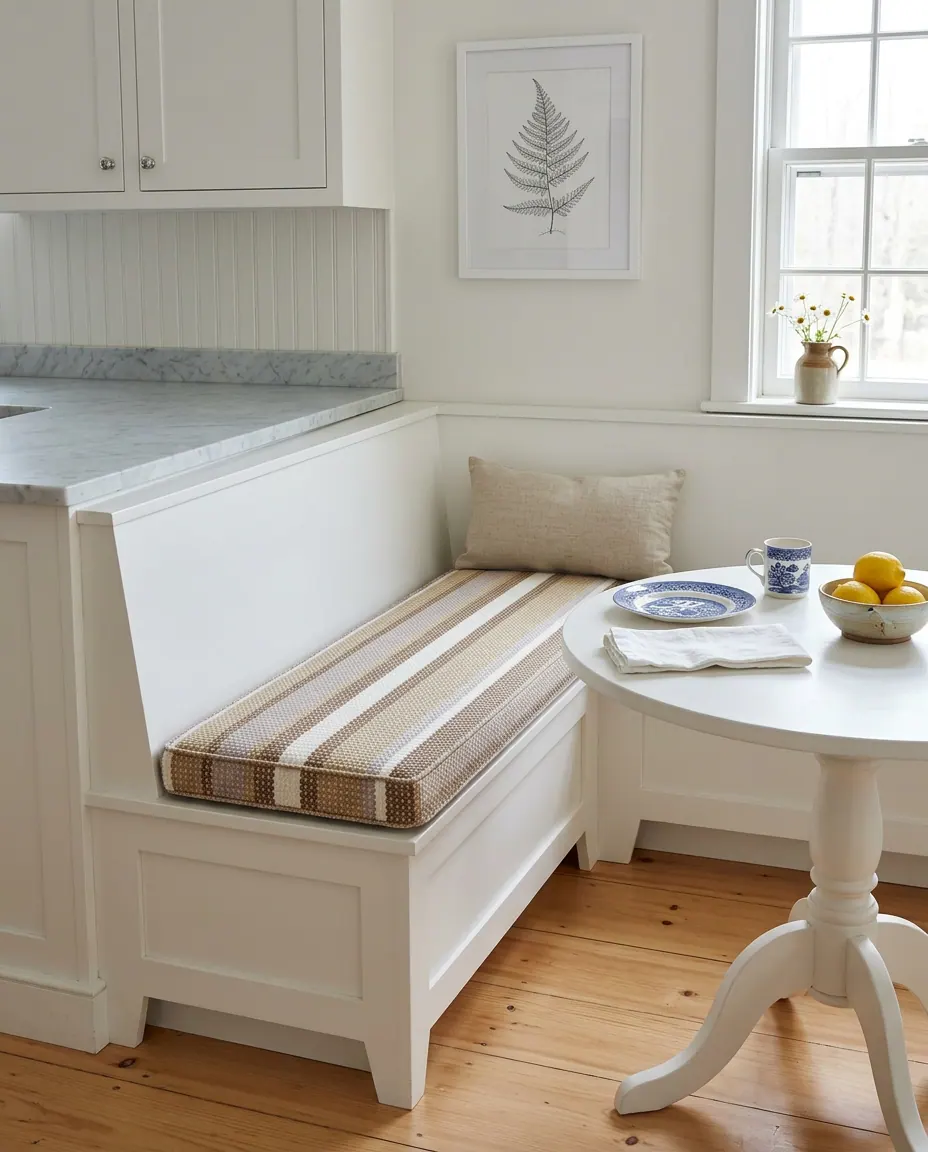
SaveA corner breakfast nook with L-shaped seat and back cushions in navy ticking, piped in solid navy.SaveGreen and white striped covers turn a Hemnes daybed into the sofa side of a breakfast nook. A glass cabinet, round table and checkerboard rug complete the relaxed kitchen corner.SaveA pale striped seat lifts a deep olive bench, while block-print, bobble-trim and linen pillows layer in pattern and texture.SaveA deep oatmeal cushion tops a painted storage bench in a cottage kitchen with beams, a butler sink and a range cooker.SaveA golden cushion brightens a white built-in kitchen bench, styled with sunflowers, the morning paper and slippers.SaveApricot limewash, sage cabinets and a blue ticking stripe: three soft colors that sit happily together.SaveOne color across four chairs: dusty blue bouclé pads tied to honey oak spindle backs.SaveA black and white banded cushion turns the end of a shaker kitchen into a sit-down corner. The diamond rug repeats its lines on the floor.SaveA striped seat cushion on a white banquette in a New England kitchen, with lemons and blue willow on the table.SaveMulberry velvet warms a pale oak banquette, and the marble top and cane chair keep the corner light.SaveWarm apricot stripes on a white L-shaped banquette give a greige dining corner its color.
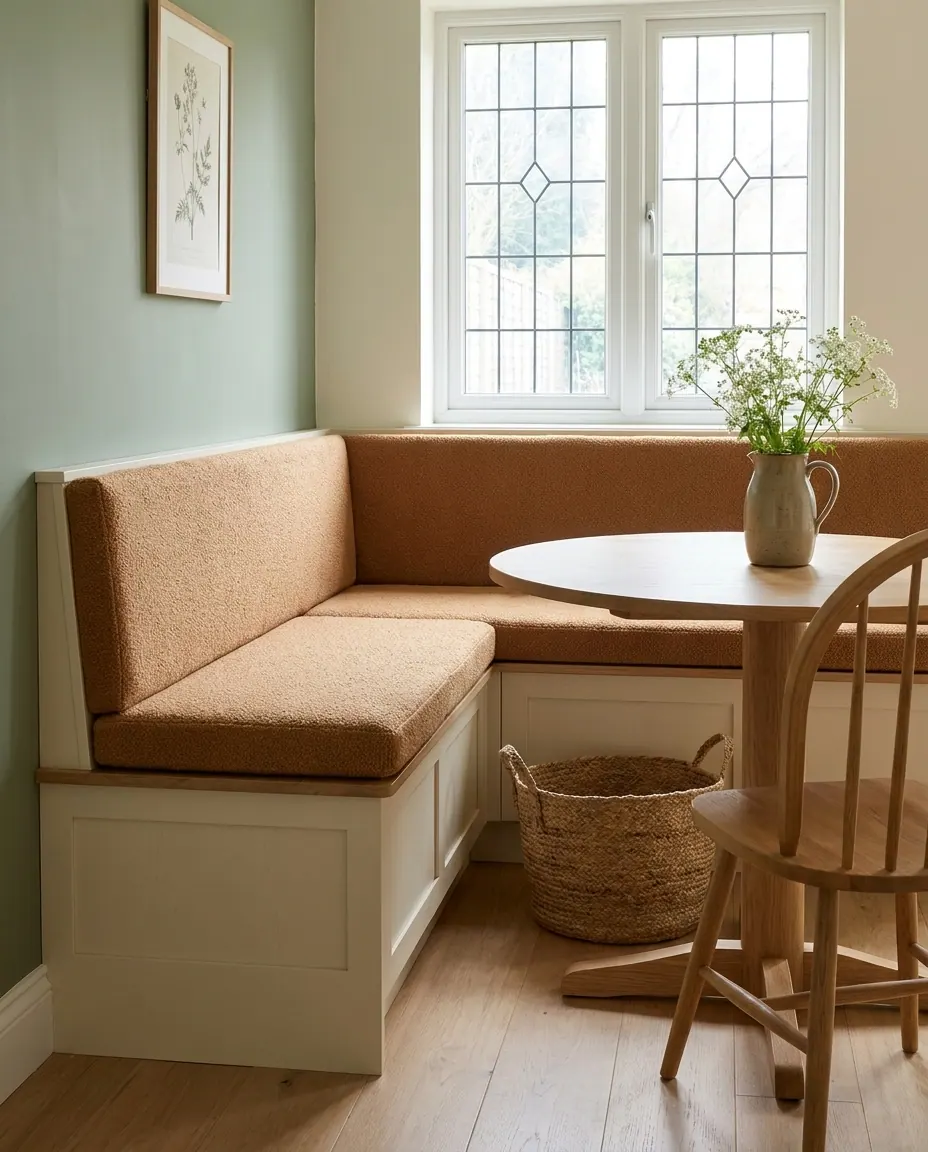
An L-shaped kitchen nook measured 90 x 55 in outside became two cushions, 82 x 18 in and 29.25 x 18 in. Measure both legs of the L, end to end.
Let the seat be the calm part of the kitchen and let the pillows talk. Two or three pillows along the back run, a check or a solid pulled from the stripe, and the corner left clear so someone can slide in. On the navy ticking banquette, navy piping repeats the darkest stripe; that single decision does most of the tailoring.
What sits across the table from your bench: chairs, stools, or the kitchen island itself?
What do you need to quote cushions for an L-shaped breakfast nook with backs?
The workshop's answer
A sketch or photo showing each leg's end-to-end length, plus the seat depth and thickness. Say whether any part is angled and whether you want backrests, and add a photo of the nook and a picture of the back style you like. Standard thickness is 4 in and can be changed, and flat cushions without buttons are possible. The workshop confirms the units and the L layout before quoting.
A common question
The end of our banquette curves. Can you follow that shape?
The workshop's answer
Yes, but not from numbers alone. Send a sketch with the total width and depth, the straight length before the curve, and where the curve starts and ends and how deep it runs, or trace the seat onto paper and photograph the cut-out beside a tape measure. If the original cushions are gone, the team can work out the sizes from the furniture itself.
A common question
If the seat fits but one back cushion doesn't, do you remake the whole set?
The workshop's answer
No, only the parts that don't fit. In one case a new seat and backrest were made while the correct armrests were kept. Send a photo with a tape measure along the full dimension; when the error was the workshop's, the remake came at no cost and the wrong piece didn't need returning. The piping color can change on the replacement.
A common question
Can you hold my order so it arrives on or after a certain date?
The workshop's answer
Yes, for an on-or-after date. Write 'please deliver on or after [date]' in the personalization box or order note, or message the shop, and the order is held or production timed to land close to that date. Transit time varies, so a single exact day can't be guaranteed. With UPS you can also reschedule or hold the delivery yourself.
A common question
I placed the nook order twice by accident. Can one be canceled?
The workshop's answer
Usually, yes: message the workshop right away, since changes and cancellations are possible before production starts. An accidental duplicate is then canceled and refunded, and the refund takes a few days to appear. You may be asked whether size, color or space was the problem, since a custom size or color can be offered instead, but the cancellation goes through on request.
A common question
I typed the wrong seat depth for our banquette. Can I send the right one now?
The workshop's answer
Yes, if you message before production starts; sizes have been corrected after ordering, as when one piece was updated to 75 x 38 x 8 in (191 x 97 x 20 cm). A finished custom piece usually can't be altered, so send the final sizes and a drawing early.
Have it made
Have your kitchen nook cushion made — ask Maggie’s workshop
Numbers first, fabric second, piping last. Jot down what you have, and the workshop will go down the list with you, item by item. — Maggie
Leave your details and the workshop will call you to confirm measurements, fabric, foam and piping. No prices, dates or payment on this page: it is a request, not an order.
Fabric · Foam · Pipingwhat the workshop will confirm with you
Not automatically. A seat and its backrest are separate items: add each backrest at its own size and write 'backrest' in the note. Pillows in listing photos are decorative and sold separately. Backs can run along every run of the nook or only one.
Will the covers come off for washing after a spill?
Yes, on untufted cushions. Each foam cushion has a zippered, fully removable cover, the zipper hidden on the back edge or underside; tufted cushions keep their covers on and are spot-cleaned. For a stain, wash the cover at 86°F (30°C) on a gentle cycle; the foam stays out of the machine.
Can a nook cushion be thinner than 4 inches?
Yes. 4 in (10 cm) is standard and 2 in (5 cm) is the thinnest standard foam. About 1 1/4 in (3 cm) can still take piping; a 1 in (2.5 cm) pad has to be made without it. Tufted cushions can't go that thin.
How firm is a banquette seat cushion?
About 6 to 7 on a 1 to 10 scale. High-density foam gives the structured, flat look of a built-in, and backs are softer than seats by default unless you ask for equal firmness. A cushion can also overhang the bench front by up to about 2 in with an inner support wrap.
How do I stop a breakfast nook seat cushion from creeping toward the table?
A non-slip base, which replaces the whole bottom panel with grippy fabric that holds by friction and leaves no residue, or ties sewn into the seams at the corners or back. Neither is standard, so request it in the order and confirm by message.
Can the chairs across the table get matching pads?
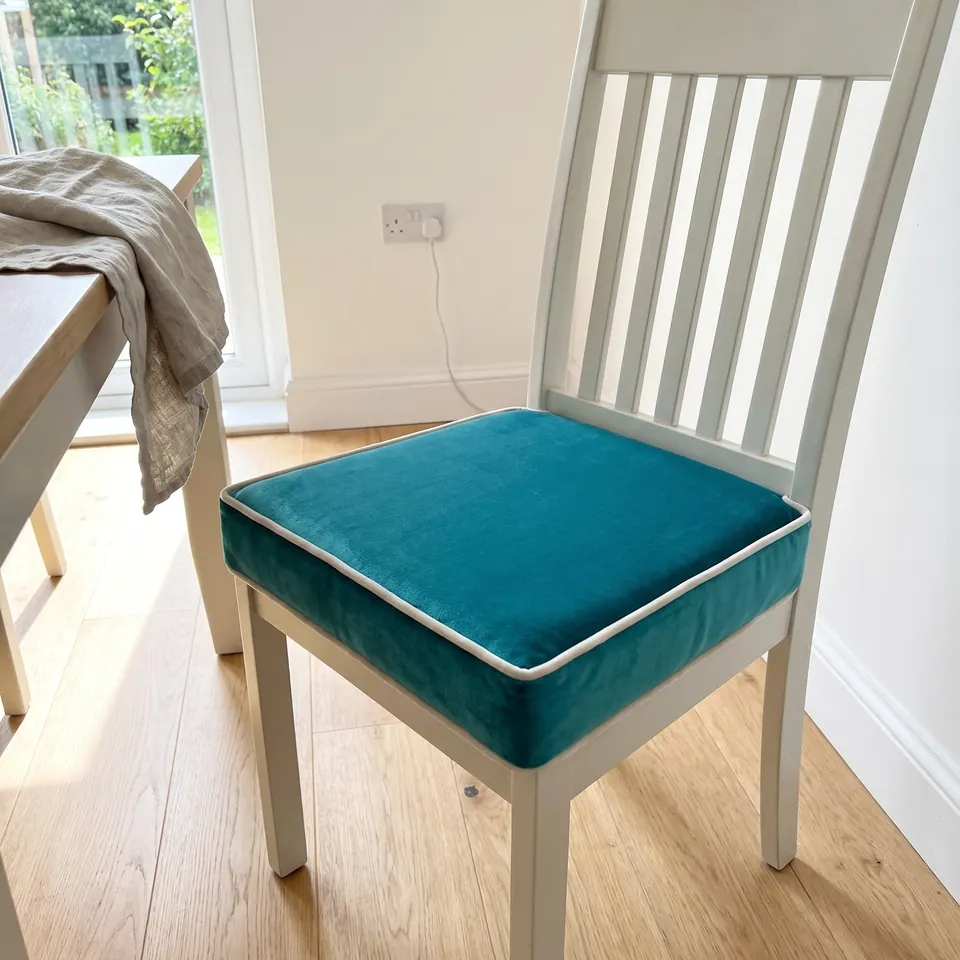
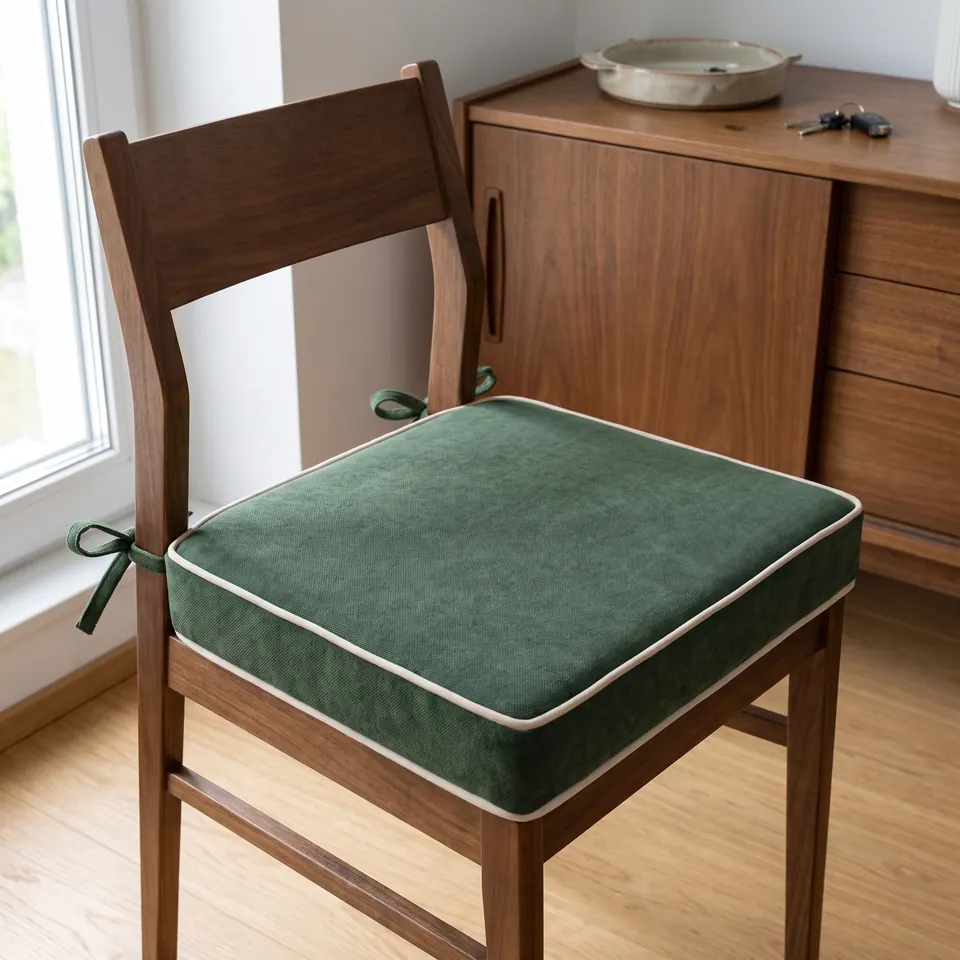
Yes. Chair pads can be made in the same fabric, with ties sewn into the seams wherever you want them, and the non-slip base is available on chair pads too. Measure each seat and give the tie position and length in writing.
Stitch straight — Maggie
Share this atlas entry
Readings
Photographs read by the masters: kitchen nook & dining bench cushions
Real cushions made for real rooms, each read for proportion, fabric and fit.

 Save
 Save
 Save
 Save
 Save
 Save
 Save
 Save
 Save
 Save
 Save
 Save