A Reading by NateL-Shaped Corner Bench Cushions
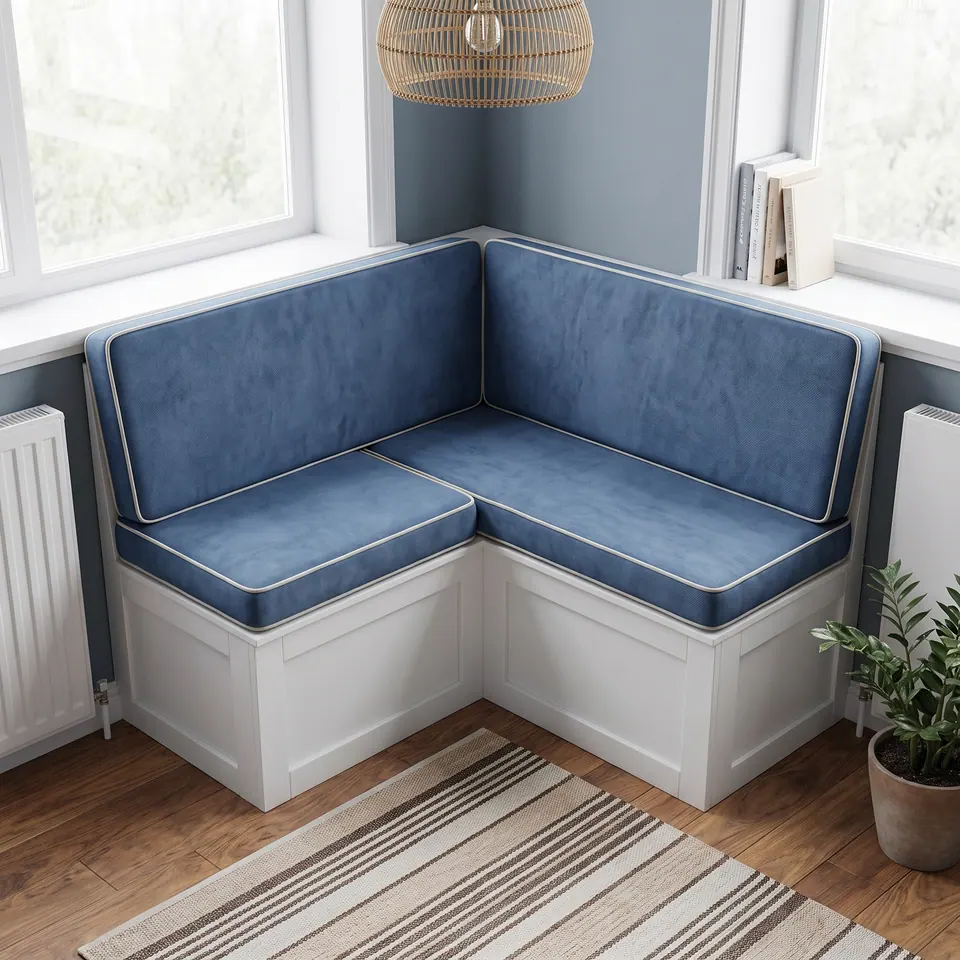
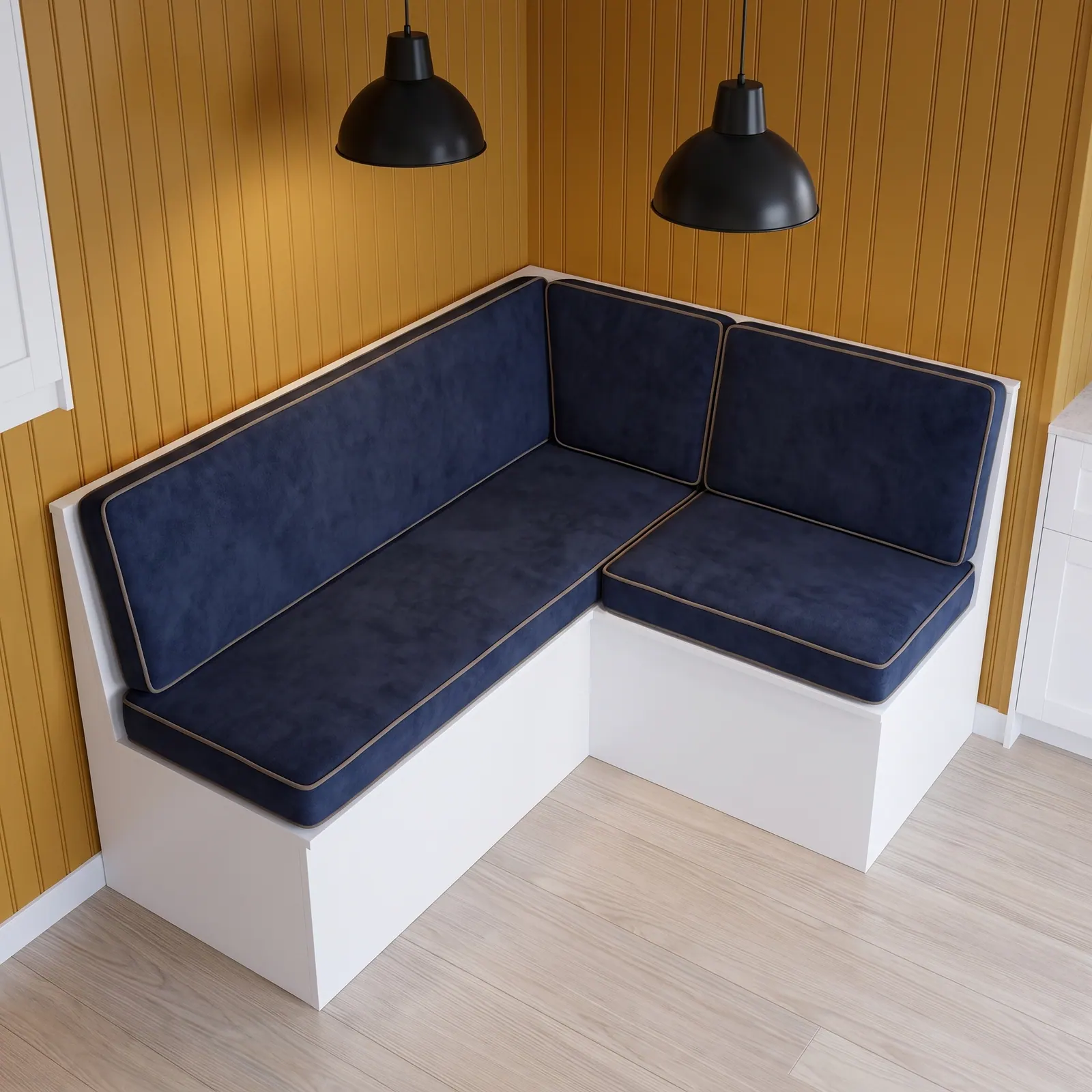
Navy velvet L-shaped banquette cushions in a mustard nook, read under four kinds of light
Nate reads a rendered corner banquette: five panels, sand piping, ochre beadboard, and why navy velvet in a render is not navy velvet under your pendants at dinner.

 Save
The quick answer
Navy velvet L-shaped banquette cushions change with the light more than most fabrics, because the pile turns lighter or darker with the angle of light, and a rendered image shows an even light no kitchen has. Use a render to plan seams and pieces, then choose the navy from a real sample in your nook's daylight and evening lamps.
The cushion, cut open
Cover fabric. A removable, zippered cover. Machine wash at 86°F (30°C) on a gentle cycle and air dry.
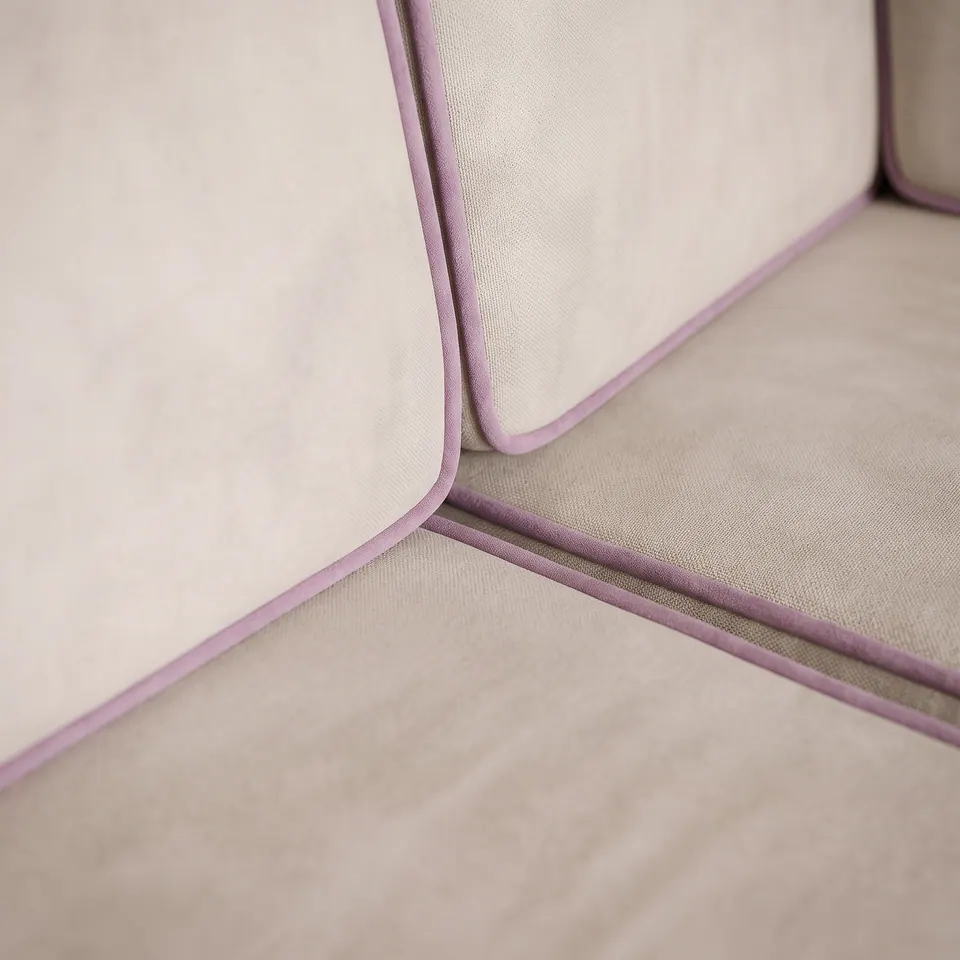
Piping. A fabric-covered cord sewn into the seams. It sits on the seam line, so it does not change the size.
Fiber wrap. Polyester fiber (Dacron) batting around the foam: it fills the cover out and softens the edges.
Foam core. About 2.0 lb/ft³ (32 kg/m³) high-resilience foam, firm to medium-firm, cut to the ordered size.
Zipper. Along the back band, as hidden as possible. The zipper side faces down or toward the wall.
Base panel. The underside of the cover. A non-slip fabric backing can cover the whole of it instead.
Pinned by Nate: the navy velvet L-shaped banquette
Pins mark the pendant, the corner backrest, the short-return seat, the long run and the white plinth, in the order you would measure them.
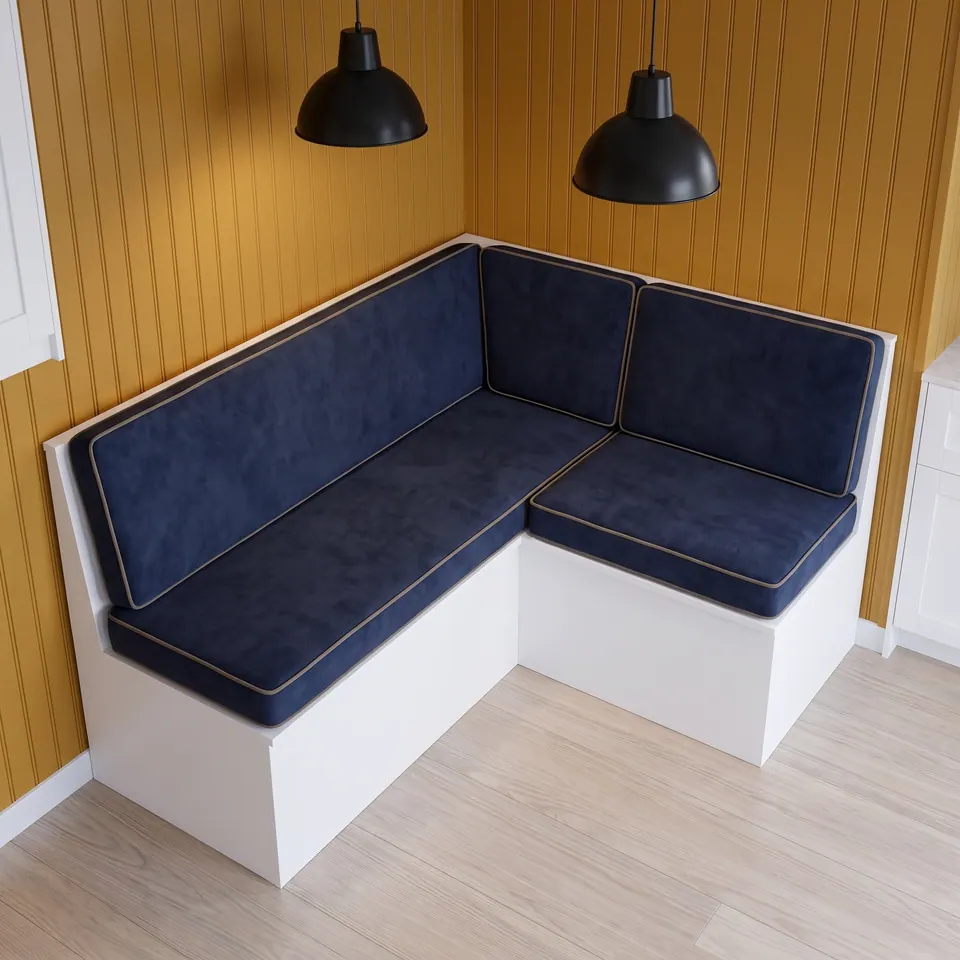
- Black enamel pendant
Two pendants mark where the table will go, centering the eye on the corner of the L.
- Corner backrest piece
A narrow separate back fills the angle so no cushion has to bend around the corner.
- Short-return seat
The short leg gets its own seat, butted against the long run with the piping marking the join.
- Long-run seat cushion
One long seat covers the main run, keeping seams to a minimum where people sit most.
- White bench plinth
The painted base keeps the navy cushions visually lifted off the floor.
- Black enamel pendantTwo pendants mark where the table will go, centering the eye on the corner of the L.
- Corner backrest pieceA narrow separate back fills the angle so no cushion has to bend around the corner.
- Short-return seatThe short leg gets its own seat, butted against the long run with the piping marking the join.
- Long-run seat cushionOne long seat covers the main run, keeping seams to a minimum where people sit most.
- White bench plinthThe painted base keeps the navy cushions visually lifted off the floor.
5 banquette cushions, one render, zero folds
First, a disclosure: this image is a rendering, not a photograph. Treat it as a drawing with good lighting. It is excellent for one job and useless for another.
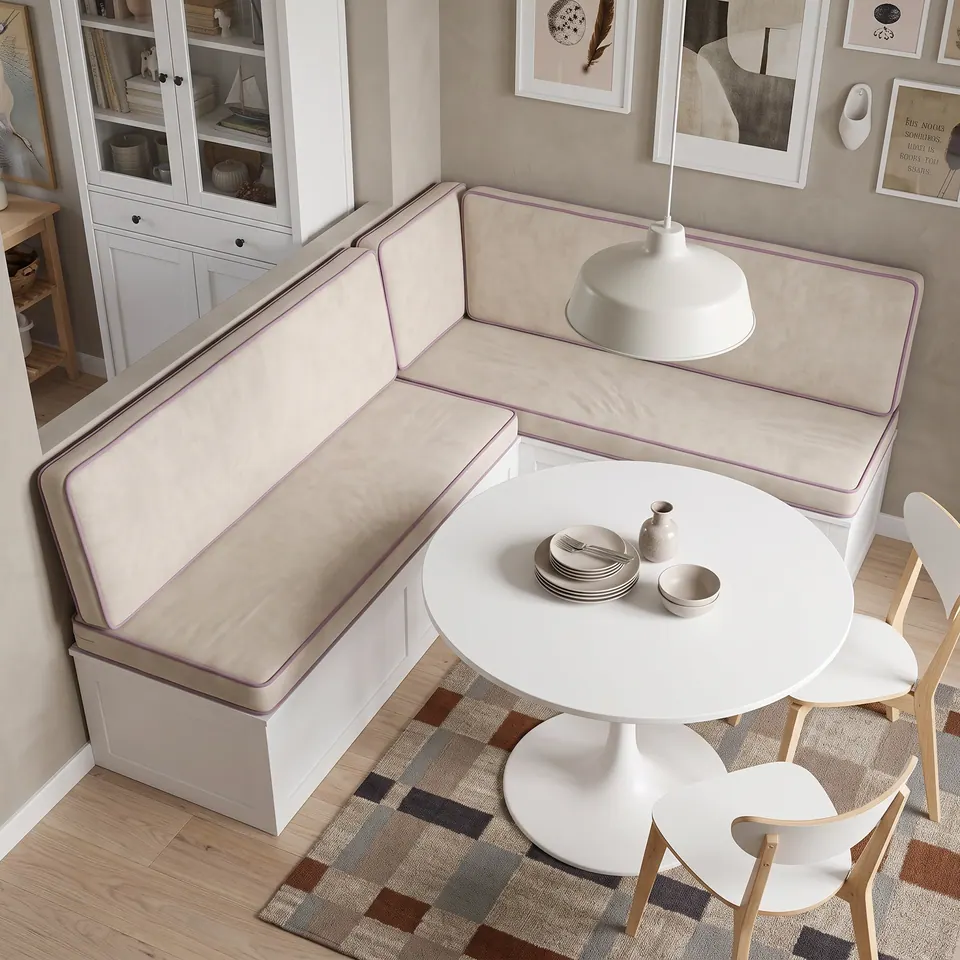
The excellent job is layout. Count the pieces: two seats and three backs. The long run gets one seat and one back. The short return gets its own seat, butted against the long one. A narrow corner backrest bridges the angle, so no cushion has to bend around the corner. Nothing folds. Every join lands where the bench turns.
Sand piping on navy velvet traces each panel. That is why the joins look planned rather than like gaps. The white painted plinth lifts the navy off the pale oak floor, and two black enamel pendants mark where the table goes, centering the eye on the corner of the L.
The useless job is color. Rendered light is even, warm and saturated, and it has no direction. Velvet does. Its pile turns lighter or darker depending on how light strikes it and where you stand. In a render, navy velvet shows one flat navy. In your kitchen it will show several.
The ochre beadboard does real work here. Warm yellow-brown against cool navy is a wide contrast, and it makes the navy read deeper than it would against white. At dinner under warm pendant bulbs, expect the navy to deepen further and the sand piping to brighten. In morning daylight the pile shows more of its blue.
So, partner: use the render to count seams and a velvet sample in your own nook to choose the color. The screen versus daylight pattern covers the second job; the L-shaped cushions and kitchen nook cushions cover the first.
Navy velvet under four lights
| Light | What navy velvet tends to do | Use it to judge |
|---|---|---|
| Rendered image | One even, saturated navy with no pile direction | Piece count and seam positions |
| Morning daylight | Pile shows its blue; the fairest view | The color itself |
| Warm pendants at dinner | Navy deepens; sand piping brightens | Whether the piping still reads |
| Phone or laptop screen | Varies with the display | Nothing final |
One cushion takes the corner
A buyer got in touch with an L-shaped dining bench, 68½ in (174 cm) along one side and 53 in (135 cm) along the other, 17¾ in (45 cm) deep, and got stuck entering the sizes. The shop asked one question first: should the pieces overlap in the corner? No.
After that the arithmetic is short: - Cushion 1 runs into the corner along the shorter side: 53 x 17¾ in (135 x 45 cm). - Cushion 2 loses the seat depth: 68½ in minus 17¾ in is 50¾ in, so 50¾ x 17¾ in (129 x 45 cm).
Two pieces, whole bench covered, no gaps, no overlap. Tolerance is kindness to your future self, and this is where it starts. The L-shaped cushion corner joint pattern draws it, and the bench cushion builder will check your numbers.
On the cutting table: the navy L
| Layout | Two seats, three backs |
|---|---|
| Fabric | Navy velvet |
| Piping | Contrast, sand |
| Edge | Box |
| Corner | Narrow separate backrest; nothing bends |
| Long-run seat | Runs all the way into the corner |
| Short-return seat | Total run minus the long seat's depth |
| Judge color in | Your own daylight and your own evening lamps |
| Best for | Kitchen nooks with the table centered on the corner |

Have it made
Have this made — ask Nate’s workshop
Every edge and both diagonals, to the nearest 1/4 in. If the numbers do not close, the workshop will say so on the call. — Nate
Leave your details and the workshop will call you to confirm measurements, fabric, foam and piping. No prices, dates or payment on this page: it is a request, not an order.
Buyer questions: backrest fill, quotes and the short side
- A common question
One backrest has a small rip and filling is coming out. What's inside?
The workshop's answerThe backrests are filled with shredded foam, which the shop says holds up longer in use. Stray pieces vacuum up easily, and the shop sent a replacement cover for the torn one.
- A common question
If I send my measurements, can you quote a custom window seat cushion?
The workshop's answerYes. Send the sizes and the shop replies with a price and a purchase link made for your order. A tufted linen window seat cushion was quoted exactly this way.
- A common question
For an L-shaped banquette, is one L cushion better than two pieces, and how long is the short side?
The workshop's answerTwo straight pieces work well; one buyer ordered 70 x 18 in (178 x 46 cm) and 102 x 18 in (259 x 46 cm). The corner is the critical point: the short-side cushion equals the total run minus the depth of the long cushion in the corner. A 61 in (155 cm) run beside a 19 in (48 cm) deep cushion needs about 42 in (107 cm), not 61 in. Very large banquettes may need more pieces.
On an L-shaped bench, one cushion runs into the corner and the other loses the seat depth: 68½ in minus 17¾ in makes a 50¾ in cushion.
Nate
Questions buyers ask next
Why put light contrast piping on dark velvet?
It draws each panel. Sand piping on navy traces every seat and back, so the joins in an L-shaped set look intentional instead of like gaps. On a dark fabric, a light cord also keeps the outline readable at night.
Do the two cushions of an L-shaped set overlap at the corner?
No. One cushion runs all the way into the corner and the other stops against its side. Overlapping would stack two cushions in the corner and leave a hump right where someone sits.
What wall color makes navy velvet look deeper?
A warm one. In this nook ochre beadboard sits across the warm and cool divide from navy, and that wide contrast makes the velvet read deeper and richer than it would against a white wall.
± 1/4 in — Nate