The Pattern Room · a side-by-side pattern
Which piece owns the corner? Joining L-shaped bench cushions
Two runs of bench, one corner, and a surprising amount of opinion about who gets it. Right, then. Here are the four ways the pieces can meet, and the one subtraction that saves the most grief.

 Save
The quick answer
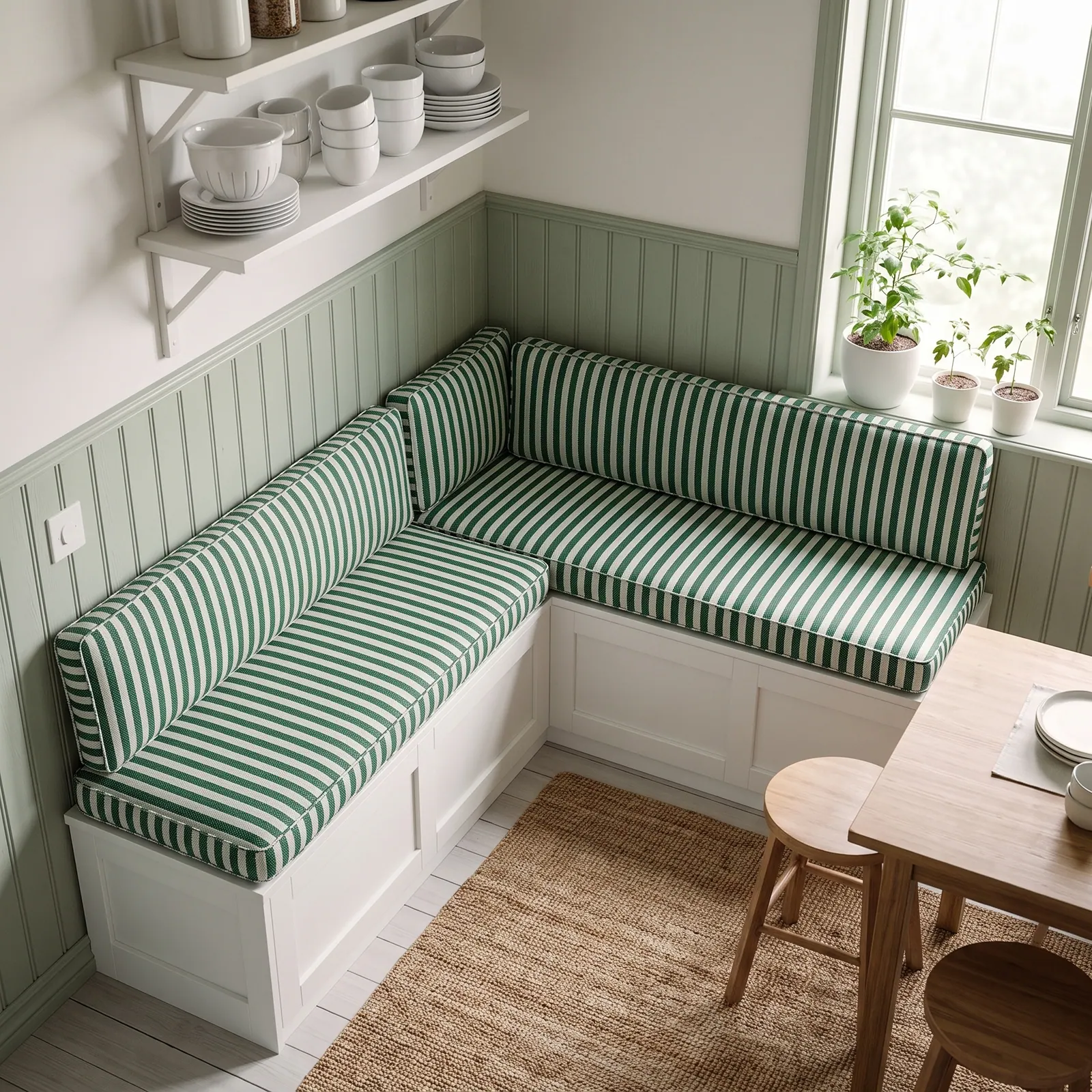
For most L-shaped bench cushions, make two rectangles that butt together: one cushion runs into the corner and the other is shortened by that cushion's depth, so a 61 in run beside a 19 in deep cushion takes about a 42 in piece. Miters, corner squares and one-piece Ls also work, but cost more or fit less forgivingly.
One corner, two cushions, no sharing
An L-shaped bench has one corner and two cushions that both think they deserve it. Only one can have it.
That's most of the decision. One of the most common L-shaped problems is a leg that came out too long, and it usually begins with both cushions claiming the same square of bench. I made the same mistake once myself, on a window seat in a drafty Colonial, and the extra length did not fold politely.
So before fabric, before piping, before thickness: decide which piece owns the corner of your L-shaped bench cushion.
4 ways two cushion runs can meet at a corner
| Corner build | Crumbs and lifting | Zipper access | Shipping | With piping | Cost and fit |
|---|---|---|---|---|---|
| Butt joint (the usual build) | One straight seam at the corner; each piece lifts on its own for a storage lid | On each back edge, easy to reach | Two rectangles; ships safely | The short piece's piped end meets the long piece's piped side in a clean T | No extra cost; the most forgiving fit |
| 45-degree miter | One diagonal seam from inside to outside corner; each piece lifts separately | Back edges, as with a butt joint | Two trapezoids | Piping meets on the diagonal, like a picture frame | Both pieces become trapezoids: more cost, less room for error |
| Corner square plus two arms | Two seams at the corner; three light pieces to lift | One per piece; keep the square's off the inside corner | Three rectangles, easiest to pack | The piped square reads as its own seat | All rectangles; the arms can be equal lengths |
| One-piece L | No corner seam to catch crumbs; the whole L lifts at once | The cover is hard to take off and put back | Largest parcel and the riskiest to ship | One continuous welt turning the inside corner | Considerably more expensive, with a much higher margin for error |
Key facts
- L-shaped benches and banquettes are normally made as two cushions meeting at the corner.
- Short-side cushion = total run minus the depth of the cushion that owns the corner.
- A 45-degree miter turns both cushions into trapezoids, which cost more and may fit less well.
- A one-piece L costs considerably more, carries more error risk and its cover is hard to remove.
- When one leg of an L-shaped set comes out too long, the corner was usually counted twice.

Have it made
Measured it? Have Maggie’s workshop make it
Have the tape measure handy when they call. Old cushions shrink and sag; the seat underneath does not. — Maggie
Leave your details and the workshop will call you to confirm measurements, fabric, foam and piping. No prices, dates or payment on this page: it is a request, not an order.
The butt joint: subtract the corner cushion's depth
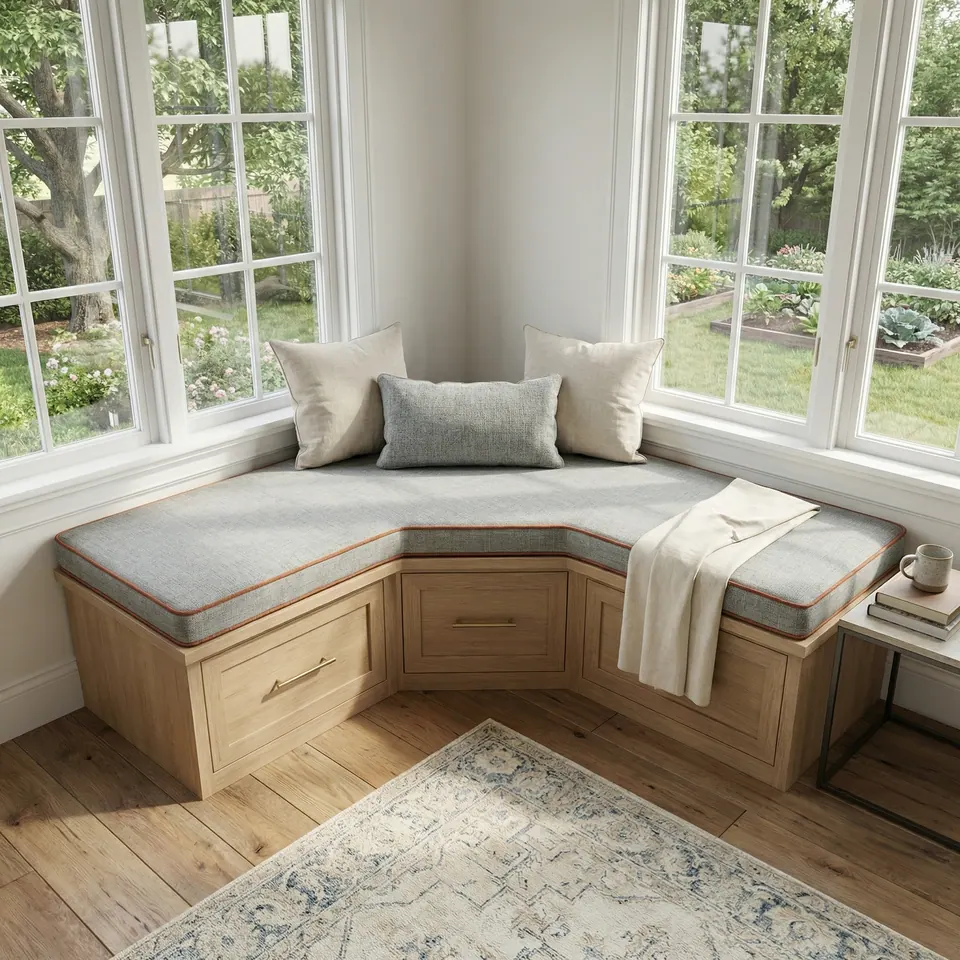
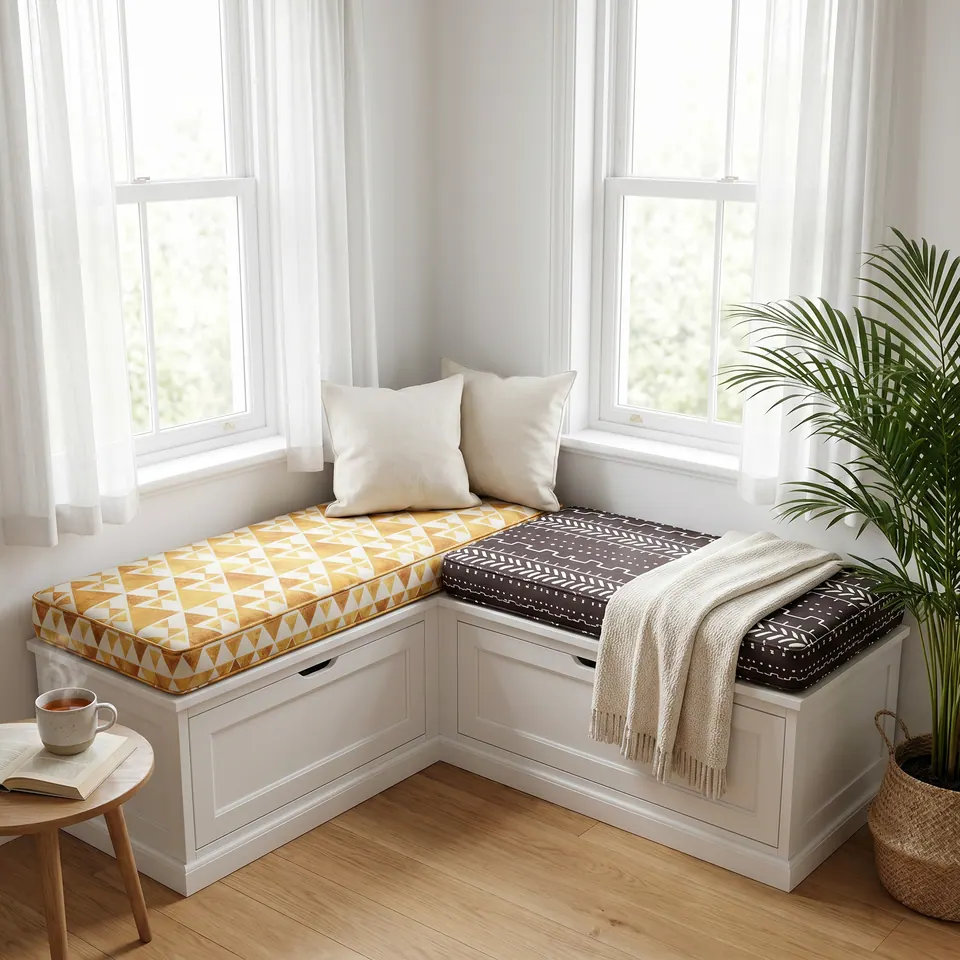
The workshop's usual build is the butt joint. One cushion runs all the way into the corner. The other stops against its side and is shortened by its depth.
The arithmetic is short: short-side cushion = total run − depth of the cushion that owns the corner. A 61 in (155 cm) run beside a 19 in (48 cm) deep cushion needs a cushion of about 42 in (107 cm), not 61.
To measure for it: - Measure each leg end to end along the wall. - Measure the seat depth, and give one depth unless the two runs truly differ. - Choose the owner, often the longer run or the side that gets sat on most. - Subtract the owner's depth from the other leg, and the first backrest's thickness from the second backrest. - Draw both legs with the overlap shaded, dear, and write every number on the drawing.
If you have outside and inside L measurements instead, send both. The workshop plans the two-piece split from them and confirms it with you. The L-shaped measuring Pattern walks through every letter.
Angled corners: when rectangles become trapezoids
Not every corner is 90 degrees, and not every buyer wants a straight seam.
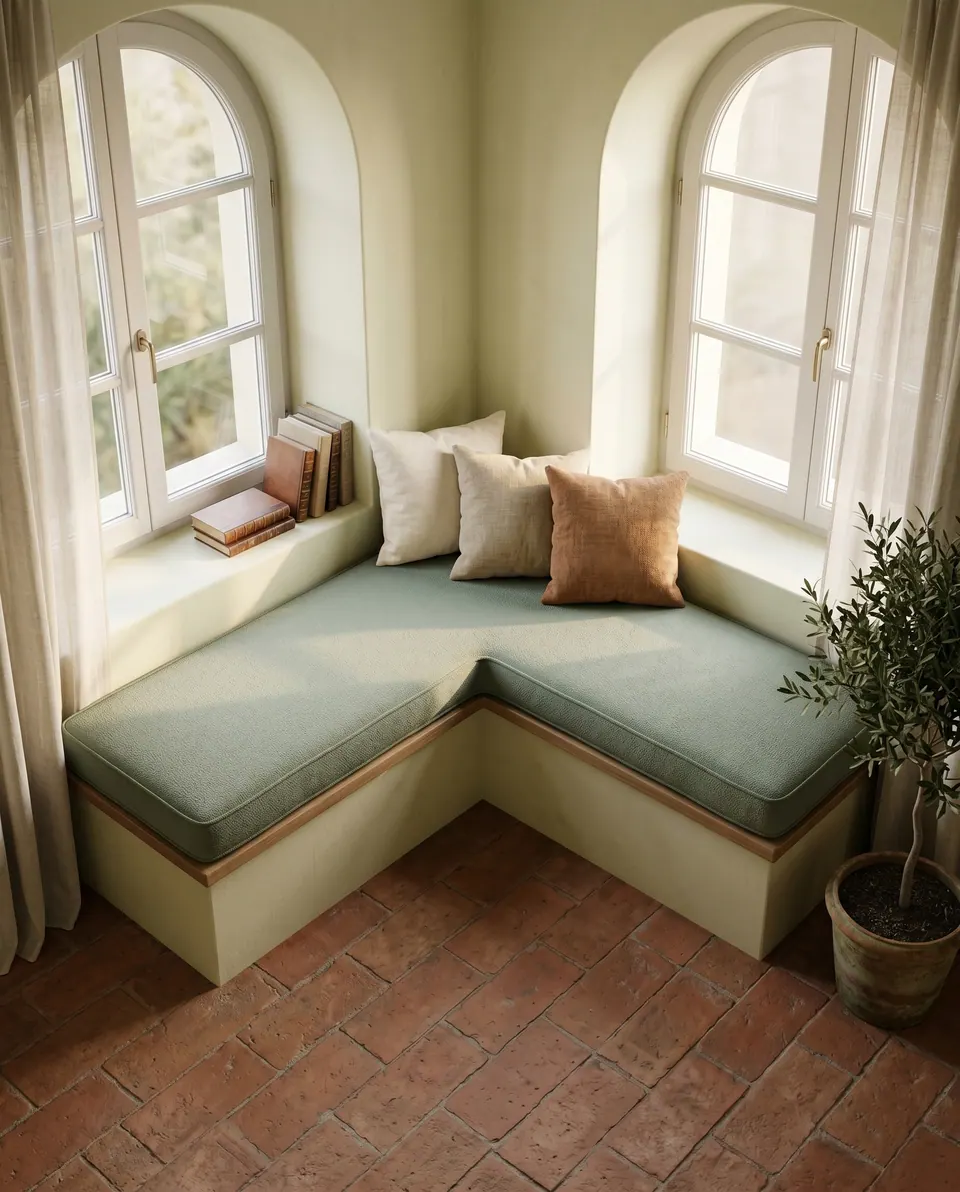
At a square corner, one long and one short rectangle is the simplest build. It costs nothing extra and fits most reliably. Cut both ends on a 45-degree diagonal for a mitered look and both pieces become trapezoids. They cost more and may not fit as well, because every angle has to be right twice.
When the corner itself isn't 90 degrees, say 120, the pieces are trapezoids whether you like it or not, and two trapezoid cushions are often the answer. For a bench with an angled middle section, the workshop proposed two rectangles plus one trapezoid, so every seam lands on a seat edge.
A diagonal cut can't be added as a note. It needs a drawing with every edge, including the angled cut; one corner bench needed ten measurements, labeled A to J, including 5 3/8 in (13.5 cm) angled corners. The trapezoid cushion calculator and the angled corner bench sketches help.
Two cushions instead of one L, and an order paused
A buyer in the US had an L-shaped kitchen bench and chose two cushions meeting at the corner rather than one L piece. Sensible. Then the order came through with 2 in on one piece and 3 in on the other, and the size range paid for didn't match the second cushion.
The workshop paused production and asked. Mixed thicknesses in an L leave a step at the corner that every guest will find. The final pieces were about 83 3/8 x 19 1/8 in and 23 5/8 x 19 in, both 3 in thick in about 2.0 lb/ft³ (32 kg/m³) foam.
Look at the numbers. 23 5/8 plus 19 1/8 is 42 3/4 in: the short leg's full run, less the depth of the long cushion that owns the corner. Nobody counted the corner twice.
Another buyer in the US sent an outside L of 90 x 55 in and an inside L of 72.75 x 39 in. Same answer: two cushions, meeting at the corner.
Common mistakes at the corner
- Giving the full wall run for both legs, which counts the corner twice and makes one leg too long.
- Measuring the outside of the frame instead of the seat.
- Forgetting to shorten the second backrest by the thickness of the first.
- Ordering the two pieces in different thicknesses, or paying for a size range that doesn't match the written size.
- Leaving the layout out of the order note. Write open or closed corner, L-shaped or straight backrest, and each piece's size.
- Asking for a diagonal join in a note instead of ordering trapezoids with a drawing.
- Choosing a one-piece L for a big bench, then wrestling the cover back on after every wash.
Build both legs before you order
Size each leg as its own cushion in the bench cushion builder: the owner at its full run, the short piece at the run minus the owner's depth, both at the same thickness. Seeing the two at their true sizes catches a doubled corner faster than any spreadsheet.
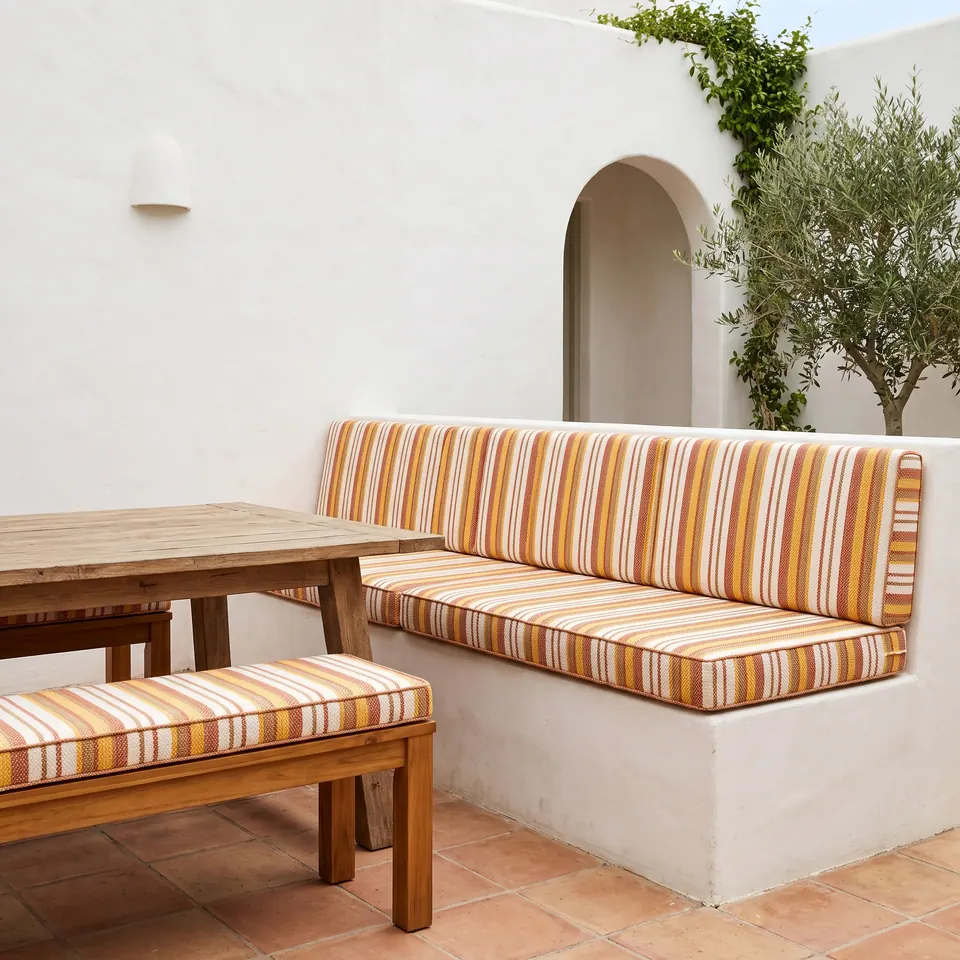
Then choose the fabric with the corner in mind. On a striped cushion the stripes turn with the L, so read up on stripe direction first. For a family table, the kitchen nook and banquette pages cover fabrics that forgive crumbs. Which leg of your bench gets sat on most?
On an L-shaped bench, the short cushion is the full run minus the depth of the cushion that owns the corner: a 61 in run with a 19 in seat takes 42 in.
Margaret Holloway
Buyer questions: settling the corner
- A common question
Should our L-shaped bench cushion be one piece or two?
The workshop's answerTwo, meeting flush at the corner, is the recommendation. Separate cushions fit more cleanly, ship much more safely, and are easier to handle, unzip and wash. A one-piece L makes the cover hard to take off and put back, costs considerably more and leaves a much higher margin for error. A small L can still be one piece: the workshop turns your sketch into a lettered template and asks you to confirm every edge and the thickness.
- A common question
How do I order cushions for an L- or U-shaped banquette?
The workshop's answerOrder each straight run as its own cushion. The key is the corner: the short-side cushion is the total run minus the depth of the long cushion sitting in the corner, so a 61 in run next to a 19 in deep cushion needs about 42 in. For a U, one layout was two sides of 63.5 x 21.5 in and a back of 93.5 x 21.5 in. Piping comes as standard.
- A common question
Our corner bench meets at 45 degrees. How should the cushions split?
The workshop's answerAt a normal 90-degree corner, one long and one short rectangle butting together is simplest, costs nothing extra and fits most reliably. A mitered 45-degree join, or a corner that isn't 90 degrees, turns the pieces into trapezoids. Those are ordered as custom shapes with a drawing of every edge, including the angled cut; a note alone isn't enough.
- A common question
What do you need from me to quote an L-shaped bench with back cushions?
The workshop's answerA sketch or photo with the end-to-end length of each leg, the seat depth and thickness, and whether any part is angled or needs backrests. Outside and inside L dimensions also work, for example outside 90 x 55 in and inside 72.75 x 39 in; the workshop plans the split into two pieces and confirms it. Backs can run along one side only, and standard thickness is 4 in.
- A common question
Do I need to mail you a paper template of the corner?
The workshop's answerNo. A hand drawing with every edge measured, or photos plus measurements, is enough for angled shapes. If you make a full-size template anyway, photograph it with the measurements marked instead of mailing it. The workshop redraws the shape as its own diagram and checks that your numbers add up before quoting.
Corner questions, answered at the bench
Which cushion should own the corner of an L-shaped bench?
Either, as long as only one does. The longer run or the side that gets sat on most is a sensible owner. What matters is that the other leg is shortened by the owner's depth, and that your drawing shows which piece is which.
Does a mitered corner look better than a butt joint?
It looks more like a picture frame, with the piping meeting on the diagonal. It also turns both cushions into trapezoids, which cost more and leave less room for error. At a square corner, a piped butt joint reads just as tailored, and it forgives a wall that isn't quite true.
Can the corner of an L-shaped banquette be its own square cushion?
Yes. A square corner cushion with a long cushion on each arm is a common layout, such as 20.75 x 65 1/8 in, 20.75 x 20.75 in and 20.75 x 65 in. You get two seams at the corner instead of one, but three lighter pieces that are easy to lift and wash.
How do I keep the two halves of an L from drifting apart?
Ask for fabric ties sewn into the seams at the corners or the back, in the positions you mark, to fix each piece to the bench. On a lift-up storage lid, split the cushion at the lid break and add ties there. A non-slip base helps on smooth benches.