The Cutting Table · a question, worked through
My corner bench meets at an angle. How should the cushions be split?
One of the questions we get most from kitchen banquettes. The geometry is easy; the ordering is where people slip.

Pinned by Nate
The quick answer
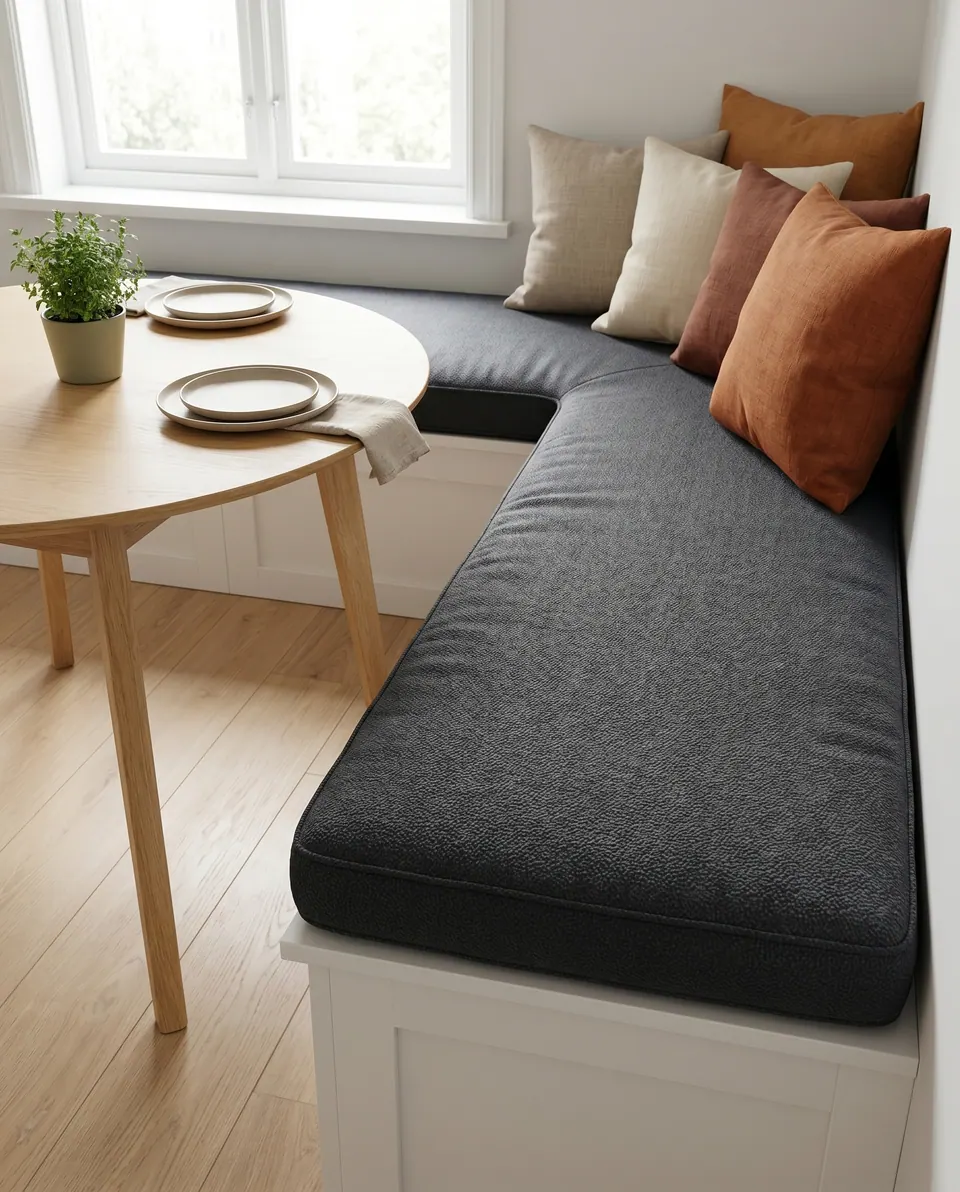
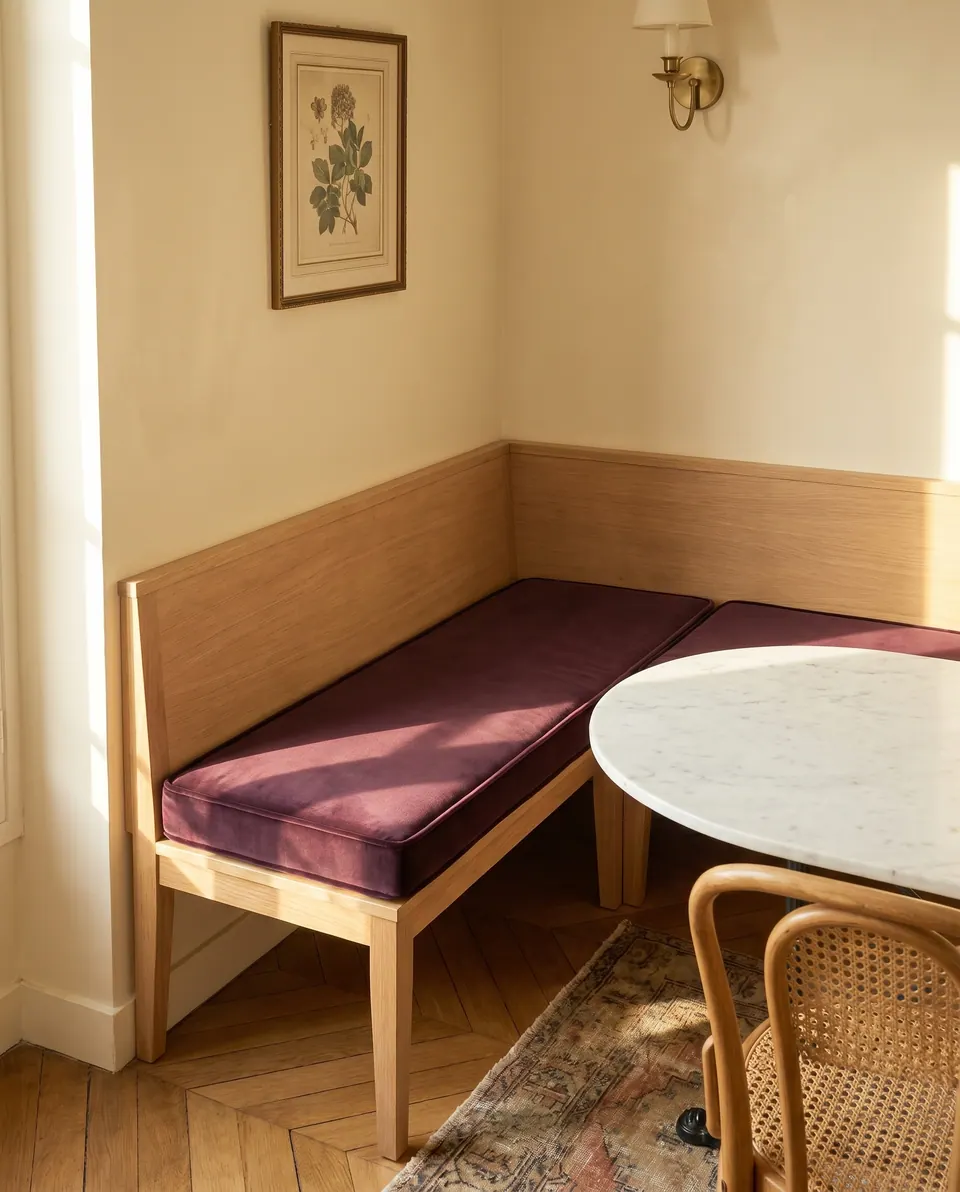
At a normal 90° corner, split the bench as one long and one short rectangle that butt together; it costs nothing extra and fits most reliably. A mitered 45° join, or a corner that isn't 90°, such as 120°, turns the pieces into trapezoids, ordered on the trapezoid listing with a drawing of every edge, including the angled cut.
Get a quote for a banquette cushion
Key facts
- At a 90° corner, one long and one short rectangle is cheaper and fits more reliably.
- A diagonal (mitered) corner join makes both cushions trapezoids.
- Diagonal cuts are ordered on the trapezoid listing, not added as a note.
- Each cushion's size range is chosen by its longest and deepest measurements.
- Corners that aren't 90°, such as 120°, are often made as two trapezoid cushions.
- A corner bench with an angled middle section was split into two rectangles and one trapezoid.
- Covers are zippered, removable and washable.

Have it made
Have Nate’s workshop cut this for you
Every edge and both diagonals, to the nearest 1/4 in. If the numbers do not close, the workshop will say so on the call. — Nate
Leave your details and the workshop will call you to confirm measurements, fabric, foam and piping. No prices, dates or payment on this page: it is a request, not an order.
Start with the square corner
Partner, at a true 90° corner the cheapest cut is also the best one. One cushion runs the full length of the long side, the short one butts against its end, and both stay rectangles. No extra charge, and the most reliable fit you'll get.
Cut both ends on a diagonal and you have two trapezoids. One reply called the price difference considerable, another called it slight; both agreed it costs more and may not sit as snugly. Angles are just lengths in disguise, and every extra angle is one more length that has to be right.
The L-shaped corner joint Pattern shows the butt joint in detail, and the banquette cushion hub covers the rest of the bench. What does your corner actually measure with a protractor or a speed square?
Four corners, four splits
| Your corner | Split the workshop suggests | How it's ordered |
|---|---|---|
| Square 90° corner | One long + one short rectangle | Standard rectangle sizes, no extra cost |
| 90° corner, mitered 45° join wanted | Two trapezoids | Trapezoid listing + drawing with the angled cut |
| Corner at 120° | Two trapezoid cushions | Trapezoid listing + photos and a paper drawing |
| L with an angled middle section | Two rectangles + one trapezoid | Photos and a full sketch; the shop proposes the split |
Ordering an angled corner, one honest length at a time
Photograph the bench
Straight on and from above, so the shop can see where the angle sits.
Draw it on paper
Label every edge with a letter, A, B, C and on, including each angled cut. One bench needed ten, A through J.
Find each cushion's range
On the trapezoid cushion listing, pick the range by that cushion's longest and deepest measurements.
Upload, don't just note
A written note like '45° corner' isn't enough. Upload the drawing with every edge measured; the trapezoid calculator helps you check it first.
Ten letters on one kitchen bench
A buyer got in touch about an L-shaped kitchen bench with 45° front corners and asked whether it should be one cushion or two. The drawing had ten measurements, A through J: runs of about 100 in (255 cm) and 75.5 in (192 cm), plus angled corners of 5 1/4 in (13.5 cm). The workshop made it as two cushions.
Another buyer's bench bent through an angled middle section. From the photo and sketch, the shop proposed three pieces: about 18 x 51.5 in (46 x 131 cm), a trapezoid of about 27 x 28 in (69 x 71 cm), and 18 x 20 in (46 x 51 cm), all 4 in (10 cm) thick on high-density foam.
Banquette cushions cut to meet at 45° are trapezoids, and a note on the order won't do; the drawing has to show the angled cut.
Nate
Buyer questions
- A common question
Can my two corner cushions meet on a diagonal instead of one long and one short?
The workshop's answerThey can, but cushions that meet on a diagonal are trapezoids: priced higher and not always as good a fit. One long and one short rectangle is simpler, costs nothing extra, and is what the shop recommends.
- A common question
My banquette cushions meet at 45° in the corner. Can I just add that in a note?
The workshop's answerNo. Cut on the diagonal, they're trapezoids, which changes the listing and raises the price slightly. Order on the trapezoid listing by each cushion's longest and deepest measurements, and upload a drawing with every edge, including the 45° cut.
- A common question
Our dining corner bench meets at 120 degrees. One cushion or two, and how do I measure?
The workshop's answerThe angle isn't a problem as long as the measurements are there. Send photos and a paper drawing of the shape with sizes; for that bench the shop recommended two trapezoid cushions ordered through the trapezoid listing.
- A common question
What measurements do you need for an angled or trapezoid cushion?
The workshop's answerEvery edge: front, back, both angled sides and any clipped corners, plus the straight depth and thickness, on a labeled drawing with a photo of the space. Measure each angled side separately.
Questions buyers ask next
Can a strongly curved corner bench cushion be made?
Mild curves are fine. Strongly curved or exact-fit shapes may be declined after a craftsman reviews them, and a full-size paper template can make a borderline shape possible. Send photos and the template idea before ordering.
My bench has one angled end, like under the stairs. Is that the same thing?
Yes, that's a trapezoid too. Order on the custom-shape listing using the longest edge and deepest depth, and upload a drawing showing the angle with all four sides measured; the cushion is cut exactly to it.
Can the covers on angled corner cushions come off for washing?
Yes. The covers are zippered and removable, so trapezoid pieces come off for washing just like the rectangles. The foam stays inside its shape while the cover is cleaned.