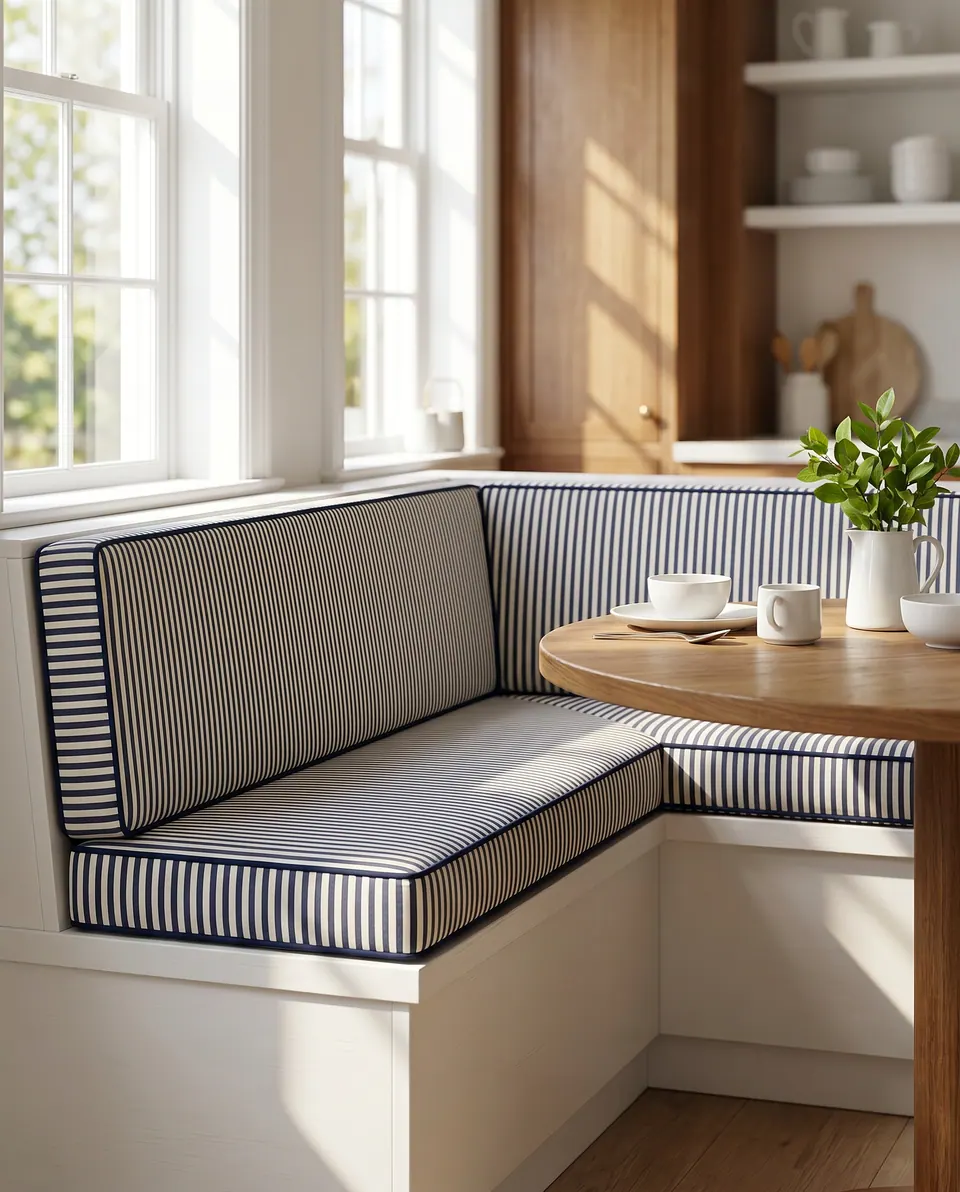
The Pattern Room · a measuring pattern
How to measure an L-shaped bench or corner banquette for cushions
An L is two straight cushions and one corner that belongs to only one of them. Measure it the way the kitchen corner actually sits, and the rest is arithmetic.

 Save
The quick answer
Measure an L-shaped bench as two straight runs: each wall from the back corner to its end, plus the seat depth of both legs. One cushion runs the full length into the corner, and the other is shortened by that depth so the corner is counted once. A 90 in and 68 in L at 20 in deep becomes 90 x 20 and 48 x 20 in.
Who owns the corner?
Every L-shaped bench has one square of seat in the corner, and only one cushion can own it. Give the full wall length for both legs and you have paid for that square twice. It is the L-bench mix-up that comes up most often.
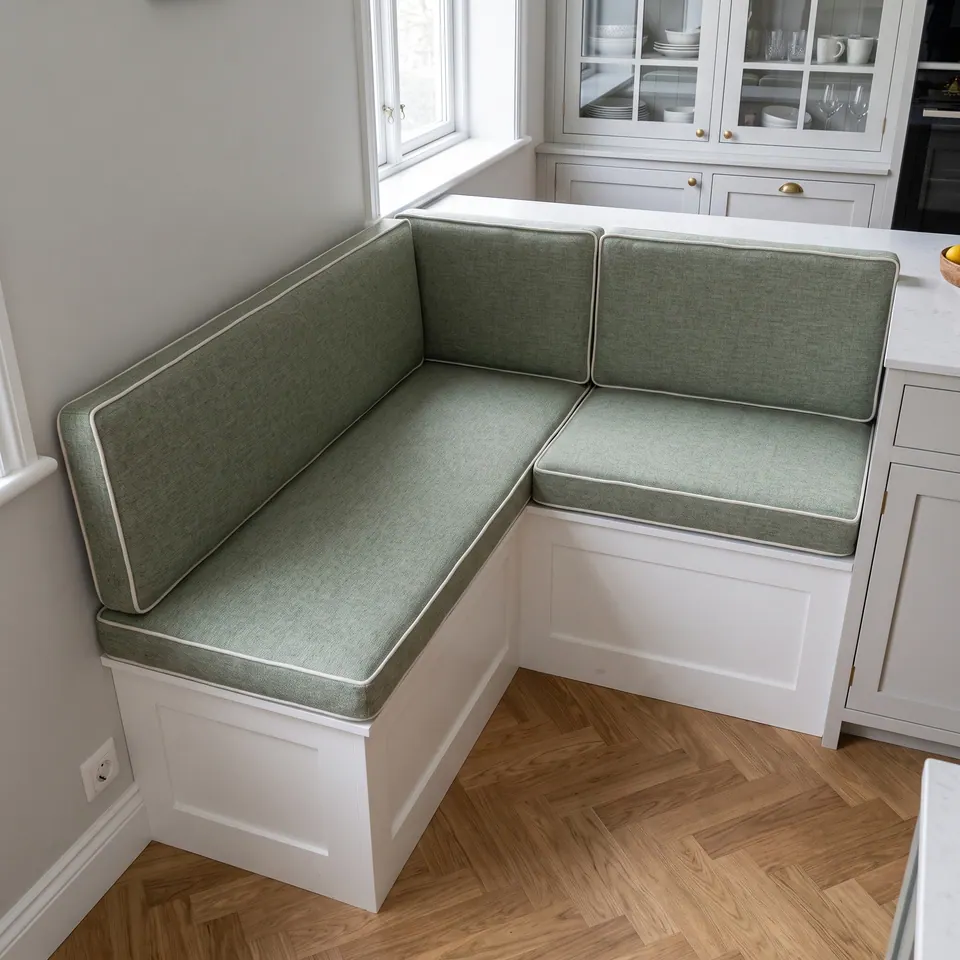
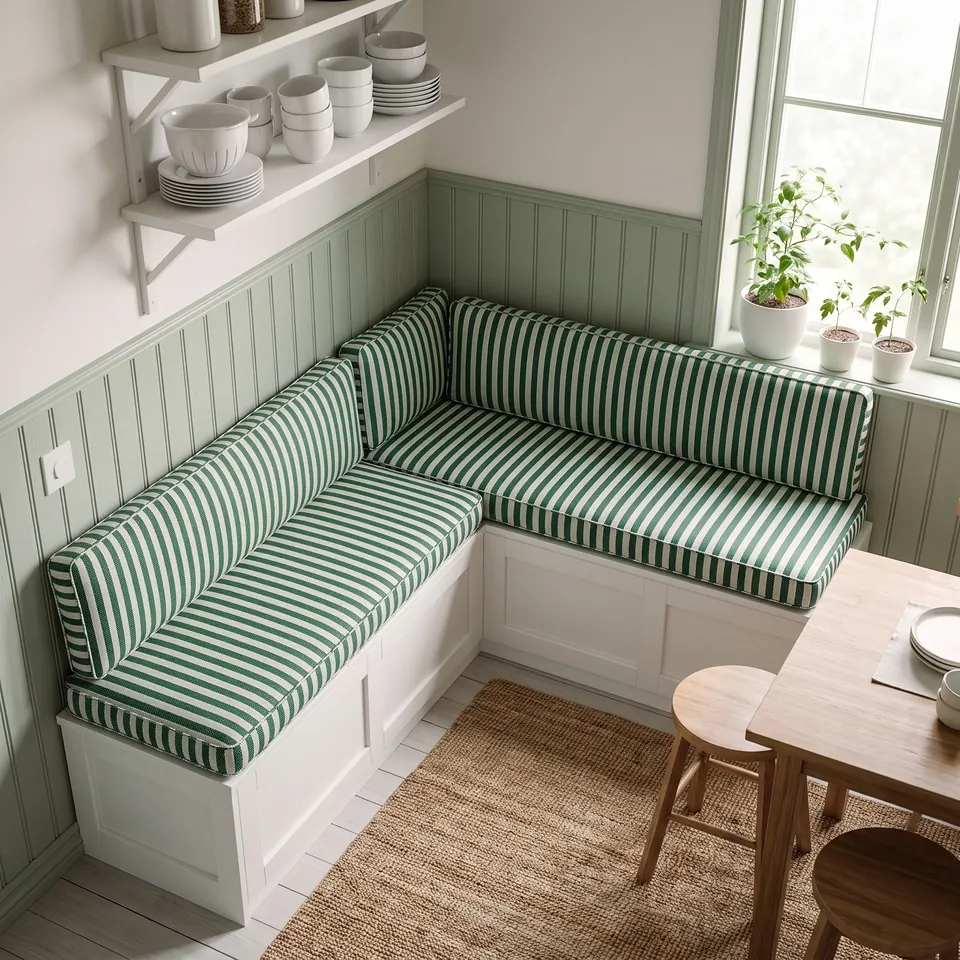
So here is how L-shaped bench cushion measurements work. The L is made as two separate L-shaped cushions that meet flush. One runs the full length of its wall into the corner. The other is shortened by the depth of the first, so the two butt together instead of overlapping. Separate pieces fit more cleanly, ship more safely and zip off for washing without a wrestling match, which matters at a kitchen nook that sees breakfast every day.
I learned this years ago on a banquette of my own, when I wrote down the bench outline instead of the cushions and spent an evening with a very long leg and a very short temper. Measure the bench, not the cushion you used to have, and then write down the cushions.
Measure the L the way the corner actually sits
Sketch the L from above and name each leg
Draw the bench as if you were standing on a chair looking down. Call the longer leg A and the shorter leg B, and mark where the walls are. Every number that follows goes onto this sketch, dear, not onto the back of an envelope you'll lose.
Pattern sheet Outside runs 90 and 68 in, depth 20 in. Piece 1 runs the full 90 in; piece 2 is 48 by 20 in and butts against it, flush. Measure each wall run from the back corner
Hook the tape in the back corner where the two walls meet and run it along the wall to the end of the seat. Do it for leg A, then for leg B. These wall runs are the numbers the corner is built from.
Measure each front run as a check
Now measure along the front edge of each leg, from the inside corner to the end. The front run should equal the wall run minus the depth of the other leg: on a 90 x 68 in L at 20 in deep, 70 in and 48 in. If it doesn't, one of your numbers, or one of your walls, is fibbing.
Take the depth of both legs, at both ends
Measure front to back on leg A and on leg B, at each end. Legs are not always equally deep, and walls are rarely square; residential walls can be 1/2 in out of line over 32 in and still pass. Write the depth of each leg separately.
Mark whatever interrupts the run
A post, a pillar, a stepped end, trim that sticks out. For a pillar, give where it sits and its width, depth and height. The cushion can be cut with a notch around it, or made as separate sections that butt together, which are easier to place.
Decide who owns the corner, and subtract
Either leg can run into the corner. Pick one, and the other leg's cushion becomes its wall run minus the corner cushion's depth. A 61 in run next to a 19 in deep cushion needs a cushion of about 42 in, not 61.
Keep the joint square
At a 90-degree corner, one long and one short rectangle butting together is simplest, costs nothing extra and fits most reliably. Cut both ends on a diagonal and each piece becomes a trapezoid, ordered on the trapezoid listing with a full drawing.
Pattern sheet Outside runs 90 and 68 in, depth 20 in. A diagonal mitre makes both pieces trapezoids. Shorten the second backrest too
Back cushions follow the same rule, shortened by the backrest thickness instead of the seat depth. On one L with 74 in and 180 in runs, 19 in deep, the seats were 74 in and 161 in, and the 14 in tall backs were 74 in and 178 in: 180 minus the 2 in backrest.
Write the finished cushions, one per line
List each piece as depth x length x thickness, for example 20 x 90 x 4 in and 20 x 48 x 4 in, and say whether your numbers run end to end or corner to corner. Add a photo of the nook. Then the maker cuts exactly what you wrote.

Have it made
Measured it? Have Maggie’s workshop make it
Have the tape measure handy when they call. Old cushions shrink and sag; the seat underneath does not. — Maggie
Leave your details and the workshop will call you to confirm measurements, fabric, foam and piping. No prices, dates or payment on this page: it is a request, not an order.
Key facts
- L-shaped benches and banquettes are normally made as two separate cushions that meet flush at the corner.
- One cushion runs the full wall length into the corner; the other is shortened by the seat depth.
- The second back cushion is shortened by the backrest thickness in the same way.
- A mitred diagonal join turns both pieces into trapezoids, which cost more and may fit less reliably.
- Standard thickness is 4 in, and most breakfast-nook buyers choose 3 or 4 in.
Four ways to split an L-shaped bench cushion
| Layout | How the pieces meet | Best for | Watch for |
|---|---|---|---|
| Long and short rectangle | Butt joint; one piece runs into the corner | Most 90-degree kitchen corners | Subtract the depth from the other leg, once |
| Square corner plus two arms | Three pieces; a square fills the corner | Long, even legs, such as two 65 in arms | Three sizes to write, all at the same depth |
| One-piece L | No joint; cut from a confirmed lettered template | Small L's only | Cover is hard to remove, costs more, less margin for error |
| Mitred corner | Diagonal seam; both pieces become trapezoids | Corners that aren't 90 degrees | Ordered on the trapezoid listing with a full drawing |
Write the cushions, not the bench outline
Here is the rule I pin above the cutting table: the numbers you send should describe the finished cushions, not the bench. The workshop will happily plan the split from outside and inside measurements, but if you write the sizes yourself, write what will actually be cut.
The difference is one corner square. On a 90 x 68 in bench at 20 in deep, the outline says 90 and 68. The cushions say 90 x 20 and 48 x 20. Send the outline as cushion sizes and one leg arrives 20 in too long.
A family in the US did this beautifully. Their kitchen bench had 65 in arms and a depth of 20.75 in, and they chose three pieces: one arm, a square corner and the other arm. After re-measuring they settled on 20.75 x 65 1/8 in, 20.75 x 20.75 in and 20.75 x 65 in, keeping about 1/4 in back so nothing hung over the edge. Three lines, three cushions, no arithmetic left for anyone else.
Handmade foam cushions can finish about 1/2 to 1 in off the written size, so leave the edge a whisker of breathing room rather than a whisker of overhang. What does your L measure along each wall?
A breakfast nook with 68 in and 90 in runs
A buyer in the US wrote to the workshop about a breakfast nook bench with runs of 68 in and 90 in, 20 in deep, and asked for it as two cushions. Sensible from the first message.
Color came next. She wanted a dark olive velvet, and from her photo of the room the workshop suggested velvet 924, with 123 and 125 as alternatives. On thickness, the workshop told her the listing photos show 4 in cushions and that most people choose 3 or 4 in. A brief sold-out error on the listing was fixed, and she ordered.
Run her numbers through the corner rule and you see why two cushions are the tidy answer. If the 90 in leg owns the corner, it is 90 x 20 in, and the 68 in leg becomes 48 x 20 in, butting flush against it. Two rectangles, one straight seam at the corner, ordered together so both legs come off the same roll.
Common mistakes on L-shaped benches
- Counting the corner twice. Full wall runs for both legs, or the outside of the frame, make one leg too long by the seat depth. The fixes after the fact: a local upholsterer shortening it, a shared-cost remake or a part refund on a reorder.
- Forgetting the second backrest. It loses the backrest thickness, just as the second seat loses the seat depth.
- Leaving the layout out of the order note. Write each piece's size and whether the backrest is straight or L-shaped.
- Putting the zipper where the corner hides it. A zipper tucked into the inside corner can't be reached.
- Choosing a delicate fabric for a family table. Pick for spills and daily wear, and keep the covers zip-off.
Try the split in a 3D bench cushion builder first
To see the pieces before you write them down, build each leg as its own straight cushion in the 3D bench cushion builder, which gives a cut list in inches and cm. The corner-joint Pattern weighs butt, square and mitre joints one by one. Three sides instead of two? The U-shaped banquette Pattern uses the same corner rule twice, and posts and casings get their own page in notched cushion cut-outs.
Back cushions on an L follow the seat rule: the second backrest is shortened by the backrest thickness, so a 180 in run takes a 178 in back.
Margaret Holloway
Buyer questions: L-shaped benches and banquettes
- A common question
How do I measure an L-shaped bench so the two cushions don't overlap in the corner?
The workshop's answerMeasure each wall from the back corner to the end of its run, plus the seat depth, and send them with a photo or sketch; the workshop works out the corner. It makes two separate cushions: one runs the full length of its wall into the corner, and the other is shortened by the seat depth so they butt together. Back cushions are shortened the same way by the backrest thickness. Just say whether your numbers run end to end or corner to corner.
- A common question
Would one L-shaped cushion be better than two pieces?
The workshop's answerThe workshop recommends two or more separate cushions meeting flush at the corner. They fit more cleanly, ship much more safely and are easier to handle, unzip and wash. A one-piece L makes the cover hard to take off and put back, costs considerably more and carries a bigger margin for error. A small L can still be one piece: your sketch becomes a lettered template, and you confirm every edge and the thickness.
- A common question
What do you need from me to quote an L-shaped bench with backrests?
The workshop's answerA sketch or photo with the end-to-end length of each leg, the seat depth and the thickness, plus a note on whether any part is angled and whether you want backrests. Outside and inside L dimensions work too; the workshop then plans the two-piece split and confirms it. A photo of the nook and a reference picture of the backrest style help, and backs can run along one side only. Standard thickness is 4 in.
- A common question
My bench corner isn't 90 degrees. How are the cushions split?
The workshop's answerAt a normal 90-degree corner, one long and one short rectangle is simplest, costs nothing extra and fits most reliably. If the corner is angled, say 120 degrees, or you want a mitred join, the pieces become trapezoids: order them on the trapezoid listing, choose each range by its longest and deepest measurements, and upload a drawing with every edge, including the angled cut. A note alone isn't enough.
L-bench questions, briefly
Which leg of an L-shaped bench should run into the corner?
Either one. Pick a leg, run it the full wall length, and subtract its depth from the other. Workshop examples go both ways: on a 74 in and 180 in L at 19 in deep, the short leg ran through and the long seat became 161 in.
How deep is a typical banquette seat?
Published banquette guides put a typical seat at about 18 in deep, or 18 to 22 in including the cushion. A back cushion takes roughly 3 in off the usable depth, so measure the bare seat and let the backs claim their share.
What thickness suits an L-shaped kitchen bench?
Standard is 4 in, and most breakfast-nook buyers choose 3 or 4 in. Published guides suggest 2 in for a high platform, 3 in for most kitchen nooks and 4 in for more comfort on a low platform, at the cost of some legroom under the table.
Can an L-shaped cushion be cut around a pillar?
Yes, two ways: one cushion with a precise notch around the pillar, or separate sections that butt together around it, which are easier to place and last longer. Send where the pillar sits plus its width, depth and height, and the workshop recommends one.
Do back cushions get shortened where they meet in the corner?
Yes. Where two backs butt together, the back that runs past the corner is shortened by the thickness of the other back. In one workroom example, a 78 in wall with 2 in thick backs took a 76 in back cushion, while the seat on the second leg lost the 20 in seat depth. Write the finished size of each back, not the wall length.
How long should each leg of an L-shaped banquette be?
Long enough to seat someone: design guides suggest at least 48 in for each outer leg, allowing about 24 in of bench per diner. A shorter leg works as a perch but seats one person awkwardly. Measure each leg from the back corner along the wall, then subtract the corner as your cushion plan requires, because only one cushion runs into it.