The Pattern Room · a measuring pattern
U-shaped banquette cushions: measuring three runs that never quite match
Three walls, three tape readings, and I promise you they won't agree. Here is a kitchen booth taken from sketch to order note, with the corner arithmetic that spares you a remake.

 Save
The quick answer
Order U-shaped banquette cushions as three straight pieces: one long cushion for the back run that fills both corners, and two side cushions, each shortened by the back cushion's depth. Measure all three wall runs separately, because they rarely match, give one seat depth per cushion, and size matching back cushions with the same corner logic.
Why a U is three cushions, not one
A U-shaped nook looks like one shape and behaves like three. U-shaped banquette cushions are made as a long back cushion plus two side cushions, all straight rectangles, and the two back corners decide which pieces run through.
Separate pieces fit better, sit neater and ship more safely than one bent piece, and you can lift one out to chase a lost crayon. The same logic covers a U-shaped cushion set for a camper dinette, and it's the backbone of most kitchen nook cushions.
A U-shaped cushion that comes out too long often traces back to one mistake: a corner counted twice. Get the corners right and the rest is tape work.
Measuring a U-shaped booth in nine steps
Sketch the U from above and name the runs
Draw the nook from above and label the runs B (back wall), L and R. Write every number on its own edge with the unit after it, and add the table, any window sill over the seat, posts and trim. A photo helps, but the numbers belong on paper.
Pattern sheet The back cushion, 93.5 in (237 cm), fills both corners; the 63.5 in (161 cm) sides butt against it. All 21.5 in (55 cm) deep. Measure each wall run on its own
Measure the seat along each wall, corner to corner, at cushion height. Don't assume the sides match: walls can run 1/2 in (1.3 cm) out of line over 32 in (81 cm) and still pass as built. Measure the bench, not the cushion you used to have.
Take the depth at both ends of every run
Depth runs from the seat's front edge straight back to the wall. Take it at both ends of each run and use the smaller figure. Banquette seats are typically about 18 in (46 cm) deep, or 18 to 22 in (46 to 56 cm) with the cushion.
Decide who owns the corners
The back cushion runs wall to wall through both corners. Each side cushion butts against its front edge, so its length is the side wall run minus the back cushion's depth: a 61 in (155 cm) run beside a 19 in (48 cm) deep cushion needs about 42 in (107 cm), not 61.
Check the depth against the table
Leave 10 to 12 in (25 to 30 cm) from cushion top to tabletop. For knee room, measure floor to the lowest point under the table (apron, rail or drawer), subtract the seat height, and sit on towels stacked to the planned height. A pedestal base keeps the corners free for knees; four legs can land right where the corner sitter's knees go, so mark them. Does your table stand on a pedestal or four legs?
Turn sills and trim into measured notches
A window sill overhanging a seat means a cutout. For each notch, give its distance from the nearest end, its width and how far it bites in. Then make the numbers close: on a stepped edge, each side must add up to the same total as the straight edge opposite.
Choose thickness from the platform height
Platform height plus cushion thickness is where you'll sit; dining seats land near 18 in (46 cm). Use 2 in (5 cm) on a high platform, 3 in (7.5 cm) for most nooks, and the standard 4 in (10 cm) where the platform is low, at the cost of legroom.
Size the back cushions with the same corner logic
The far-wall back runs its full length. Each side back is the side seat length plus the back seat's depth, minus the back cushion's thickness. Standard backs are about 16 in (40 cm) tall and 4 in (10 cm) thick; split long ones, since an 88 in (224 cm) back sits better as two 44 in (112 cm) pillows.
Write each piece on its own line
One line per cushion, in one unit: back, left and right seats as length x depth x thickness, then fabric and piping codes and the wall-facing edge for the hidden zipper. Every custom piece is measured and photographed before shipping; ask for those photos.

Have it made
Measured it? Have Maggie’s workshop make it
Numbers first, fabric second, piping last. Jot down what you have, and the workshop will go down the list with you, item by item. — Maggie
Leave your details and the workshop will call you to confirm measurements, fabric, foam and piping. No prices, dates or payment on this page: it is a request, not an order.
A taupe nook with pets, made as three straight cushions
A buyer in the US wanted a taupe, pet-friendly fabric with welting for a U-shaped banquette. The numbers were clean: two side cushions of 63.5 x 21.5 in (161 x 55 cm) and one back-run cushion of 93.5 x 21.5 in (237 x 55 cm), all 2 in (5 cm) thick.
The workshop sent its pet-friendly fabric chart and explained the order: three straight cushions, each its own item, piping standard on all three.
- What it taught
- Order a U-shaped banquette as three straight cushions, one per run.
The window sill that needed two cutouts
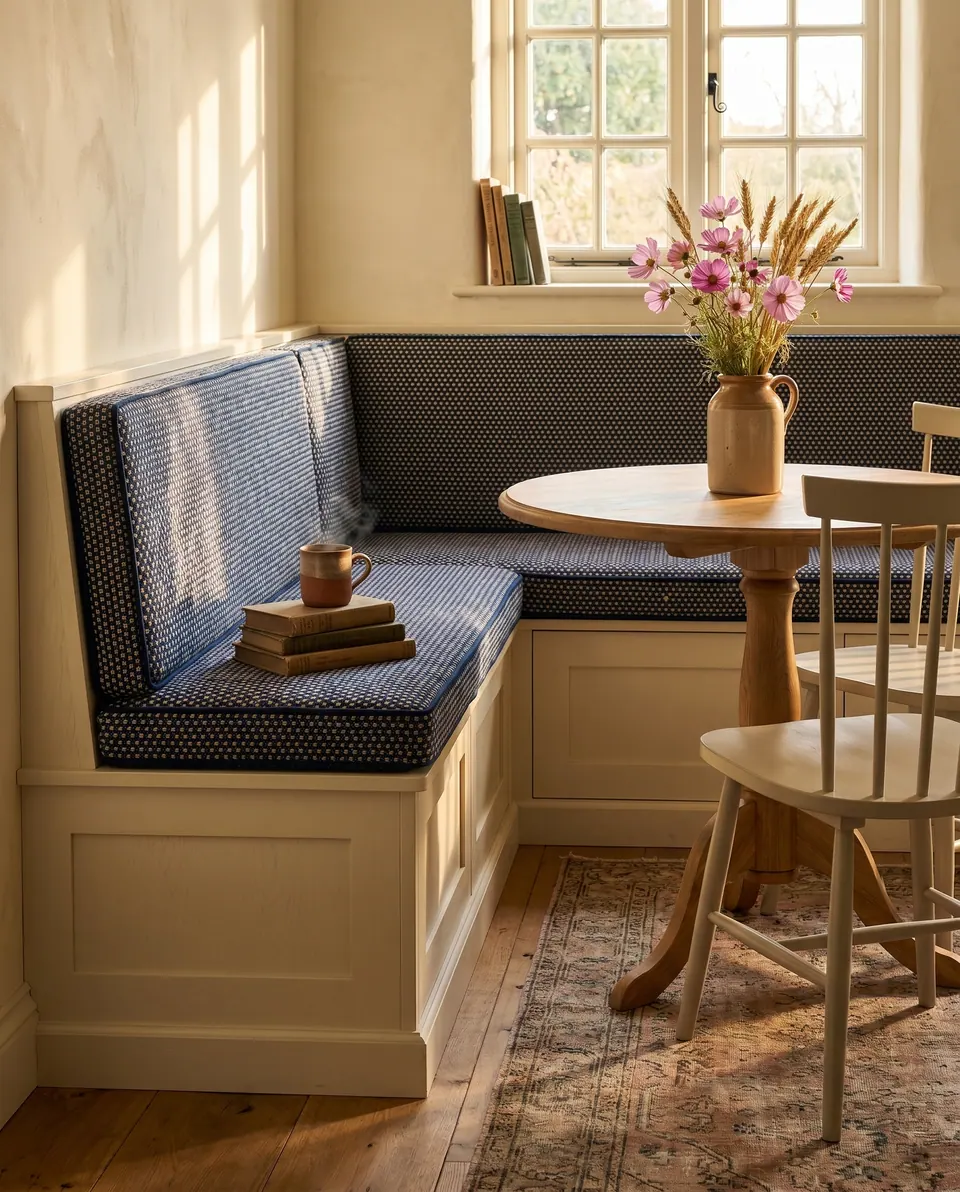
A family ordering three cushions for a U-shaped breakfast nook had a window sill overhanging two seats, so two cushions needed cutouts. They chose a navy ticking stripe and worried about food. The workshop was straight with them: the ticking is 100% cotton and stains more easily, but the covers zip off and wash at 86°F (30°C), and firm high-density foam made 2.5 in (6.5 cm) comfortable.
It also warned that solid navy piping might not match the stripe's navy exactly, and caught the third piece's edges failing to close by 2 1/4 in (about 6 cm). The buyer re-measured, and only then was foam cut.
- What it taught
- On a stepped cutout, the edges on each side must add up to the same total.
Where U-shaped orders go wrong
- Giving the full wall run for a side cushion. The back cushion already fills the corner.
- Assuming left and right match. Each cushion carries its own measured number.
- Forgetting to subtract the back thickness from the side backs.
- Choosing fabric for the photo, not the table. Kids and pets want a tight, washable mid-tone weave.
- Leaving the layout out of the order note. Name each piece: back, left, right.
A U-shaped banquette is three straight cushions. The back cushion fills both corners, and each side cushion is its wall run minus the back cushion's depth.
Maggie
Try each run in the builder before you order
Before you write the order note, put each run into the bench cushion builder, one piece at a time, and check the thickness and piping line at your real sizes. For the corner rule on its own, see L-shaped bench cushion measurements; for cushion height against the table, banquette cushion thickness. Right, dear: three runs, three lines, one unit, and you're done.
Buyer questions: booths and nooks
- A common question
How should I order cushions for a U-shaped banquette?
The workshop's answerOrder each straight run as its own cushion, not one bent piece. The short side is the total run minus the depth of the cushion in the corner, so a 61 in run beside a 19 in deep cushion needs about 42 in. Piping comes standard.
- A common question
Do you make cushions for a U-shaped dinette in a camper?
The workshop's answerYes, regularly. Send a drawing of every run, the depth and thickness, and a photo. Each piece is sized separately: one dinette used a 65 x 17.5 in seat, two 17.5 x 24.5 in side seats and a 65 in back cushion 4 in deep.
- A common question
How do I size back pillows where two walls meet?
The workshop's answerTake the shorter wall's seat length plus the long side's seat depth, minus the corner pillow's thickness, then split that line into two or three pillows. Leave about 1.5 in of allowance so plump pillows nest in the corners.
- A common question
Our back run is long. Should it be one cushion or two?
The workshop's answerThe workshop usually recommends equal pieces for fit, durability and handling: 92 in as two 46 in cushions, a 197 in nook in three. Long soft backs sag, so an 88 in back works better as two 44 in pillows. One piece is possible on request.
Booth questions, answered short
How deep should the seats in a U-shaped booth be?
About 18 in (46 cm) is typical, or 18 to 22 in (46 to 56 cm) including the cushion. Back cushions take roughly 3 in (7.5 cm) off the usable depth, so a shallow bench may want slim backs or none.
Can the whole U be one continuous cushion?
It can be made, but straight pieces meeting at the corners fit better, ship more safely and come out one at a time for cleaning. A curved banquette is the exception: there, a full-size paper template is the most accurate measurement.
Where do the zippers go on banquette cushions?
On the back edge facing the wall, or underneath if you prefer. On long bench covers the zipper often wraps around two corners so the foam slides out. Mark each piece's wall side on your sketch.
How tall should banquette back cushions be?
About 16 in (40 cm) tall, measured from the top of the seat cushion, and 4 in (10 cm) thick. The workshop recommends 16 in over 12 in (30 cm) for proper support and won't go lower.
How should I label the three runs of a U-shaped banquette?
Letter them in one direction, say clockwise A, B and C starting from the left as you face the table, and write each run's length and depth next to its letter. Then say which runs own the two corners, meaning which cushions run into them. The runs that butt against a corner lose the depth of the cushion they meet, and the letters keep that math straight.
What kind of table works best inside a U-shaped banquette?
A pedestal or center-support table. Design guides favor them for banquettes because corner legs get in the way of knees and make sliding into the middle run awkward. Keep roughly 10 to 12 in between the cushion top and the tabletop, and check that the base doesn't block the cushion ends of the side runs.