A Reading by NateU-Shaped Banquette Cushions
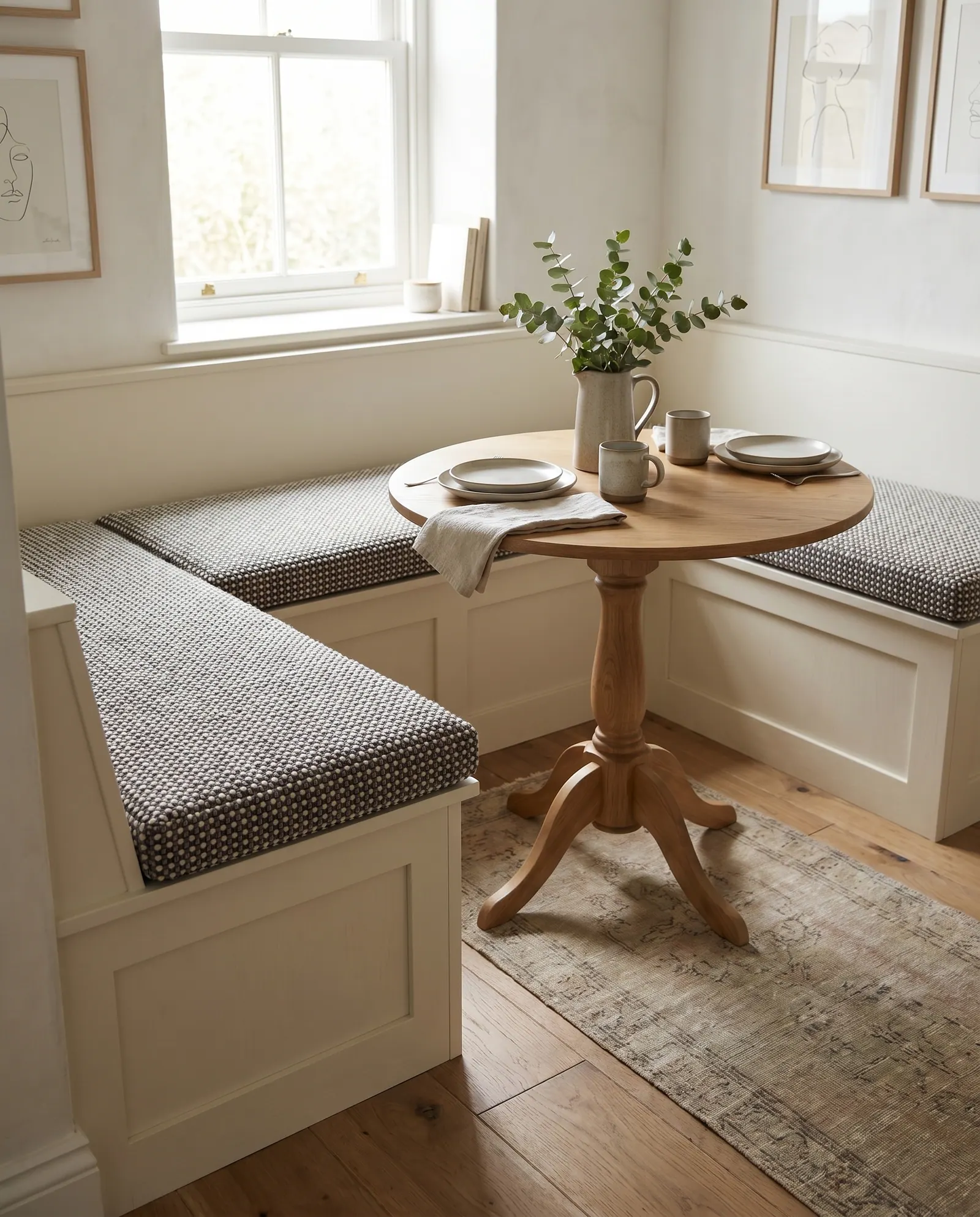
Charcoal U-shaped breakfast nook cushions around an oak table, drawn edge by edge
Three cushions, one U, two butted corners, one pedestal table. Read it like a drawing: edges first, fabric second.

 Save
The quick answer
A U-shaped banquette cushion set works best as three separate box-edge pieces: one back run across the full width and two side pieces that butt against it at the corners. Decide which piece runs full length before you measure, and shorten the pieces that stop at a corner by the seat depth, so nothing overlaps.
The cushion, cut open
Cover fabric. A removable, zippered cover. Machine wash at 86°F (30°C) on a gentle cycle and air dry.
Piping. A fabric-covered cord sewn into the seams. It sits on the seam line, so it does not change the size.
Fiber wrap. Polyester fiber (Dacron) batting around the foam: it fills the cover out and softens the edges.
Foam core. About 2.0 lb/ft³ (32 kg/m³) high-resilience foam, firm to medium-firm, cut to the ordered size.
Zipper. Along the back band, as hidden as possible. The zipper side faces down or toward the wall.
Base panel. The underside of the cover. A non-slip fabric backing can cover the whole of it instead.
Pinned by Nate
Five points on the drawing: three cushions, two corners, one table.
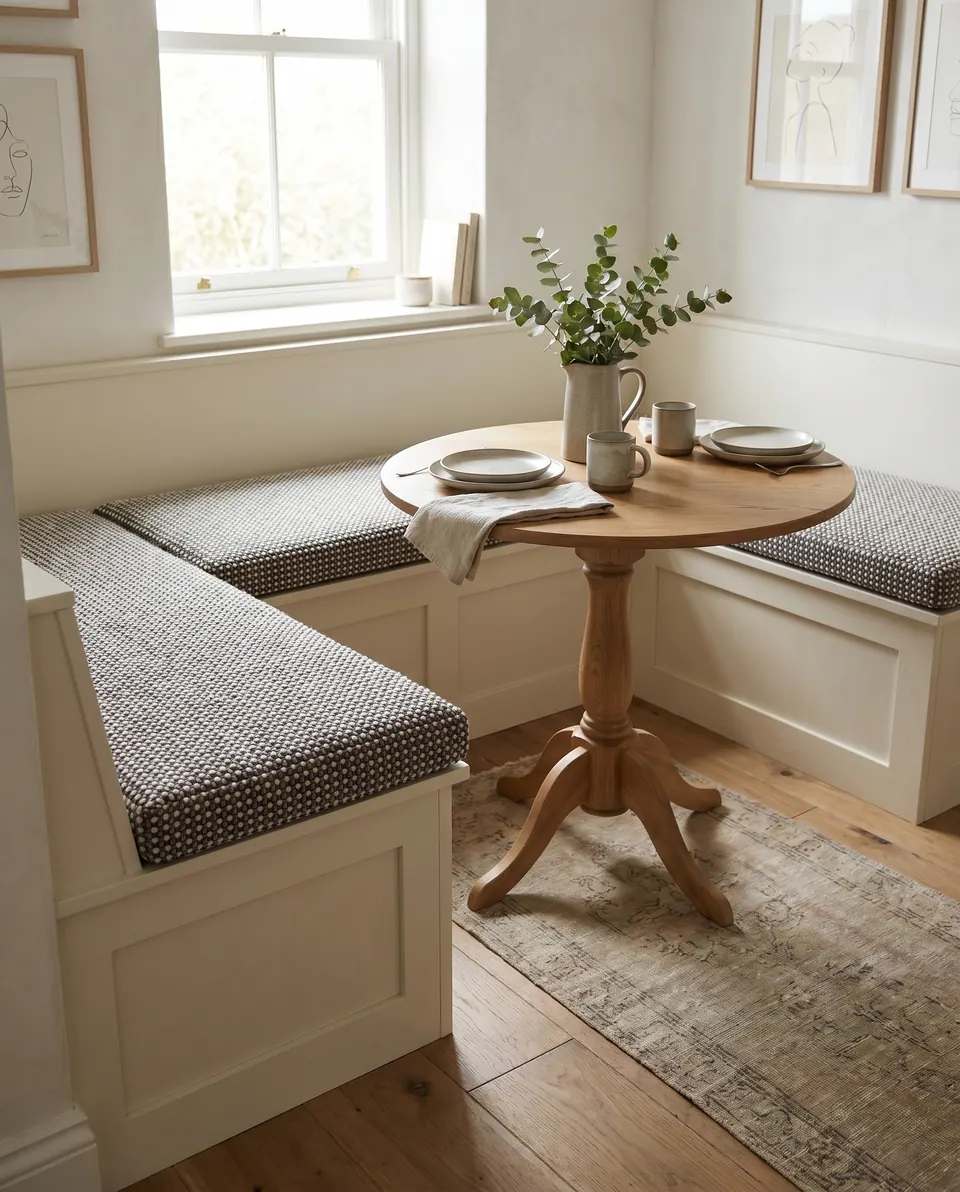
- Left side cushion
Each arm of the U has its own cushion, butted at the corners.
- Back run under window
The back piece runs the full width and the side pieces tuck against it.
- Right side cushion
Salt-and-pepper weave disguises crumbs at a breakfast table.
- Pedestal oak table
A single pedestal leaves room for knees on all three sides.
- Eucalyptus jug
Green and stoneware keep the table in the same gray-cream range.
- Left side cushionEach arm of the U has its own cushion, butted at the corners.
- Back run under windowThe back piece runs the full width and the side pieces tuck against it.
- Right side cushionSalt-and-pepper weave disguises crumbs at a breakfast table.
- Pedestal oak tableA single pedestal leaves room for knees on all three sides.
- Eucalyptus jugGreen and stoneware keep the table in the same gray-cream range.
The anatomy of a U, corner first
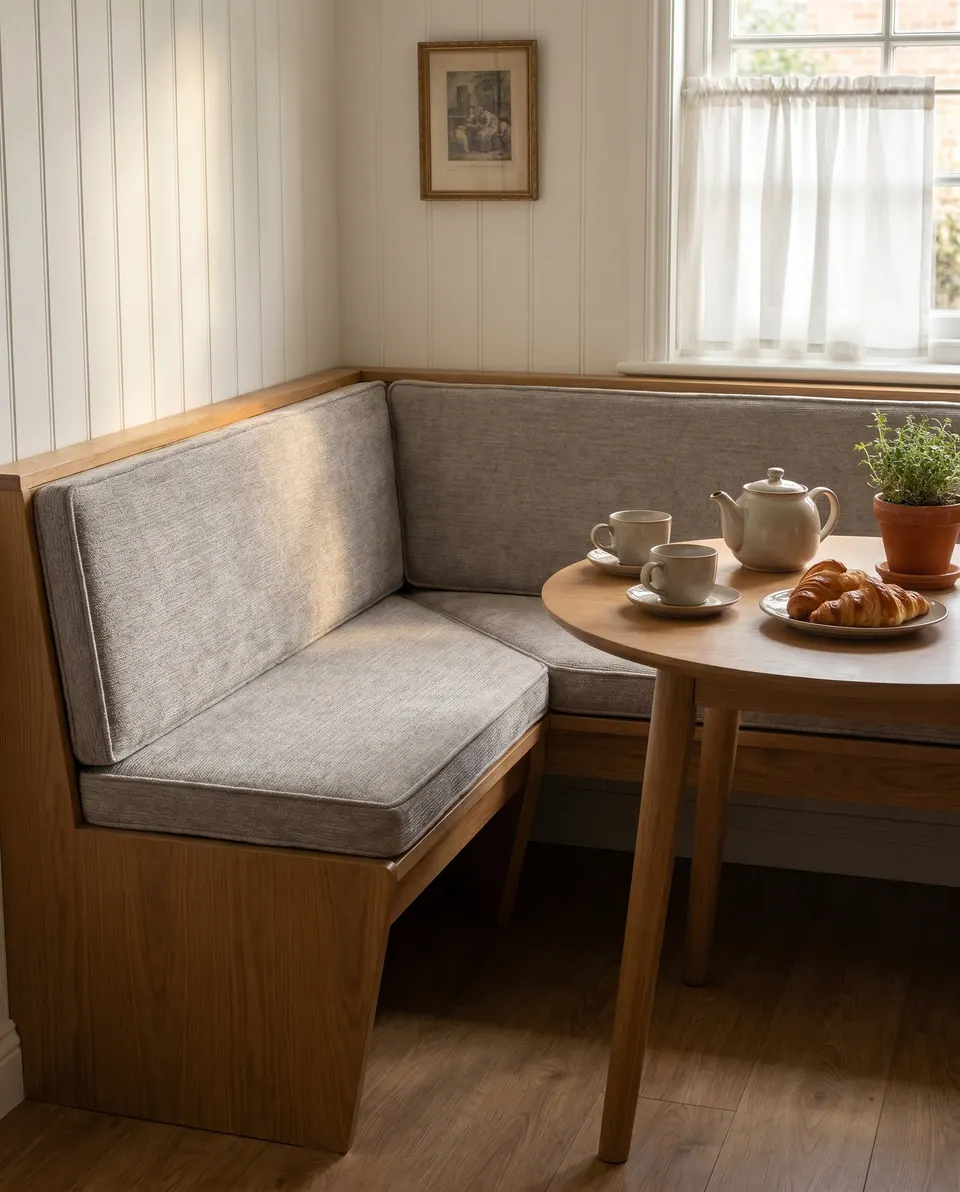
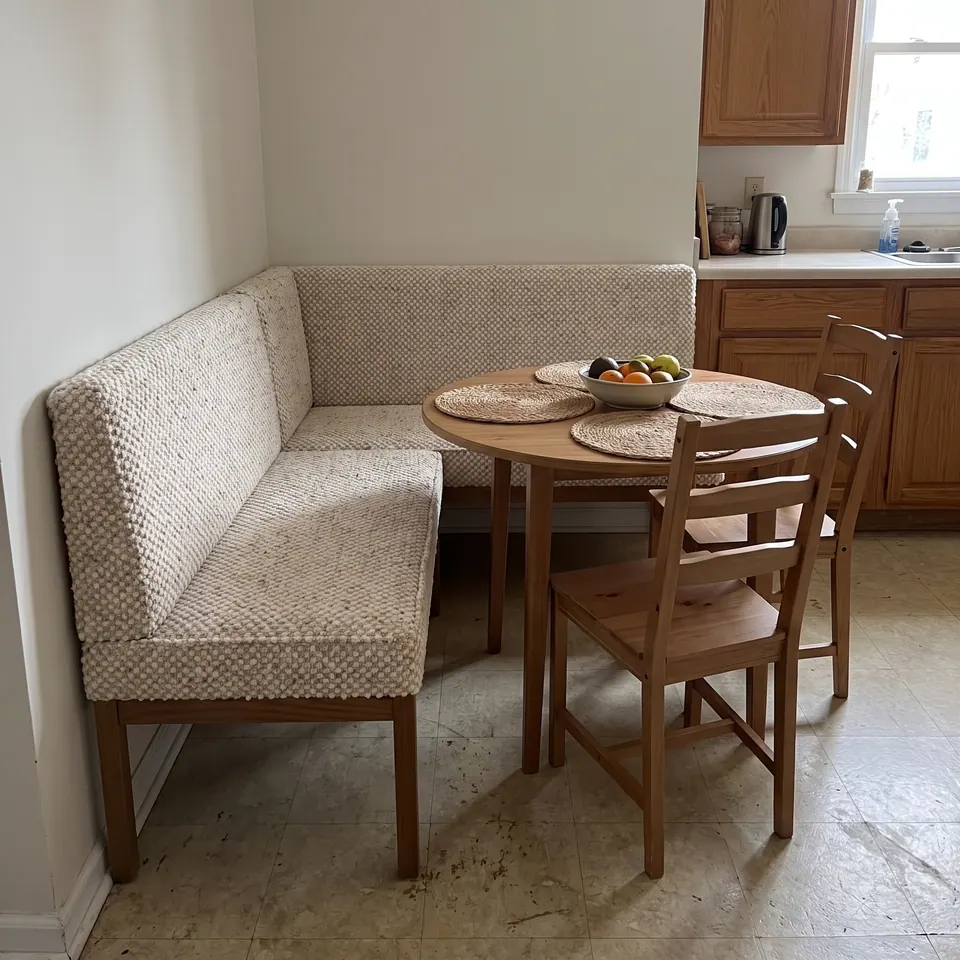
Start with the corners, partner, because that is where a U-shaped banquette goes right or wrong. Here the back run under the sash window spans the full width, and the two side pieces butt against it, square edge to square edge. No overlap, no gap, no wrestling one long piece around a bend.
Three pieces beat one. Each stays a manageable size, and you can lift one side to wipe up without moving the table. The box edge gives every piece a straight side band, so the butt joints close flat. A knife edge, thinner at the rim, would leave a V-shaped valley at each corner.
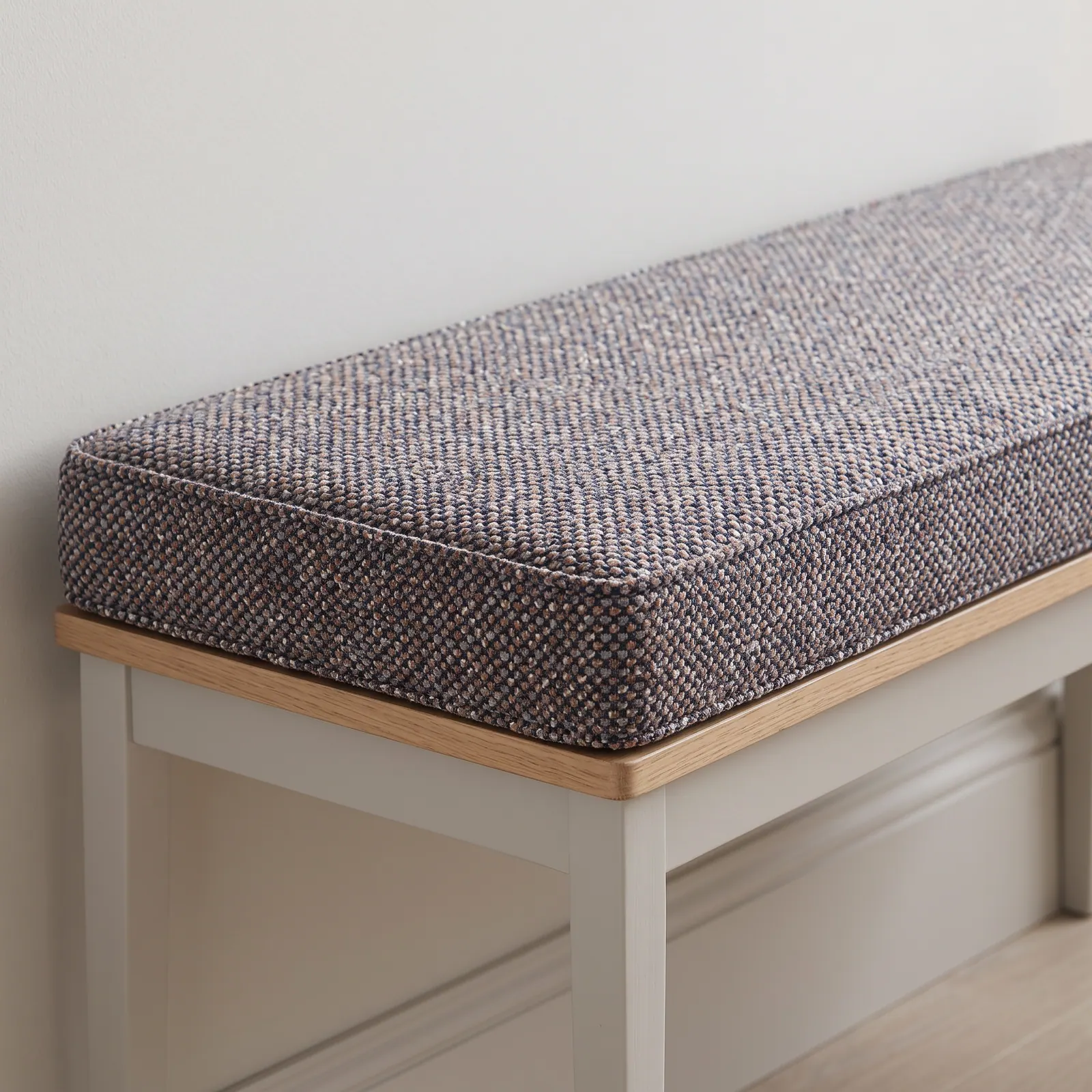
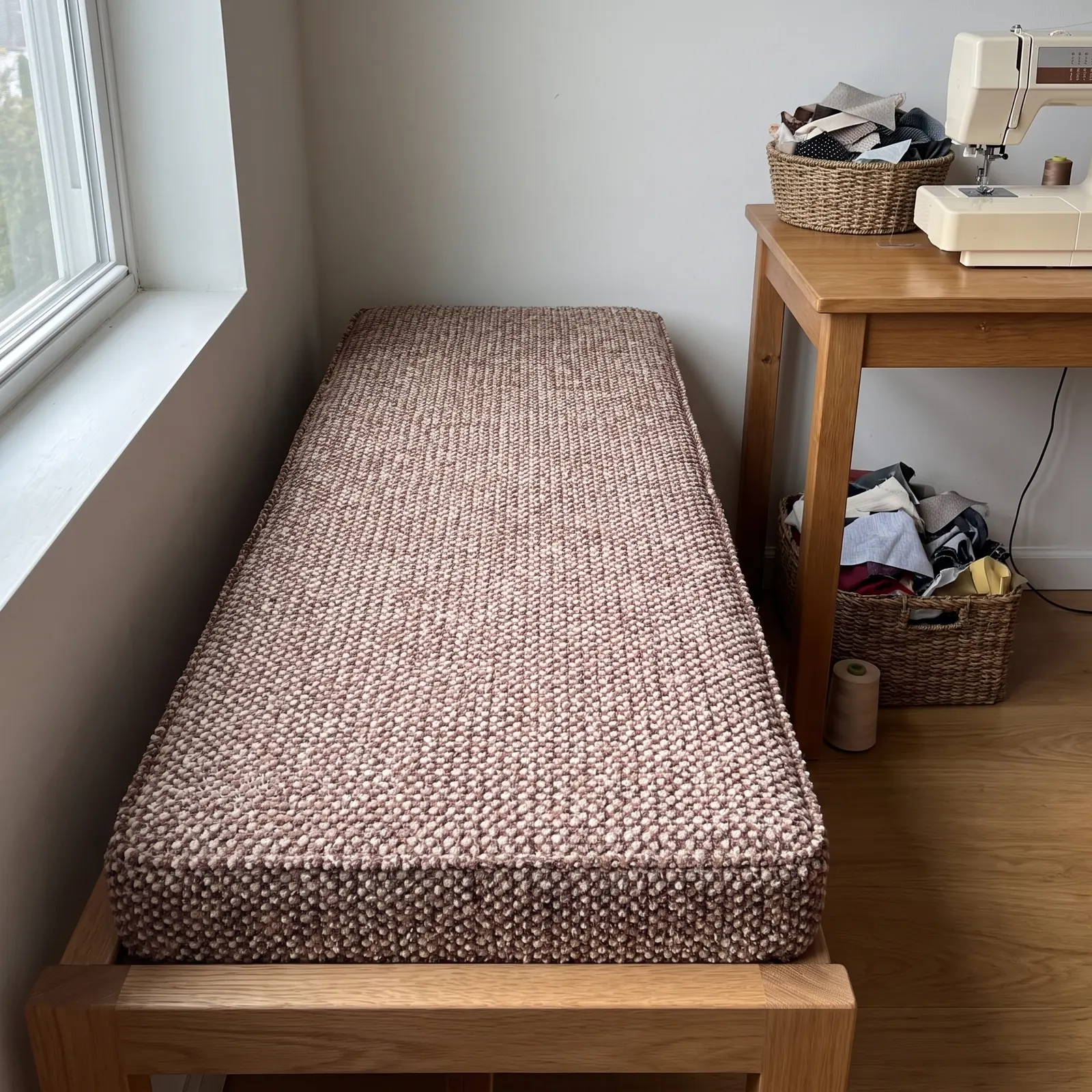
The fabric is a charcoal-and-ivory dotted weave from the patterned woven family, salt and pepper at a glance. At a breakfast table, crumbs and marks vanish into the pattern, and the seats still read light against cream paneling. No piping, so the corners meet as clean seams.
The table setting stays gray-cream: stoneware, a linen napkin, eucalyptus in a white jug, books on the sill, line drawings in oak frames. The warmth comes from the oak pedestal table and a faded vintage rug, and one pedestal leaves knee room on three sides. Which side of your nook should run full length? The U-shaped banquette Pattern walks through it.
Box, knife, rounded or angled: edges and corners compared
| Edge or corner | What it does | Use it on |
|---|---|---|
| Box edge | Straight side band; joints close flat | U and L nooks |
| Knife edge | Thin at the rim, full in the middle | Chair pads, pillows |
| Rounded corners | Softens an open end; traced | Open ends, curves |
| Angled corners | Cut to the bench angle | Angled nooks, bays |
The 2 1/4 inch discrepancy caught before cutting
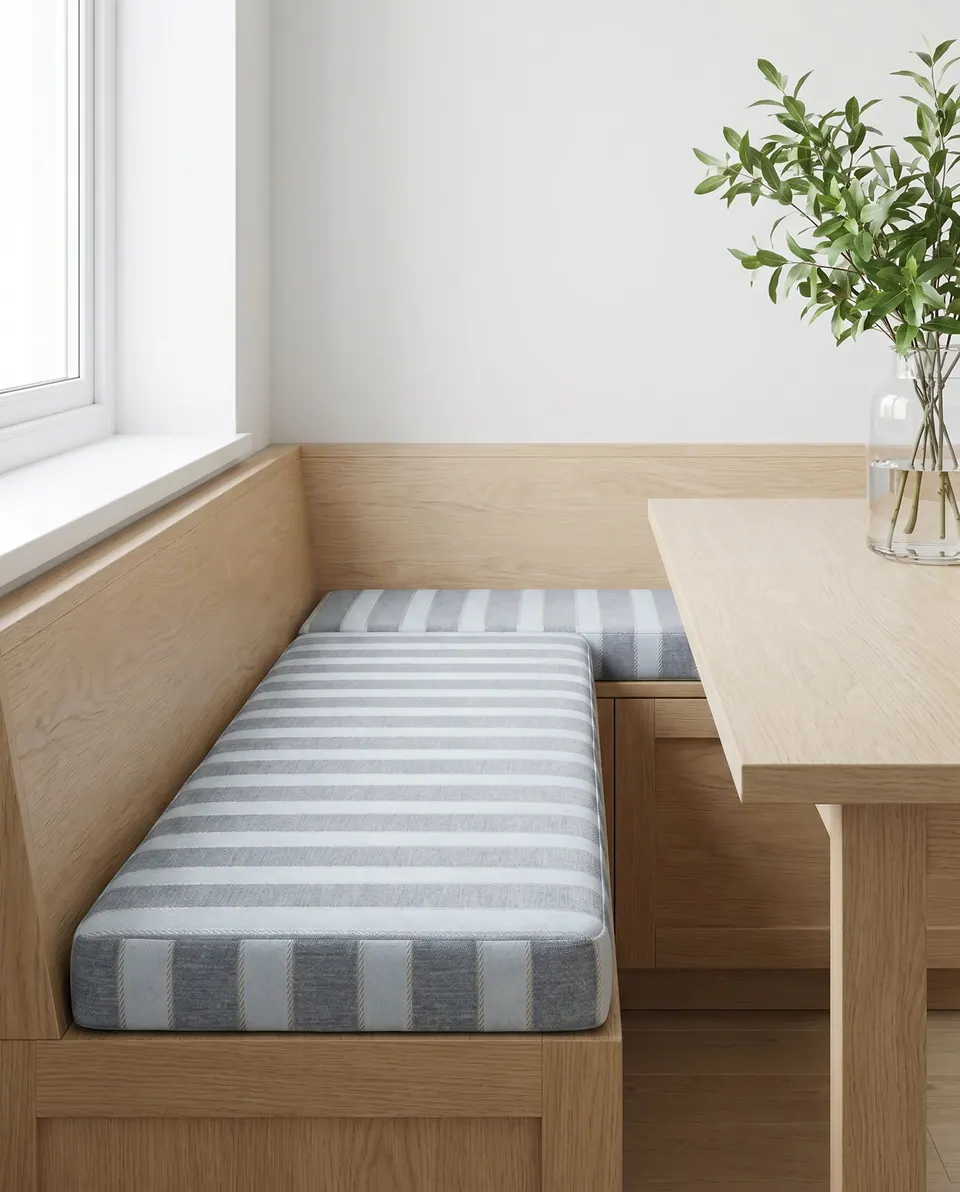
A buyer in the US sent sizes for three cushions in a U-shaped breakfast nook. Two pieces needed cutouts because the window sill overhangs two seats. The family worried about food, and the workshop was frank: the navy ticking stripe they loved is 100% cotton and stains more easily, though everything washes at 86°F (30°C). The firm foam meant 2 1/2 in (6.4 cm) would still be comfortable, and a solid navy piping might not exactly match the stripe's navy.
Then the arithmetic. On the third piece the stepped edges didn't add up: one side came out 2 1/4 in (5.7 cm) off the other. The buyer re-measured before production. Tolerance is kindness to your future self.
Piping, order changes and the L-bench rule
- A common question
Which piping color would go with my main fabric? I can't decide.
The workshop's answerThe workshop suggests pairings and sends example photos: cream piping for a soft contrast, tone-on-tone green or a contrasting gold with a chenille, forest green with burnt terracotta.
- A common question
Can I still change the fabric or piping color after I've ordered?
The workshop's answerYes, as long as the order hasn't gone into production. Send the new body and piping codes and the order is updated right away, including piping switched to match the body.
- A common question
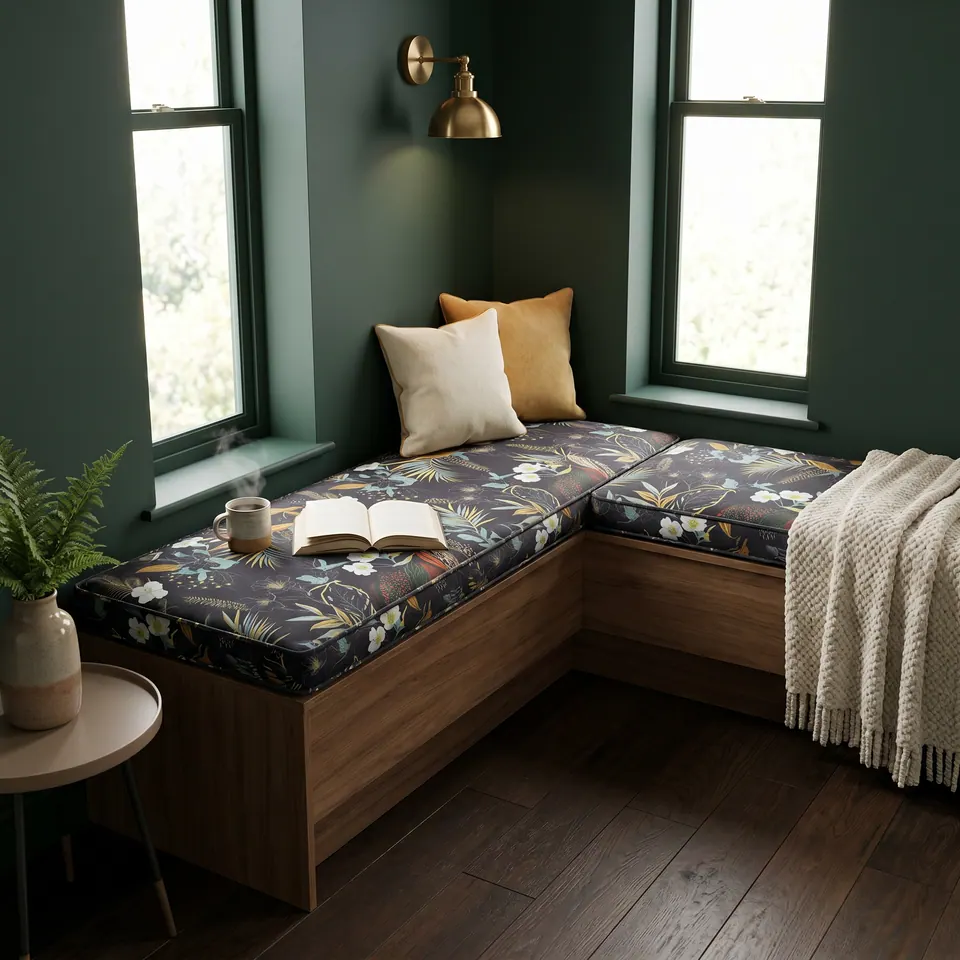
How do I size two cushions for an L-shaped bench so they don't overlap?
The workshop's answerOne cushion runs into the corner; the other is total length minus seat depth. On a 68 1/2 x 53 1/8 in (174 x 135 cm) bench with 17 3/4 in (45 cm) depth, that is 53 1/8 in into the corner and 50 3/4 in (129 cm) for the other.
On the cutting table
| Set | Three box-edge cushions for a U-shaped nook |
|---|---|
| Layout | Back runs full width; sides butt at the corners |
| Fabric | Charcoal-and-ivory dotted weave |
| Piping | None; corners meet as clean seams |
| Foam | About 2.0 lb/ft³ (32 kg/m³), firm |
| Care | Covers wash at 86°F (30°C) |
| Best for | Breakfast nooks with a pedestal table |

Have it made
Have this made — ask Nate’s workshop
Every edge and both diagonals, to the nearest 1/4 in. If the numbers do not close, the workshop will say so on the call. — Nate
Leave your details and the workshop will call you to confirm measurements, fabric, foam and piping. No prices, dates or payment on this page: it is a request, not an order.
In a U-shaped banquette, let the back cushion run the full width and shorten each side cushion by the seat depth, so the corners butt and never overlap.
Nate
Questions buyers ask next
Should a U-shaped banquette cushion be one piece or three?
Three is usually easier. Separate pieces stay a manageable size, butt cleanly at the corners and lift out one at a time for cleaning; a single U-shaped piece is large and awkward.
Box edge or knife edge for a breakfast nook?
Box edge. Its straight side band lets pieces butt tightly at the corners and keeps the front crisp. A knife edge thins toward the rim, which suits chair pads but leaves gaps where banquette pieces meet.
Which fabrics hide crumbs at a breakfast table?
Small-scale patterns and mixed-tone weaves, like a salt-and-pepper dot, hide crumbs and marks better than solids. All-cotton stripes stain more easily, so choose a removable cover you can wash at 86°F (30°C).
± 1/4 in — Nate
More photographs to read
 Save
 Save
 Save
 Save
 Save
 Save