A Reading by MaggieBanquette & Kitchen Nook Cushions
Gray striped banquette cushions: how the cloth feels, wears and washes in a kitchen corner
Two box cushions, one corner, and a chenille stripe that has to survive breakfast. A layer-by-layer look at what you actually sit on.

 Save
The quick answer
For an L-shaped kitchen banquette, two rectangular box cushions that meet at the corner are easier to cover, flip and wash than one L-shaped piece. A soft chenille stripe in dove gray and white forgives crumbs and everyday wear better than a flat pale solid, and on a dining bench the thickness should follow seat-to-table height, not comfort alone.
The cushion, cut open
Cover fabric. A removable, zippered cover. Machine wash at 86°F (30°C) on a gentle cycle and air dry.
Piping. A fabric-covered cord sewn into the seams. It sits on the seam line, so it does not change the size.
Fiber wrap. Polyester fiber (Dacron) batting around the foam: it fills the cover out and softens the edges.
Foam core. About 2.0 lb/ft³ (32 kg/m³) high-resilience foam, firm to medium-firm, cut to the ordered size.
Zipper. Along the back band, as hidden as possible. The zipper side faces down or toward the wall.
Base panel. The underside of the cover. A non-slip fabric backing can cover the whole of it instead.
Pinned by Maggie: the corner, the gusset and the stems
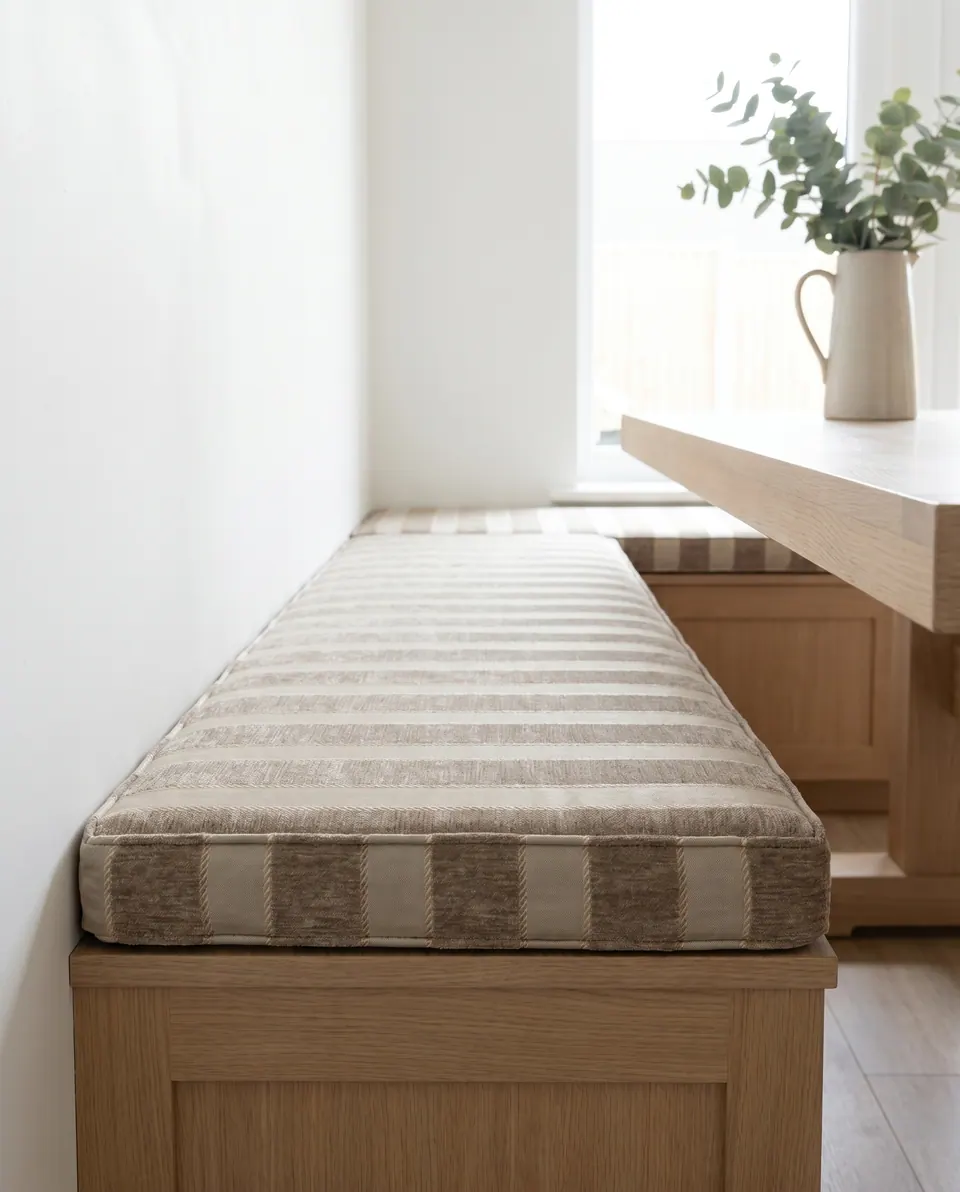
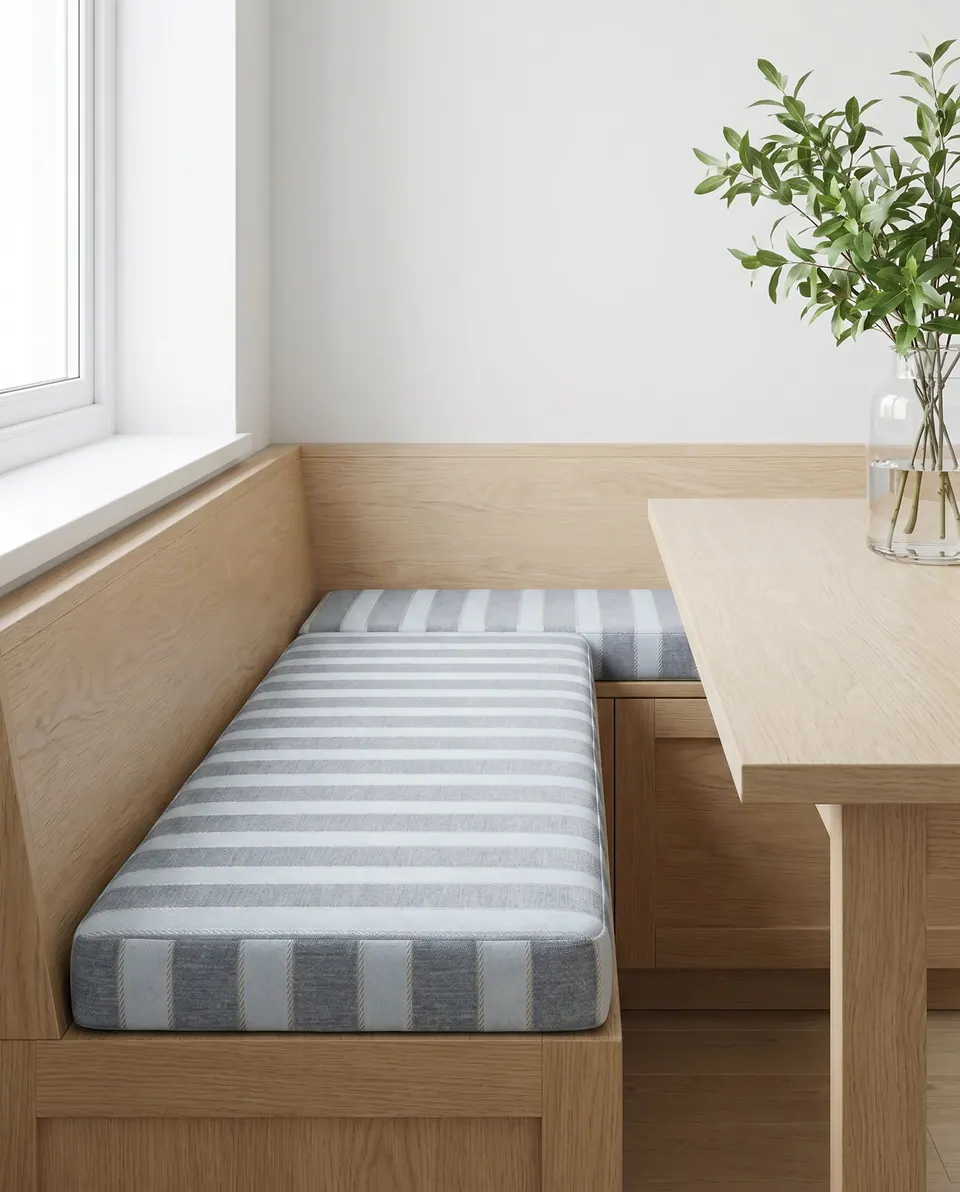
Four pins trace the seat from the striped run to the corner joint, the boxed front and the vase by the window.
- Striped seat run
Stripes run from wall to front edge, dividing the long cushion into tidy bands.
- Corner return cushion
A separate cushion on the back wall keeps the corner joint clean instead of forcing one L piece.
- Boxed front gusset
On the gusset the stripe becomes vertical bars, a tidy finish when the table is pulled out.
- Glass vase of stems
A single clear vase keeps the corner light and repeats the gray-green of the stripe.
- Striped seat runStripes run from wall to front edge, dividing the long cushion into tidy bands.
- Corner return cushionA separate cushion on the back wall keeps the corner joint clean instead of forcing one L piece.
- Boxed front gussetOn the gusset the stripe becomes vertical bars, a tidy finish when the table is pulled out.
- Glass vase of stemsA single clear vase keeps the corner light and repeats the gray-green of the stripe.
Anatomy of the seat, from the top panel down
- Top panel: dove gray and white chenille stripe, soft and slightly raised under the hand, running from wall to front edge.
- Welt: self piping in the same stripe, which firms the seam where elbows and bags rub.
- Boxed gusset: the side band, where the stripe turns into short vertical bars that look tidy when the table is pulled out.
- Core: a foam block whose thickness is chosen from seat height to table height.
- Corner: a second rectangle butting against the first, instead of one L-shaped piece.
How a chenille stripe behaves under a breakfast crowd
A straight welt is a kind of honesty, and a kitchen banquette tests it twice a day. These gray striped banquette cushions sit on a built-in pale oak corner, and the first thing to know is how the cloth behaves.
Chenille has a soft, velvety yarn with a little loft, so it feels warm rather than slick when you slide in with a coffee. The woven stripe does useful work: crumbs and faint marks lose themselves in the pattern, where a flat pale solid would show every one. The flip side of any pile yarn is that it can catch on rough buckles, so blot spills fast and brush the pile back the way it lies. Read kitchen banquette cushion fabric and stain first aid before the first glass of juice goes over. Woven stripes like this one live with our jacquard and damask cloths.
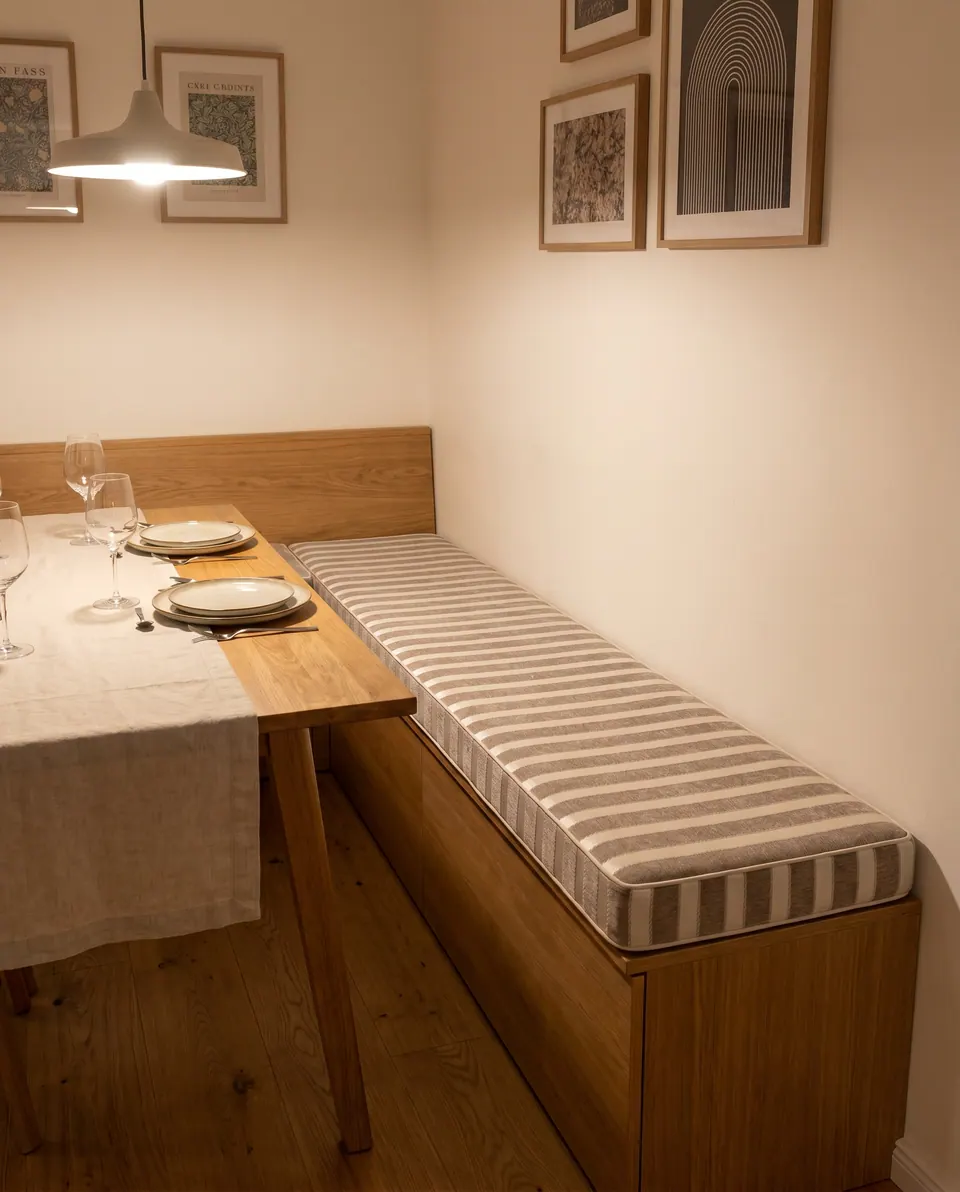
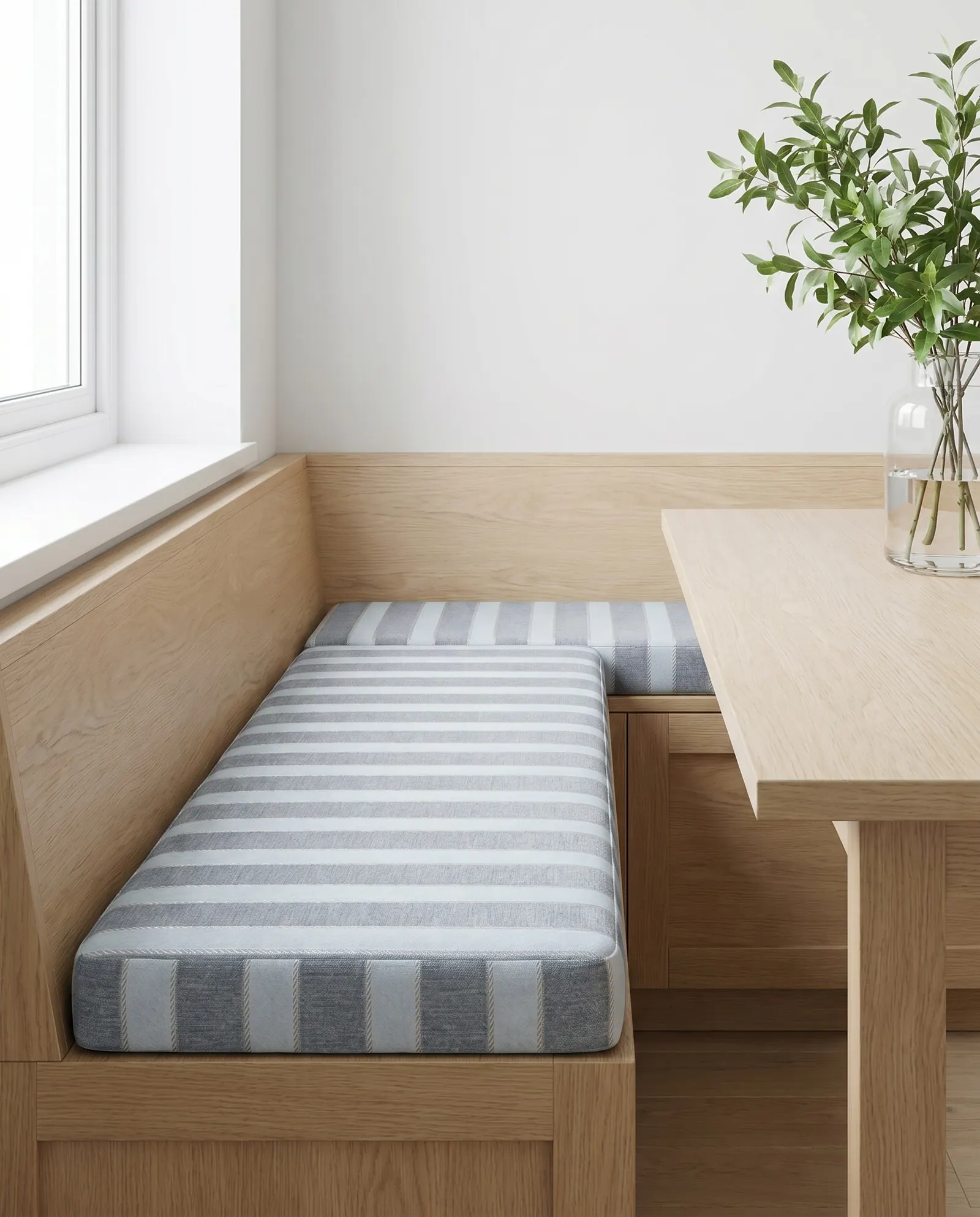
Now the photo. Stripes run from wall to front edge on both cushions, so the pattern turns the corner without a clash. The corner is solved with two rectangles, one running into it and one butting against it, which is simpler to cover, flip and wash than a single L. On the boxed gusset the stripe becomes vertical bars. And the cushion is only a fraction of the oak backrest's height, low enough that nobody ends up perched above the table.
The props stay light. North daylight off the deep white sill keeps the grays fresh, the pale oak table repeats the banquette, and one clear glass vase of olive-leaf stems picks up the faint gray-green in the stripe. Nothing on the table competes with the seat. Measure the long run first, then let the return cushion sit behind it. The L-shaped corner joint Pattern shows the options, and more corners live under banquette cushions.
Two small boys and three rounded corners
A family with two small boys wrote to the workshop about a corner dining bench with a rush seat and three rounded corners, about 71 x 47 1/4 in (180 x 120 cm) outside and 17 3/4 in (45 cm) deep. They needed it washable, which with two boys is less a preference than a survival plan.
The shop made two pieces meeting at the corner and had the buyer mark where each curve began, at about 7, 7 7/8 and 8 5/8 in (18, 20 and 22 cm). From those marks it drew a template and sent it back for checking. The drawing listed a left piece of about 29 1/2 x 17 1/4 in (75 x 44 cm), a right piece of about 52 3/4 x 17 in (134 x 43 cm) and a 17 3/4 in (45 cm) square at the corner.
Then thickness. The shop suggested about 4 in (10 cm), but the seat was already about 17 in (43 cm) high, so the buyer chose 2 in (5 cm) to keep the table at the right height. The order went out in olive-green velvet with mustard piping and ties to the spindles. Pick thickness from seat-to-table height, not comfort alone; banquette thickness and table height has the numbers.
Buyer questions: notches, backrests and whose numbers count
- A common question
Our breakfast nook has a small notch cut out of each corner. Can the cushion follow that shape?
The workshop's answerYes, corners can be customized. Send a drawing with the sizes; the shop redraws it as a standardized template in centimeters and asks you to confirm it before production.
- A common question
How tall is a standard backrest cushion, and can mine be shaped differently?
The workshop's answerThe standard backrest is 16 in (40 cm) high and 4 in (10 cm) thick, running the same length as the seat. It can have a curved or rounded top, be split into two pieces, or be made to custom dimensions such as 36 in wide x 8 in deep x 12 in high (91 x 20 x 30 cm), with tufting that matches the seat.
- A common question
Can you check my numbers and decide the final size for me? And is your mockup drawing exact?
The workshop's answerThe shop makes each cushion strictly to the dimensions you give and can't take responsibility for deciding the final measurements. It will turn your numbers into a drawing so you can check the shape, but the numbers are yours to confirm. The best way is to sketch your final measurements on paper and send a photo of the sketch.
On the cutting table: the oak corner banquette
| Product | Two box cushions for an L-shaped kitchen banquette |
|---|---|
| Layout | Long run into the corner, return cushion butting against it |
| Fabric | Dove gray and white chenille stripe |
| Hand | Soft, slightly raised pile; warm rather than slick |
| Stripe direction | Wall to front edge on both pieces |
| Piping | Self piping in the stripe |
| Edge | Box edge; stripe shows as vertical bars on the gusset |
| Thickness | Chosen from seat-to-table height |
| Care | Blot spills fast; brush the pile in its natural direction |

Have it made
Have this made — ask Maggie’s workshop
I once cut a lovely cushion two inches short, and I have not forgotten it. That is why the workshop goes over your measurements with you on the phone. — Maggie
Leave your details and the workshop will call you to confirm measurements, fabric, foam and piping. No prices, dates or payment on this page: it is a request, not an order.
On an L-shaped banquette, two rectangular cushions that meet at the corner are easier to cover, flip and wash than one L-shaped piece.
Maggie
Questions buyers ask next
Does a woven stripe hide crumbs better than a plain pale seat?
Yes, a woven stripe breaks up the surface, so crumbs and faint marks are harder to spot than on a flat pale solid. You still need to brush and blot, but the bench looks tidy between cleanings.
How should the stripes run where two banquette cushions meet in a corner?
Run them from the wall to the front edge on every piece. The pattern then turns the corner without a clash, and the stripe shows as short vertical bars on the front gusset of both cushions.
Is chenille soft enough for everyday family dining?
It is soft and warm to sit on, and a patterned chenille forgives everyday wear. The pile can catch on rough buckles, so blot spills quickly and brush it back the way it lies. For heavy spill duty, compare performance fabrics as well.
Stitch straight — Maggie