The Pattern Room · a measuring pattern
The best fabric for kitchen banquette cushions, spills included
Syrup, soup and a toddler with opinions: the breakfast nook is the hardest-working seat in the house. Here is the checklist I wish I'd had the first time I covered one in pale linen and called it practical.

 Save
The quick answer
The best fabric for kitchen banquette cushions is a tight, smooth performance weave or a polyester velvet, sewn as a zippered cover that comes off and machine-washes at 86°F (30°C) on a gentle cycle. For messy young kids, the workshop leans to the soft performance weave. Choose a mid-tone, skip 100% cotton stripes at a toddler's seat, and ask about a waterproof liner.
Why the breakfast nook is the hardest seat to dress
A kitchen banquette cushion sees more meals than any dining chair in the house, and it can't be pushed back from the table to be wiped. So the best fabric for kitchen banquette cushions is chosen for its cover, not its color card.
Right, then. The question arrives in a dozen wordings that mean one thing: which fabric cleans? The workshop's answer barely moves. Its soft performance weave and its velvet are the easy-clean picks for kitchen and dining benches, and for a nook with messy kids it leans to the soft weave.
The rest is everything around the fabric: zipper, tone, piping and the extras that keep a banquette cushion put. If the nook is still a pencil sketch, start with kitchen nook cushions.
The breakfast-nook fabric checklist, in order
Say indoors, and say who eats there
The workshop's first fabric question is indoors or outdoors, because that decides which chart the search starts in. Then say who sits there. Two adults with coffee is a different job from spaghetti night with three kids.
Pick a tight, smooth weave that wipes
The soft performance weave (the workshop's 'soft fabric') is a thick poly-cotton blend with a soft hand; it wipes clean and doesn't collect lint. Polyester velvet is the other easy-clean pick, because marks lift off its short pile. Both are tightly woven, with no loops to snag.
Insist on a cover that comes off
Every foam cushion from the workshop has a zippered, removable cover at no extra cost, hidden on the back edge or the underside. Wash it inside out at 86°F (30°C) maximum, gentle cycle, mild detergent, no bleach, then air-dry. See how to wash cushion covers.
Choose a mid-tone that forgives syrup
Pure white shows every drip. For kitchens with kids and pets, the workshop's advice is a tight, washable weave in a mid-tone: dove gray, oatmeal, warm taupe. Judge swatches at the table, at breakfast, in your own light.
Let the piping frame, not audit
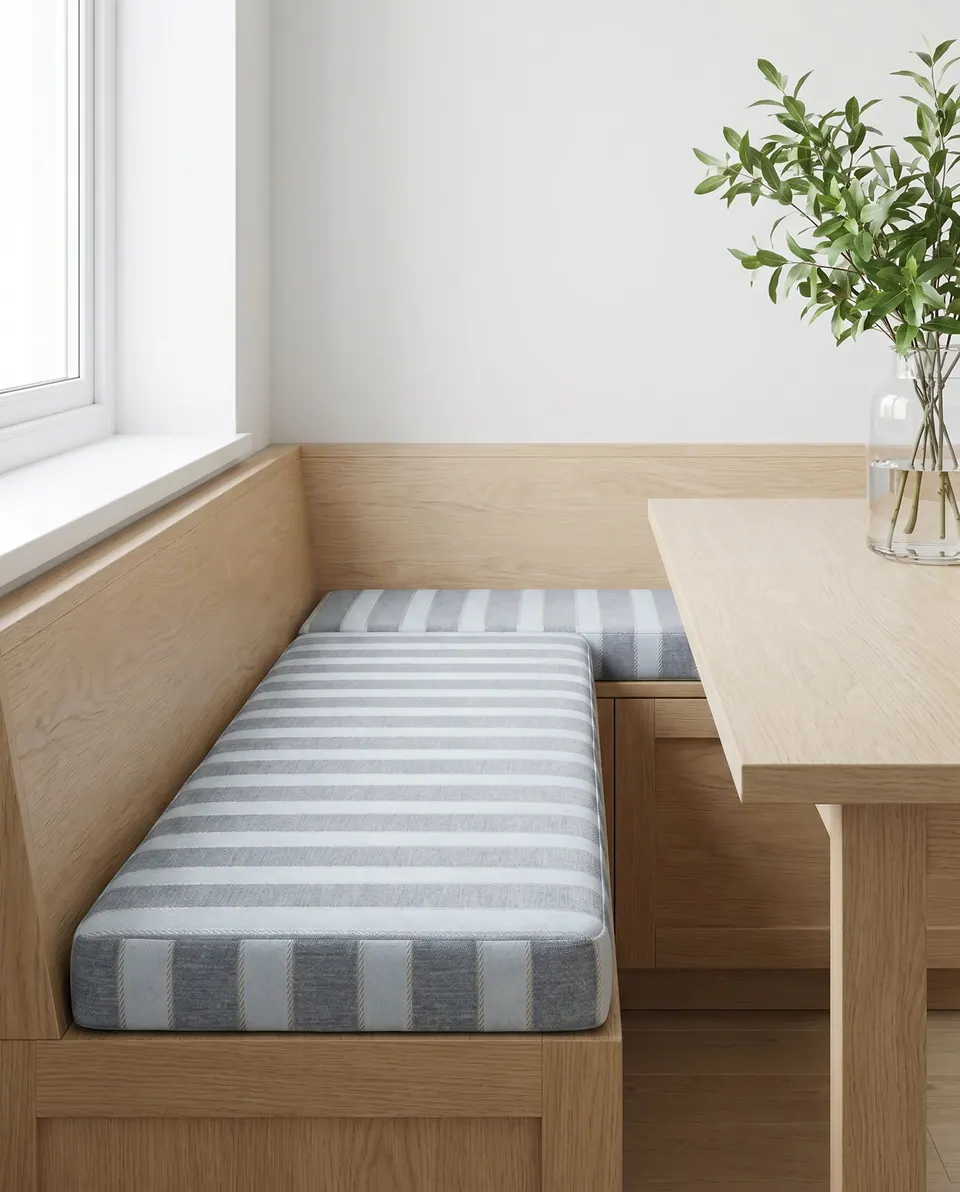
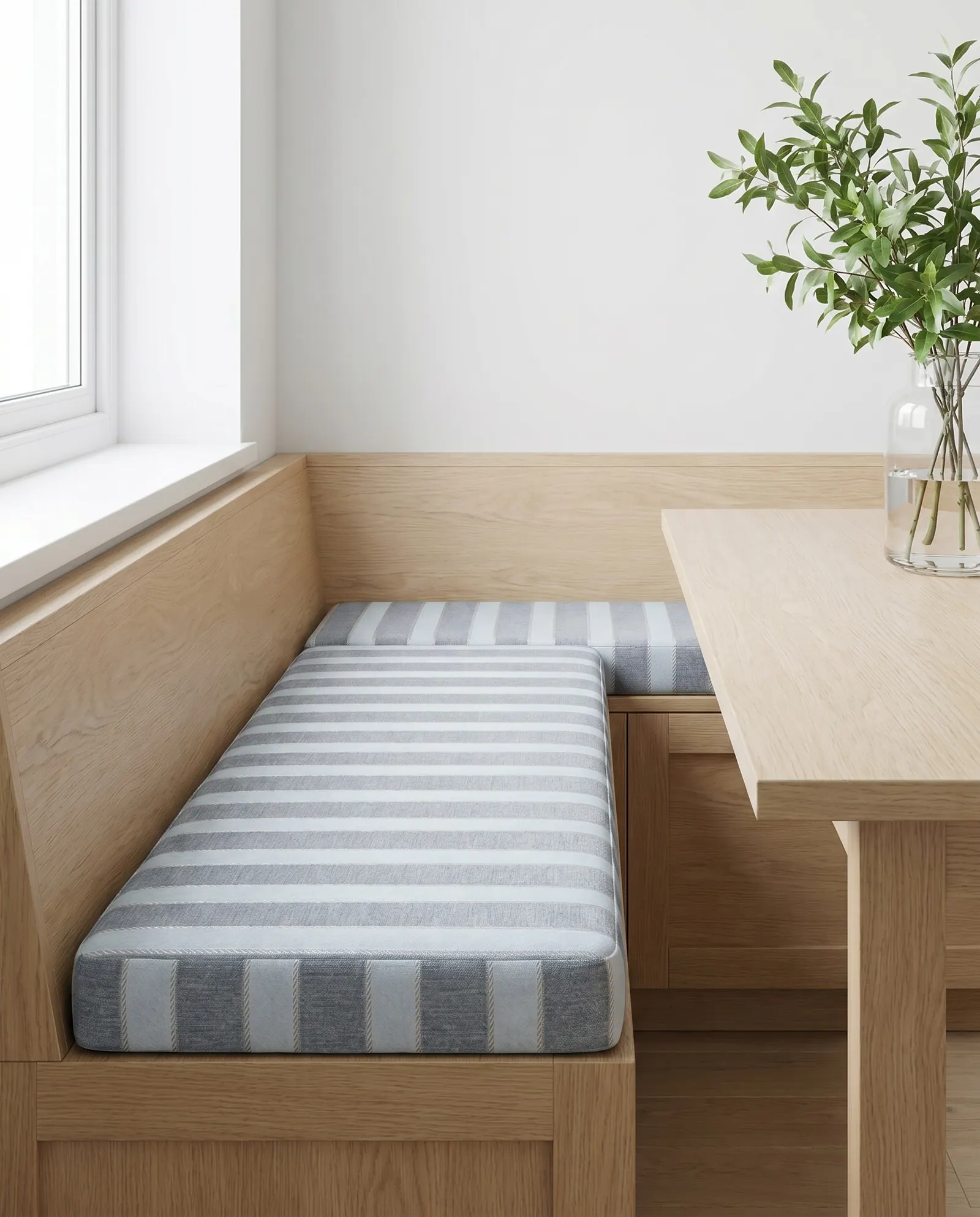
Self piping, cut from the cushion's own fabric, is the only guaranteed color match; a solid cord beside a stripe may miss the stripe's navy. A pale welt at a child's seat outlines every jam finger. Write the body and piping codes separately, since neighboring chart numbers can differ only in tone. More in piping choices.
Add liquid protection only where it earns its place
The standard indoor fabric is durable and easy to clean, not waterproof. For a toddler seat, ask for the water-repellent B19, the water-resistant premium charts, the faux leather chart, or a waterproof liner under an ordinary cover.
Keep the cushion on the bench
A cushion that slides every time someone scoots in wears at the front edge. Ask in writing for ties with their position and length, or a non-slip base that replaces the bottom panel, grips by friction and is safe on wood. Ask whether that backing is washable. See stopping a bench cushion from sliding.

Have it made
Measured it? Have Maggie’s workshop make it
I once cut a lovely cushion two inches short, and I have not forgotten it. That is why the workshop goes over your measurements with you on the phone. — Maggie
Leave your details and the workshop will call you to confirm measurements, fabric, foam and piping. No prices, dates or payment on this page: it is a request, not an order.
Six fabrics at the family table
| Fabric | Wipes clean | Best at the table for | Watch for |
|---|---|---|---|
| Soft performance weave | Yes Yes, smooth and lint-free | Messy young kids, daily meals | Thinner than velvet |
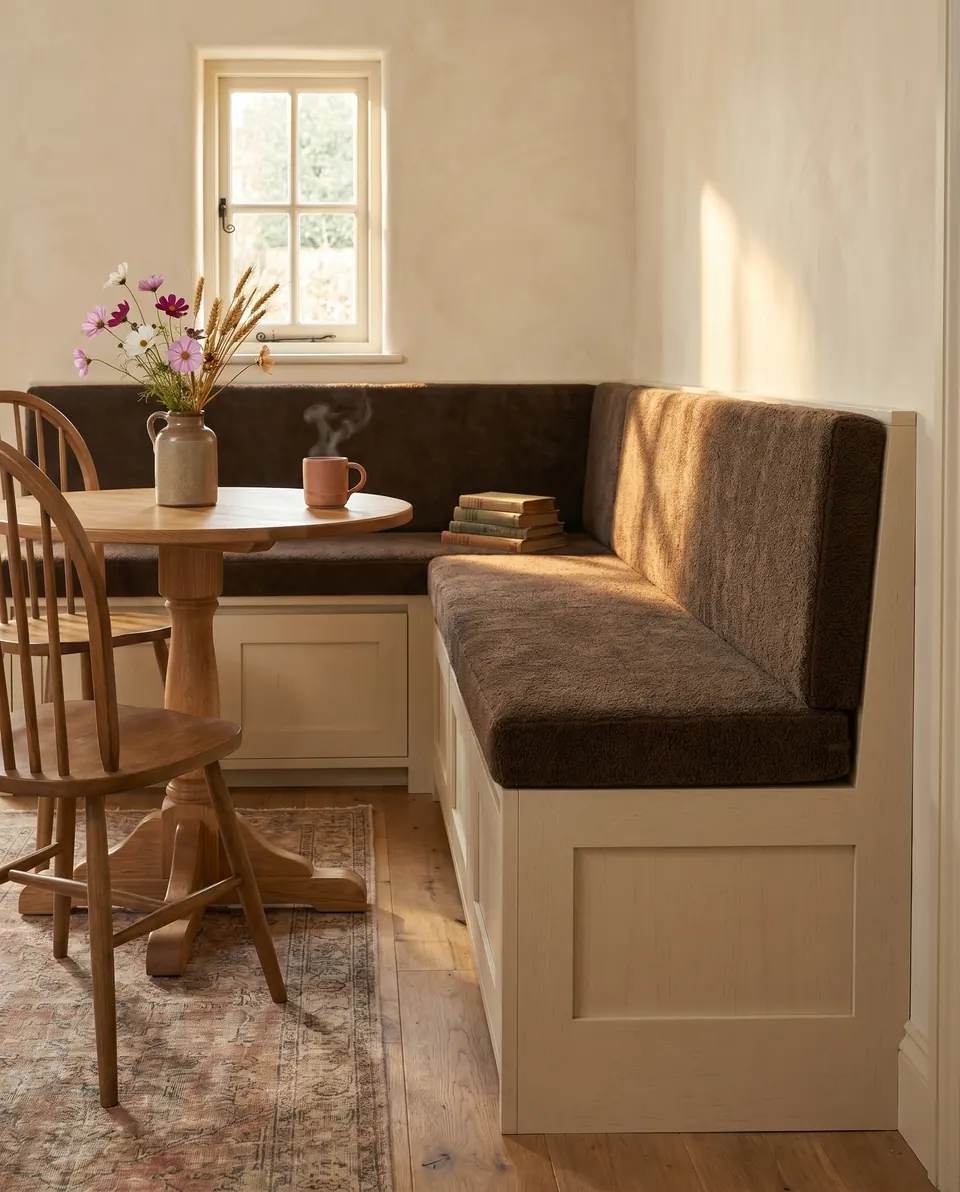
| Polyester velvet | Yes Yes, marks lift off the pile | Adult tables, restaurant booths | Pile direction shifts the tone |
| Linen and linen-look | Partly Yes, for small spills | Calmer nooks, lighter use | Standard 'linen' is usually a blend |
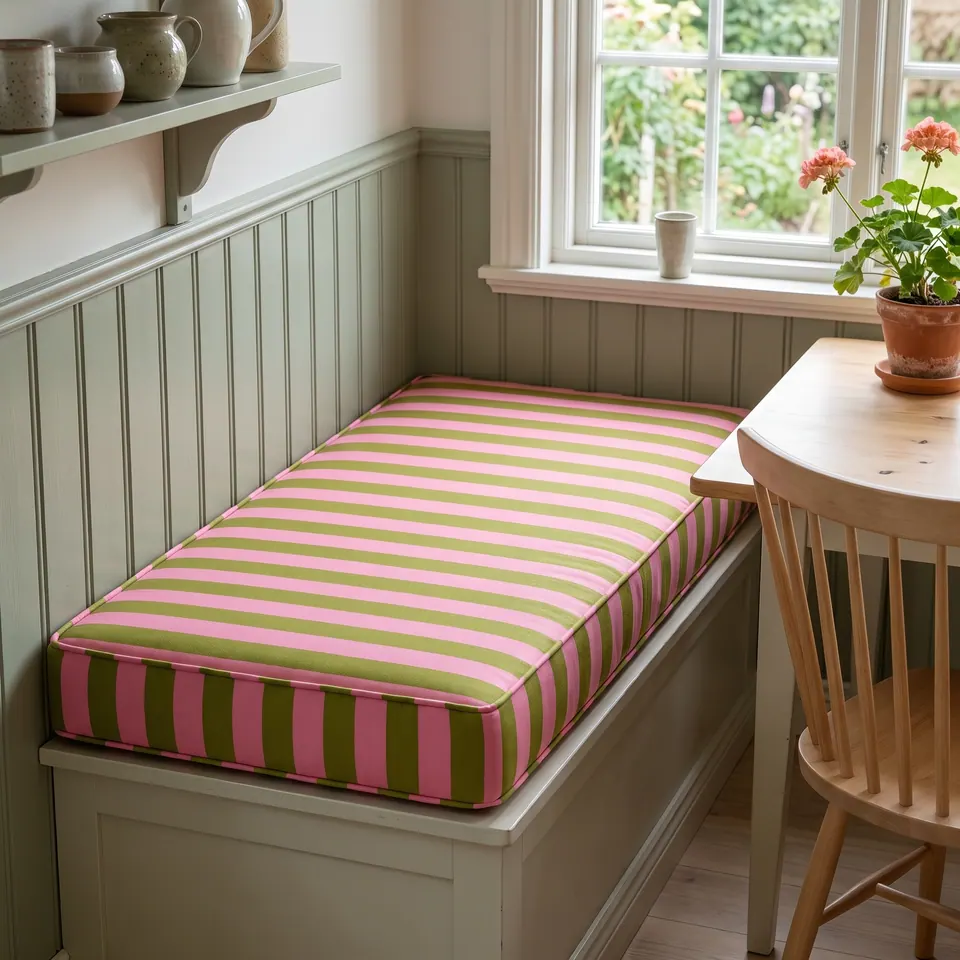
| Cotton stripe and ticking | No Stains more easily | Grown-up benches | 100% cotton; long pieces need a seam |
| Faux leather | Yes Wipes down | Toddler seats, spill zones | PU can peel in warm, humid rooms |
| Outdoor fabric, indoors | Yes The toughest option | Heavy daily use | Its own chart and care |
Common mistakes at the kitchen table
- Choosing for the photograph, not the spaghetti. Looks-first fabric is a regret the workshop hears about often.
- Pure white at a daily table. Every drip shows; pick a mid-tone.
- Velvet at a toddler's seat by default. It works on a banquette, but for messy young kids the workshop leans to the soft weave.
- Typing ties into the size box. Ties aren't standard, and requests typed into the dimension field get overlooked. Ask in writing, then confirm by message.
- Unchecked stepped cutouts. Steps plus the short edge must equal the long edge. See notched cushion cutouts.
When a second cover set beats a new cushion
At a kitchen table the cover does the hard work while the foam carries on. When a cover is tired, or you want a new color, a fresh cover over the existing foam is often the sensible buy, and some buyers keep a spare set in a second color for wash day. See covers for existing foam.
For a café or restaurant booth, the workshop points buyers to velvet: highly durable and the easiest to wipe by hand between services. The commercial cushion specs pattern has the rest.
So: who eats at your banquette on a Tuesday night, and what do they spill? Answer that honestly, dear, and the fabric very nearly chooses itself.
Buyer questions: what goes on the kitchen bench
- A common question
What's the best fabric for our kitchen banquette? We eat there every single day.
The workshop's answerThe soft performance weave and velvet are the easiest to clean and the usual picks for kitchen and dining benches; with messy kids, the soft weave edges out velvet. Linen is an alternative, outdoor fabric is tougher still, and every cover machine-washes at 86°F (30°C) on a gentle cycle.
- A common question
What exactly is your 'soft fabric'? Is it chenille, or cotton?
The workshop's answerNeither. It's the workshop's best-selling upholstery range, codes 901 to 946: a thick, durable weave with a soft hand, usually described as a polyester-cotton blend. It wipes clean and washes at 86°F (30°C). For a natural fiber, choose cotton-linen.
- A common question
Is the linen on your chart real, 100% linen?
The workshop's answerUsually not. The standard linen charts are blends or linen-look weaves, chosen because they're durable and easy to clean. A separate 100% linen chart is available on request, and a sturdy acrylic linen suits hard-working seats.
- A common question
We're fitting out booths for a small restaurant. Which fabric is the most durable and easiest to keep clean?
The workshop's answerVelvet. It is highly durable and the easiest to wipe down and spot-clean by hand, and all covers come off and machine-wash at 86°F (30°C). The best-selling everyday weave is a safe alternative.
- A common question
Our cats claw everything. What will hold up on the bench seat?
The workshop's answerNo fabric is fully claw-proof, but tight, loop-free weaves snag far less, and all of the workshop's fabrics are woven that way. The pet-friendly chart is the first pick for cats, in good taupes and neutrals. Order swatches so you, and the cats, can test the texture.
Banquette fabric, briefly
Can I use outdoor fabric on an indoor banquette?
Yes. The outdoor fabrics work indoors too and are the toughest option for a hard-working bench. Ask for swatches from the outdoor chart.
Does faux leather make sense for a breakfast nook?
For toddler seats and spill zones, a faux leather chart is offered for wipe-clean bench cushions. Keep it away from hot, humid spots: polyurethane faux leather can start to peel after 2 to 3 years in warm, damp rooms.
How thick should a kitchen banquette cushion be?
Many nooks land between 2 and 3 in (5 to 7.5 cm). In one real U-shaped nook, firm 32-density foam made 2½ in (6.4 cm) comfortable at the table. Check the gap to the tabletop first.
Will a striped fabric run the full length of a long banquette?
Not in one piece. The fabric roll is about 55 in (140 cm) wide, so on long cushions the stripes run front to back by default and a long striped piece needs a seam. Stripes are pattern-matched on one face only.