 Save
- Corner seat cushion
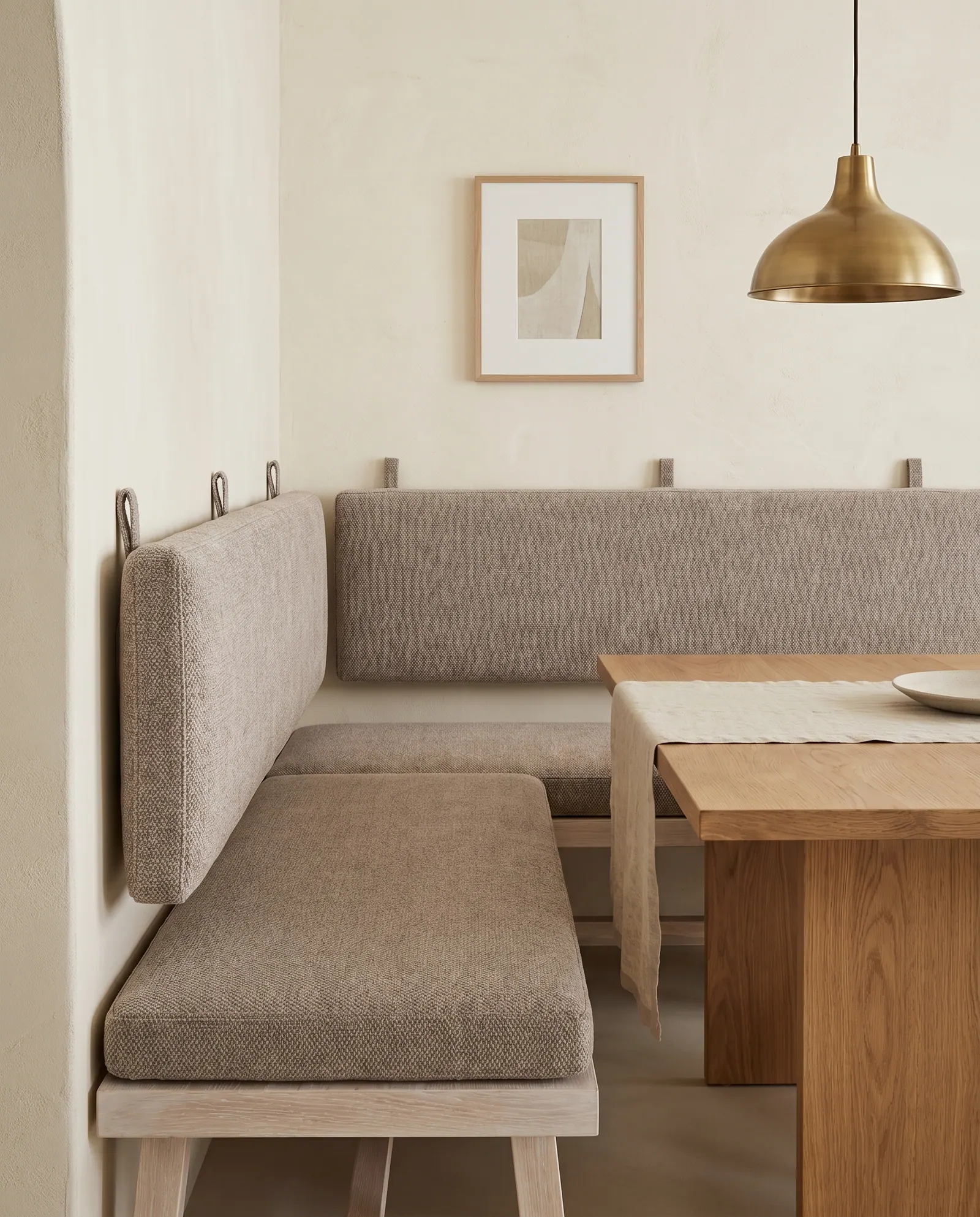
Separate seat pieces meet in the corner, so each can be lifted and cleaned on its own.
- Hung backrest
The backrest hangs from wall hooks, so the bench needs no fixed back at all.
- Wall hooks
Loops on the back of the cushion slip over these hooks and keep the backrest level.
- Brass pendant
Warm brass over the table balances the cool taupe of the upholstery.
- Oak table
Honey oak repeats the bench legs and keeps the corner warm.
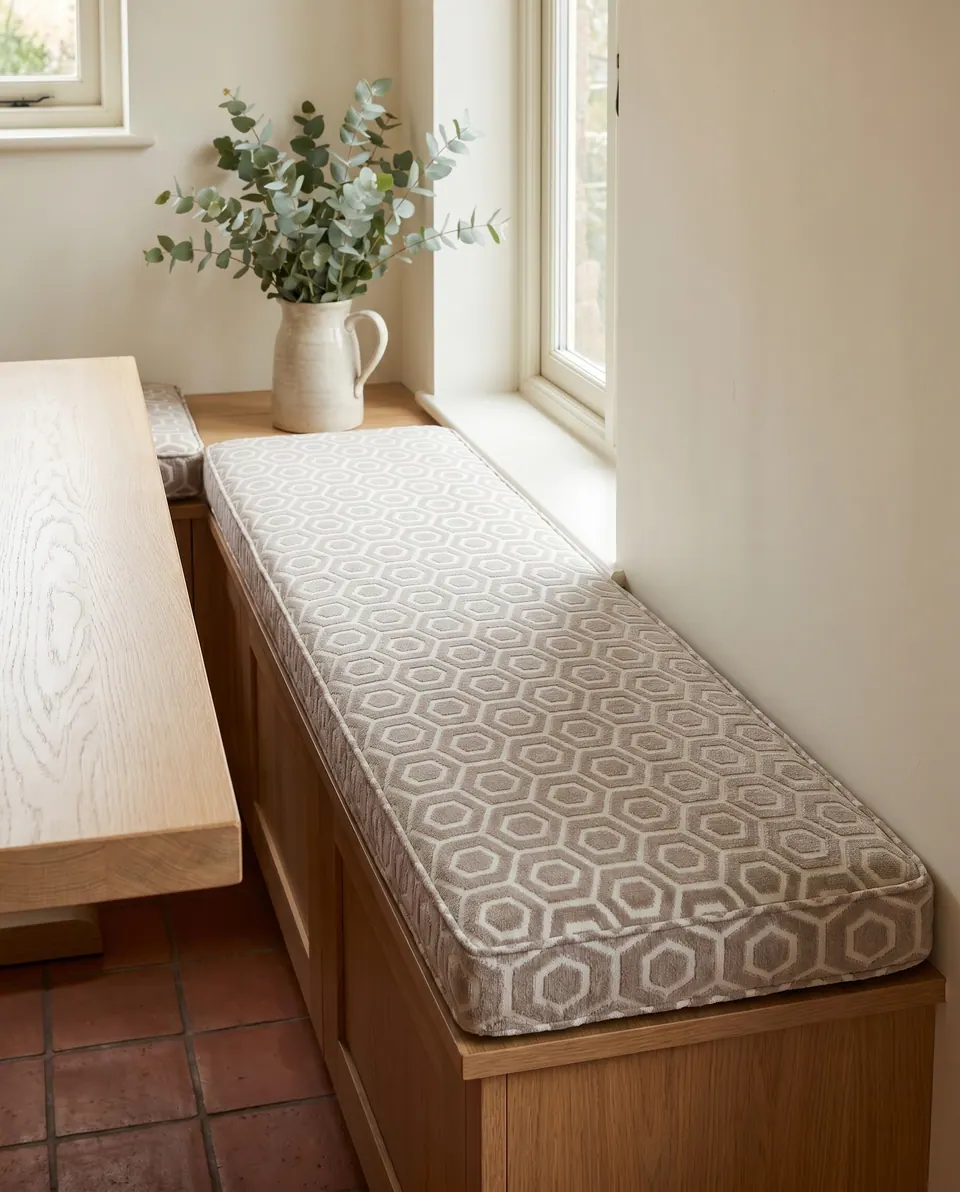
Plate Taupe L-Shaped Banquette with Backrests Hung on Wall Hooks
Taupe seat and back cushions turn a simple corner bench into a dining banquette. The backrests hang from wall hooks instead of a fixed frame.
A Reading by MaggieBanquette & Kitchen Nook Cushions
A taupe L-shaped banquette with hung backrests, put through real family life
Kids, dogs, crumbs and coffee at seven in the morning. Here is how this corner of taupe weave and wall hooks will hold up, and where it will quietly show its age.

The quick answer
A taupe L-shaped banquette with hung backrests ages well in a busy kitchen because every piece comes off on its own. The corner seat is two separate cushions and the backrests hang from wall hooks, so one spilled cup means lifting one cushion, not the set. Pair that with a tight, loop-free weave in a mid-tone, which snags less under claws.
Pinned by Maggie: seat, hooks and the warm bits
Five pins cover the corner seat, the hung backrest and its hooks, then the brass and oak that keep all that taupe from going cold.
The numbers match the pins on the plate.
- Corner seat cushionSeparate seat pieces meet in the corner, so each can be lifted and cleaned on its own.
- Hung backrestThe backrest hangs from wall hooks, so the bench needs no fixed back at all.
- Wall hooksLoops on the back of the cushion slip over these hooks and keep the backrest level.
- Brass pendantWarm brass over the table balances the cool taupe of the upholstery.
- Oak tableHoney oak repeats the bench legs and keeps the corner warm.
The daily-life scorecard for a hung-back banquette
- Spills: the seat pieces are separate, so a juice spill means one cushion off the bench and one cover in the wash.
- Kids: a backrest knocked off its hooks goes straight back on. Nothing is screwed down, so nothing tears loose.
- Dogs and cats: no fabric is fully claw-proof, but a tight, flat weave without loops gives claws less to catch.
- Crumbs: taupe is a mid-tone, so toast crumbs and paw dust don't announce themselves the way they would on ivory.
- Foam: 32-density foam keeps its shape without going lumpy, which matters on a bench used three meals a day.
- Sun: soft, diffused light like this is kind to any color. A nook with hard afternoon sun deserves a read on fading first.
No piping, no fixed back, no fuss
Right, then. The bench is a simple limed oak base with no back at all. The upholstery does the rest: seat cushions along both runs, and flat backrest cushions hung by loops over wall hooks on a level line. That is how an open bench becomes a banquette without a carpenter.
There is no piping on these box cushions, and I admit my hand twitched. But on a soft taupe weave against limewashed plaster, a welt would draw lines the room does not want. The set reads as tailored because seat and back share one fabric and a similar thickness.
The warmth comes from elsewhere. A brass dome pendant hangs over the oak table, a linen runner and a stoneware plate sit on top, and honey oak repeats in the bench legs. Take those away and the taupe would read as gray. The second photo shows the same soft, chenille-type pile in wine on a round ottoman cushion, if taupe feels too quiet for you.
More corner layouts are in banquette cushions, the woven family sits in the jacquard and damask library, and fabric for claws is covered in pet-friendly cushion fabric. What would your household do to a corner like this in its first month, dear?
The velvet rolls that needed a board behind them
A buyer wrote to the workshop designing a velvet corner banquette over a wooden frame 118 x 69 1/4 in (300 x 176 cm) and 19 3/4 in (50 cm) deep. The seat would come in several pieces, with the foam set about 6 in (15 cm) in from each end so the wood showed: runs of 112 1/4 in (285 cm) and 63 in (160 cm), in firm foam at least 2 in (5 cm) thick.
For the back, they pictured vertical half-round rolls about 6 in (15 cm) wide, fixed with Velcro strips. The workshop explained that foam alone cannot hang as a fixed backrest. The rolls would be upholstered onto a thin wooden board instead, and the buyer agreed.
A back that hangs needs something rigid behind it, or a wall to lean on. Ask me how I know; we don't discuss that roll. The details are in keeping back cushions upright.
Buyer questions: claws, backrests and lumpy foam
- A common question
We have kids, dogs and cats. Which fabric will survive, and is any of it claw-proof?
The workshop's answerNo fabric is fully claw-proof. The workshop's fabrics are tightly woven without loops, and flat, tight weaves snag much less, because claws catch on looped weaves. There is a separate pet-friendly performance fabric chart with good taupes and neutrals. Order swatches first so you, and your pets, can test the texture.
- A common question
For the back of a bench, is a pillow-filled backrest or a foam one better, and will it stay put against the wall?
The workshop's answerBoth are made, and the workshop sends photos of each. The pillow version is separate soft pillows, for example three along an 84 in (213 cm) bench. The foam version looks like a shorter seat cushion in one, two or three pieces, cut as a wedge so it stays in place without Velcro. Neither is freestanding; a backrest has to lean against a wall.
- A common question
How dense is the foam? I don't want the seat going lumpy.
The workshop's answerEvery cushion uses 32-density high-density foam (32 kg/m³, about 2 lb/ft³), typically a cold foam. It is chosen to keep its shape over time without lumps while staying comfortable for everyday sitting.
On the cutting table: the taupe corner
| Set | L-shaped banquette: seat cushions on both runs plus flat backrest cushions |
|---|---|
| Corner | Separate seat pieces meeting in the corner |
| Backrest | Hung by loops over wall hooks; the bench has no fixed back |
| Fabric | Taupe chenille-type weave |
| Edge and piping | Box edge, no piping |
| Foam | 32-density high-density cold foam |
| Pets | Tight, loop-free weaves snag less; no fabric is claw-proof |
| Best for | A family kitchen nook with an open bench and a plain wall |

Have it made
Have this made — ask Maggie’s workshop
Numbers first, fabric second, piping last. Jot down what you have, and the workshop will go down the list with you, item by item. — Maggie
Leave your details and the workshop will call you to confirm measurements, fabric, foam and piping. No prices, dates or payment on this page: it is a request, not an order.
On a family banquette, make every piece removable on its own. Separate corner seats and hung backrests mean one spill costs one cover, not five.
Maggie
Questions buyers ask next
Is taupe a practical color for a kitchen banquette?
It is one of the more forgiving choices. A mid-tone taupe shows crumbs, dust and light marks less than cream or white, and it sits comfortably beside oak, brass and limewashed walls, as it does in this nook.
Can banquette backrest cushions hang from wall hooks?
In this photo, flat backrest cushions hang by loops over wall hooks, which turns an open bench into a banquette. A flat, firm backrest suits that; soft foam rolls need a thin wooden board behind them to hang without sagging.
How do I clean one section of an L-shaped banquette?
When the seat is made as separate pieces, lift only the stained one, unzip its cover and wash it on its own. Keeping each piece removable is the main reason corner seats are usually made in two parts.
Stitch straight — Maggie
More photographs to read
 Save