The Pattern Room · a measuring pattern
How to keep back cushions upright on benches and banquettes
Right, then. A slumped back cushion is a fastening problem, not a foam problem, and the fix depends entirely on what it leans against. Here's the checklist.

 Save
The quick answer
To keep back cushions in place, match the fix to what's behind them: ties for slats or a rail, a non-slip backing for a flat wall, a wedge shape for a lean. Standard backs aren't freestanding; on a bare wall they hang by hook-and-loop tape, fabric loops on a rod, or top-corner ties on hooks or a rail.
A back cushion slumps for a reason
Every slumped back cushion I've met was leaning on something nobody asked about. I've done it myself: a lovely piped back, no plan for what held it, and a banquette that looked like it had given up by Tuesday.
What keeps back cushions in place is decided by what's behind them, not by the cushion. So what's behind yours?
For sizing the back itself, see back cushion height; for the whole family, backrest cushions and banquette cushions.
What's behind the back decides the fix
| Behind the back cushion | The fix | What to write in the note |
|---|---|---|
| Slats, spindles or a rail | Fabric ties near the top, on the back side | Tie count and each position from a named end |
| A flat wall or solid panel | Non-slip backing | Which cushions get it |
| A bare wall, back to be hung | Hook-and-loop tape, fabric loops on a rod, or top-corner ties on hooks | Cushion sizes, loop size and how many |
| A bench where the back must lean | Wedge back, thicker at the bottom | Width, height, top and bottom thickness |
| An outdoor chair frame | Double piping, or straps | A photo of the chairs |
| Nothing: a floor cushion set | Metal frame, or a wooden back frame | Ask for the frame when you order |
Fixing a slumping back, in order
Look behind the cushion
Slats, spindles, a rail, a flat wall, a window sill, or nothing at all. Every fix below starts from that one word.
Slats or a rail: ask for ties near the top
Matching fabric ties sewn near the top, on the back side, stay hidden and hold the cushion to the slats. They double as a handle for lifting a large back, and ties can also fix a back to its seat.
A flat wall: ask for a non-slip backing
Against a flat wall or solid back, ties have nothing to wrap. A non-slip backing grips by friction, not adhesive, and leaves no residue. Say which cushions get it, seats and backs alike.
A lean: choose a wedge
A wedge back, thicker at the bottom, sits at its own angle and stays put without hook-and-loop tape. Give width, height and both thicknesses; one was 28 x 24 in (71 x 61 cm), tapering from 9 in (23 cm) to 4–5 in. On an angled bench, the bottom edge can be shaped to the seat.
A bare wall: hang it
The workshop sews one side of hook-and-loop tape to the cushion; you fix the other side to the wall with strong adhesive, or screws for a firmer hold, and the back peels off for cleaning. Or ask for two fabric loops per cushion to hang from a rod.
Under a window, clear the hardware
On one studio bench, the trim started 4 in above the seat cushion and a lever sat 11 in above it. A back 14–16 in (36–41 cm) tall and 3–4 in thick kept the lever behind it, left loose so the window still opened.
Floor cushions: a wall, or a frame
A floor-cushion backrest isn't freestanding. With no wall behind it, ask for a metal frame, or a version with a wooden back frame.
Put every fix in writing
List each cushion with its fix in the personalization box, such as 'backs: two ties near the top' or 'all pieces: non-slip base.' Then look for the extras in the pre-shipment photo.

Have it made
Measured it? Have Maggie’s workshop make it
Have the tape measure handy when they call. Old cushions shrink and sag; the seat underneath does not. — Maggie
Leave your details and the workshop will call you to confirm measurements, fabric, foam and piping. No prices, dates or payment on this page: it is a request, not an order.
What the workshop builds for a wall, and what it won't
Here's the honest line, dear. The standard back cushion has no rigid board inside, so it can't be screwed to a wall or hung on a French cleat, and fixed upholstered wall panels aren't the usual make.
What it does build: a removable piped cover over shredded foam about 4 in (10 cm) thick, or a solid foam core wrapped in fiber for a firmer, flatter panel. It fastens with hook-and-loop tape, adhesive, loops on a rod, or ties on the top corners for hooks or a rail. Thin wall backs of 1 to 2 in are possible too.
One exception: a channel back of vertical rolls can't hold its shape on foam alone, and needs upholstering onto a thin wooden board fixed to the banquette. For fill, see shredded foam, solid wedge or fiber; if the seats slide too, ties, non-slip base or velcro.
Scalloped velvet backs, 24 inches high, and one tight corner
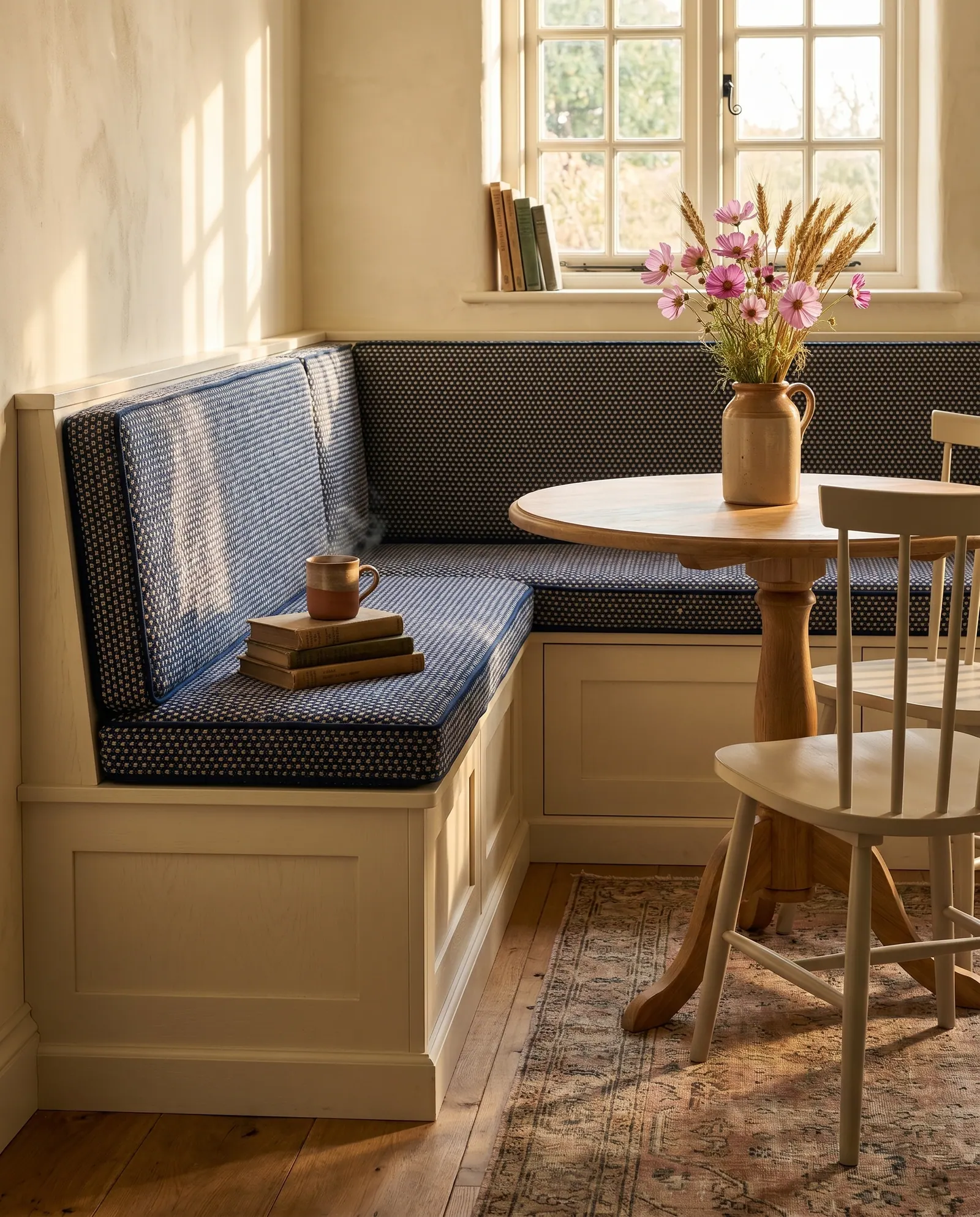
A buyer in the US ordered a corner banquette in velvet: two scalloped back cushions 24 in (61 cm) high, one 80 in (203 cm) long and one 53 in (135 cm), over seats of 16 x 80 in and 16 x 37 in. After paying, the color moved from pale pink to graphite gray with off-white piping. A good call, if you ask me.
The seats were 4 in thick; the backs, shredded foam. Then the workshop spotted the snag. Both backs had been measured wall to wall, so in the corner they would have run straight into each other. One back came off 4 in shorter, and the pair sat square.
When two backs share a corner, one of them has to give way.
Back cushion mistakes, mine included
- Ordering ties for a back that leans on a flat wall. Ties need slats or a rail to wrap.
- Measuring two corner backs wall to wall. Shorten one by its thickness.
- Forgetting the window latch. Size the back to clear the lowest hardware.
- Expecting a floor-cushion back to stand in the open. It needs a wall or a frame.
- Judging a shredded-foam back on day one. Vacuum-packed fill needs shaking and 48 to 72 hours to recover.
- Asking for a tufted back with a zipper. Zippered, removable backs come only in the non-tufted style.
A back cushion leaning on slats or a rail wants fabric ties; a back cushion leaning on a flat wall wants a non-slip backing.
Maggie
Banquette backs,
- A common question
My banquette back cushions keep sliding down. How do I stop them?
The workshop's answerIt depends on what they lean against. Against a frame, railing or slats, matching ties are sewn near the top on the back, hidden and handy for lifting. Against a flat wall or solid back, a non-slip backing works better; it can go on every cushion, so say which. Double-piped outdoor backs often need no straps.
- A common question
Will a back cushion stand up by itself, or does it need a wall behind it?
The workshop's answerStandard backs aren't freestanding. They lean on a wall, a cabinet back or something solid, and are sized to your wall; one 25 x 74 in corner bench set rests its back right on the wall. For floor cushion sets with no wall, metal frames can be sent, or a wooden back frame made.
- A common question
Can you build a banquette back as a panel with a board inside, so I can screw it to the wall?
The workshop's answerNormally not. The cushions have no rigid board, so they can't be screwed on or hung on a French cleat. The back is made like a back pillow: a piped, removable cover over shredded foam about 4 in thick, or a fiber-wrapped foam core, fixed with hook-and-loop, rod loops or top-corner ties.
- A common question
Do you make wedge back cushions that are thicker at the bottom?
The workshop's answerYes, often. Send the width, height and the thickness at top and bottom, or a dimensioned photo or diagram, such as a 28 x 24 in wedge tapering from 9 in to 4–5 in. Wedges can be split into pieces, and on an angled dining bench the bottom edge can be shaped to sit better.
Short answers on backs that behave
Can a back cushion be tied to the seat cushion under it?
Yes. Fabric ties can be sewn into the seams in any position, and one use is tying a backrest to its seat. Say which edges meet and where each tie goes, so the pair lines up when tied.
Is a non-slip backing sticky against the wall?
No. It's a grippy fabric sewn in as a whole panel, and it holds by friction, not adhesive, so it leaves no residue. It's an add-on chosen in personalization; ask if your version is washable.
Do outdoor back cushions need straps to stay up?
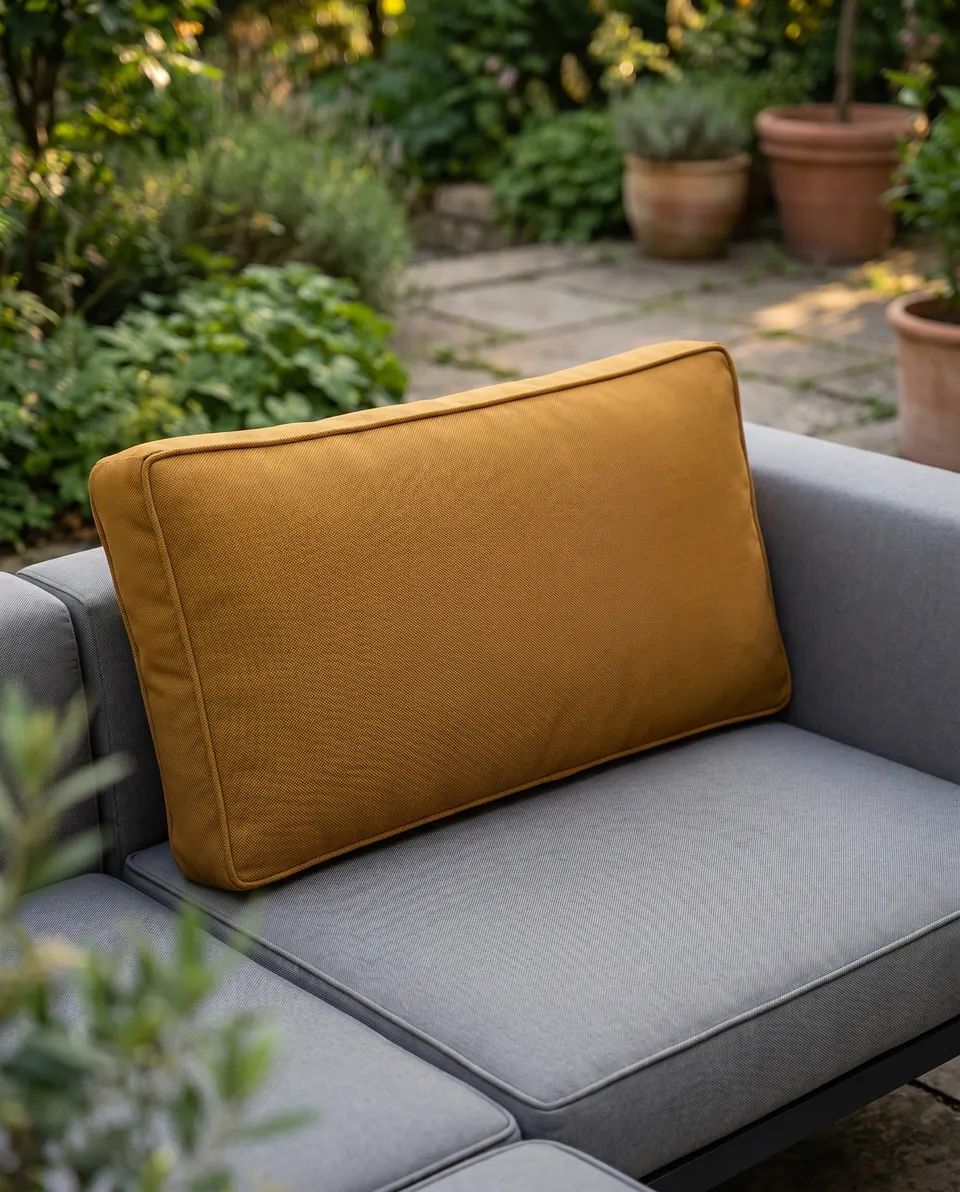
Often not. Outdoor back cushions made with double piping usually have enough structure to hold their place, and for one set of patio chairs the workshop suggested exactly that instead of straps. Send a photo of the chairs first.
Can I unzip and wash a back cushion cover?
On a non-tufted back, yes: every foam cushion has a zippered, removable cover, with the zipper hidden on the edge facing the wall or underneath. Tufted backs can't take a zippered cover.