The Pattern Room · a measuring pattern
How tall should a back cushion be? Sizing backrests to your seat
A backrest that fits badly was usually measured carefully, just from the wrong line. Start at the top of the seat cushion, not the bench, and the rest of the sizing falls into place.
 Save
The quick answer
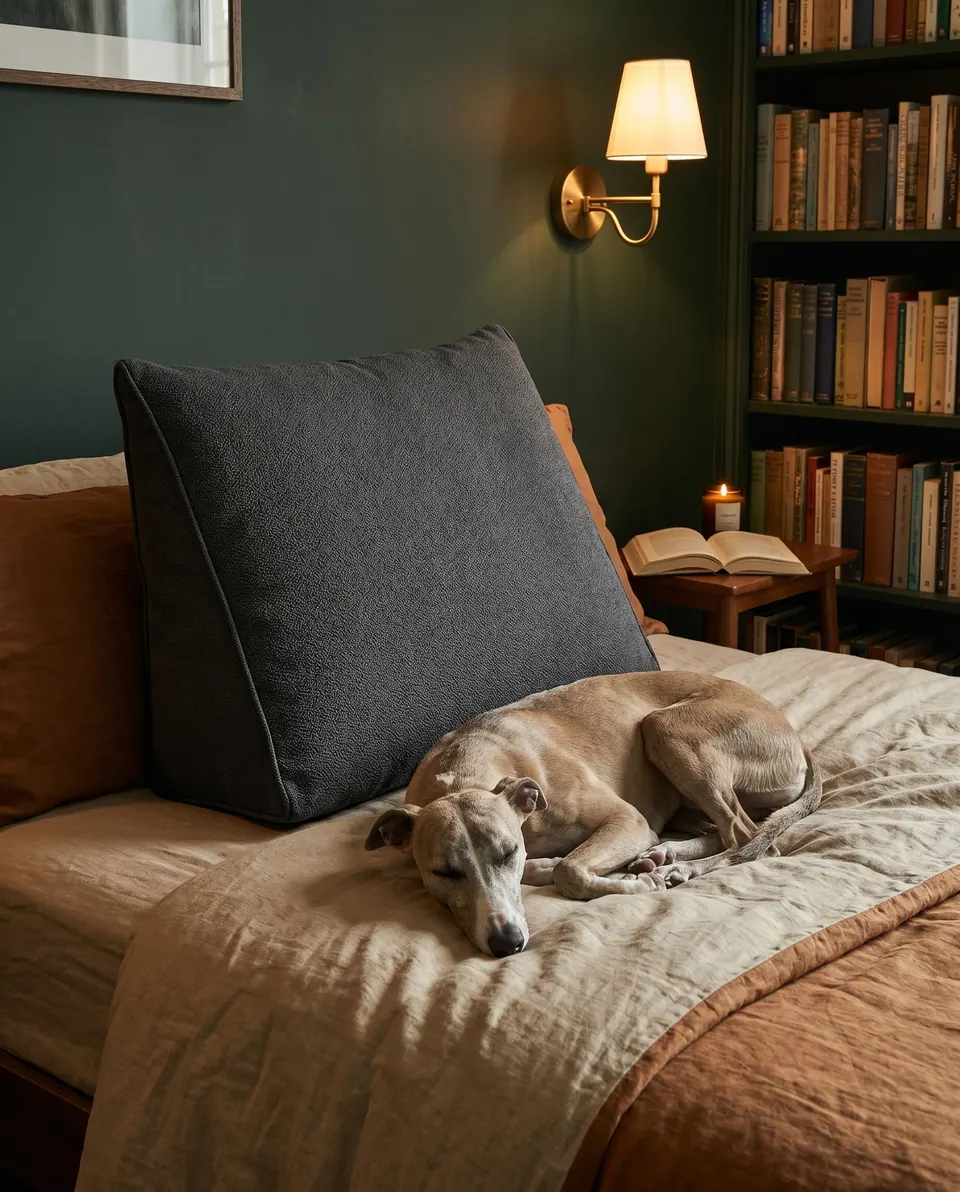
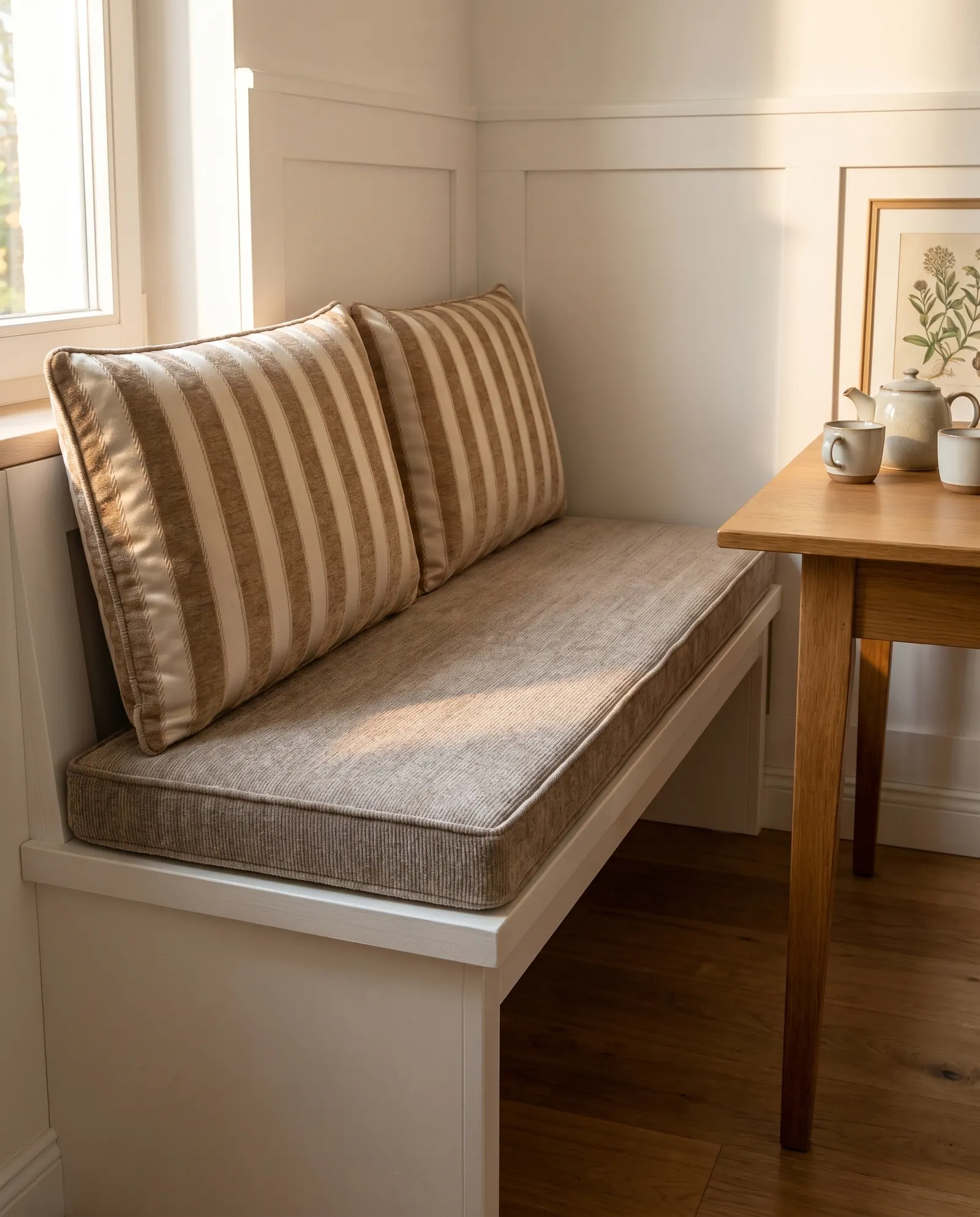
A standard back cushion is 16 in (40 cm) tall and 4 in (10 cm) thick, made the same length as the seat, with its height measured from the top of the seat cushion. Subtract the seat thickness from your wall or frame height, allow about 3 in (7.5 cm) of lost seat depth, and go lower only to clear a sill or window hardware.
Start at the top of the seat cushion, not the bench
Back cushion height is counted from the top of the seat cushion, because that is where a back cushion stands. Most of the backrests that fit badly were measured with care, just from the bench instead.
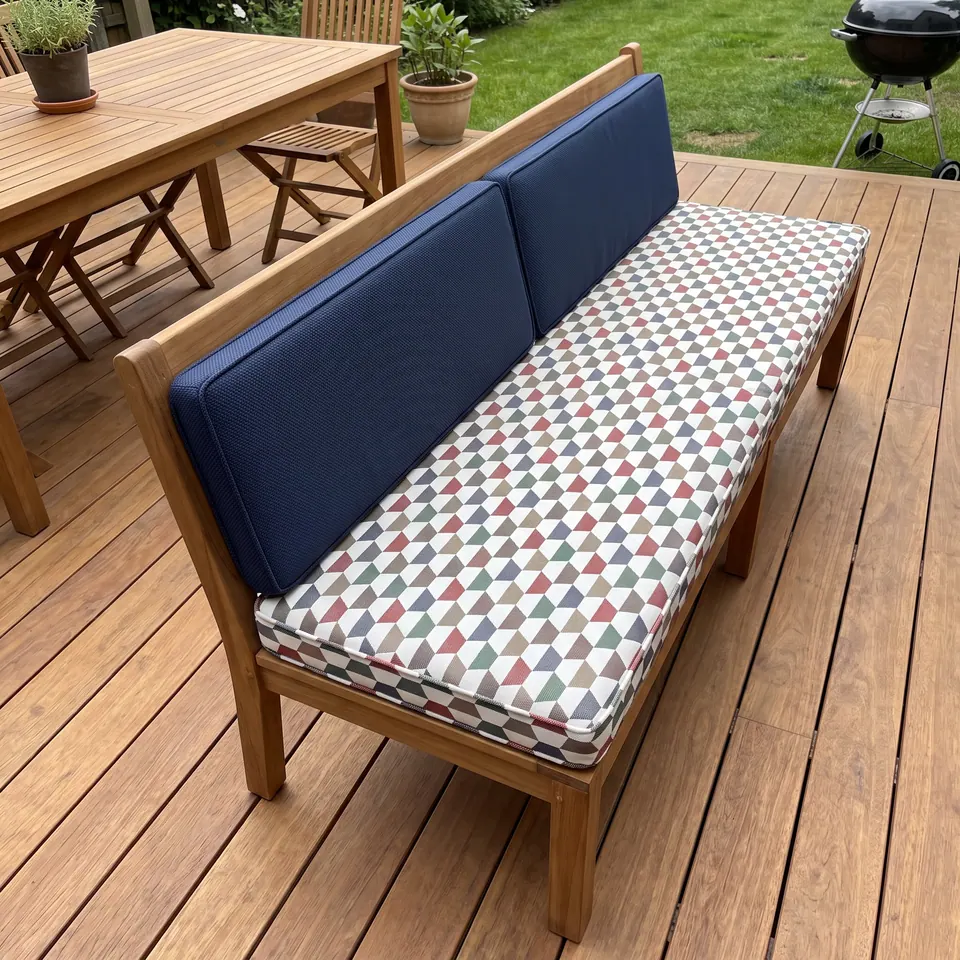
Set a 16 in (40 cm) back on a 4 in (10 cm) seat and the pair reaches 20 in (51 cm) above the bench. Order the back to the full wall height instead and the two cushions shove each other: the back tips forward and the seat creeps toward your knees.
In the shop where I swept floors as a boy, the old men put it plainly: measure a back from where a person sits, not where the wood stops. The question keeps arriving for bench seat and back cushion sets and kitchen banquettes. The answer takes a pencil and one subtraction.
Sizing a back cushion from the seat up, in eight steps
Settle the seat cushion first
The back stands on the seat, so the seat's thickness decides everything above it. The workshop's standard for bench, banquette and window-seat cushions is 4 in (10 cm), and most buyers keep it.
Measure the back area, then subtract the seat
Measure from the bench or frame up to where you want the back to end. Take the seat thickness off that number and you have the back cushion's height. A 21 in (53 cm) back area over a 4 in (10 cm) seat takes a 17 in (43 cm) backrest.
Pattern sheet Side view. The back cushion stands on the seat cushion, so its height is the frame height minus the seat thickness: 21 − 4 = 17 in. Start from 16 in tall and 4 in thick
Standard back pillows and backrests are about 16 in (40 cm) tall and 4 in (10 cm) thick. The workshop recommends 16 in over a 12 in (30 cm) back because it supports the back properly. Lower backs of 14 to 15 in (36 to 38 cm) are made when a sill or a short wall asks for them; write the height in the personalization box.
Give up about 3 in of seat depth, on purpose
A back cushion takes about 3 in (7.5 cm) off the usable seat depth. If the back stands on the bench behind the seat rather than on top of it, size the seat as bench depth minus the back's thickness. A back a little thinner than the seat gives some of that room back.
Match the length, then decide on pieces
A backrest is made the same length as the seat it serves. Measure the inside length each back must fill, between the arms or walls, not the outside of the frame. A long back can be split into two or three equal pillows, which keeps it from sagging.
Check the sill, the trim and the window hardware
Under a window, size the back to the window, not the wall. With a lever 11 in (28 cm) above the seat cushion, the workshop advised a back 14 to 16 in (36 to 40 cm) tall and 3 to 4 in (7.5 to 10 cm) thick, left loose so the window still opens.
Choose a wedge for a deep seat
For deep lounging seats, and banquettes that need extra support, the workshop recommends a wedge: 35.5 in (90 cm) long, 16 in (40 cm) high, 6 in (15 cm) thick at the bottom and 4 in (10 cm) at the top. Wedge-shaped foam backs stay put without hook-and-loop tape, and they forgive small measuring errors that would spoil a single curved back.
Write the seat and the back as two sizes
A seat cushion and its backrest are separate items: add the back at its own size and write 'backrest' in the note. Label every number, such as 17 in high x 75 in long x 4 in thick. Handmade pieces can vary by about 1 in (2.5 cm) either way, so if a size is a hard maximum, say so.
Have it made
Measured it? Have Harlan’s workshop make it
Old upholsterers will tell you the real cutting happens in the conversation, long before the shears come out. Tell the workshop what you sit on, and they will talk it through with you. — Harlan
Leave your details and the workshop will call you to confirm measurements, fabric, foam and piping. No prices, dates or payment on this page: it is a request, not an order.
Back cushion heights, seat by seat
| Where the back goes | Height above the seat cushion | Thickness | The reason |
|---|---|---|---|
| Bench or banquette against a wall | 16 in (40 cm), the standard | 4 in (10 cm) | Supports the back; same length as the seat |
| Bench under a window with a lever | 14 to 16 in (36 to 40 cm) | 3 to 4 in (7.5 to 10 cm) | Keeps the lever behind it; stays loose so the window opens |
| Deep lounging seat or banquette | 16 in (40 cm) wedge | 6 in (15 cm) at the base, 4 in (10 cm) at the top | More support where the seat runs deep |
| Daybed dressed as a sofa | About 20 in (50 cm) | Pillow backs | The daybed set standard |
| Deep-base sofa | About 17.5 in (45 cm) over an 8 in (20 cm) seat | Made to order | About 25.5 in (65 cm) in all |
| Floor cushion under a low sill | What's left: 7 in (18 cm) under an 11 in (28 cm) sill | A low, flat piece | Replaces the round bolster |
The 75-inch studio bench and the 11-inch lever
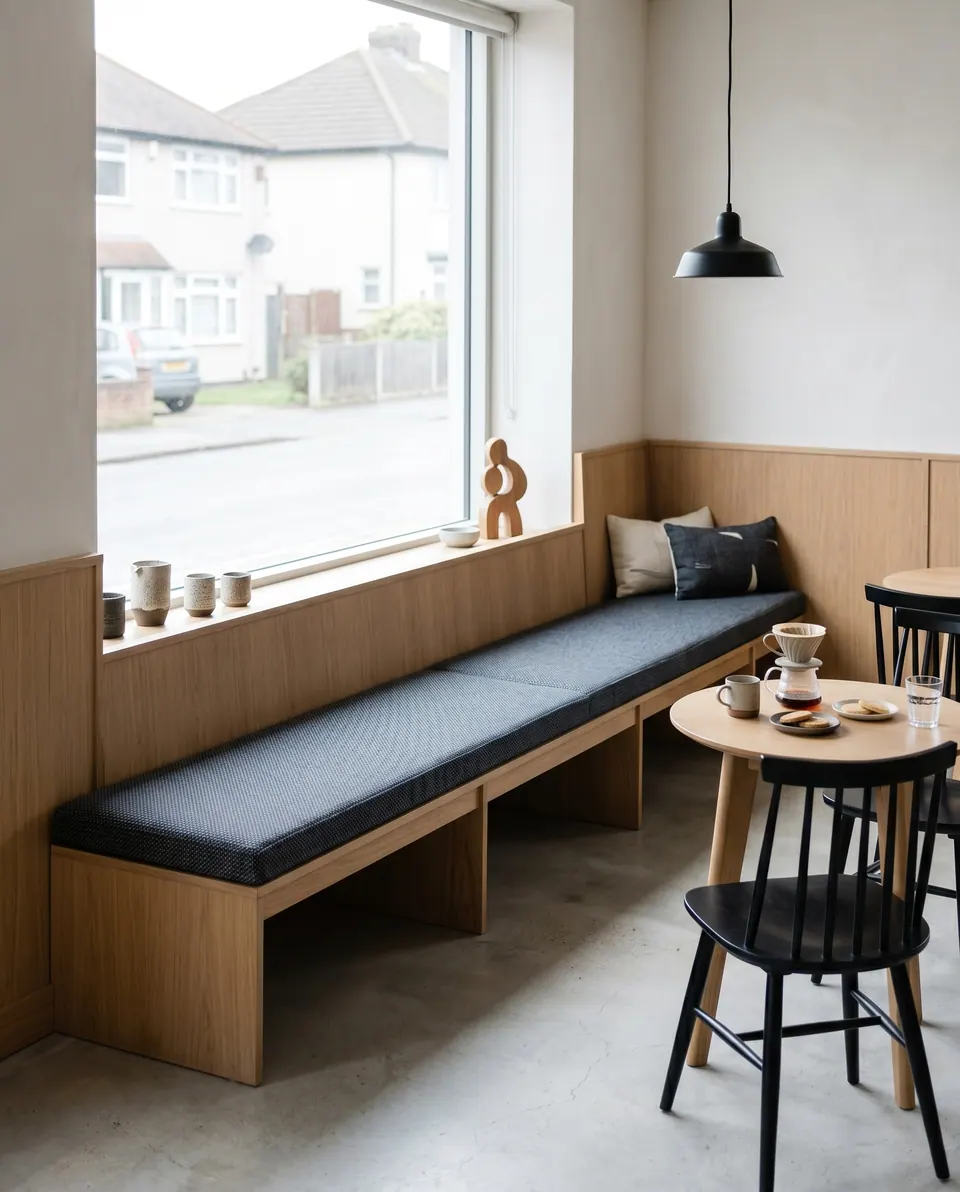
A designer wrote to the workshop about a wellness studio: a 75 x 20 x 3 in (191 x 51 x 7.5 cm) bench cushion in linen with contrast piping, and a matching back cushion leaning against the windowsill behind it.
The window told the workshop more than the wall. Its trim started 4 in (10 cm) above the seat cushion, and a lever sat 11 in (28 cm) above it.
The workshop advised a back 14 to 16 in (36 to 40 cm) tall and 3 to 4 in (7.5 to 10 cm) thick, so the lever stayed tucked behind it, and left loose, so anyone could still reach in and open the window. The client chose freestanding benches in the end, and the designer's next project, a banquette with a 45-degree corner, was made as trapezoid cushions. The lesson stayed on my bench: size a back to the hardware, not just the wall.
- What it taught
- Size back cushions around window hardware, not just the wall height.
Backrest mistakes that come back to the workshop
- Measuring from the bench. The back stands on the seat. Leave the seat's thickness in and the cushions push each other out.
- Sizing to the outside of the frame. Measure the inside length each back must fill, inside the arms, or it bulges.
- Forgetting the back takes depth. When the back stands behind the seat, seat depth is bench depth minus the back's thickness.
- Assuming seat and back match. Give both sizes separately. Many buyers want a firmer seat and a thinner, softer back.
- Ordering for a generic daybed. Backs cut to a standard daybed instead of the measured frame ended in a partial refund.
- A loose back with nothing to lean on. Backrests aren't freestanding. Against a wall they stand; on a smooth bench, ask for ties sewn in to hold the back to the seat.
Check the stack in the Studio before you write
The seat height calculator shows where the top of the seat cushion lands for your bench and the thickness you choose, so you know the line to measure the back from. Run it with the seat you plan to order, then stand a tape on that line against the wall.
For the filling inside the back, read shredded foam, wedge or fiber. If your backs tend to slump, keeping back cushions upright covers ties and structure, and a daybed has its own proportions in daybed back cushions.
So tell me, my friend: from the top of your seat cushion, how far is it to the sill? Get that number right and the rest is tailoring. Buy the cushion once, cry once.
A standard back cushion stands 16 in tall on top of a 4 in seat cushion, so the pair reaches 20 in above the bench.
Harlan
Back lean: 5 to 10 degrees, and how a wedge makes it
Banquette design guides treat the angle of the back as a core dimension, not a detail: they put the top of the back cushion 12 to 20 in above the seat and lean it back about 5 to 10 degrees. On a built-in with a vertical wall, the cushion itself has to create that lean. A wedge back, thicker at the bottom than at the top, pushes the sitter's lower back forward and lets the shoulders rest further back; the workshop's standard wedge is about 6 in (15 cm) thick at the base and 4 in (10 cm) at the top, and custom wedges can be split into pieces for a long wall. A rectangular back of even thickness sits upright, which suits dining, while a wedge suits lounging and deep seats. Remember that a thicker base also takes more seat depth.
Buyer questions: backs, bolsters and odd walls
- A common question
Can you make a back cushion to match the bench cushion I already have?
The workshop's answerYes. Backrests are made to any size in the same fabric as the seat, either firm foam like the seat, which holds its shape upright, or a soft filled pillow, which is plumper and more relaxed. Order them together, or add one later by quoting the original fabric code, as one buyer did for a window-seat back 90 in long, 11 in high and 3 in deep.
- A common question
Can I order only the back cushions and skip the seat?
The workshop's answerYes. Backrest-only orders come in any size and color, for example seven banquette back pillows 14 in high and 3 in thick in lengths of 21, 26 and 27 in, or a single 13 x 50 in back. Round bolsters are sold separately, and only the non-tufted style can have a zippered, removable cover.
- A common question
How close to my numbers will a handmade cushion come out?
The workshop's answerWithin about 1 in (2.5 cm) either way, as the listings state, and long pieces vary the most. If a size is a hard maximum, say so: when a buyer said 24 in was the absolute limit, the cushion was made 23 in. Measure height only after the cushion has fully expanded.
- A common question
Could the back be an upholstered panel with a board inside, hung on a French cleat?
The workshop's answerNormally not. The backrests have no rigid board, so they can't be screwed to a wall or hung on a cleat. They're made like back pillows: a removable piped cover over shredded foam about 4 in (10 cm) thick, or fiber-wrapped solid foam for a flatter panel, held with hook-and-loop tape, loops on a rod, or ties at the top corners.
- A common question
On your size menu, which number is the length and which is the width?
The workshop's answerLength is the long side, measured left to right across the front. Width is the short side, front edge to back edge, which is the same as seat depth. Thickness is how tall the cushion stands. If in doubt, label your numbers, such as 20 in deep x 60 in across.
Backrest sizing, in short
Are daybed back cushions taller than bench backs?
Yes. Daybed sets use backs about 20 in (50 cm) tall, against the 16 in (40 cm) standard for benches and banquettes. Back pillows can be made taller still, such as 26 in, to span a mattress that sits against a window.
Where does the back line start on the short wall of an L-shaped banquette?
At the corner, not at the seat's edge. The short wall's usable back line is its seat length plus the long side's seat depth, minus the corner pillow's thickness. Divide each line into two or three pillows and leave about 1.5 in (4 cm) so they nest in the corner.
Can a backrest be made taller than 16 inches?
Yes, heights are made to order. For a deep-base sofa the workshop suggested an 8 in (20 cm) seat under a back of about 17.5 in (45 cm), about 25.5 in (65 cm) in all. Write the height in the personalization box, measured from the top of the seat cushion.
Should the back be thinner than a thick 8-inch seat?
Often, yes. Many buyers pair a thicker, firmer seat with a thinner or softer back, such as 4 in backs on an 8 in seat, and a thinner back also costs less. It gives back some seat depth, too, because a back cushion takes about 3 in off the usable seat.
Should banquette back cushions lean back?
A little. Design guides put banquette backs 12 to 20 in above the seat with a recline of about 5 to 10 degrees. Against a straight wall, a wedge cushion that is thicker at the bottom than the top creates that lean; the workshop's standard wedge is about 6 in (15 cm) at the bottom and 4 in (10 cm) at the top.
How tall should a wall-hung banquette back be?
Most design guides put the back's top 12 to 20 in above the seat cushion, and one DIY builder hung a board about 18 in tall on straps. Keep it below any window sill or shelf above. If you'd rather not hang a board, the workshop makes soft foam backrests about 4 in thick that hang from a rod on fabric loops or fix with hook-and-loop.