The Cutting Table · a common question
How do I keep back cushions from sliding or falling off?
Also asked as:Is there a way to secure the back cushions?Afraid the backrest cushions will fall
One question settles it, and it isn't about the cushion. It's about what the cushion leans on.

The quick answer
Keep back cushions in place by matching the fix to what they lean on: sewn fabric ties if the back rests against a frame, railing or slats, and a non-slip backing if it rests against a flat wall or a solid backrest. Outdoor back cushions made with double piping often have enough structure to stay put without straps.
 Save
Key facts
- Ties suit back cushions that rest against a frame, railing or slats.
- A non-slip backing suits back cushions that lean on a flat wall or solid back.
- A non-slip bottom can go on seat and backrest cushions alike; say which ones.
- Ties can sit near the top of the backrest's back side, out of sight.
- Ties on the back make a large backrest easier to lift.
- Double piping gives outdoor back cushions enough structure to stay put.
- Straps on back cushions carry a small extra cost.
- Standard backrests are about 16 in (40 cm) tall and 4 in (10 cm) thick, made the same length as the seat.
- A thick non-tufted backrest needs a foam wedge, because fiber fill cannot hold a 12 to 14 in (30 to 35 cm) profile.

Have it made
Have Maggie’s workshop cut this for you
I once cut a lovely cushion two inches short, and I have not forgotten it. That is why the workshop goes over your measurements with you on the phone. — Maggie
Leave your details and the workshop will call you to confirm measurements, fabric, foam and piping. No prices, dates or payment on this page: it is a request, not an order.
Pick the fix by what's behind the cushion
| The back cushion leans on | The fix | Why it works |
|---|---|---|
| A frame, railing or slats | Matching fabric ties | There is something to tie to |
| A flat wall or solid backrest | Non-slip backing | Nothing to tie to, so grip does the work |
| A bench, backrests lying horizontal | Non-slip bottom on every cushion | Seats and backs both stay where you set them |
| An outdoor chair, double-piped back | Often nothing at all | The piping gives the cushion structure; straps stay optional |
Long backrests, flat walls and the lifting problem
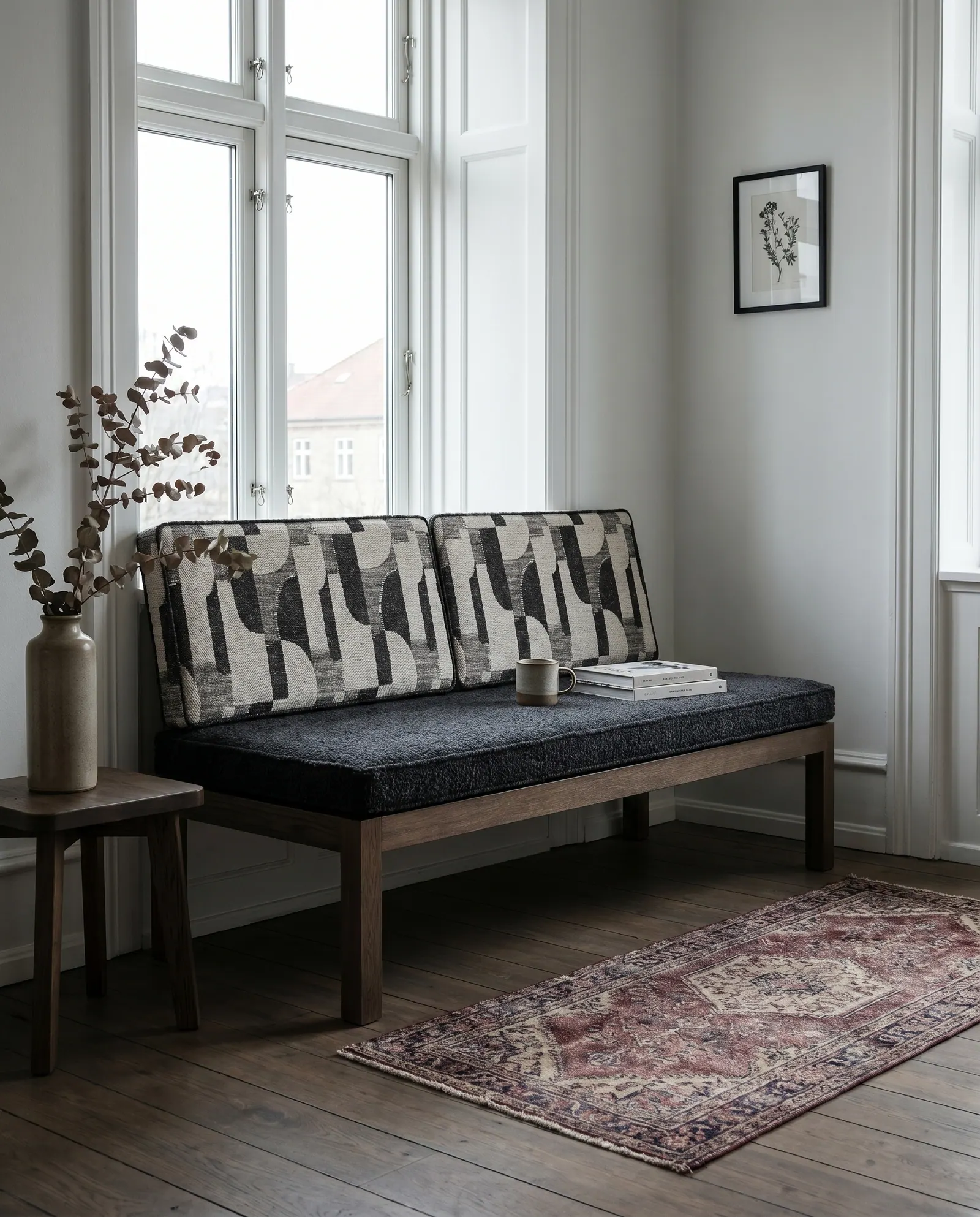
A buyer wrote to the workshop worried that the long, horizontal backrest cushions on a bench would slide or fall off. The answer was a non-slip base on every cushion, backs included. It goes on seats and backrests alike; you only have to say which ones get it.
Big backrests bring a second nuisance: they're awkward to lift. Ties sewn near the top of the back side, where nobody sees them, do double duty. They hold the cushion to a frame and give your hand something to grab.
The full rundown lives in the bench cushion sliding Pattern, and the back cushions staying upright Pattern handles slump. What does your backrest lean on, dear: wood slats or a painted wall?
Thirteen patio pieces, zero straps needed
A buyer in the US ordering cushions for a 13-piece patio set asked whether every back cushion needed straps. My honest answer was: probably not. Those backs were made with double piping, and the two welts give a cushion enough structure to sit up against the chair instead of sliding. Straps were still on offer, and adding them nudged the total up only a little. What the workshop suggests first for sets like that is a non-slip base on the seats, so the whole arrangement stays where you left it. A straight welt is a kind of honesty.
Outdoor back cushions made with double piping often hold their shape well enough to stay upright on the chair without any straps.
Maggie
Buyer questions
- A common question
How do I keep my back cushions in place?
The workshop's answerIt depends where they sit. If the backs rest against a frame, railing or slats, matching fabric ties are added so you can tie them on. If they lean against a flat wall or a solid backrest, a non-slip backing works better to stop sliding.
- A common question
My backrest cushions lie horizontally on a bench. How do I stop them sliding or falling off?
The workshop's answerThe workshop can put a non-slip bottom on every cushion, backrests included, so nothing slides. Say which cushions should have it when you order.
- A common question
Can you sew ties on the back of a large backrest so it's easier to lift?
The workshop's answerYes. The ties go on the back near the top, where they can't be seen.
- A common question
How do I keep a cushion on a lift-up lid, like a storage chest or an RV bench?
The workshop's answerAsk for ties on the hinge side only, with the hinge positions, widths and a photo. If ties won't fit, size the cushion inside the lid's bevel with a non-slip base, though it can still slide when the lid lifts.
Questions buyers ask next
Can a non-slip backing cover only part of a cushion?
No. The non-slip backing always covers the whole underside; a grip strip with a plain fabric border isn't possible. It's a fabric backing rather than glue or rubber, and it sits hidden underneath anyway.
Is a non-slip base on the seats better than straps for an outdoor set?
For outdoor sets the workshop sometimes suggests a non-slip base on the seats rather than straps on the backs, since double-piped backs often stay put on their own. Straps remain an option for a small extra cost.
Can dining chair pads be ordered with ties as well?
Yes. Chair pads are made to your seat measurements with ties at the back, selectable at checkout on the chair cushion listing. Send a photo and all four edge measurements of the seat.