The Pattern Room · a measuring pattern
Replacement sofa and couch cushions: measuring, foam and covers
A cushion should outlive the chair it sits on, my friend, and when it doesn't, a good frame deserves a second set. Here is how replacement sofa seats are measured, filled and covered so they fit the first time.
 Save
The quick answer
To replace sofa cushions, send the length, depth and thickness of each piece, measured from the old cushion if it fit well or from the seat deck if it didn't, with photos of a tape along every side. New seats use firm, about 2.0 lb/ft³ (32 kg/m³) foam wrapped in batting, and three worn seats can become one long cushion.
Most sofas are not worn out. Their seats are.
Most sofas we hear about are not worn out. Their seats are. The frame is sound and the arms are square, but the cushions have sunk, gone lumpy or come from a line the store no longer sells.
Replacement seat and back cushions are made from your measurements, the same way the workshop makes bench cushions, with the thickness matched to the originals. One sofa seat of 71 x 25 in (180 x 64 cm) and its backrest were remade at 7 to 8 in (18 to 20 cm). Buy the cushion once, cry once: the money goes into foam and fit, not into a new frame. The living room cushions collection shows what a fresh set can look like.
So, before anything else: did the old cushions ever fit the way you liked?
Replacing sofa seat cushions in eight steps
Decide what you are copying
If the old cushions fit the way you liked, send their measurements. If they never fit, or you want a different thickness, measure the seat deck instead: the platform the cushions rest on, inside the arms and in front of the back. If the cushions are gone altogether, send the deck sizes and photographs, and the sizes can be worked out from the sofa itself.
Measure length, depth and thickness
Length runs arm to arm, depth runs front to back, and thickness is the height of the cushion itself. Buyers use depth for both of the last two, which causes more mix-ups than anything else, so label every number. Measure to the nearest 1/8 in, twice, and type the numbers out as well as photographing the tape.
Trace a T-shaped or curved front
A T-shaped cushion widens at the front to reach past the arms. Trace the old cushion or the seat deck on paper rather than guessing the steps in the outline, and mark which side is up. For a curved front, give the straight length of each side before the curve starts and how deep the curve runs. A very complex T can be made as several simpler pieces; the paper template Pattern shows the tracing.
Measure each back cushion on its own
Give seat and back sizes separately and never assume they match. A buyer in the US ordering tufted velvet cushions for two couches needed seats of 24 x 58 in (61 x 147 cm) and backs of 14 x 58 in (36 x 147 cm). A back from a discontinued store sofa can be copied from its measurements and photos, matching bolsters included, in the closest fabric the workshop carries. The backrest cushions collection covers the rest.
Choose foam for the years, not the showroom
The workshop's standard seat foam is 32 kg/m³, about 2.0 lb/ft³: high-density polyurethane with a medium-firm to firm feel that holds its shape and resists sagging. It is not memory foam. Each block is wrapped in polyester batting, and an extra 3/4 in (2 cm) layer can be added. A softer 28 kg/m³ grade can be written into the order, and a firmer seat has been offered for sitters over 220 lb (100 kg). The foam firmness finder helps you name the feel you want.
Decide: whole cushions, or covers over your inserts
A new cover over old, slouchy filling keeps the slouch; the crisp look comes from high-density foam. If your foam is still sound, covers alone make sense: measure the bare insert, not the old cover, and note any wrap. One vintage sofa had three inserts of 5 x 23 1/2 x 29 in (13 x 60 x 74 cm) with a 1 in (2.5 cm) Dacron wrap, and the closest velvet to the old color was suggested. More in covers for foam you already own.
Consider one long seat instead of three
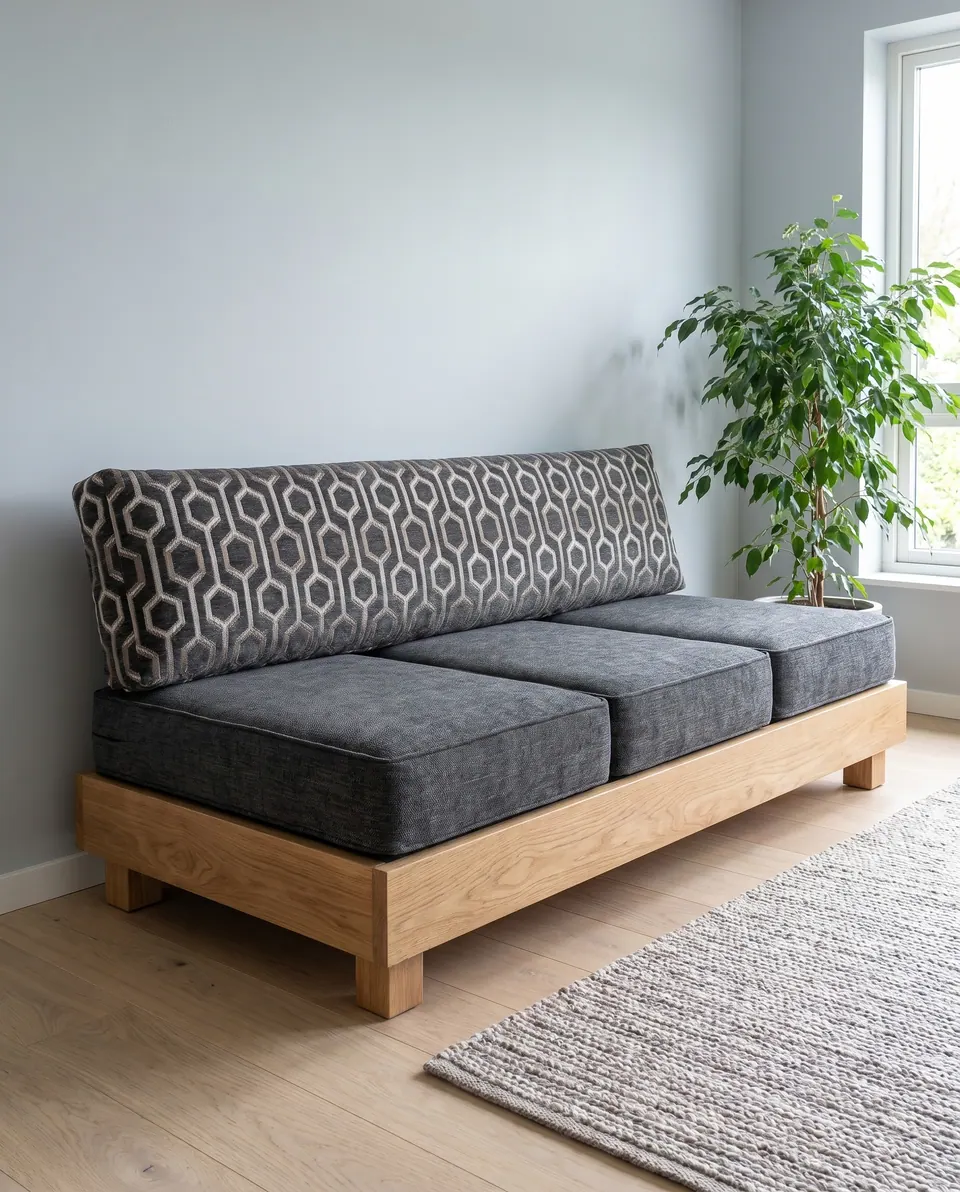
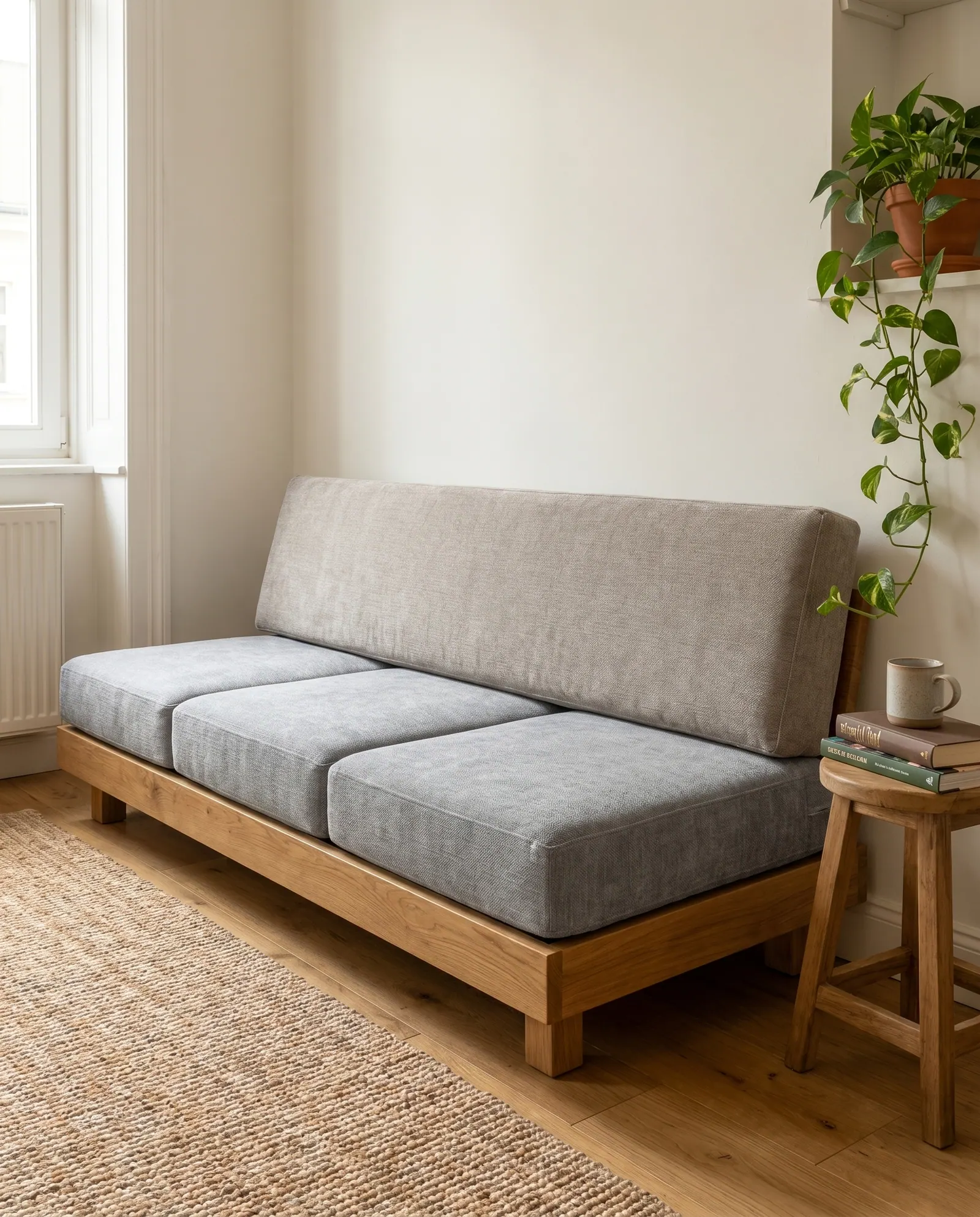
Swapping three separate seat cushions for one long cushion is popular and gives a clean, unbroken line. Past about 79 in (2 m) a single piece gets hard to make, ship and lift, so ask up front whether yours will be one piece or split; the trade-offs are in one piece or two. The low oak platform sofa at the top of this page keeps separate heather gray seats under one full-width back.
Send the whole picture at once
Length, depth and thickness for every piece; photos of each old cushion with a tape along every side; your fabric code; and the words covers only or with foam. Order every visible piece together, so they are cut from one dye lot and sit side by side without a shade between them.

Have it made
Measured it? Have Harlan’s workshop make it
Old upholsterers will tell you the real cutting happens in the conversation, long before the shears come out. Tell the workshop what you sit on, and they will talk it through with you. — Harlan
Leave your details and the workshop will call you to confirm measurements, fabric, foam and piping. No prices, dates or payment on this page: it is a request, not an order.
Copy the old cushion, or measure the seat deck?
| Copy the old cushion | Measure the seat deck | |
|---|---|---|
| Choose it when | The old cushion fit the way you liked | It bulged, gapped, or you want a new thickness |
| What to measure | Every edge of the old cushion, plus its thickness | Inside the arms, and from the front edge to the back |
| Shaped fronts | Trace the cushion itself on paper | Trace the deck, with the step past the arms |
| Also send | Photos with a tape along every side | Photos of the empty seat and the thickness you want |
| Watch for | A cushion that never fit gets copied faithfully | The outside of the frame measured by mistake |
Four dining chairs, copied from their worn cushions
A buyer in the US wanted exact copies of the worn seat and back cushions on four upholstered dining chairs, in cream. They sent photographs of the old cushions with the dimensions written in. The workshop confirmed it could make them the same, a seat and a back for each chair, and quoted the set.
That is the whole method, and it works on a sofa as well as a chair. An old cushion that fit is the best drawing of the new one you will ever have. Photograph it from above, lay a tape along every edge and write the numbers beside it. Chair seats have their own notes under dining chair pads.
- What it taught
- The easiest way to order replacement cushions is photos of the old cushion with a tape measure on each side.
What the workshop doesn't make, and what to ask for instead
The workshop makes foam cushions and their covers. It does not make a fitted slipcover for a whole conventional sofa, arms, back and skirt, or custom covers for an unrelated multi-piece set such as a five-piece sectional with a storage ottoman. Drape-over slipcovers with skirts for fixed upholstery are outside the shop as well, and its fabrics run at most 55 in (140 cm) wide, so large seamless cloths are not possible.
What it can make is a zippered cover for each loose cushion, in your sizes, or new cushions that lift out, foam and all. On most tired sofas the loose cushions are the part that gave out. Inserts on their own are covered under foam inserts.
Replacement mistakes worth avoiding
- Measuring the old cover instead of the foam. Covers are cut to the numbers you give; measure the bare insert.
- Copying a cushion that never fit. If the old one bulged or gapped, measure the seat deck, not the cushion.
- Measuring the outside of the frame. Measure inside the arms and in front of the back, where the cushion actually sits.
- Leaving thickness off a cover order. A cover about 1 in (2.5 cm) too small makes the foam bulge and feel over-firm.
- Replacing one cushion from a newer roll. Dye lots vary; for pieces that sit side by side, consider remaking the whole visible group.
- Measuring the new cushion the day it arrives. Foam travels compressed; wait 3 to 4 days and measure with the tape flush against a wall.
- Forcing a cushion into a fixed frame. Order the depth about 1 in (2.5 cm) under the frame to allow for spread, and say when a size is a hard maximum.
A new cover over old, slouchy sofa foam keeps the slouch. A crisp replacement seat starts with new high-density foam inside the cover.
Harlan
Couch seat thickness and foam
Most sofa seat cushions are 4 to 6 in thick, and a standard seat sits 18 to 20 in off the floor, so a new cushion that's thicker or thinner than the original changes how the sofa sits. If you plan to reuse the old covers, match the original thickness exactly. Foam sellers grade seat foam by density, roughly 1.8 to 2.9 lb/ft³ for polyurethane, and recommend a polyester batting wrap on indoor cushions for a rounded, upholstered look. The workshop's standard seat foam is 32 kg/m³, about 2.0 lb/ft³, wrapped in polyester fiber wadding, with a softer 28-density option on request. To size replacements, measure the old cover between its seams with the foam inside, or the frame, rather than the tired bare foam.
Buyer questions
- A common question
Can you remake the seat cushions on my sofa, or turn three of them into one long cushion?
The workshop's answerYes. Replacement seat and back cushions for a sofa or wood-frame couch are made from your measurements, the same way as bench cushions, with the thickness matched to the originals, such as a 71 x 25 in seat and backrest at 7 to 8 in. One long cushion in place of three gives a clean, seamless look. Send length, width, thickness and your fabric code for a quote.
- A common question
The store discontinued my sofa's back cushions. Can you copy them?
The workshop's answerYes. The workshop makes the same backrests to your measurements, matching bolsters too; one order was two backrests of 15 x 38 x 14 in. It suggests the closest fabric in its range to the original color, such as an ivory-look option. Send the old cushion's measurements and photos for a quote.
- A common question
Should I measure my old cushions or the seat they sit on?
The workshop's answerIf the current cushions fit the way you like, send their dimensions. If they fit badly or you want a different thickness, send the seat dimensions instead. For covers on foam you already own, measure the bare foam, not the old cover, draw it with every side labeled and give the thickness. When one set of chair-pad covers came out about 3/4 in short, the remake was cut 1/2 to 3/4 in larger.
- A common question
Can you make a slipcover for the sofa I bought from another store?
The workshop's answerNo. The workshop doesn't make fitted covers for a whole conventional sofa with arms, back and skirt, or for an unrelated multi-piece sofa such as a five-piece set with a storage ottoman. It can make zippered covers for the individual cushions in custom sizes if you send the measurements, and its covers come off easily for washing.
- A common question
Can I order a second set of covers in another color later on?
The workshop's answerYes. The workshop keeps your exact sizes, so extra covers can be ordered with the cushions or later, in the same fabric or a different one, custom sofa sizes included. People use spares to change fabric with the seasons, to rotate covers on laundry day or to replace a color they regret.
Replacement cushion questions
How do I measure a T-shaped sofa cushion for replacement?
Trace it. Lay the old cushion on paper, or paper over the seat deck, and draw the outline, including the step where it widens in front of the arms. Mark which side is up and write every edge length. Very complex T shapes can be made as several simpler pieces.
What foam should go into new couch seat cushions?
A high-density polyurethane foam that holds its shape. The workshop's standard is about 2.0 lb/ft³ (32 kg/m³), medium-firm to firm, wrapped in polyester batting. A softer 28 kg/m³ grade is available, and anyone heavy on a seat every day should say so for a firmer build.
Will new covers alone make old sofa cushions look crisp?
Only if the foam inside is still firm and square. A new cover over soft or slouchy filling keeps that shape, which is why the workshop asks whether you want covers only, covers for the bolsters too, or new foam as well.
How soon can I measure replacement cushions after unpacking?
Give them 3 to 4 days. Foam travels vacuum-packed and most pieces recover in 48 to 72 hours; then measure with the tape flush against a wall. Shake shredded-foam backs and pull them from both sides. A piece still flat after about a week gets replacement foam.