The Pattern Room · a measuring pattern
Replacing a discontinued cushion by copying the one you have
When a store stops making your cushion, the cushion you still have becomes the pattern. Read it the way you would read a swatch: its size, its edges, and its color in honest daylight.

 Save
The quick answer
To copy an existing or discontinued cushion, measure the old one seam to seam and the frame it sits in, note the edge style, piping, zipper side, ties and true thickness, and photograph it beside a white card in daylight. Then order swatches of the closest codes. Size and construction can be copied exactly; another brand's color can only be matched closely.
The old cushion is already the pattern
A worn cushion from a discontinued set is not a dead end. It is a pattern with every answer already sewn into it.
That is the quiet work behind replacement cushions to match existing ones. The store may have dropped the style, the fabric or the whole collection, but the cushion on your chair still knows its length, its edge, where its zipper hides and how far its ties reach. The copies that fit the first time came from people who read the old cushion slowly before they wrote a single number.
This Pattern is about copying a cushion someone else made. Reordering one of the workshop's own fabrics months later is a dye-lot question, covered in dye lots and later matches. Choosing a new color to sit with a sofa or a wall lives in matching cushions to paint and wallpaper. Sofa seats have their own Pattern: replacement sofa seat cushions.
Reading the old cushion, one detail at a time
Measure the frame before the cushion
The seat, bench or chair frame tells you what will fit; an old cushion that has sagged gives misleading numbers. Measure inside the arms or side rails, at the front and at the back.
Then measure the cushion seam to seam
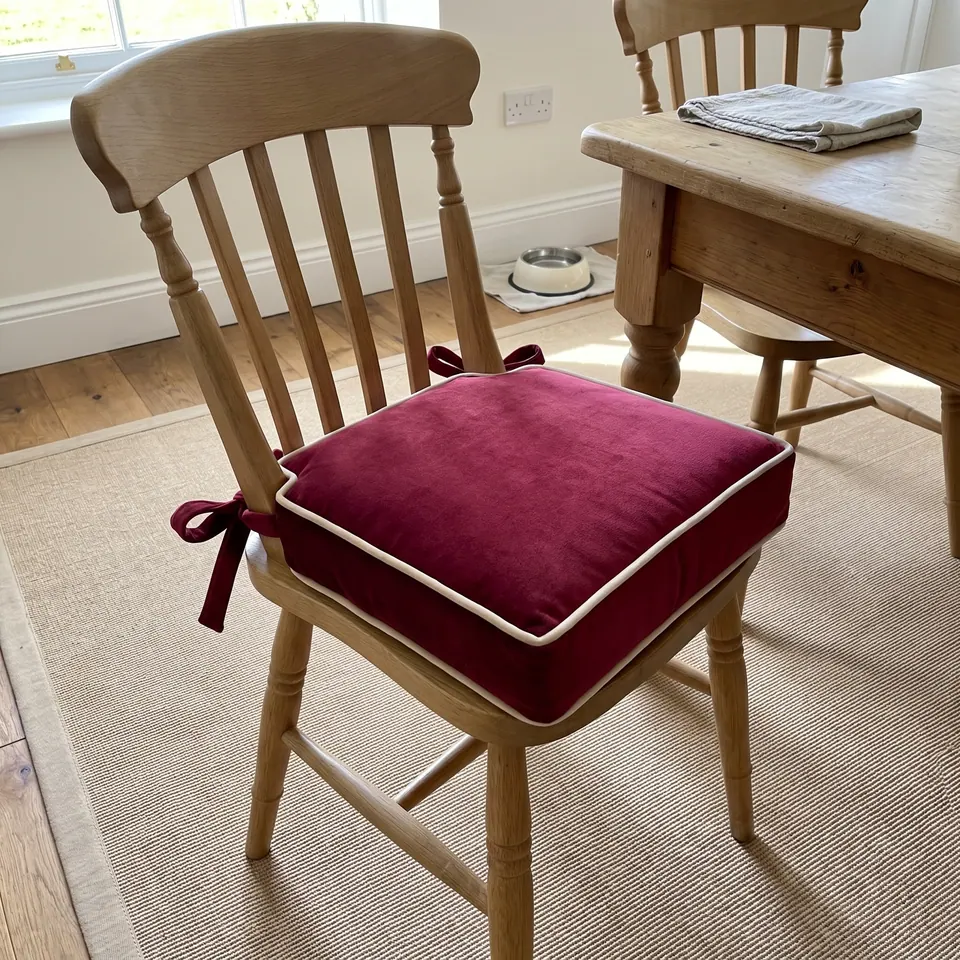
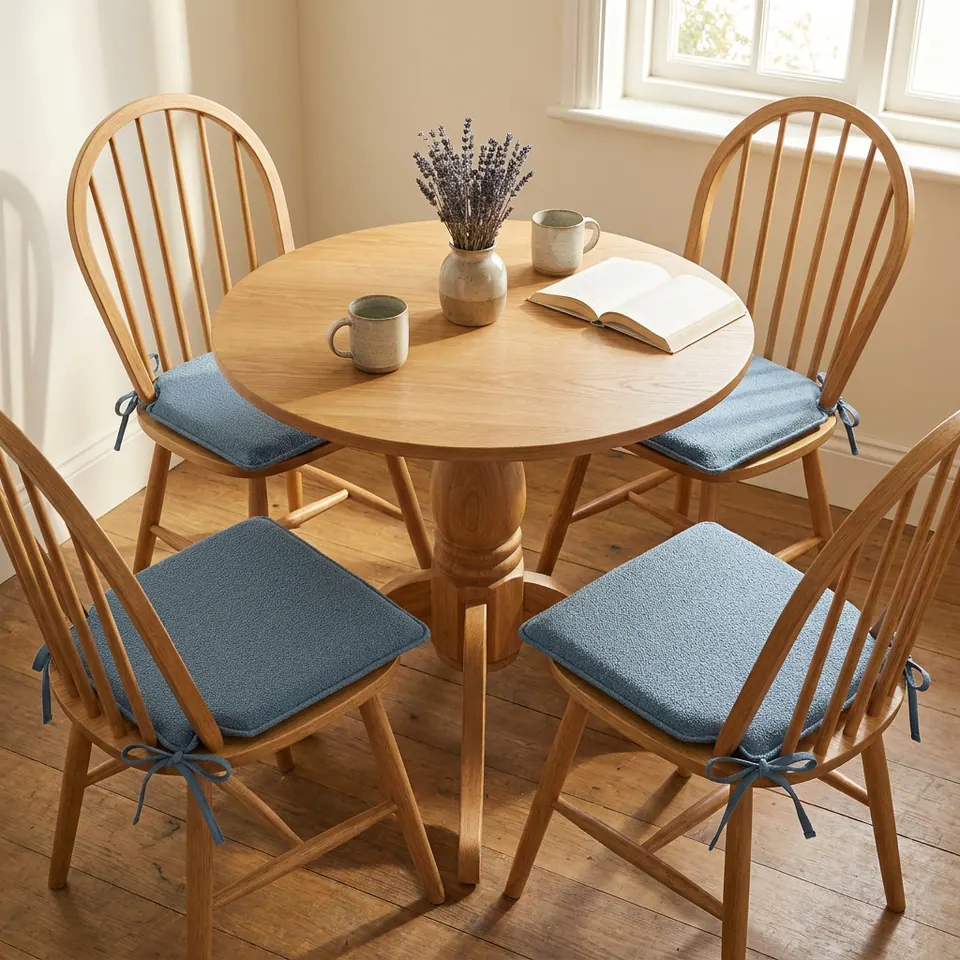
Run the tape from seam to seam across the widest point, with the old foam still inside, and stay off the crowned middle. On a tapered seat, take the front and the back separately: one chair cushion measured 17 in (43 cm) at the back, 19 in (48 cm) at the front and 19 in (48 cm) deep, and half an inch on that front edge changes the whole cover.
Decide on the true thickness
Lay a straightedge across the top and measure down to the seat at rest. An old cushion has usually flattened, so choose between its tired height and the height it arrived with. Matching the original thickness also means an old cover can be reused.
Name the edge and the piping
A box edge with a side band, or a knife edge that tapers to one seam? Piping in the cushion's own fabric or a contrast color, and how thick? These details are what make a copy read as a copy.
Find the zipper and the ties
Note which edge the zipper sits on and whether it wraps a corner. Count the ties, measure how far each sits from the corner, and measure their length. Ties are an extra on a new order, so anything you don't write down won't be there.
Photograph it beside a white card, in daylight
Set the cushion near a window, out of direct sun, with a plain white card or a sheet of printer paper against it, flash off. Then take one photo per side with a tape measure laid along it, the numbers readable.
Order swatches of the closest codes
Ask the workshop for its nearest codes to your photos, then order up to 5 of them in one sample order. Hold each against the old cushion in morning light, at noon and under your own lamps.
Send everything in one message
Each piece with its size and quantity, the edge and piping notes, the zipper side, tie positions, the fill you want (firm foam or a soft pillow back), the photos and your chosen code. One message, nothing left to memory.

Have it made
Measured it? Have Élodie’s workshop make it
Describe the room at four in the afternoon: the floor, the wall, the one color you love. That is where a good fabric choice begins. — Élodie
Leave your details and the workshop will call you to confirm measurements, fabric, foam and piping. No prices, dates or payment on this page: it is a request, not an order.
What copies exactly, and what only comes close
| What you're copying | Exact or close? | What the workshop does |
|---|---|---|
| Length, width and shape | Exact | Cuts to the numbers you write, with a drawing to approve for anything that isn't a rectangle |
| Thickness | Exact | Makes the thickness you name; 4 in (10 cm) is standard, others on request |
| Edge, piping, zipper side and ties | Exact | Follows your notes; ties and a non-slip base are extras you ask for in writing |
| A seat and back as a set | Exact | Makes backrests in the seat's fabric, with firm foam like the seat or a softer pillow fill |
| The color of another brand's fabric | Close | Names its nearest codes from daylight photos and sends close-ups; swatches settle it |
| A paint chip or a printed color code | Close | Suggests the nearest chart color; no exact match is promised |
| One color name across velvet, linen and corduroy | Close | Points you to the fabric family whose tones come nearest |
Why the color can only come close
Size is arithmetic. Color is light.
Another brand's fabric was dyed to another mill's recipe, woven with its own texture, and photographed under someone else's lamps. Even inside one workshop, a single color name reads differently in corduroy and in velvet. A terracotta linen and a burnt-terracotta velvet can sit side by side and still disagree, not because either is brighter, but because one is flat-woven and the other has a pile that catches light. Daylight never lies; your screen sometimes does.
So, my friends, the workshop won't promise an exact match to a sofa it has never seen. It names its closest codes from your daylight photos, sends close-ups of each, and leaves the final choice with you, since you are the one who can see the piece in person. With creams this matters most: its linen range runs from a whiter code to a warm cream with no gray in it, and a phone photo won't tell you which your old cushion is. The swatch Pattern shows how to judge them, and the linen family shows the range.
When the match matters more than the old cover, there is a gentler answer: replace every cover in the set at once, so nothing new ever sits beside anything old. What color is your old cushion when the morning light reaches it?
Three copies
Two floor backrests the store stopped making. A buyer had a pair of floor backrests from a set that was no longer sold, each 15 x 38 x 14 in (38 x 97 x 36 cm), and wanted them made again. The workshop said it could make the same backrests and named the fabric in its range that came closest to the original ivory.
Four dining chairs, seat and back. Another buyer wanted exact copies of the worn seat and back cushions on four cream dining chairs and sent photos with the dimensions. The workshop confirmed it could replicate them and quoted per chair, shipping included. The checklist is in copying chair seat and back cushions, and more chairs live in the dining chair cushion atlas.
One armchair, two squares. An armchair needed a new seat and back, both 22 x 22 in (56 x 56 cm). The buyer chose charcoal linen, and when the cushions arrived, they fit perfectly.
Three different pieces, one habit: each buyer measured what was there and said exactly what it was.
Where copies go wrong
- Measuring the sagged old cushion instead of the frame it sits in.
- Ordering covers only, then measuring the old cover instead of the bare insert.
- Copying a flattened thickness without deciding whether that height is the one you want.
- Giving one thickness for a seat and a back that were never the same.
- Choosing a cream or a charcoal from a screen, with no swatch held beside the old piece.
- Leaving the ties, the zipper side or the non-slip base out of the written order.
- Forgetting to say 'with foam' or 'covers only' in every message.
A discontinued cushion is not lost. Its size, its edge and its zipper can be copied exactly; only its color has to be found again, in daylight.
Élodie
Buyer questions: matching what's already there
- A common question
Can you match a cushion to my couch, even though it's from another brand?
The workshop's answerClose, but not guaranteed. Send daylight photos of the couch or chairs and the workshop suggests the nearest codes from its charts, such as a forgiving cream linen to sit beside dining chairs. The final choice stays with you, because colors look different on screens. For a real check, order swatches, up to 5 codes per sample order, and hold them against the piece at home. If the sizes allow, replacing all the covers means everything matches.
- A common question
Can I get the same color in a different fabric, say linen instead of velvet?
The workshop's answerClose, not identical. Colors with the same name differ in tone between corduroy and velvet, and linen and velvet reflect light differently: one terracotta linen sits very close to a burnt-terracotta velvet, and the small gap comes from the fabric type. Beyond the basic linen chart there is a wider linen catalog, where the workshop finds the nearest named linen for a color like rust orange.
- A common question
Can I add matching back cushions to a seat cushion, now or later?
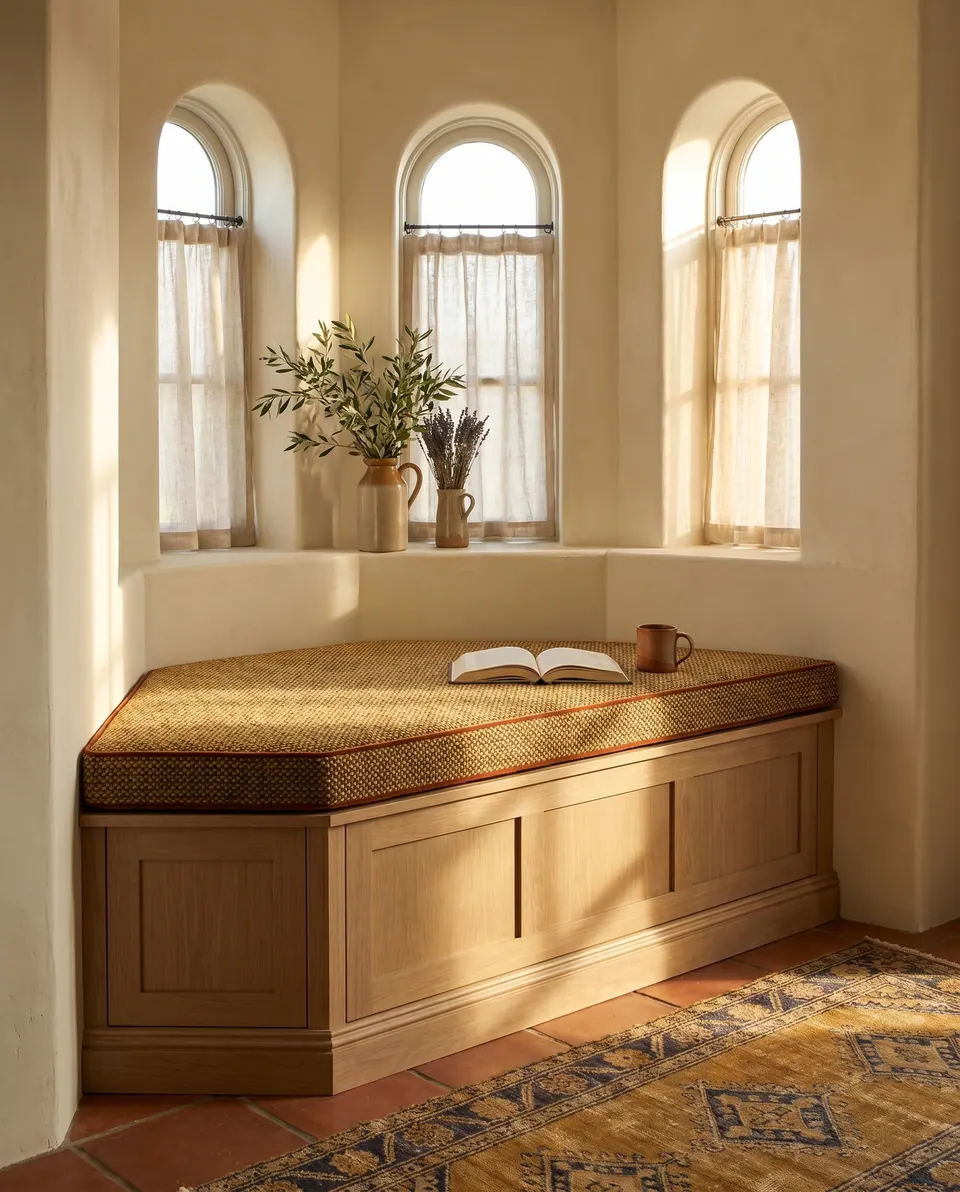
The workshop's answerYes. Backrests are made to any size in the seat's fabric, with firm foam like the seat for a structured look or a soft pillow fill for a relaxed one. Order them together, or add them later by quoting the original fabric code, as one buyer did for a window-seat back 90 in (229 cm) long, 11 in (28 cm) high and 3 in (7.5 cm) deep.
- A common question
Is this fabric bright white or a warm cream? I'm matching an old cushion.
The workshop's answerIt depends on the code. On the linen chart, L-01 is the whiter option and L-02, the best seller, is a warm cream with no gray undertone. In the soft range, 909 is a pure white and 910 a cream. On the outdoor range, S-09 leans toward stark white and was the closest when matching one existing cushion, though fabric batches can vary very slightly in shade.
- A common question
My old cushion is smaller than your smallest size option. Can you still copy it?
The workshop's answerYes. Select the smallest or closest option and write the real size in the personalization box, for example 11 in (28 cm) wide when the list starts at 12, or a 16 x 16 x 2 in (41 x 41 x 5 cm) cover. It is cut to the size you write. The price can't drop below the smallest option, because shipping is a large part of a small cushion's cost.
Before you copy
Can I order just a new cover for my old foam?
Yes. Covers only is its own option and usually costs noticeably less than a full cushion. Measure the bare insert, not the old cover, at its widest and thickest point, and write 'covers only' in every message. One buyer with good inserts switched six velvet cushions to covers only and cut the quote substantially.
How do I copy a tapered or shaped chair cushion?
Give the front width, the back width, the depth and the thickness at the very least. For a shaped seat like a spindle-back chair, the workshop has asked for three widths and three depths, left, center and right, so the curve can be cut accurately. Add one photo taken straight down.
Will the zipper go where my old one was?
It can. The workshop hides zippers on the back edge, facing the wall, or on the underside, and you choose which. On long bench covers it often wraps around two corners so the foam slides out. Write the side you want in the order; otherwise it goes on the back edge.
Should I copy the old cushion's thickness if it has gone flat?
Usually not. Measure the space instead: the seat height you want minus the bare seat, or the clearance under a window sill. An old cushion compresses with use, so its height today is less than the day it arrived. The workshop's standard is 4 in (10 cm), and any other thickness can be written in.