The Pattern Room · a measuring pattern
Velvet seat cushions: how the pile catches the light on a chair
At chair height, light rakes across velvet the way late sun crosses a parlor floor. Here is how to choose the thickness, the color and the ties so a whole set of velvet seats reads as one family.

 Save
The quick answer
A velvet seat cushion from the workshop is 4 in (10 cm) thick as standard, or 2 in (5 cm) as a tie-on chair pad, cut to your exact seat in short-pile polyester velvet with piping included. Ties are added only on request. The velvet has no stain-repellent coating, so blot spills and wash the zip-off cover at 86°F (30°C) on a gentle cycle.
The chair pad that changes color when you stand up
A velvet seat cushion changes color when you stand up. Sit, and the pile bends one way; rise, and it lifts toward the window and catches a paler light. That small piece of theater is why people choose velvet for a chair, and why a few of them write to the workshop worried.
This Pattern covers velvet seat cushions for dining chairs, desk chairs, bistro chairs and stools: the boxed 4 in (10 cm) cushion and the thinner tie-on pad. The workshop's velvet is a short, tight-pile polyester, and the whole chart lives in the velvet swatch library. Chair shapes and tie styles for every kind of seat sit under dining chair cushions.
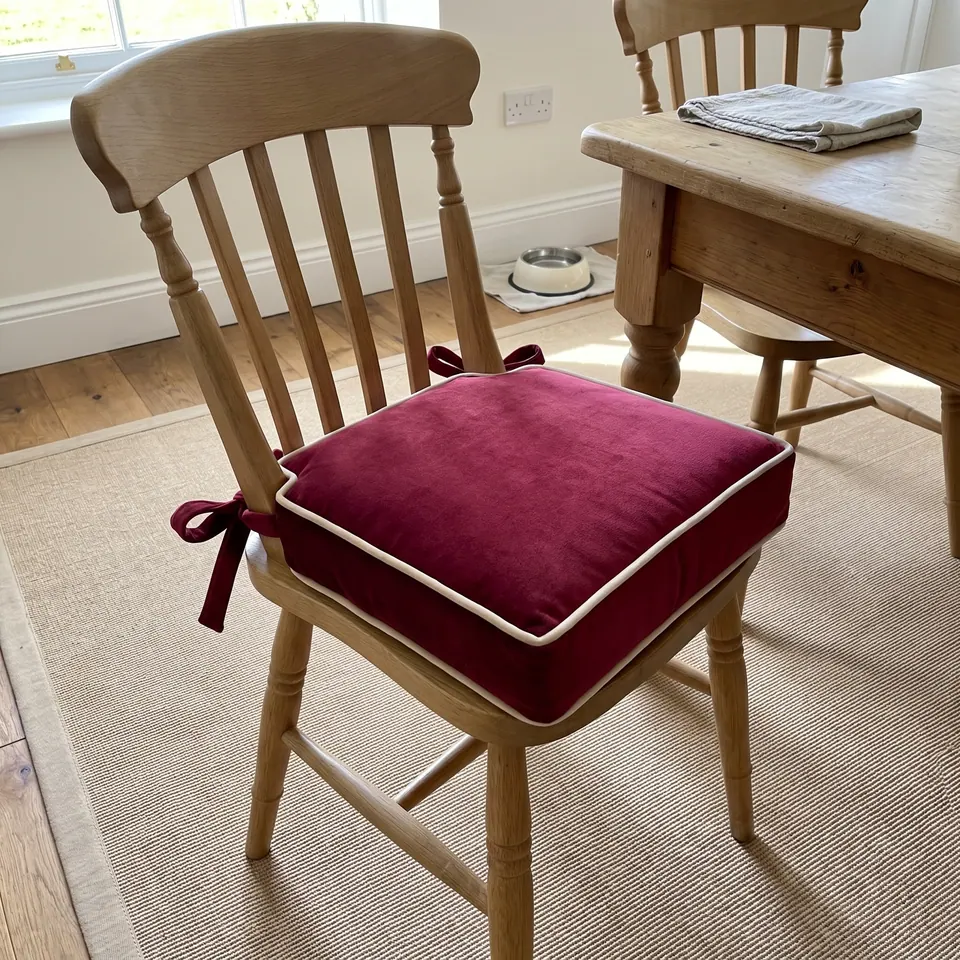
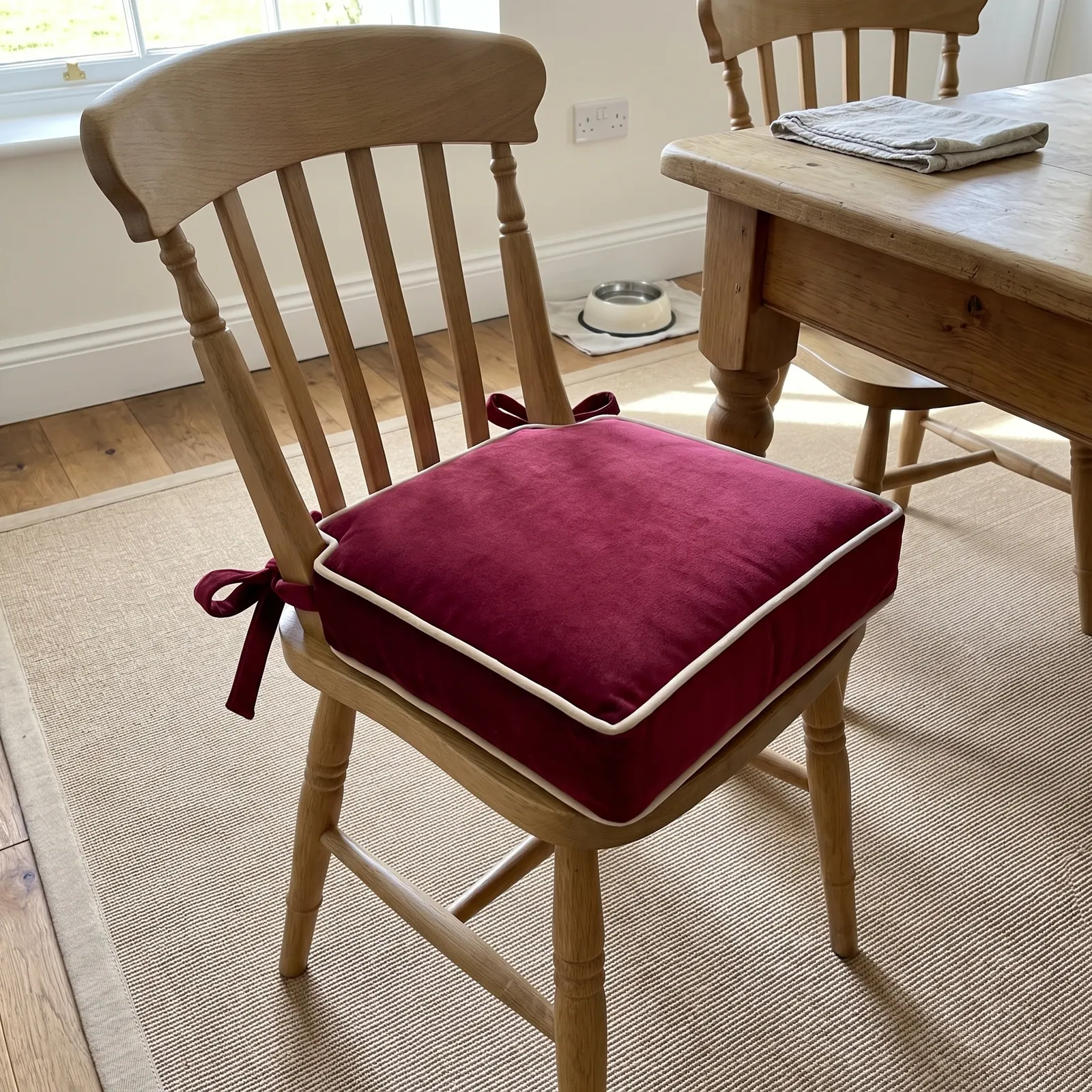
Look at the cranberry cushion at the top of this page. On a scrubbed pine farmhouse chair, an off-white welt draws the edge so the deep berry never turns heavy, and velvet ties bowed at the back posts keep a thick seat square on smooth wood.
On the cutting table: a velvet seat cushion
| Fabric | Polyester velvet with a short, tight pile; no stain-repellent coating |
|---|---|
| Thickness | 4 in (10 cm) as standard; 2 in (5 cm) suits most tie-on chair pads; 3 in (7.5 cm) sits between |
| Foam | about 2.0 lb/ft³ (32 kg/m³) high-density foam, dense enough not to collapse |
| Size | Choose the nearest option, then write the exact size in the personalization box; the cushion is made to the written size |
| Piping | Included; the same color, or any code from any fabric chart |
| Ties | Only on request: say how many, where and in which color |
| Cover | Hidden zipper; the cover comes off the foam whole |
| Care | Blot spills; wash at 86°F (30°C) on a gentle cycle and air dry |
| Where | Indoors, or under a closed roof out of rain and direct sun |
Ordering velvet seat cushions for a set of chairs
Measure every seat, not just one
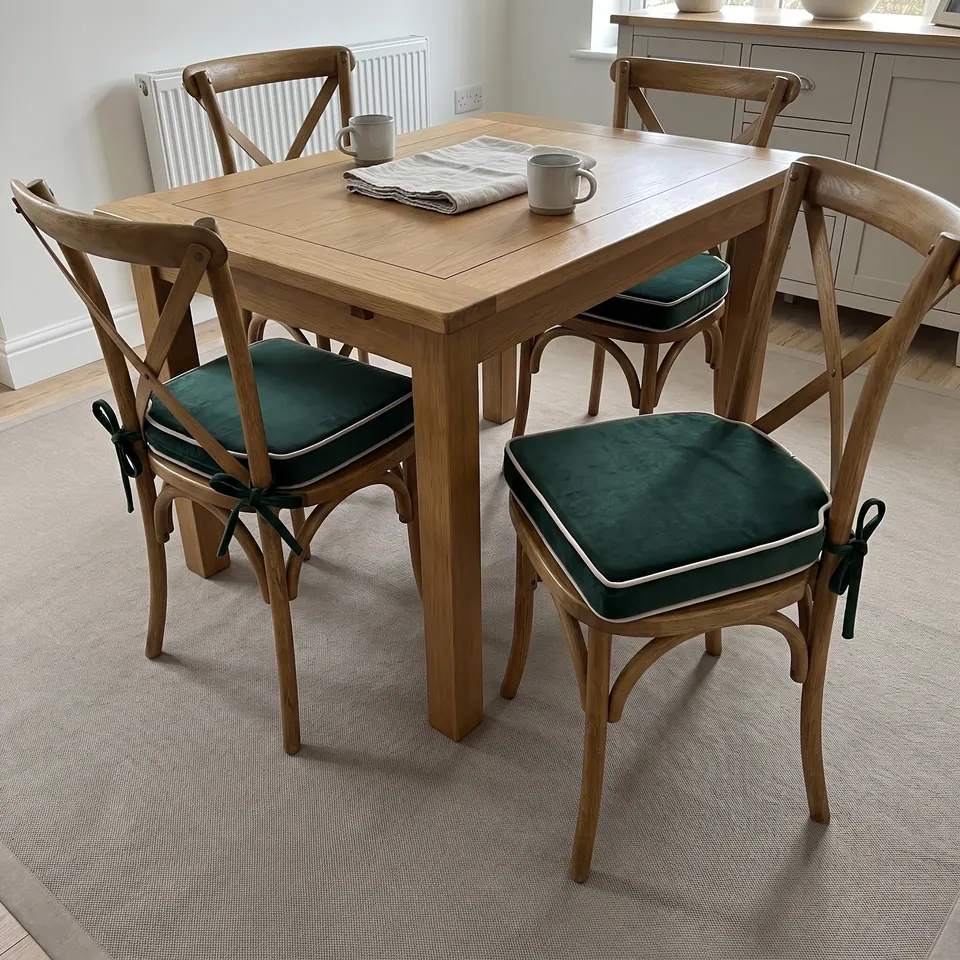
Take the front width, the back width between the posts and the depth down the middle, then both side edges if the seat tapers. Chairs from one set are rarely identical, and published guides put most dining seats at 16 to 20 in (41 to 51 cm) wide. A rattan bistro seat curves at the front, so the burgundy pad in the gallery was shaped to it, not squared off. The chair pad measuring Pattern walks through it, and the chair cushion builder checks your numbers.
Choose thickness by the table, not the showroom
A 2 in (5 cm) pad compresses a little under you: on a 15 1/2 in (39 cm) chair seat it lands near 16 1/2 to 17 in (42 to 43 cm). The standard 4 in (10 cm) velvet cushion is plusher and shows more of its boxed side band, which is exactly where velvet's sheen lives. Say whether the cushion is for a chair, a stool or a bench, and the workshop will tell you which suits.
Judge the color in daylight, at seat height
Ask for close-up photos of the codes you like, or order swatches, and lay them on the chair near a window in the morning and again at dusk. Greens are the hardest to read on a screen: one olive velvet looks yellow-lime under white bulbs and calm under warm ones. Daylight never lies; your screen sometimes does. See swatches before ordering.
Pick the piping from any chart
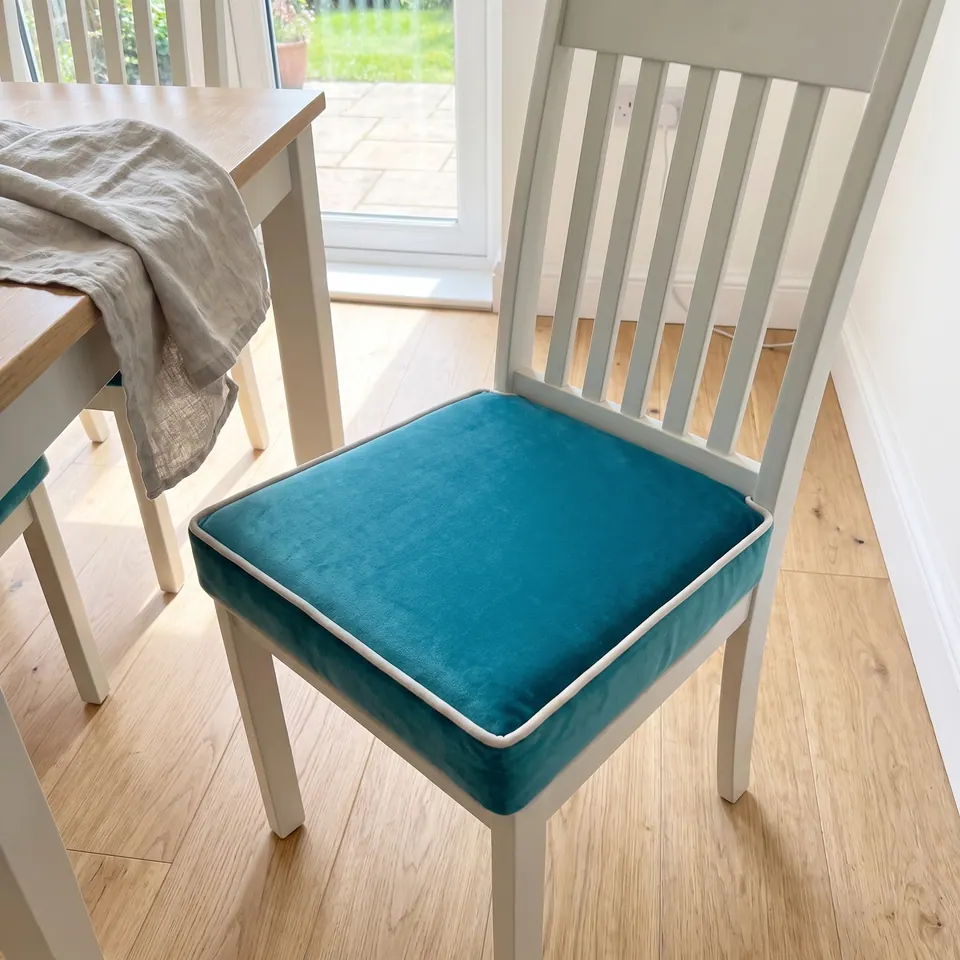
Piping costs nothing extra and can match or contrast, using any code in any range. The graphite desk chair cushion in the gallery wears a mustard welt that picks up the pale birch frame; the eucalyptus pad on the oak ladder-back chair is self-piped, so the green stays quiet. More in matching, contrast or no piping.
Ask for ties, in writing
Ties are never added unless you ask. Write how many, where (the two back corners suit most chairs) and the color: velvet to match the body, or the piping shade. The tie placement Pattern shows positions chair by chair.
Order the nearest size, write the real one
Select the closest size in the dropdown, which only sets the price bracket, then type the exact size, thickness, fabric code and piping code in the personalization box. Fractions of an inch are fine.
Order the whole set at once
Pieces cut together come from one dye batch and catch the light alike. A ninth chair added next spring may come back a breath warmer or cooler; see dye lots and later add-ons.

Have it made
Measured it? Have Élodie’s workshop make it
Color is easier to settle in a conversation than on a screen. Tell the workshop about the room and the light it gets, and the fabric choice follows. — Élodie
Leave your details and the workshop will call you to confirm measurements, fabric, foam and piping. No prices, dates or payment on this page: it is a request, not an order.
Why one velvet shows two shades around a table
Velvet has a nap, a direction in which the pile leans. Brushed one way it reflects and reads pale; brushed the other it drinks the light and reads deep. Around a dining table every chair meets the window at its own angle, so eight cushions from the same roll can look like two colors at breakfast and one at supper.
That is the cloth doing what it was woven to do. Before you worry, brush each seat the same way with a soft brush and look again in daylight from one spot. Velvet also crushes where it is sat on; once the pile is dry, brush it first against the nap and then with it, and it stands back up. Longer care notes are in velvet bench cushion care.
Which wall of your dining room holds the window, my friends? That is the side your pile will glow on.
Eight chairs, one velvet, and a date on the calendar
A buyer in the US needed eight velvet seat cushions, 17 x 18 in (43 x 46 cm) each, in velvet 904 with piping and ties, and hoped to have them within about a week. The answer was plain: choose the 18 x 18 in option, write 17 x 18 in the note, and all eight would be cut to 17 x 18. The eight were quoted as one batch, at a better rate than eight singles.
The ties were no trouble. The calendar was: the earliest the set could arrive was about two weeks out. Velvet is cut, piped and closed by hand, and eight seats take the time eight seats take.
What I love about this order is what it got right. One size written clearly, one color code, one cutting, so all eight chairs catch the same evening light.
- What it taught
- Order a set of velvet chair cushions together, with the exact size in the note, and allow about two weeks.
Tie-on velvet pad or boxed velvet seat cushion
| 2 in (5 cm) tie-on pad | 4 in (10 cm) velvet seat cushion | |
|---|---|---|
| Best on | Dining and kitchen chairs pulled up to a table | Desk chairs, bistro chairs, stools and chairs you linger in |
| Seat height | Adds a little under 2 in once sat on | Adds close to 4 in; check the table apron |
| How the velvet shows | Mostly the top face | Top face plus a boxed side band that catches the light |
| Holding it on | Ties at the back posts | Ties, or a non-slip base where there is nothing to tie to |
| Feel | Firm and slim | Plush but supportive |
Velvet seat mistakes I see at the cutting table
- Choosing the color from a phone at midnight instead of a swatch on the chair in daylight.
- Assuming ties come standard. They are sewn on only when you ask.
- Typing the tie request into the size box, where it can be missed, instead of the personalization note.
- Ordering four chairs now and four next season from a different dye batch.
- Rubbing a spill into the pile. Blot with a dry cloth; there is no stain-repellent coating to lean on.
- Tumble drying the cover. Air dry it, then brush the pile back up.
- Putting velvet where rain can reach. It belongs indoors or under a closed roof.
- Judging two shades before brushing both cushions the same way.
A velvet seat cushion shows two shades because its pile leans two ways. Brush every seat in one direction before you judge the color.
Élodie
Buyer questions: velvet on chairs
- A common question
Is 2 inches enough for a velvet chair cushion, or should I go thicker?
The workshop's answerFor chair pads, 2 in (5 cm) usually suits best, with 3 or 4 in (7.5 or 10 cm) possible; the velvet seat cushion itself is 4 in (10 cm) as standard. The 32-density foam is firm and won't collapse, though a 2 in pad compresses slightly, so a 15 1/2 in (39 cm) chair ends up near 16 1/2 to 17 in (42 to 43 cm). The workshop asks what the cushion is for before recommending.
- A common question
Do the velvet covers come off, and can they go in the washing machine?
The workshop's answerYes. Every cover has a zipper on the underside, where it stays hidden, and comes off the foam completely. Velvet machine washes like every other fabric, at 86°F (30°C) on a gentle or delicate cycle; let it air dry rather than tumble drying. Button-tufted cushions are the one exception, because their covers are sewn through.
- A common question
Which velvet is olive green, and will it look too bright on my chairs?
The workshop's answerOlive is velvet 123, a muted, earthy olive that sits well beside warm wood. It shifts with the light: under white bulbs it reads yellow-lime, under warm light much calmer. Greens are the hardest colors to judge on a screen, so ask for close-ups under your own lighting or order samples first. L24 is the linen alternative.
- A common question
What fabric and piping codes are on the velvet cushion in your photo?
The workshop's answerSend a screenshot of the exact photo and the workshop names both codes; the mustard velvet, for example, is P-60 with P-61 piping, and the navy with ivory piping is P-66 with P-52. You can ask for your order to copy a photo's colorway. Sunlight and camera angle can shift a tone slightly, but it is the same fabric.
- A common question
The care note says 30 degrees. Is that Fahrenheit?
The workshop's answerNo, it is Celsius, which is 86°F. Unzip the cover, turn it inside out if you can, and wash it on a gentle, delicate or cold cycle with a mild detergent and no bleach. Air dry it instead of using the dryer.
Velvet seat cushion questions, briefly
Can a velvet seat cushion be made round for a stool?
Yes. Round seats are cut to your diameter; one example was a 12 in (30 cm) round pad, 4 in (10 cm) thick, with a zippered cover and ties or a loop. Measure the seat edge to edge in two directions and send a photo of the stool.
Can I have velvet piping on a linen chair cushion?
Yes. The body and the piping can be different fabric types, such as a linen body with a velvet welt. Write both codes separately in the order note, cushion first and piping second, and the cushion is made that way.
Is velvet sensible on kitchen chairs that children use every day?
It holds up better than people expect. The workshop points families to velvet as one of its two hard-wearing ranges, because marks lift off the tight pile and the cover unzips for a gentle 86°F (30°C) wash. Choose a mid-tone rather than pale ivory.
Can a velvet chair cushion have a grippy underside instead of ties?
Yes. A non-slip base replaces the whole bottom panel with a grippy fabric that holds by friction, not adhesive, so it won't mark wood. It always covers the entire underside and must be requested; it helps most on stools and chairs with nothing to tie to.