The Pattern Room · a measuring pattern
How to measure dining chairs for seat pads with ties
A dining chair seat is rarely the rectangle it pretends to be. Here is how I measure one the way it actually tapers, where the ties go, and why a pad that stops an inch shy of the edge can still look made for the chair.

 Save
The quick answer
To measure a chair seat for a cushion, take three numbers: the front width, the back width between the back posts, and the depth down the middle, then both side edges if the seat tapers. Most dining seats run 16 to 20 in (41 to 51 cm) wide and deep, and pads are 2 to 2 1/2 in (5 to 6 cm) thick, with ties at the back corners.
Four chairs from one set, four slightly different seats
Line up four dining chairs from the same set and measure each one, and I'll wager one comes out a quarter inch off. Chairs are glued, clamped and sanded by people, and plenty of seats taper from front to back.
That is why how to measure a chair seat for a cushion is really a question of how many numbers you send. Width x depth describes a rectangle. A kitchen chair usually wants three measurements and sometimes six, and measurements that don't add up are among the most frequent problems we see.
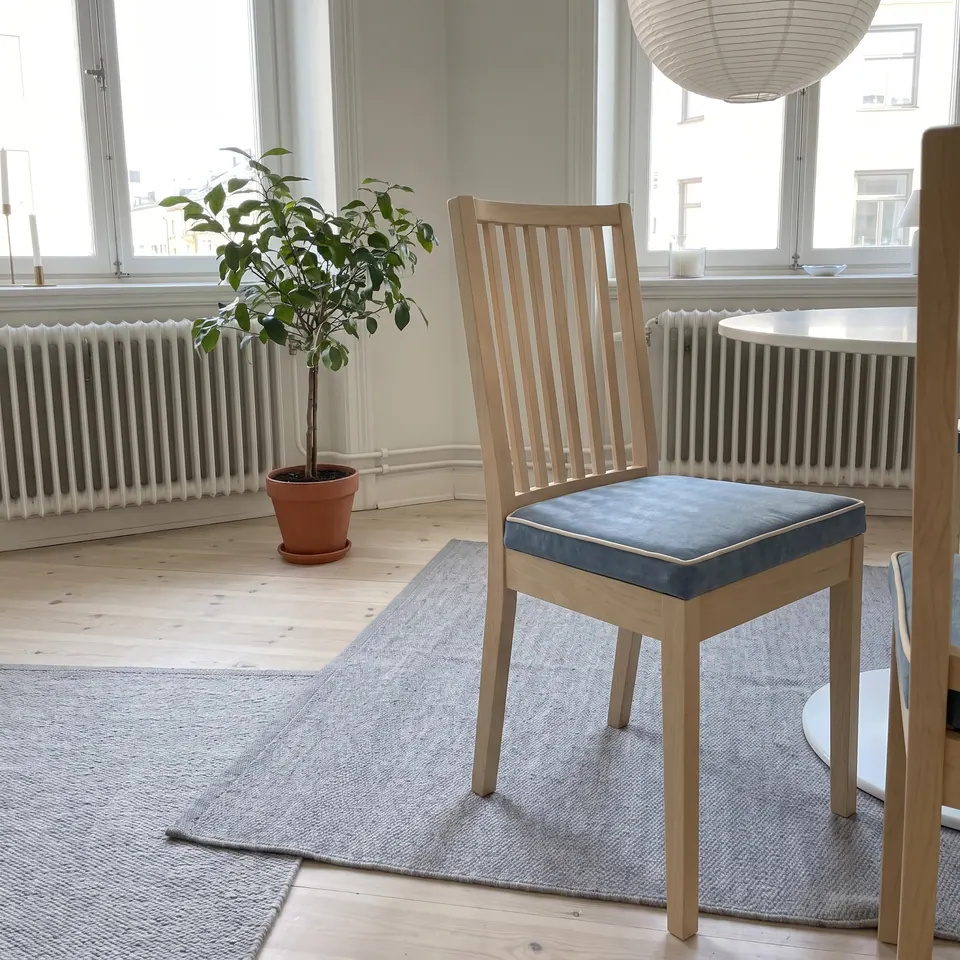
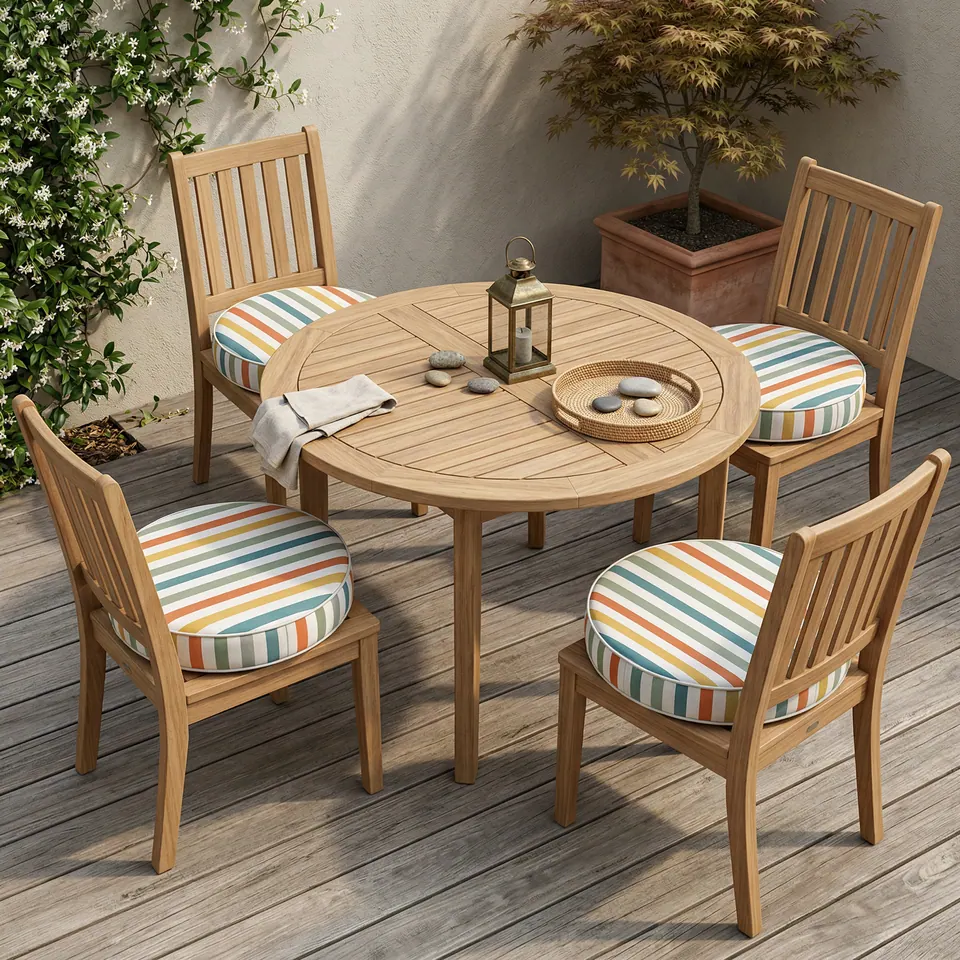
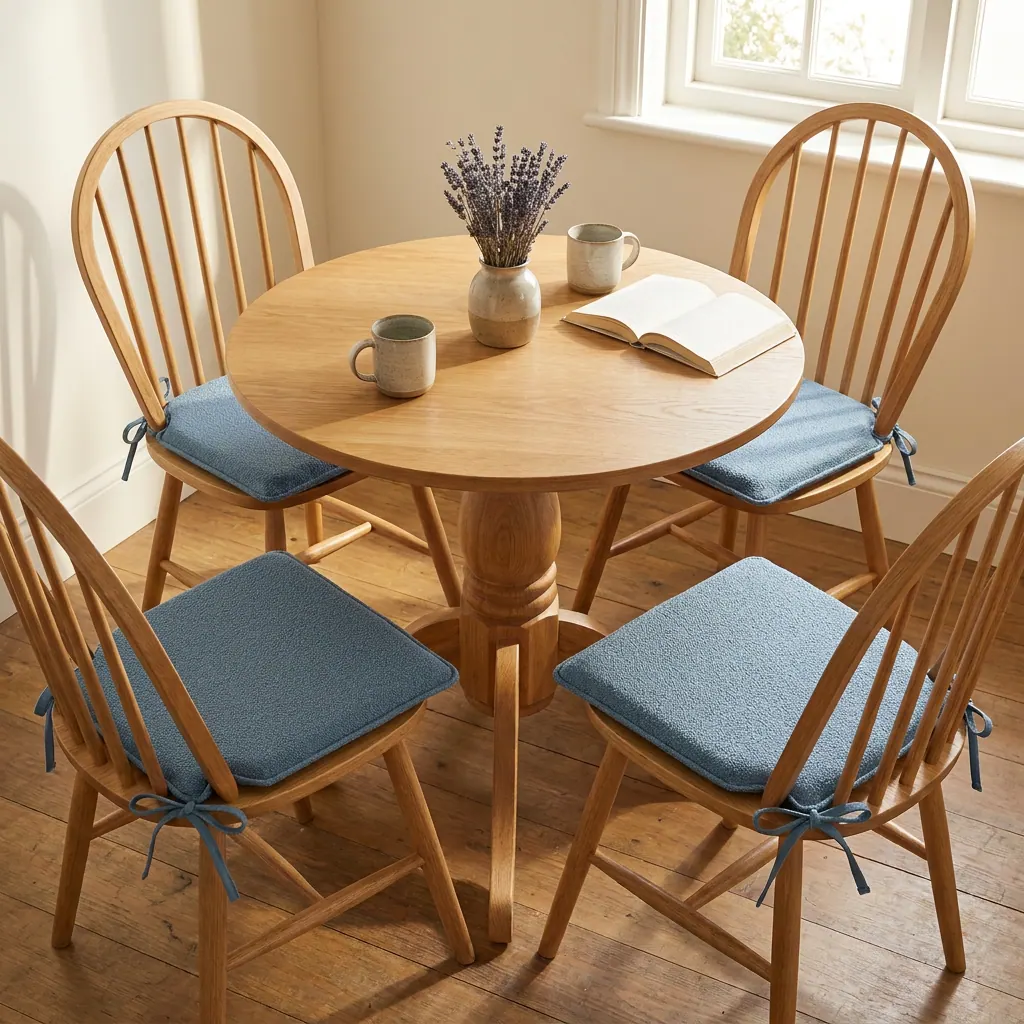
The dusty blue pads at the top of this page sit on spindle-back Windsor chairs around a round pedestal table, each tied at the back posts. That seat, wider in the middle than at either end, is exactly the kind that needs the extra numbers. The dining chair cushions collection shows the family.
Measuring a dining chair seat, step by step
Measure the chair, not the old pad
Take the tape to the chair itself. Product pages rarely give a detailed seat size, and an old pad has usually slid, shrunk or squashed. Overall chair width x depth x height won't do either, because the pad follows the seat, not the frame.
Take the front width
Measure straight across the front edge of the seat, side to side, to the nearest 1/8 in. Measure twice, photograph the tape, and type the number out as well, because tape photos get misread. If the front corners are rounded, note roughly how far the curve runs, such as about 1 in.
Take the back width between the posts
Measure across the back of the seat where the pad will sit, between the back posts or the outer spindles. On a Windsor or spindle-back chair this is often the narrowest line on the seat. The ties fasten here, so note what the posts are: round spindles, square posts or a ladder-back rail.
Take the depth down the middle, then both sides
Measure depth straight, at 90 degrees from the front edge to the back, down the center of the seat. Then measure the left and right edges separately. A slanted side is always longer than the straight depth, so if yours comes out shorter, measure again. Four vintage ladder-back chairs only added up once the sides were re-measured to about 11 in (28 cm), against edges of 13 and 14 in (33 and 36 cm).
Pattern sheet Front 18 in, back 16 in, depth 17 in. Ties sit at the back posts; the zipper runs along the back edge. For a shaped seat, take three widths and three depths
A seat that swells in the middle needs more than one width. For a spindle-back seat the workshop drew three horizontal and three vertical lines on the buyer's photo, and they measured along each: 14 1/2 in (37 cm) at the spindles, 17 in (43 cm) at the widest, 14 in (36 cm) at the front, and 14 1/2, 15 1/2 and 13 1/2 in (37, 39 and 34 cm) deep at left, center and right. With six numbers the pad could be cut accurately.
Trace a curved seat instead
For a rocker, a horseshoe seat or a rattan armchair, lay paper on the seat, trace the edge, cut it out and write the widest width and the depth on it. Photograph it flat from directly above with a tape measure in the frame; there's no need to mail it. The method is in the paper template guide.
Decide how close to the edge the pad should sit
A chair pad looks right anywhere within about 1 to 2 in of the seat edge. If you want wood trim or a cane rim to show, size the pad down yourself and send the finished size. The workshop cuts what you write, so the allowance is your decision.
Settle the back posts: ties, not notches
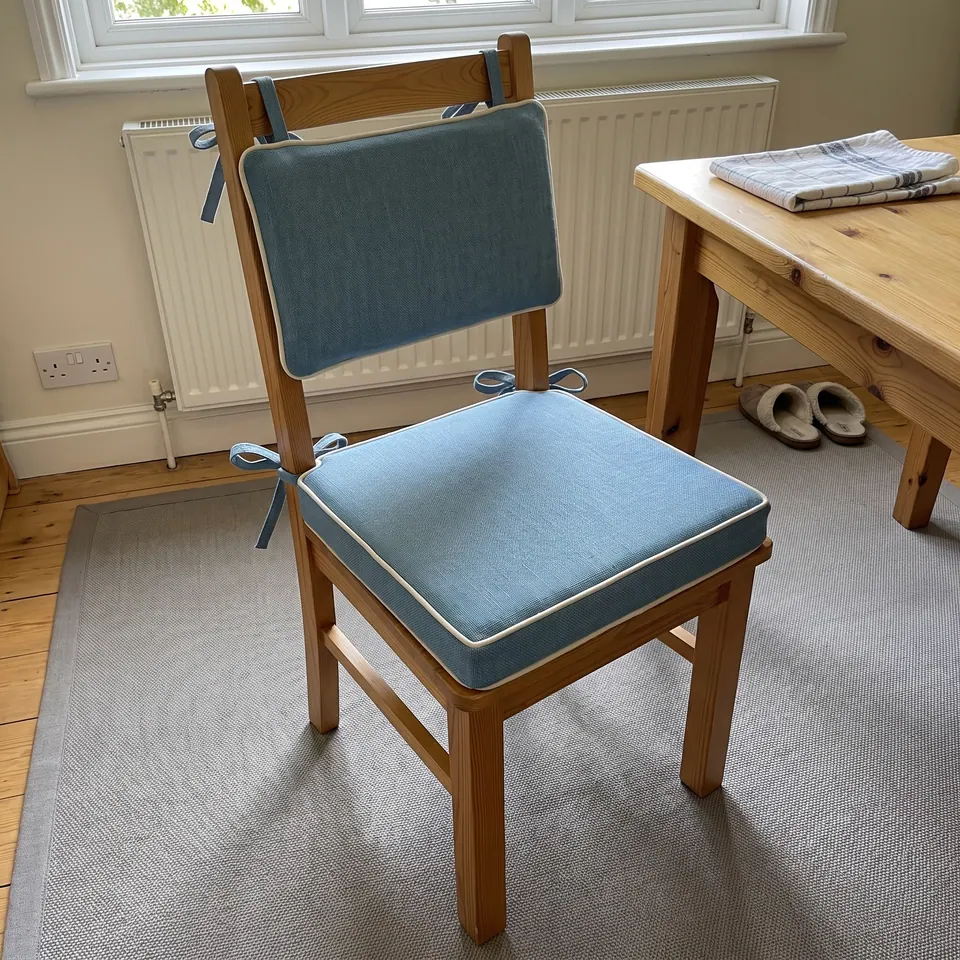
Notches cut around back posts can't be made reliably from a distance, so the workshop suggests an arched back edge or ties instead. Chair pads usually take two ties at the back corners, fastened around the spindles or the ladder-back. On the dining chair listing ties are an option at checkout; anywhere else, write the number, position, length and color in your note. More on tie placement.
Choose the thickness with the table in mind
Dining pads usually run 2 to 2 1/2 in (5 to 6 cm) thick, and 2 in is the one the workshop suggests most; 3 in (7.5 cm) or 4 in (10 cm) can be made. Firm 32-density foam won't collapse, but a 2 in pad compresses a little, so a 15 1/2 in (39 cm) seat lands at about 16 1/2 to 17 in (42 to 43 cm). Keep 10 to 12 in (25 to 30 cm) between the pad and the tabletop.
Write it up and check the sketch
Choose the dropdown size that covers your widest and deepest numbers; it only sets the price. Type the exact size, fractions and all, with thickness and fabric code, in the personalization box, and set the quantity for identical chairs. The workshop sends a sketch for your OK before cutting; later, check the pre-shipment photo for the ties.

Have it made
Measured it? Have Maggie’s workshop make it
I once cut a lovely cushion two inches short, and I have not forgotten it. That is why the workshop goes over your measurements with you on the phone. — Maggie
Leave your details and the workshop will call you to confirm measurements, fabric, foam and piping. No prices, dates or payment on this page: it is a request, not an order.
Chair seats by shape, and the numbers each one needs
| Seat shape | What to measure | Seen in past orders |
|---|---|---|
| Square or rectangular | Width x depth, to the nearest 1/8 in | Most dining seats run 16 to 20 in (41 to 51 cm) each way |
| Tapered (trapezoid) | Front width, back width, depth, both side edges | Six chairs at 18 in front, 16 in back, 17 in deep (46/41/43 cm) |
| Tapered, larger | The same four numbers | 21 in (53 cm) deep, 20 1/2 in (52 cm) front, 19 in (48 cm) back |
| Spindle-back, shaped | Three widths and three depths | 14 1/2 / 17 / 14 in wide; 14 1/2 / 15 1/2 / 13 1/2 in deep |
| Curved (rocker, horseshoe, rattan) | A paper template, photographed beside a tape | A rattan seat 24 x 21 1/4 in (61 x 54 cm), under 3 in thick |
| Round | Diameter | 12 in (30 cm) across, 4 in (10 cm) thick, zip cover and ties |
Six tapered kitchen chairs and a one-photo upload box
A buyer in the US had a new kitchen set with six trapezoid chairs. They measured every seat the way I'd hope: 18 in (46 cm) across the front, 16 in (41 cm) across the back and 17 in (43 cm) deep.
The snag was the order form, which allowed a single photo. So they merged three measurement photos into one image, uploaded it, and sent the same image by message for good measure. Nothing was left to guess.
They chose brown velvet with cream piping and matching cream ties, and six pads were cut from one clear set of numbers. I've been stitching since the Reagan years, and I still admire a buyer who sends the same picture twice. A straight welt is a kind of honesty; so is a photo with the tape in it.
- What it taught
- Merge measurement photos into one image when the upload field allows only one.
Where chair pad fits actually go wrong
Seat pads are the easy part. On a U-shaped rattan armchair, 24 x 21 1/4 in (61 x 54 cm), the pad was straightforward; the back cushion pressed against the curved frame was the risk, and the workshop asked for a straight-on photo of the curve before committing.
Subtle curves are the other trap. A buyer whose U-shaped pad arrived looking almost square had described a gentle curve with too little detail. If the curve matters to you, draw it, mark where it starts and stops on each side, and say how deep it runs.
Then the posts. I learned long ago that a notch cut from a photograph is a guess with scissors, dear. An arched back edge or two good ties does the same job without the guesswork, and ties undo on wash day.
Try the numbers in the chair cushion builder
Before you write in, try your front width, back width and depth in the chair cushion builder to see the shape you're describing. If a side comes out shorter than the depth, or the front looks narrower than you remember, go back to the chair with the tape.
Matching a bench as well? The kitchen nook cushions room and matching bench and chair cushions help keep the fabric and piping in step.
Chair pad mistakes that come back to the workshop
- Typing a tie request into the dimension box. It gets overlooked; ask for ties in writing with position, length and color, and confirm by message after ordering.
- Sending width x depth for a tapered seat. Give the front width, the back width and both sides, or the pad is cut square.
- Measuring a slanted side shorter than the straight depth. That can't happen; measure depth at 90 degrees and check that the numbers close.
- Describing a gentle curve vaguely. A subtle U-shape can arrive looking square; mark where each curve starts and ends.
- Taking the size from a product page. Measure the seat by hand.
- Skipping the pre-shipment photo. It's the last chance to see the ties before the box is sealed.
Chairs are rarely square. Measure a dining chair seat across the front, across the back between the posts, down the middle, and along both sides.
Maggie
Typical seat sizes by chair type (measure yours)
| Chair | Typical seat | Typical pad thickness |
|---|---|---|
| Dining chair | 16 to 20 in wide and deep | About 2 in |
| Kitchen chair | 15 to 17 in | 1 to 2 in |
| Bar stool, round | 13 to 14 in across (stock pads) | 2 to 4 in suggested |
| Bar stool, square | About 12 x 12 in | 1 to 2 in |
| Rocking chair seat | 17 to 19 in | 2 to 3 in |
| Adirondack seat | About 20 in wide, 18 to 18 1/2 in deep | 2 to 2 1/2 in |
Buyer questions: chairs, ties and odd sizes
- A common question
How do I measure my dining chair seats for cushions?
The workshop's answerMeasure the chair itself, since product pages rarely give a detailed seat size. For a tapered seat send the depth and the front and back widths, for example 21 in deep, 20 1/2 in at the front and 19 in at the back. Shaped seats such as spindle-backs take six numbers: three widths and three depths. The workshop sends a sketch and waits for your OK before cutting.
- A common question
My chair seat is wider at the front than the back. Can you make a pad to fit?
The workshop's answerYes, tapered chair pads are routine. Send the front width, back width, depth, both side edges and thickness on a sketch, ideally with photos showing the tape. The workshop reviews them and flags fit problems before production, such as a depth that would leave a gap at the front. For a matching back cushion, take the seat-to-top distance minus the seat thickness: 19 in minus a 3 in seat gives 16 in.
- A common question
Can my dining chair pads come with ties?
The workshop's answerYes. Ties go at the back to fasten around the spindles or a ladder-back, and on the dining chair cushion listing they're an option at checkout, so nothing extra needs writing. Covers zip off and wash, and pads can be made in exactly the same fabric as a bench cushion. The workshop can send color close-ups or a swatch card to help you choose.
- A common question
Can the pads be notched around my chair's back posts?
The workshop's answerNotches around back supports can't be made reliably from a distance, so the workshop suggests an arched back edge instead. Send a drawing: a 20 in chord with a 12 1/2 in radius gives a 5 in arc height. The workshop confirms a diagram with sharp corners where the arc meets the sides, about 1 in rounded front corners, the zipper along the arc and ties inset 4 1/2 in.
- A common question
My seat size isn't in the dropdown. How do I order an exact size with fractions?
The workshop's answerPick the dropdown range that covers your widest and deepest measurement; it only sets the price. Then type the exact size, thickness and fabric code in the personalization box. Fractions such as 19 3/8 in are fine, and so are centimeters. Set the quantity for identical chairs; if the sizes differ, send each one and the workshop creates a custom order link.
Chair pad questions, briefly
What size are most dining chair pads?
Most dining chair seats run 16 to 20 in (41 to 51 cm) wide and deep. Common stock pads are 15 x 17 in, 16 1/2 x 17 in and 19 x 19 in, 2 to 2 1/2 in (5 to 6 cm) thick, with 2 in the practical minimum for comfort. Made-to-measure pads follow your own seat.
Will a thicker pad leave my chairs too high for the table?
It can. A dining seat usually finishes around 18 in (46 cm), within 17 to 19 in, and you want 10 to 12 in (25 to 30 cm) between the cushion top and the tabletop. Foam settles a little in use: a 3 in pad sits closer to 2 1/2 in.
Should the pad match the seat size exactly?
Not to the hair. A chair pad looks right anywhere within about 1 to 2 in of the seat, and many people size it slightly smaller so wood trim or a cane rim shows. Decide the finished size yourself and write that number; the workshop cuts to what you send.
Can a chair pad have a non-slip base?
Yes, a non-slip base is available on chair pads and helps on smooth wooden seats. A reversible pad, with the same fabric on both faces, is made without it, so choose one or the other. Ties at the back corners hold either style in place.
How much wood should show around a chair pad?
A little is normal. Catalog photos usually show 1 to 2 in of seat around the pad, and a pad within about that much of the seat's width and depth sits comfortably. A custom pad can run closer to the edge, so decide whether you want a framed look or full coverage before you write the size in the order note.
Can I size a chair pad without a tape measure?
Only roughly. A US letter sheet, 8 1/2 x 11 in, laid on the seat gives a quick sense of scale while you look for a tape, and one chair-pad maker suggests exactly that. A made-to-measure pad still needs real numbers, so measure the front width, back width and depth with a rigid tape before you order.