 Save
A Reading by MaggieDining Chair Cushions & Pads
A dusty blue chair cushion with ties, and the edge decisions behind it
Maggie reads a two-piece dusty blue set on an old pine chair, then works through the edges and corners buyers ask about most: box, knife, rounded and curved.
Adding a tie-on back pad turns a hard pine chair into a seat you can stay in through a long dinner.

The quick answer
For a dining chair cushion with ties, use a box edge on the seat and a slimmer pad on the back. The box seat holds its shape under daily sitting, while a thin back panel tied at top and bottom lies flat against the rail. For chair seats, 2 in (5 cm) is the recommended thickness, with 3 or 4 in (7.5 or 10 cm) possible.
The pine chair that needed a second piece
Right, then. A hard pine chair is honest furniture, and honesty gets uncomfortable around the second helping.
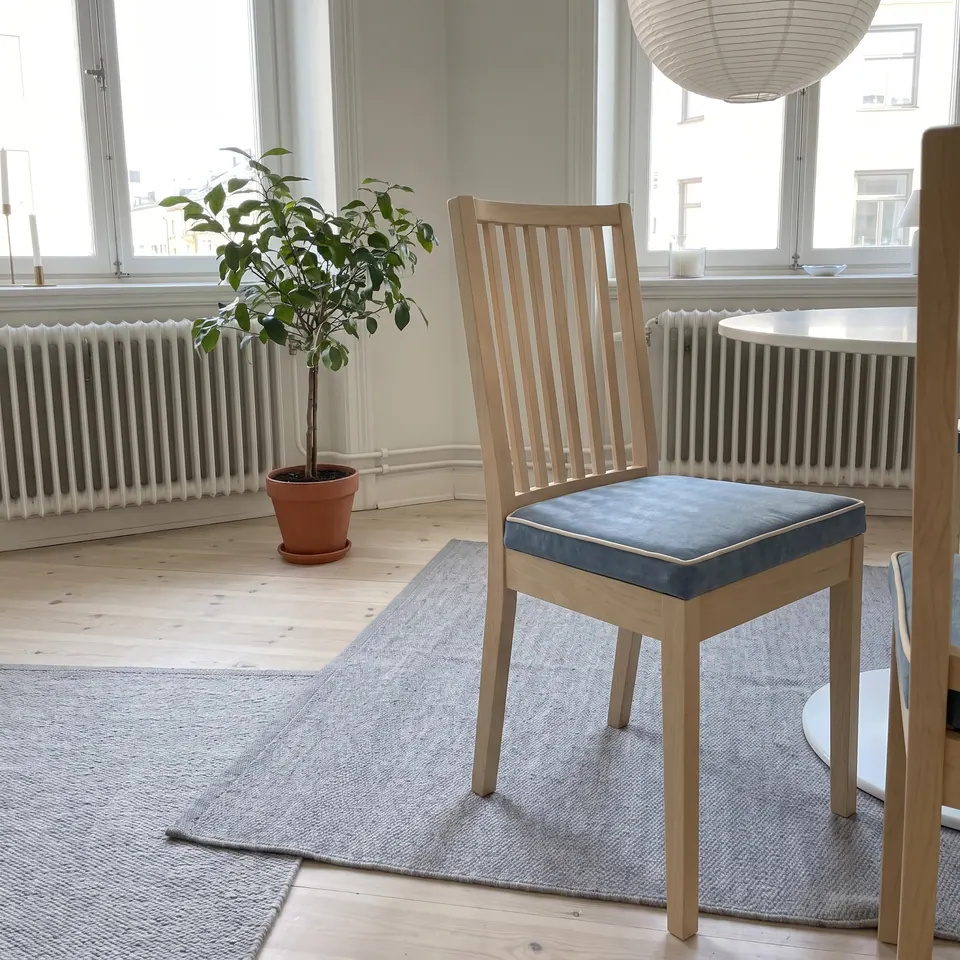
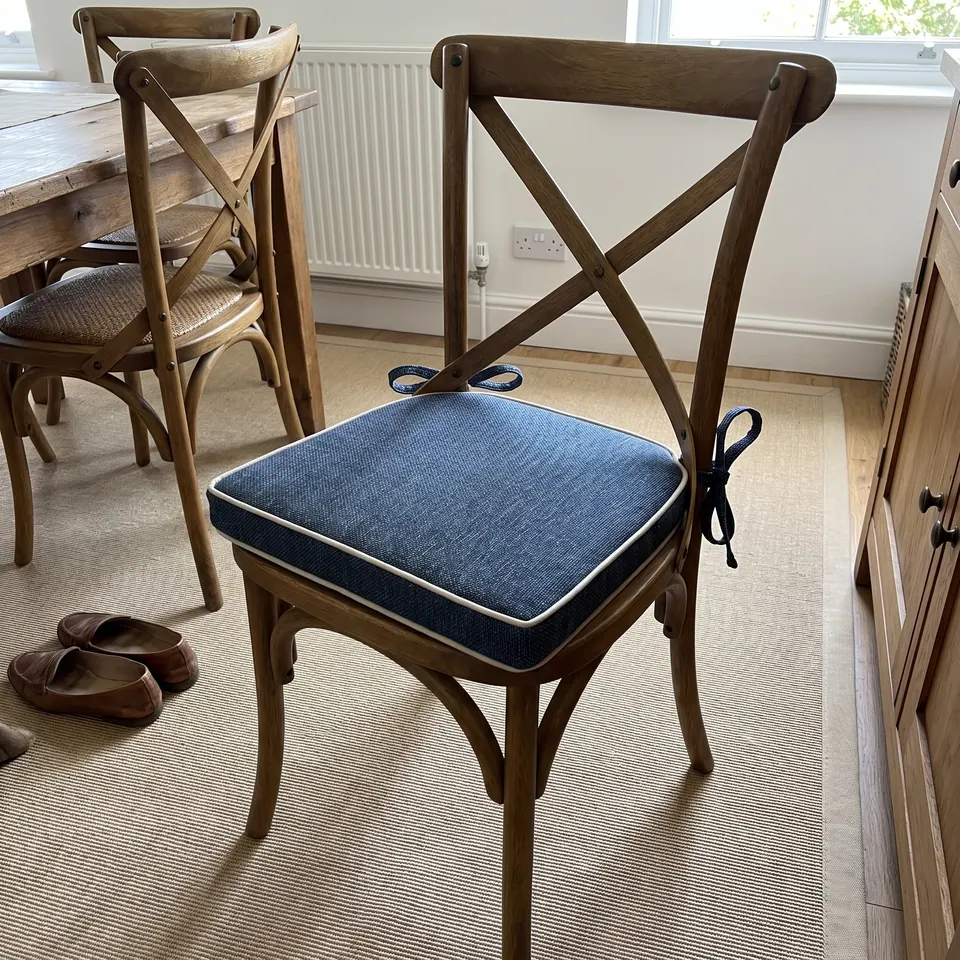
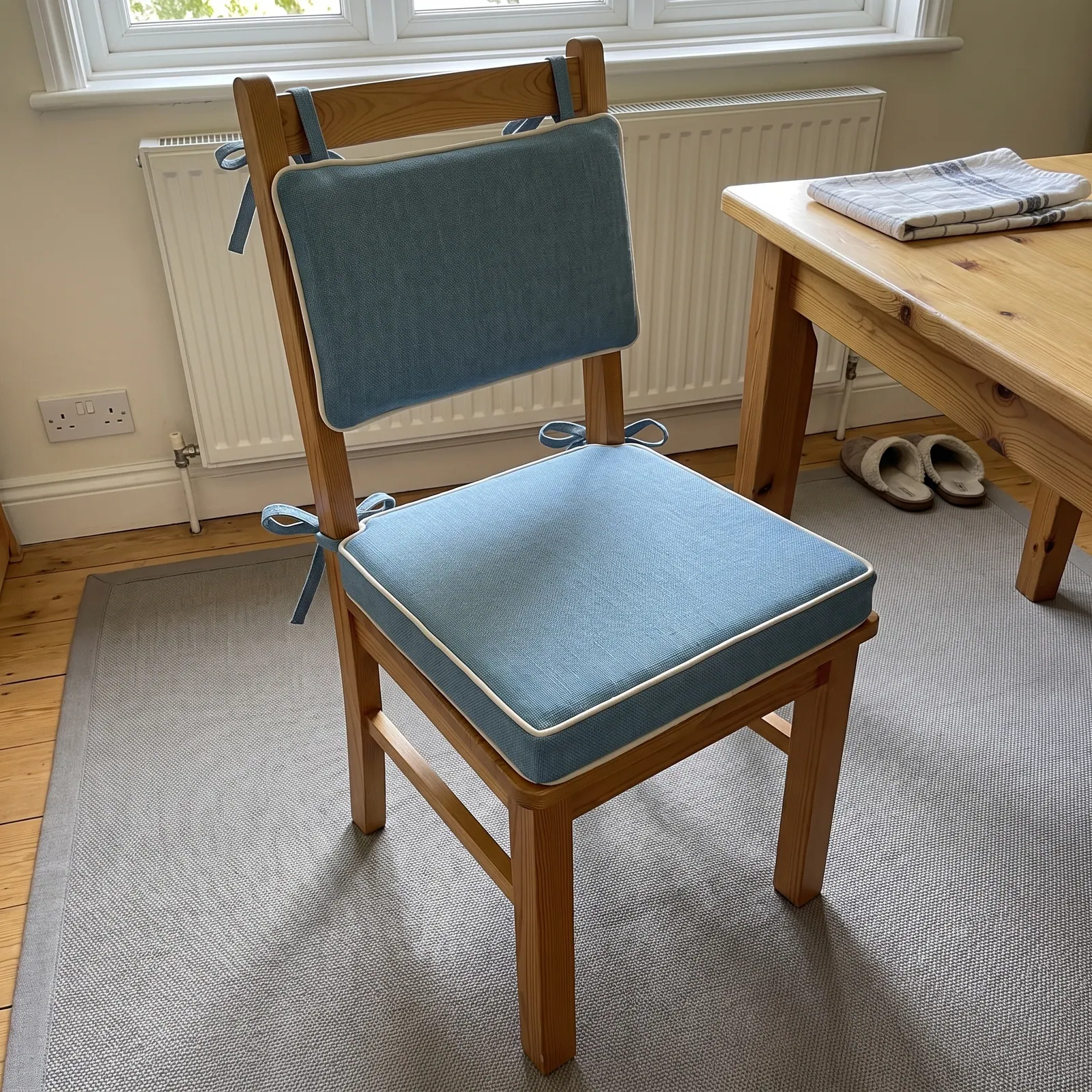
This set solves it in two pieces. The seat is a box cushion, with a proper side wall, in a dusty blue linen-look weave. The back is a slimmer panel tied at the top corners and again at the bottom, so it pulls flat against the rail instead of sagging like a tired flag. Both pieces carry the same ivory contrast piping. That shared welt is what makes two cushions read as one set; change the piping on one and they look borrowed from different chairs.
Color does the quiet work. Old pine goes orange with age, and a soft blue sits opposite orange, so it calms the wood rather than fighting it. Late-morning light from the sash window keeps the blue gentle, not icy. The gray sisal rug and white panel radiator stay neutral. A blue-striped tea towel on the table repeats the cushion color, and fleece-lined slippers under the table tell you this is a family kitchen, not a showroom.
I will admit I once cut a back pad exactly as wide as the chair posts. The ties had nothing to pull against, and it bowed like a sail. Cut the back pad slightly narrower than the posts and the ties will pull it flat. The chair cushion builder sets both pieces for you, and the dining chair cushions hub has more sets like this one. How many hours a day do your kitchen chairs actually work?
Pinned by Maggie
Five pins point to the tie-on back pad, the top-rail ties, the ivory-piped seat, the slippers and the striped tea towel.
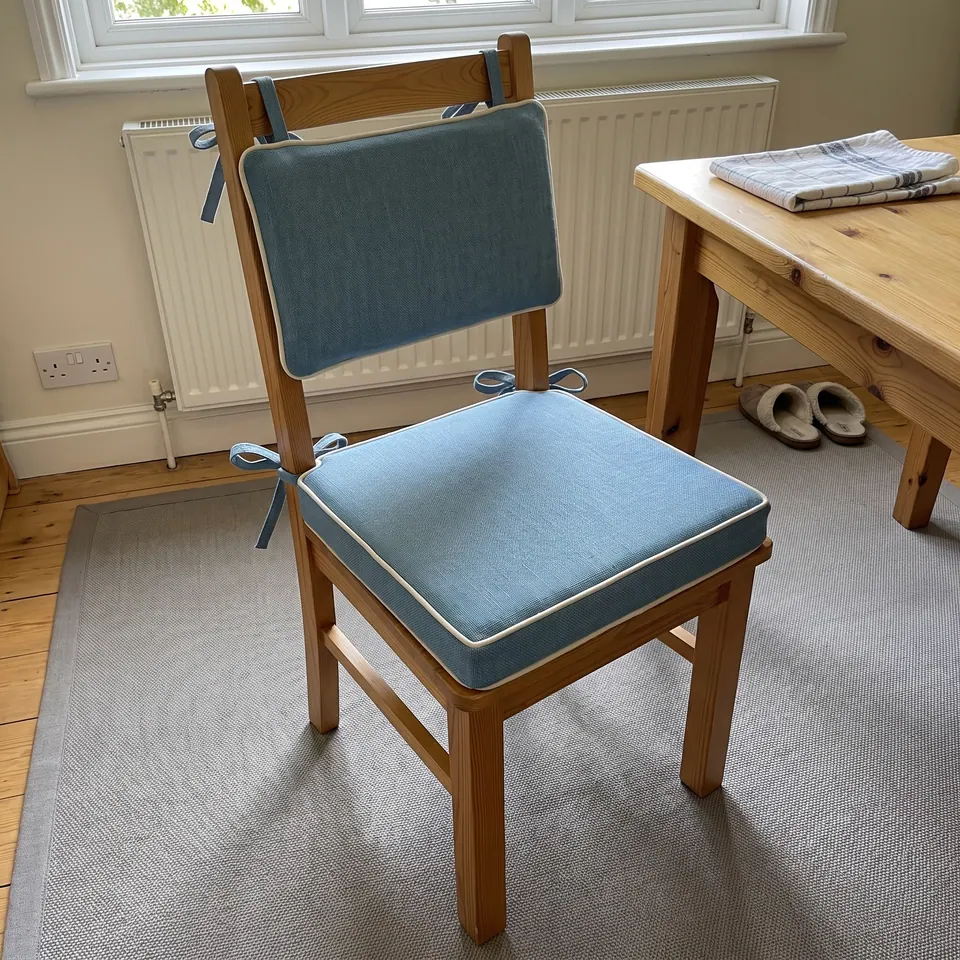
- Tie-on back pad
A slimmer back panel tied top and bottom softens the hard rail.
- Top rail ties
Ties at the top corners pull the back pad flat against the frame.
- Ivory piped seat
The same ivory welt on both pieces makes them read as a set.
- Slippers under table
Slippers make the scene feel like a real family kitchen.
- Striped tea towel
A blue stripe on the table repeats the cushion color.
- Tie-on back padA slimmer back panel tied top and bottom softens the hard rail.
- Top rail tiesTies at the top corners pull the back pad flat against the frame.
- Ivory piped seatThe same ivory welt on both pieces makes them read as a set.
- Slippers under tableSlippers make the scene feel like a real family kitchen.
- Striped tea towelA blue stripe on the table repeats the cushion color.
Box, knife, rounded, curved, angled: a field guide
| Edge or shape | What it looks like | Where it earns its keep |
|---|---|---|
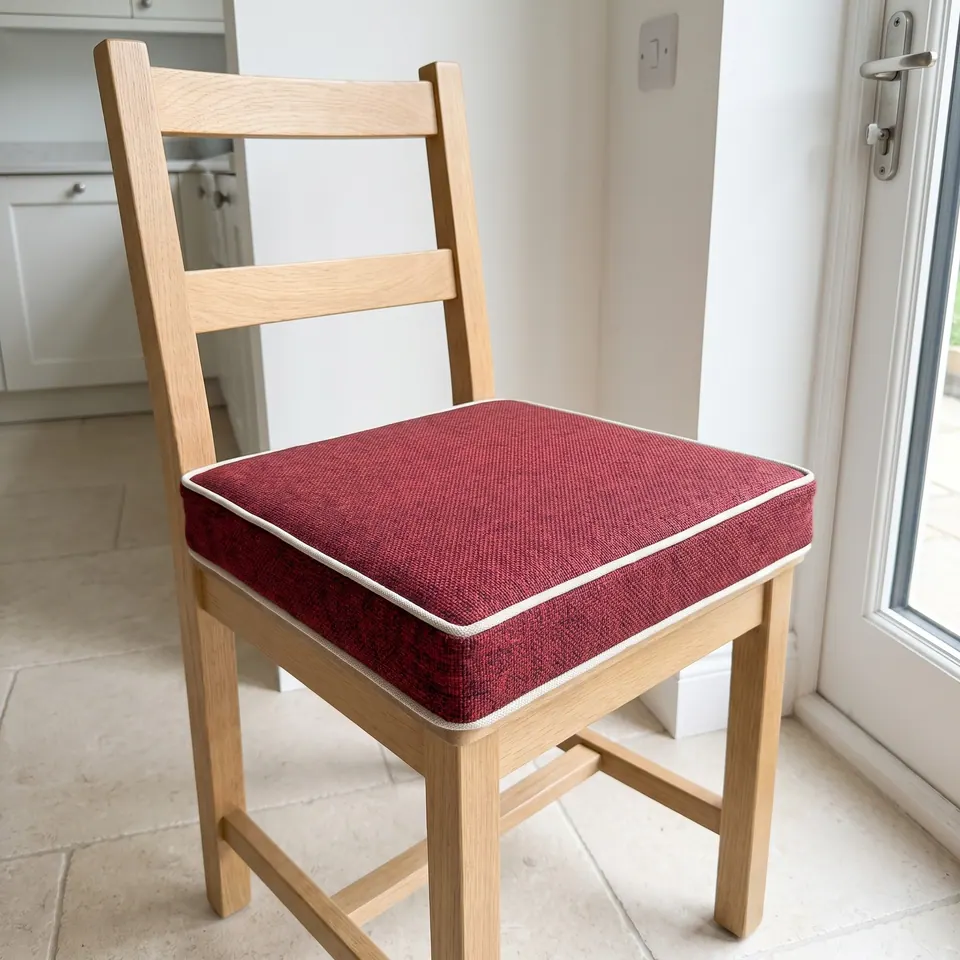
| Box edge | A side wall between top and bottom, often piped | Seats that take daily weight, like this one |
| Knife edge | Top and bottom sewn straight together, thin at the rim | Slim back pads and light chair pads |
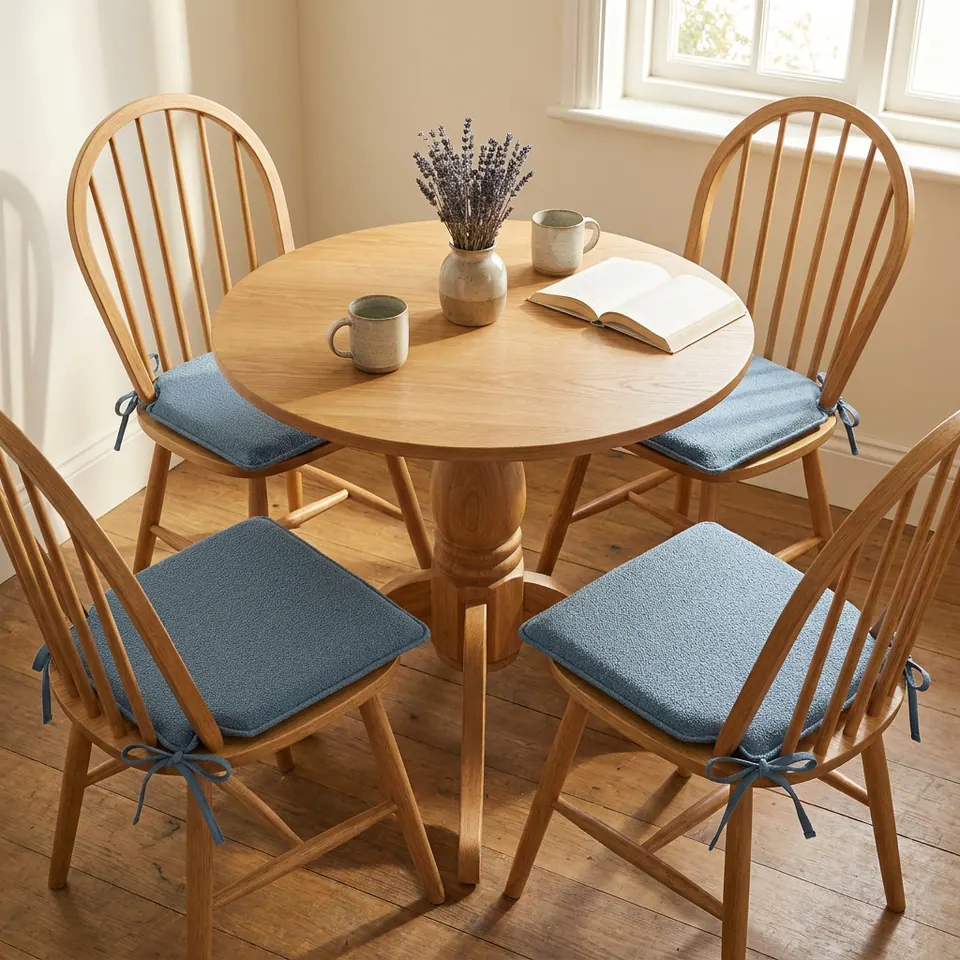
| Rounded corners | Corners eased into a curve | Seats that round off at the back |
| Curved front | A front edge that bows outward | Armchairs and bowed seats; send a sketch |
| Angled sides | Wider at the front than at the back | Tapered chairs; order on the trapezoid listing |
A curved front, the wrong listing and a remake
A buyer messaged the workshop about two armchairs with shaped seats. The cushions measured 19 in (48 cm) across the back, 17 in (43 cm) along each side, and 22 in (56 cm) across a curved front that bowed out to 20 in (51 cm) deep at the center. They were 4.75 in (12 cm) thick.
She ordered through the rectangle listing. The shop canceled that order with a full refund and had her reorder through the trapezoid listing, with photos uploaded. She also asked about the non-slip base: it covers the whole underside, not a strip with a 4 in (10 cm) fabric border.
Then a production error. The cushions were remade from scratch before they shipped, together with her other order.
My checklist from that one: shaped seats go on the custom-shape listing, and the old cushion is the best template you own. The tapered dining chair pads sketch shows more shapes like it, and the box edge vs knife edge pattern explains the side wall.
Buyer questions: bulk orders, rounded backs and how thick is thick enough
- A common question
Is there a discount for a big chair cushion order, say 11 for the patio chairs?
The workshop's answerYes. Eleven chair cushions, 15.75 x 18 x 2 in (40 x 46 x 5 cm) with double piping and ties, were given a bulk discount on the quote, and delivery by mid-July was confirmed.
- A common question
Can a seat cushion be rounded at the back or curved across the front?
The workshop's answerYes. For a curve the shop needs the straight length of each side edge before the curve starts, plus the depth or radius of the curve, ideally on a sketch. If the original cushions are gone, the production team works out the dimensions from the furniture itself.
- A common question
How thick should outdoor chair pads be, and a bench cushion for an older parent?
The workshop's answerFor chairs, 2 in (5 cm) is the most suitable, with 3 or 4 in (7.5 or 10 cm) possible. For a bench used for long sitting, 4 in (10 cm) gives the best support, with 3 in (7.5 cm) as the alternative. Back cushions can be thinner, around 2 in (5 cm).
On the cutting table: seat and back pad
| Product | Two-piece chair cushion set: box seat and back pad |
|---|---|
| Fabric | Dusty blue linen-look weave |
| Piping | Ivory contrast piping on both pieces |
| Seat edge | Box edge |
| Back pad | Slimmer panel, cut a little narrower than the posts |
| Fastening | Ties on the seat, and at top and bottom of the back pad |
| Thickness | Chair seats usually 2 in (5 cm); 3 or 4 in possible |
| Chair | Pine farmhouse chair at a pine table |
| Best for | Hard-backed kitchen chairs used for long dinners |

Have it made
Have this made — ask Maggie’s workshop
Numbers first, fabric second, piping last. Jot down what you have, and the workshop will go down the list with you, item by item. — Maggie
Leave your details and the workshop will call you to confirm measurements, fabric, foam and piping. No prices, dates or payment on this page: it is a request, not an order.
A chair seat cushion and back pad read as one set when both carry the same piping; change the welt color on one and they look borrowed from two chairs.
Maggie
Questions buyers ask next
Should a chair back pad be as thick as the seat cushion?
Usually not. A back pad works best slimmer than the seat, so it lies flat against the rail when tied. Back cushions can be around 2 in (5 cm), while a seat for long sitting may go thicker.
Can I order a curved or angled chair cushion on a rectangle listing?
No. Shaped seats belong on the custom-shape or trapezoid listing, with photos. One buyer who used the rectangle listing had the order canceled with a full refund and reordered on the trapezoid listing.
Is contrast piping a good idea on a dining chair cushion?
It is when you want the edge to show. Ivory piping on dusty blue outlines the box edge and ties a seat and back pad together as a set. On a busy pattern, matching piping is calmer.
Where do the ties go on a tie-on chair back pad?
At the top corners and again at the bottom, so the pad is pulled flat against the frame from both ends. Place them where the chair has rails or posts to tie around.
Stitch straight — Maggie
More photographs to read
 Save
 Save
 Save
 Save
 Save
 Save