A Reading by MaggieDining Chair Cushions & Pads
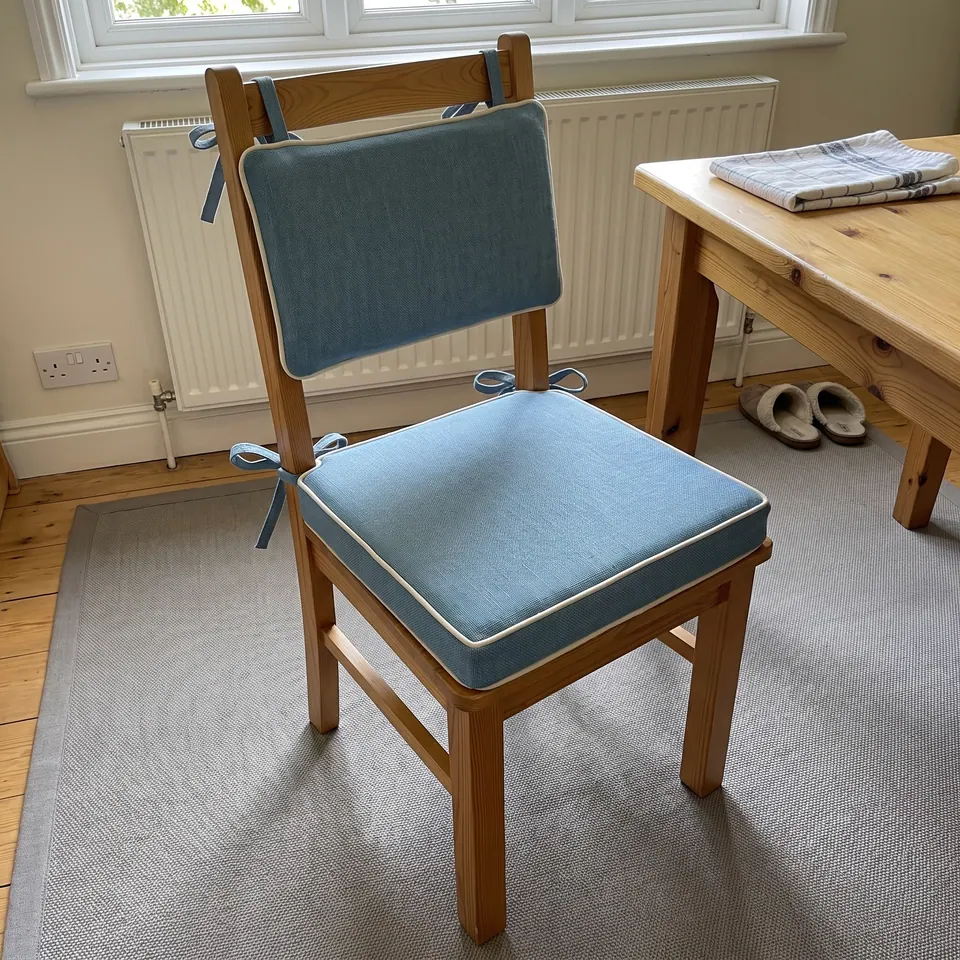
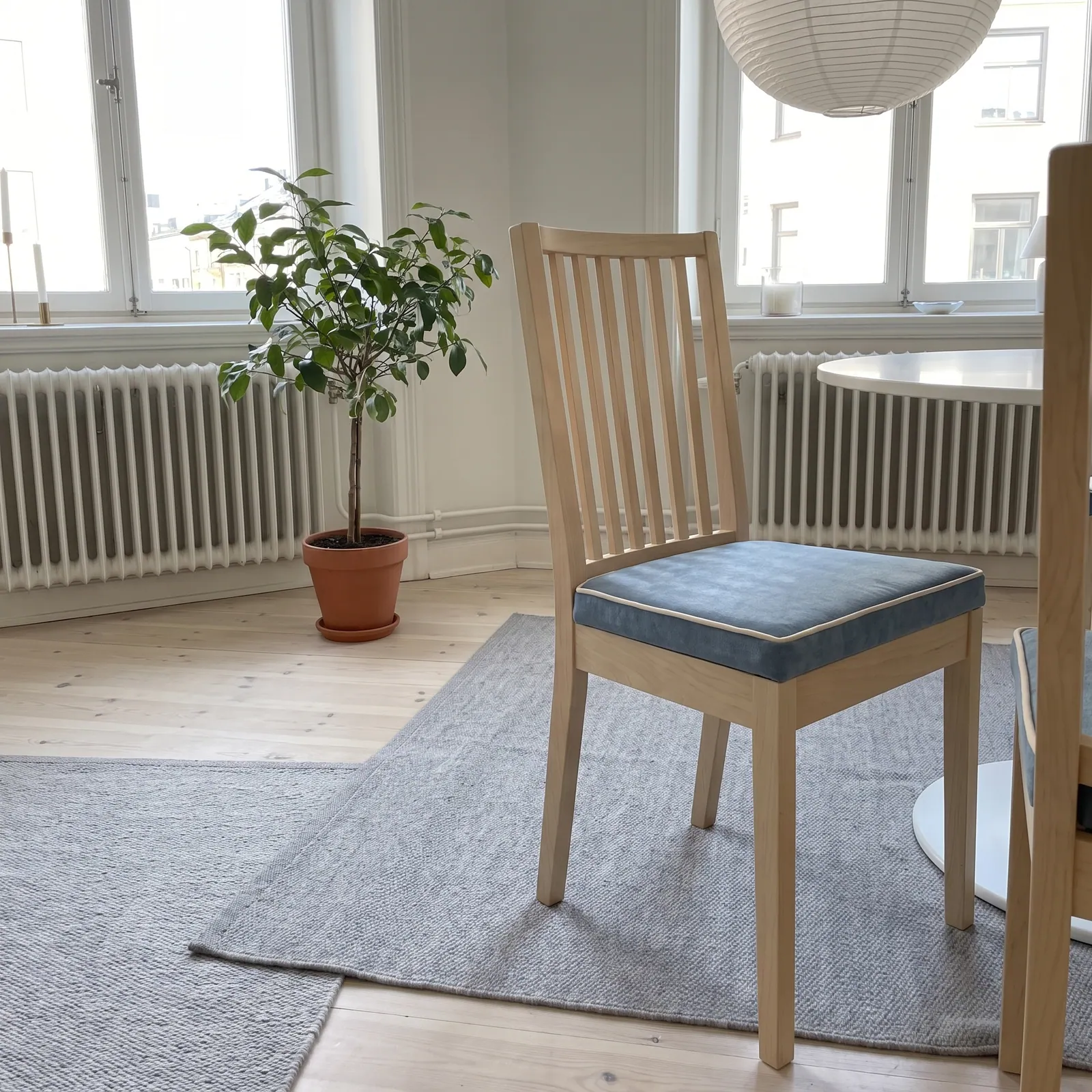
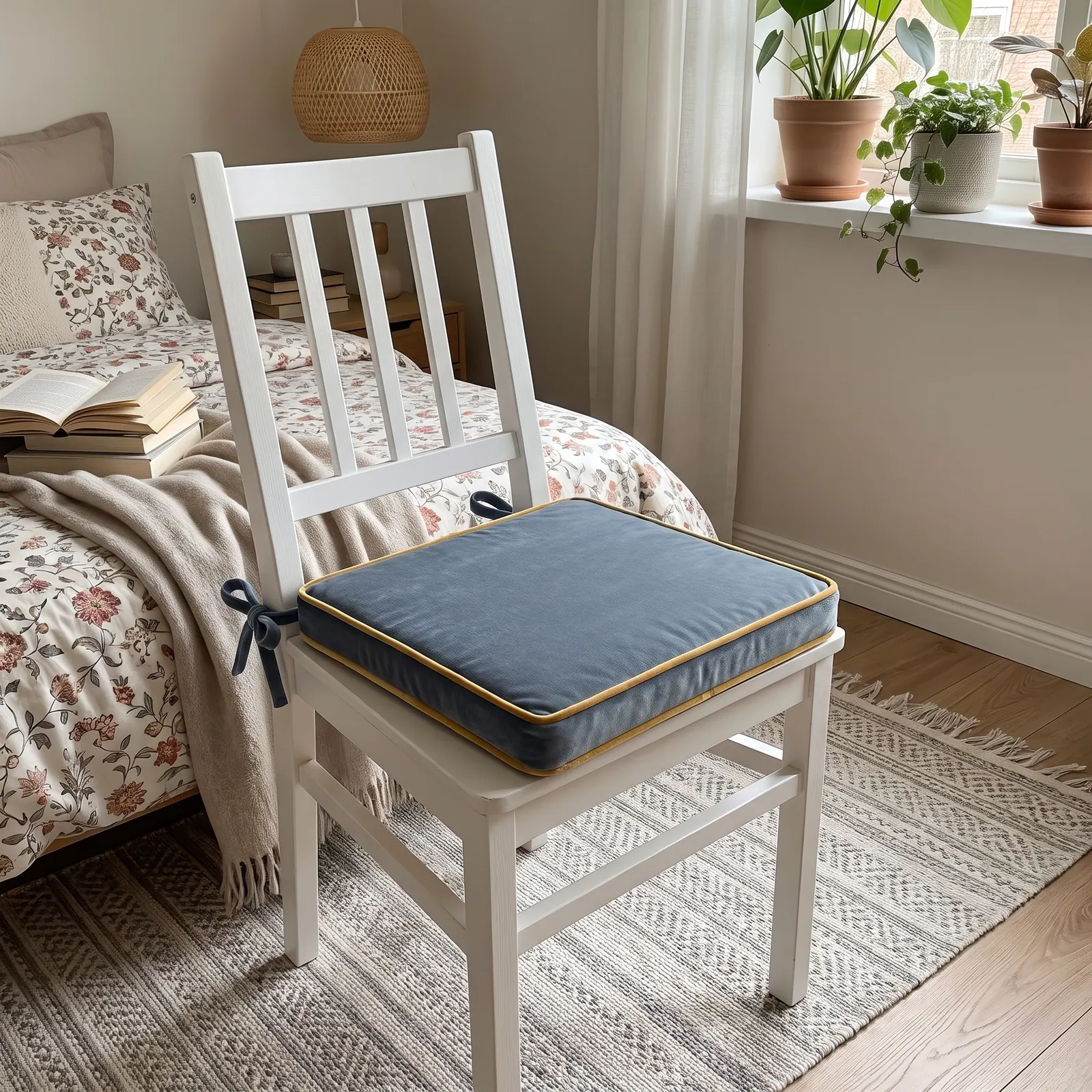
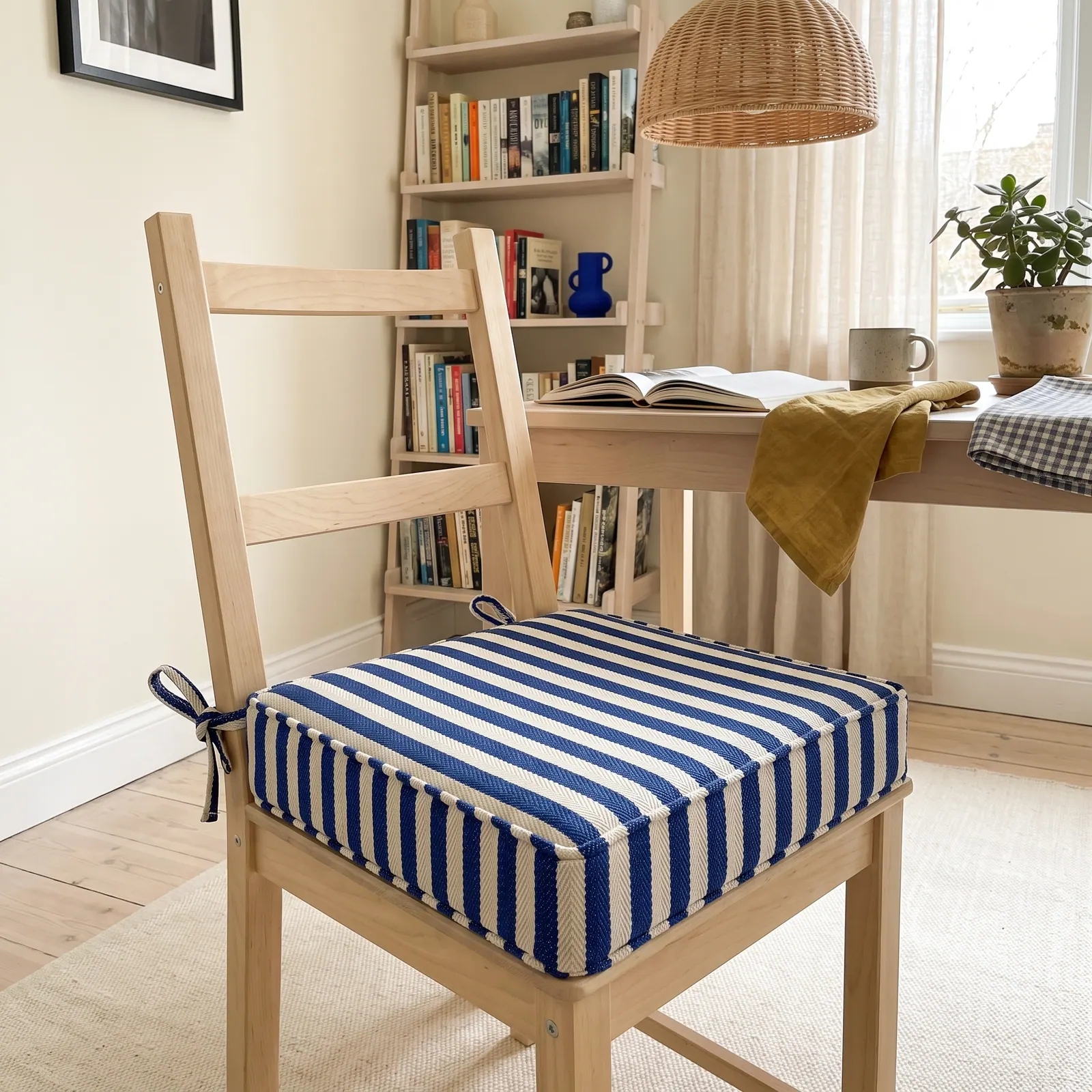
A steel-blue seat pad with cream piping on a blond slat-back dining chair
The questions came in first, as they usually do. Then the chair, and the thin cream line that decides how the pad looks from the doorway.

 Save
The quick answer
Piping on a dining chair cushion should repeat something already in the room: here a cream welt on a steel-blue linen-look pad echoes the white window frames and radiators, so the outline looks planned. Self piping makes the pad read as one quiet block, and no piping gives the softest edge. All three cost the same.
Buyer questions first: round seats, firm foam, thin pads
- A common question
Can you make round cushions? I'm opening a café with bar stools.
The workshop's answerYes. Send a reference photo plus the diameter and thickness. One coffee shop ordered five 16 in (41 cm) rounds, 4 in (10 cm) thick and built for heavy use. The workshop makes the cushion and foam only, not the metal stool frames.
- A common question
Do you make firm replacement cushions for dining chairs?
The workshop's answerYes, in any size and thickness, with about 2.0 lb/ft³ (32 kg/m³) high-resilience foam that stays firm and doesn't flatten for years. Send length, width, thickness and the number of chairs for a quote.
- A common question
Will a 2 in seat cushion collapse when I sit on it? Should I choose 2 in or 3 in?
The workshop's answerThe 32-density foam is dense and firm, so it won't collapse, but 2 in (5 cm) is on the thin side and compresses slightly under body weight. For a 15 3/8 in (39 cm) chair and a target sitting height of about 16 1/2 to 17 in (42 to 43 cm), 2 in lands close. The workshop first asks whether the cushion is for a bench, the floor or a chair.
Now, the reading
One cream line in a room of straight lines
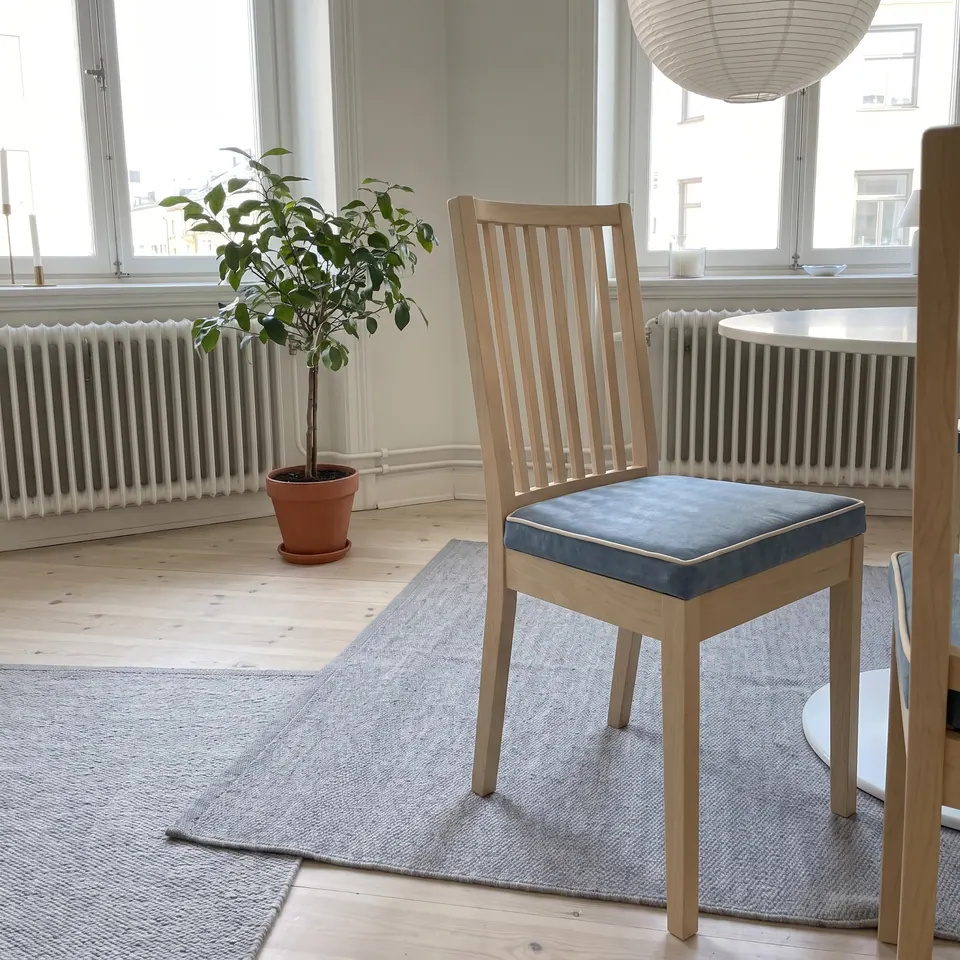
Now the chair. A blond birch slat-back, tall windows, white column radiators, a gray wool flatweave rug, a round white pedestal table. It is a room of verticals, and the dining chair cushion knows it.
The pad is slim, well under the height of the seat rail, so the slats stay the main feature. Its color is steel blue in a linen-look weave, one shade deeper than the rug, which is why it anchors the chair instead of floating on it.
Then the welt. Cream piping runs around the front edge and repeats the painted window frames and radiators behind. Take the cream away and the pad is simply blue; with it, the pad belongs to the room.
A rice-paper globe pendant and a potted fig in a terracotta pot are the only curves. The fig stands between chair and window and keeps a cool blue from turning cold. A candle on the sill, and that is all.
I once piped a navy pad in bright white for a kitchen with no white anywhere in it. It looked like a chalk outline. The welt needs a partner, dear. What could yours repeat?
Five checkpoints by the window
Five pins, from the cream welt up to the paper globe.
- Cream piped front
The cream welt repeats the painted window frames and radiators behind the chair.
- Paper globe pendant
A soft round lamp is the only curve up high in a room of straight lines.
- Potted fig tree
Green foliage between chair and window keeps the cool blue from feeling cold.
- Gray flatweave rug
The seat color sits one shade deeper than the rug, so the pad grounds the chair.
- White column radiator
Period radiators give the plain modern chair a backdrop with character.
- Cream piped frontThe cream welt repeats the painted window frames and radiators behind the chair.
- Paper globe pendantA soft round lamp is the only curve up high in a room of straight lines.
- Potted fig treeGreen foliage between chair and window keeps the cool blue from feeling cold.
- Gray flatweave rugThe seat color sits one shade deeper than the rug, so the pad grounds the chair.
- White column radiatorPeriod radiators give the plain modern chair a backdrop with character.
Self, contrast or no piping on a dining chair pad
| Piping | What it does to the line | Choose it when |
|---|---|---|
| Self piping | Same fabric as the pad; the edge is felt more than seen, and the pad reads as one block | The chair is the star, or the fabric is a busy pattern |
| Contrast piping | A drawn outline, like the cream welt here | The welt color already lives in the room: frames, radiators, rug |
| No piping | A plain seam and the softest edge | The pad is very thin; 1 in (2.5 cm) pads are made only without piping |
Four ladder-back chair cushions and a diagram that didn't add up
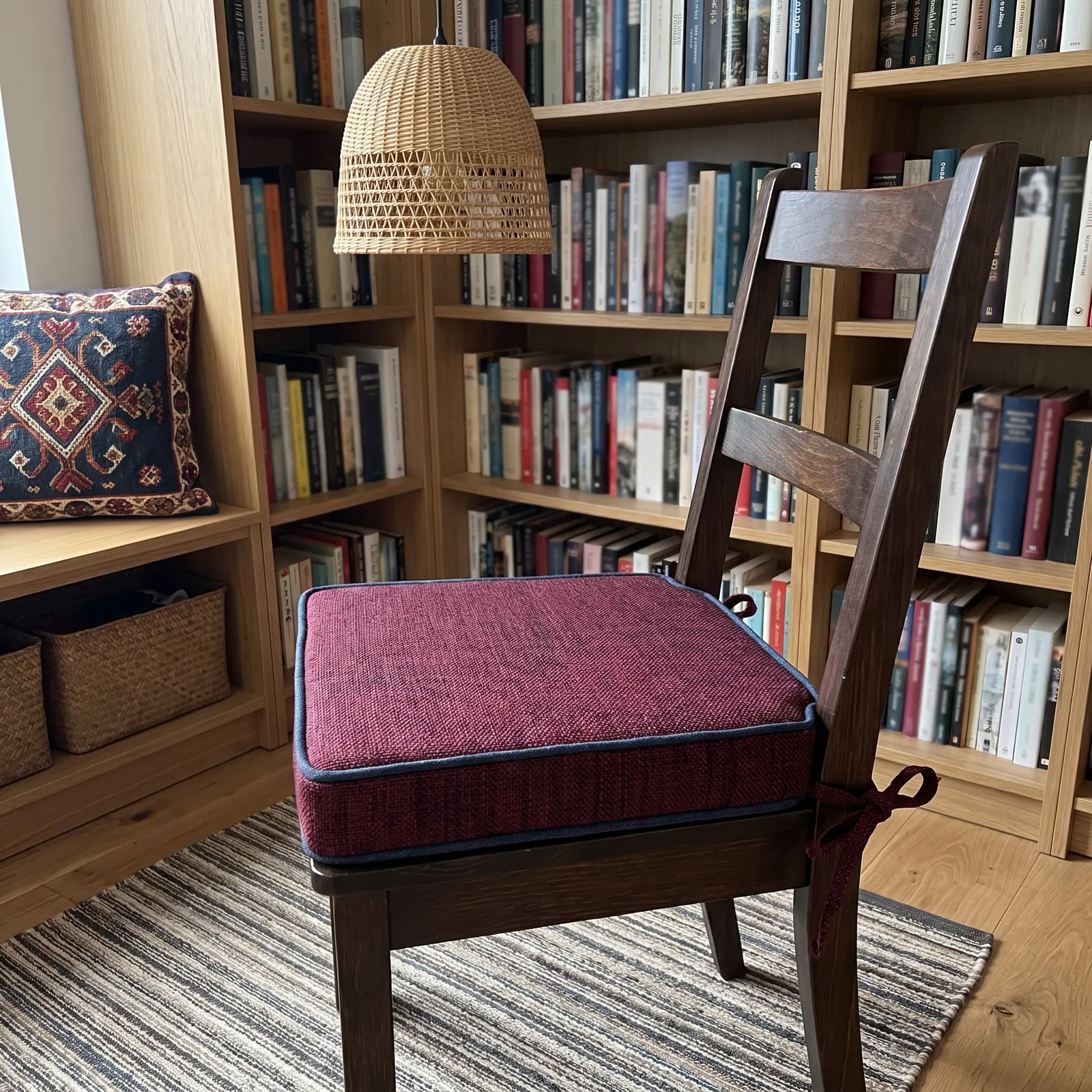
A buyer in the US wanted 4 in (10 cm) cushions for four vintage ladder-back dining chairs and sent a diagram of the seat. The workshop asked for both side edges, then flagged that the numbers didn't add up.
The buyer measured again: about 11 in (28 cm) on each side, 13 in (33 cm) on one edge and 14 in (36 cm) on the other. Now the shape closed. Ties went on at the back, making each a chair cushion with ties, and the covers came off for washing.
After comparing close-ups, the buyer picked a linen with a contrasting piping code, the welt ordered as its own fabric, the way it should be. Old chairs are rarely square; the chair pad measuring guide shows where to put the tape.
The lesson: On chair seats, measure the left and right edges separately; chairs are rarely perfectly square.
Cut sheet: the window chair
| Cushion | Dining chair seat pad, box edge |
|---|---|
| Fabric | Steel-blue linen-look weave |
| Piping | Cream contrast welt |
| Profile | Slim, below the seat rail |
| Foam | 32-density high-resilience foam, about 2.0 lb/ft³, firm |
| Thickness | 2 in (5 cm) compresses slightly; 3 in (7.5 cm) sits higher |
| Ties | Added at the back on request |
| Cover | Removable and washable |

Have it made
Have this made — ask Maggie’s workshop
I once cut a lovely cushion two inches short, and I have not forgotten it. That is why the workshop goes over your measurements with you on the phone. — Maggie
Leave your details and the workshop will call you to confirm measurements, fabric, foam and piping. No prices, dates or payment on this page: it is a request, not an order.
Choose contrast piping on a chair cushion only when the welt has a partner in the room, like a cream welt that repeats white window frames and radiators.
Maggie
Questions buyers ask next
Which piping color suits a blue dining chair pad?
A color already in the room. Cream suits this steel-blue pad because the window frames and radiators are painted white; in a room of warm wood, a tan or caramel welt would do the same job.
Why keep a dining chair seat pad slim?
A slim pad stays below the seat rail, so the slats or spindles remain the chair's main feature, and it raises the seat only a little. Firm foam keeps even a thin pad from bottoming out.
Does piping go on the top edge only?
No. On a box-edge cushion the piping runs around both the top and bottom edges, so the side band is framed from above and below and the pad looks finished from any angle.
Stitch straight — Maggie
Chair cushions and the lines they draw
 Save
 Save
 Save
 Save
 Save
 Save