 Save
A Reading by MaggieDining Chair Cushions & Pads
An indigo chair cushion with ties on a bentwood cross-back, and how to measure a seat like it
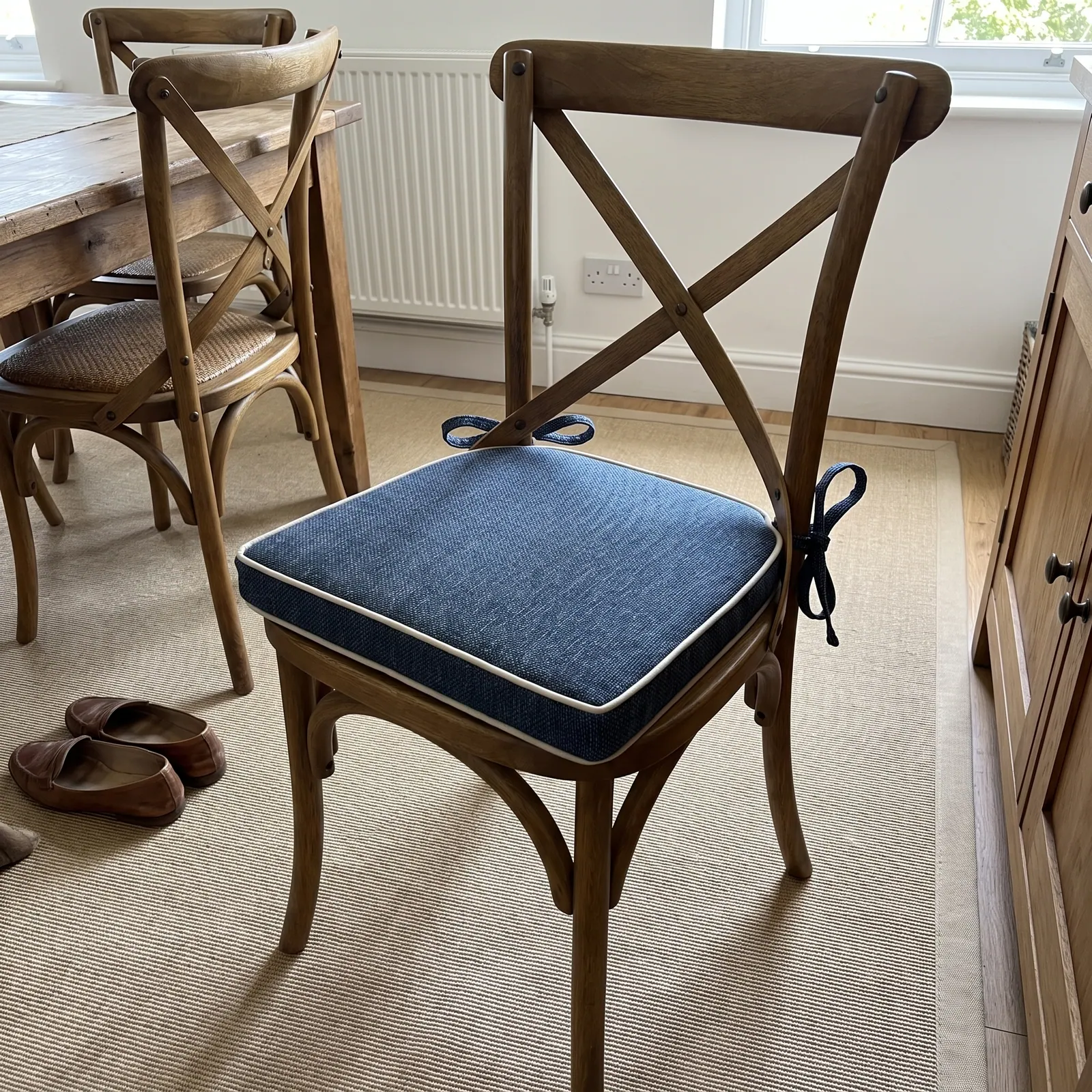
A curved front, an ivory welt and two navy bows you can barely see. Measuring this seat is easy once you stop trusting the tape measure alone.
Indigo with an ivory welt is a relaxed, denim-like pairing that suits weathered oak.

The quick answer
To measure a bentwood cross-back chair for a chair cushion with ties, photograph the seat from directly above, note the width and depth, and trace the curved front on paper, since a tracing reproduces a curve most accurately. Mark the rear posts and the cross-back so the ties land where they can wrap. Measure the chair, never the old pad.
A curved seat in cool daylight
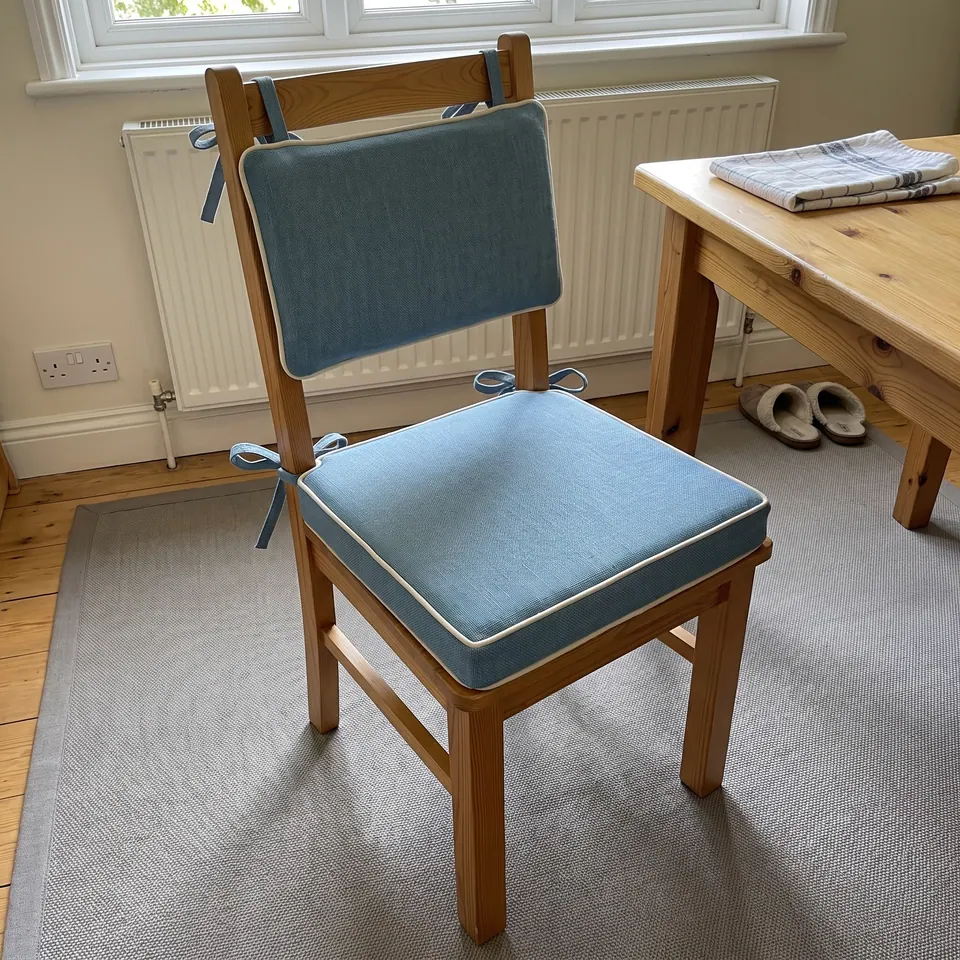
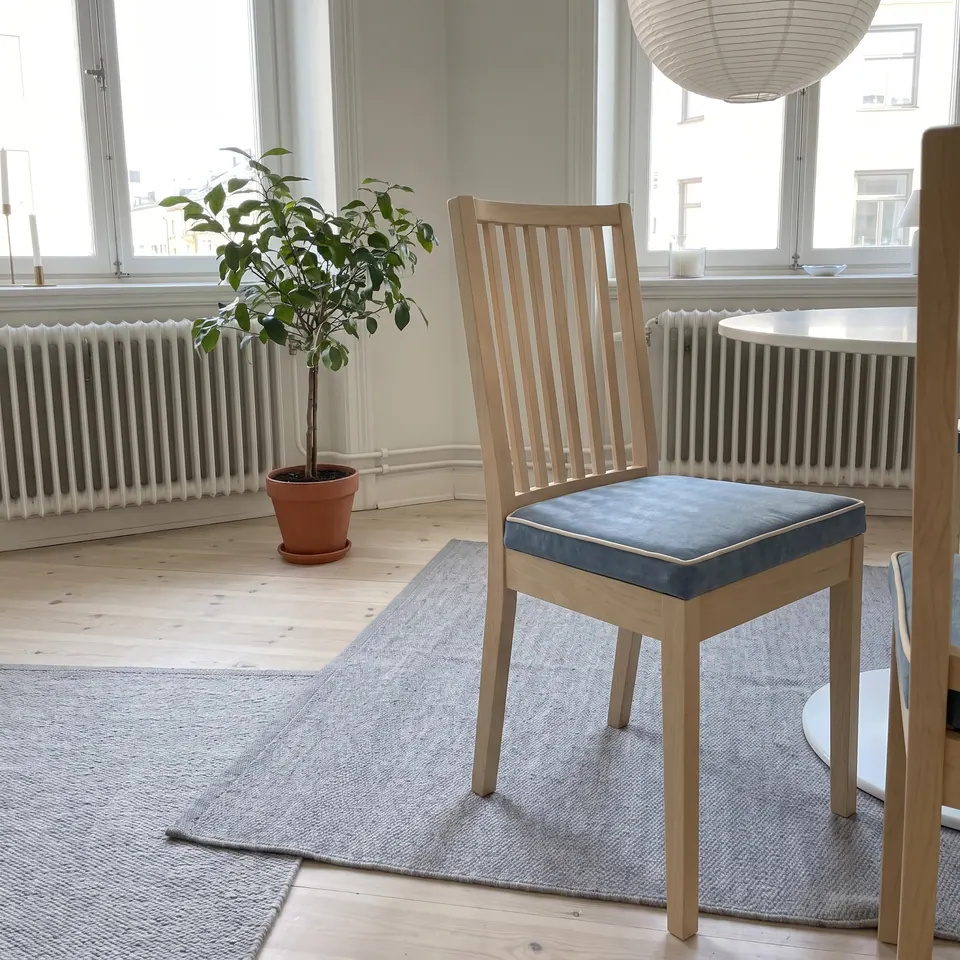
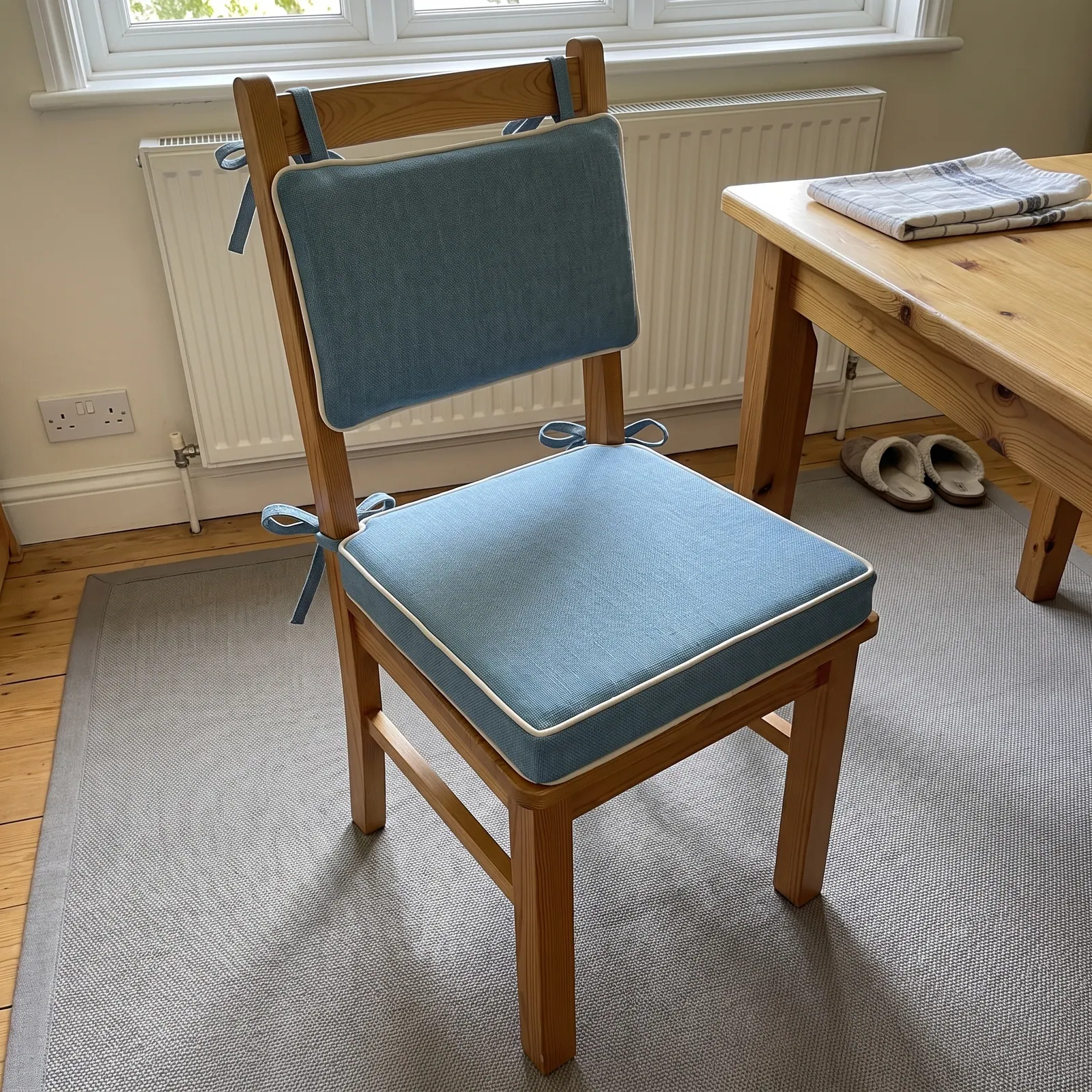
A bentwood cross-back is a bistro chair that has lived a little, and this one sits by a weathered oak table on a sisal rug, with rattan-seated chairs behind it. The chair cushion with ties on it is a heathered indigo weave from the linen-look charts, and it suits the room better than a glossy velvet would. Denim tones get along with oak, rattan and old paint alike, which is handy when no two chairs around a table match.
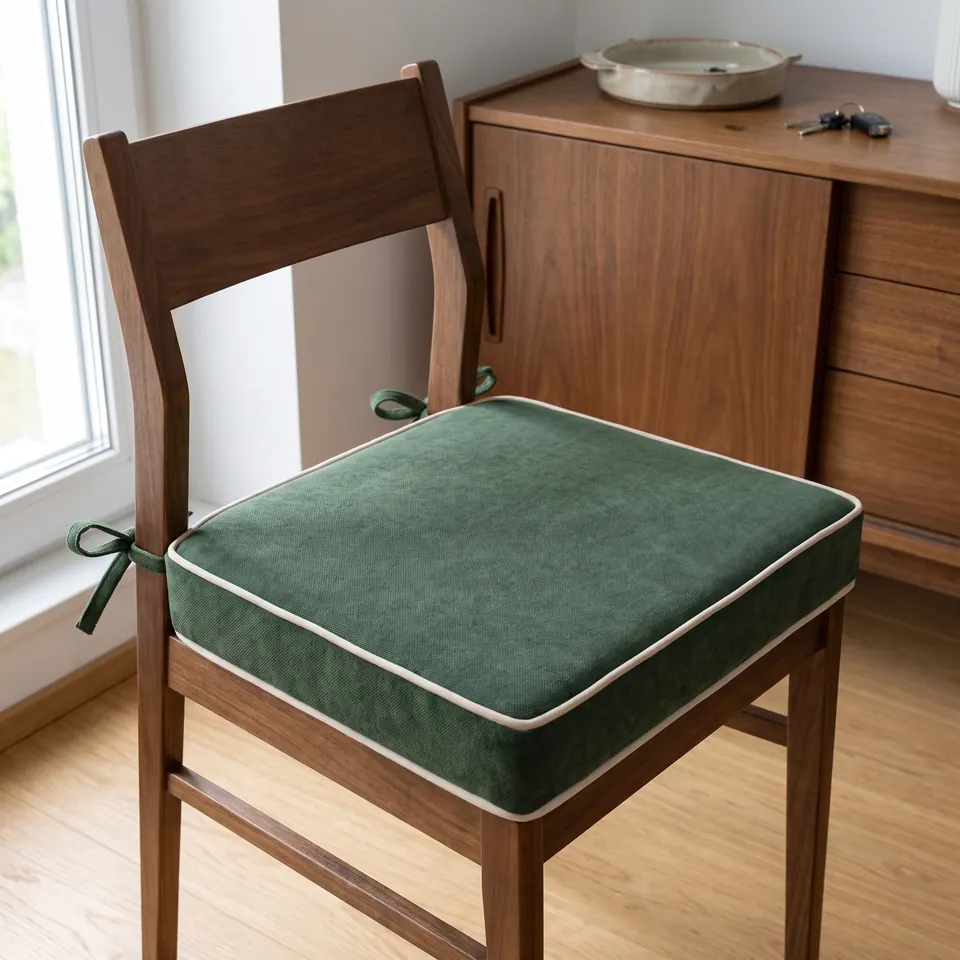
Now the part I care about most. Ivory piping runs along the rounded front of the seat and turns with it evenly. A straight welt is a kind of honesty; on a curve, the honesty is in the easing, and you only get a clean curve if the pad was cut from the real shape of the seat.
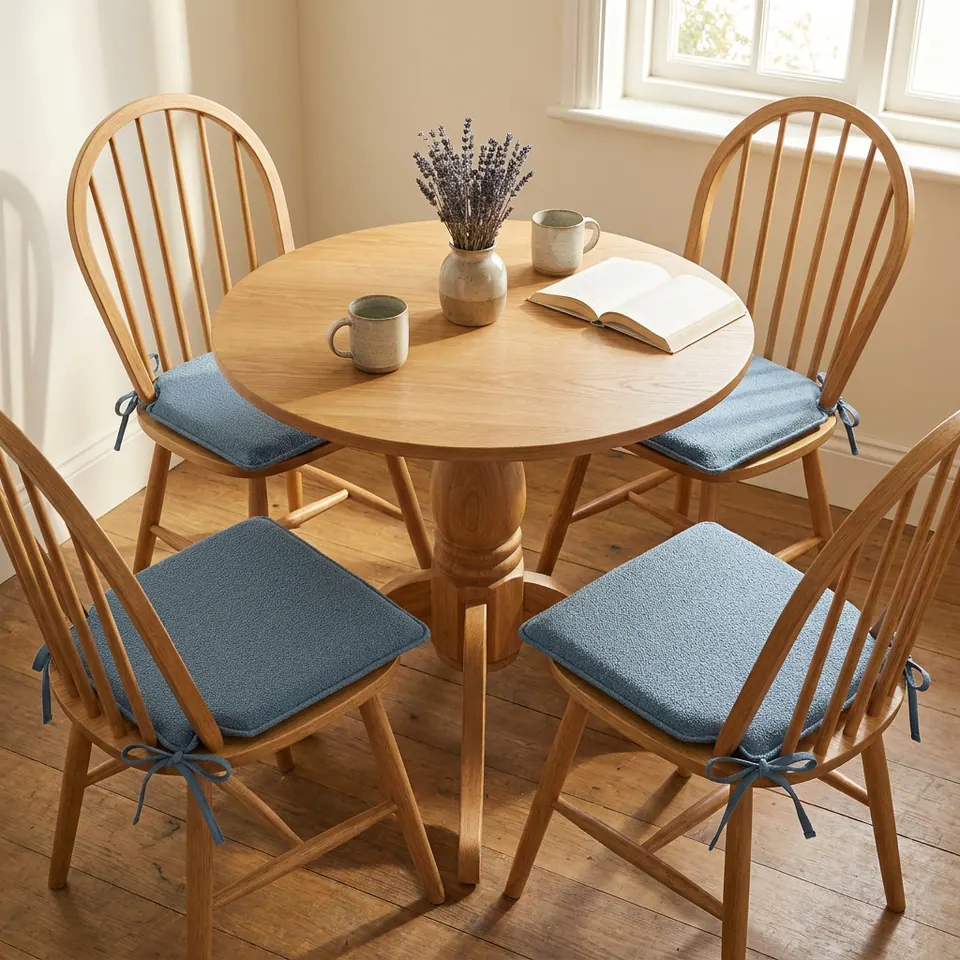
The ties are navy, not ivory, and that is deliberate. One wraps the rear post so the curved pad can't creep forward. A second bow sits where the X of the cross-back meets the seat, hidden from the front. Nobody sees the hardware; everyone sees a pad that stays put.
The props keep it relaxed: a pair of kicked-off leather loafers on the sisal, a white panel radiator, the edge of an oak dresser. Cool daylight, nothing staged too hard. How many different chairs sit around your table?
Pinned by Maggie
Five pins, from the tie on the rear post to the loafers on the rug.
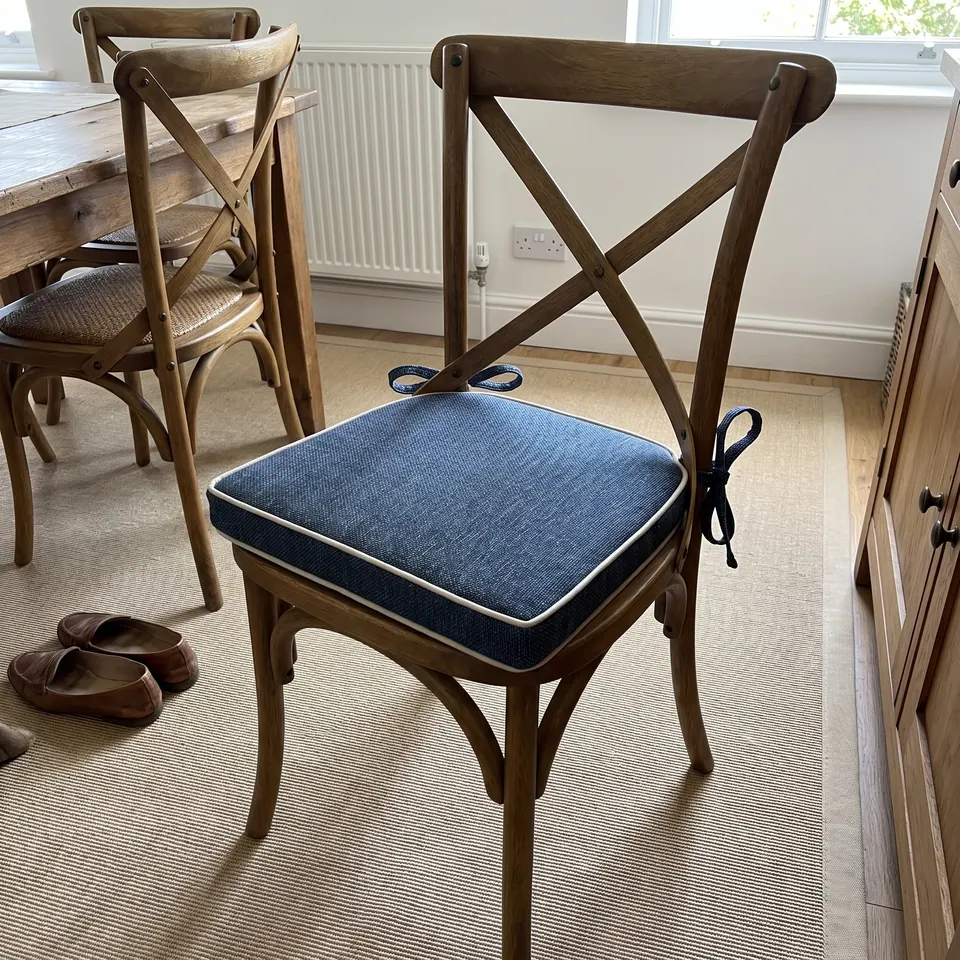
- Navy tie on rear post
The tie wraps the back leg so the curved seat pad cannot slide.
- Tie through cross-back
A second bow sits where the X meets the seat, hidden from the front.
- Curved piped front
Ivory piping traces the rounded front of the bentwood seat.
- Leather loafers
Kicked-off shoes keep the room relaxed and real.
- Rattan-seated chair
Denim blue sits easily beside rattan, paint and oak.
- Navy tie on rear postThe tie wraps the back leg so the curved seat pad cannot slide.
- Tie through cross-backA second bow sits where the X meets the seat, hidden from the front.
- Curved piped frontIvory piping traces the rounded front of the bentwood seat.
- Leather loafersKicked-off shoes keep the room relaxed and real.
- Rattan-seated chairDenim blue sits easily beside rattan, paint and oak.
Measuring a bentwood seat in five moves
Photograph from directly above
Stand over the chair and get the whole seat in the frame, with a tape measure laid across it. A side view hides the curve.
Write the width and the depth
Width across the widest point, depth from front to back. Label both; depth is not thickness, and a pad has both.
Trace the seat on paper
Lay paper on the seat, press it into the edges and draw the outline. A tracing is the most accurate way to reproduce a curve; the paper template pattern shows how.
Mark the tie points
Mark both rear posts and the spot where the cross-back meets the seat, so the ties land where they can wrap. More on where ties go on chairs.
Check the new seat height
A pad lifts you toward the tabletop. Run your numbers through the seat height calculator before you pick a thickness.
Covers cut to the foam already in hand
A buyer in the US already had good foam for a hanging porch swing and wanted covers only, with extra-strong zippers: a seat of 55.25 x 27.75 x 4 in (140.3 x 70.5 x 10 cm) and a back pad of 50 x 13 x 4 in (127 x 33 x 10 cm), in cinnamon.
The first thing the workshop asked for was the foam sizes. Not the old covers, not a catalog size: the foam. The covers were quoted without inserts and cut to those numbers. A different seat, the same rule as the bentwood chair: measure the thing itself.
- Sizes
- Seat 55.25 x 27.75 x 4 in; back 50 x 13 x 4 in
- Fabric
- Cinnamon, with extra-strong zippers
The lesson: If you already have good foam, zippered covers made to its exact size are a cheaper refresh.
Buyer questions: copies, curves and second thoughts
- A common question
Can I cancel my custom order if I don't need it right now?
The workshop's answerYes, as long as production hasn't started: the order is cancelled and refunded to the original payment method. The workshop can also hold the order until you're ready, or change details without cancelling at all.
- A common question
Can you copy the seat and back cushions I already have on my dining chairs?
The workshop's answerYes. Send photos with the dimensions, and the workshop replicates both the seat and the back cushion for each chair. Ask it to state the shipping cost in the quote.
- A common question
Can you make a cushion for a vintage barrel-back rattan chair with a rounded back?
The workshop's answerYes, semicircular back included. Send the width and depth, for example 17 x 18 in (43 x 46 cm), plus a clear photo from directly above that shows the whole seat. A simple tracing or template of the seat is even better for getting the curve right.
For a curved chair seat, a paper tracing beats a tape measure. Send the width, the depth and a photo taken from directly above the seat.
Maggie
On the cutting table
| Cushion | Shaped chair pad with a curved front, box edge |
|---|---|
| Fabric | Heathered indigo linen-look weave |
| Piping | Ivory contrast, following the curved front |
| Ties | Navy, around the rear post and through the cross-back |
| What to send | Top-down photo, width and depth, and a paper tracing |
| Thickness | Your choice; check the new seat height at the table first |
| Care | Zippered cover, machine wash at 86°F (30°C) max on gentle, air dry |
| Best for | Mixed bentwood and rattan chairs around a rustic oak table |

Have it made
Have this made — ask Maggie’s workshop
Numbers first, fabric second, piping last. Jot down what you have, and the workshop will go down the list with you, item by item. — Maggie
Leave your details and the workshop will call you to confirm measurements, fabric, foam and piping. No prices, dates or payment on this page: it is a request, not an order.
Questions buyers ask next
Where should the ties go on a cross-back chair?
Around the rear posts, which stop a curved pad from sliding forward, and through the cross-back where the X meets the seat, where the bow stays hidden from the front. Ties can be sewn into the seams at the corners or the back, in any position.
Can a chair pad have a curved front instead of square corners?
Yes. Curved and rounded seats are made from a dimensioned drawing, a photographed paper template or a top-down photo with measurements. The workshop checks the shape before cutting, and a tracing gives the most faithful curve.
Is a linen-look weave practical on dining chairs?
Yes. The standard linen-look charts are mostly durable, hard-wearing blends, and a heathered weave forgives crumbs better than a flat solid. The zippered cover comes off and washes at 86°F (30°C) on a gentle cycle, then air-dries.
Should the piping color match the ties?
Not necessarily. Here the piping is ivory to outline the curved front, and the ties are navy so they disappear against the dark frame. Piping can match or contrast using any chart code, and it is included in the price either way.
Stitch straight — Maggie
The same linen-look family on benches and window seats
 Save
 Save
 Save
 Save
 Save
 Save