A Reading by MaggieDining Chair Cushions & Pads
An olive chair cushion with ties, and the props that frame it
Maggie takes apart a walnut mid-century chair pad, from cream welt to rear-post bows, and explains why a stoneware dish and a set of keys earned their places on the sideboard.

 Save
The quick answer
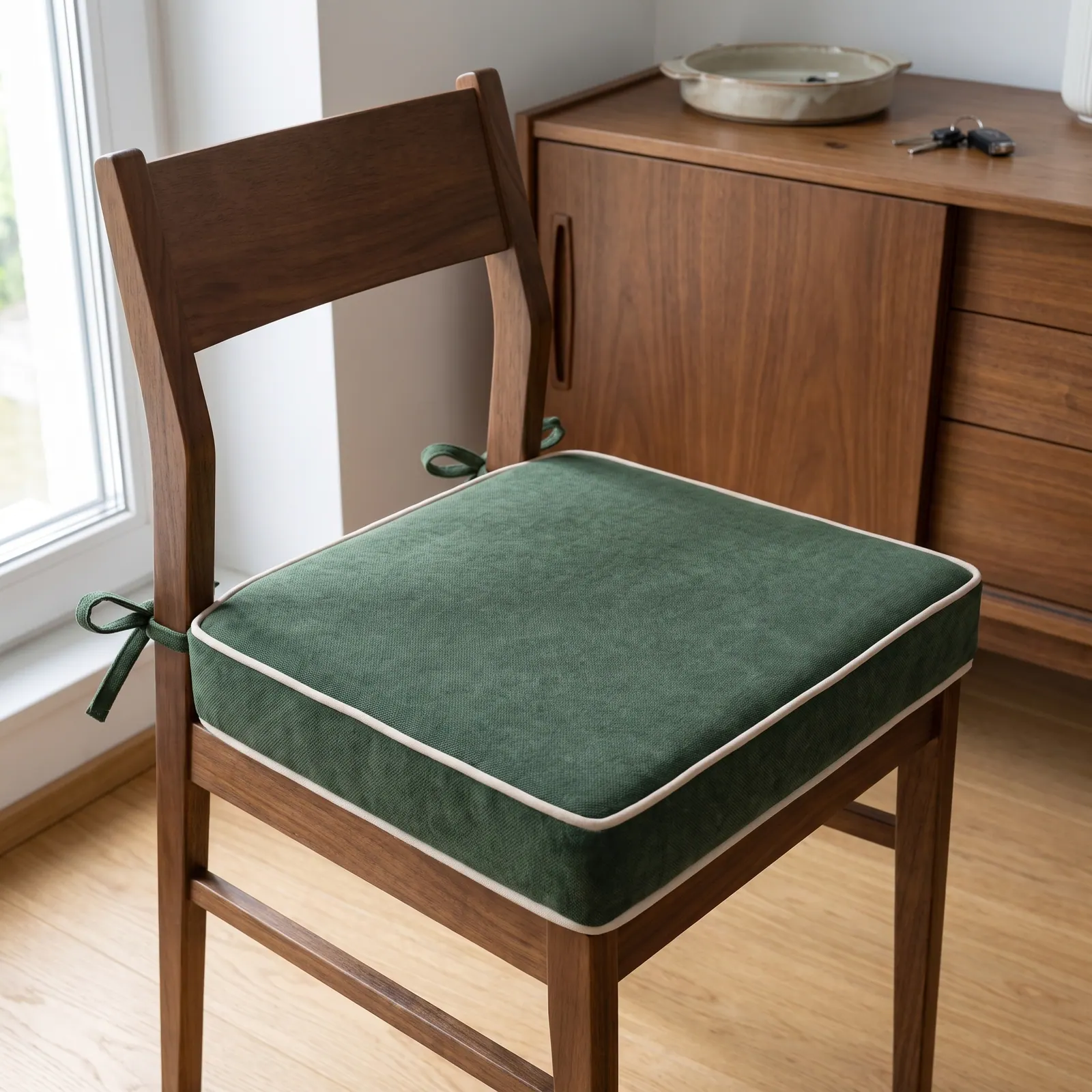
To style an olive chair cushion on dark walnut, give it a light piping such as cream so the outline doesn't sink into the wood, then repeat that cream once nearby, like a stoneware dish on the sideboard. Tie the cushion high on the rear posts with ties in the body color, so they hold the seat but vanish from the front.
The cushion, cut open
Cover fabric. A removable, zippered cover. Machine wash at 86°F (30°C) on a gentle cycle and air dry.
Piping. A fabric-covered cord sewn into the seams. It sits on the seam line, so it does not change the size.
Fiber wrap. Polyester fiber (Dacron) batting around the foam: it fills the cover out and softens the edges.
Foam core. About 2.0 lb/ft³ (32 kg/m³) high-resilience foam, firm to medium-firm, cut to the ordered size.
Zipper. Along the back band, as hidden as possible. The zipper side faces down or toward the wall.
Base panel. The underside of the cover. A non-slip fabric backing can cover the whole of it instead.
Anatomy of a walnut chair pad
Cut this chair cushion with ties in half and you would find three decisions, stacked.
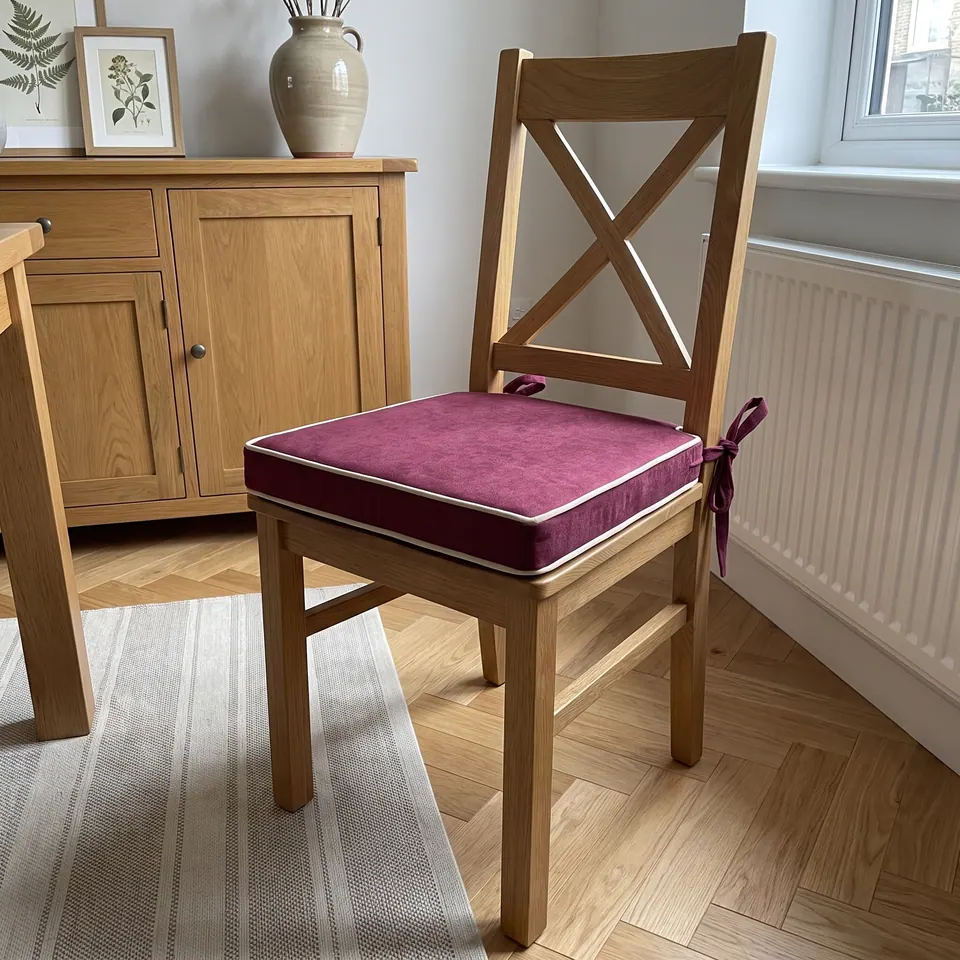
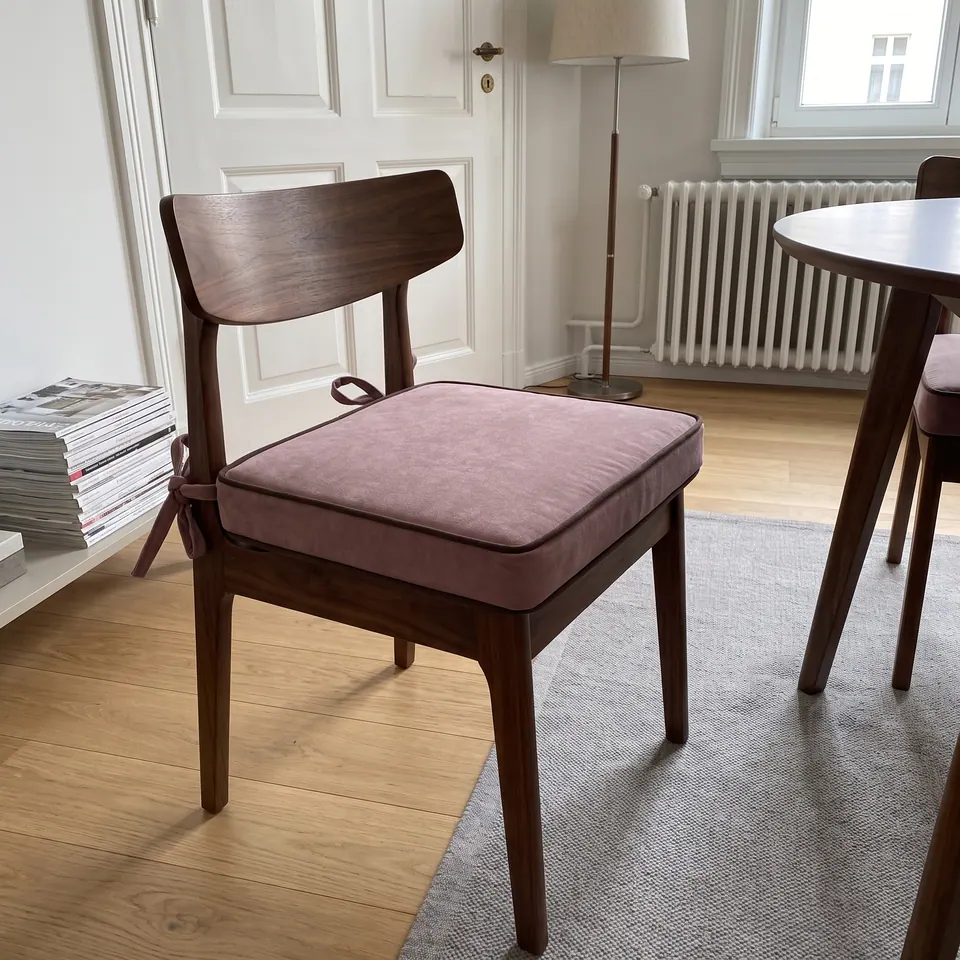
The body is a deep olive linen-look, cut as a box. It is fairly thick, close to the height of the seat rail, which balances the chunky back rail above it. A thin pad would look lost under that rail.
Around the edge runs a cream welt, and this is the one I would fight for. Walnut and olive are both deep, earthy tones; without a pale line the cushion would sink into the chair. A straight welt is a kind of honesty, and on dark wood it is also a rescue: it draws the outline the eye needs.
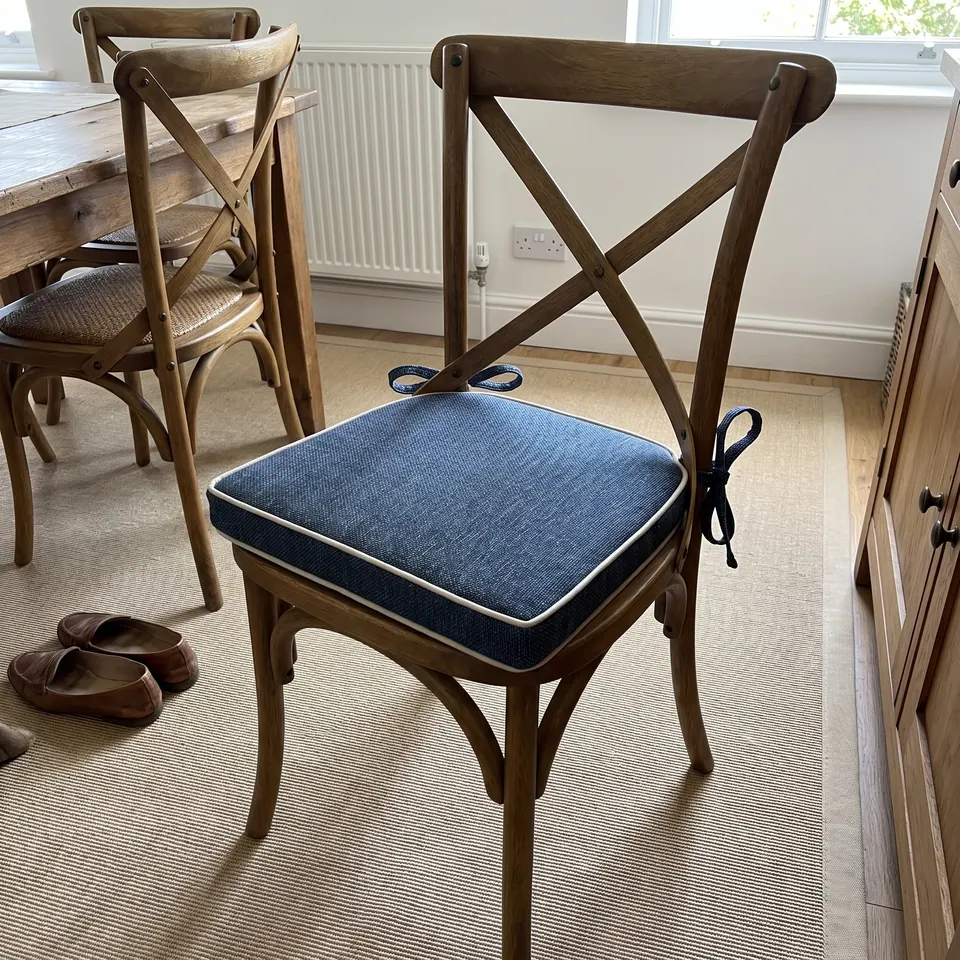
At the back, ties in the same olive knot high on the rear posts, finished in neat bows. On a smooth walnut seat they stop the pad sliding forward, and from the front they hardly show. Our tie placement Pattern covers where they go on other chairs.
Pinned by Maggie: ties, welt and sideboard
Five pins go from the left back-post tie to the walnut sideboard, each one showing how a single chair borrows its setting.
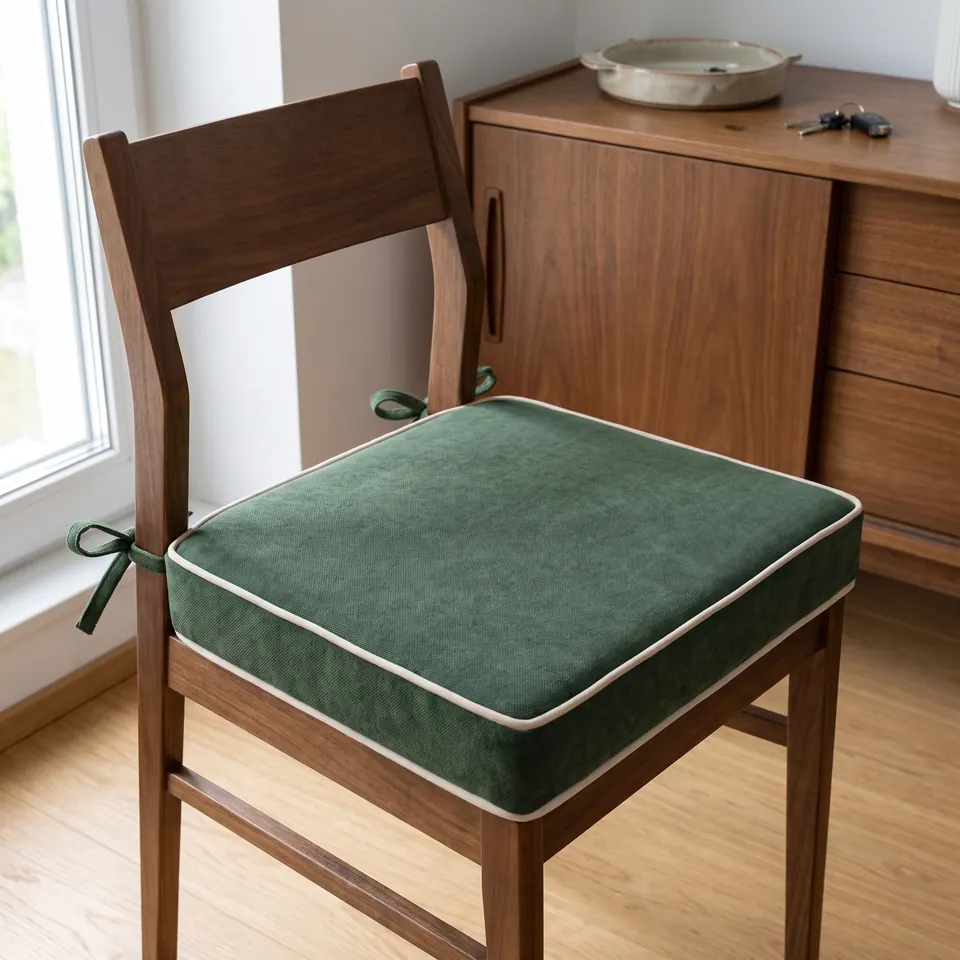
- Left back-post tie
Ties in the same green knot high on the posts and vanish from the front view.
- Right tie bow
A neat bow on each rear post stops the cushion sliding forward on a smooth walnut seat.
- Cream piped corner
Without the pale welt, deep olive would sink into dark walnut.
- Stoneware dish
A cream glazed dish repeats the piping color up on the sideboard.
- Walnut sideboard
Matching walnut furniture sets the mid-century tone the olive was chosen for.
- Left back-post tieTies in the same green knot high on the posts and vanish from the front view.
- Right tie bowA neat bow on each rear post stops the cushion sliding forward on a smooth walnut seat.
- Cream piped cornerWithout the pale welt, deep olive would sink into dark walnut.
- Stoneware dishA cream glazed dish repeats the piping color up on the sideboard.
- Walnut sideboardMatching walnut furniture sets the mid-century tone the olive was chosen for.
Why these props, and only these
The styling is spare on purpose, and every piece has a job.
- The walnut sideboard. Matching mid-century wood sets the tone the olive was chosen for. The chair does not stand alone; it belongs to a set.
- The stoneware baking dish. A cream glaze up on the sideboard repeats the piping color. One echo is enough to make the welt look planned.
- The house keys. They say this corner is used daily, on the way in and out. A lived-in prop beats a staged one.
- The white-framed window. It brings soft light across the seat and gives the cream welt a match in paint.
No throw, no extra pillow, no plant. On a dining chair, more would crowd the cushion. For more olive and khaki pairings, see our sage and olive Concept Sketch. Which piece in your room could play the stoneware dish?
Samples first, then the client
An interior designer in the US wrote to the workshop about a client's seating nook: a 36 x 60 in (91 x 152 cm) floor cushion and a backrest 36 in (91 cm) wide, 8 in (20 cm) deep and 12 in (30 cm) high with a rounded top. The shop clarified the thickness, 8 in as in the photos, and quoted two floor cushions and one back before the order came down to a single floor cushion.
What I liked was the order of things. Before the client said yes, the designer asked for two linen samples to hold up in the room, and confirmed the backrest would carry the same tufting as the seat.
Give thickness and backrest height as separate numbers. Then style with a swatch in your hand, dear, not a screen.
On the cutting table: the walnut chair pad
| Product | Box chair cushion with ties |
|---|---|
| Fabric | Olive green linen-look weave |
| Piping | Contrast piping in cream |
| Edge | Box edge, close to the seat rail height |
| Ties | Body color, knotted high on the rear posts |
| Grip | Ties or a non-slip base, added at checkout or later |
| Curved or rounded seats | Measure where each curve starts, plus photos |
| Best for | Walnut and dark-wood mid-century dining chairs |

Have it made
Have this made — ask Maggie’s workshop
Have the tape measure handy when they call. Old cushions shrink and sag; the seat underneath does not. — Maggie
Leave your details and the workshop will call you to confirm measurements, fabric, foam and piping. No prices, dates or payment on this page: it is a request, not an order.
Buyer questions: late add-ons, curves, ottomans
- A common question
I forgot to add the non-slip base and ties at checkout. Can I still get them?
The workshop's answerYes. Both can be chosen at checkout, or the shop sends a separate payment link afterward. Once a custom payment link is paid it closes and shows sold out, which simply means your payment went through.
- A common question
How do I measure a chair cushion with a curved top or rounded corners?
The workshop's answerFor a curved top, give three numbers: how far each side edge runs straight before the curve begins, the width where the curve starts, and the total height from the bottom edge to the highest point. For rounded corners, measure how far from the corner the curve begins along both edges, for example 8 in (20 cm), and send photos.
- A common question
Is the ottoman fixed to the corner floor sofa, and does it come with it?
The workshop's answerThe corner sofa listing includes the ottoman, and a lower-priced listing leaves it out. The ottoman is a separate piece, not attached at all, so it can sit on either side, and it may arrive in its own package.
On a walnut chair, an olive chair cushion needs a cream welt. Without that pale piping, deep green sinks into dark wood and the seat loses its outline.
Maggie
Questions buyers ask next
Should the ties on an olive chair pad match the body fabric or the cream piping?
Match the body. Olive ties knotted on dark rear posts nearly disappear from the front, while cream ties would pull attention to the back of the chair. Save the light color for the welt, where it outlines the seat.
What piping color keeps a dark green cushion visible on a walnut chair?
A light one, such as cream or off-white. Dark green and walnut sit close in depth, so a matching welt blends in. A pale welt draws the box outline, and repeating it once nearby makes it look intended.
How do I style a dining corner around one cushioned mid-century chair?
Keep to a few props with clear jobs: one piece of matching wood, one object that repeats the piping color, and something that shows daily use. Skip throws and extra pillows on dining chairs; they crowd the seat.
Does a thick box cushion suit a mid-century chair with a heavy back rail?
Often, yes. A box close to the height of the seat rail balances a chunky back rail, where a thin pad would look undersized. Measure the rail height and the seat before you choose a thickness.
Stitch straight — Maggie