The Cutting Table · a checklist answer
How do I stop my kitchen chair cushions from sliding?
Also asked as:How do I keep chair pads from sliding off the seat?Can you put ties on dining chair cushions?
Four fixes, in the order I'd reach for them. Start with what the chair gives you to hold on to, then work down to what goes under the pad.

 Save
The quick answer
To make kitchen chair cushions non-slip, tie them to the back posts first: two ties at the back corners hold best on spindle, ladder and cross-back chairs. On a smooth seat with nothing to tie to, use a sewn-in non-slip base or shelf-liner mesh cut to the seat. Then check the fit, because an undersized pad shifts whatever sits under it.
Get a quote for a chair cushion with ties
Key facts
- Ties are sewn in only on request; on chair pads they go at the back to wrap spindles, posts or a ladder-back rail.
- On the dining chair cushion listing, ties are an option you select at checkout.
- A non-slip base replaces the whole bottom panel with grippy fabric that holds by friction, not glue or rubber, and leaves no residue on wood.
- The non-slip base costs extra, scales with cushion size and has no border-only version; the washable material adds time, so ask for the new date in writing.
- Shelf-liner mesh or rubber rug underlay grips best on smooth wood, stone and metal seats; rubber loses its grip with age.
- Velcro tabs and snaps aren't made; a two-sided velcro strip has been added on request at extra cost.
- An undersized pad shifts, so measure the chair seat, not the old pad.
- Finished pads can differ from the ordered size by about 0.5-1 in (1-2 cm), so send the true seat size without subtracting anything.
- Rectangular seat cushions come in standard thicknesses from 2 to 5 in (5 to 12.5 cm).

Have it made
Have Maggie’s workshop cut this for you
I once cut a lovely cushion two inches short, and I have not forgotten it. That is why the workshop goes over your measurements with you on the phone. — Maggie
Leave your details and the workshop will call you to confirm measurements, fabric, foam and piping. No prices, dates or payment on this page: it is a request, not an order.
Four fixes, ranked for kitchen chairs
- Ties at the back posts. Two ties at the back corners, knotted around spindles, posts or a ladder-back rail. The surest hold, and they undo on wash day.
- A sewn-in non-slip base. The whole bottom panel is a grippy fabric that holds by friction. Best on smooth seats with nothing to tie to.
- Shelf liner or rubber rug underlay, cut to the seat. The cheap fix for a pad you already own. Best on smooth wood, stone and metal.
- A pad cut to the real seat. An undersized pad has room to wander, and no liner fixes that for long. Measure the chair, not the old cushion.
Why ties come first on most kitchen chairs
Right, then. Most kitchen chairs hand you an anchor: two back posts, a row of spindles, a ladder-back rail, a cross-back X. Tie the pad to it and it can't creep forward, however often someone scoots in for seconds.
Chair pads are made with ties at the back for exactly this, and on the dining chair cushion listing they're an option you tick at checkout. Anywhere else, write them into your order: ties are never added unless you ask. One buyer assumed they came standard and unpacked chair cushions with nothing to tie; the workshop offered to pay half of a local tailor's bill to add them. The tie placement Pattern gives positions chair by chair.
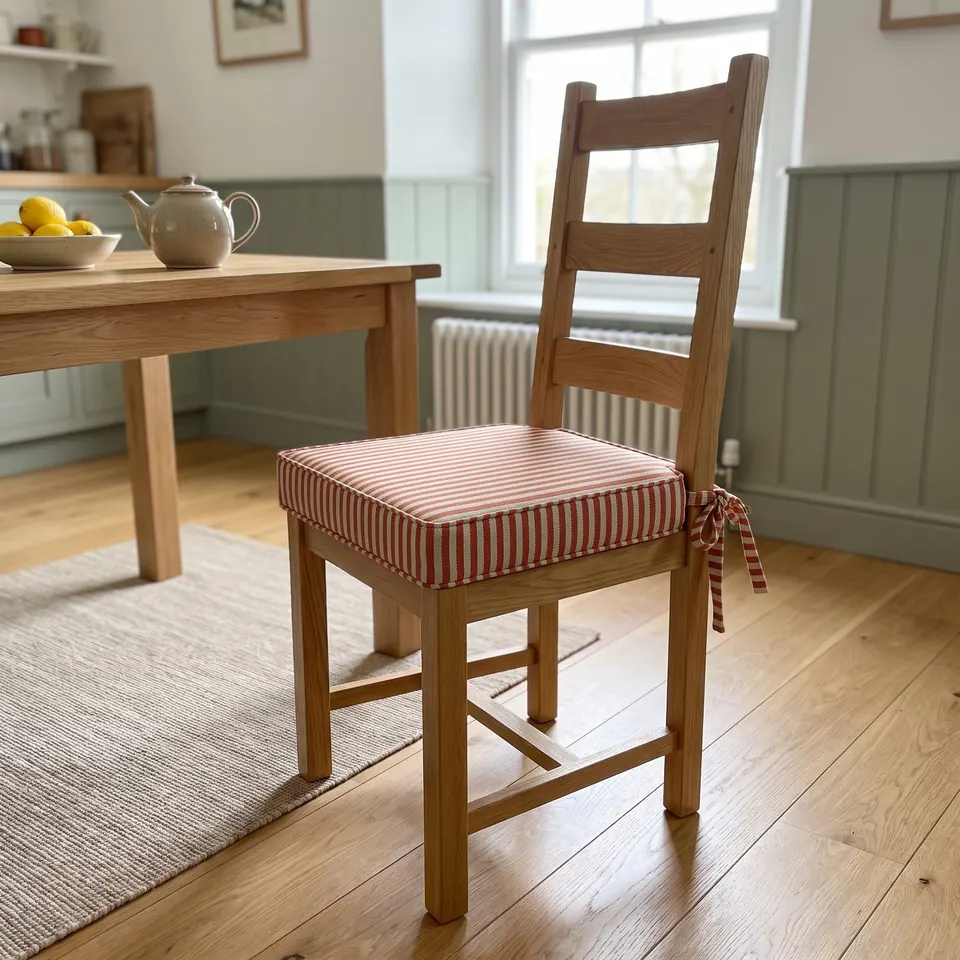
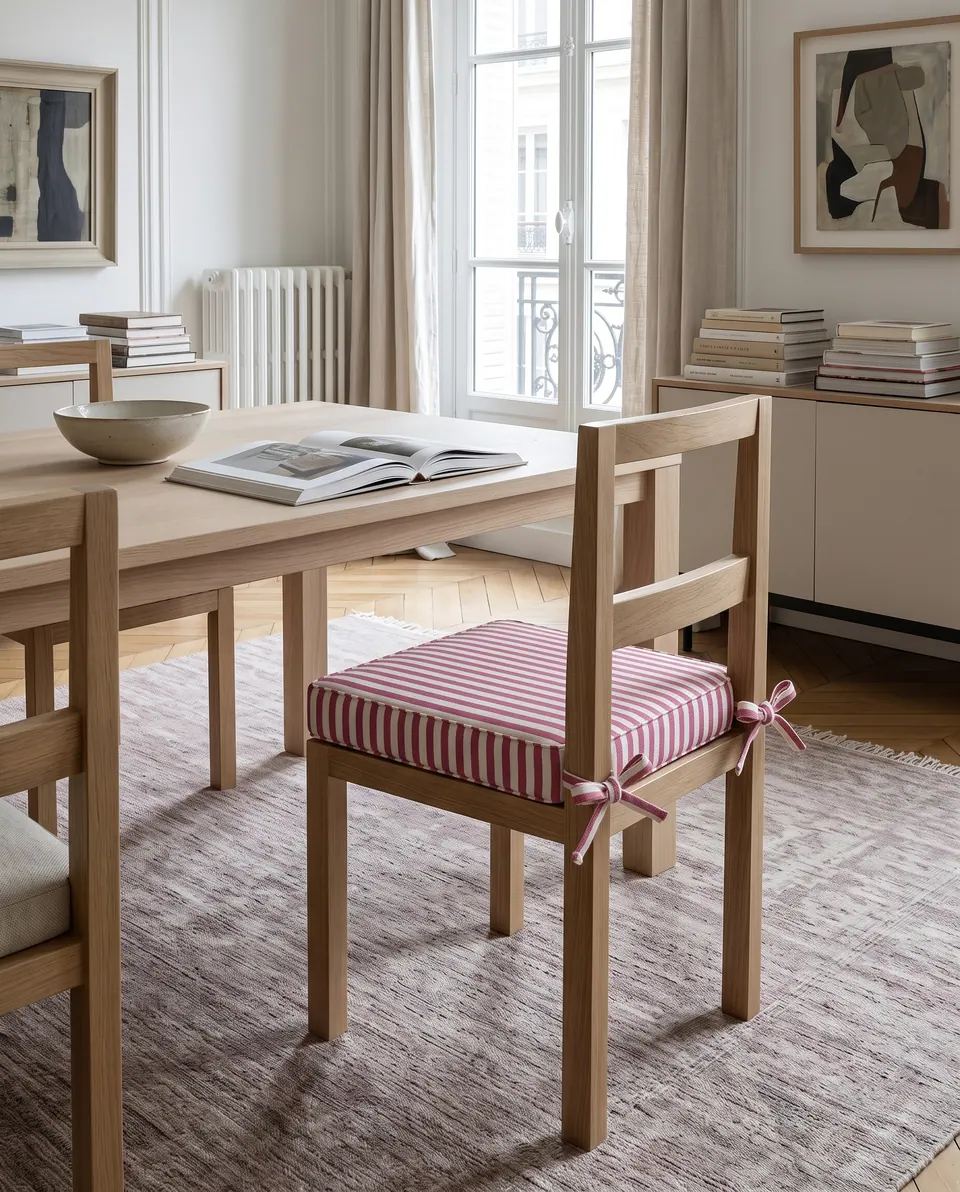
In the gallery, a rose-and-white striped pad is tied in bows at the back posts of a pale oak ladder-back chair. The bows hold and decorate at once.
Velcro? Tabs and snaps aren't made; a two-sided strip has been added on request, at extra cost. I'd still reach for ties, dear.
Grip underneath: a sewn-in base or a sheet of liner
No posts, no spindles, just a smooth painted or stone seat? Then the grip has to come from underneath.
The sewn-in route is a non-slip base: the whole bottom panel is cut from grippy fabric that holds by friction. It isn't glue or rubber, it leaves no residue, and it's safe on wood. There's no border-only version, and it costs extra, more on bigger cushions. The washable non-slip material adds time to the order, so ask whether yours is the washable kind.
For a pad you already own, cut shelf-liner mesh or rubber rug underlay to the seat. Rubber loses its grip as it ages and gets replaced, not repaired. More in non-slip bases and wood finishes and under dining chair cushions. What are your kitchen chairs made of?
Match the fix to the chair
| Chair | Best fix | Where it goes |
|---|---|---|
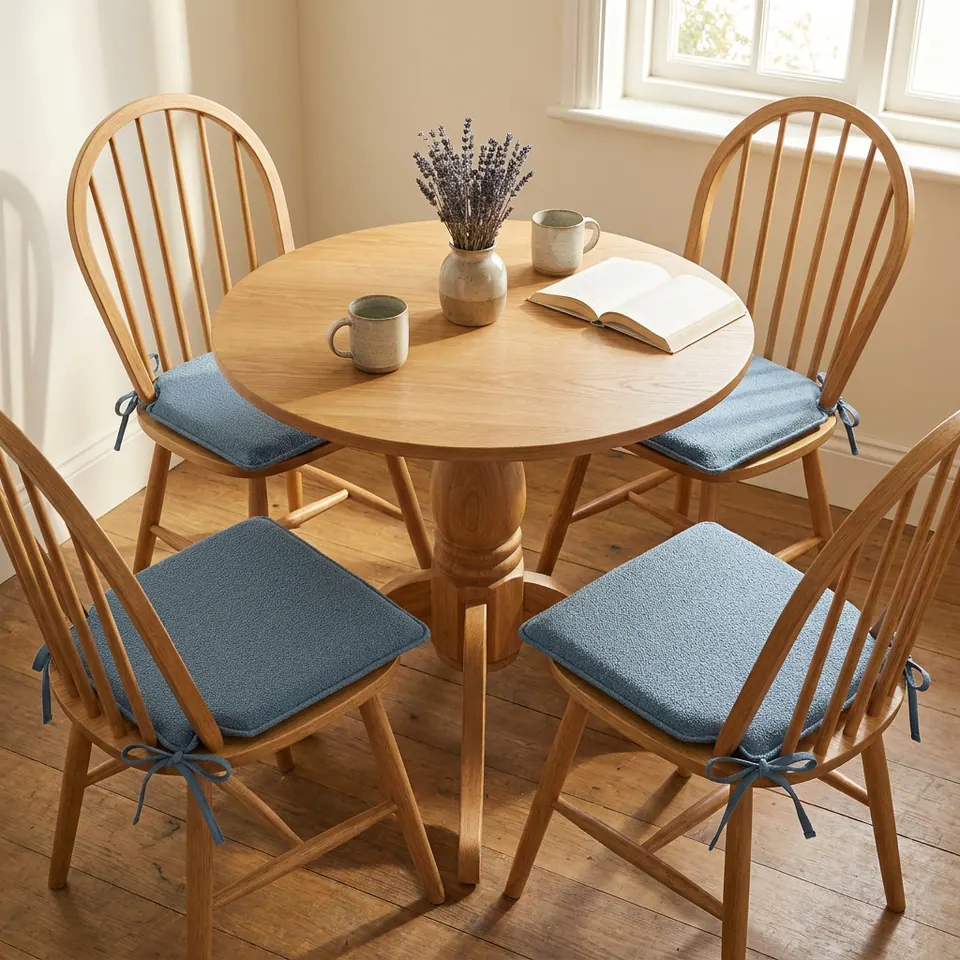
| Spindle-back or Windsor | Two ties | Back corners, around the outer spindles |
| Ladder-back | Two ties | Back corners, around the posts |
| Cross-back bistro | Two ties | Back corners, around the back posts |
| Metal café chair with a solid splat | Longer ties | Center of the back edge, around the splat |
| Backless stool | Four ties | One at each corner, knotted to the legs |
| Smooth seat, nothing to tie to | Non-slip base or liner | The whole underside of the pad |
A kitchen chair gives you two back posts for free. Tie to them before you buy anything to put underneath.
Maggie
Buyer questions
- A common question
Can you make custom dining chair cushions with ties that fasten to the chair back?
The workshop's answerYes. Chair pads are made to measure with ties at the back to secure them to the spindles or a ladder back, and on the dining chair cushion listing ties are an option you select at checkout. For shaped seats, send a photo of the chair and a diagram with every edge measured, plus the quantity and thickness you want.
- A common question
Will a non-slip bottom damage my wooden chairs, and can it cover just the middle?
The workshop's answerIt won't damage wood: it's a fabric backing, not an adhesive or rubber coating. It always covers the entire underside; a version with grip in the middle and a fabric border isn't possible. Once the cushion is in place you can't see it.
- A common question
Could you use velcro instead of ties to hold the cushion down?
The workshop's answerTies and a non-slip bottom are the standard fixes, and the workshop usually suggests one of those. Velcro tabs and snaps aren't made, but a two-sided strip has been added on request, one side sewn under the cushion and the matching side sent to you, at extra cost. Write it in the personalization box and wait for confirmation.
- A common question
Can I still machine wash a cover that has a non-slip bottom?
The workshop's answerYes, with the current material. The earlier backing made covers non-machine-washable, so the workshop sourced a washable non-slip fabric that keeps covers washable at 86°F (30°C). It has to arrive first, so the non-slip base adds time to the order.
- A common question
My cushion came out the wrong size. Will you remake it?
The workshop's answerSend a photo with a tape measure along the full dimension. In past cases where the workshop made the error, it remade only the pieces that didn't fit and didn't ask for the wrong one back.
Questions buyers ask next
How many ties does a kitchen chair pad need?
Two, at the back corners, for a chair with posts, spindles or a ladder back. A backless stool needs four, one at each corner, knotted to the legs. Ties are sewn in only on request, so name the count and positions in your order.
I forgot to order ties on my chair pads. Can they still be added?
Message the shop before production. Ties and the non-slip base are small flat add-ons, and when a buyer forgets them the workshop sends a separate payment link for the add-on. Then check the pre-shipment photo to make sure they're sewn on.
How long does rubber shelf liner keep gripping under a chair pad?
Not forever. Rubber rug underlay and rubber shelf liner lose their grip as they age, and a worn piece is replaced rather than repaired. PVC or silicone mesh does the same job, and all of them grip best on smooth wood, stone and metal seats.
Can a non-slip base go on a covers-only order?
Yes. It can be added to a covers-only order and to fabrics such as corduroy or linen, and you can choose it for some cushions in a set and not others. If you change your mind, it can come off the order before production.