A Reading by MaggieDining Chair Cushions & Pads
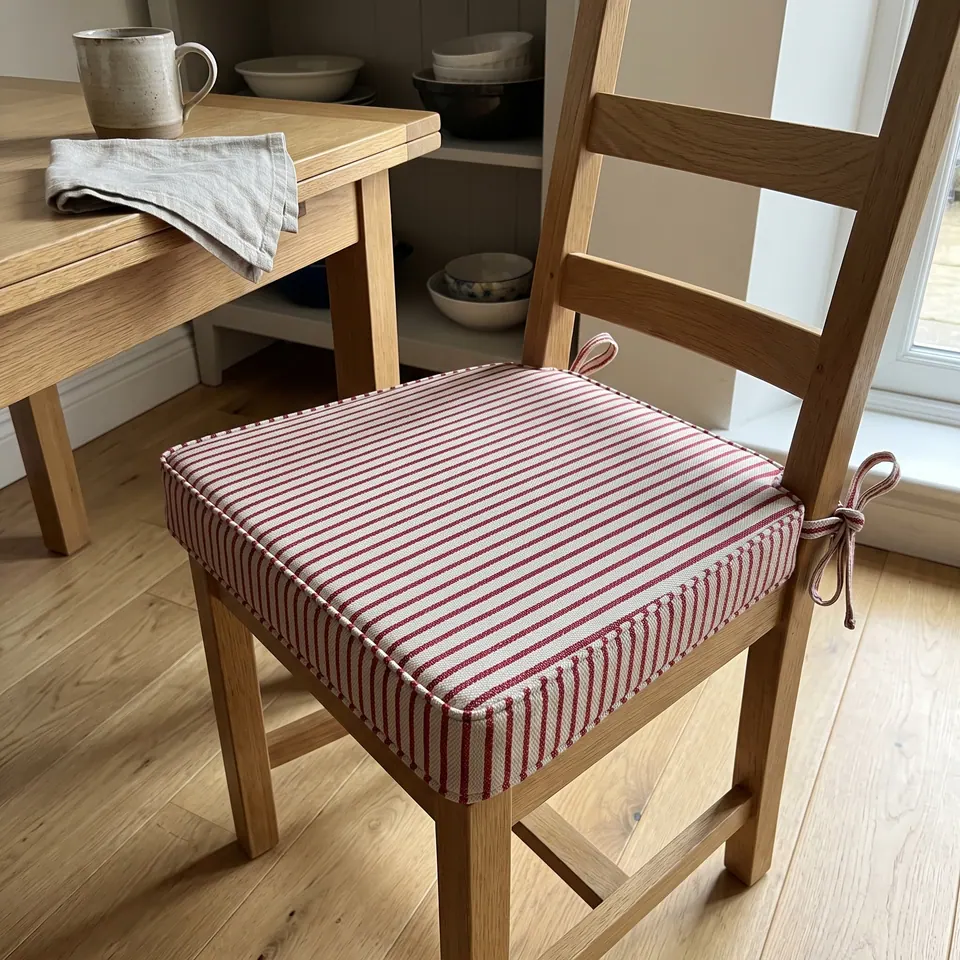
A rust-striped chair cushion with ties, built for the second cup of tea
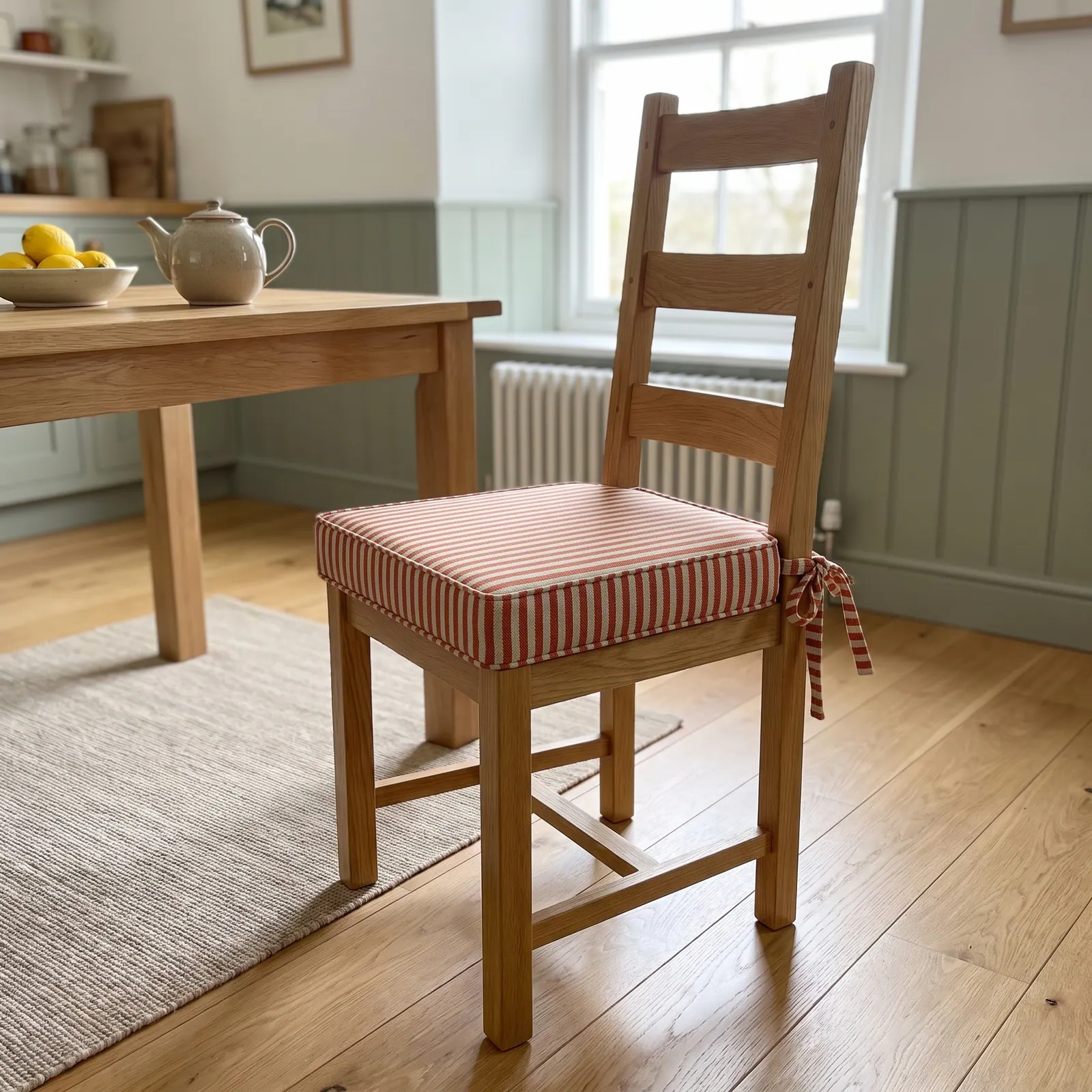
An oak ladder-back, a sage-paneled wall and a boxed pad that has to outlast a crossword. I take it apart seam by seam, because comfort on a kitchen chair is built, not bought.

 Save
The quick answer
A chair cushion with ties stays comfortable through long sitting when it has a box edge, is cut to the seat itself, and is tied at the back legs so it cannot creep forward. Send a photo of the chair with the seat measured, because ties and thickness depend on the frame: one armchair took 5 in (13 cm) on a 21.5 in (55 cm) seat.
The 5 in tie-on pad, cut open
Striped cotton cover. Rust and white stripe on the top and the side band, cut so the stripes run front to back on every chair. The cover unzips for washing.
Self piping. Cut from the same stripe, so the edge follows the pattern instead of drawing a new line around it.
Fiber wrap. Polyester batting around the foam. It fills the cover out and softens the front edge, where the backs of your knees rest.
Foam core. 5 in (13 cm) on a 21.5 in (55 cm) seat, as one buyer ordered for an armchair. On a kitchen chair, check the table clearance before going this thick.
Zipper. On the back band, facing the chair back, so nobody at the table ever sees it.
Base panel and ties. A plain underside. The ties are sewn into the back seam at each corner and knotted around the back posts.
Why the first cup never tests a chair pad
The first cup of tea never tests a chair pad. The second one does.
This chair cushion with ties sits on an oak ladder-back in a cottage kitchen, built the way a long-sitting pad should be. A box edge, a straight side band between top and bottom, keeps the foam's shoulders square. A domed pad tips you forward; a banded one holds you still.
The welt is self piping cut from the same rust and white stripe. A straight welt is a kind of honesty, and this one runs true along the front, where the backs of your knees find any wobble.
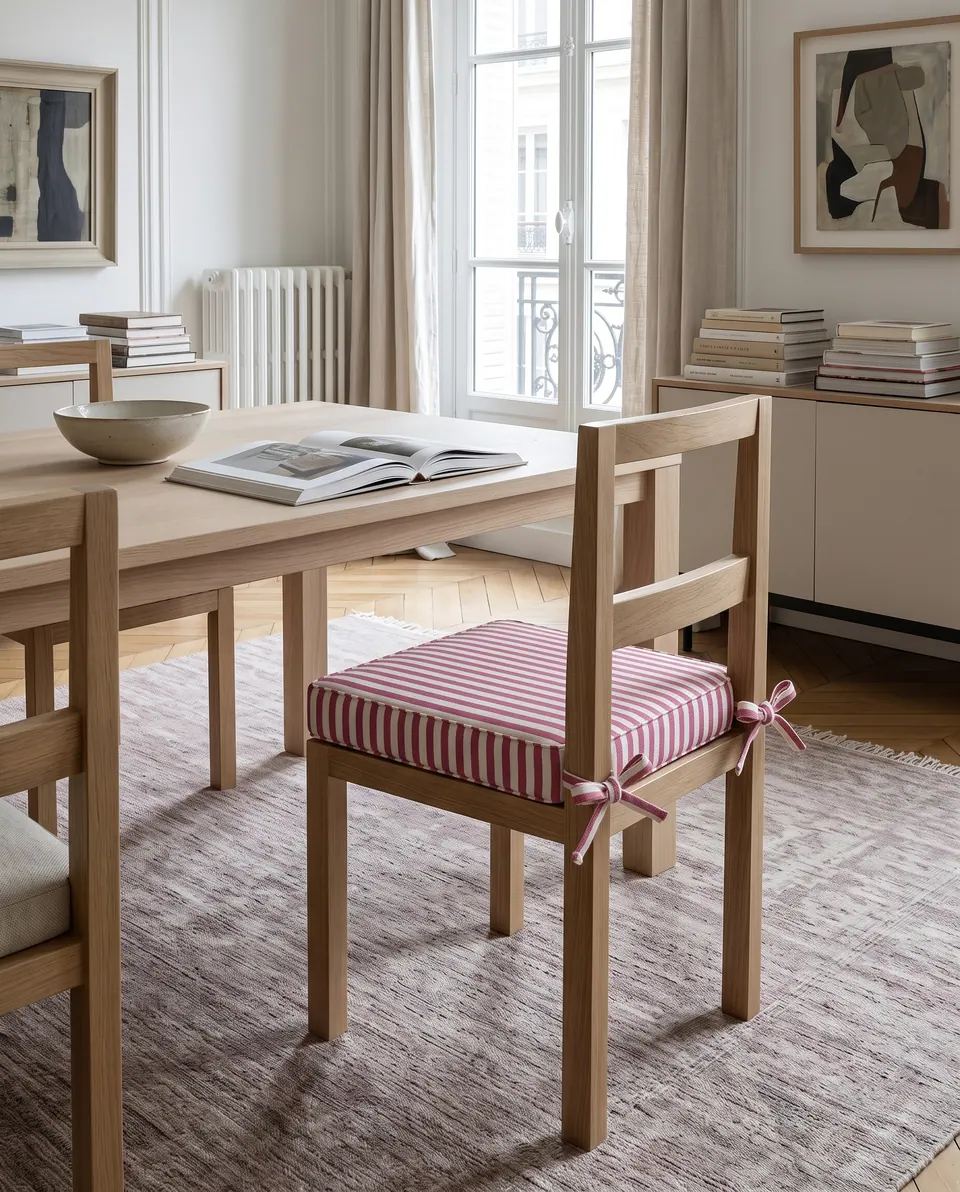
The stripes run front to back on every chair, leading the eye to the table. The ties, cut from the stripe and left long, hang from the back posts like ribbon. Knotted at the back legs, they stop the slow forward creep that ends most long breakfasts on the edge of the seat.
Measure your own seats with the chair pad Pattern: most land between 16 and 20 in (41 and 51 cm) each way.
Pinned by Maggie: five things on the table
Five pins, from the ribbon ties at the back post to the sage boards behind the teapot.
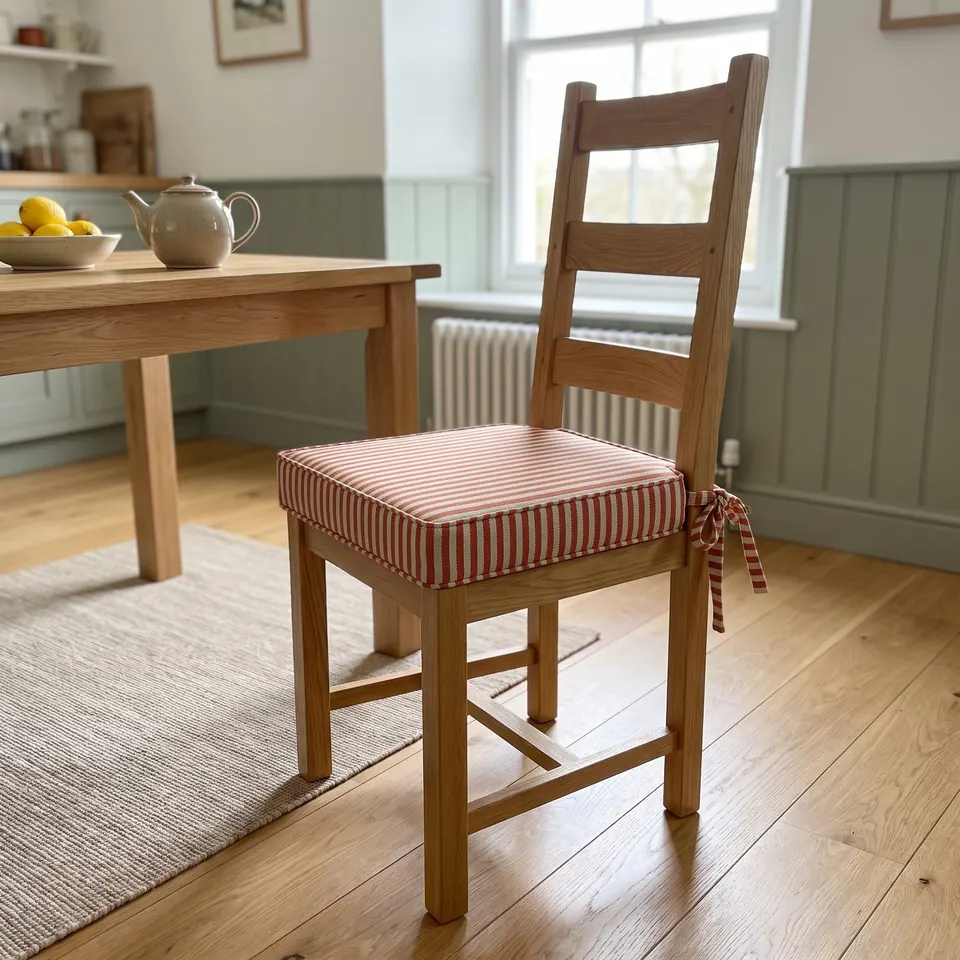
- Striped tie ribbons
Ties cut from the same stripe are left long so they hang like ribbon.
- Rust stripe top
Warm rust against cool sage makes both colors look richer.
- Cream teapot
A pale teapot repeats the white of the stripe on the table.
- Bowl of lemons
Lemon yellow sits neatly between the rust and the oak.
- Sage paneling
Painted tongue-and-groove is the cool backdrop the rust was chosen against.
- Striped tie ribbonsTies cut from the same stripe are left long so they hang like ribbon.
- Rust stripe topWarm rust against cool sage makes both colors look richer.
- Cream teapotA pale teapot repeats the white of the stripe on the table.
- Bowl of lemonsLemon yellow sits neatly between the rust and the oak.
- Sage panelingPainted tongue-and-groove is the cool backdrop the rust was chosen against.
Rust against sage, and why the lemons are there
The paneling came first. Sage tongue-and-groove is a cool gray-green, and rust sits nearly opposite it on the color wheel, so each makes the other look deeper. Soft light from the sash window keeps the pair calm.
Every prop has a job:
- Cream teapot: repeats the white of the stripe on the table.
- Bowl of lemons: the bridge, a yellow between the rust and the oak.
- Oak table and floorboards: neutral ground, so one stripe carries all the color.
- Cast-iron radiator: old house, warm room.
- Gray woven rug: softens the floor and cools the wood.
- Framed picture over the shelf: lifts the eye above the chair back.
Painted paneling at home? Pick a stripe from across the wheel. Our striped cottons stain more easily than a performance weave, so near a teapot the zippered cover earns its keep. What color are your kitchen walls?
The armchair that needed 5 inches
A buyer wrote in about an armchair that needed a seat pad with back ties, about 5 in (13 cm) thick on a 21.5 in (55 cm) seat base. Before anything was cut, they sent a photo of the chair.
The workshop replied with close-ups of smoke, beige, brown and mint linen plus a swatch card, and confirmed that the product photo's color sat between beige and smoke. Nobody guessed.
Ties and thickness depend on the frame, so send the chair, not just the numbers. On a kitchen chair, check table clearance and leave 10 to 12 in (25 to 30 cm) from the top of the pad to the tabletop.
- Sizes
- Seat base 21.5 in (55 cm); pad about 5 in (13 cm) thick, with back ties
- Fabric
- Linen, with smoke, beige, brown and mint considered
The lesson: Send a photo of the chair with the seat measured; ties and thickness depend on the frame.
On the cutting table: the rust stripe pad
| Cushion | Boxed dining chair pad with ties |
|---|---|
| Fabric | Rust and white striped cotton, front to back |
| Piping | Self piping from the same stripe |
| Fastening | Long ties in the stripe, knotted at the back posts |
| Zipper | Back band, facing the chair back |
| Thickness | Chosen from the frame, 10 to 12 in (25 to 30 cm) below the tabletop |
| Care | Zippered cover; blot spills early on cotton |
| Best for | Kitchen nooks where people linger |

Have it made
Have this made — ask Maggie’s workshop
Numbers first, fabric second, piping last. Jot down what you have, and the workshop will go down the list with you, item by item. — Maggie
Leave your details and the workshop will call you to confirm measurements, fabric, foam and piping. No prices, dates or payment on this page: it is a request, not an order.
Buyer questions: backs, a Barcelona chair and bar stools
- A common question
Does a swing cushion order include the back cushions, and is one long backrest cheaper than several short ones?
The workshop's answerThe outdoor bench cushion is the seat only; backs are quoted separately. For a swing about 71.5 in (182 cm) long, four backs about 18 in (45.5 cm) wide and 21.5 in (55 cm) tall cost the same as one full-length backrest, foam included.
- A common question
Can you make seat and back cushions for a Barcelona-style chair?
The workshop's answerYes, on request. Its intricate design makes it a more expensive model that isn't on the menu, so send reference photos, your fabric choice and exact measurements for a custom quote on the seat and backrest.
- A common question
Besides benches, do you make bar stool pads, chair cushions or throw pillows?
The workshop's answerYes, all made to order. Send the sizes and the workshop quotes them; one buyer had two chair cushions made at about 19.25 x 18.5 in (49 x 47 cm).
A chair cushion with ties should be knotted at the back legs. Back ties stop the slow forward creep that ends most long breakfasts on the front edge of the seat.
Maggie
Questions buyers ask next
How thick should a tie-on pad be on a kitchen chair?
Most dining chair pads are 2 to 2 1/2 in (5 to 6 cm) thick. Go thicker only on a deep seat or an armchair, and keep about 10 to 12 in (25 to 30 cm) between the top of the pad and the tabletop.
Why does a box edge feel better than a flat pad over a long breakfast?
A box edge has a side band between top and bottom, so the foam keeps square shoulders and a level top. A flat knife-edge pad domes in the middle and tips you forward over an hour at the table.
Can a striped cotton chair pad live with daily breakfast spills?
Yes, with a zippered cover. Striped cotton is an indoor fabric that stains more easily than a performance weave, so blot early and wash the cover at 86°F (30°C) at most on a gentle cycle, then air dry.
Stitch straight — Maggie
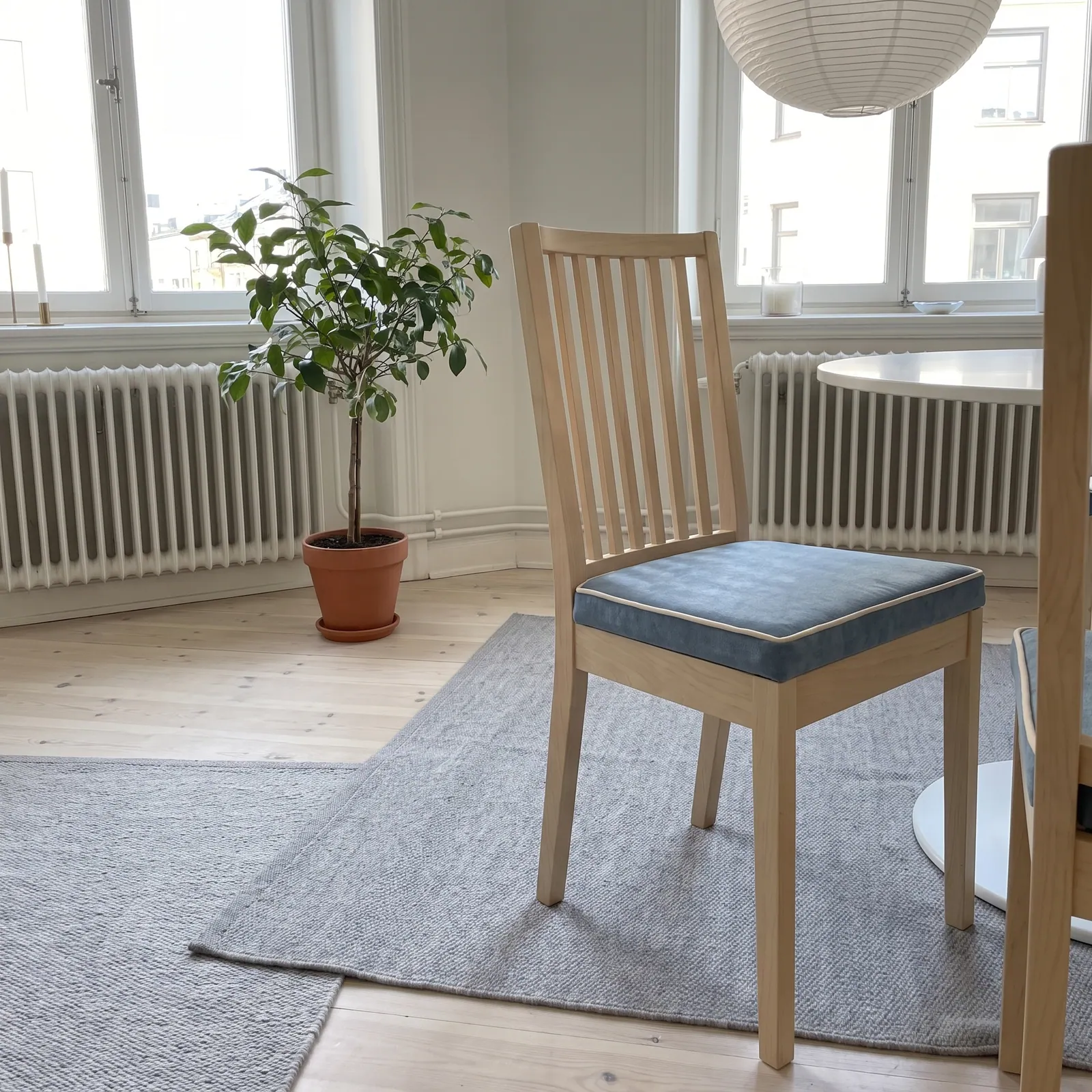
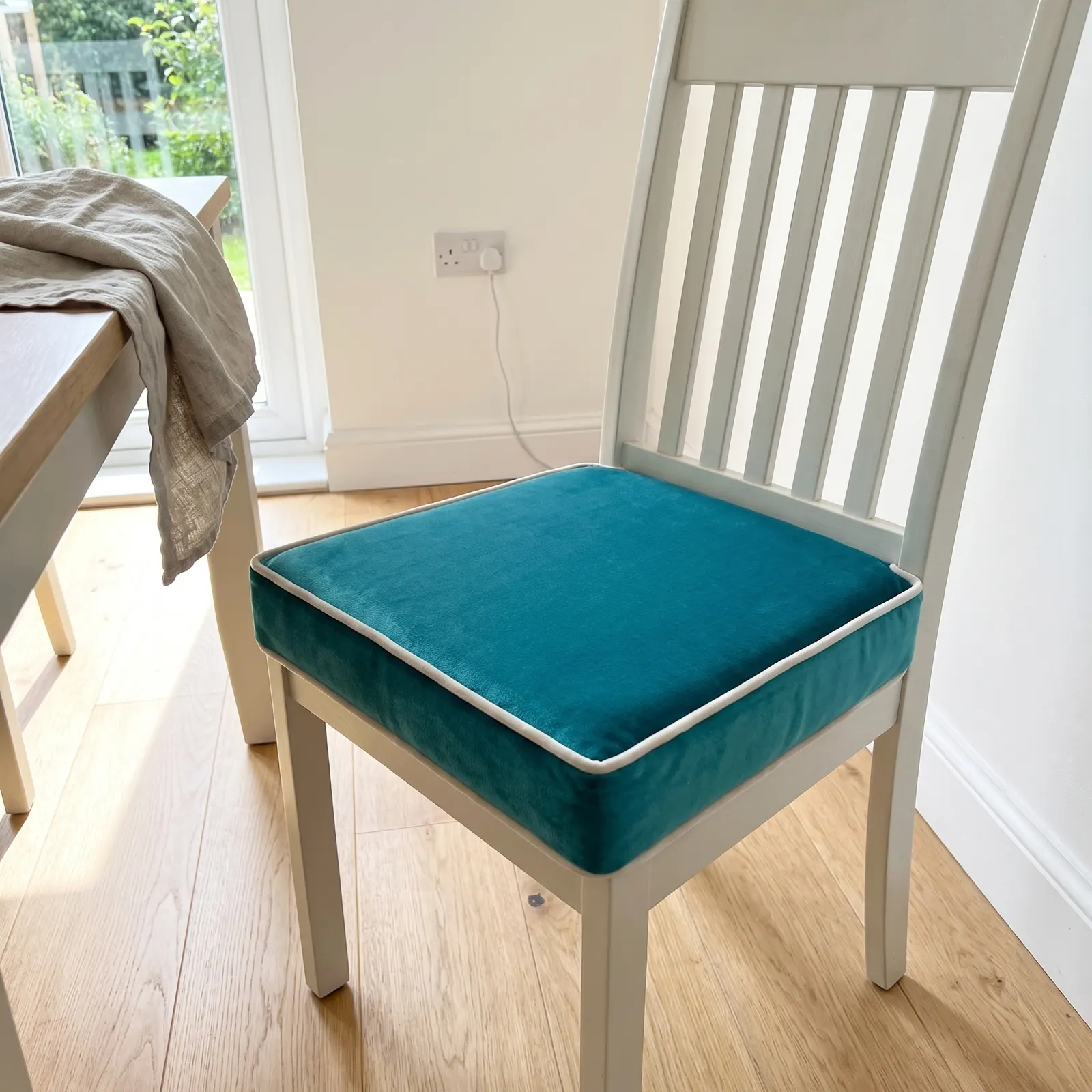
Seat pads on other chairs, in other light
 Save
 Save
 Save
 Save
 Save
 Save