 Save
A Reading by MaggieDining Chair Cushions & Pads
A red pencil-stripe chair cushion, and the quiet way to mix kitchen pattern
A thin red stripe, a gray linen napkin, speckled stoneware. Three textures in one kitchen, and not a cross word between them. Here's why.
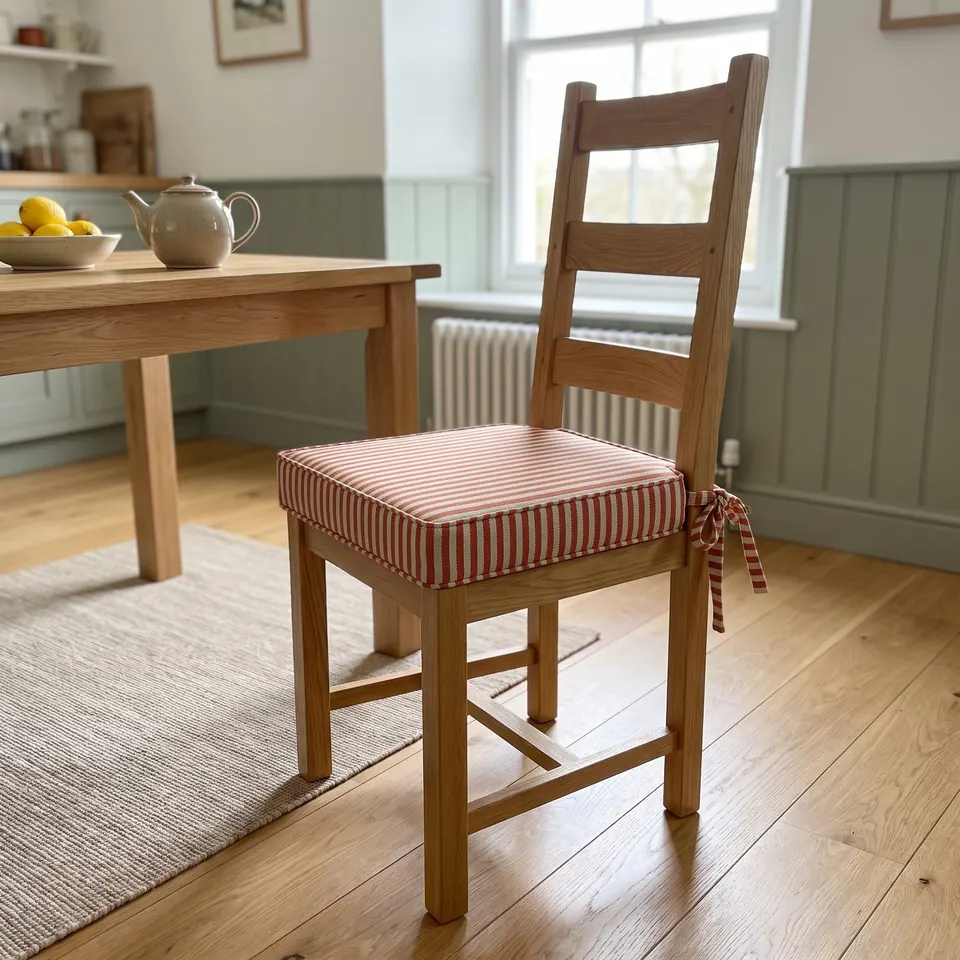
Fine red lines and a self-piped edge give the look of classic ticking on a thick, comfortable pad.

The quick answer
A striped chair cushion with ties mixes well with other patterns when the stripe is thin, the piping matches it, and everything around it is plain texture: linen, stoneware, oak. Ties are an optional extra; piping is included in any color. Give separate codes for fabric and piping, because neighboring chart colors differ only in tone.
Reading the kitchen corner
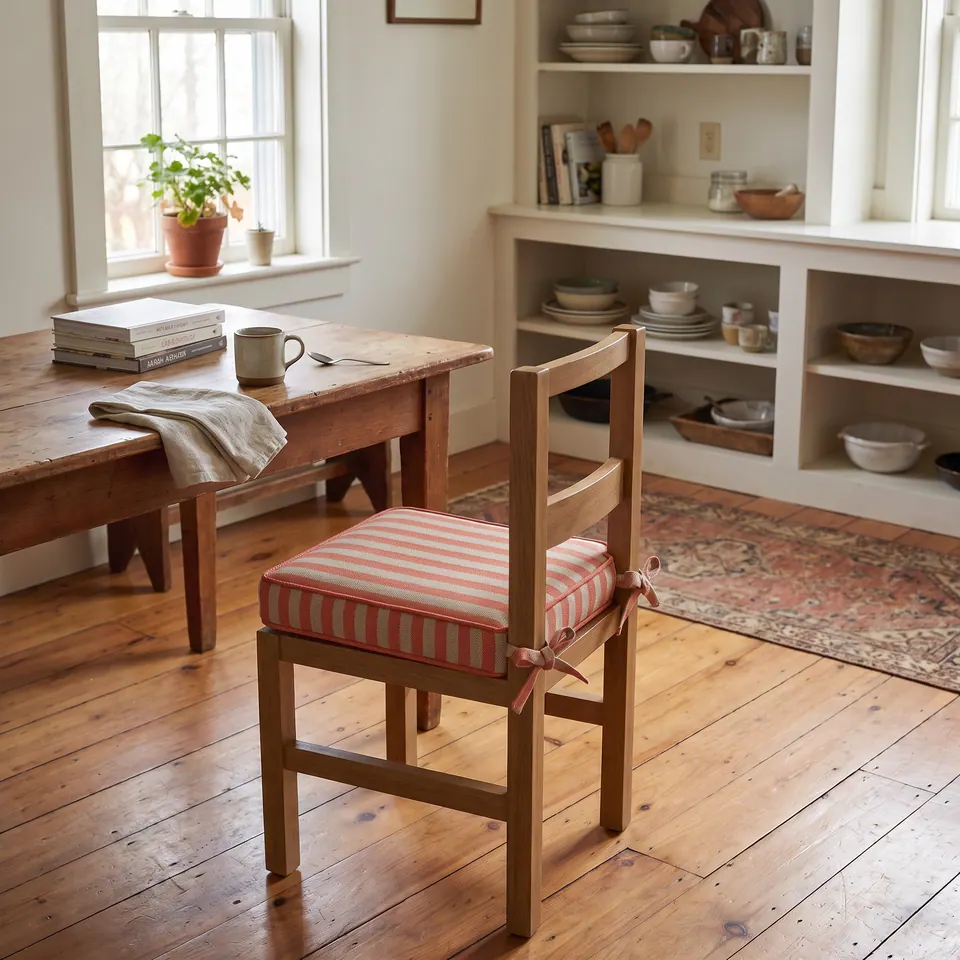
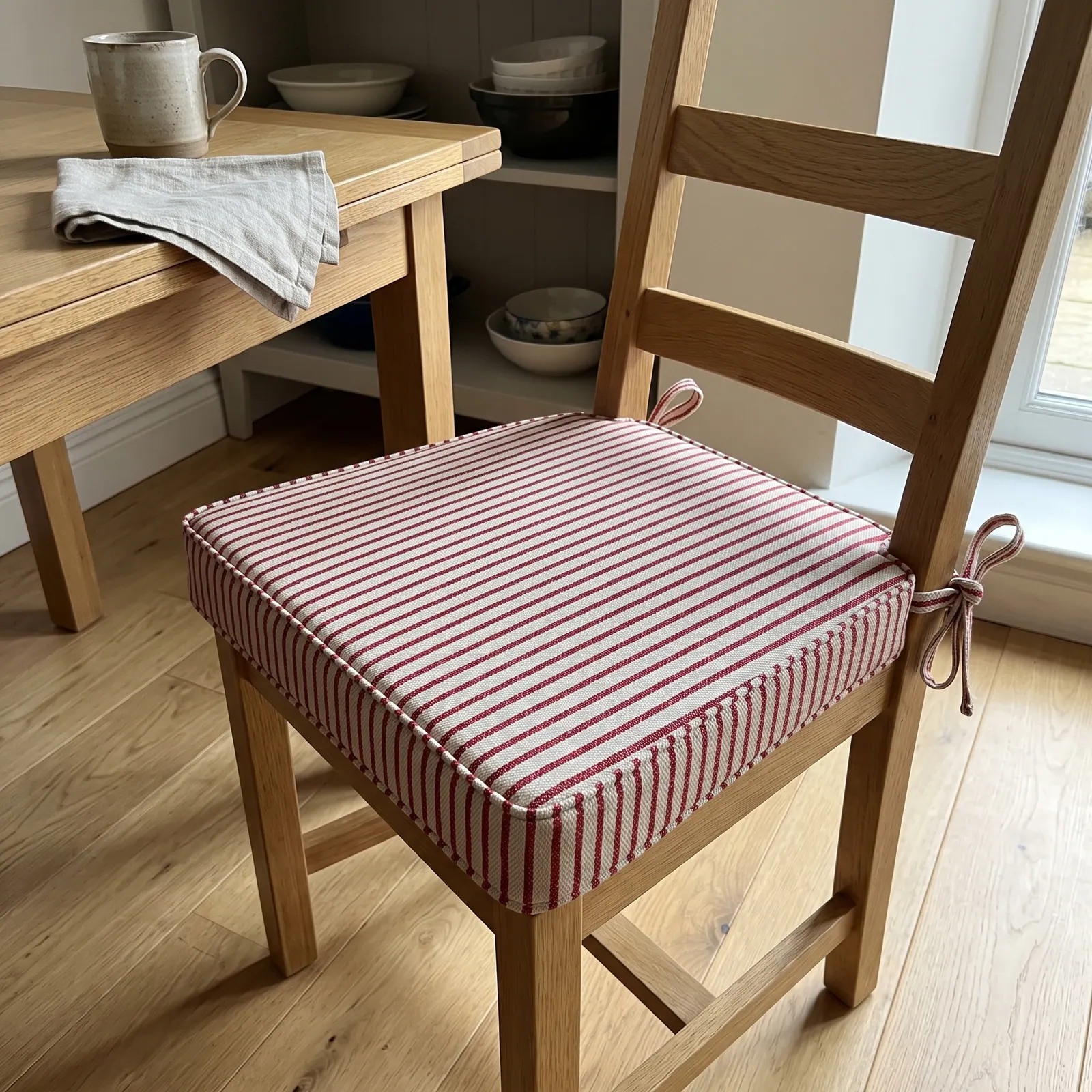
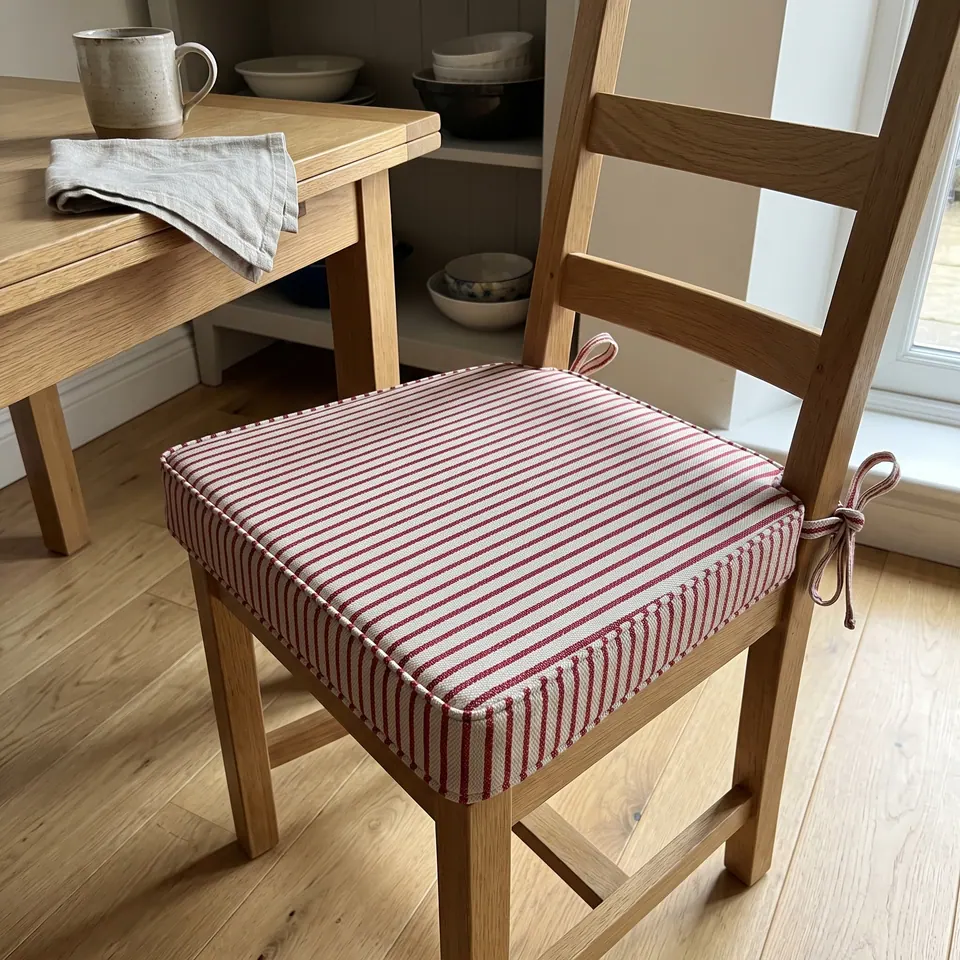
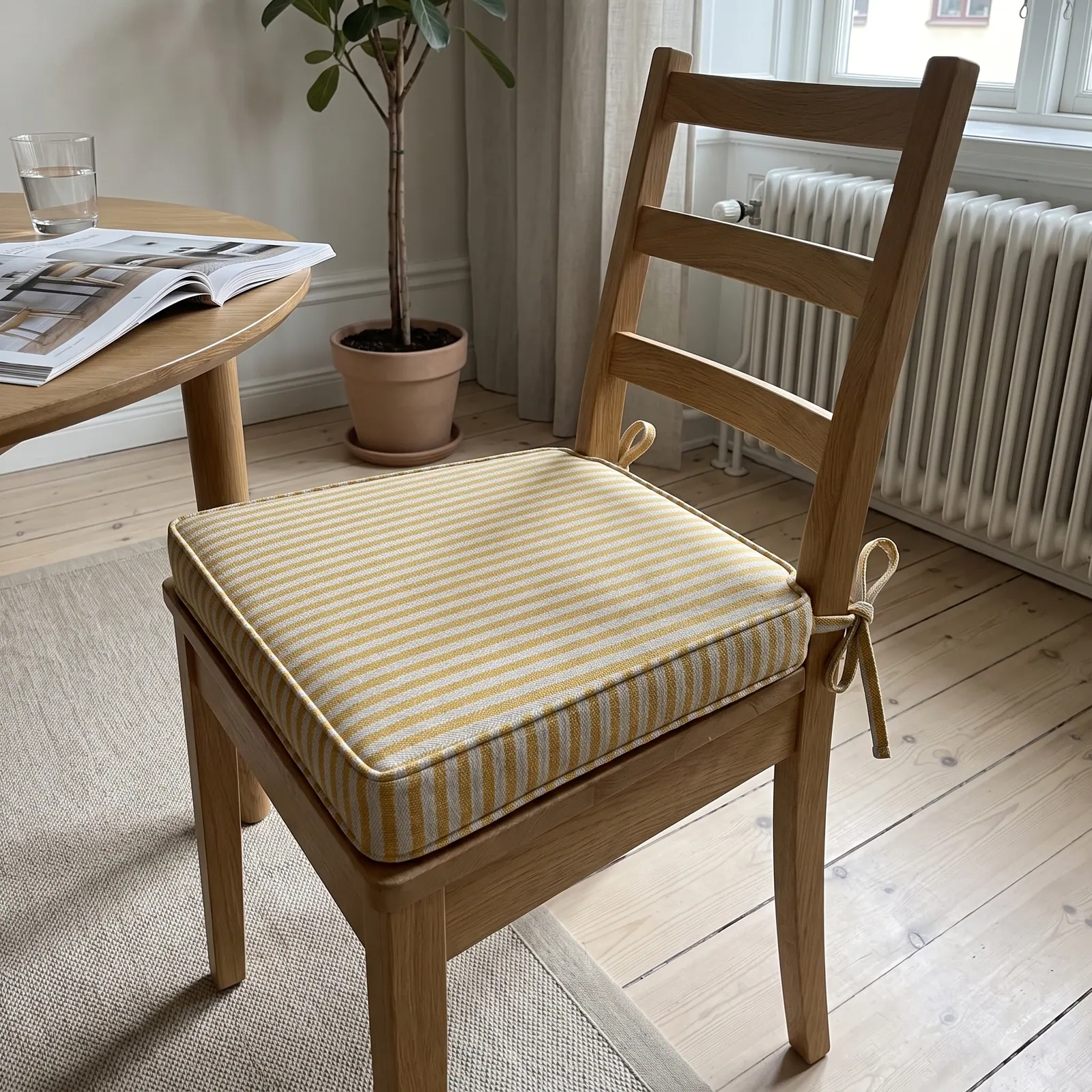
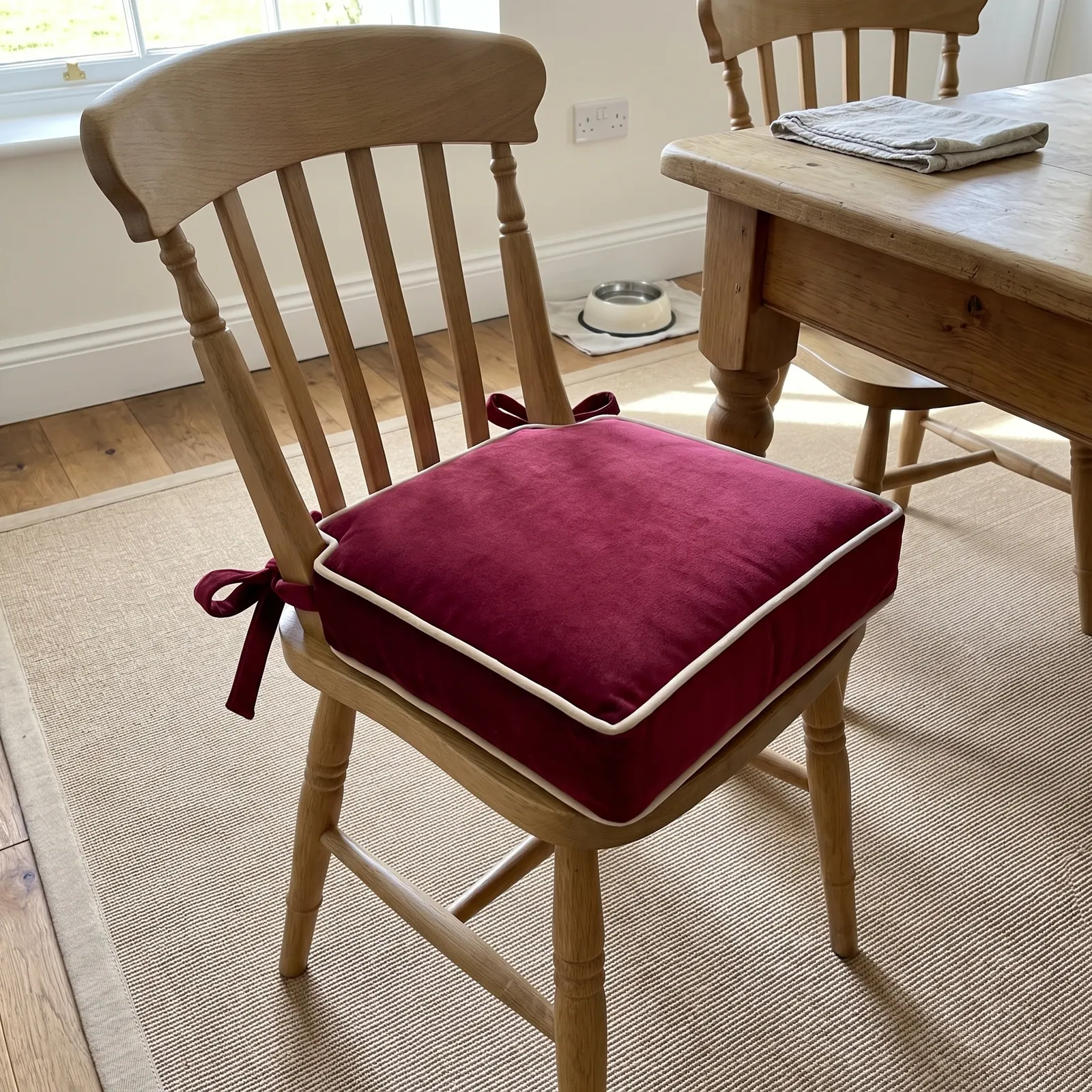
Fine red lines on cream, a boxed pad on an oak ladder-back, and a double bow knotted around the back post in the same stripe. That is the whole dining chair cushion, and it is very well behaved.
Look at the front corner. The pencil stripe runs the full depth of the seat and carries straight over the piped edge, so the box looks wrapped rather than assembled. The piping is cut from the stripe itself. A straight welt is a kind of honesty, and on a stripe any wobble shows at once.
The pad is generous, nearly as tall as the seat rail. On a solid country chair that looks right; on a spindly bistro chair it would look like a hat. The bow is the stripe again, not a contrast ribbon, so the tie reads as part of the cushion.
Five details, pinned
From the bow on the back post to the mug on the table.
- Bow tie on back post
A double bow in the stripe fabric holds the pad against the ladder-back post.
- Self-piped corner
The pencil stripe runs straight over the piped edge so the box looks neatly wrapped.
- Linen napkin
Crumpled gray linen adds softness next to the crisp stripe.
- Stoneware mug
A speckled mug keeps the kitchen mood without adding color.
- Dresser of bowls
Stacked crockery behind sets the country-kitchen scene.
- Bow tie on back postA double bow in the stripe fabric holds the pad against the ladder-back post.
- Self-piped cornerThe pencil stripe runs straight over the piped edge so the box looks neatly wrapped.
- Linen napkinCrumpled gray linen adds softness next to the crisp stripe.
- Stoneware mugA speckled mug keeps the kitchen mood without adding color.
- Dresser of bowlsStacked crockery behind sets the country-kitchen scene.
Three patterns, one rule: only one is loud
The stripe is the only pattern with color in it. Everything else is neutral texture: a crumpled gray linen napkin, a speckled stoneware mug, a dresser of stacked bowls, honey oak. Speckle and slub read as texture, not pattern, so they sit beside a stripe without competing.
That is the rule I give for any kitchen nook cushion or set of chair pads. One pattern with color; the rest plain or textured. Want a second pattern? Make it the same stripe at another scale, on the table linen, not the seat.
Two practical notes. The striped cottons and ticking are 100% cotton with the stripes woven in, so custom stripe colors are not possible, and spills want quicker attention than on a performance weave. And stripes are matched on one face only, so the top of the pad is the good side.
The sage that turned olive, and eight pads that came up short
A buyer messaged the workshop because her sage linen cushion read more olive in person, and the red piping was not the red she had pictured. She switched to new covers in a dark chart red.
Then she ordered eight covers for her own chair pads: slightly tapered, rounded at the front corners, 19¾ to 17¾ in (50 to 45 cm) across, 17 in (43 cm) deep, 1½ in (4 cm) thick, with bow ties. They came about ¾ in (2 cm) short each side, the piping looked one number off, and the ties were too short. The workshop remade them ½ to ¾ in larger with the right piping.
Every one of those problems was a missing sentence in the order note.
- Sizes
- Eight pads, 19¾ to 17¾ in wide, 17 in deep, 1½ in thick
- Fabric
- Sage linen, dark red piping
The lesson: For covers over existing foam, measure the bare insert, add ½ to ¾ in (1 to 2 cm) of ease, and put tie length and color in writing.
Three kitchen-table questions
- A common question
Can I buy just the ottoman, in the same color as my sofa?
The workshop's answerYes. The ottoman is sold on its own at 39 x 39 in (100 x 100 cm), and the workshop sets up a custom order in the matching color.
- A common question
Is piping included, and do ties and a non-slip bottom cost extra?
The workshop's answerPiping is included in any color at no extra charge. Ties and a non-slip bottom are optional extras. For a reversible cushion, leave the non-slip bottom off.
- A common question
How do I measure a spindle-back chair seat so the pad fits exactly?
The workshop's answerTake six numbers. Across: back width at the spindles, widest point, front. Front to back: depth at left, center and right. One set read 14½, 17 and 14 in across; 14½, 15½ and 13½ in deep.
On a striped chair cushion, piping cut from the same stripe makes the box edge look wrapped, and any wobble in the seam shows at once.
Maggie
Cut sheet for the chair pad
| Cushion | Dining chair pad with ties, box edge |
|---|---|
| Fabric | Red and cream pencil stripe, 100% cotton |
| Piping | Self piping cut from the stripe |
| Ties | Double bow at the back posts; optional extra |
| Shape | Follows the seat; six measurements |
| Thickness | 2, 3, 4 or 5 in (5 to 12.5 cm) standard |
| Care | 86°F (30°C) gentle wash, air dry |
| Best for | Ladder-back and spindle-back kitchen chairs |

Have it made
Have this made — ask Maggie’s workshop
Have the tape measure handy when they call. Old cushions shrink and sag; the seat underneath does not. — Maggie
Leave your details and the workshop will call you to confirm measurements, fabric, foam and piping. No prices, dates or payment on this page: it is a request, not an order.
Questions buyers ask next
Are the stripes matched on every side of a chair pad?
Stripes are matched on one face only, so the top of the pad is the good side. On longer cushions they run front to back by default, since the roll is about 55 in (140 cm) wide.
Can the stripe colors on a chair pad be customized?
No. The stripes are woven into the cloth, so custom color combinations are not possible. Stripe widths on the charts run from about ¼ in (0.7 cm) to about 2¼ in (5 to 6 cm).
What pairs well with a striped seat cushion in a kitchen?
Plain, textured things: linen napkins, speckled stoneware, honey oak, a woven rug. Speckle and slub count as texture, so they never argue with a stripe.
Stitch straight — Maggie
Chair pads in stripes, velvet and ticking
 Save
 Save
 Save
 Save
 Save
 Save