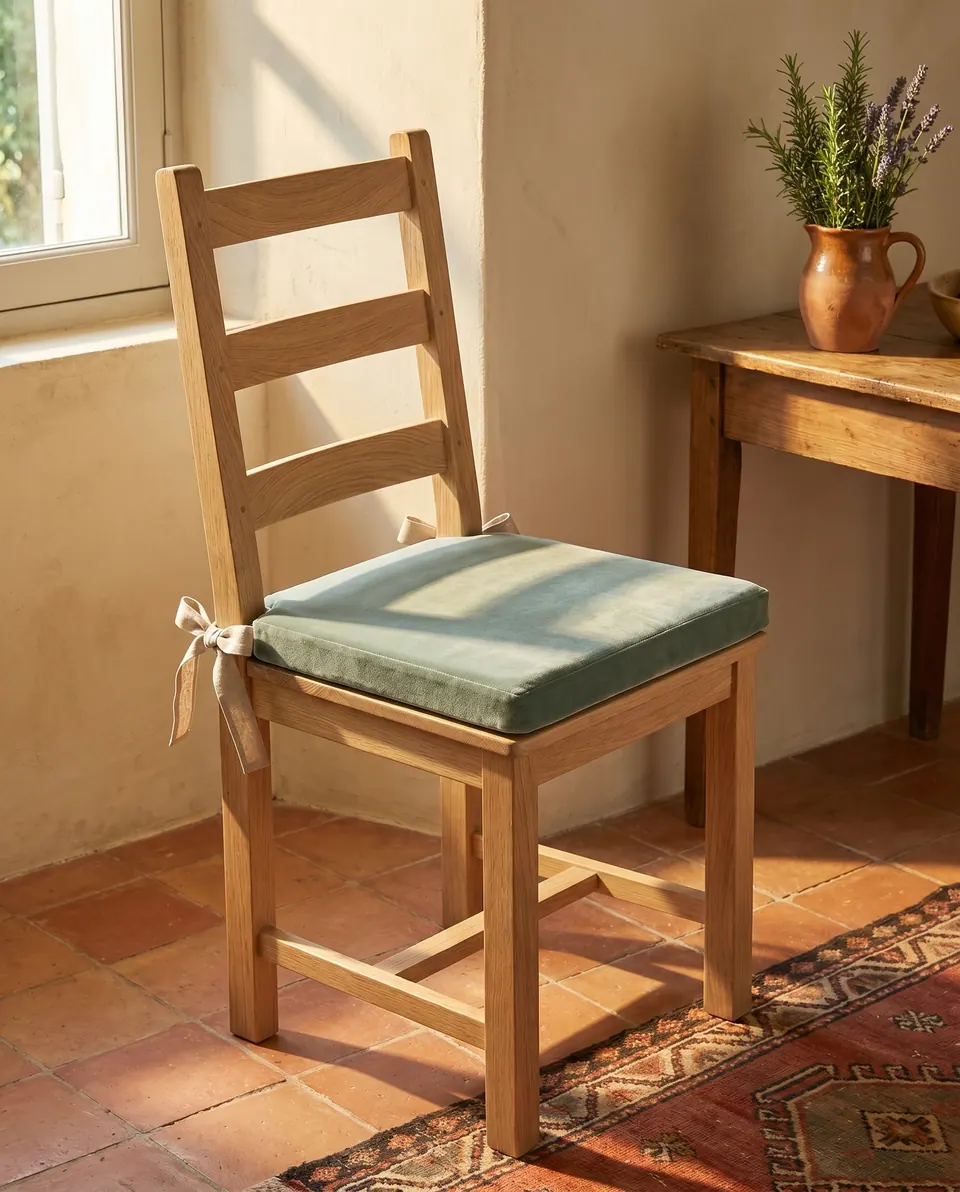
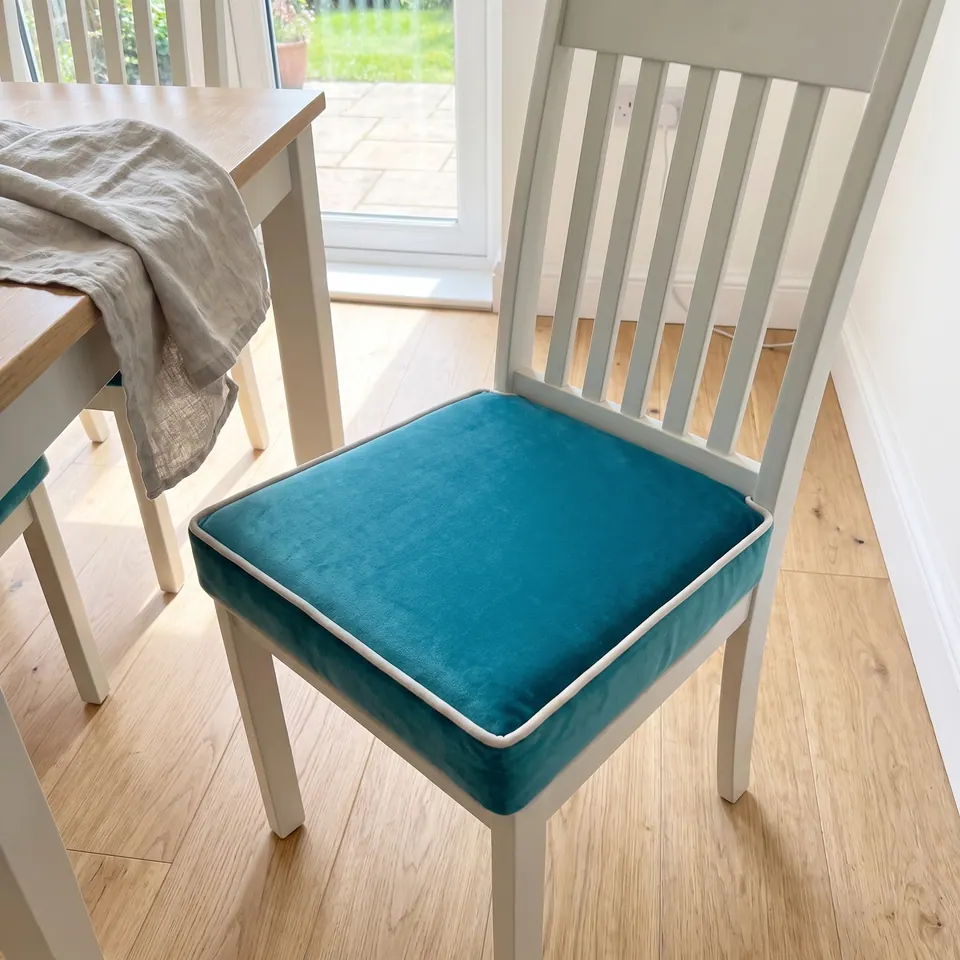
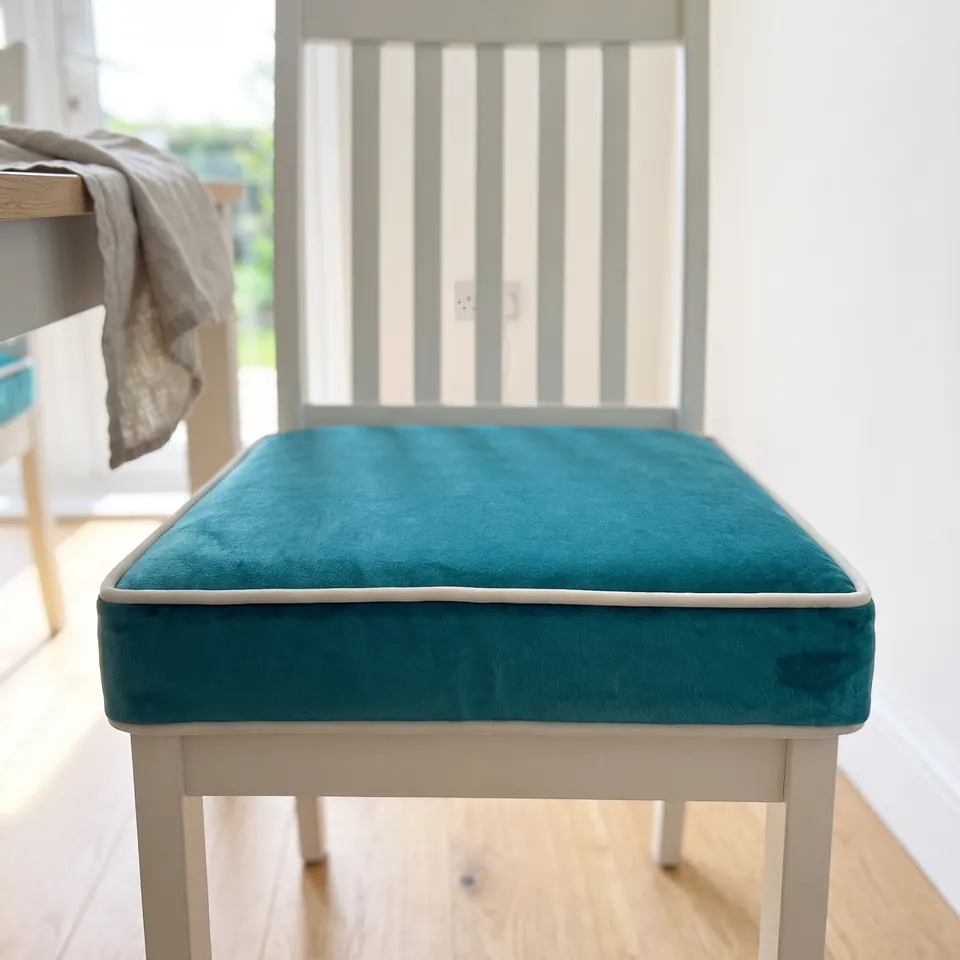
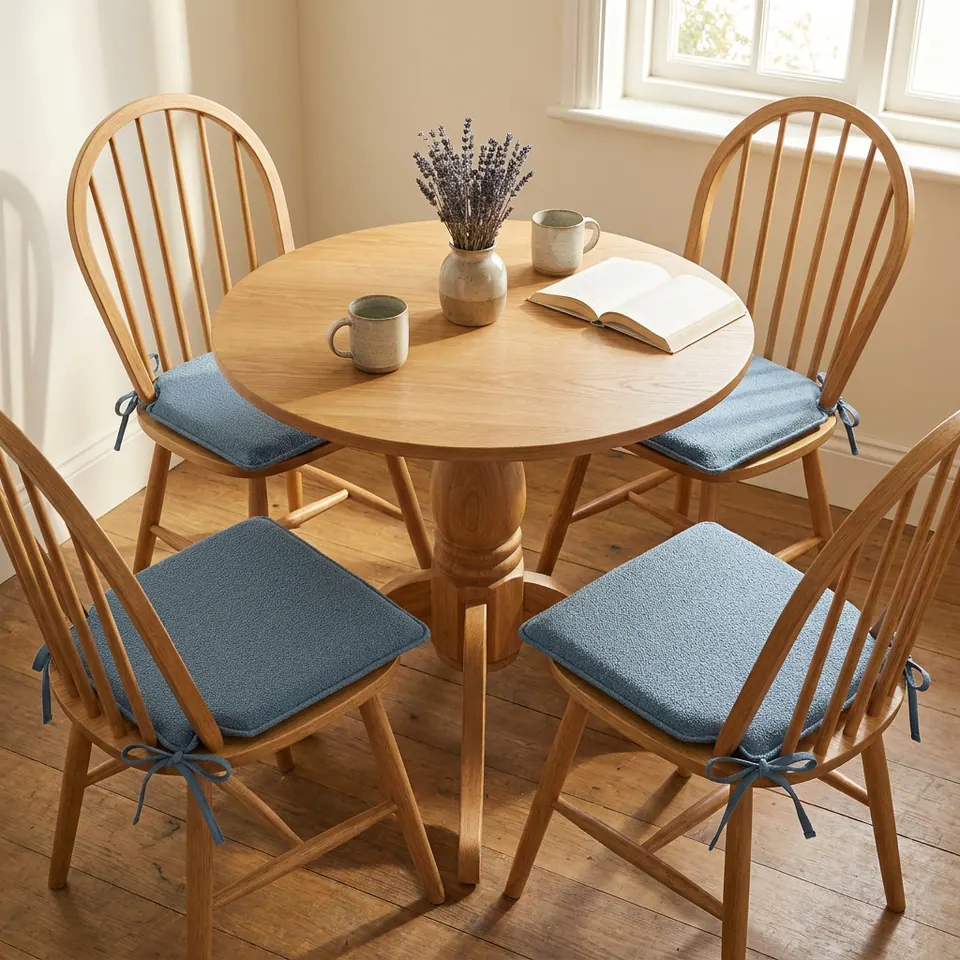
Concept Sketches · 8 scenes
Trapezoid chair cushions: dining pads for seats wider at the front
Most dining chairs are trapezoids pretending to be squares, and a square pad gives the game away at the back corners. Eight sets from past orders, each with the one measurement that decided the fit.

 Save
The quick answer
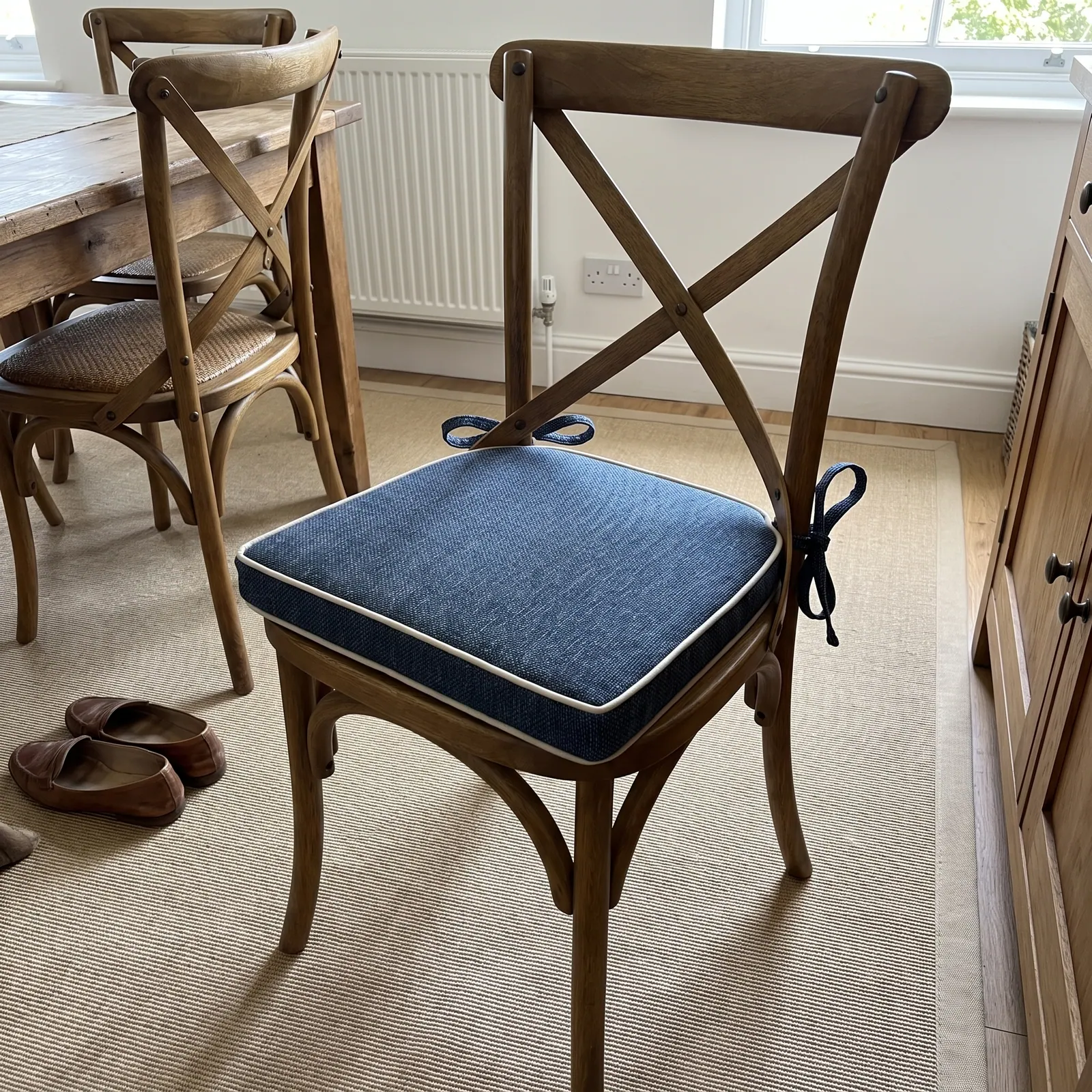
A trapezoid chair cushion is a dining chair pad cut wider at the front than the back, made from your seat's own edges instead of one width and one depth. Measure the front, back, left and right edges separately and run the depth to the seat's front edge. One set of six ran 18 in (46 cm) front, 16 in (41 cm) back, 17 in (43 cm) deep.
A square pad on a tapered seat shows at the corners
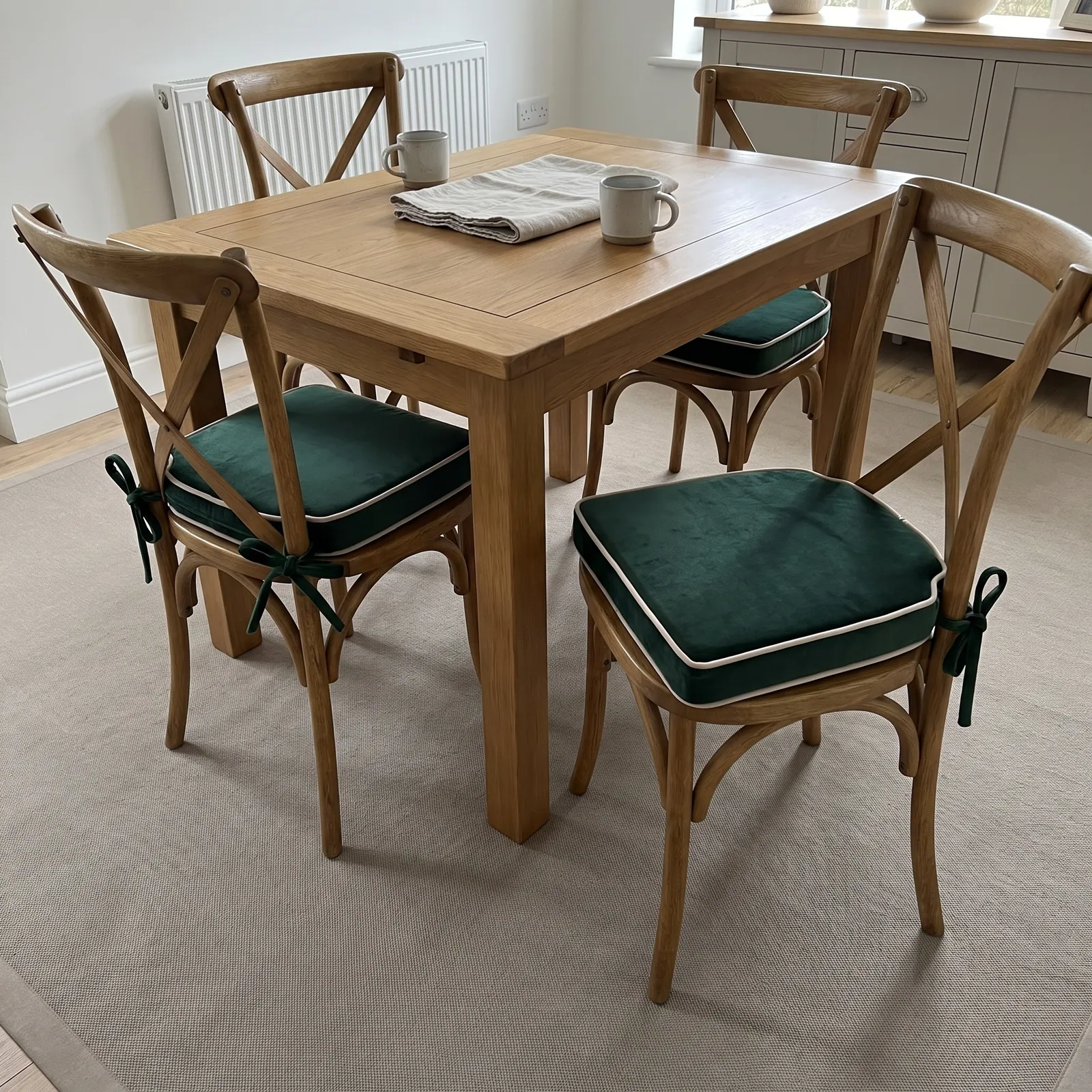
Lay a tape across the front of a dining chair seat, then across the back. On most chairs the two numbers disagree; in the sets below, by 2 to 3.75 in (5 to 9.5 cm). A square pad on a seat like that hangs past the back corners and leaves bare wood at the front.
A trapezoid chair cushion is a pad cut to the seat you own: wider at the front, narrower at the back, sometimes a hair different left to right. Early on I cut a set of kitchen pads from one tidy width and one tidy depth, and the back corners told on me for years. Right, then.
Here are real sets of four, six and eight chairs, in velvet, linen-look weaves and one tufted solid. Plain rectangles live under dining chair cushions, and breakfast-table seats also sit with kitchen nook cushions. What does your chair measure across the front, and across the back?
Eight dining sets and the number that decided each fit
01A past project
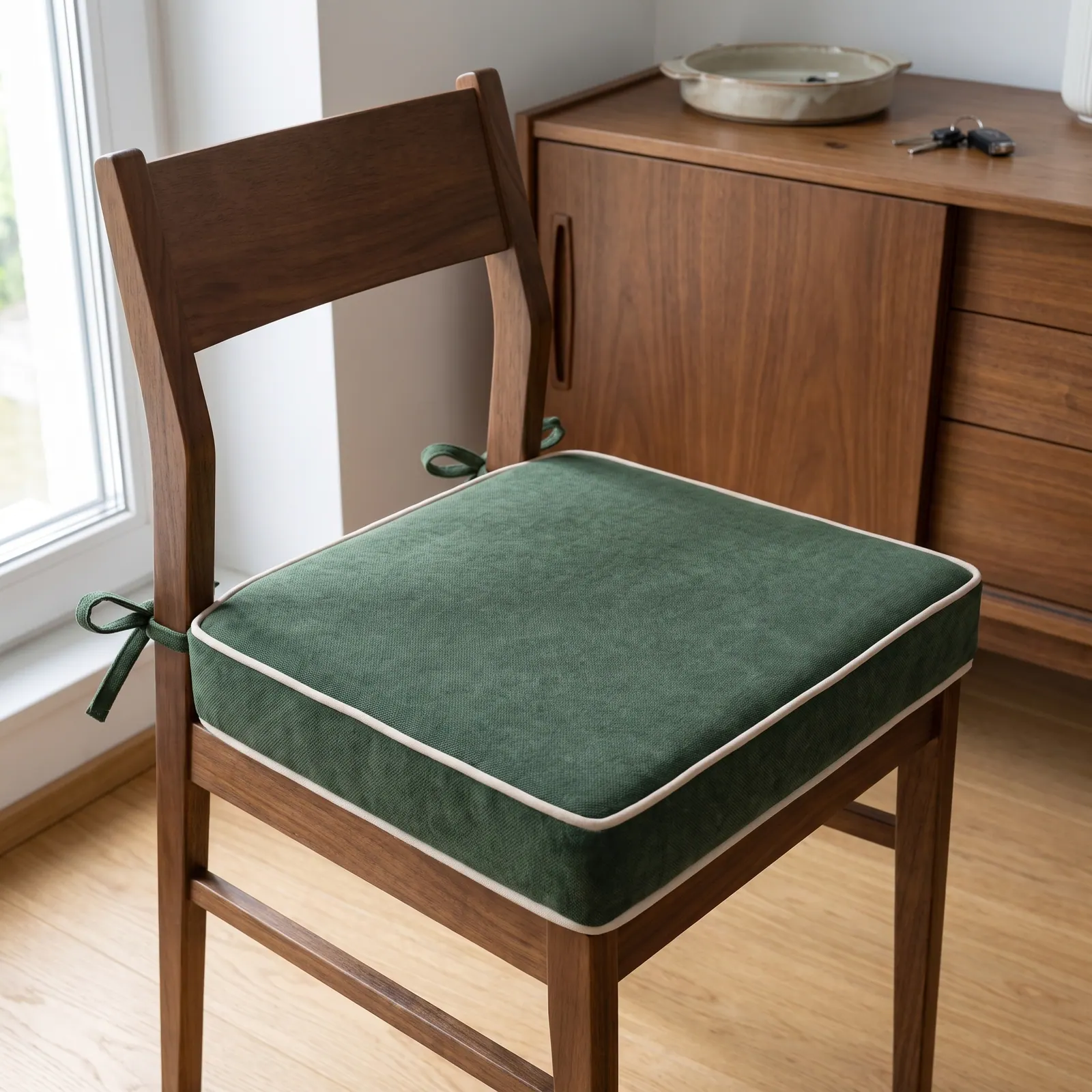
Six brown velvet chair pads with a 2 in taper
A buyer in the US measured six trapezoid seats: 18 in (46 cm) front, 16 in (41 cm) back, 17 in (43 cm) deep. The order form took one photo, so three measurement shots were merged into a single image and sent by message too. The set went out in brown velvet with cream piping and cream ties.
The takeaway: With one upload slot, merge the measurement photos into one image.
02A past project
Four kitchen chairs and an olive that read lime
A buyer wrote in about four kitchen chairs, 15 in (38 cm) at the back and 18.75 in (48 cm) at the front, pads 3 in (7.6 cm) thick, worried a zipper would fight the shape. Firm foam holds the trapezoid, the workshop said, and the zipper is sized for easy removal. It also warned that one olive on the shortlist looks yellow-lime under white light.
The takeaway: Judge greens under your own kitchen bulbs before committing a whole set.
03A past project
A 21 in front edge and a depth that stopped short
A buyer in the US asked for a pad 19 in (48 cm) deep, 21 in (53 cm) across the front and 19 to 20 in (48 to 51 cm) across the back. The three tape-measure photos showed that 19 in would leave a gap at the front, so the workshop asked before cutting, and the pad was made flush with the front edge.
The takeaway: Measure depth to the seat's front edge, not to where the old pad stopped.
04A past project
Spindle-back chairs: three widths, three depths
For a buyer in the US with spindle-back chairs, the workshop drew three lines across and three down a photo of the seat. The widths came back 14.5, 17 and 14 in (37, 43 and 36 cm) at the spindles, the widest point and the front; the depths 14.5, 15.5 and 13.5 in (37, 39 and 34 cm) at left, center and right. Six numbers, one accurate pad.
The takeaway: A seat that swells at the sides needs three widths and three depths.
05A past project
Eight chairs, one arch instead of two notches
One buyer wrote in about eight chairs whose back supports cut deep into the seat. Notches can't be fitted reliably from a distance, so the workshop proposed an arched back and caught a 1 in (2.5 cm) depth error in the drawing. The approved pad: 20 x 18.25 in (51 x 46 cm), 13.5 in (34 cm) straight sides, a 5 in (13 cm) arc, ties inset 4.5 in (11 cm), a non-slip base, 2 in (5 cm) thick.
The takeaway: Swap hard notches for an arch, and approve the diagram before cutting.
06A past project
Four curved-side chair pads and a bench to match
A buyer in the US wanted five tufted cushions in dark green-gray, no piping: four chairs at 15.5 in (39 cm) back, 18.5 in (47 cm) front and 17.25 in (44 cm) slightly curved sides, plus a 15.75 x 59.875 in (40 x 152 cm) bench. Chair ties went at cut-outs in the back, the bench took 20 in (51 cm) ties at each corner, and the workshop asked for a detailed drawing before quoting.
The takeaway: Draw the curves and mark every tie; numbers alone show neither.
07A past project
A new cover for an old tapered pad
A buyer in the US wanted a cover only for a tapered pad 17 in (43 cm) at the back, 19 in (48 cm) at the front, 19 in (48 cm) deep and 3.5 in (9 cm) thick. The workshop asked for a fresh measurement and a photo before quoting, and the buyer kept one linen-look fabric for body and piping.
The takeaway: Re-measure an old pad before ordering its new cover.
08A past project
Two armchairs with a curved front edge
A buyer messaged the workshop about two armchairs: 18.9 in (48 cm) at the back, 16.9 in (43 cm) sides, and a curved 22 in (56 cm) front reaching 20.1 in (51 cm) at the center, 4.7 in (12 cm) thick. Ordered on the rectangle listing, the pads were canceled with a full refund and reordered on the custom-shape listing with photos.
The takeaway: One curved or angled edge makes a custom shape; order it that way from the start.
What to measure on each kind of chair seat
My checklist, dear. Draw the seat from above, put a number on every edge, and take the depth straight at 90 degrees; an angled side is always longer than the depth. The trapezoid cushion calculator checks that the numbers close, the dining chair pad measurements Pattern goes step by step, and the trapezoid cushions hub covers the rest of the geometry.
| Seat | Numbers to send | Seen on the cutting table |
|---|---|---|
| Plain tapered seat | Front, back, both sides, depth to the front edge | 18 in (46 cm) front, 16 in (41 cm) back, 17 in (43 cm) deep |
| Spindle-back | Three widths and three depths | 14.5 / 17 / 14 in across; 14.5 / 15.5 / 13.5 in deep |
| Supports cutting into the seat | Width, depth, straight sides, arc, tie inset | 20 x 18.25 in with a 5 in (13 cm) arc |
| Curved sides or front | Every edge plus a drawing or paper template | 17.25 in (44 cm) curved sides; a 22 in (56 cm) curved front |
| Cover for an old pad | Fresh measurements and a photo | 17 / 19 / 19 in, 3.5 in (9 cm) thick |
Ties, grip and the pre-dispatch photo
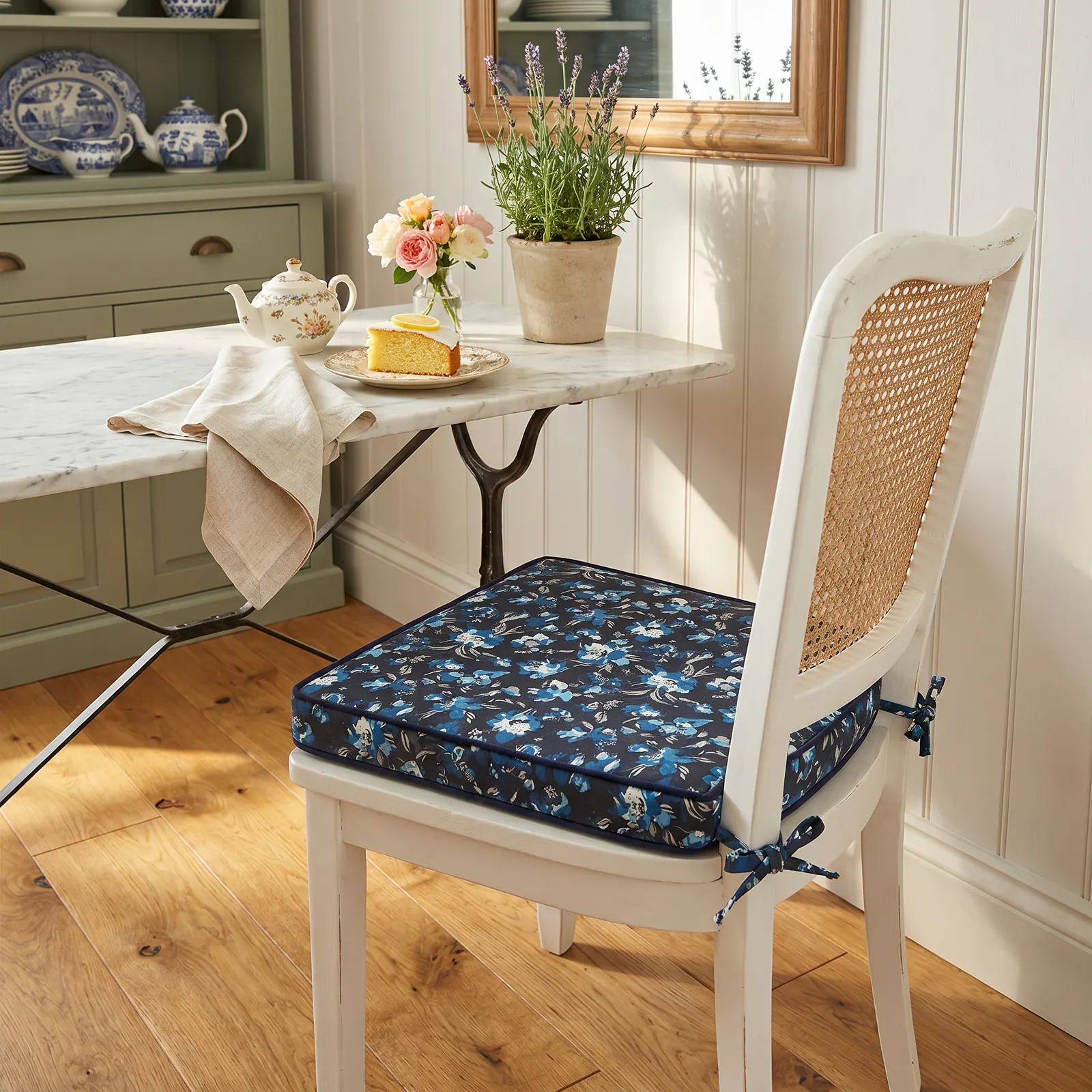
Ties go at the back, around the spindles or the ladder-back. On the dining chair listing they are a checkout option; on a custom shape, write each tie's position, length and color into the order, then look for them in the pre-dispatch photo. The tie placement Pattern lays out the options. A non-slip base is optional on any shape and costs more on larger pads.
Sketch the shape first in the chair cushion builder, and if a bench joins the set, carry on with matching dining bench and chair cushions.
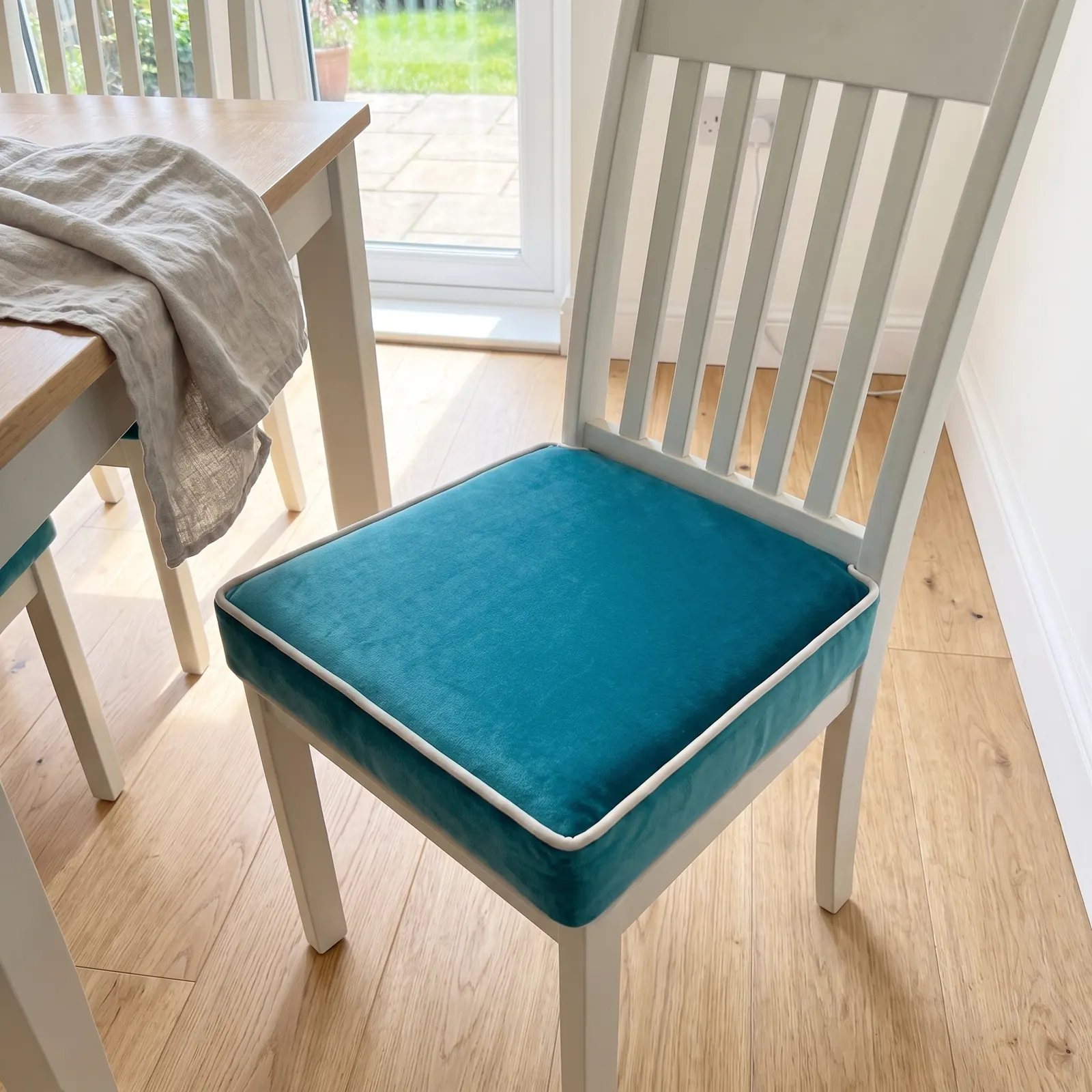
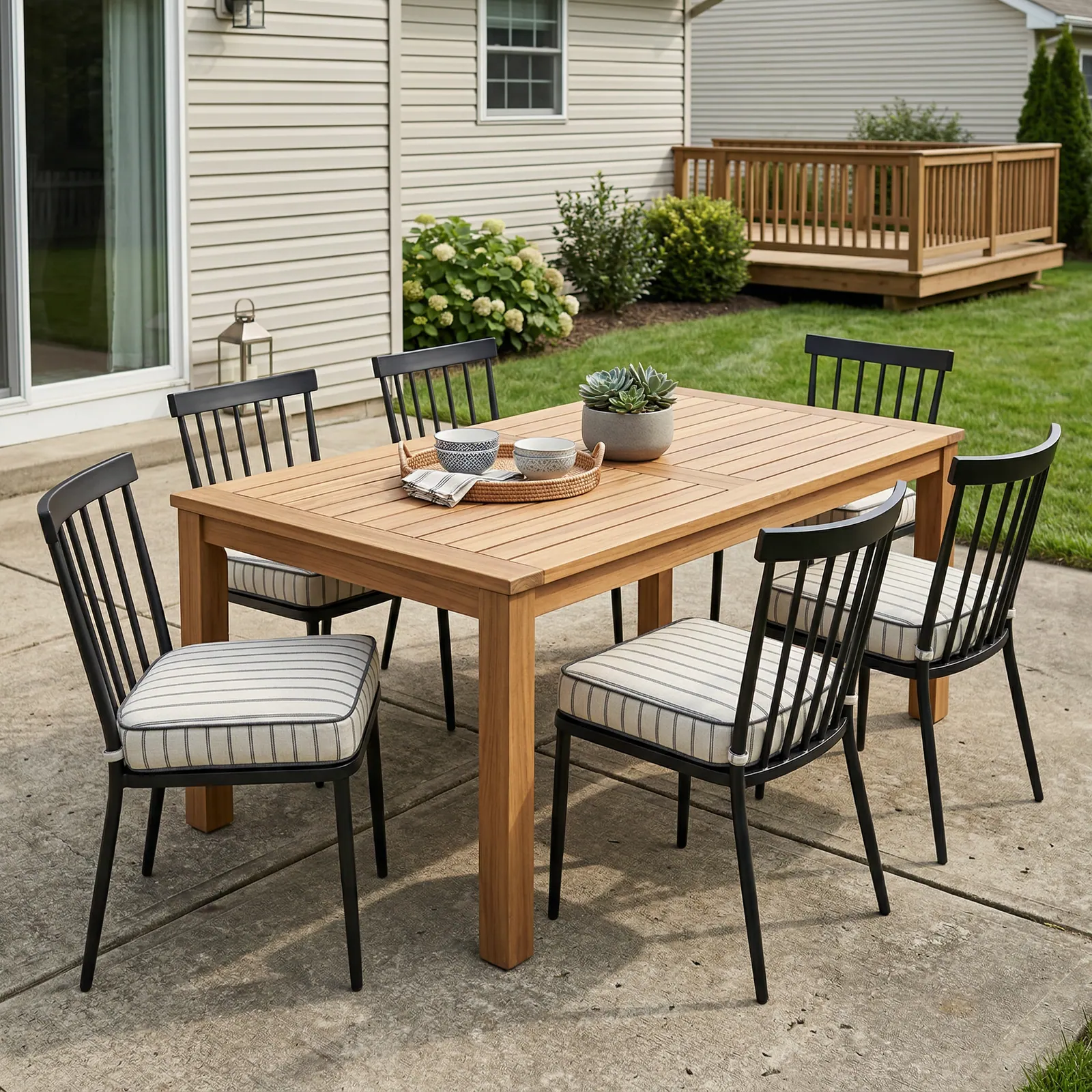
Dining chair pads fit when the left and right edges are measured separately and the depth runs all the way to the seat's front edge.
Maggie
Chair-pad questions
- A common question
My chair seats aren't rectangles. How do I order pads for them?
The workshop's answerUse the custom-shape (trapezoid) listing. Pick the size range by the widest point and the deepest depth; it only sets the price bracket. At checkout, upload a drawing with every edge measured and a photo of the seat, and put the thickness and fabric code in the personalization box. The pad is cut to your drawing, and you can send the drawing first for a check.
- A common question
Can dining chair pads come with ties to hold them on?
The workshop's answerYes. Ties go at the back for spindles or a ladder-back, and on the dining chair cushion listing they are an option at checkout. For shaped seats, send a photo of the chair and a diagram with the front, back, left and right edges, plus quantity and thickness. Covers come off for washing and can match a bench cushion's fabric.
- A common question
Do the chair pads have a grippy bottom, or is that extra?
The workshop's answerIt's an optional add-on, available on any shape, and the cost scales with cushion size. Write 'non-slip base' and your exact size in the personalization note; the workshop includes it in your quote or sends a link for the difference. You can add it to some cushions in a set and not others.
- A common question
My armchair seat curves at the front. How do I measure it?
The workshop's answerTrace the seat onto paper, cut it out, write the widest width and the depth on it, and photograph it flat from above beside a tape measure; there's no need to mail it. Or send the width, depth, where the curve starts and ends on each side, how deep it runs, and a top-down photo. The craftsmen confirm the shape before you order.

Have it made
Have an idea like this made — ask Maggie’s workshop
I once cut a lovely cushion two inches short, and I have not forgotten it. That is why the workshop goes over your measurements with you on the phone. — Maggie
Leave your details and the workshop will call you to confirm measurements, fabric, foam and piping. No prices, dates or payment on this page: it is a request, not an order.
Questions buyers ask next
How can I tell if my dining chair seat is a trapezoid?
Measure straight across the front of the seat and straight across the back. If the numbers differ, the seat is a trapezoid and the pad is a custom shape. In the dining sets on this page the difference ran from 2 in (5 cm) to 3.75 in (9.5 cm).
How thick should a tapered dining chair pad be?
The dining sets here ran 2 to 3.5 in (5 to 9 cm) thick, and a pair of armchairs went to 4.7 in (12 cm). A thicker pad raises the seat, so check the clearance under your table before you choose.
Where do the ties go on a pad that narrows toward the back?
At the back, wrapping the spindles or uprights. On the arched-back set of eight they sat 4.5 in (11 cm) in from the corners to meet the chair's supports. Write each tie's position, length and color into the order so none is left off.
Will a zipper spoil the shape of a trapezoid pad?
No. Firm foam holds the taper, and because the workshop sews the cover and fits the foam itself, the zipper is sized for easy removal. On the arched-back pads the zipper ran along the arc at the back of the seat.