 Save
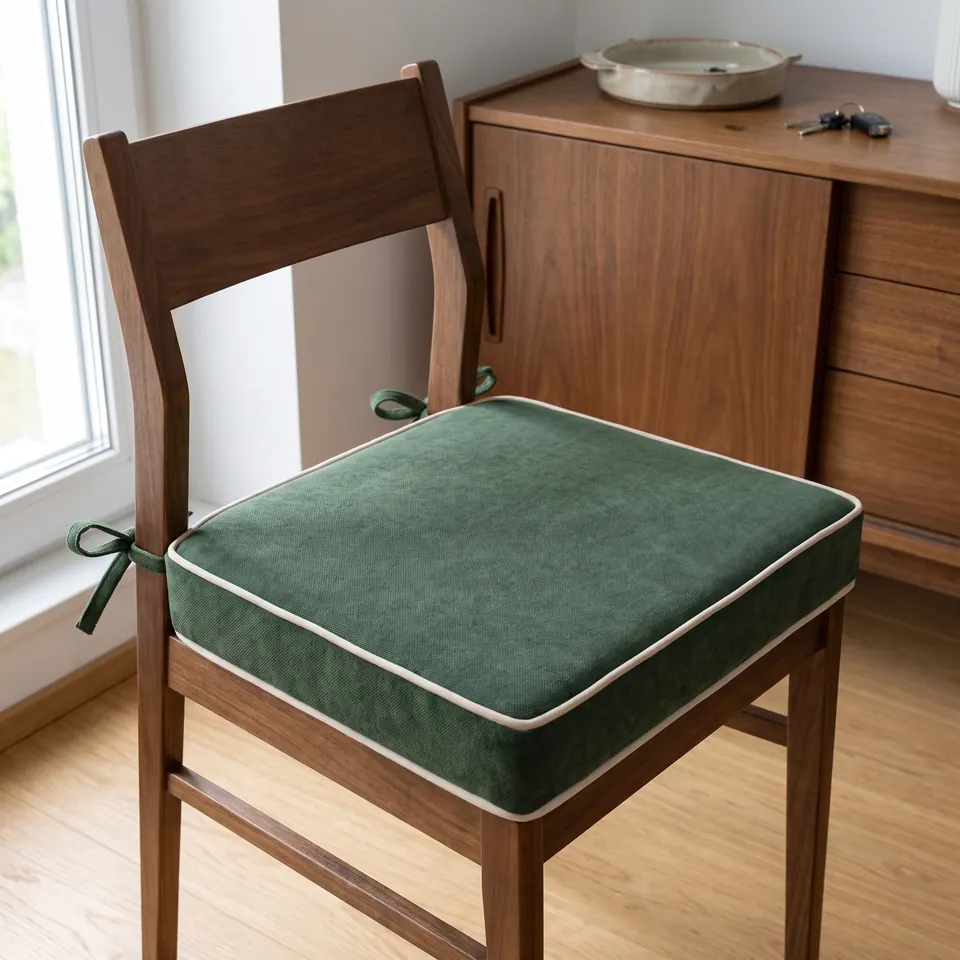
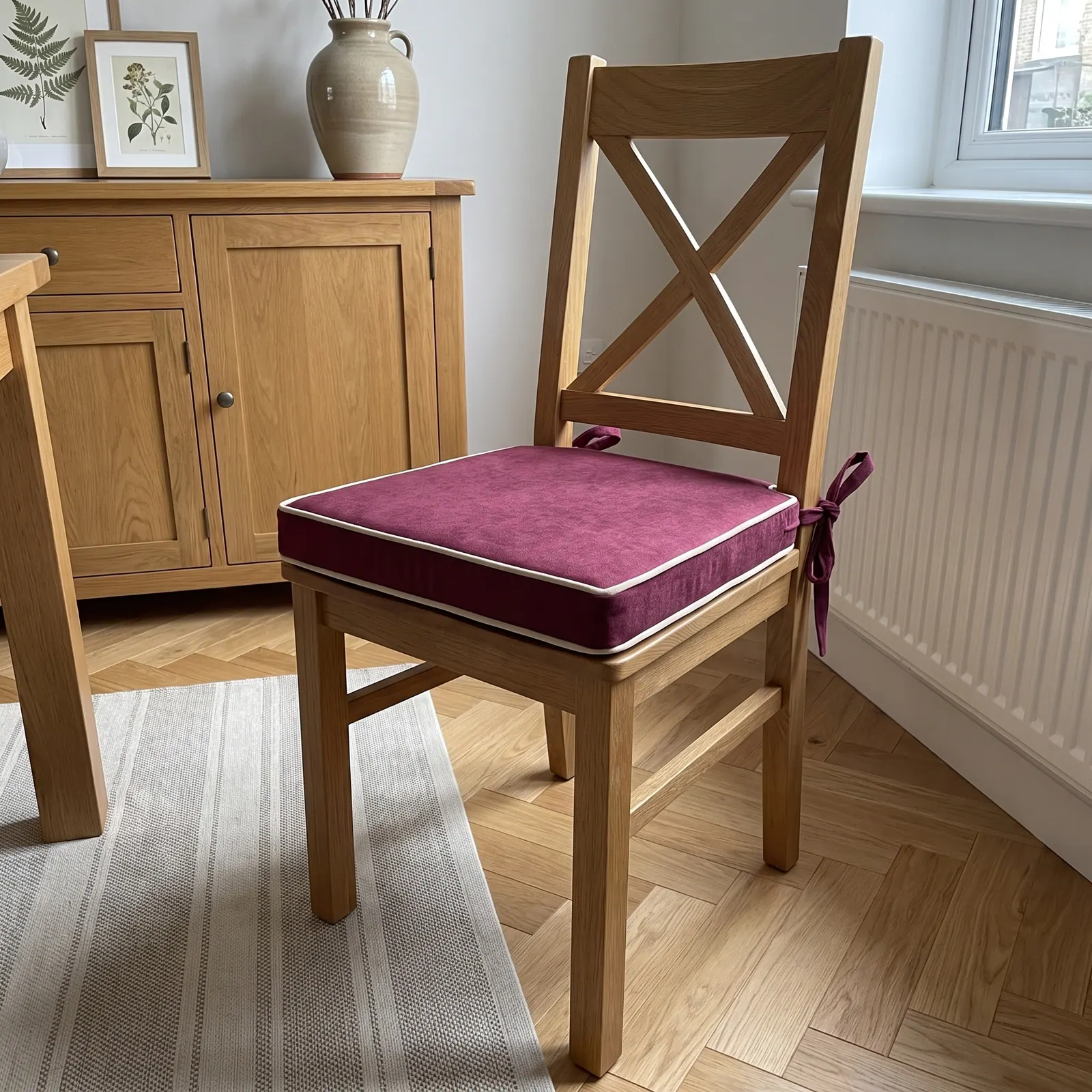
- Bowed tie at back post
Ties sit at the rear posts so the front of the cushion stays clean.
- Cream piped front
The welt echoes the stoneware vase and the painted radiator.
- Botanical fern prints
Framed ferns add a cottage note that suits the cross-back chair.
- Stoneware vase
Dried grasses bring soft texture and a pale tone above the oak.
- Striped flatweave rug
A neutral stripe underfoot keeps the jewel-toned seat as the only color.
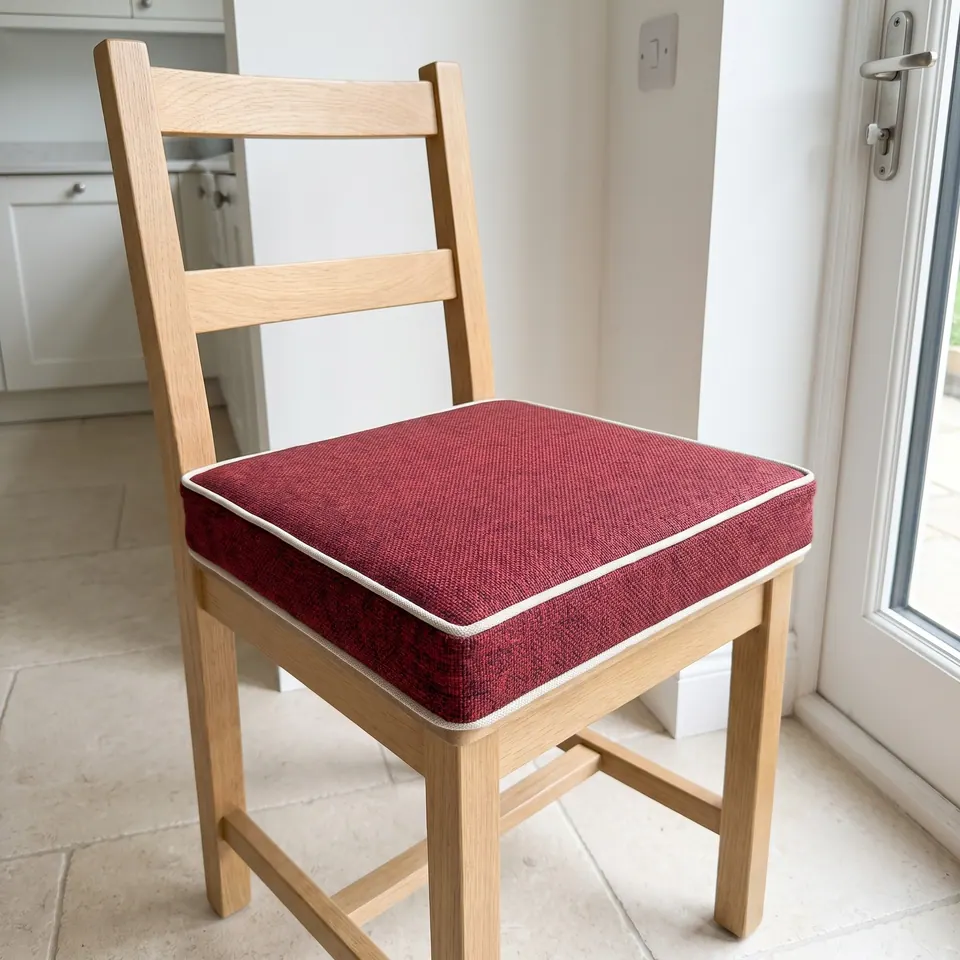
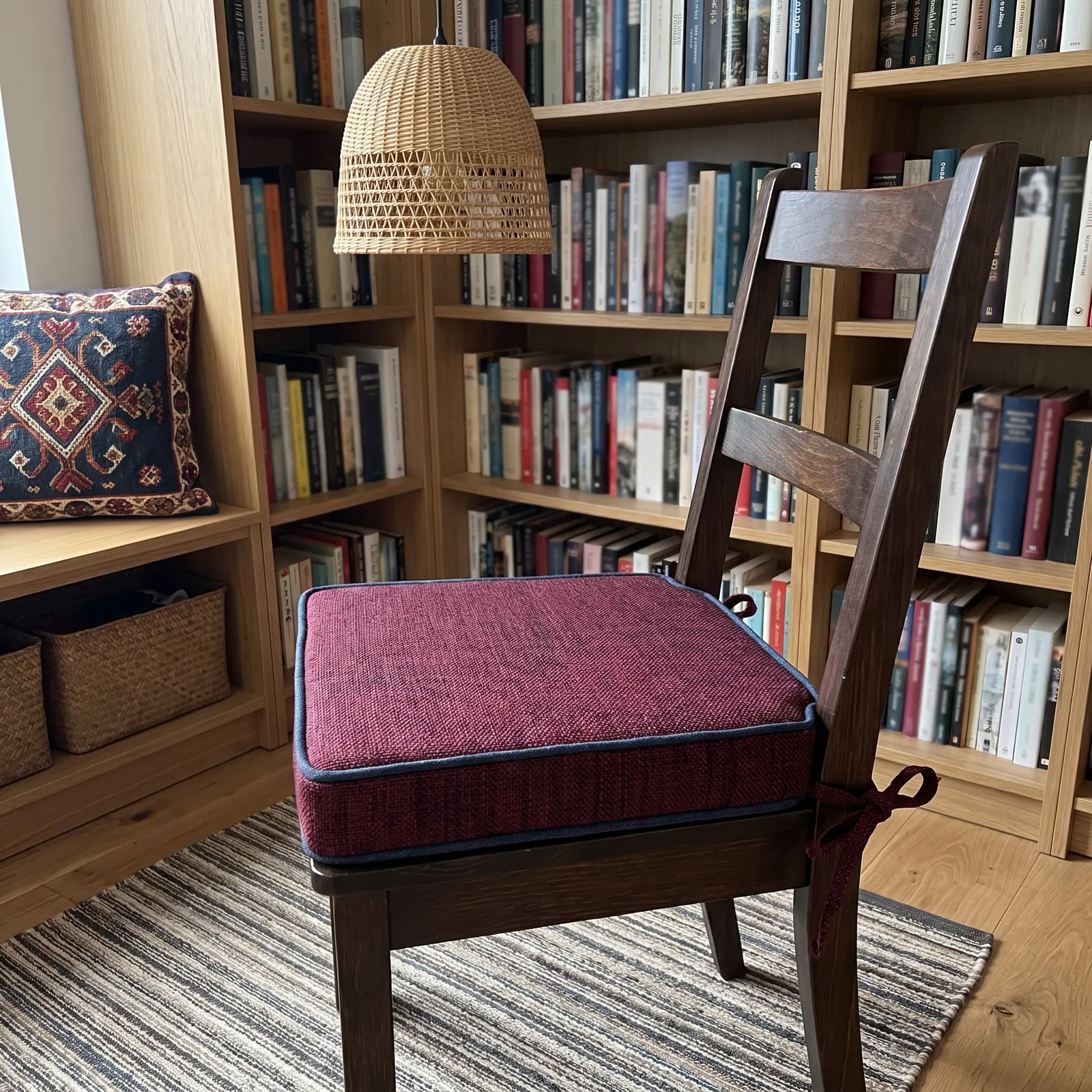
Plate Wine Red Seat Cushion on an Oak Cross-Back Chair, Herringbone Floor
The berry tone appears nowhere else in the room, which is exactly why it reads as the finishing touch.
A Reading by MaggieDining Chair Cushions & Pads
A wine red chair cushion with ties, and how linen-look cloth lives at the table
One berry-colored pad on an oak cross-back chair, a cream welt, two bows at the back posts. Let's talk about what that cloth does after a year of Sunday dinners.

The quick answer
A linen-look chair cushion is a hard-wearing blend, usually linen-polyester or cotton-linen, that suits daily dining chairs and cleans simply: unzip the cover, turn it inside out and wash it at 86°F (30°C) on a gentle cycle. The cloth is pre-shrunk, so air-dry it, skip the bleach and iron only on low, and it goes back over the foam.
Oak, oak, oak, and one berry
Everything in this dining room is honey oak: the cross-back chair, the sideboard, the herringbone floor. Oak on oak on oak needs one jewel color to interrupt it, and a magenta wine does the job without raising its voice. It appears nowhere else in the room, which is exactly why it reads as the finishing touch.
The welt is cream, and it earns its keep. It repeats the stoneware vase on the sideboard and the painted panel radiator, so the edge looks planned rather than bought. A straight welt is a kind of honesty, and this one runs true along the front edge, where every eye lands first.
The ties are bowed at the rear posts, the right spot for any dining chair cushion on a cross-back: the front of the pad stays clean, and nobody catches a knee on a bow. Framed fern prints and a vase of dried grasses give the room its cottage mood, and a cream striped flatweave rug keeps the floor quiet so the seat stays the only color.
Now the hand. Most linen-look fabrics are blends, linen with polyester or cotton, and the mix is the point: the matte, slightly uneven look of linen with more backbone for daily sitting. The upholstery cloths start at about 7.4 oz per square yard (250 g/m²). I once covered a chair in a delicate pure linen for a nephew who treated it as a launch pad, and I have steered people toward blends ever since.
How many dinners a week does your chair see, dear?
Pinned by Maggie
Five spots on this oak chair where the decisions show.
The numbers match the pins on the plate.
- Bowed tie at back postTies sit at the rear posts so the front of the cushion stays clean.
- Cream piped frontThe welt echoes the stoneware vase and the painted radiator.
- Botanical fern printsFramed ferns add a cottage note that suits the cross-back chair.
- Stoneware vaseDried grasses bring soft texture and a pale tone above the oak.
- Striped flatweave rugA neutral stripe underfoot keeps the jewel-toned seat as the only color.
Washing a linen-look chair pad: the checklist
The full routine is in how to wash cushion covers. Here is the short version I keep taped inside the linen closet.
- Unzip the cover and slide out the foam. The foam is never washed.
- Turn the cover inside out and close the zipper.
- Wash at 86°F (30°C) at most, on a gentle or delicate cycle, with mild detergent.
- No bleach and no tumble dryer. Air-dry it.
- Iron on low only if it needs it, then zip it back over the foam.
- Chose a non-slip base? Keep that panel out of the washer and dryer, where it shrinks, and wipe it clean instead.
The reversible Danish lounge chair
A buyer in the US wrote in about a mid-century Danish lounge chair. The seat was a trapezoid: 23 in (58 cm) wide at the front, 22 in (56 cm) at the back, 24 in (61 cm) deep and 4 in (10 cm) thick, not tufted, with the zipper at the back. The back cushion was a plain 22 x 19 in (56 x 48 cm) rectangle, 3 in (7.5 cm) thick.
Both were to be reversible, so neither got a non-slip bottom; a grippy base makes a cushion one-sided. The workshop sent the seat through the custom-shape order and the back through the rectangle order, one shape each, and confirmed the piping was included, with ties and non-slip as optional extras. Say “reversible” out loud when you order. It saves a round of messages.
- Sizes
- Seat 23 in front, 22 in back, 24 in deep, 4 in thick; back 22 x 19 x 3 in
- Fabric
- Buyer's choice
The lesson: One shape per order line, and say 'reversible' so no non-slip base is added.
Buyer questions: ottomans, second thoughts and curved chairs
- A common question
Is the ottoman attached to the corner floor sofa, and does it come with it?
The workshop's answerThe corner version includes the ottoman, and it can also be ordered without one. The ottoman is a separate piece, not attached at all, so you can move it to either side, and it may arrive in its own package.
- A common question
I don't need my custom order right now after all. Can I cancel it?
The workshop's answerYes. Before production starts, the order can be cancelled and refunded to the original payment method. The workshop can also hold the payment until you're ready, and if you only need to change something, it can update the order without cancelling.
- A common question
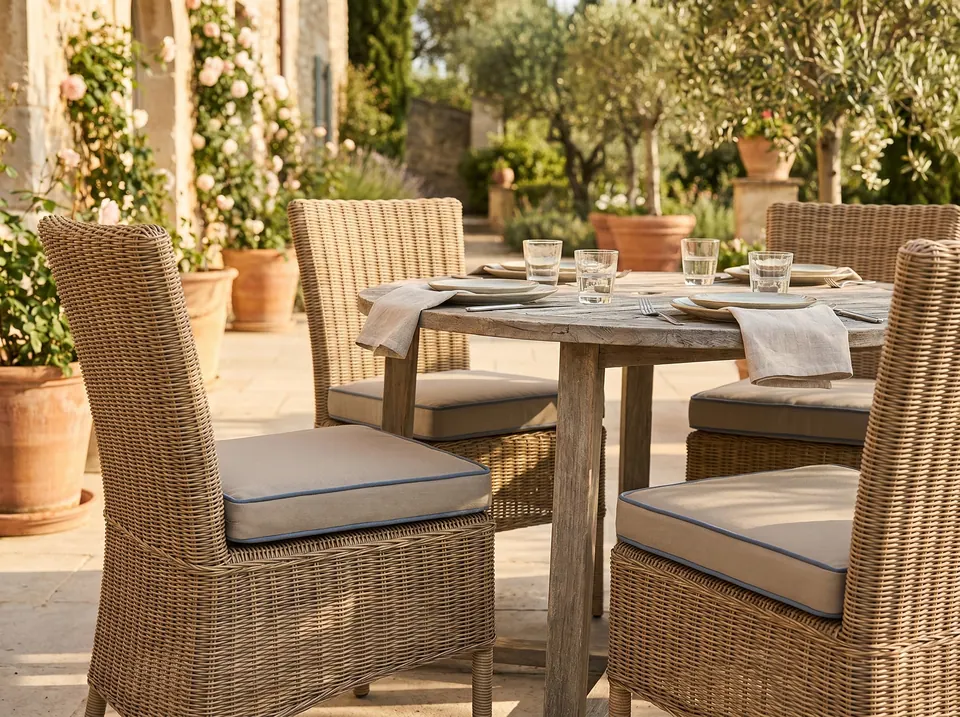
Can you make a cushion for a vintage rattan barrel-back chair with a rounded back?
The workshop's answerYes, semicircular back and all. Send the width and depth (for example 17 x 18 in, or 43 x 46 cm) with a clear photo taken from directly above the whole seat. A tracing or paper template of the seat is even better for reproducing the curve accurately.
On an all-oak dining set, a berry or plum chair cushion with an off-white welt looks traditional but fresh.
Maggie
On the cutting table: the chair pad
| Cushion | Dining chair pad with ties |
|---|---|
| Fabric | Linen-look blend in magenta wine |
| Piping | Contrast cream welt, included |
| Edge | Box edge with a side band |
| Fastening | Fabric ties at the back posts; non-slip base optional |
| Cloth weight | Upholstery grade, from about 7.4 oz/yd² (250 g/m²) |
| Care | Zip-off, inside out, 86°F (30°C) gentle, air-dry, low iron |
| Best for | Oak dining sets, kitchen nooks, everyday meals |

Have it made
Have this made — ask Maggie’s workshop
Have the tape measure handy when they call. Old cushions shrink and sag; the seat underneath does not. — Maggie
Leave your details and the workshop will call you to confirm measurements, fabric, foam and piping. No prices, dates or payment on this page: it is a request, not an order.
Questions buyers ask next
Is linen-look fabric the same as real linen?
Not quite. Most linen-look charts are blends, such as linen-polyester, 50/50 linen-polyester or cotton-linen, chosen for durability. True 100% linen and 100% cotton charts exist too, so ask which one a color code belongs to before you order.
Will a linen-look cover shrink in the wash?
The fabrics are pre-shrunk. Keep the wash at 86°F (30°C) or cooler on a gentle cycle, skip the tumble dryer and air-dry the cover, and it will go back over the foam the way it came off.
Where can ties go on a chair pad?
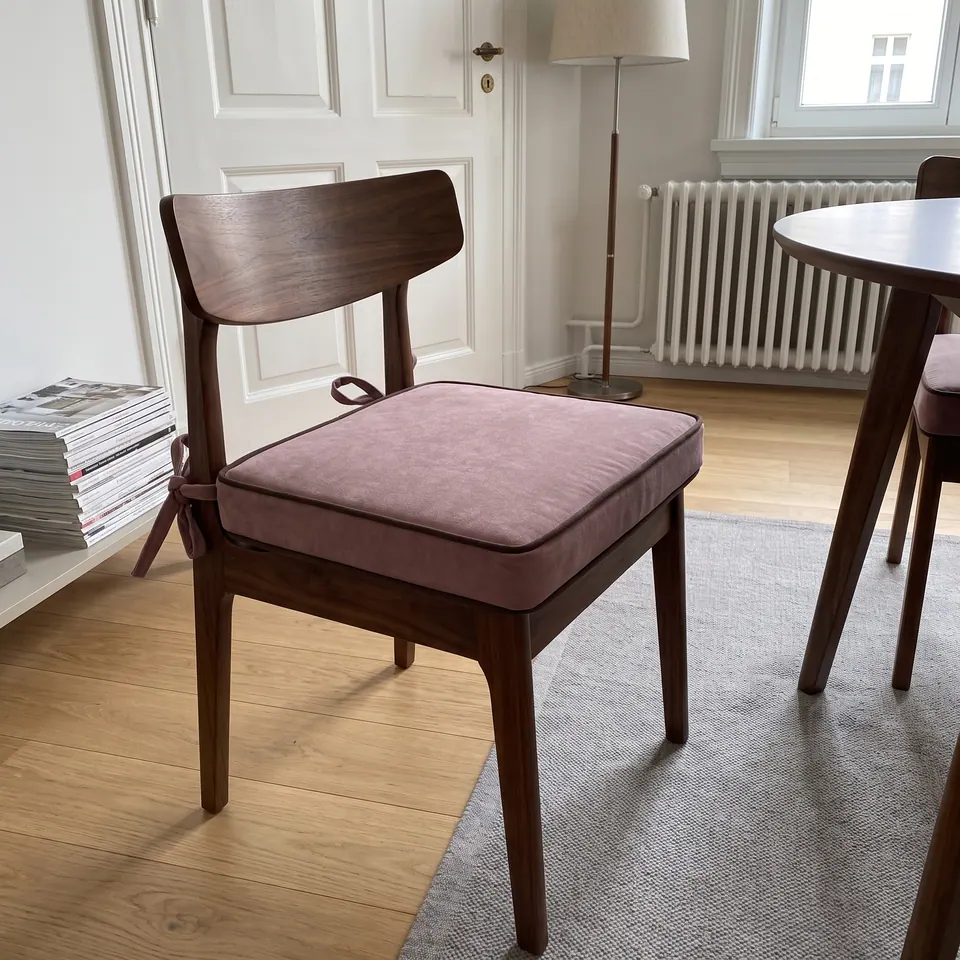
Anywhere you ask. Fabric ties are sewn into the seams at the corners or along the back, in any position. On a cross-back or spindle chair, a pair at the back posts, as in this photo, holds the pad without showing at the front.
My chair seat is wider at the front than the back. Is that a special order?
Yes, that is a trapezoid, and it is made from a drawing with the front width, back width and depth. The workshop checks the geometry, works out any missing sides and sends it back for your approval before cutting.
Stitch straight — Maggie
More photographs to read
 Save
 Save
 Save
 Save
 Save
 Save