 Save
A Reading by MaggieDining Chair Cushions & Pads
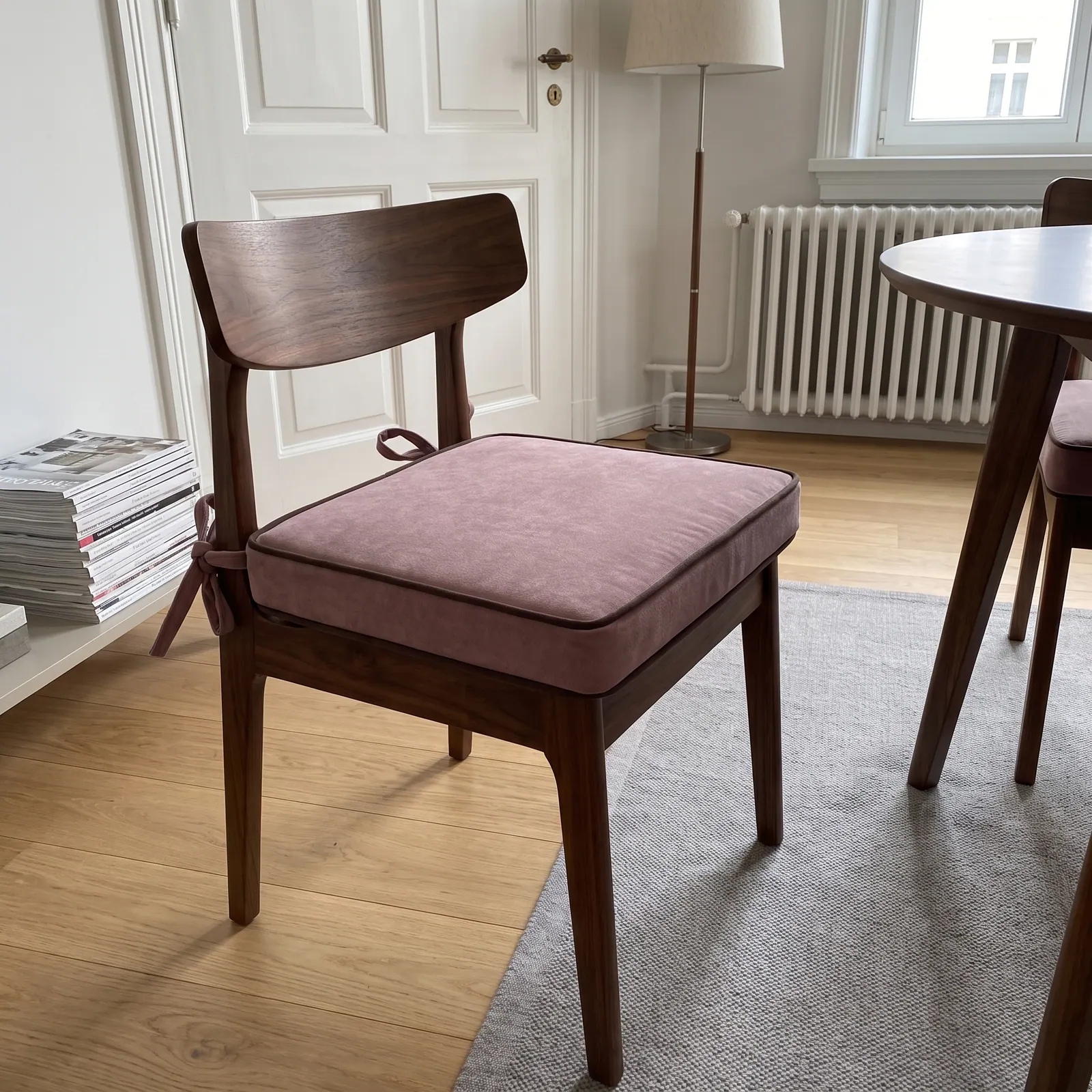
A dusty mauve dining chair cushion, piped in brown to match the walnut
Pale fabric, dark chair, one brown line between them. And under the linen-look, a core firm enough to keep that line straight.
Brown piping ties the soft mauve to the walnut frame instead of setting it apart.

The quick answer
A dining chair cushion keeps a crisp box edge only with a firm core, so choose high-density foam, which gives a structured, flat seat, over a soft filling that can flatten at the front. On this walnut chair, a dusty mauve linen-look pad with dark brown piping and mauve ties fills the seat to its edges and looks upholstered on.
Brown piping on a pink cushion, and why it works
The piping on this cushion matches the chair, not the fabric. That one decision makes a pale mauve pad look upholstered on rather than dropped on.
Dark brown welt against walnut reads as a single line. Your eye follows the frame, meets the cushion and never finds the seam where chair ends and fabric begins. A straight welt is a kind of honesty; a brown one on walnut is also good manners.
The room is tall and old: a paneled white door, a column radiator, a wood-stem lamp under a linen drum shade. That is a lot of dark timber and white paint under cool, overcast light. A muted pink softens all of it without asking for attention, and a linen-look weave has a dry, flat surface that does not shine back at the lamp.
The props are honest city-apartment props. A casual stack of magazines on a low shelf. A gray flatweave rug that lets chair legs slide. The round walnut table behind shows how the same color would carry across a full set of dining chair cushions.
The ties are mauve, bowed at the back legs. They keep the pad centered on a curved-back seat, where a cushion loves to drift sideways.
Pinned by Maggie: a walnut chair, one brown line
Five pins, and the first one to find is the brown piping, because everything else follows it.
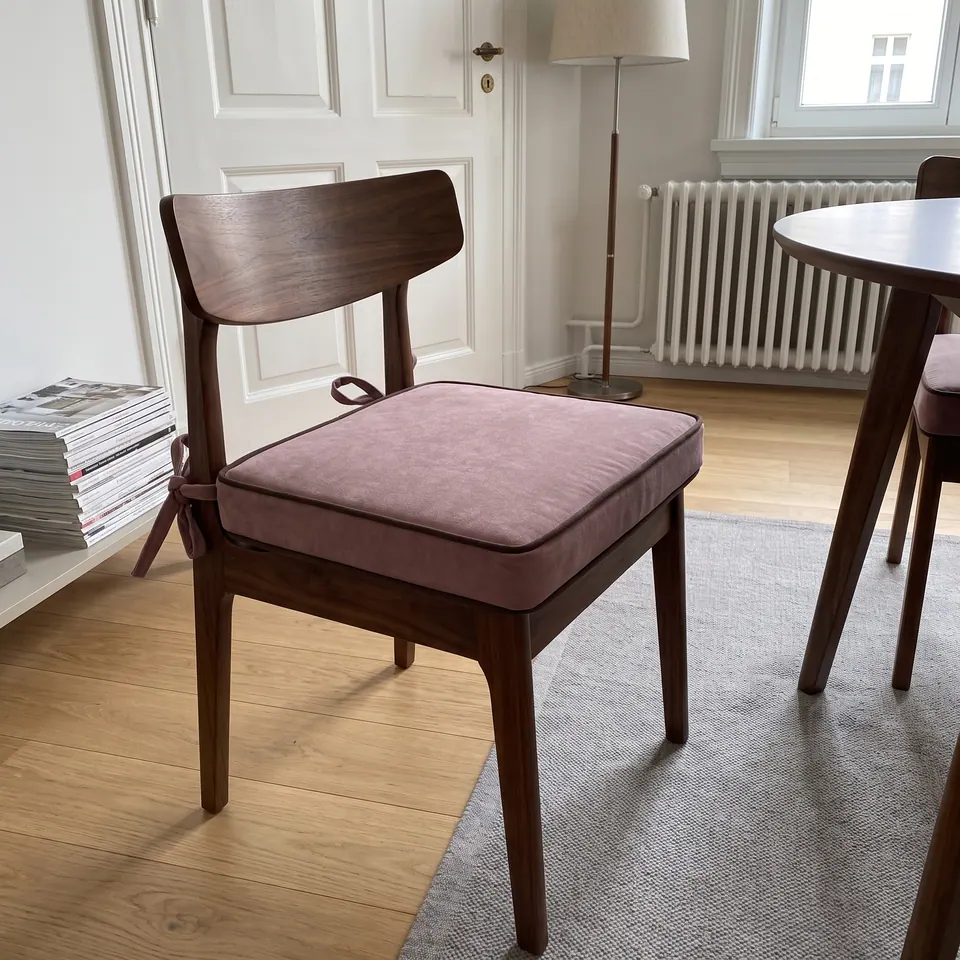
- Dark brown piping
Piping matched to the wood, not the fabric, makes the cushion look upholstered onto the chair.
- Tie on back leg
Mauve ties bowed at the rear keep the pad centered on a curved-back seat.
- Stacked magazines
A casual stack adds a lived-in, city-flat feel beside the chair.
- Linen-shade floor lamp
A slim wood-stem lamp repeats the walnut and adds height to the corner.
- Round walnut table
A matching walnut table shows the cushion color working across a set.
- Dark brown pipingPiping matched to the wood, not the fabric, makes the cushion look upholstered onto the chair.
- Tie on back legMauve ties bowed at the rear keep the pad centered on a curved-back seat.
- Stacked magazinesA casual stack adds a lived-in, city-flat feel beside the chair.
- Linen-shade floor lampA slim wood-stem lamp repeats the walnut and adds height to the corner.
- Round walnut tableA matching walnut table shows the cushion color working across a set.
What keeps a box edge straight at dinner
This is a medium box, and it fills the seat to its edges. That shape holds only with a firm core. The workshop's cushions use high-density foam, which is what gives them a structured, flat look; a soft filling rounds the edges off.
A dining chair works hard. People drop onto it, shuffle forward to reach the salt, lean back after dessert. Much of that weight lands near the front edge, and that is where a soft pad gives up first. When it does, the seat slants forward and you spend the evening sliding toward the table.
So think about who sits there. A household with a child who treats chairs as trampolines needs either a firm core or a filling you can unzip and push back into shape. A café seat, sat on and off all day, wants the thicker option. The foam firmness finder walks through the choices for a seat like this one.
Mind the height, too. Cushion thickness adds to seat height, so a thick pad on a tall chair can bring your knees up against the table apron. Measure the gap between seat and tabletop before you choose.
Is there a chair in your house that everyone avoids because it tips you forward, dear?
Five round pads for a new coffee shop
Café owners wrote to the workshop about five bar stools in a coffee shop they were about to open. They wanted round seat pads like a reference photo: 16 in (41 cm) across and 3.5 to 4 in (9 to 10 cm) thick.
The workshop quoted the 4 in version for all five, built for heavy café use. A café seat is sat on and off all day, so the thicker pad was the sensible one.
They also hoped to buy 30 in (76 cm) steel or gunmetal stool frames from the workshop. It had to say no: it makes the cushion and the foam, not metal bases, so the frames came from elsewhere.
The right order of work: give the diameter and the thickness, source the frames separately, and check the frame's seat before ordering the pad. Our Pattern on cushions for cafés and rentals lists what else to specify.
Buyer questions: tapered seats, a flattened front and a chair that sits too low
- A common question
Can you make a tapered seat cushion and a back cushion for a chair on my covered porch?
The workshop's answerYes. Send a drawing with the back edge, front edge, depth and both side edges written on it, plus the back cushion size and the thickness you want. The back cushion's height can be the seat-to-top distance minus the seat thickness: 19 in (48 cm) minus a 3 in (8 cm) seat gives 16 in (41 cm).
- A common question
My child jumps on the chair, and the front of the cushion has flattened so the seat slants forward. Can I fix it?
The workshop's answerYes. Take off the cover, pull and redistribute the filling back into shape, then put the cover back on.
- A common question
Can you make a cushion to raise a vintage office chair that sits too low for my desk?
The workshop's answerYes, for example at 17 x 18 in (43 x 46 cm), ordered through either the bench listing or the chair cushion listing. Select the closest size option and write your exact size and thickness in Add Personalization.
On the cutting table: the mauve walnut chair
| Cushion | Box seat pad for a curved-back walnut dining chair |
|---|---|
| Fabric | Dusty mauve linen-look weave (931) |
| Piping | Dark brown contrast welt, matched to the walnut |
| Edge | Medium box edge, filling the seat to its edges |
| Core we would choose | High-density foam, for a structured, flat seat |
| Fastening | Mauve ties bowed at the back legs |
| Room | Paneled door, column radiator, walnut table, gray flatweave rug |
| Best for | Dark wood dining chairs dressed in a light fabric |

Have it made
Have this made — ask Maggie’s workshop
Have the tape measure handy when they call. Old cushions shrink and sag; the seat underneath does not. — Maggie
Leave your details and the workshop will call you to confirm measurements, fabric, foam and piping. No prices, dates or payment on this page: it is a request, not an order.
When the dining chair is dark wood and the cushion fabric is pale, piping in the wood's color makes the pad look upholstered on.
Maggie
Questions buyers ask next
What piping color suits a light cushion on a dark wood chair?
Match the piping to the wood rather than to the fabric. Dark brown welt on a walnut chair, as here, ties the pale mauve pad to the frame so the cushion reads as part of the chair instead of an add-on.
How firm should a dining chair cushion be?
Firm enough to keep its shape where you sit down, which is mostly toward the front edge. A high-density foam core gives a structured, flat seat; a soft fill feels plush at first but can slump and tilt the seat forward.
How thick should a café or bar stool cushion be?
For heavy commercial use, one café chose round pads 16 in (41 cm) across at 4 in (10 cm) thick, the thicker of the two options it considered. Give the diameter and thickness, and source the stool frames separately.
Why does a curved-back chair need cushion ties?
A curved back leaves room for the pad to drift sideways. Ties bowed around the back legs, like the mauve ties here, keep the cushion centered through a whole meal of shifting, reaching and pushing back from the table.
Stitch straight — Maggie
More photographs to read
 Save
 Save
 Save
 Save
 Save
 Save