The Pattern Room · a measuring pattern
Commercial seating cushions for cafés, rentals and offices: what to specify
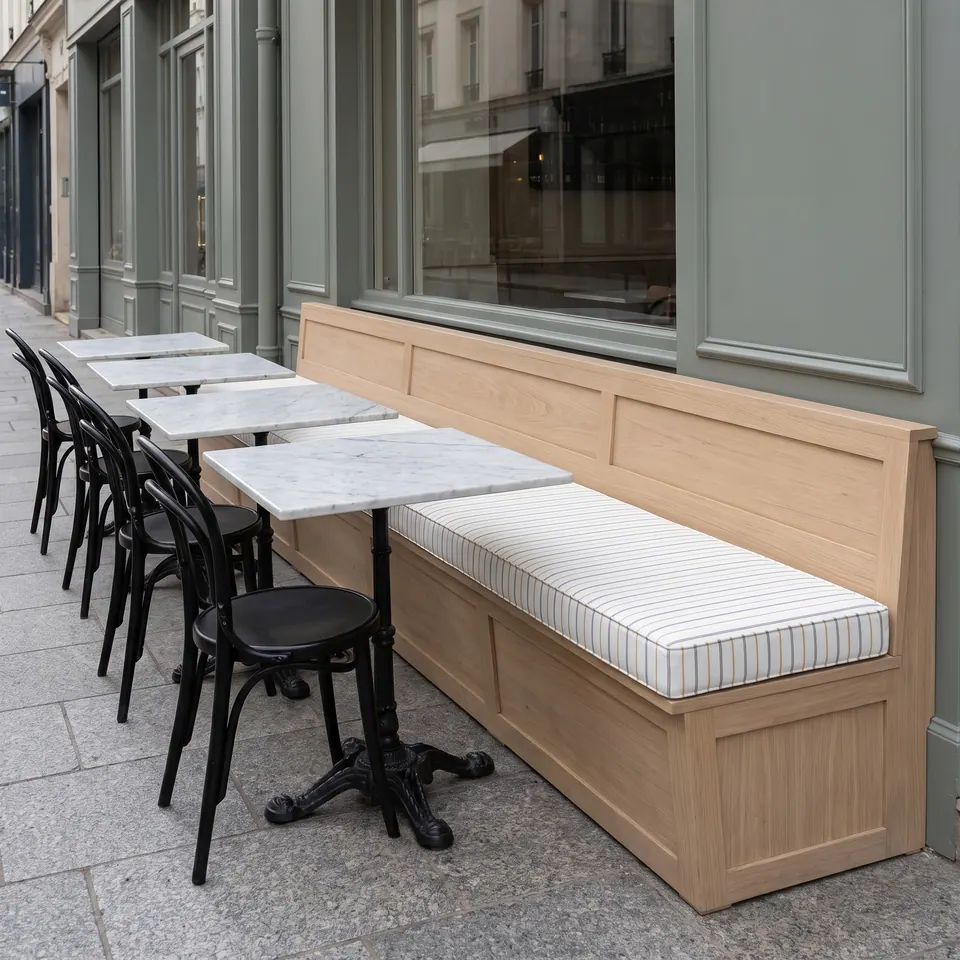
A café bench never gets a day off, and it rarely gets the same sitter twice. Here's the spec I'd write before the first customer sits down.

 Save
The quick answer
Commercial seating cushions need three things a home cushion can skip: contract-grade fabric rated around 40,000 Martindale or more, high-density foam at about 2.0 lb/ft³ (32 kg/m³), and zippered covers that come off for washing, ideally with a spare set. Add ties where chairs get moved, and ask your local code office and insurer which fire standard applies before you order.
Seats that never get a day off
A home bench gets sat on after supper. A café banquette gets sat on from the first coffee to closing time, by strangers in wet coats with a plate in one hand. Rain doesn't negotiate, and neither does a lunch rush.
So commercial seating cushions are specified, not picked. The requests come from restaurant owners, clinic managers, office fit-outs, classroom teachers and rental hosts, and the workshop's answers barely change: tougher cloth, denser foam, covers that come off, and a drawing with every number on it.
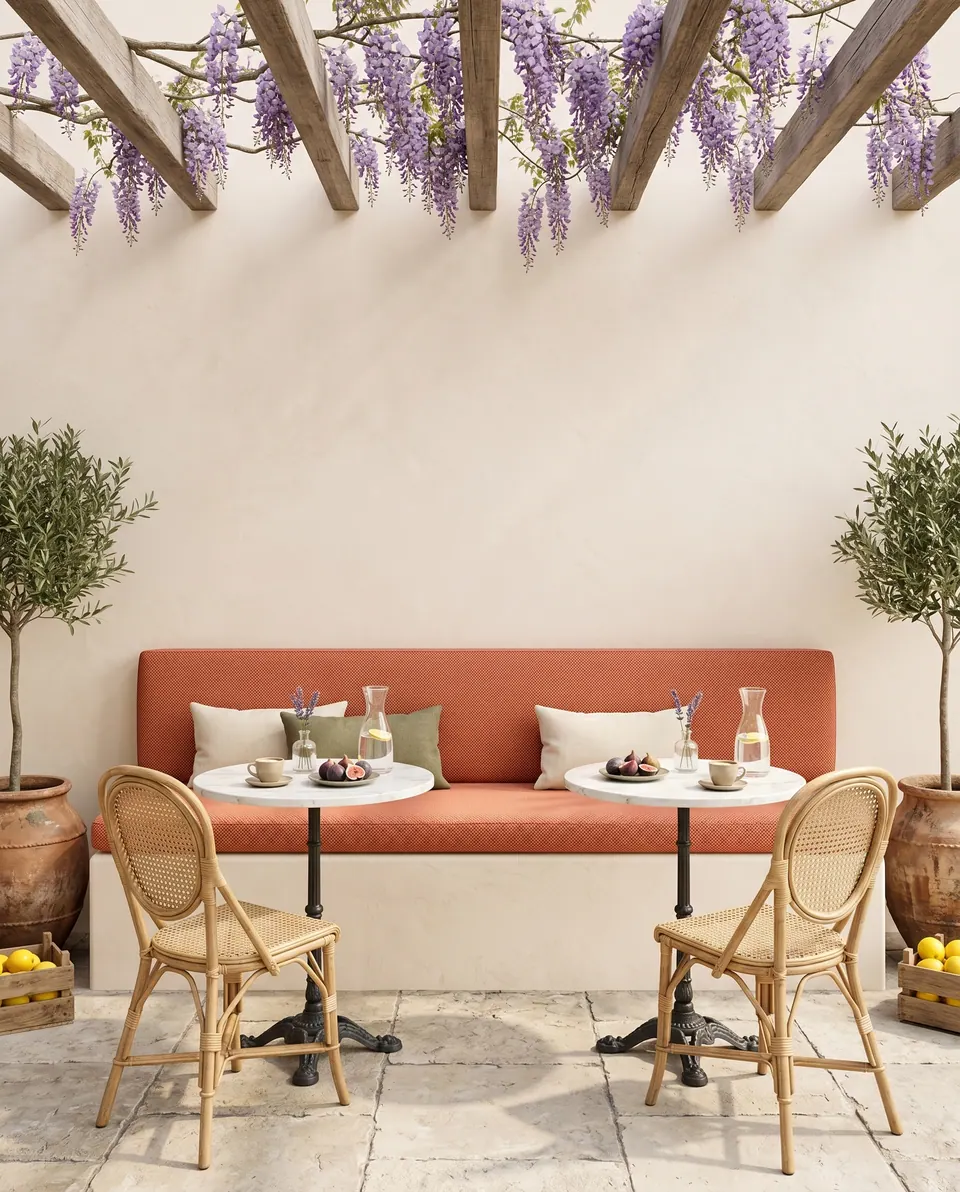
The spec below holds for a banquette in a bistro, a waiting-room bench cushion or a U-shaped booth.
The commercial cushion spec sheet, line by line
Name the space and count every seat
For a proposal the workshop asks for three things: the total number of cushions, every size, and the type of space, whether hotel, café, clinic or office. Add a photo of each bench or booth. It has made clinic waiting benches, office reading benches and 40 x 40 in (102 x 102 cm) corner cushions for early-learning classrooms.
Draw it once, in one unit
Every dimension goes on one drawing, all in inches or all in centimeters, never mixed, with your fabric codes attached. The workshop checks drawings before quoting and has caught plans like two 50 in cushions drawn on a 103 in run. Measure the real space end to end and don't shave anything off; the fitting allowance is the maker's job. See what to send for a quote.
Split at the corners, and wherever a piece must lift out
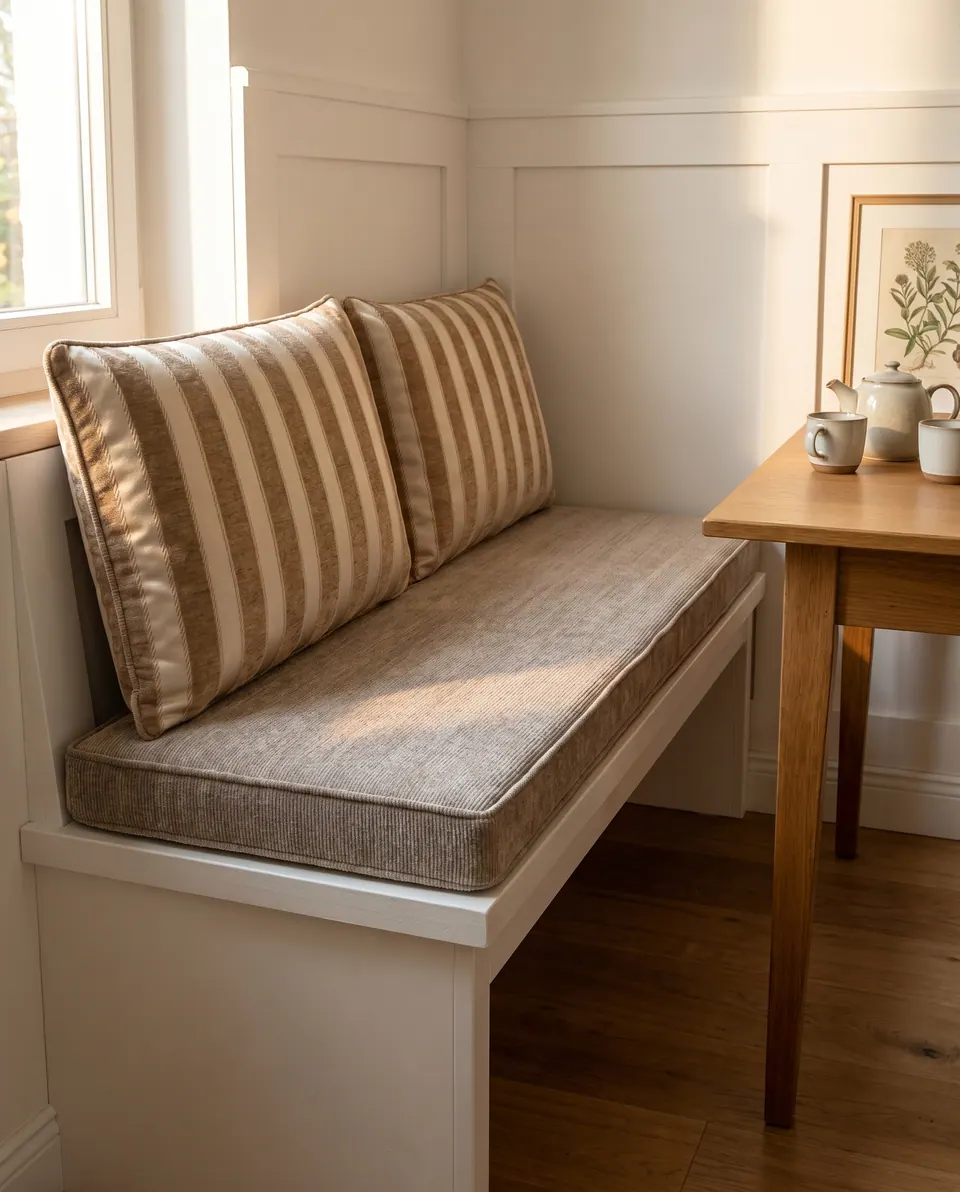
U-shaped and long booths are made as separate pads, not one bent piece. Backrests split too: a 76 in (193 cm) back was made as two halves to fit a 14 in (36 cm) gap between a lift-up storage bench and the window, and each half lifts out on its own. More in one long cushion or two.
Ask for contract-grade cloth, and read the number right
For heavy use, the workshop offers contract-grade fabrics rated 40,000 Martindale, the figure the supplier reports. Published contract bands start between 30,000 and 40,000 cycles, depending on the source. For restaurants the workshop's first pick is velvet: very durable and the easiest to wipe and spot-clean by hand between services. If a spec sheet asks for double rubs, remember that Martindale and Wyzenbeek results can't be converted. See Martindale vs double rubs.
Make 2.0 lb/ft³ (32 kg/m³) foam the floor, not the upgrade
The standard commercial fill is high-density foam at about 2.0 lb/ft³ (32 kg/m³), written 32 DNS on workshop quotes. It is firmer and holds its shape longer under constant daily use than the 1.75 lb/ft³ (28 kg/m³) often specified, and it comes as standard. The conversions live in foam density in lb/ft³ and kg/m³.
Order covers that come off, and a second set
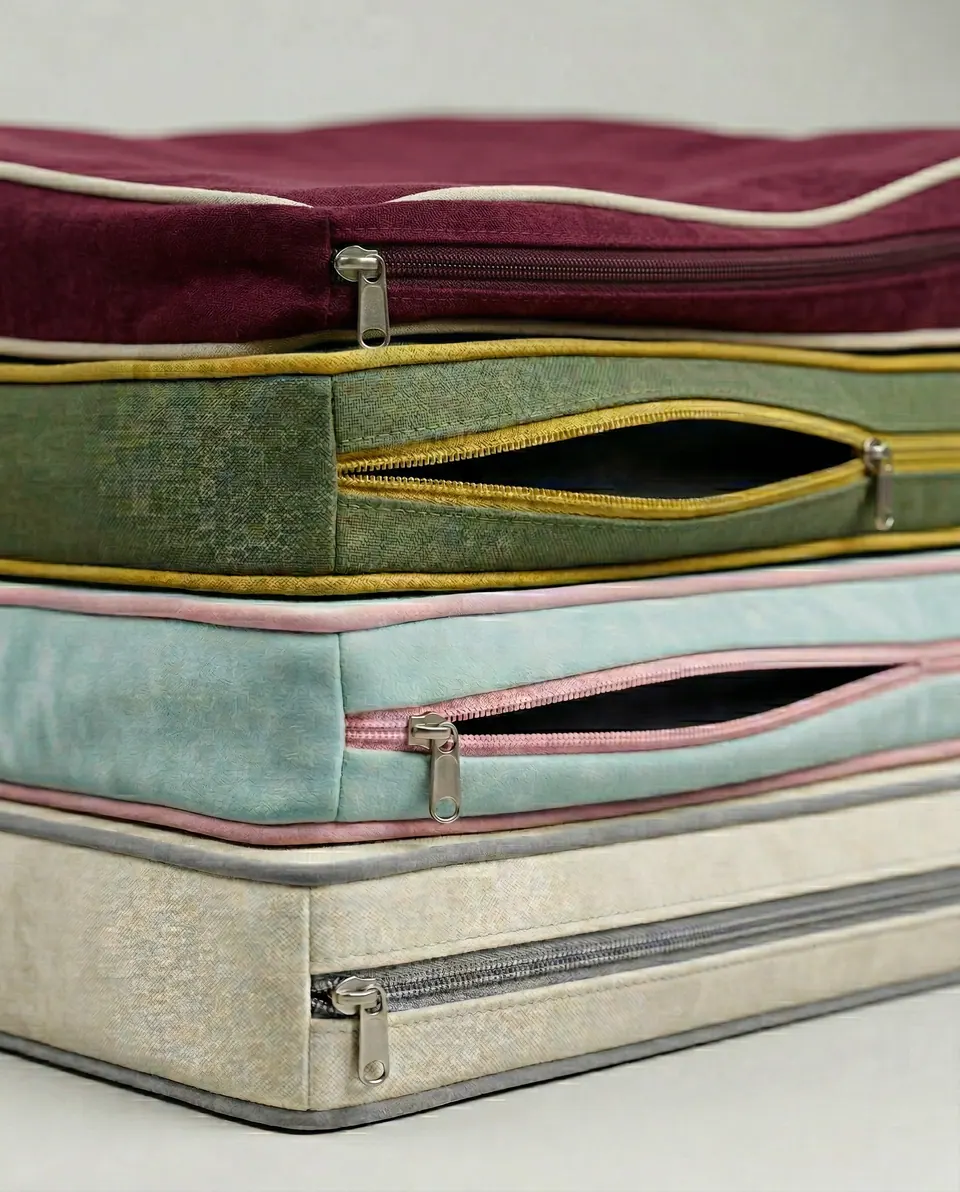
Every foam cushion has a zippered, fully removable cover. Covers machine-wash at 86°F (30°C). For commercial clients a second set of covers can be quoted, so one set stays on the seats while the other is in the wash. Care steps are in how to wash cushion covers.
Decide how each cushion stays put
Chairs get stacked and loose cushions wander. Fabric ties can be sewn into the seams at the corners or the back, in any position; note the position and length of each on the drawing. Velcro wall mounting isn't offered and underside snap fasteners aren't made, so settle the fixing before the bench is built. See stopping a bench cushion from sliding.
Put the fire standard and the opening date at the top
Two lines belong in your first message: the exact fire standard your project must meet, and the day the doors open. The maker can't guess either one.

Have it made
Measured it? Have Callum’s workshop make it
Short list: size, sun hours, how fast it has to dry. The workshop goes through it with you. — Callum
Leave your details and the workshop will call you to confirm measurements, fabric, foam and piping. No prices, dates or payment on this page: it is a request, not an order.
Home order or commercial spec: the differences that matter
| Line item | Typical home order | Commercial spec | Why it matters |
|---|---|---|---|
| Fabric | Chosen for color and hand | Contract grade near 40,000 Martindale, or velvet for fast wipe-downs | Hundreds of sits a week wear the face |
| Foam | About 2.0 lb/ft³ (32 kg/m³) standard; 1.75 lb/ft³ (28 kg/m³) softer on request | about 2.0 lb/ft³ (32 kg/m³) high-density | Holds its shape under all-day use |
| Covers | One zippered cover, washes at 86°F (30°C) | Zippered cover plus a quoted spare set | Seats stay dressed on wash day |
| Long runs | One cushion per bench | Separate pads, split at corners and lift-out points | Easier to fit, clean and replace |
| Staying put | Ties optional | Ties marked on the drawing, by position and length | Moved chairs don't shed cushions |
| Fire rules | Rarely raised | The exact standard your code office or insurer names | A home cushion may not qualify |
Fourteen feet of booth, one unit of measure
A restaurant owner in the US wrote to the workshop needing booth seats for a U-shaped layout, due within a few weeks. The numbers: two end pads at 24 x 19 in (61 x 48 cm) and one long run at 14 ft x 19 in (427 x 48 cm).
The workshop's advice was plain. Make it three separate pads, not one piece bent around the corners. Send the final measurements in one unit only, all inches or all centimeters, because a booth drawn half in feet and half in inches is how a run comes out short. On that job, production plus delivery came to about 1 to 2 weeks, confirmed before the order went in.
The cloth was velvet, the easiest to wipe between services. A booth that long is a weather front: measure it end to end, twice, in one unit.
- What it taught
- Split long booths into pads and keep all measurements in one unit.
Fire rules: name the standard, don't assume it
Here's the line people skip. A cushion made for a home is not automatically fit for a business. Fire requirements for restaurants, clinics, schools and rentals depend on your local code and your insurer.
So ask them first. Get the exact name of the standard in writing, whether it's California's TB 117-2013 or a building-code class, and put it in your first message.
What the workshop can say honestly: it makes no fire-retardant claim for its fabrics or foam. The standard foam is not a certified fire-retardant grade, and no certified alternative is offered. When a project needs a certified insert, the workshop can quote covers only, and the insert comes from a supplier who holds that certificate. The opposite need, no added treatments, is covered in flame-retardant-free cushions.
Five corner sets, and how to fix them down
A buyer in the US was planning five sets of tufted floor cushions for commercial corner seating and asked the right questions early: what size, whether lumbar pillows could be added, and how to fix the cushions down.
You choose the seat size, and the set comes with a matching backrest about 16 in (40 cm) high and round armrests; seats run about 4 in (10 cm) thick. Ties were offered. Underside snap fasteners were not, because the workshop doesn't make them. The curved corners needed their own drawings.
That order of questions is the right one, friend. Decide how a cushion attaches to a built-in frame before you design the frame around it.
- What it taught
- Settle how cushions attach to a built-in frame before you design the bench around them.
Mistakes that stall a commercial order
- Mixed units on one drawing. Pick one unit and write it after every number.
- Assuming a home cushion meets your code. Get the standard's exact name from your code office or insurer before you order.
- Designing the bench first and the fixing second. Velcro wall mounting and underside snaps aren't offered; ties are. Plan around them.
- An opening date nobody wrote down. Everything is made to order, with no stock to send early. Put the opening date in your first message and in the order note, and count courier business days back from opening day.
- An address that can't take a parcel yet. A café mid-renovation may have nobody to sign. Use an address that can receive deliveries now, with the suite number, door code and a phone number, and check it again after an express checkout.
- One cover set for a seven-day room. Without spares, a seat sits bare on wash day.
A restaurant booth cushion is specified, not picked: contract cloth near 40,000 Martindale, 2.0 lb/ft³ (32 kg/m³) foam, and a spare set of zip-off covers.
Callum
Buyer questions: booths, benches and busy rooms
- A common question
We're fitting out a restaurant and need booth and banquette cushions. Can you take on a client project like that?
The workshop's answerYes. Send a drawing with every dimension, all in inches or all in centimeters, never mixed, plus your fabric codes. The workshop checks the drawing for inconsistencies before quoting. U-shaped and long booths are made as separate pads, and matching lumbar pillows can be made at a set height, such as 12 in (30 cm), in custom lengths. Production and delivery time come with the quote.
- A common question
Do you make bench cushions for places like clinics, offices or schools?
The workshop's answerYes: clinic waiting benches, office reading benches, 40 x 40 in (102 x 102 cm) corner cushions for early-learning classrooms and public welcome centers. Send a photo of the benches and the measurements of each section. Long pieces can be split; a 76 in (193 cm) backrest was made as two halves so it lifts out easily. Velcro wall mounting isn't offered at the moment.
- A common question
What's the toughest, easiest-to-clean fabric for restaurant seats?
The workshop's answerVelvet is the workshop's pick for restaurants and other high-traffic rooms: highly durable and the easiest to wipe down and spot-clean by hand. All covers come off and machine-wash at 86°F (30°C). The best-selling everyday weave is a safe alternative that goes out in large numbers every day without problems.
- A common question
What foam density and fabric rating do you use for contract seating?
The workshop's answerHigh-density foam at about 2.0 lb/ft³ (32 kg/m³), written 32 DNS, is the standard, firmer and longer-lasting than the 1.75 lb/ft³ (28 kg/m³) often specified. Contract-grade fabrics rated 40,000 Martindale are available. For a proposal, send the number of cushions, every size and the type of space. L-shaped runs with rounded ends, color matching and a second set of covers can all be quoted.
- A common question
How long does a larger batch take, and can you rush it?
The workshop's answerEverything is made to order, so there's no stock to send early, and the batch size and the fabric drive the time. On one order, five large bench cushions, about 31 x 79 in (80 x 200 cm) and 8 in (20 cm) thick with bolsters, took about 10 days to make. Give your deadline with the quote request so the date is confirmed before you pay.
- A common question
Can you make floor sofa sets in quantity for a café or a shop seating area?
The workshop's answerYes. Floor sofa sets, a seat cushion and backrest with or without armrests, have been made in custom sizes for shop seating areas, catering businesses and playrooms. Send the count, the sizes and your opening date together, so the quote covers the timing too.
Commercial cushions, short answers
Is a Martindale rating the same as double rubs?
No. Martindale rubs the fabric in a figure-eight and counts cycles; Wyzenbeek, common in North America, rubs back and forth and counts double rubs. The two results can't be converted, so compare like with like. The workshop's fabric ratings are given in Martindale.
Can commercial cushions use softer foam than 2.0 lb/ft³ (32 kg/m³)?
They can, but think twice. A softer 1.75 lb/ft³ (28 kg/m³) foam is available on request and sits plusher, with a slight sink-in. Under all-day use the standard 2.0 lb/ft³ (32 kg/m³) foam holds its shape longer, which is why it is the commercial default.
Can the cushions match a color from our interior plan?
Specific colors can be matched on commercial jobs. Order swatches first and judge them in the room's own light, beside the booth wood or wall paint rather than on a screen, then send the fabric codes with your drawing so the quote is exact.
Can booth cushions have curved or rounded ends?
Yes. L-shaped runs with curved or rounded ends can be made for commercial seating. Draw each curve showing where it starts, where it ends and how deep it runs, or trace a paper template and photograph it flat beside a tape measure.
What should the very first message to the workshop include?
The type of space, the number of cushions, every size in one unit, fabric codes, a photo of each bench or booth, the fire standard your code office or insurer names, and your opening date. That list turns a conversation into a quote.