A Reading by CallumBanquette & Kitchen Nook Cushions
Coral Banquette Cushions: From Plaster Ledge to Café Seating
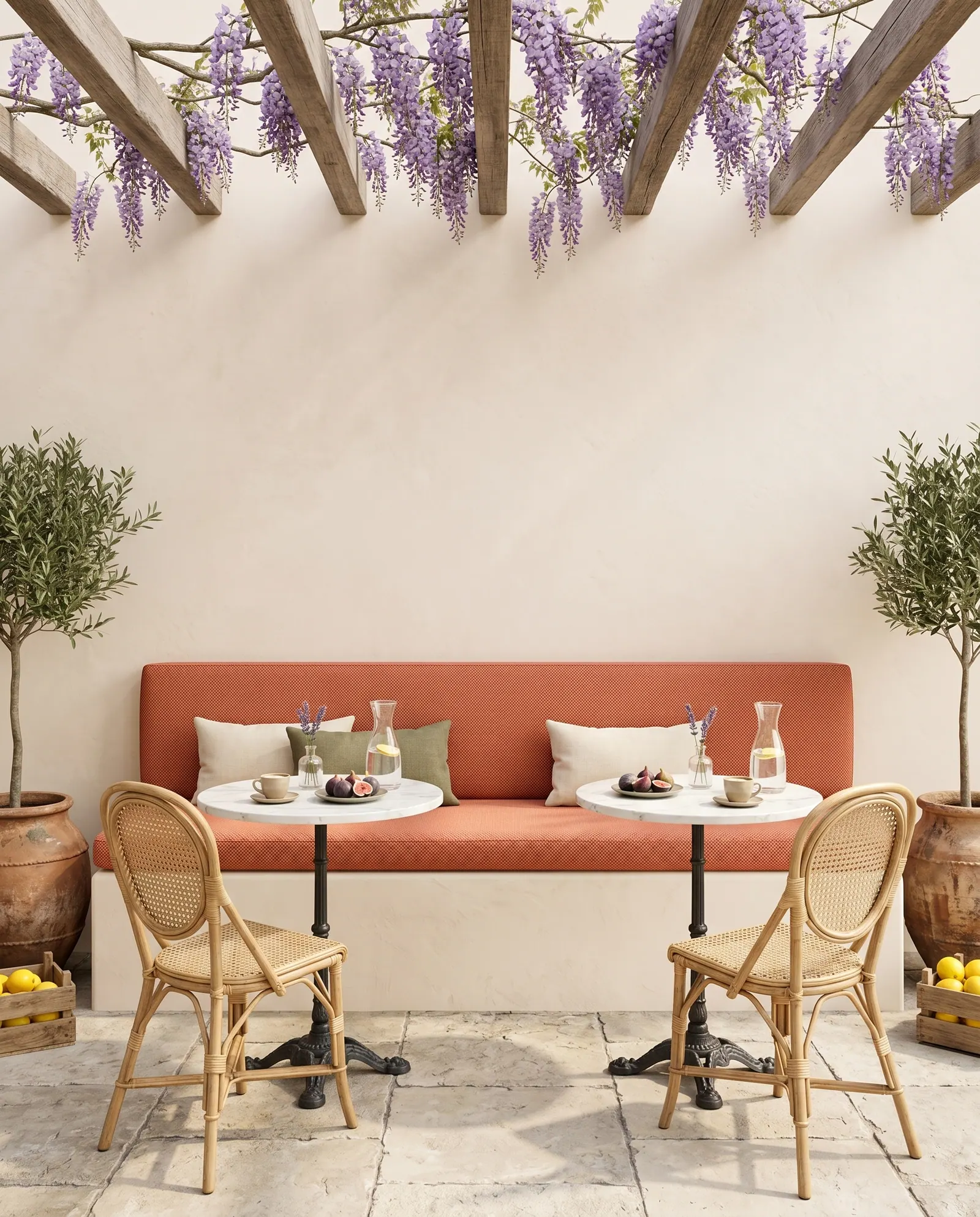
Take the cushions away and this terrace is a plastered ledge under a pergola. Put them back and two bistro tables have a banquette. One color does the work.
 Save
The quick answer
An outdoor banquette cushion set works best as a separate seat and backrest in one fabric code, with the back sitting flush on the seat so the bench reads as a single upholstered block. On this terrace, coral outdoor acrylic with self piping turns a bare plaster ledge into café seating, and the pergola's filtered shade keeps the color from bleaching.
The cushion, cut open
Cover fabric. A removable, zippered cover. Machine wash at 86°F (30°C) on a gentle cycle and air dry.
Piping. A fabric-covered cord sewn into the seams. It sits on the seam line, so it does not change the size.
Fiber wrap. Polyester fiber (Dacron) batting around the foam: it fills the cover out and softens the edges.
Foam core. About 2.0 lb/ft³ (32 kg/m³) high-resilience foam, firm to medium-firm, cut to the ordered size.
Zipper. Along the back band, as hidden as possible. The zipper side faces down or toward the wall.
Base panel. The underside of the cover. A non-slip fabric backing can cover the whole of it instead.
Before the cushions: a handsome ledge nobody lingers on
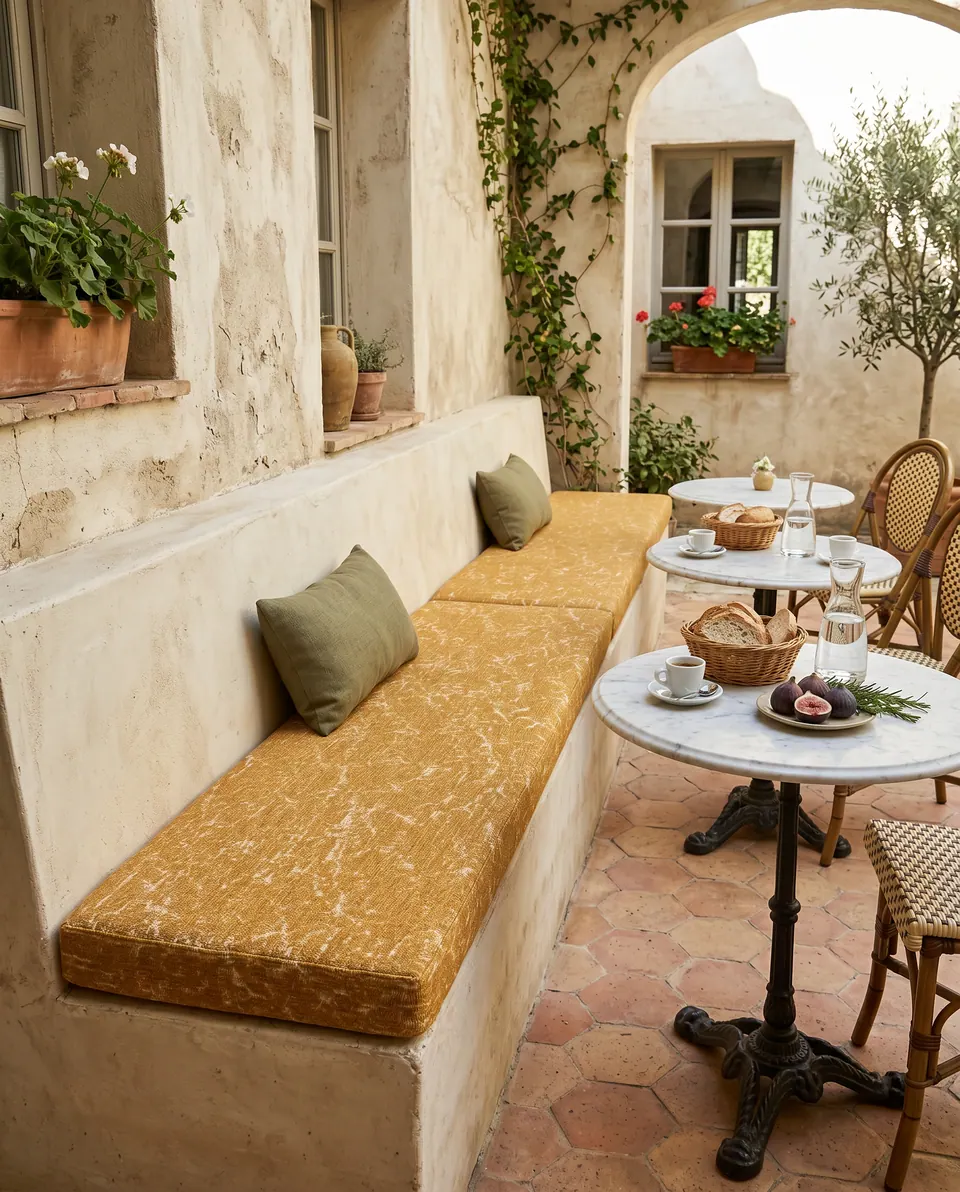
Picture it bare first. A long plastered block against a wall, limestone flagstones underfoot, wisteria on a timber pergola overhead. Handsome, and about as welcoming as a dock piling. Nobody lingers over figs on a bare ledge.
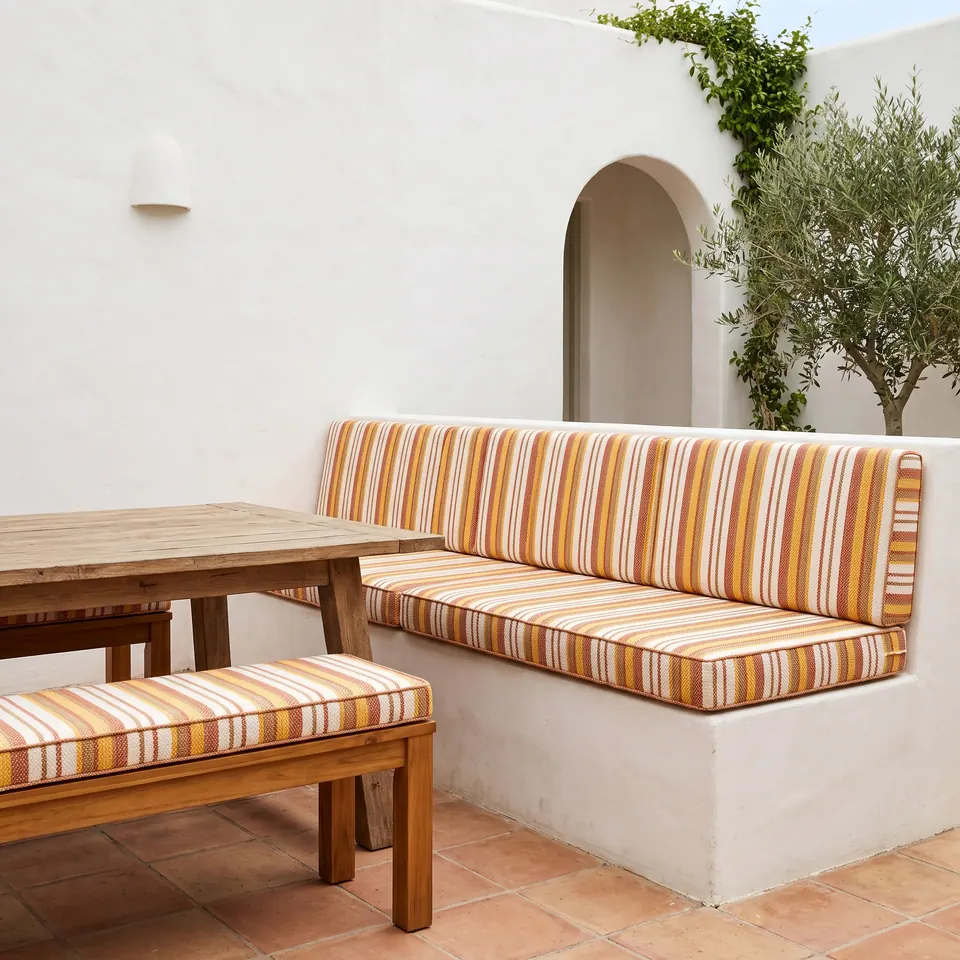
Now the after. One coral seat cushion runs the full length of the block, and a coral backrest sits flush on top of it, in the same fabric code. The piping is self piping, so the edges vanish into the color and the whole thing reads as one upholstered banquette. That's the makeover. Not a new wall, just foam and cloth cut to fit.
Sage and ivory scatter pillows are spaced to mark two place settings, one for each marble bistro table, rather than lined up like fence posts. The coral turns up again in the terracotta urns under the two olive trees and in the figs on each plate. Rattan cane bistro chairs close the open side of each table and pick up the honey tone of the pergola beams. Glass carafes, coffee cups, lavender sprigs in bud vases, a crate of lemons: café props, all small enough to leave the cushion the loudest thing in the frame.
The pergola does more than look pretty, friend. Filtered shade keeps a saturated color like coral from bleaching. The cloth comes from our outdoor acrylic family, made for patio life, but shade still buys you seasons. Rain doesn't negotiate, so bring the set under cover when a storm rolls in. More sheltered setups live under patio and porch cushions.
Five pins on a café banquette
Five pins, from the coral backrest to the wisteria overhead, showing how two cushions turned a terrace into a café.
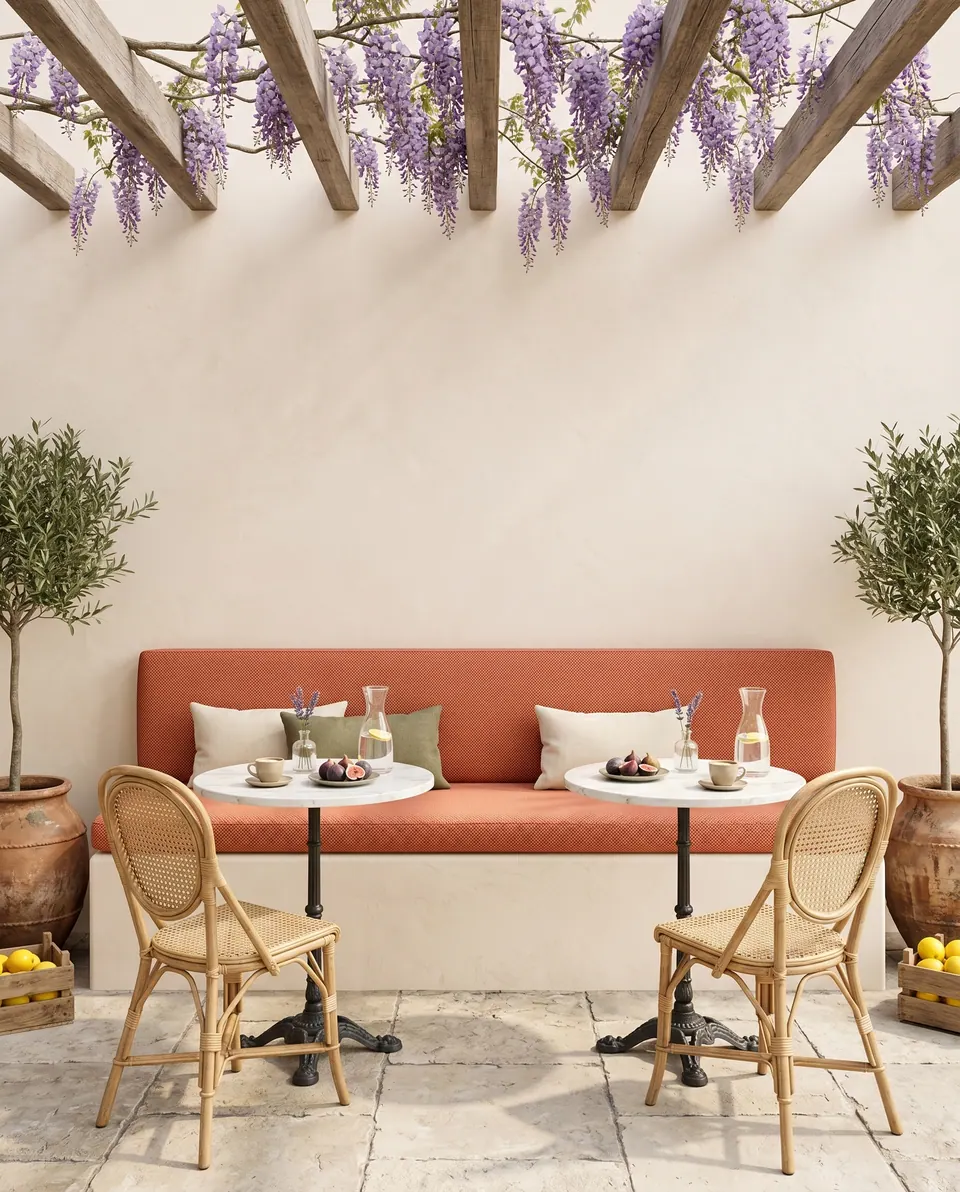
- Coral backrest cushion
A separate back panel lets the seat be deep enough for dining without the sitter sinking backward.
- Seat cushion edge
The seat matches the backrest exactly, so the banquette reads as one upholstered block.
- Ivory and sage pillows
Pillows in olive-leaf green and ivory cool the coral down without adding a pattern.
- Rattan bistro chair
Cane chairs on the open side mirror the honey tones of the pergola beams.
- Wisteria pergola
Filtered shade from the pergola keeps a saturated color like coral from bleaching.
- Coral backrest cushionA separate back panel lets the seat be deep enough for dining without the sitter sinking backward.
- Seat cushion edgeThe seat matches the backrest exactly, so the banquette reads as one upholstered block.
- Ivory and sage pillowsPillows in olive-leaf green and ivory cool the coral down without adding a pattern.
- Rattan bistro chairCane chairs on the open side mirror the honey tones of the pergola beams.
- Wisteria pergolaFiltered shade from the pergola keeps a saturated color like coral from bleaching.
Cross-section: the banquette from stone to shoulder
- Limestone flagstones and a plastered block: the base, left exactly as it was built.
- Seat cushion: box edge and self piping, cut to the full length of the block.
- Backrest: a separate cushion in the same coral code, roughly a third of the seat depth, sitting flush on the seat.
- Back thickness: buyers often ask for the back a few centimeters, about an inch, thinner than the seat, which keeps the profile tailored.
- Pillows: sage and ivory, one pair per table, to mark where people sit.
- Canopy: wisteria on timber beams, the filtered shade that protects the color.
A kitchen nook where the wall set the height
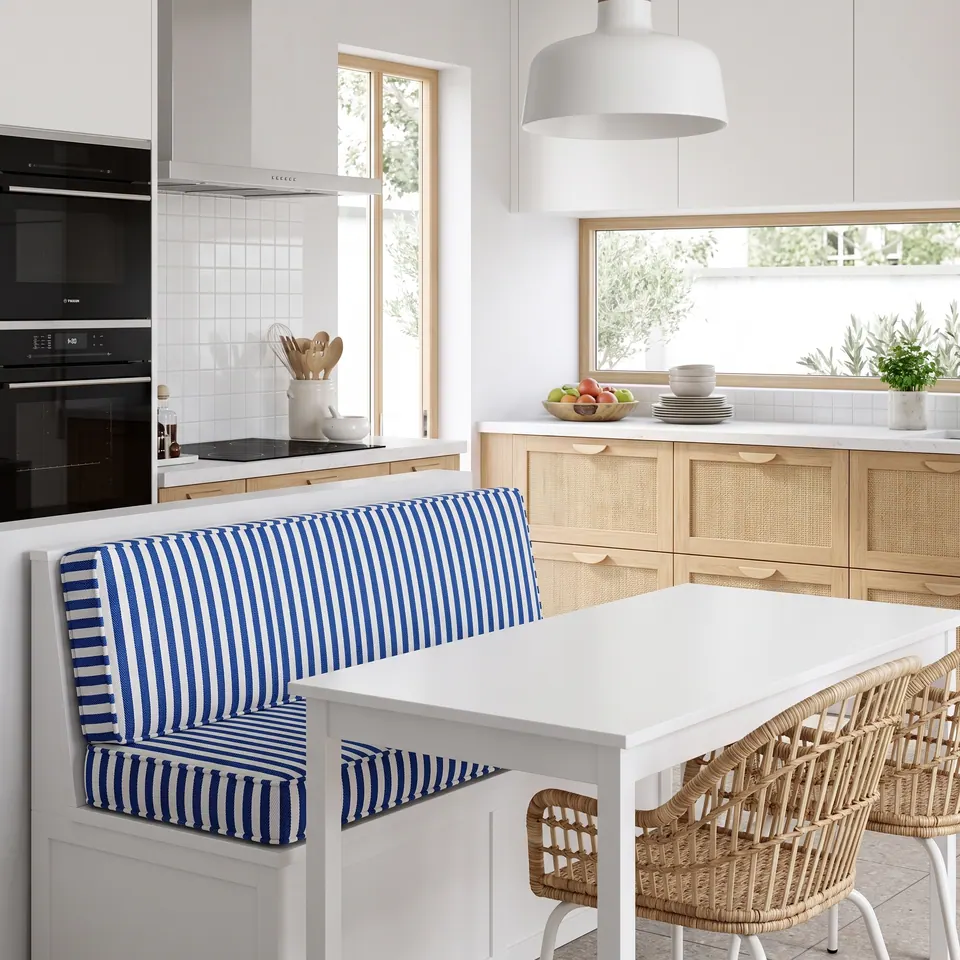
A buyer wrote to the workshop about a U-shaped kitchen dining nook that gets heavy daily use, with a cut-out divider wall behind one bench. That wall made the rule: backrests no taller than 15 in (38 cm). They also asked for commercial-grade foam.
The workshop confirmed 32-density medium-firm foam, backrests 14.5 in (37 cm) high and 3 in (7.5 cm) thick, on 2 in (5 cm) seats. The seats measured 17.75 x 50 in (45 x 127 cm), with two more at 17.75 x 62 in (45 x 157 cm), in fabric P-56, picked after comparing P-57, P-54 and P-50. For the back bench, the workshop recommended two back cushions rather than one long cushion dressed with small pillows, and said exact, snug measurements were right.
Nine pieces went on one order, placed during a sale, and the workshop offered a second set of covers in another color later at half the cushion price.
Same lesson as the terrace. Low backs work around obstacles; order exact sizes and match the seat and back lengths so the run reads as one piece. The banquette thickness and table height Pattern has the numbers. What sits behind your banquette: a wall, a window or a divider?
Buyer questions: sage greens, odd shapes and covers alone
- A common question
Which of your linen colors is closest to sage green?
The workshop's answerL-24: a soft, muted gray-green, squarely in the sage family. L-25 is the other green, but it is darker and cooler and not a sage. The workshop sends close-ups on request and can photograph L-24 next to a warm neutral such as L-54.
- A common question
My bay window seat is an unusual shape. Can I send a picture with measurements and get a quote?
The workshop's answerYes. Send the shape with every measurement marked on it. One unusual bay window cushion was quoted as a single total that already included taxes and delivery to the door.
- A common question
Can I order just the cover for a trapezoid window seat?
The workshop's answerYes. Send every exact measurement, ideally on a drawing with each side labeled, and the workshop will quote the cover on its own.
On the cutting table: the terrace banquette
| Pieces | Long seat cushion plus a separate backrest |
|---|---|
| Fabric | Coral outdoor acrylic, one code (0820) for both |
| Piping | Self piping in coral |
| Edge | Box edge on seat and back |
| Back depth | About a third of the seat depth, sitting flush on the seat |
| Back thickness | Often ordered about an inch thinner than the seat |
| Pillows | Sage and ivory, one pair per table |
| Best for | Café-style terraces and covered patio banquettes |

Have it made
Have this made — ask Callum’s workshop
Short list: size, sun hours, how fast it has to dry. The workshop goes through it with you. — Callum
Leave your details and the workshop will call you to confirm measurements, fabric, foam and piping. No prices, dates or payment on this page: it is a request, not an order.
On an outdoor banquette, order the seat and backrest as two cushions in one fabric code; a back about a third of the seat depth keeps diners upright.
Callum
Questions buyers ask next
How deep should the backrest be on a dining banquette?
On this terrace the backrest is roughly a third of the seat depth and sits flush on the seat. That proportion keeps diners upright at table height, instead of letting them sink backward away from their plates.
Should outdoor banquette pillows match the cushion color?
They don't have to. Here sage and ivory pillows cool the coral down without adding a pattern, and they are spaced to mark place settings. Pull pillow colors from the plants, stone or pots already on the terrace.
Is self piping or contrast piping better on a bold outdoor color?
Self piping lets a single bold color read as one solid block, as on this coral banquette. Contrast piping outlines each cushion separately, which suits pale fabrics that need a crisp edge more than saturated ones.
Fair winds — Callum