Patio and porch outdoor bench cushions, built for the worst day of the season
Out here the weather writes the spec. These are the patio, porch and backyard cushions buyers ask us about most, with the measurements, the build and the few mistakes that send a cushion back to the cutting table.
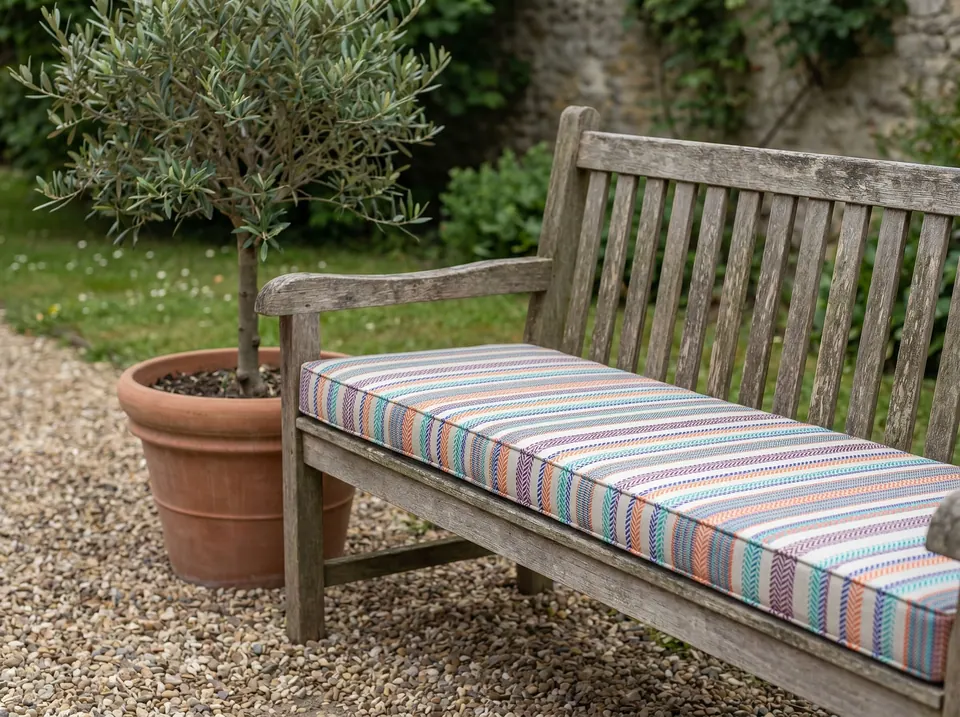
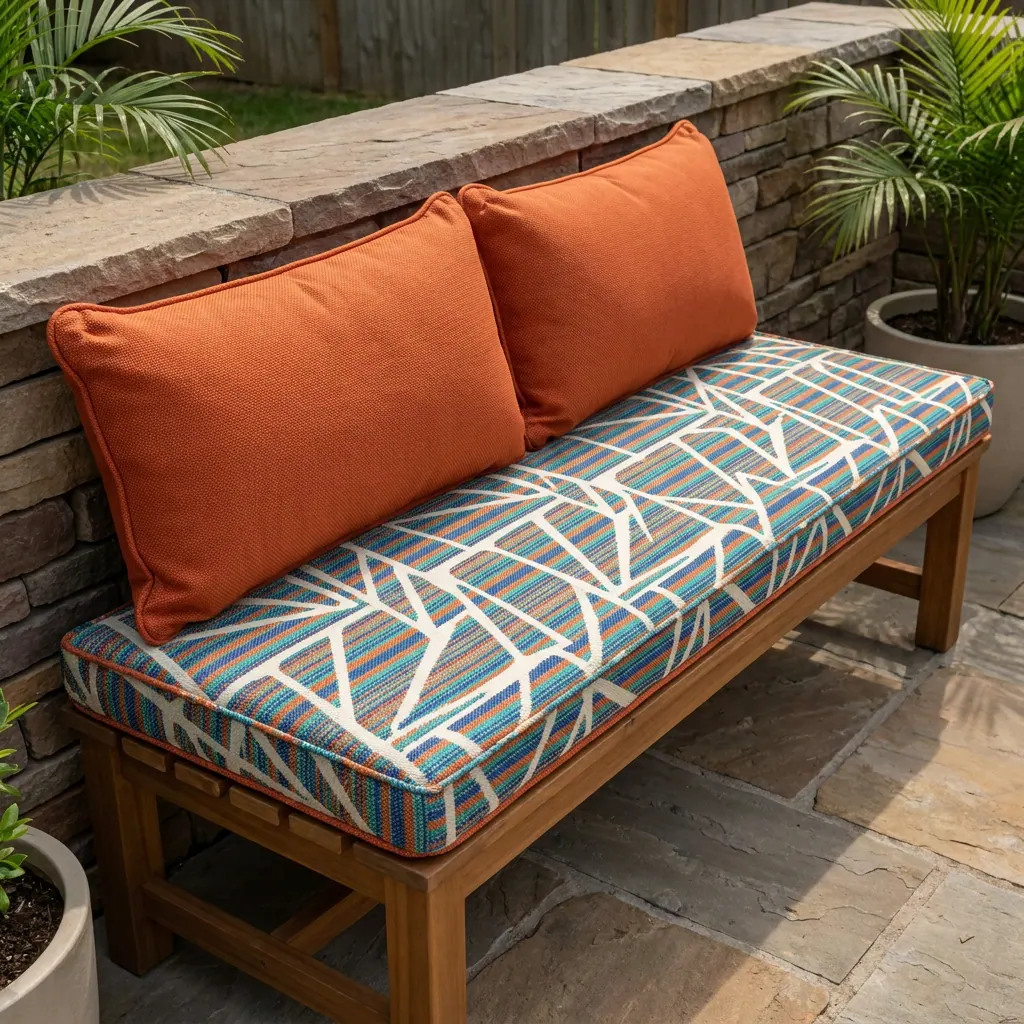
SaveA lively outdoor weave of fine teal, blue and orange stripes crossed by white branch lines, paired with solid burnt orange pillows on a teak patio bench.
The quick answer
A patio bench cushion should be a plain, non-tufted foam cushion in outdoor fabric, 4 in (10 cm) thick unless your seat height says otherwise. Tufting lets water in even when the fabric is made for outdoors. Measure the bench itself, add ties or a non-slip base on narrow seats, and bring the cushions indoors for the off-season.
Every one is cut to your measurements. The number is how many readings the atelier has published for that shape.
Sizes & measuring
On the cutting table: outdoor sizes and what to measure
Measure the bench, not the old cushion. Length first, then depth, then the thickness you want.
How to measure Seen from above, the cushion fills the frame: measure length and depth inside it, wood to wood. Seen from the front: the thickness you want.
Standard thickness
4 in (10 cm); outdoor quotes assume it unless you ask otherwise
Thinnest foam cushion
2 in (5 cm); about 1 in (2.5 cm) only without piping
Outdoor build
Plain, non-tufted foam cushion; tufting lets water in
Front overhang
Up to about 2 in (5 cm) past the bench edge with an inner support wrap
L-shaped corner bench
End-to-end length of each leg, the seat depth and thickness; outside and inside measurements also work
Rounded or curved end
A measured sketch showing where each curve starts and ends, or a paper template photographed beside a tape measure
Cover
Zippered and removable, zipper hidden on the back edge or underside; bench covers often zip around two corners
Staying put
Ties at the corners or back on request, or a non-slip base across the whole bottom panel
Who sits outside, and what the cushion has to survive
The first thing a patio cushion meets isn't a person. It's weather. Sun on the teak at noon, dew by six, a squall over the fence on a Tuesday afternoon.
This corner of the Atlas covers the outdoor seats buyers ask us about: a patio bench cushion on teak or cedar, box pads for Adirondack chairs, L-shaped cushions for masonry corner benches, a balcony bench in a city apartment, the seat by the pool. Swings have their own page under porch swing cushions, loungers under chaise and sunbed cushions, and fabric-by-fabric weather advice sits with outdoor and water-repellent cushions.
The people writing in have a backyard, a porch, or a balcony exactly one bench wide. They all want the same thing: a cushion that is still square in September.
Plain box edges, and why the buttons stay indoors
Outside, the bench decides the shape and the weather decides the build. Most cushions in these photographs are box-edged foam: flat top, straight sides, piping or none.
What you won't find on a good patio bench is tufting. Tufted cushions let water in even when they're sewn in outdoor fabric, so outdoor seats are made as plain foam cushions. Keep the buttons for the living room floor cushion.
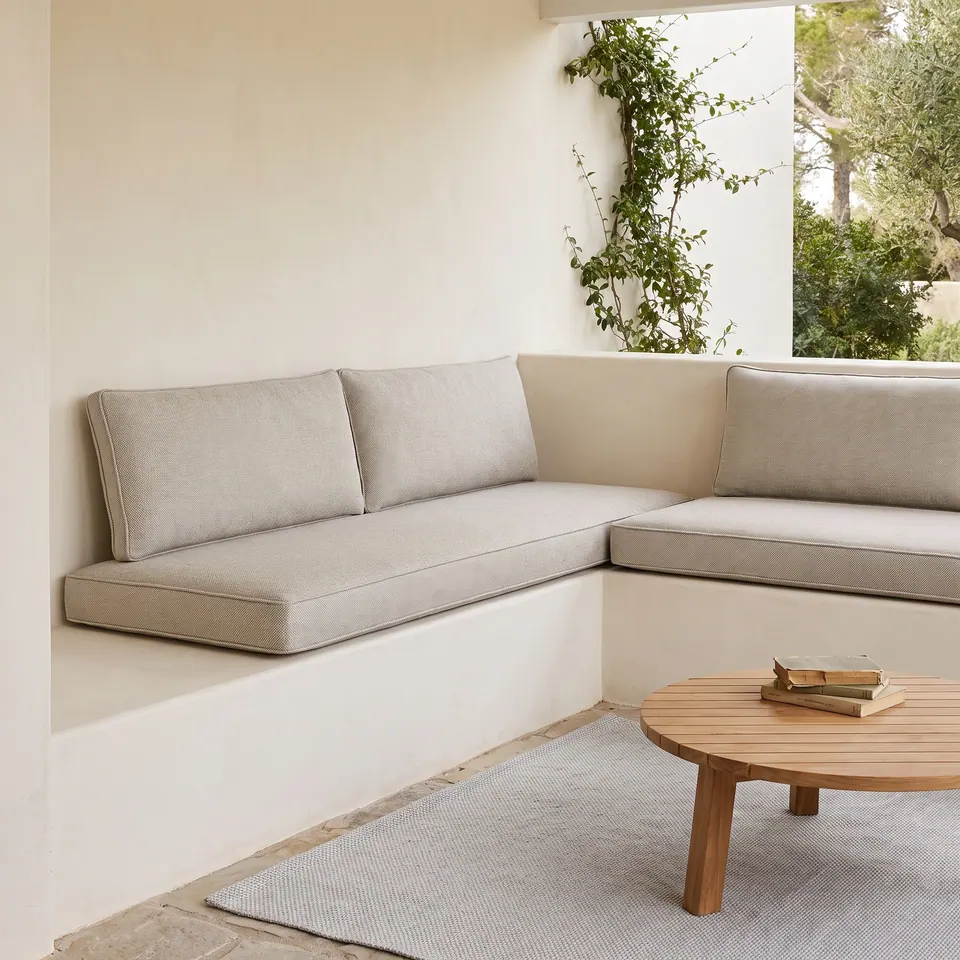
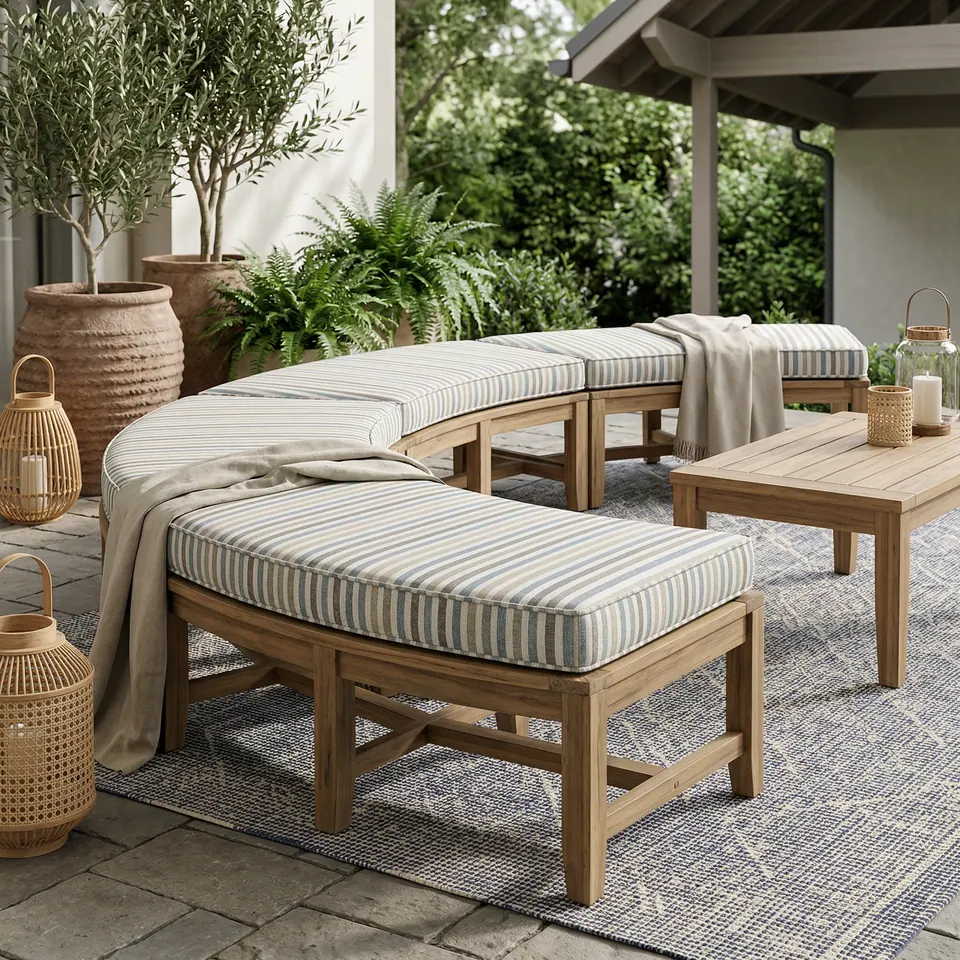
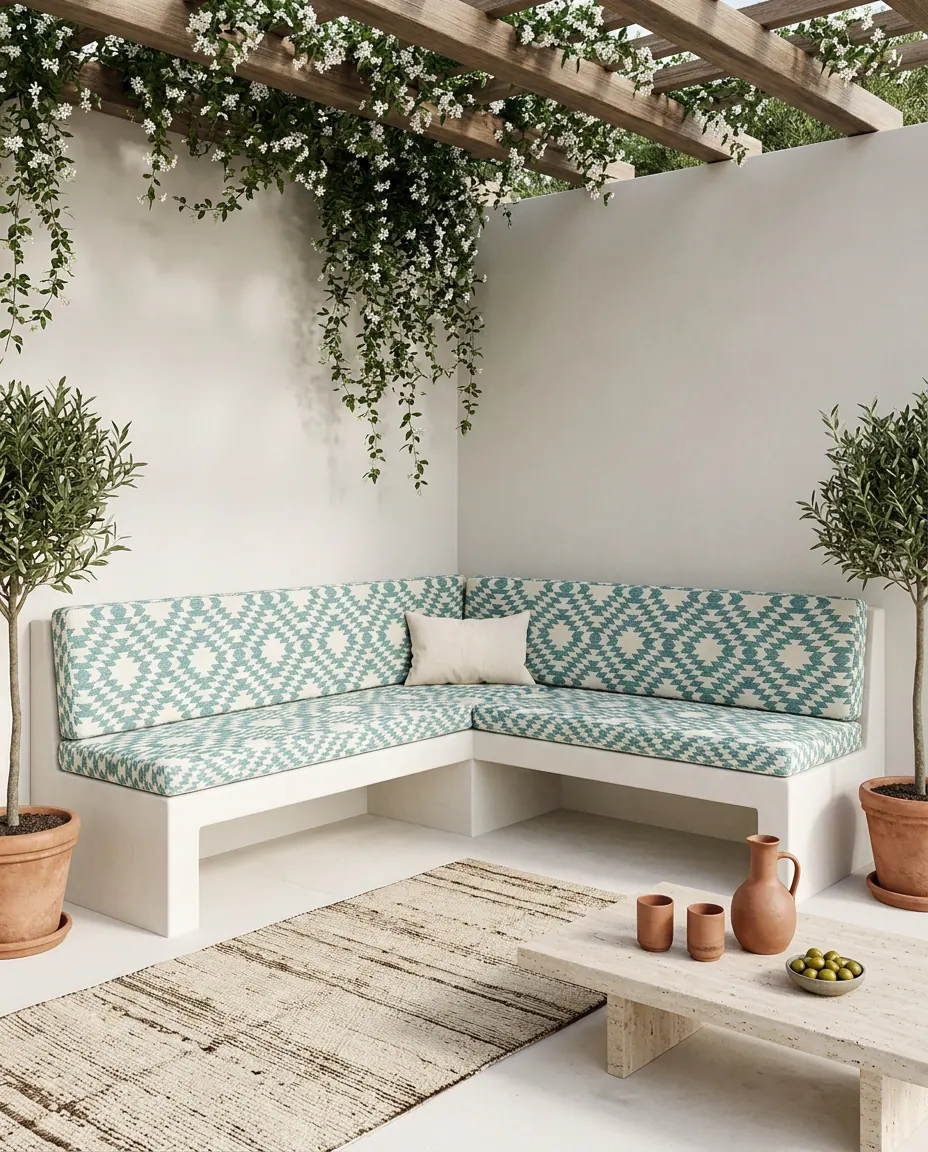
Corners and curves are fair game. A masonry corner bench takes an L-shaped cushion in two pieces. A bench with a rounded end is traced on paper and cut to the template. Benches around a fire pit have their own fire pit bench sketches.
Outdoor fabric: what goes on the bench, what stays in the house
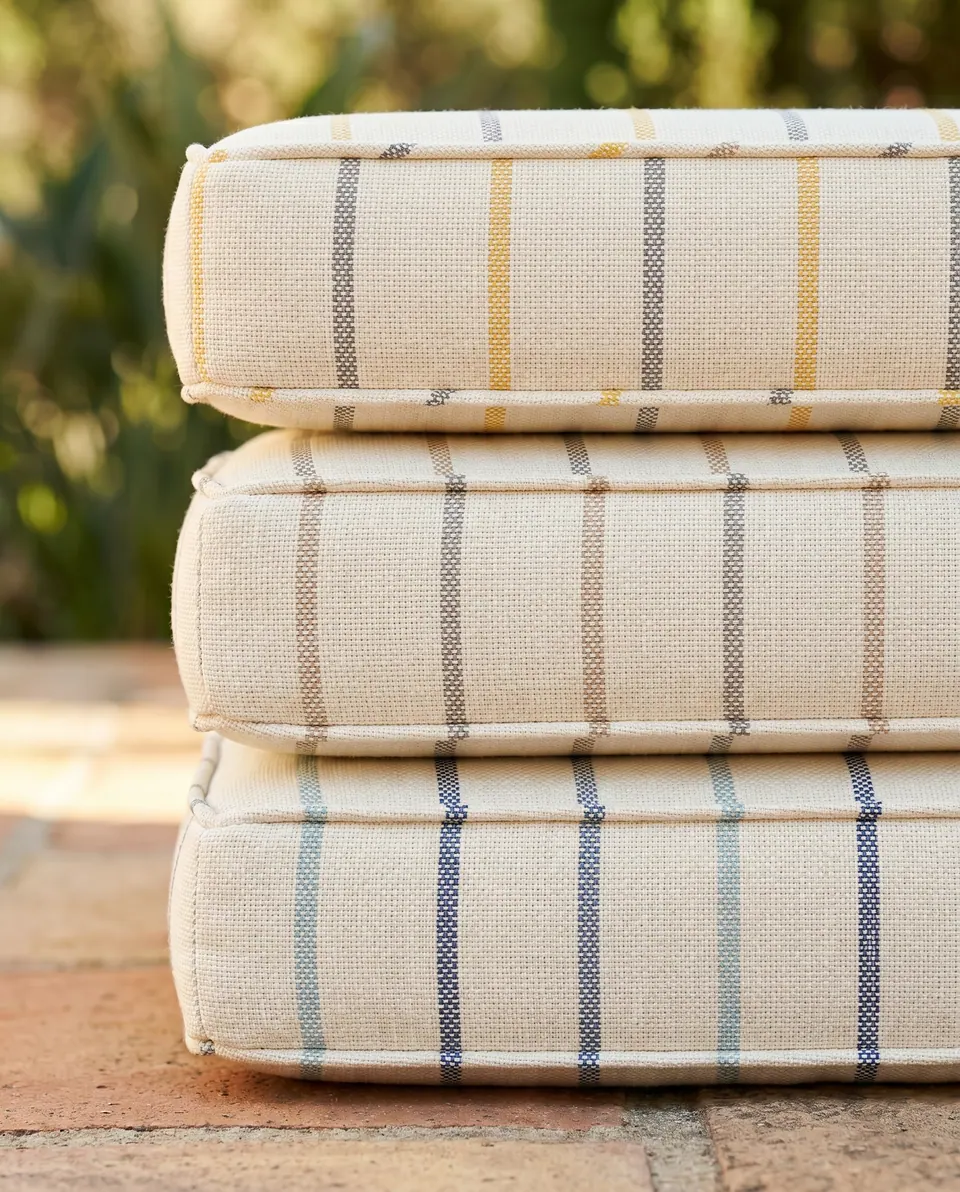
Stripes are the patio's native tongue: coral and white on weathered teak, sage and white along a fence. Before you fall for one, know this. The fabric roll is about 55 in (140 cm) wide, so on a long cushion the stripes run front to back by default, and a very long striped piece needs a seam. Stripes are matched on one face only.
A roofed porch with walls on two sides is a different animal. Whether indoor fabric belongs there is answered in indoor cushions on a covered porch.
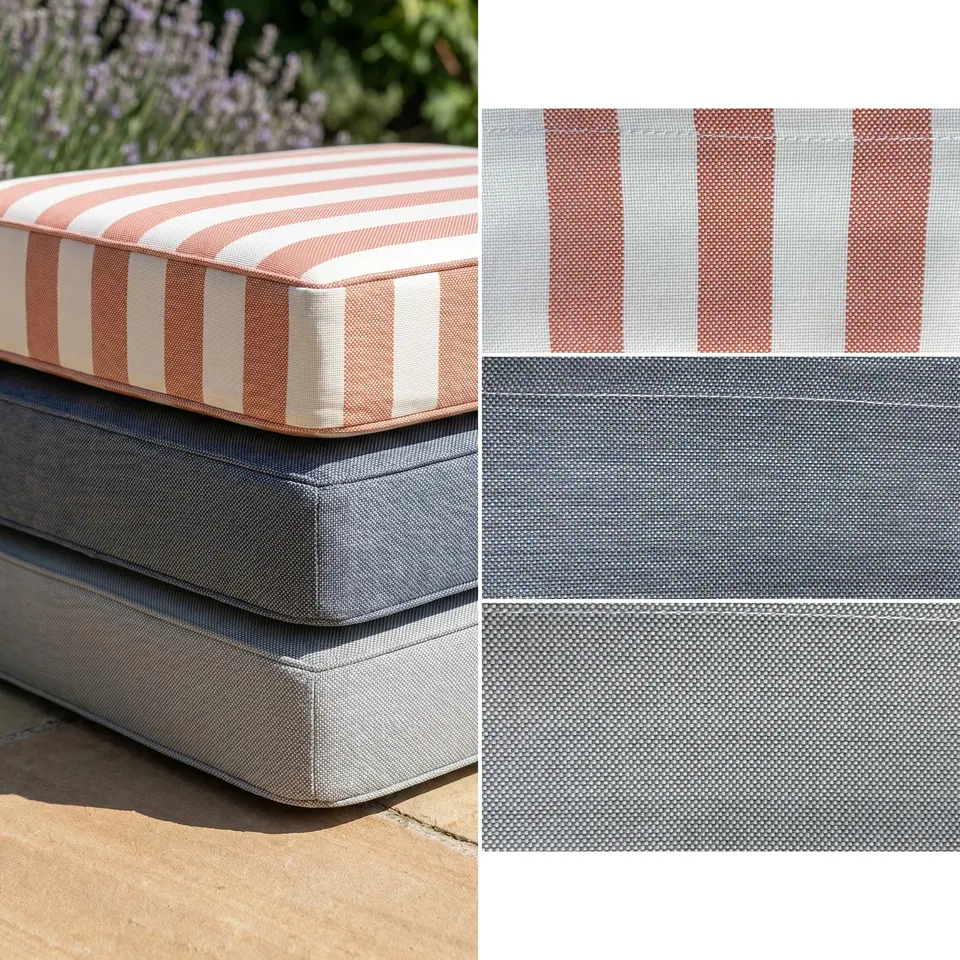
The count is how many published readings use each family. Open a family for its swatch book, care notes and neighbors.
Foam, thickness and the off-season
Outdoor quotes assume 4 in (10 cm) of foam, and most buyers keep it. Firmness runs roughly 6 to 7 on a 10-point scale, and a backrest comes softer than the seat unless you ask for them to match. High-density foam gives the flat, structured look on the teak benches above.
Then the chore nobody likes. Treat the covers with a fabric protectant spray, and store the cushions indoors when the season ends. Garage shelf, basement, spare closet. Somewhere dry.
A real project
Ninety inches of corner bench, planned as two pieces
A buyer wrote to the workshop about an L-shaped bench and, instead of each leg's length, sent two sets of numbers: 90 x 55 in on the outside, 72.75 x 39 in on the inside.
That was enough. Outside and inside dimensions give you the depth of every run. Before quoting, the workshop checked two things: that the numbers really were inches, not centimeters, and that the layout really was an L. Then the workshop planned the seat as two pieces, 82 x 18 in and 29.25 x 18 in, and sent the split back for a yes.
Backrests came last. On an L they can run along one side only, a foam wedge along the longer run, for instance. The seats stayed at the standard 4 in: flat, plain, no buttons.
Measured
Outside 90 x 55 in, inside 72.75 x 39 in; seat pieces 82 x 18 in and 29.25 x 18 in
What it taught
Outside and inside L measurements are enough; the workshop plans the two-piece split and confirms it before quoting.
Where patio cushion orders go sideways
Tucking 'add ties' into the size box. Ties come only on request, and a note among the numbers gets overlooked. Write position, length and color, then confirm by message.
Leaving a light foam cushion loose on a narrow bench. It slides when you sit. Order ties or a non-slip base with the cushion.
Cutting a cushion exactly to a slim seat and hoping it stays. With nothing to grip, it moves; a slightly larger size or a non-slip base solves it.
Ordering button-tufted cushions for an open patio. Tufting lets water in, whatever the fabric.
Approving the pre-dispatch photo without looking for the small extras: ties, straps, the non-slip base.
Assuming a non-slip bottom goes in the washer. Ask first; the newer washable version adds about a week.
Photographs from the workbench
Open any photograph large; each one has its own link and a Save button.
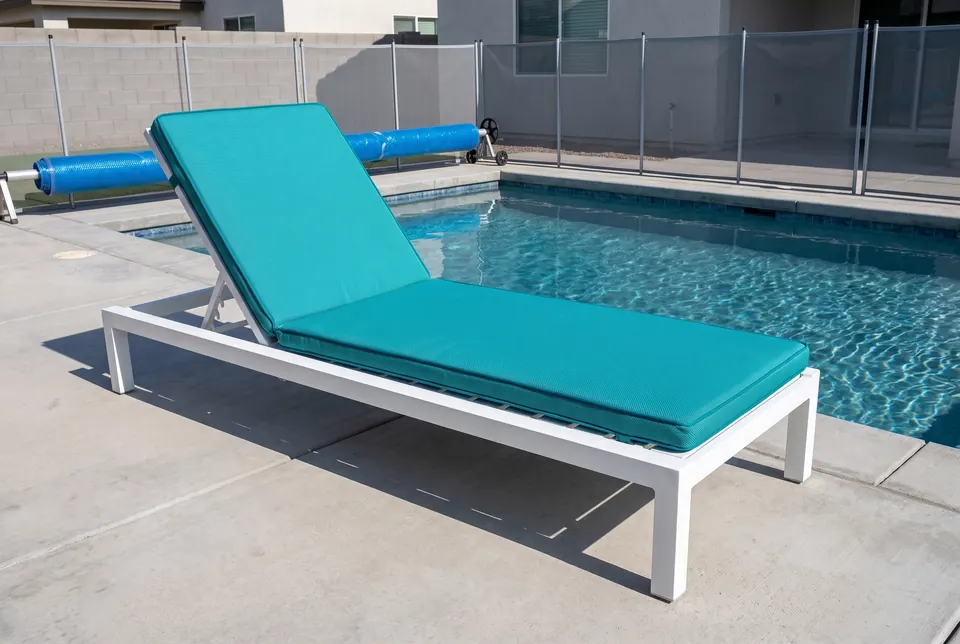
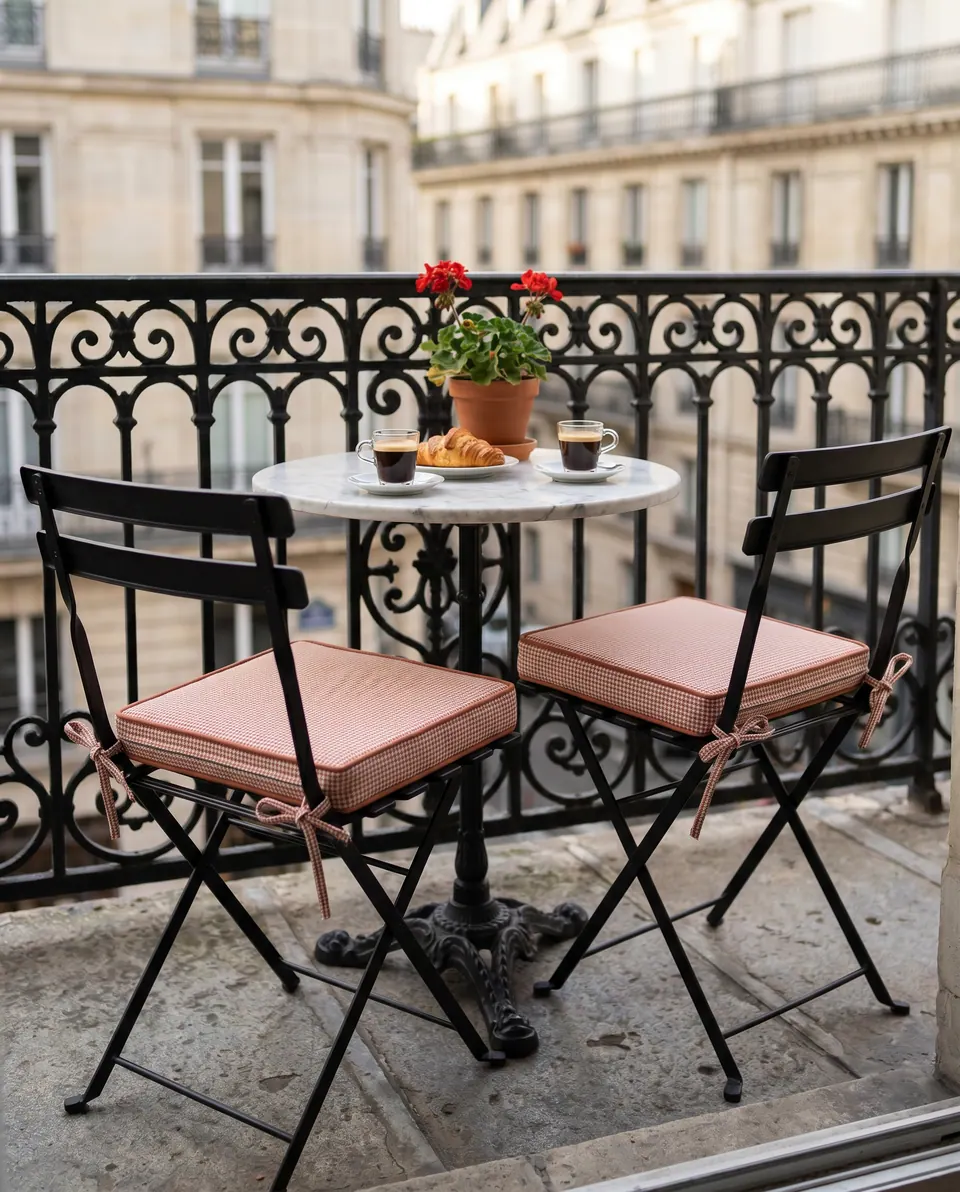
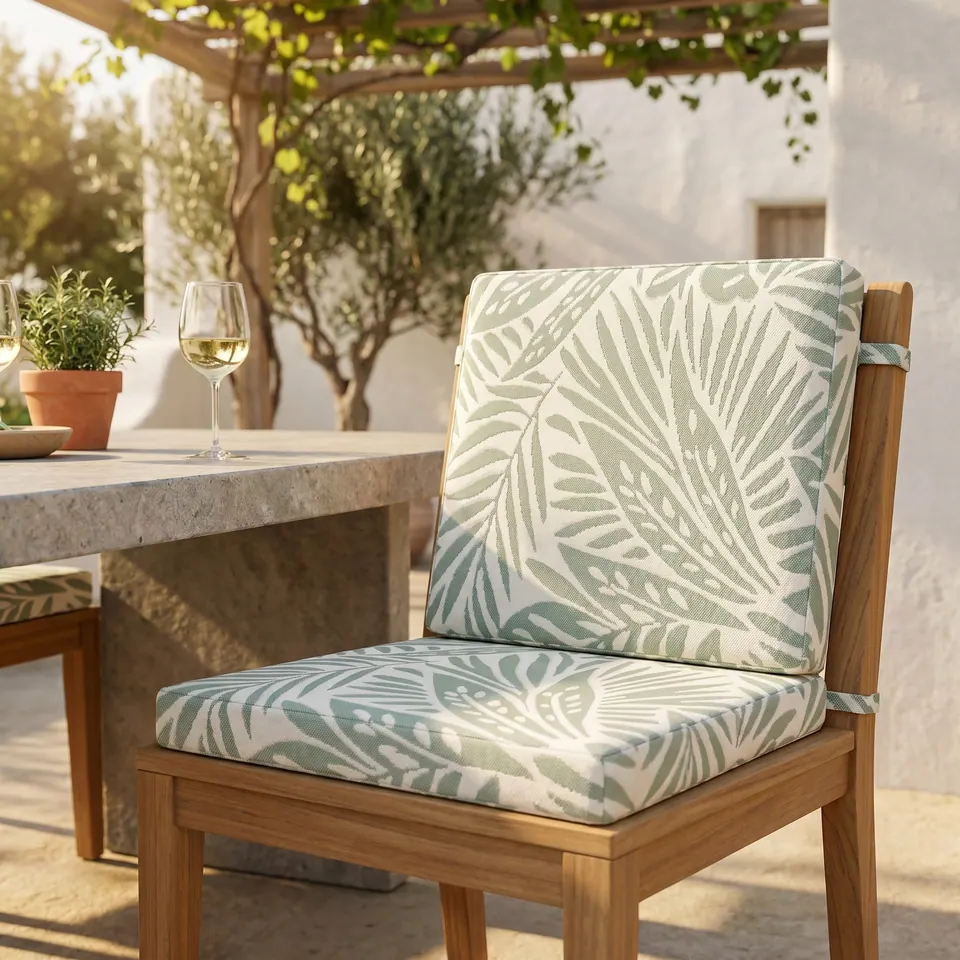
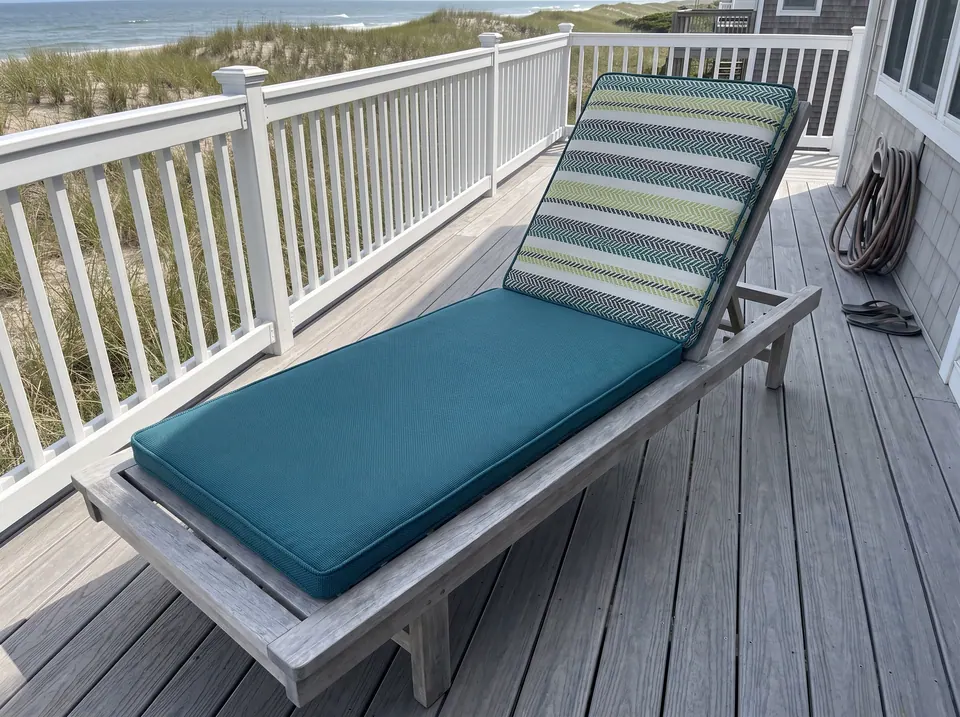
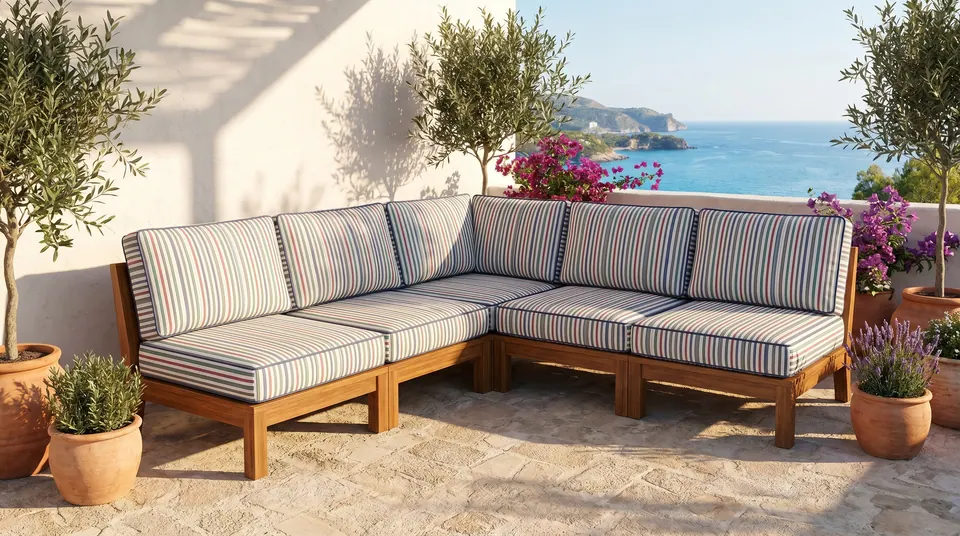
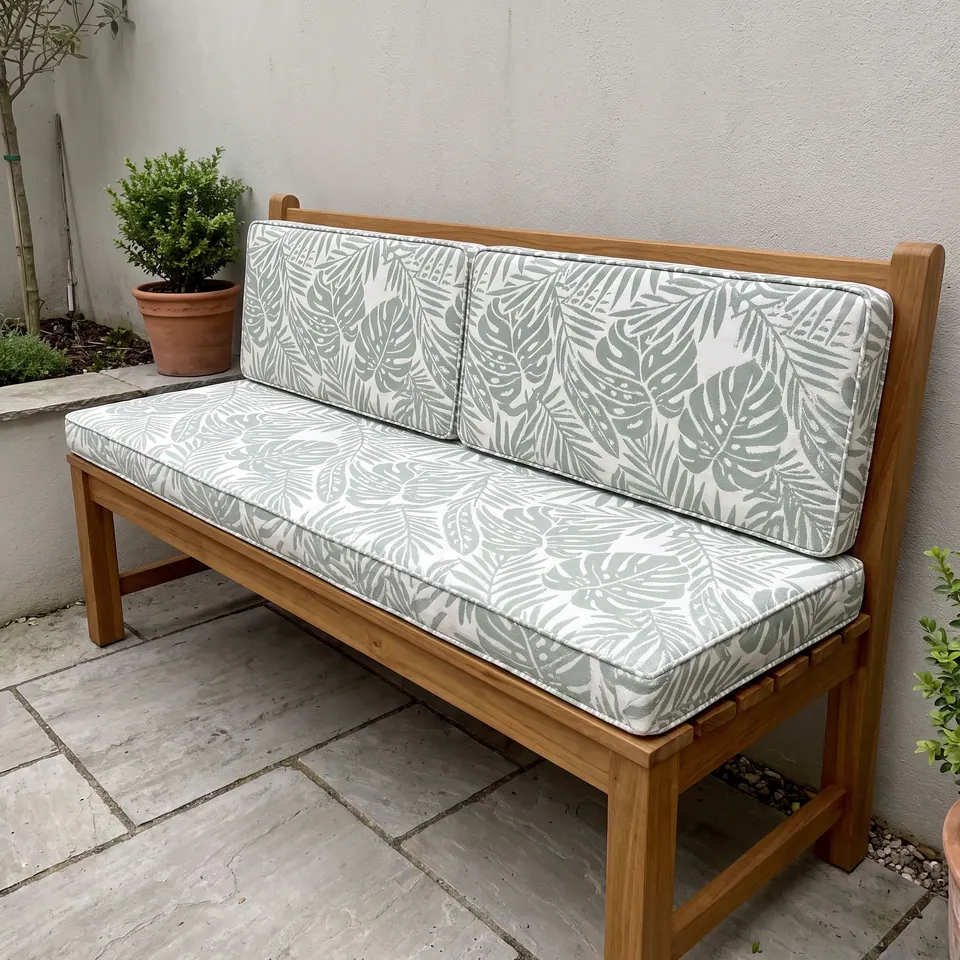
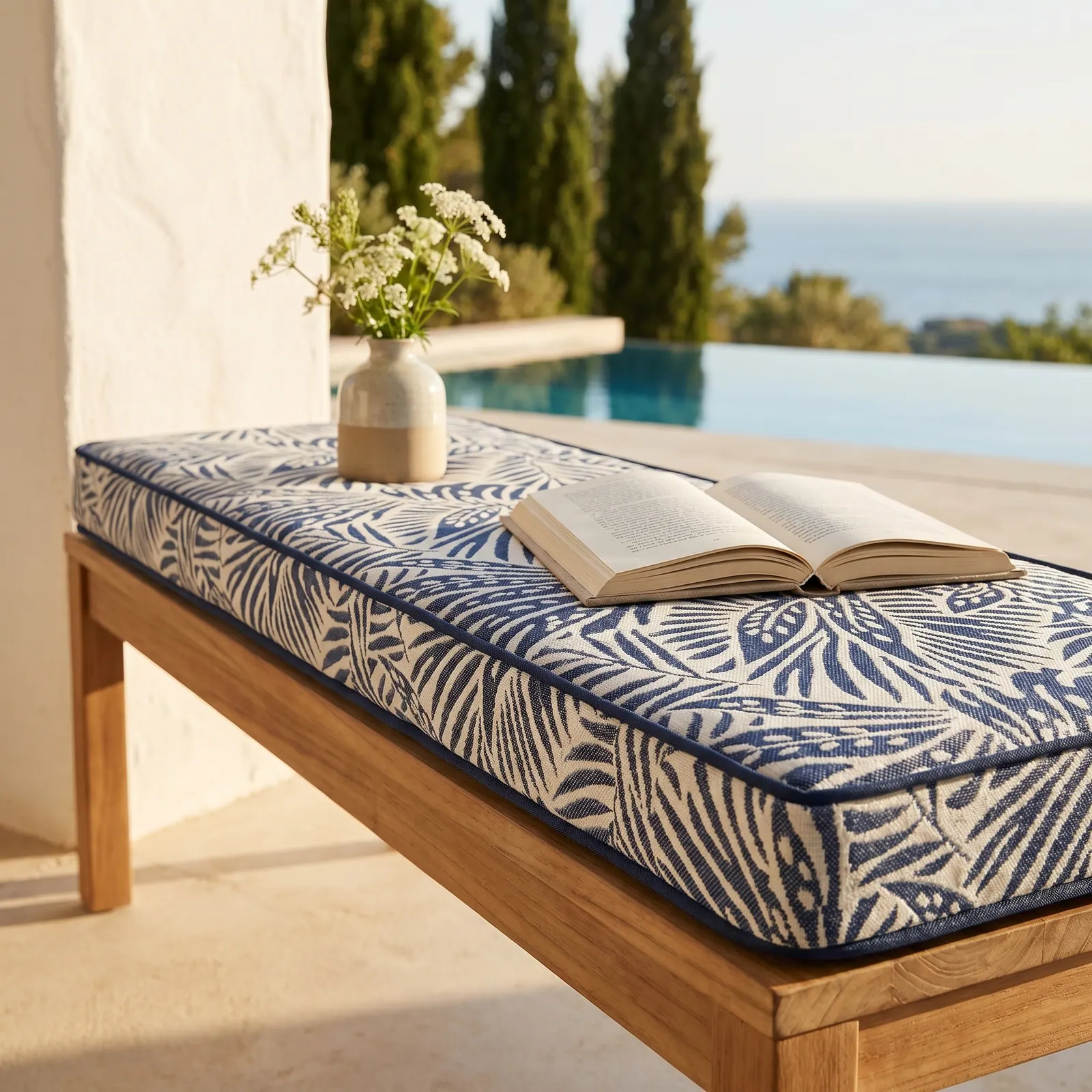
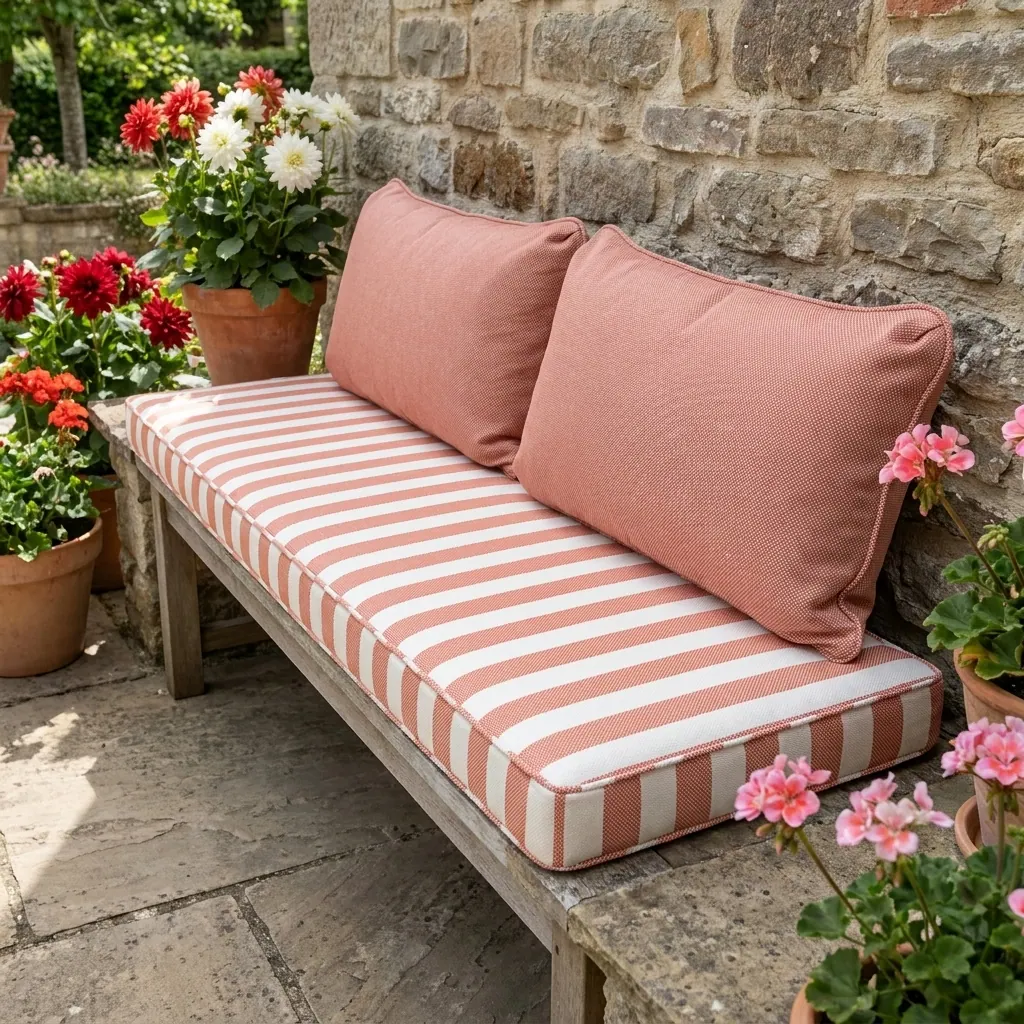
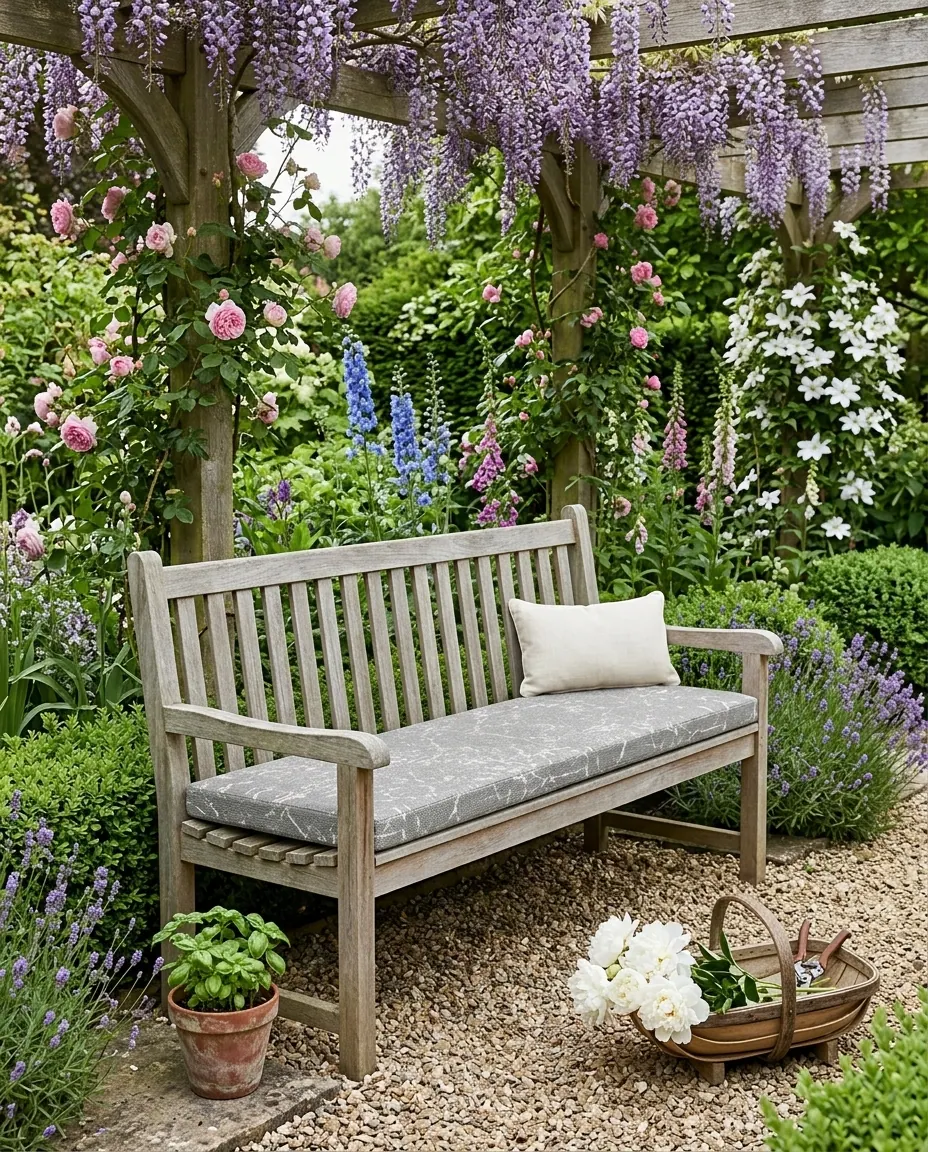
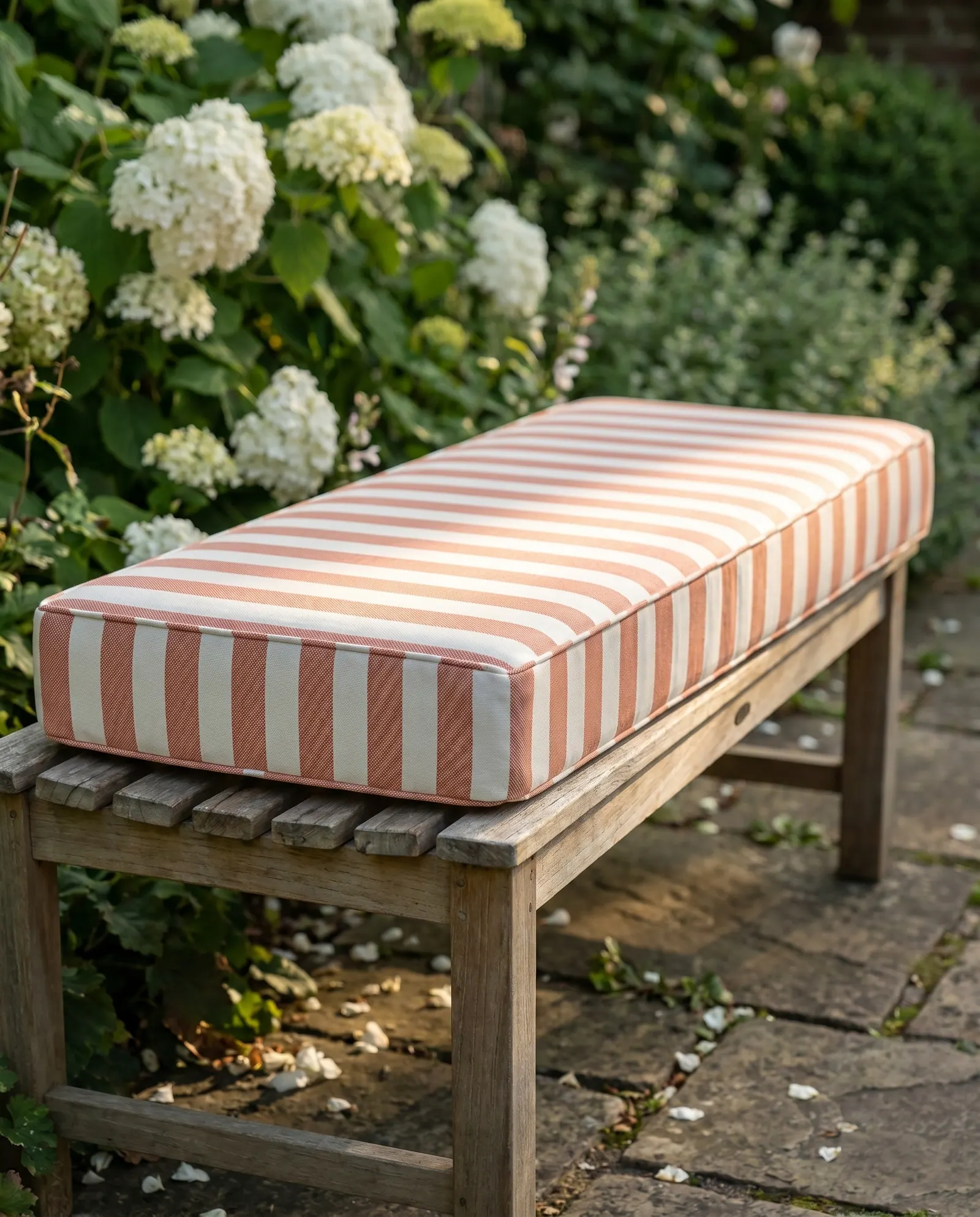
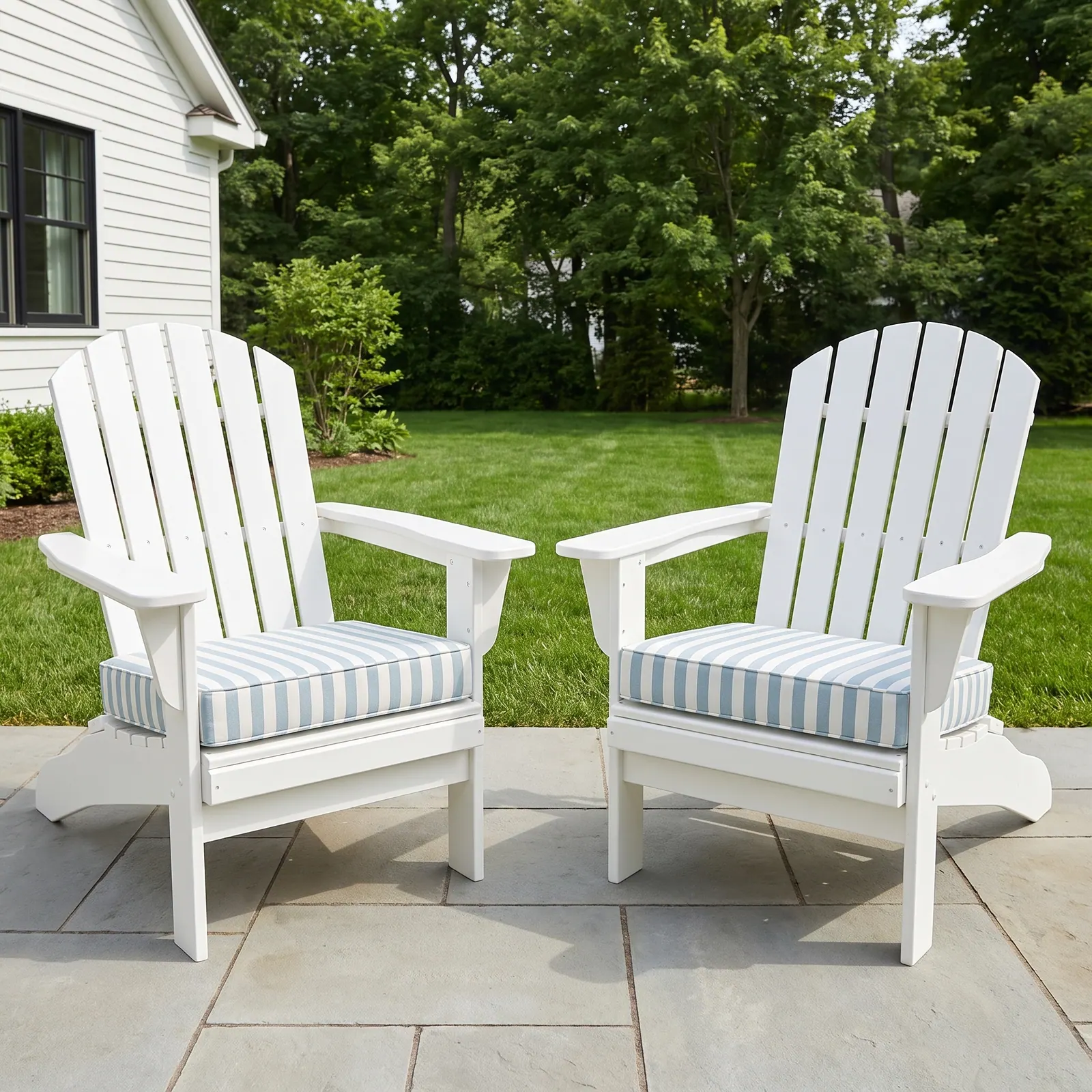
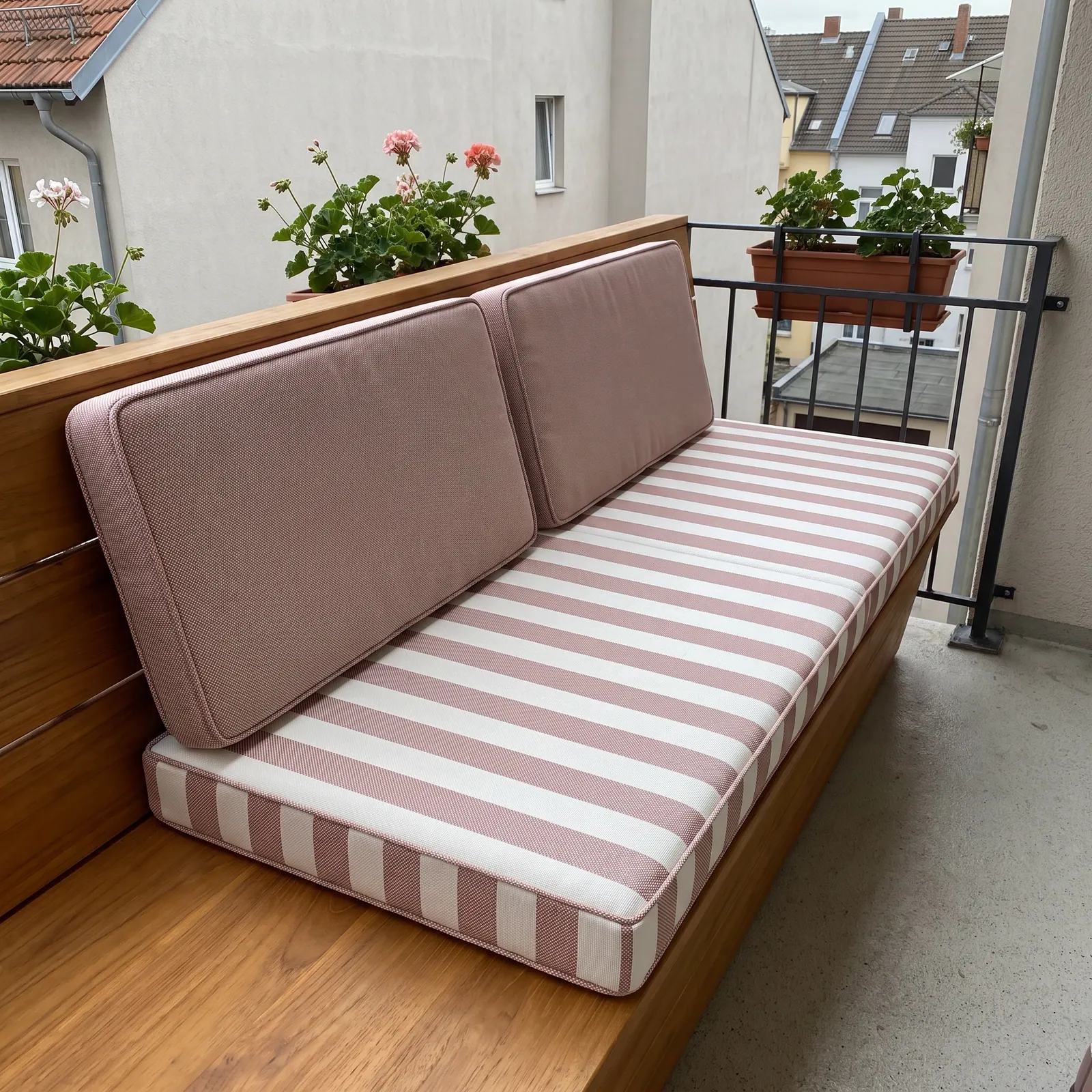
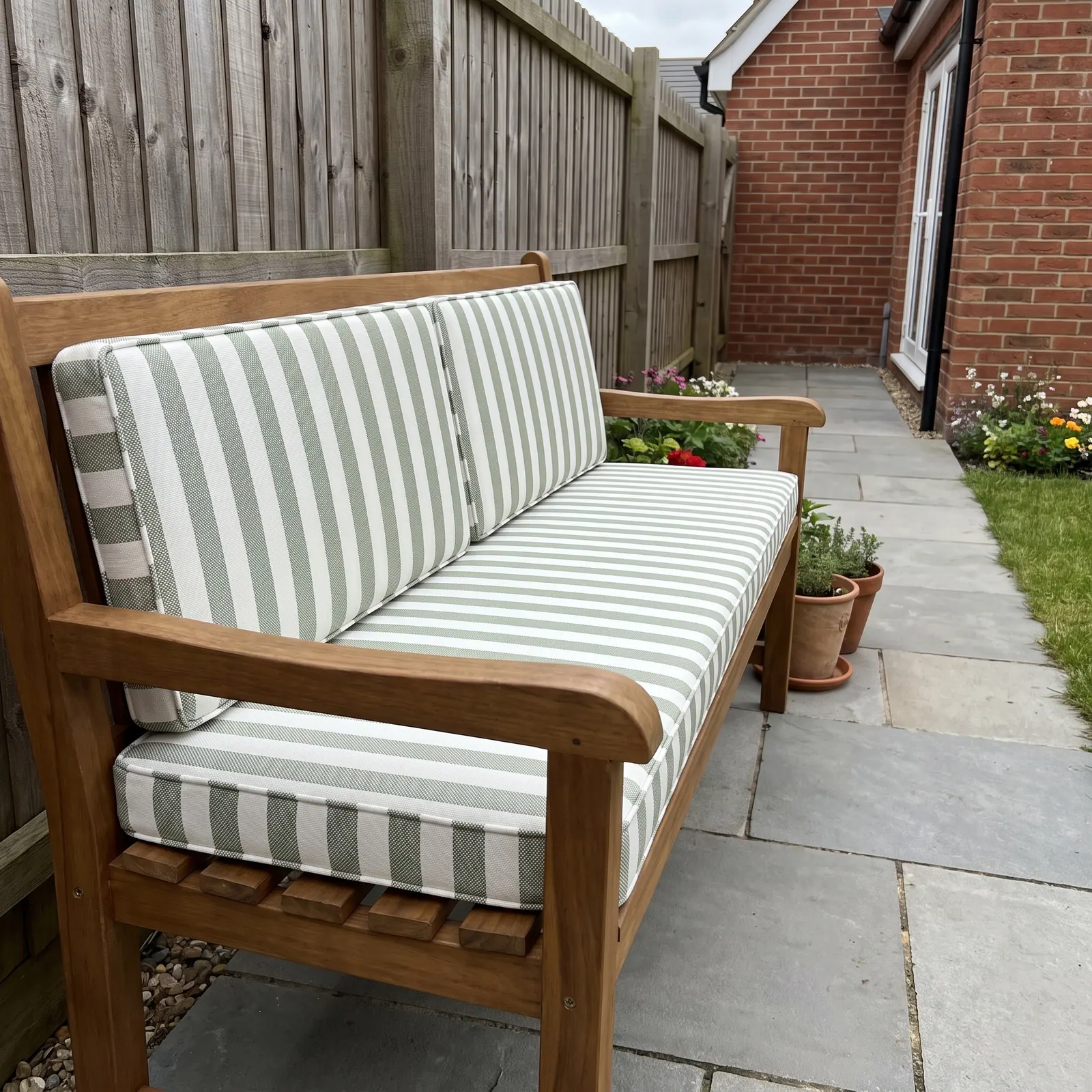
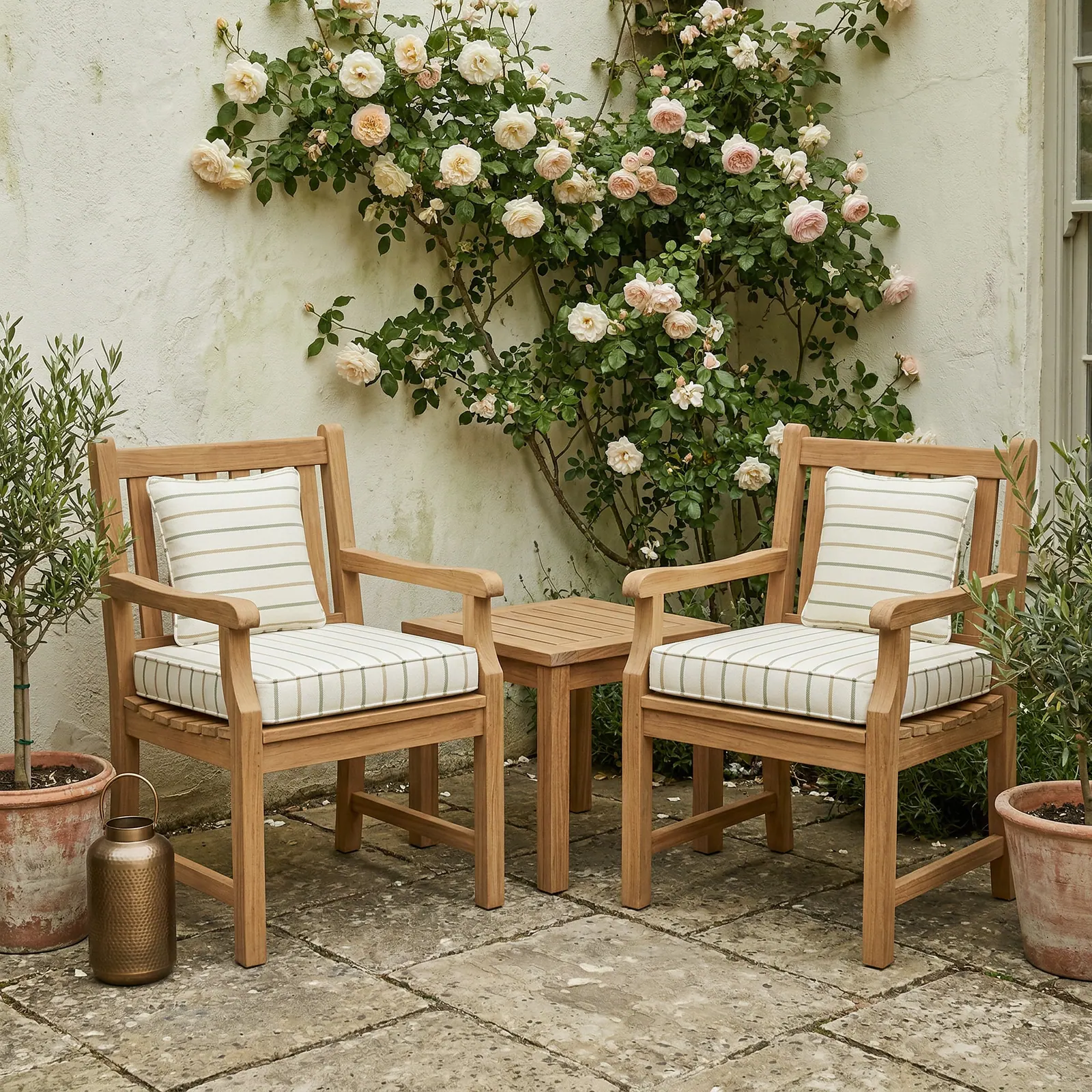
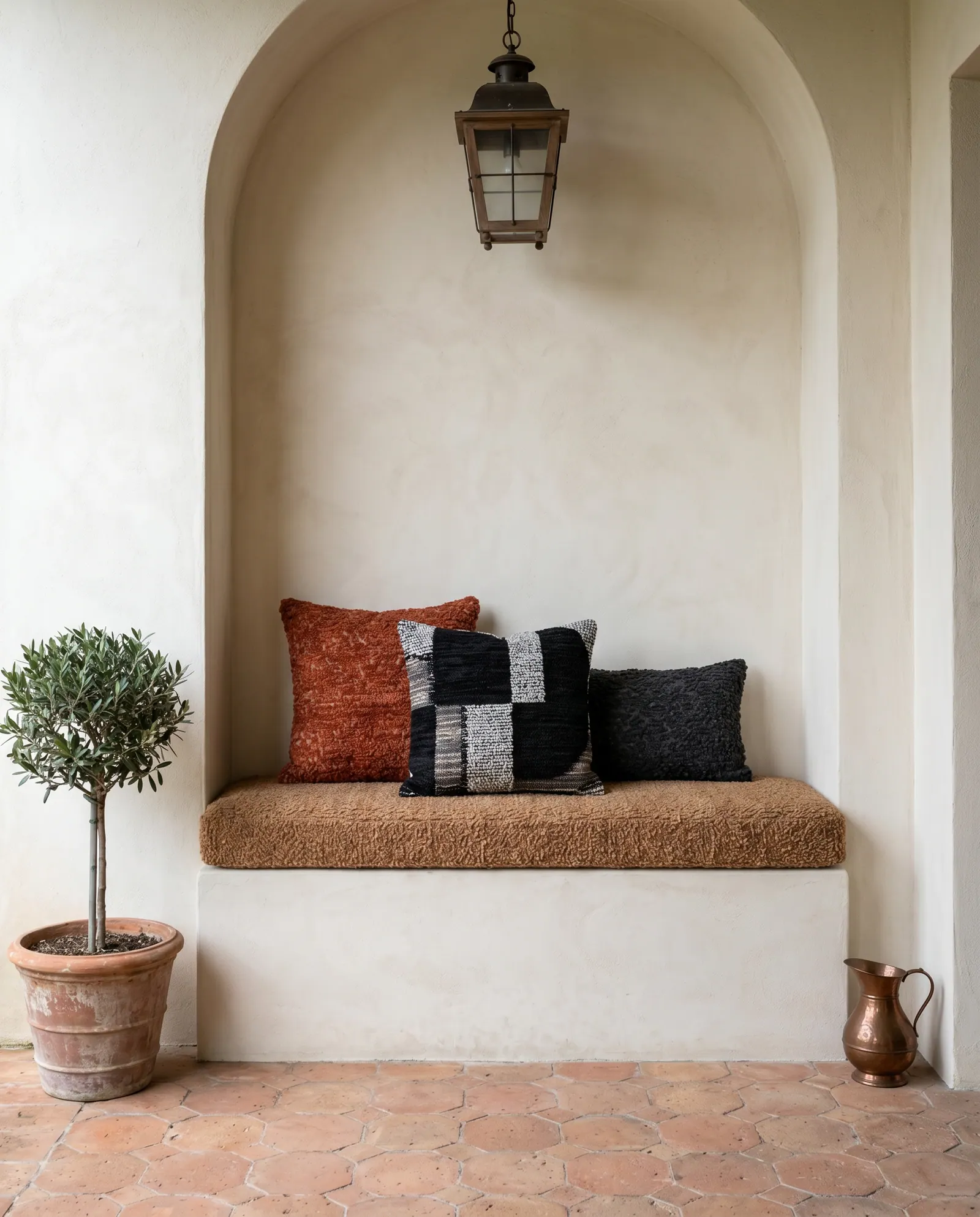
SaveA navy awning-stripe cushion gives a silvered teak bench a crisp outline in the middle of a rose garden.SaveA full-length navy-piped leaf cushion turns a teak bench into a poolside reading seat.SaveCoral awning stripes and solid coral pillows bring warmth to a weathered bench set against old honey-colored stone, framed by dahlias and geraniums.SaveA soft gray marbled seat lets wisteria, roses and delphiniums take the color in an English cottage garden.SaveA coral awning stripe revives a silvered teak bench; the water-repellent weave suits a seat that stays outside all summer.SaveTwo white Adirondack chairs get thick striped seat pads in powder blue, facing a green lawn and tall trees.SaveA built-in balcony bench gets a deep striped seat and two solid dusty pink back cushions, with geranium planters along the rail.SaveIn a slim side garden, a teak bench with sage striped cushions turns a path along the fence into a place to sit.SaveMatching seat and back cushions fit a built-in corner bench on a Mediterranean patio shaded by jasmine.SaveThin sage stripes on ivory give two teak armchairs an English courtyard feel beneath a flowering rose.SaveA caramel cushion made to fit a built-in plaster bench under an arch, with an iron lantern and an olive tree.
Button-tufted patio cushions let water in, even when they're sewn in outdoor fabric. Order a patio bench cushion plain, 4 in thick.
Look at the hero photograph. A teal, blue and burnt orange stripe with a white branch print sits on teak against a stacked stone wall, and two plain burnt orange pillows lift the warmest color straight out of the stripe. One pattern, one solid. Outdoors, where leaves and shadows are already busy, that's plenty.
The gallery plays the same tune more quietly. Navy palm jacquard with navy piping by the pool. Powder blue stripe pads on two white Adirondack chairs. Dusty rose stripe with plain rose back cushions on a city balcony.
Garden benches: a seat pad, a seat and back, or both
The classic two- and three-seat garden bench, with arms, a slatted seat and a curved or straight slatted back, rarely matches a stock pad, because arms and curved backs vary from maker to maker. Measure the seat inside the arms at the front and at the back, since some benches are wider at the front, and the depth from the back rail to the front edge. A seat cushion 3 to 4 in thick suits outdoor use; add a separate back cushion if the slats are widely spaced or the back is curved, and ask for ties at the back corners of the seat and the top corners of the back. Order the pieces in outdoor fabric, and store them indoors in the off-season or cover them in storms, because standard foam doesn't dry quickly.
Buyer questions
A common question
One end of my backyard bench is rounded. How do I get that shape to you?
The workshop's answer
Don't send numbers alone, because a curve can't be read from them. Either sketch the seat with its total width and depth, the straight length of each edge before the curve starts, where the curve starts and ends and how deep it runs, then photograph the sketch. Or, for a tricky curve, lay wrapping paper on the seat, trace it with a marker, cut it out and photograph it flat beside a tape measure. The shape is confirmed with you before production.
A common question
My new cushion measured shorter than the size I ordered. What now?
The workshop's answer
Lay a tape measure along the full length and send the workshop a photo. Past cases include 54 in arriving instead of 57 in, and a piece 6 in too short; when the size error was the workshop's, the cushion was remade and the buyer kept or discarded the wrong one. A partial refund has been the other choice. Remakes shipped by FedEx with tracking.
A common question
We're moving soon. Can the cushions arrive after we get into the new house?
The workshop's answer
Often, yes: write 'please deliver on or after' plus the date in the personalization box or the order note, or send a message. In past orders the finished order was held, or production timed, so it arrived as close to that date as possible, and it shipped straight to the new address. Transit time varies, so a single exact day can't be promised.
A common question
I hit the order button by mistake. Can you cancel it?
The workshop's answer
Yes, if you message before production starts. An accidental order is canceled and refunded, and the refund can take a few days to show. You may be asked why first: if the worry was size, color or space, a custom size or color can be offered and your measurements checked. If you still want to cancel, it is done on request.
A common question
I picked the wrong color at checkout. Is it too late to change it?
The workshop's answer
Usually not, as long as production hasn't started. The change is checked with the production team first, so send the exact color name or number from the chart rather than a general shade. If the fabric is already cut or the order is packed, it ships as ordered, and an extra cover set in the other color is the fix. Sizes can be corrected too if you message quickly.
Have it made
Have your patio bench cushion made — ask Callum’s workshop
Sun, rain, salt. Say which of them your cushion will meet, and the workshop will plan around it. — Callum
Leave your details and the workshop will call you to confirm measurements, fabric, foam and piping. No prices, dates or payment on this page: it is a request, not an order.
Fabric · Foam · Pipingwhat the workshop will confirm with you
Why are patio bench cushions made without tufting?
Because every button is a way in for water. Tufted cushions let water in even when they are made in outdoor fabric, so outdoor seats are built as plain, non-tufted foam cushions with a zippered cover. Button tufting belongs on indoor pieces.
Can a patio cushion sit a little past the front of the bench?
Yes, by up to about 2 in (5 cm), when an inner support wrap is added to carry the edge. Say how much overhang you want when you send the bench measurements, so the cushion is cut to the finished size rather than the bench size.
How thin can a balcony bench cushion be made?
The thinnest standard foam cushion is 2 in (5 cm). A cushion of about 1 in can be made, but only without piping, while a cushion of about 1 1/4 in (3 cm) can still take piping. Outdoor quotes otherwise assume 4 in (10 cm).
Where is the zipper on an outdoor bench cushion?
Hidden, on the back edge facing the wall or on the underside; you choose which. On bench covers the zipper often wraps around two corners so the foam slides out easily. Every foam cushion gets a zippered, fully removable cover at no extra cost.
Is a protectant spray worth using on patio cushion covers?
The workshop recommends a fabric protectant spray for outdoor cushions. Treat it as one part of the routine, alongside a non-tufted build and bringing the cushions indoors in the off-season, not as a replacement for either.
Will a non-slip bottom mark a teak or cedar bench?
No. The non-slip base is a grippy fabric that replaces the whole bottom panel and holds by friction. It isn't adhesive or rubber, leaves no residue and is safe on wood. It is an extra, chosen in the personalization box, and there is no border-only version.
What size cushion fits a garden bench?
There's no standard size, so measure yours: seat length inside the arms at the front and the back, and depth from the back rail to the front edge. As a rough guide, outdoor bench cushions run about 44 to 60 in long and 18 to 20 in deep. A curved or slatted back can take a separate back cushion tied to the slats.
Should a garden bench get a seat pad only, or a seat and back?
It depends on the back. A bench with a solid or tightly slatted back is often comfortable with a seat cushion alone, 3 to 4 in thick for outdoor use. Open or curved backs with widely spaced slats feel better with a separate back cushion tied to the slats. Each is its own order line, so you can start with the seat and add the back later.
Fair winds — Callum
Share this atlas entry
Readings
Photographs read by the masters: patio, porch & backyard cushions
Real cushions made for real rooms, each read for proportion, fabric and fit.
 Save
 Save
 Save
 Save
 Save
 Save
 Save
 Save
 Save
 Save
 Save
 Save