The Cutting Table · a common question
How long do outdoor cushions last before they need replacing?
Also asked as:left in sun rain etcweather is very hot and very cold with snow
Sun does most of the damage, every day the cushions stay out. Here is what the published numbers say, and what moves them.
The quick answer
Outdoor cushions typically last about 2 to 5 years, by makers' published estimates. By fabric, guides give roughly 5 to 12 years for solution-dyed acrylic, 3 to 8 for olefin and 1 to 5 for polyester, and they disagree. Indoor off-season storage is often said to double cushion life. Replace them when the foam stops springing back or mildew won't clean out.
 Save
Key facts
- Published guides put outdoor cushions at about 2 to 5 years overall.
- Makers' estimates by fabric: solution-dyed acrylic about 5-12 years, olefin 3-8, polyester 1-5; the sources disagree with each other.
- Off-season indoor storage is often said to double cushion life; one maker adds roughly 30-50% for a covered patio over full exposure.
- The workshop's outdoor fabric is polyester-based with water-repellent and UV-resistant finishes, not solution-dyed acrylic.
- Standard outdoor cushions use high-density foam that isn't quick-dry, with no mesh drainage bottom as standard.
- Outdoor cushions should be plain, not tufted: tufting lets water in even through outdoor fabric.
- Covers unzip, so a worn cover can be replaced over foam that is still good.

Have it made
Have Callum’s workshop cut this for you
Short list: size, sun hours, how fast it has to dry. The workshop goes through it with you. — Callum
Leave your details and the workshop will call you to confirm measurements, fabric, foam and piping. No prices, dates or payment on this page: it is a request, not an order.
Published lifespans, fabric by fabric
Other makers' estimates, and they disagree. Read them as a ranking, not a promise.
| Fabric | Makers' published estimate | What gives out first |
|---|---|---|
| Solution-dyed acrylic | About 5-12 years | Holds its color longest; can still mildew if left wet |
| Solution-dyed olefin | About 3-8 years | Long, direct sun stiffens the fiber and dulls the color |
| Outdoor polyester | About 1-5 years | Color first; one supplier reports visible fading within 12-24 months |
| Untreated cotton or canvas | 1-2 seasons | Breaks down quickly outdoors |
| The workshop's outdoor range | No figure given | Polyester-based with water-repellent, UV-resistant finishes; UV rating and weight shared per fabric code |
One fabric maker rates outdoor polyester at about 1,000 hours of lightfastness and solution-dyed acrylic at 2,000-plus.
What moves the number more than the label
Storage moves it most. One maker estimates that indoor off-season storage often doubles a cushion's life; a covered patio adds roughly 30 to 50 percent. Bring them in before the first frost and they'll forgive you everything.
Water comes next. Dry-fast, open-cell foam drains quickly; ordinary seat foam stays wet longer. The workshop's standard outdoor build uses high-density foam that isn't quick-dry, with no mesh bottom as standard, so it belongs on a covered porch or indoors when the weather turns. See dry-fast foam and winter storage.
How many hours of straight sun does your patio get in July, friend?
Five signs a cushion has had its seasons
- The foam won't spring back. Press a thumb in; a dent still there after about 10 seconds means spent foam.
- Mildew or mustiness survives a proper cleaning. If it's in the foam, a new cover won't cure it.
- Top and underside no longer match. A big color gap means the face has had its sun.
- Dents or curled edges that stay. The foam has set.
- Seams opening, heavy pilling, a zipper that has quit. The cover is done, even if the foam isn't.
New covers, or a whole new cushion?
Run the thumb and smell tests first. If the foam passes, only the cover is worn, and zippered outdoor covers can be made to fit your existing inserts from measurements and photos; measure the furniture frame too, since old cushions compress. If the foam fails, replace the whole cushion. See water-repellent fabric and outdoor cushions.
Hot summers, snowy winters, one honest answer
Their summers run very hot and their winters cold and snowy, the buyer wrote, and they wanted cushions with a fast-drying bottom to leave out all year. The workshop told them plainly: the standard build has foam that isn't quick-dry and no mesh bottom, so it isn't the cushion to sit uncovered through rain and snow.
The fabric handles sun and showers. The plan has to handle winter: a covered porch, or indoors until spring.
- What it taught
- Build for the worst month, then decide where the cushions spend it.
A cushion's years are counted in sun hours, not birthdays.
Callum
Buyer questions
- A common question
Can I leave outdoor cushions out all year, rain and snow included?
The workshop's answerShowers, yes; a whole season uncovered in rain and snow, no. The standard foam isn't quick-dry, and there's no mesh drainage bottom as standard. They do best on a covered porch, or stored indoors over winter.
- A common question
Is your outdoor fabric solution-dyed acrylic, olefin or polyester?
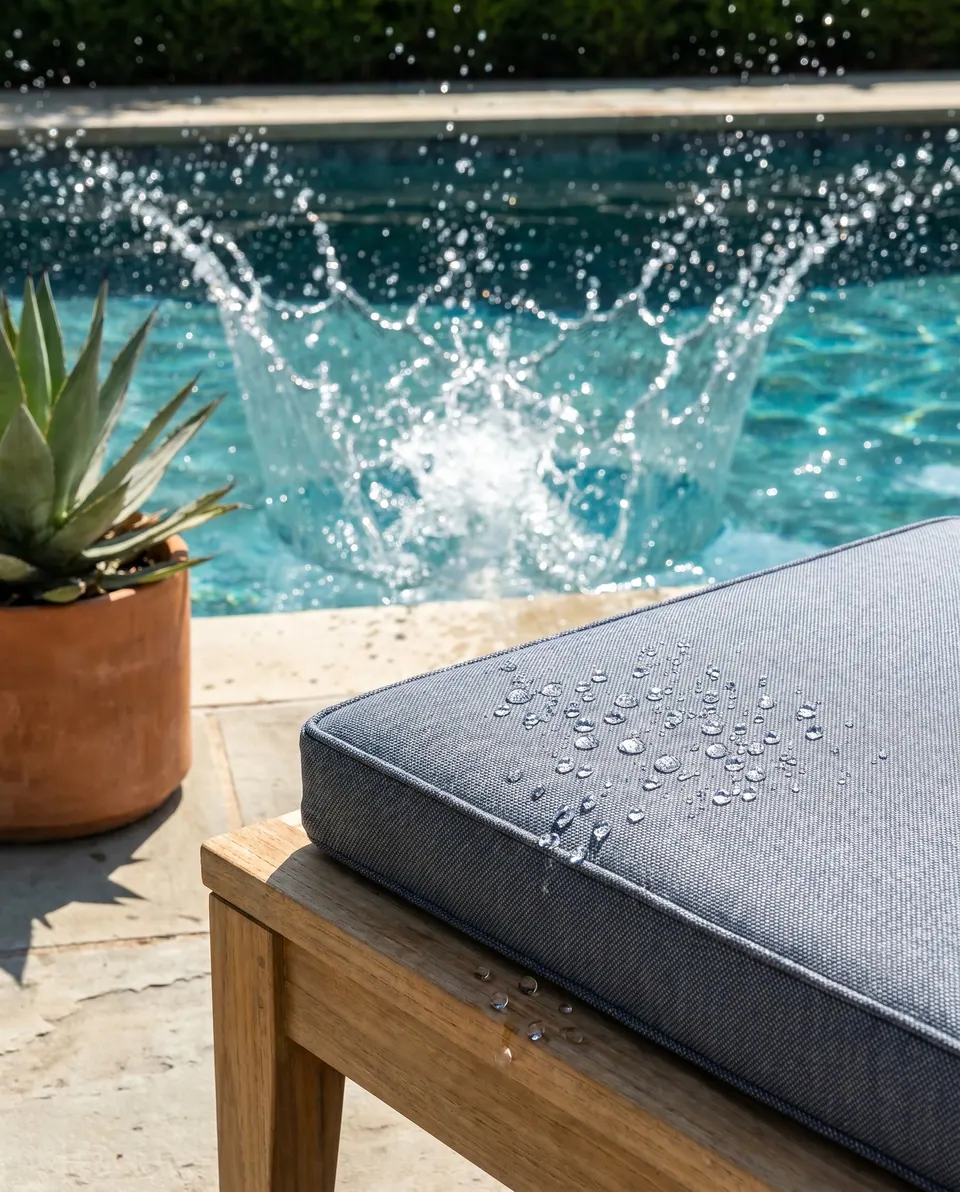
The workshop's answerPolyester-based, with a water-repellent, UV-resistant finish; not solution-dyed acrylic. It resists fading and cleans easily. UV rating and weight vary by fabric, so the workshop shares them once you pick a code.
- A common question
The inserts in my outdoor cushions are fine, but the covers are shot. Can you make new covers?
The workshop's answerYes. Zippered outdoor covers are made to fit existing inserts from measurements and photos. One order was covers for 32 x 32 x 6 in (81 x 81 x 15 cm) seats.
- A common question
Could I get a tufted cushion for out by the pool?
The workshop's answerTufted shapes can be made in outdoor fabric, but tufting lets water in even then. For wet spots, choose a plain, non-tufted foam cushion with a zippered cover.
Questions buyers ask next
Does bringing outdoor cushions inside for winter really add years?
It's the biggest lever you have; one maker estimates it often doubles a cushion's life. Let them dry right through, then store them where air moves, never sealed damp in plastic.
Why is my patio cushion faded on top but fine underneath?
The top takes the sun; the underside doesn't. A strong difference between them is one of the clearest signs a cover is near its end.
Would quick-dry foam make my outdoor cushions last longer?
It helps where cushions get wet often, since dry-fast foam drains quickly. The workshop's standard outdoor foam isn't quick-dry, so for dry-fast foam or a mesh base, ask the workshop before ordering.