The Pattern Room · a measuring pattern
Outdoor cushion care: cleaning, drying and storing them for winter
Outdoor fabric sheds a shower. It was never meant to sit under snow. Here is the routine I'd hand anyone with a porch swing or a pool lounger, from the first spring rain to the day the frost comes.

 Save
The quick answer
Outdoor cushion care comes down to keeping them clean and dry: brush off debris, wash zip-off covers at 86°F (30°C) on a gentle cycle, air dry them, and stand cushions on edge after rain. Before the first frost, clean them and let them dry right through, then store them indoors where air moves, never sealed in plastic.
Mildew is dirt plus damp, not a bad fabric
Mildew is dirt plus damp, given time. It grows on the pollen, dust and leaf litter left on the fabric, not on the fiber itself. So when spots show up on a cushion, the fabric hasn't failed. The routine has.
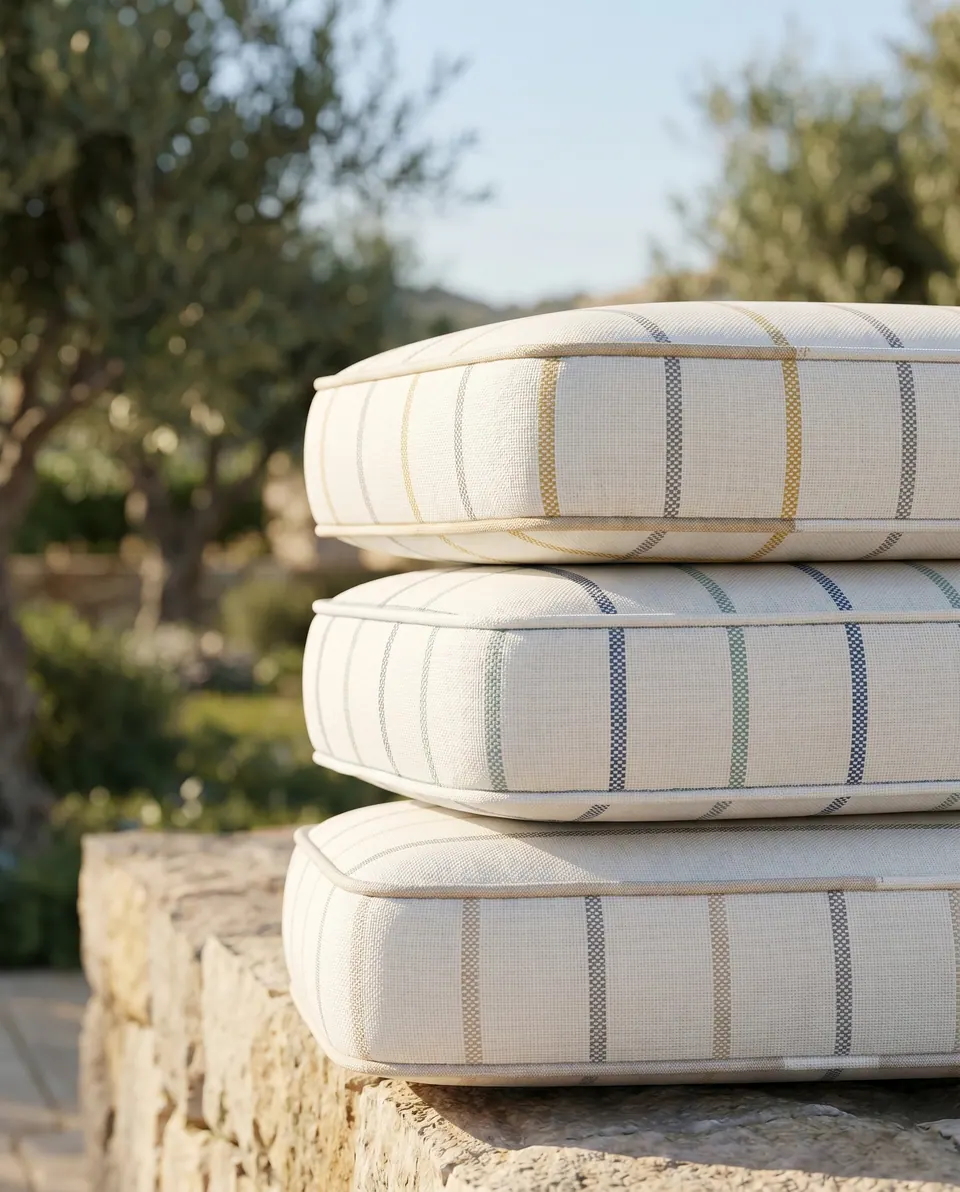
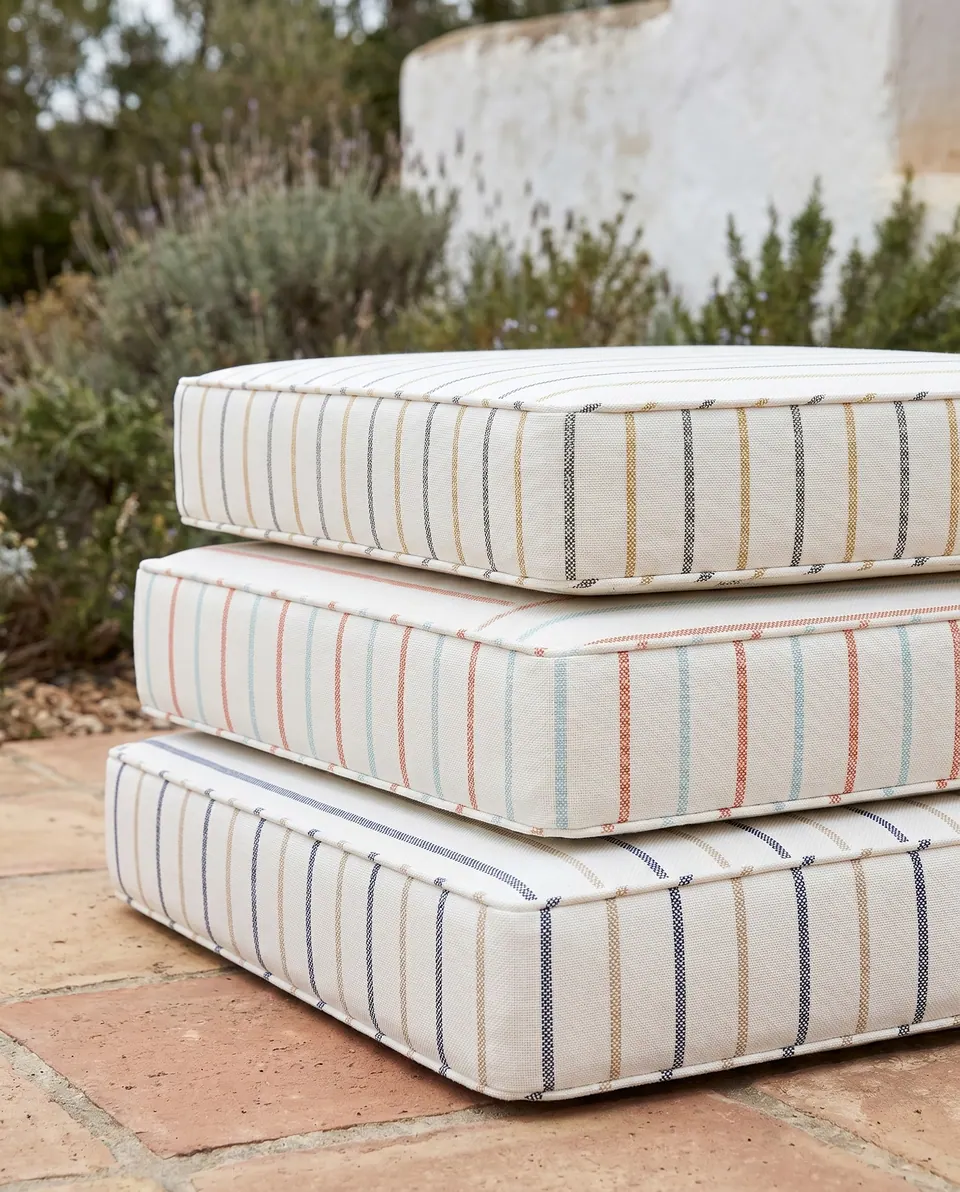
Good outdoor fabric is water-repellent and UV-resistant. It sheds a shower and dries its face quickly. But water still finds the seams, the zipper and the dip around any tufting button, and once it reaches standard foam it stays there a day or two. That's where outdoor cushion care earns its keep.
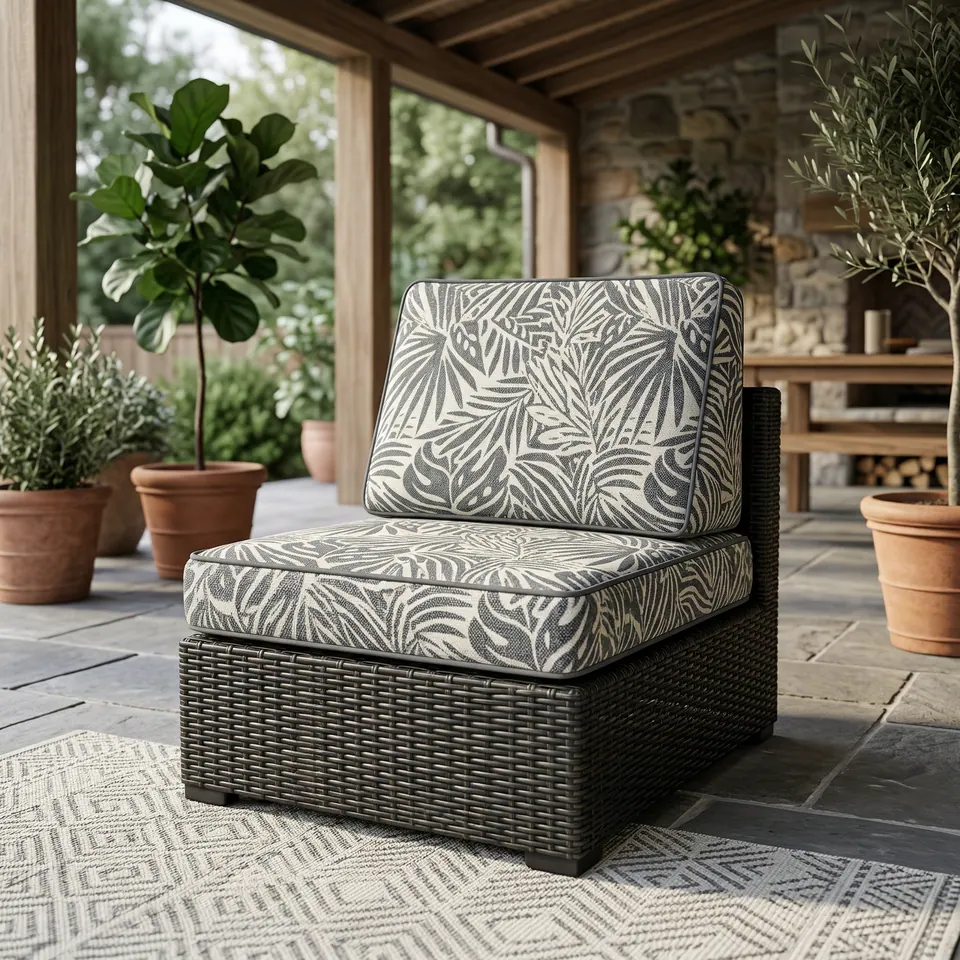
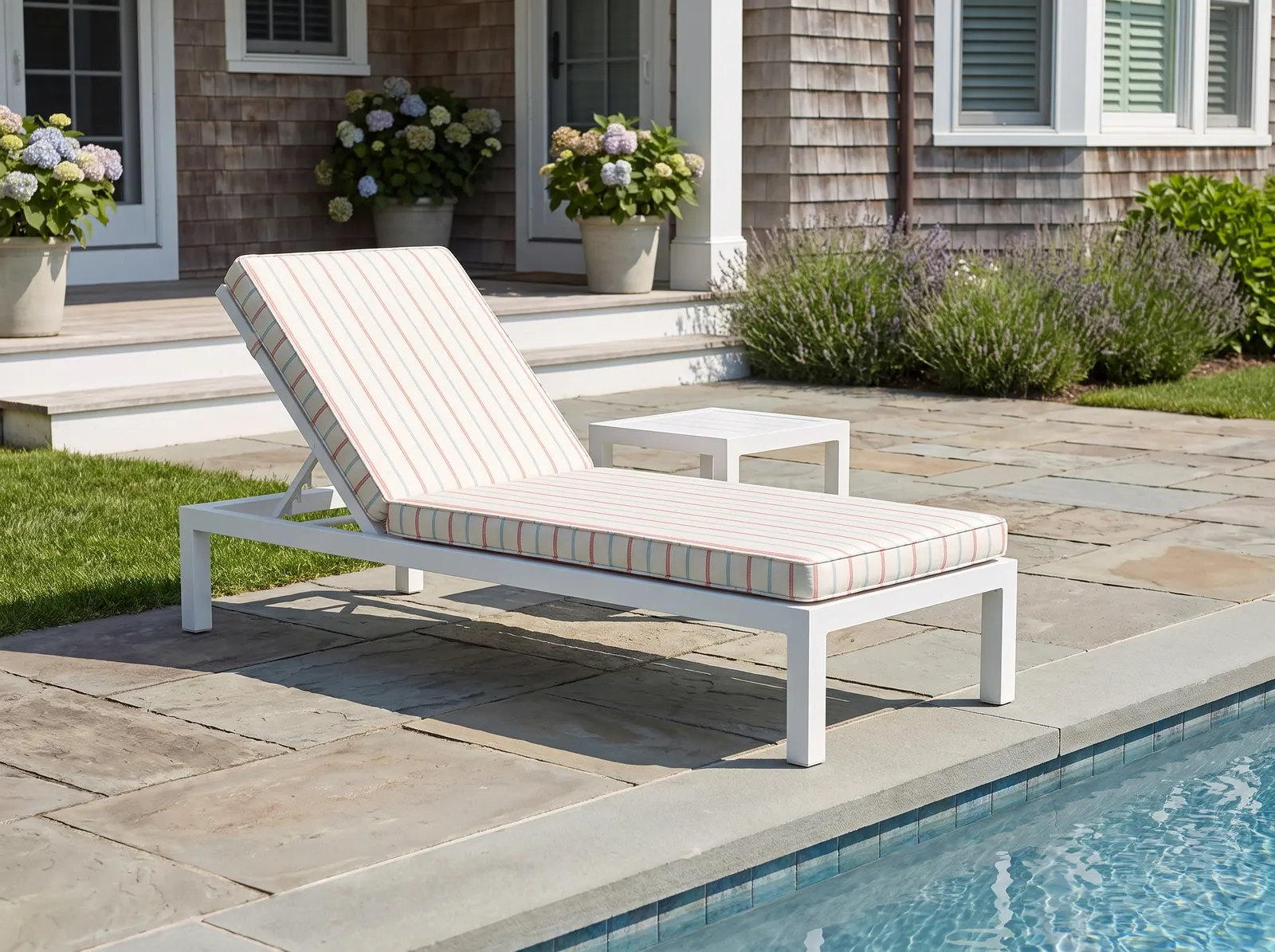
The coral and aqua pinstripe lounger at the top of this page lives beside a pool. The porch swings further down live under a roof. Same habits, different speeds. The outdoor cushions collection shows the family.
Can outdoor cushions stay out in the rain all year?
Straight answer, friend: not uncovered through rain and snow. The workshop's outdoor fabrics handle sun and rain showers, and the covers zip fully off. But the standard foam inside isn't quick-dry, and there's no mesh drainage bottom as standard. In a climate with hot summers and snowy winters, the workshop tells buyers plainly that these cushions belong on a covered porch, or indoors for the winter.
A roof changes things. Under a closed roof where neither rain nor direct sun reaches the seat, even indoor fabrics are fine, as indoor cushions on a covered porch explains. A screened porch is different: pollen, dust and humid air get through, so it wants outdoor fabric. If cushions must live on an open deck, ask about dry-fast foam over a breathable bottom.
Up in New England, where I cut canvas for years, that means indoors before the first hard frost. Where will your cushions spend January?
The outdoor cushion routine, from spring rain to first frost
Brush them off before the dirt settles
Through the season, and after any windy day, brush off leaves, pollen and grit with a soft brush, and wipe bird droppings while they're fresh. Dirt left sitting is what mildew feeds on.
Stand them on edge after rain
After a downpour, stand each cushion on its long edge where air moves. Standard foam takes 24 to 48 hours to dry through; dry-fast foam takes 1 to 3 hours with airflow. Don't put a damp cushion back on the seat, or under a furniture cover.
Spot clean in place
For marks, mix about 1/4 cup of mild soap into a gallon of lukewarm water, sponge the spot, rinse with clean water and let it air dry. Tufted cushions have no zipper, so they are always cleaned this way, with a damp cloth. More in tufted cushion care.
Wash the covers cool and gentle
Unzip the covers, turn them inside out and machine wash at 86°F (30°C) at most on a gentle cycle with mild detergent. Take off any white non-slip bottom first: it must not go in the washer or the dryer, where it shrinks. Wipe it by hand instead. The full routine is in washing cushion covers.
Air dry, never tumble
Hang the covers or lay them flat in the shade and let them air dry; skip the dryer. Stand the foam on edge meanwhile. Before anything goes into storage, cover and foam must both be dry right through.
Treat mildew early, and bleach only what can take it
Brush off what you can, then sponge with the mild soap solution. Chlorine bleach is for bleach-safe outdoor fabrics only: among the workshop's whites, V-45/V-54, M-01 and S-09 are the codes it names for bleach cleaning. Acrylic makers publish 1 cup of bleach and 1/4 cup of mild soap per gallon of water, left about 15 minutes, then rinsed. Standard covers get no bleach.
Refresh the finish after cleaning
A water-repellent finish wears down with time and with every cleaning, and it can be renewed. Once the fabric is clean and dry, a fabric protectant spray puts it back; the workshop recommends one for cushions that live outside.
Before the first frost, clean and dry them through
Bring them in before the first frost and they'll forgive you everything. Give every cushion a last brush and spot clean, wash the covers if they need it, and let the foam stand on edge until it's dry to the core, a full 24 to 48 hours for standard foam.
Store them dry and breathing
Store cushions indoors, standing on edge or stacked with spacers so air moves between them. A breathable cover keeps dust off; sealed plastic traps moisture, so never use it. Long cushions can be folded or rolled for storage without creasing or damage.

Have it made
Measured it? Have Callum’s workshop make it
Sun, rain, salt. Say which of them your cushion will meet, and the workshop will plan around it. — Callum
Leave your details and the workshop will call you to confirm measurements, fabric, foam and piping. No prices, dates or payment on this page: it is a request, not an order.
How long a wet cushion takes to dry
| What's inside the cover | Drying time after a soaking | Best home |
|---|---|---|
| Standard high-density foam | 24 to 48 hours | A covered porch in season; indoors over winter |
| Dry-fast (reticulated) foam | 1 to 3 hours with airflow | Open decks and poolsides, over a mesh or breathable bottom |
| Polyester fiber fill | 12 to 48 hours | Throw pillows and back pillows under a roof |
| Closed-cell (PE) foam | Doesn't absorb water, but feels hard | A thin base under a softer layer, as on boats |
A long bench cushion cut in two for the storage shelf
A buyer wrote to the workshop about an outdoor bench 20 1/2 x 87 3/4 in (52 x 223 cm). They wanted a seat cushion in a blue outdoor stripe, 4 in (10 cm) thick, and asked for it in two pieces from the start, so it would be easier to store.
That's a sailor's kind of thinking. One long cushion is fine on the bench and a wrestling match on the way to the basement. Two pieces of 20 1/2 x 43 7/8 x 4 in (52 x 111.5 x 10 cm) carry one at a time and sit on a shelf.
They also wanted piping close to the lighter blue in the stripe, and the workshop matched it with a solid outdoor blue. Plan the storage when you plan the cushion, not the week the frost comes. The trade-offs are in one piece or two.
- What it taught
- Splitting a long outdoor seat in two makes it easier to store and handle.
Where the weather catches people out
- Sealing cushions in plastic for winter. Trapped moisture has nowhere to go; store them breathing.
- Putting cushions away cool and damp. Standard foam needs 24 to 48 hours on edge to dry through.
- Using indoor fabric in the open air. Linen, velvet and chenille aren't made for it; tell the maker indoor or outdoor first.
- Bleaching a fabric that isn't bleach-safe. Check the code; standard covers get mild soap only.
- Tumble drying the covers. The non-slip bottom shrinks in heat and the cover won't close; air dry.
- Leaving tufted cushions out in the rain. Water gets in at every button; choose plain foam-filled cushions outdoors.
- One long cushion across a lift-up storage lid. Split it at each lid break and add ties.
Mildew on an outdoor cushion is dirt plus damp, not a fabric flaw. Brush the cover clean and dry the foam a full 48 hours before storage.
Callum
Outdoor stain quick reference
| Stain | First step | Then |
|---|---|---|
| Sunscreen or cooking oil | Blot; cover with baking soda or cornstarch for 10 to 15 minutes | Brush off, mild soap and water, rinse |
| Bird droppings or spilled drinks | Lift off what you can | 1 tsp borax + 1 tsp dish soap per quart of warm water; rinse |
| Mildew spots | Brush off loose growth outdoors | 1 part borax to 4 parts warm water, 15 to 30 minutes; rinse |
| Stubborn stains on bleach-safe whites | Check the code is bleach-safe | 1 cup bleach + 1/4 cup mild soap per gallon; rinse well |
| Pollen and dust | Hose or brush off before it's wet | Rinse; dry the cushion on its side |
Buyer questions: rain, snow and storage
- A common question
Can I leave my outdoor cushions out in rain and snow all year round?
The workshop's answerThey're made for sun and rain showers: the outdoor fabrics are water-repellent and UV-resistant, the covers zip fully off for washing, and ties on the back corners come at no extra charge. But the foam isn't quick-dry and there's no fast-drying mesh bottom as standard, so they aren't meant to sit uncovered through rain and snow. Keep them on a covered porch, or store them indoors over winter.
- A common question
Are your outdoor cushions waterproof, or only water resistant?
The workshop's answerThey're made from a separate water-repellent outdoor range with its own color chart, which the workshop sends on request. In practice it's water-resistant rather than sealed: it handles rain showers and spills well, and outdoor seats and backs get outdoor-suitable inserts. As with any outdoor textile, store them indoors during long off-season stretches.
- A common question
Which white outdoor fabrics can take bleach?
The workshop's answerAll of the white and off-white outdoor fabrics can be cleaned. For stubborn stains, the ones we name for chlorine bleach are V-45/V-54, M-01 and S-09, so if you expect to bleach-clean, choose one of those codes when you order.
- A common question
My tufted cushion has no zipper. How do I clean it?
The workshop's answerClean it in place by hand: wipe the surface gently with a damp cloth, with a little mild soap and water for marks. If you'd rather machine wash, choose the untufted, foam-filled version, which has a zippered, removable cover.
- A common question
Our outdoor bench is very long. Can the cushion be one piece, and how do we store it?
The workshop's answerVery long pieces can exceed the maximum single-piece length, so they're often made in sections, and you choose where the joins fall. A long pool bench can be one piece, two long cushions or one per seat. The foam is flexible, so a long cushion can be folded or rolled for storage without creasing or damage.
- A common question
Can I put my linen or velvet cushions outside for the summer?
The workshop's answerNo. Linen, velvet, chenille and the other indoor-listing fabrics aren't made for open-air use, and chenille in particular isn't recommended in humid climates. The outdoor fabrics resist moisture, mildew and mold far better. Order through the outdoor listing, where the 100-plus colors are all outdoor-rated and any piping combination is possible.
Outdoor cushion care, in brief
Can outdoor cushion covers go in the dryer?
Air dry them instead. Covers wash at 86°F (30°C) at most on a gentle cycle, then dry in the air; heat can shrink the white non-slip bottom so the cover no longer closes. If you must iron, use a low synthetic setting and never steam.
How do I get mildew spots off an outdoor cushion?
Catch them early. Brush off what you can, sponge with about 1/4 cup of mild soap in a gallon of lukewarm water, rinse, and dry the cushion on edge in moving air. Use a bleach solution only on bleach-safe outdoor fabrics, then keep the fabric clean so mildew has nothing to feed on.
Does outdoor fabric need a protectant spray?
It helps. A water-repellent finish wears down with time and cleaning and can be renewed, and the workshop recommends a fabric protectant spray for cushions that live outside. Apply it to clean, dry fabric. If a cushion in indoor fabric is headed outside, spray it, though outdoor fabric is the better answer.
Why not store outdoor cushions in plastic bags?
Plastic traps whatever moisture is left in the foam, and damp foam in the dark is how mildew starts. Store cushions dry, with spacers or room between them so air moves, and use a breathable cover if you want to keep dust off.
How do I get sunscreen or cooking oil off an outdoor cushion?
Blot it, don't rub. Cover the spot with baking soda or cornstarch, leave it 10 to 15 minutes to draw out the oil, and brush it off. Then clean with mild soap and water, rinse well, and stand the cushion on its side to dry. If the stain has soaked through, unzip the cover and wash it on its own.
What's a safe way to clean bird droppings off outdoor cushions?
Lift off what you can first, then work in a mix of 1 teaspoon borax and 1 teaspoon dish soap per quart of warm water. Rinse thoroughly and dry the cushion on its side. Keep bleach solutions for fabrics that are bleach-safe; the workshop names particular white outdoor codes for that, so check yours before reaching for bleach.