The Pattern Room · a measuring pattern
Dry-fast foam for outdoor cushions: when you need it and when you don't
A summer storm soaks two cushions the same. One is dry by supper; the other is still heavy two days later. The difference is inside, and the roof over the seat decides which one you need.

 Save
The quick answer
Insist on dry-fast (reticulated) foam when outdoor cushions stay out uncovered: on an open deck, by the pool, or through a rainy season. It drains nearly as fast as water enters and dries in 1 to 3 hours with airflow, against 24 to 48 hours for standard foam. Under a covered porch, or for cushions brought in before rain, standard seat foam in outdoor fabric is enough.
Why one cushion dries by supper and the other doesn't
Standard foam is a sponge with walls. Each cell is closed off by thin windows, so water that gets in stays in. Left out in the rain, it holds water for days, invites mildew, and under hard sun it goes brittle and crumbly.
Reticulated foam has those windows removed. What's left is an open lattice, and water runs through it nearly as fast as it arrives. A typical grade is about 1.8 lb/ft³ (29 kg/m³) and around 33 on the ILD firmness scale, with softer and firmer grades near 25 and 45.
That's the whole trick. Not a coating. Just a foam that lets go of water.
Three foams after the same rainstorm
| Dry-fast (reticulated) | Standard seat foam | Closed-cell | |
|---|---|---|---|
| Drying time | 1 to 3 hours with airflow | 24 to 48 hours | Doesn't absorb water |
| Typical density | About 1.8 lb/ft³ (29 kg/m³) | About 2.0 lb/ft³ (32 kg/m³) in the workshop's seats | Varies; sold by thickness |
| Feel | Set by grade, about 25 to 45 ILD | Medium-firm | Hard; used thin |
| What goes under it | Mesh or breathable fabric, no fiber wrap | Any cover; an optional waterproof insert cover keeps showers out | Works as a base layer under softer foam |
| Where it belongs | Open decks, pool edges, seats left out in rain | Covered porches, cushions brought in | Boat decks and wet bases |
Where outdoor cushions need dry-fast foam, and where they don't
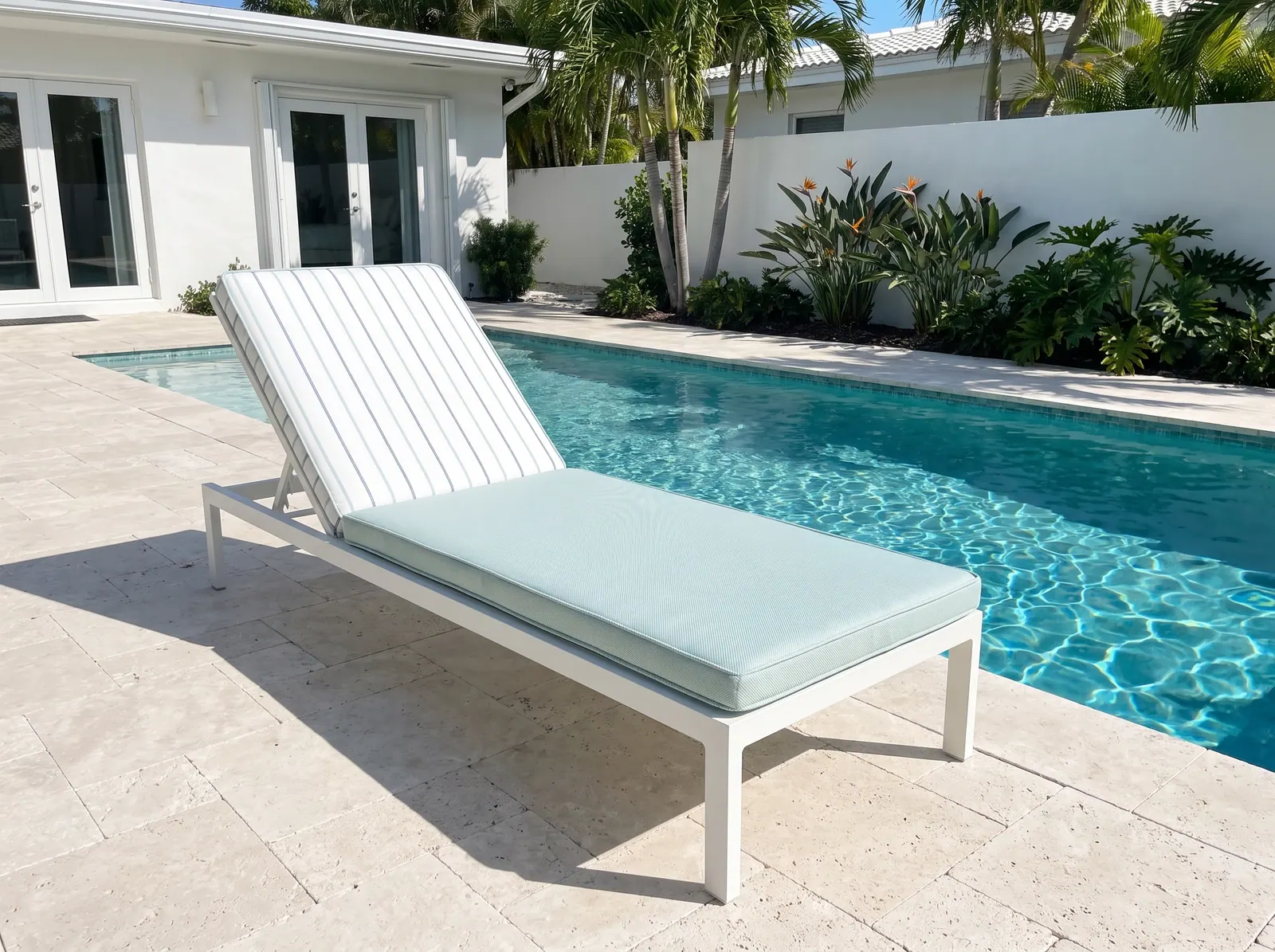
Rain doesn't negotiate. If the cushion lives where weather reaches it and nobody carries it in, insist on dry-fast foam: an uncovered deck, a pool edge, a chaise lounger in a yard with afternoon storms. Ask for it by name, with a mesh or breathable bottom.
If the seat sits under a solid roof, or you bring the cushions in when the sky turns, standard foam in outdoor fabric does the job. The workshop's standard outdoor cushion is exactly that: its regular seat foam, about 2.0 lb/ft³ (32 kg/m³), in water-repellent, UV-resistant outdoor fabric. There's no quick-dry foam and no mesh bottom as standard, and the workshop says so when asked.
A buyer in the US sent drawings of storage benches with lift-up lids, in a climate with very hot summers and snowy winters. The answer was plain: no quick-dry foam, no mesh bottom, and a fabric that suits a covered porch or cushions stored for winter. She asked for close-ups of eight outdoor colors, chose one, and ordered 3 in (7.5 cm) cushions split at the lid lines. She knew exactly what she was buying.
A screened porch keeps rain off but not humidity, pollen and dust, so choose outdoor fabric there even with standard foam. The covered porch Pattern and the patio and porch cushions room walk through the rest.
Specifying a dry-fast cushion that actually drains
Name the foam type, not just the feel
Write 'reticulated open-cell foam' on the order, with a grade. A quote that says '32-density medium-firm' describes regular seat foam, however good the rest of the spec looks.
Ask for a mesh or breathable base
Water has to leave through the bottom. A tight or waterproof backing under dry-fast foam traps the very water the foam was bought to shed. A mesh bottom panel lets it out.
Leave out the fiber wrap
No Dacron wrap. Polyester fiber fill takes 12 to 48 hours to dry, which undoes the point of the foam.
Keep the top plain
Skip tufting. Water gets in through the dips around the buttons even in outdoor fabric, and the workshop's zippered outdoor versions are made without it.
Pick a fabric that breathes
Water-repellent outdoor fabric sheds showers and lets air through. Coated waterproof cloth blocks airflow and turns sticky in summer heat. The outdoor fabric Pattern compares the fibers.
Check the thickness under a real body
Outdoor quotes here assume 4 in (10 cm). A 2 in (5 cm) cushion on a lounge chair squashes to almost nothing under a full body's weight.
Get it in writing, then check the photo
Extras typed into the size box get overlooked. Confirm foam type, base and ties by message after ordering, and look for each of them in the pre-dispatch photo.

Have it made
Measured it? Have Callum’s workshop make it
Sun, rain, salt. Say which of them your cushion will meet, and the workshop will plan around it. — Callum
Leave your details and the workshop will call you to confirm measurements, fabric, foam and piping. No prices, dates or payment on this page: it is a request, not an order.
The daybed quote that said '32-density'
A buyer wrote in planning a luxury outdoor daybed for a place with heavy rain. The request was specific: quick-dry foam at about 2.2 to 2.5 lb/ft³ (35 to 40 kg/m³), mesh strips on the undersides, double piping all round.
The quote came back with a lot of what was asked: a breathable mesh base for drainage, UV-resistant thread, a concealed heavy-duty zipper, double welt in matching fabric and removable covers. A production drawing went out for approval before cutting, and that quote gave about 10 to 14 days of production.
Read the foam line, though. It said 32-density medium-firm foam, the workshop's regular seat foam, not reticulated. A good build, drained from below, but not dry-fast inside.
That's the lesson I hand every poolside buyer. The mesh base is the door; the foam is the room. If the room holds water, the door only helps so much.
A drying routine for standard foam outdoors
Plenty of good outdoor cushions are standard foam, and they last with a routine.
- Bring them in, or stand them on edge under cover, when rain is coming.
- If one gets soaked, unzip the cover and let the foam dry in moving air. Allow 24 to 48 hours.
- Wash covers on a gentle cycle at 86°F (30°C) and air dry them.
- A fabric protectant spray is recommended after washing.
- Store for winter indoors, with air around the foam, never sealed in plastic.
The outdoor cushion care Pattern has the full seasonal list. Where do yours spend the night, friend: under the roof, or under the sky?
Where the weather catches people out
- Indoor fabric on an open patio. Linen, velvet and chenille belong under a roof; tell the maker indoor or outdoor before the color search starts.
- A waterproof liner around dry-fast foam. It traps the water the foam was meant to drain. Liners belong around standard foam in damp or spill-prone spots.
- A tufted cushion by the pool. Tufting lets water in, even in outdoor fabric.
- Covers-only orders measured over the old cover. Measure the bare foam's length, width and thickness, and say 'covers only' in the request.
- Ties or a non-slip base typed into the size box. Ask by message, and check the pre-dispatch photo.
- Damp cushions stored in sealed bags. Winter damp with no air is how mildew starts.
A summer storm leaves standard foam wet for 24 to 48 hours; reticulated dry-fast foam drains in 1 to 3 hours with airflow.
Callum
Where the workshop stands on dry-fast foam
Dry-fast foam is the right answer for cushions that sit uncovered through rain, and it's worth being clear about what the workshop offers. Its outdoor cushions are quoted with the same firm high-density foam used indoors, about 2.0 lb/ft³ (32 kg/m³), wrapped in polyester fiber, in woven outdoor fabric with a water-repellent, UV-resistant finish. There is no quick-dry foam and no mesh drainage bottom as standard; a mesh base has been built only for large premium projects. That combination suits covered porches, screened rooms and cushions that come inside for storms and winter. If your seat will be rained on every week, ask the workshop before ordering, and plan for drying time and storage.
Buyer questions: rain, roofs and outdoor foam
- A common question
We get very hot summers and snowy winters. Can I leave the outdoor cushions out all year?
The workshop's answerNot uncovered through rain and snow. The outdoor fabric is water-repellent and UV-resistant, and covers zip off for washing, but the foam isn't quick-dry and there's no mesh drainage bottom as standard. They do best on a covered porch, stored indoors over winter.
- A common question
Are your outdoor cushions actually waterproof, or only water resistant?
The workshop's answerWater-resistant. The outdoor range is a water-repellent fabric with its own color chart, not a sealed, coated material. It handles rain showers and spills well. For a big patio job you can order one cushion first to check the fit, and cushions should come indoors for the long off-season.
- A common question
Our porch has a roof. Will ordinary indoor cushions be all right out there?
The workshop's answerYes, if the roof is closed and rain and direct sun don't reach, linen, velvet and the soft standard fabrics are fine, though they aren't waterproof. For a screened porch that gets pollen, dust and humidity, or any open-air spot, choose outdoor fabric; samples can go out first.
- A common question
What outdoor fabrics do you carry, and how are the charts different?
The workshop's answerClose to 200 outdoor fabrics on 4 to 5 charts, all water-resistant and UV- and fade-resistant, made to stay out all summer. They feel like woven cloth, not vinyl. The charts share one quality and differ only in texture, color tone and pattern; orders can add foam, an anti-slip underside and piping.
Dry-fast foam, briefly
Is reticulated foam softer than regular foam?
Not by nature. It comes in firmness grades, commonly around 25, 33 and 45 ILD, with about 33 typical. Its density, around 1.8 lb/ft³ (29 kg/m³), tells you little about how it sits, so ask for the firmness grade.
How long does dry-fast outdoor foam last?
Foam sellers put it at about 10 to 15 years. Sun is still the enemy: prolonged UV degrades polyurethane foam, so a good cover and winter storage matter as much as the foam itself.
Does dry-fast foam need a special cover?
It needs a breathable one. A mesh bottom panel or an open outdoor weave lets water out; a coated or waterproof backing traps it. Skip any fiber wrap, and keep the top plain rather than tufted.
Where does closed-cell foam fit in?
Under something softer. Closed-cell foam doesn't absorb water and it floats, but it's hard, so it's used thin as a base or barrier layer, mostly on boats and wet decks. On its own it makes a very firm seat.
Should dry-fast cushions go into storage bags over winter?
No. Store them dry, with air around them and spacers between stacked cushions, never sealed in plastic. A long cushion can be folded or rolled for storage without damage.