The Pattern Room · a measuring pattern
Measuring rounded corners, oval wicker seats and bistro benches
Porch furniture was never built with a square corner in sight. Wicker loveseats, oval settees and bistro benches all round off, and a new cushion has to round off the same way, in the same place.
 Save
The quick answer
To measure a rounded corner cushion, write the full length and depth as if the corners were square, then measure how far from each corner point the curve begins along both edges. For oval or irregular seats, trace the seat on paper, write the widest width and depth on it and photograph it from above beside a tape measure. Round seats need a diameter and thickness.
The number nobody writes down
The number that decides a rounded corner cushion is the one most folks never send: how far from the corner the curve begins. Length and depth, everybody writes down. The curve, hardly anybody.
I grew up on a porch full of wicker, and not one of those loveseats had a square corner. Send a maker two numbers and you'll get a rectangle, and a rectangle on a round-cornered frame sticks its corners out like a hound's ears. Every wicker loveseat cushion replacement I've made started with that missing number.
This Pattern covers rounded corners, clipped corners, ovals and rounds, plus the paper trick that settles every argument. The wider family is under patio and porch cushions.
Measuring a rounded corner, step by step
Measure it as if it were square
Take the full length and depth at the longest and widest points, as though each corner ran out to a sharp point. Measure to the nearest 1/8 in, twice.
Find where each curve begins
Tape along one edge from that imaginary corner point to where the curve starts, then along the other edge. Buyers have sent 2.5 in (6.5 cm) each way; one sent 8 in (20 cm).
Read the pair of numbers
Equal distances mean a true circular corner, and that distance is its radius. Unequal ones, say 2 in and 4 in, mean a stretched corner: write both and say which edge gets the long sweep.
Note every corner separately
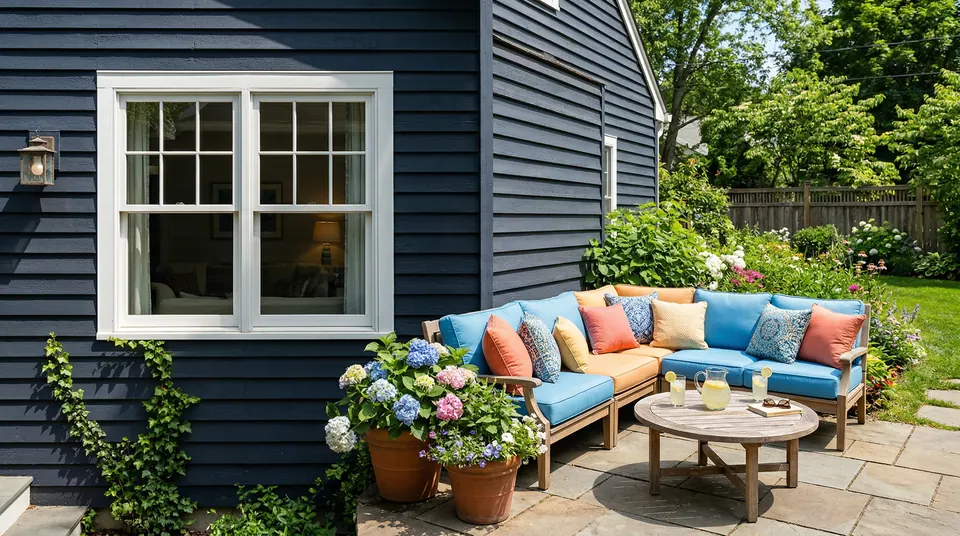
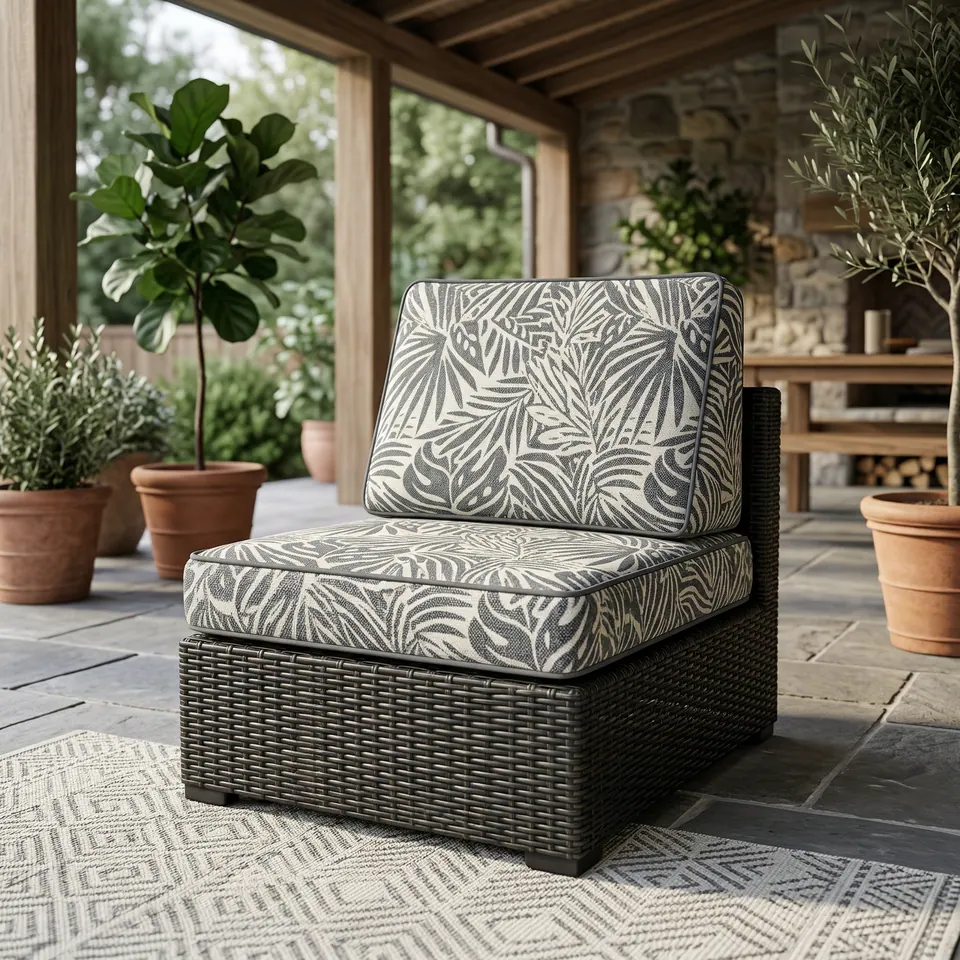
Some seats round only the front corners, some only the back, like the sectional below. Measure all four.
Trace the tricky ones
For an oval seat cushion or a curve you can't pin down, lay wrapping paper on the seat, trace the edge and cut it out. Write the widest width and the depth on the paper template.
Pattern sheet Lay paper on the seat and trace the edge, write the widest width and the front-to-back depth on the template, then photograph it flat from directly above with a tape measure in the picture. Photograph it top side up
Lay it flat, top side up, tape in the shot, camera straight overhead. A flipped tracing comes out mirrored. No need to mail the paper.
Draw it and send it
Sketch the seat from above with every number on its edge and each curve's start and end marked. Upload it with a furniture photo on the custom-shape listing; the workshop redraws it and confirms before cutting. See the custom shape drawing.
Give round seats a diameter
Order a round seat by diameter and thickness: 'round, 16 in diameter'. Measure across in two directions first; if they differ, it's an oval, so trace it.

Have it made
Measured it? Have Rosa’s workshop make it
Tell the workshop who sits there: grandkids, the dog, a cup of coffee at six. The right fabric and foam follow from the people. — Rosa
Leave your details and the workshop will call you to confirm measurements, fabric, foam and piping. No prices, dates or payment on this page: it is a request, not an order.
Rounded, clipped, oval or round: what to send
| Shape | Where you'll see it | What to measure | How to write it |
|---|---|---|---|
| Rounded corners | Wicker loveseats, patio sofa seats, sectional inserts | Size as if square, plus where each curve starts on both edges | 'Front corners rounded, curve starts 2.5 in along each edge' |
| Clipped corners | Window ledges, angled front corners | How far each cut runs in along both edges | 'Two front corners clipped 3 in each way' |
| Oval | Wicker settees, oval chair seats | A traced template with widest width and depth | Template photo from above, tape in shot |
| Round | Bistro stools, bar stools, play tents | Diameter and thickness | 'Round, 16 in diameter, 4 in thick' |
| One rounded end | Custom bistro and hall benches | Length, depth, where the curve starts and how deep it runs | A drawing of the curve; see chord and rise |
Ten covers, two rounded corners and one good question
A buyer in the US wrote in about an outdoor sectional with benches. The inserts were fine; the covers were finished. They needed ten: seven at 25 x 15.5 x 4.25 in (63.5 x 39.5 x 11 cm), one at 47 x 15 x 5.5 in, and two at 76.5 x 30.5 x 5.5 in (194 x 77.5 x 14 cm) with rounded back corners, all piped and zipped, in a UV-resistant outdoor fabric.
They'd measured the boxed side panel seam to seam, 5.5 in, and the workshop took that as given. Then it asked the question this Pattern is about: how far from each corner does the curve begin? The rounded corners were never the problem. The missing number was.
What I took home: measure a boxed panel seam to seam and let a full insert crown the top; don't enlarge the panel. More in covers for existing foam.
- Measured
- 7 at 25 x 15.5 x 4.25 in; 2 at 76.5 x 30.5 x 5.5 in with rounded back corners; 1 at 47 x 15 x 5.5 in
- What it taught
- Measure boxed panels seam to seam and let full inserts crown the top; don't enlarge the panel.
When a clipped corner is the easier answer
Not every corner needs a curve. A clipped corner cushion is cut straight across each corner and described with two plain numbers: how far the cut runs in along each edge. Three inches off both front corners; a back corner taken off for a window ledge. It's cut exactly to your drawing.
Clipped and rounded both go through the custom-shape listing, sized by the longest length and widest depth, with fabric and piping codes in the personalization notes.
And if the budget's tight, neighbor, there's the old porch answer: a plain rectangle is much cheaper than any shaped piece, and a throw pillow tucked into each corner fills the gap like it was planned.
Where rounded-corner orders go sideways
- Two numbers for a round cushion. '16 x 16' reads as a square; write 'round, diameter 16 in'.
- A gentle curve in numbers alone. Subtle rounds get read as square. Draw every curve.
- A style photo instead of a sketch. The photo suggests a shape; the ordered size decides it.
- A shaped seat on the rectangle listing. The order is held, then refunded for reordering or sent a price-difference link.
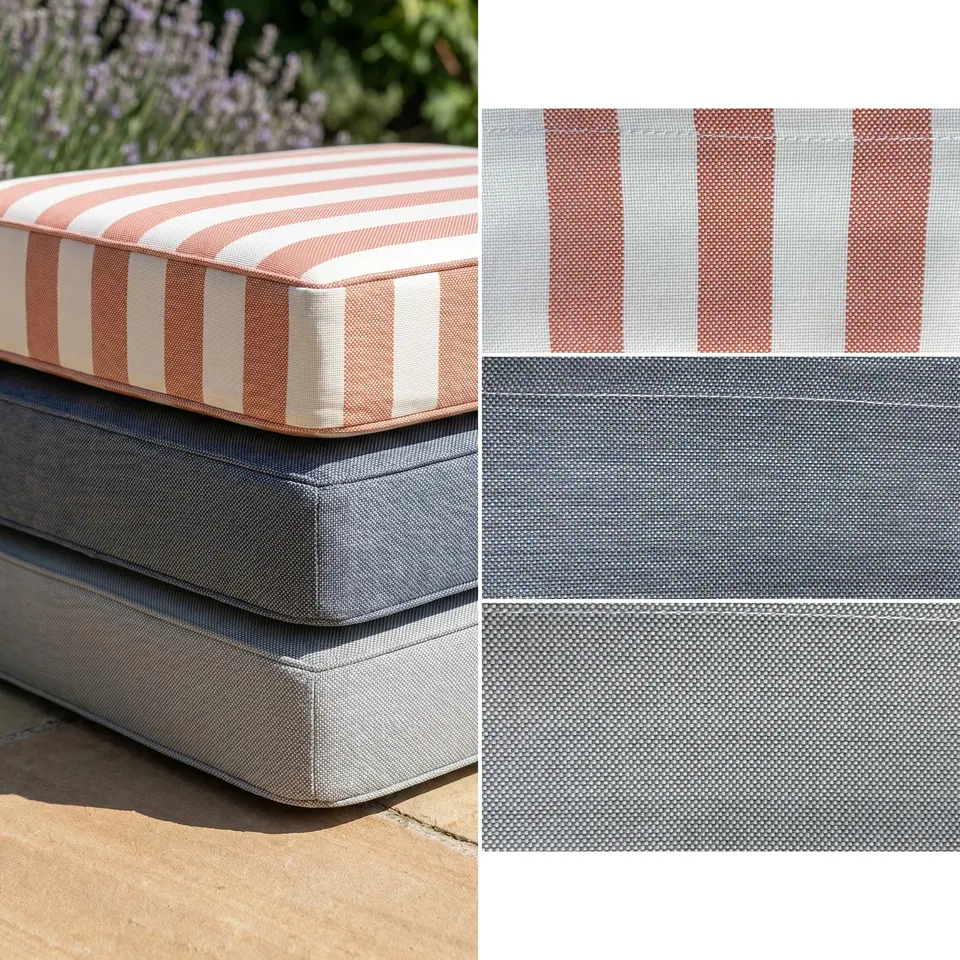
- No margin on a cover for a firm insert. Handmade sizes vary by about 1/2 to 1 in and piping adds to the outside; say whether your sizes include it. See size tolerance.
Try the corner in the Studio first
Before you trace a thing, play with it. The chair cushion builder takes a corner radius, or a round seat, so you can watch a 2.5 in round-off appear on a seat pad in 3D, ties and piping included. For loveseat and bench seats, the bench cushion builder has a rounded front, measured the same way: from the corner to where the curve starts.
Then take the tape back out to the porch. The builder shows the idea; your furniture decides the numbers. So what does the curve on your wicker loveseat measure?
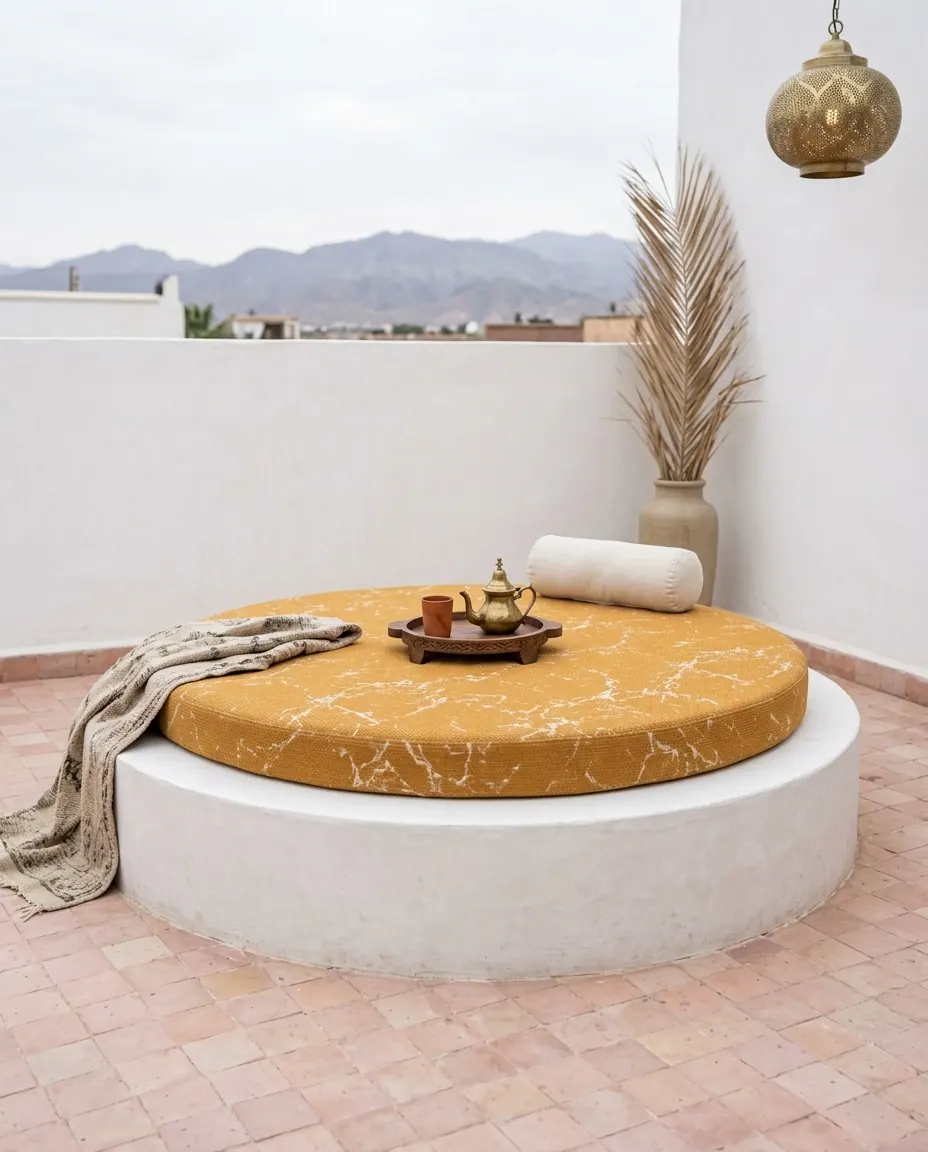
Round cushions are ordered by diameter and thickness. Write 'round, 16 in diameter, 4 in thick', because 16 x 16 in reads as a square.
Rosa Delgado
Buyer questions: corners, ovals and rounds
- A common question
Our long seat cushions have rounded corners. What should I measure so new ones match?
The workshop's answerMeasure each cushion as a full rectangle at its longest and widest points, then how far from each corner point the curve begins along both edges, for example 2.5 in each way. Add top-down photos with a tape along the edges, or trace the curve on paper.
- A common question
Could you cut the corners off at an angle instead of rounding them?
The workshop's answerYes: 3 in off two corners, both front corners angled, or a back corner removed for a window ledge. Order on the custom-shape listing, sized by the widest depth and longest length, with a drawing showing how far each corner cuts in along both sides.
- A common question
Do you make round seat cushions in custom sizes?
The workshop's answerYes, specified by diameter and thickness with a drawing or photo. Past rounds include 16 in (40.5 cm) café bar-stool cushions at 4 in thick for heavy commercial use and a 41 in (104 cm) round for a play tent. Stool frames and bases aren't made.
- A common question
Why can't a rounded-corner cushion go through the cheaper rectangle listing?
The workshop's answerShaped cushions need extra cutting and sewing, so they're priced separately and made on their own production line. One ordered as a rectangle is refunded for reordering or sent a link for the difference. A rectangle with throw pillows in the gaps is the budget route.
Rounded corner questions, answered short
Is a corner radius the same as where the curve starts?
On a true circular corner, yes: a curve that begins 2.5 in (6.5 cm) from the corner point along both edges is a 2.5 in radius. If the two distances differ, it isn't a circle, so give both.
Can an oval wicker cushion have piping?
Yes. Oval and rounded wicker seat cushions are quoted with piping, and matching square throw pillows can be priced alongside. The shape is checked and confirmed before you order.
Can ties be added to a rounded seat cushion?
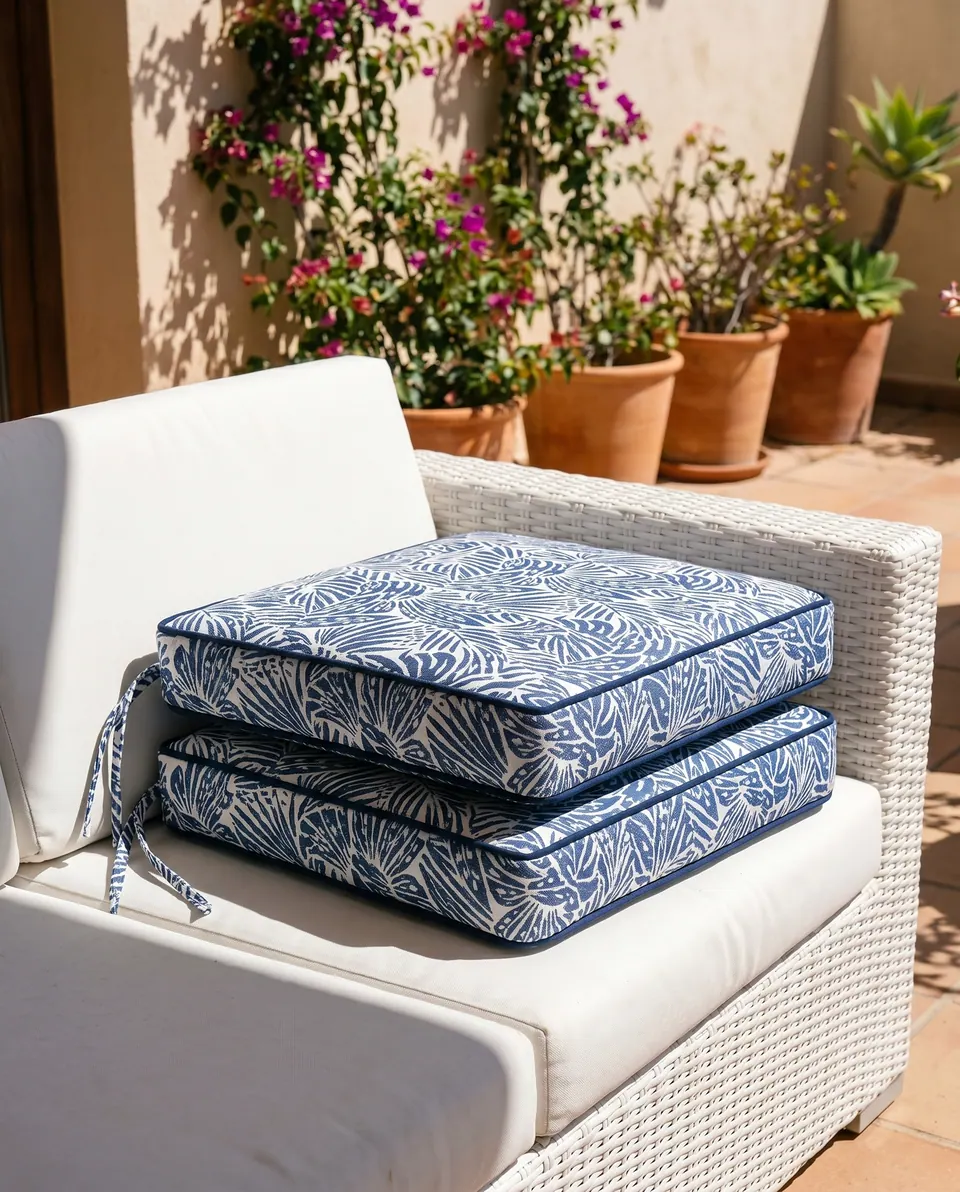
Yes. Fabric ties can be sewn into the seams at the corners or along the back, in any position. A photo and sketch of the seat let them land where the frame can take them.
Should the cushion be smaller than a wicker frame with arms?
Treat the inside size as a hard maximum and ask for it sized under, not over. Plump cushions spread, so ordering the depth about 1 in under a fixed frame is a common fix.