The Pattern Room · a measuring pattern
How to draw a custom-shaped cushion so it isn't made mirror-image
An odd shape is a list of honest measurements plus one fact people forget to write down: which side is up. This is the drawing standard I'd hand a new hire, and the check every drawing gets before a blade touches foam.

 Save
The quick answer
A good custom shape cushion drawing shows the seat from above as you stand in the room, with a letter and a typed measurement on every edge, short returns included, the wall and front edges marked, and the zipper or non-slip face noted. The workshop checks the geometry and sends a scale drawing back, and nothing is cut until you approve it.
A trapezoid has one true top
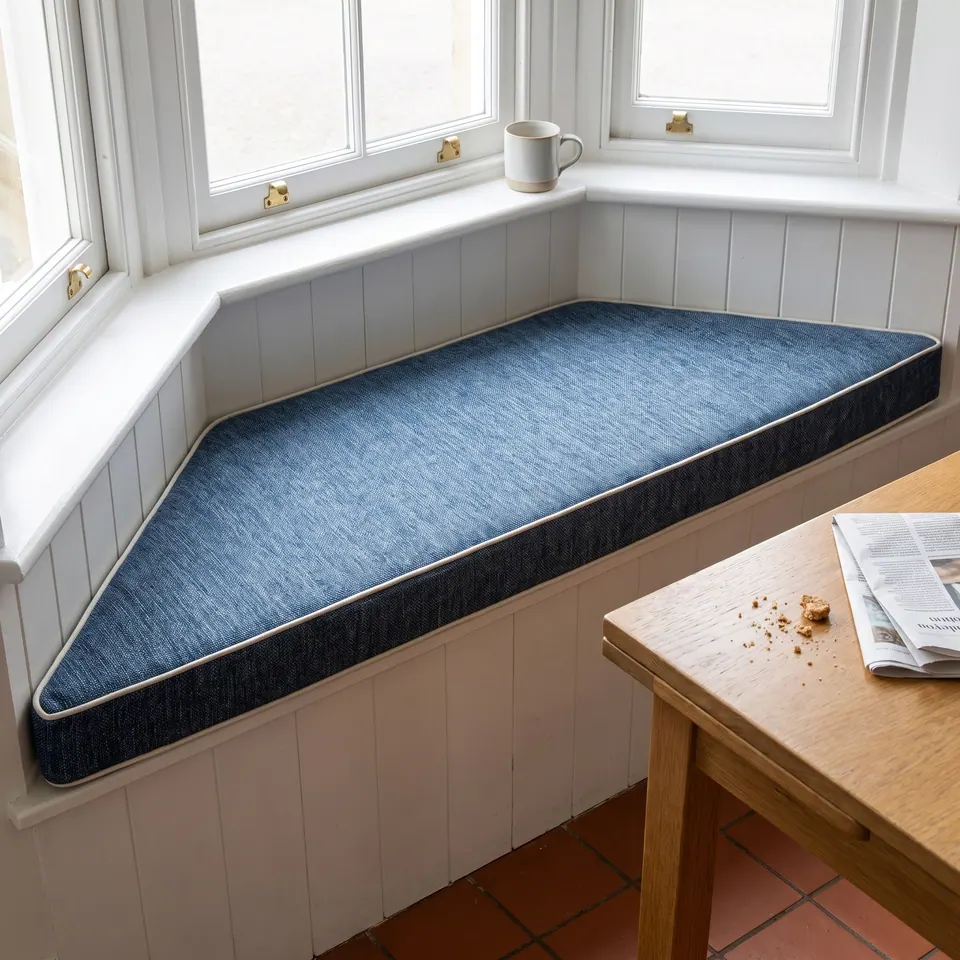
A rectangle forgives you. Flip it, spin it, it still fits. A trapezoid, a notched seat or a stepped bench has one true top, and if the drawing doesn't say which, you can receive a perfect cushion that only fits upside down.
That is why a custom shape cushion drawing needs a standard. For odd shapes, the drawing is where an order succeeds or fails: short edges left off, slants written shorter than the depth, letters that refer to different edges than the maker's diagram. Buyers often apologize that a sketch isn't to scale. It doesn't need to be. It needs to be complete and oriented.
Measure twice; the fabric remembers.
Eight rules for a drawing nobody can misread
Stand in the room and draw from above
Stand where you'd sit down, look down at the seat and draw what you see. Write 'viewed from above' on the page and mark the front edge, the one your knees hang over. That one note fixes left and right for everyone who touches the order.
Pattern sheet Front, back and depth fix the shape; the slanted sides follow from them. Letter every edge, short returns included
Go around the shape and give each edge a letter, A, B, C, with its length beside it. Short edges count: a 2 in (5 cm) straight end on a bay seat, or the two 4.3 in (11 cm) edges on one buyer's angled-top bay. Add any clipped corner.
Mark the wall edges and the front
Hatch every edge that touches a wall or window and label the room side 'front'. Old walls are rarely square, so the maker cuts from the wall edges and lets the diagonals follow. On a bench the zipper runs along the back edge; on a trapezoid, say which wall-side edge should carry it.
Measure depth square, then close the shape
Seat depth runs at 90 degrees from the back line to the front edge, and an angled side is always longer than the depth. Steps plus the short edge must equal the long edge. In an older house, add both diagonals.
Type the numbers as well as drawing them
Photos of a tape measure get misread. Type every edge in your message too, in one unit only; fractions like 19 3/8 in are fine. When one buyer's sketch of an angled-top bay was hard to read, the workshop asked for each side typed: A 4.3, B 4.3, C 78.5, D 48, E 24, F 24, G 23 in. It went ahead in 131 deep navy velvet.
Say which face is up
A non-slip base, a one-sided zipper, a notch or a set of ties makes a cushion one-sided. Write where the zip goes, which face gets the grip and which edge meets the wall or chair back, with tie positions and lengths.
Get every image into the order
Some order forms take one image. A buyer in the US ordering six trapezoid chair seats, 18 in (46 cm) at the front, 16 in (41 cm) at the back and 17 in (43 cm) deep, merged three measurement photos into one image and sent it by message as well. Or upload one image and write 'drawings sent via message' in the personalization.
Approve the scale drawing, letter by letter
The workshop checks the geometry, works out missing sides, converts inches to centimeters, flags impossible numbers and sends back a lettered diagram. Production waits for your yes, so check each letter against your own sketch before you give it.
Pattern sheet Front 86.5 in, back 39.5 in, depth 24.5 in, straight ends 2 in. The slanted sides work out at about 32.5 in. The written slant of 31 in does not match the geometry, so something needs re-measuring.

Have it made
Measured it? Have Nate’s workshop make it
Every edge and both diagonals, to the nearest 1/4 in. If the numbers do not close, the workshop will say so on the call. — Nate
Leave your details and the workshop will call you to confirm measurements, fabric, foam and piping. No prices, dates or payment on this page: it is a request, not an order.
The trapezoid that fit only upside down
This one has happened more than once. A trapezoid seat cushion arrived with its non-slip face on the wrong side. Grip-down, the slant ran the wrong way. Turned over, it fit the bench perfectly, with the grip on top doing nothing.
The shape was right; the orientation had never been written down. A rectangle with a non-slip base can be turned end for end. A trapezoid with one cannot be flipped without swapping its left and right.
In past cases like this the workshop measured first, checking the shape against the order with measured photos, because a cushion that only fits zip-up is sometimes a measuring issue rather than a mirror. Then it remade the cover with the grip on the correct face or the zip underneath. If one reaches you this way, send the workshop measured photos with the grip face showing. The fix is one line on the drawing: top side up, viewed from above, front edge here.
A 1.5 in disagreement that saved a bay cushion
A buyer in the US sent a bay seat drawing: bottom 86.5 in (220 cm), top 39.5 in (100 cm), depth 24.5 in (62 cm), 2 in (5 cm) straight ends and angled sides of 31 in (79 cm).
The check: offset (86.5 - 39.5) / 2 = 23.5 in; rise 24.5 - 2 = 22.5 in; slant = the square root of 23.5² + 22.5², about 32.5 in. That is 1.5 in off the written 31. For 31 in to hold, the top would need to be about 43 in.
The workshop asked for the top to be re-measured. The buyer confirmed just under 40 in and found the slants really were 32.5 in. The cushion went ahead at 4 in (10 cm) thick.
Photo, sketch or paper template: what each tells the maker
| What you send | Good for | Weak spot |
|---|---|---|
| A photo of the seat | Walls, trim, casing, context | Not a measurement; production follows the drawing |
| A photo of a tape measure | Backing up one number | Easily misread; type the number too |
| A hand sketch, every edge measured | Trapezoids, bays, notches, steps | Must be complete and oriented; scale doesn't matter |
| A paper template photographed flat beside a tape | Curves and asymmetric bays | Trace it top side up and mark the front |
| The workshop's lettered diagram | Your last check before cutting | Only as good as your read of each letter |
Run your trapezoid through the calculator first
Before you send anything, put the front, back, depth and any straight ends into the trapezoid cushion calculator. It works out the slant and corner angle and prints a full-size template. If your measured slant and the calculated one differ by more than about 1 in (2.5 cm), re-measure before you draw the final copy.
Which edge on your seat haven't you measured yet? Find it now, partner, not after the order ships. For three-sided bays, see bay window seat measuring; for curves, chord and rise; for posts and casings, notched cushions. Finished shapes live under trapezoid cushions and window seat cushions.
Drawing mistakes that stop the cutting table
- Leaving off short returns and clipped corners. Nobody can guess a 2 in edge.
- Writing a slant shorter than the depth. That is geometrically impossible, so one number is wrong.
- Ordering an angled seat as a rectangle. The rectangle listing never asks for a drawing; if front and back lengths differ, it's a custom shape.
- Agreeing a change in chat but not in the order. Production sews to the order record.
- Assuming a cushion that only fits zip-up was mirrored. Measure it against the order first.
If the measured slant of a trapezoid cushion differs from the calculated slant by more than 1 in, re-measure before anyone cuts the foam.
Nate
Buyer questions: drawings, uploads and approvals
- A common question
My seat isn't a rectangle. How do I order a cushion in a custom shape?
The workshop's answerUse the separate custom-shape (trapezoid) listing. Pick the size range by the longest length and the deepest depth; that only sets the price bracket. Upload a drawing with a measurement on every edge plus a photo of the seat, and put thickness and fabric code in the personalization. The cushion is cut to the drawing, and the makers will review it first if you message it.
- A common question
The order form only takes one photo and I have three drawings. What should I do?
The workshop's answerUpload the one image the form allows and write 'drawings sent via message' in the personalization, then send the rest in the conversation, or merge them into one image. If attachments won't go through on a first message, they sometimes go through once the maker has replied, and email is a fallback. Two different shapes are two separate orders.
- A common question
Will I see a drawing before you cut my shaped cushion?
The workshop's answerYes. Shaped and multi-piece orders get a drawing with dimensions and fabric choices to approve before production, and you can still adjust it then, for example changing one depth. On request, the workshop also sends photos of the finished cushions before they ship.
- A common question
My bench is an odd shape. What's the best way to send you the measurements?
The workshop's answerSend a photo of the space and a hand sketch with every side measured and labeled A, B, C. For a back cushion, add the wall height above the seat, and mention trim that sticks out. The workshop asks about any missing side, checks which side is length and which is width, and sends its own drawing for your OK.
- A common question
Can you cut the cushion around the posts at each end of my window seat?
The workshop's answerYes. Mark each notch's width, depth and position along the edge and add a few wide-angle photos; the workshop redraws it as a template for you to confirm before cutting. If the notches sit on the back edge, say so, because the zipper runs along the back.
Drawing questions, measured
Does a cushion sketch have to be drawn to scale?
No. A hand sketch on paper is fine. What matters is a measurement on every edge, the view from above and the front edge marked. The workshop redraws the shape to scale; if a sketch is hard to read, it asks for a larger copy with each edge clearly labeled.
Should a custom shape be measured in inches or centimeters?
Either works, and fractions such as 19 3/8 in are accepted. Pick one unit and use it on every edge, because a drawing that mixes the two invites errors. The workshop converts inches to centimeters itself when it redraws the shape for approval.
How do I show a curved edge on the drawing?
Mark where each curve starts and ends and how deep it runs at its shallowest and deepest points, or trace the seat onto paper, cut it out and photograph it flat beside a tape measure. The template method is recommended for tricky curves.
Why does the workshop cut from the wall edges in an old house?
Because old walls are rarely square. When corners are out of square, the workshop cuts from the edges that meet the walls and lets the diagonals follow, accepting a result within about 1/4 in. Both diagonals on your drawing show how far out the corners are.