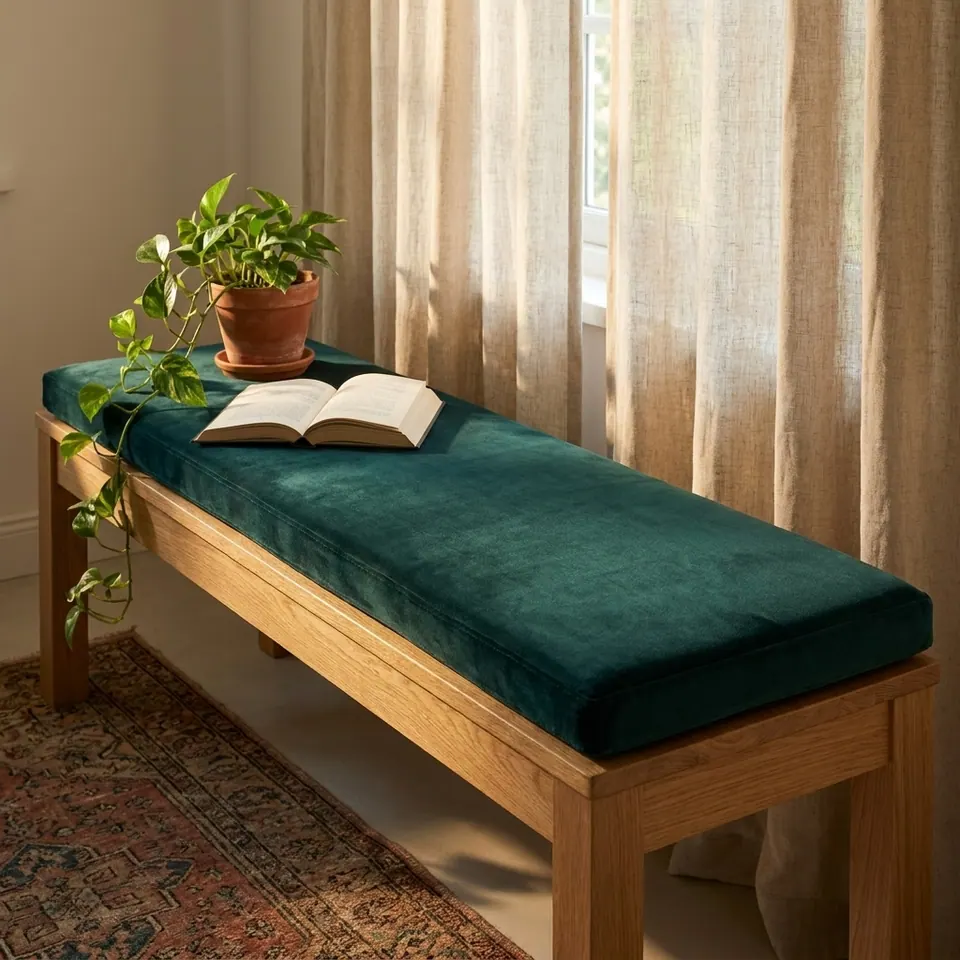
The Pattern Room · a measuring pattern
One printable cushion measuring worksheet for any shape you order
Most orders that stall at the cutting table stall on paper, not on foam. This is the sheet I'd hand every buyer: one box per shape, the unit circled once, and the checks the workshop runs before a blade moves.

 Save
The quick answer
A cushion measuring worksheet records one shape per sheet: length (A), depth (D) and thickness (T) for a rectangle; front, back, straight depth, both slants and both diagonals for a trapezoid; each run for an L or U; the diameter for a round. Circle one unit, add fabric and piping codes, and send it with a photo that shows the tape.
Three numbers that stop an order cold
Three kinds of number stall more cushion orders than any curve does: an inch figure read as centimeters, a slanted side that can't close, and a bench measured through a flattened old pad.
A cushion measuring worksheet catches all three before they leave your house. One shape per sheet. One unit, circled. A letter on every edge. The same three slips keep coming back, and each costs a round of messages before anything is cut.
Print this page, or copy the boxes onto any paper. Fill in the header, then only the box for your shape. The length, depth and thickness Pattern explains each letter at length.
Filling in the sheet in seven steps
Circle the unit before you write a number
Inches or centimeters, but only one per sheet. Production runs in centimeters, so inch figures are converted and rounded to the nearest centimeter. A sheet with both units is a sheet somebody has to guess at.
Tape the frame, not the old pad
Measure the bench, sill or frame inside, wall to wall. An old pad has sagged and rounded; it describes the cushion you had, not the seat you have.
Pattern sheet Plan: the cushion fills the inside of the frame, 48 by 18 in, measured wood to wood. Front view: 4 in thick. Fill only the box that matches your shape
Rectangle: A, D and T. Trapezoid or bay: every edge plus the straight depth. L or U: each run end to end. Round: the diameter. One angled end, a notch or a curve means it isn't a rectangle, however nearly it is one.
Pattern sheet Front, back and depth fix the shape; the slanted sides follow from them. Letter every edge and add the diagonals
Short straight returns count as edges. In older rooms, add both diagonals; they show which way the shape leans, which no single width can.
Measure positions from a named end
Notches, ties and hinges need a starting point: "8 5/8 in from the left end", not "near the left". Left means standing in the room, facing the seat.
Pattern sheet Outside runs 90 and 55 in, depth 18 in. Piece 1 runs the full 90 in; piece 2 is 37 by 18 in and butts against it, flush. Measure a backrest from the top of the seat cushion
A back cushion stands on the seat cushion, so its height runs from the top of the seat cushion to where the back should end. Measured from the bench top, it comes out one seat-thickness too tall.
Pattern sheet Side view. The back cushion stands on the seat cushion, so its height is the frame height minus the seat thickness. Photograph the seat with the tape in frame
One wide photo of the whole seat, one close photo with the tape along the longest edge. A traced curve gets photographed flat beside the tape too.
Pattern sheet Lay paper on the seat and trace the edge, write the widest width and the front-to-back depth on the template, then photograph it flat from directly above with a tape measure in the picture.

Have it made
Measured it? Have Nate’s workshop make it
Send the numbers in inches: length × depth × thickness, plus any angle. The workshop checks them with you, because foam has no undo button. — Nate
Leave your details and the workshop will call you to confirm measurements, fabric, foam and piping. No prices, dates or payment on this page: it is a request, not an order.
Box 1: the header every sheet needs
Fill this in on every sheet, whatever the shape.
| Field | Write it here | Why the workshop asks |
|---|---|---|
| Unit (circle one) | in / cm | Inch figures read as centimeters change both the size and the quote |
| Cushion name and quantity | __________ × ____ | Each distinct shape is its own order line with its own drawing |
| Indoor or outdoor | indoor / outdoor | The color search starts in the right chart |
| Thickness (T) | ________ | Standard is 4 in (10 cm) for seat, bench and window-seat cushions |
| Fabric code, body | ________ | Neighboring chart numbers can differ only in tone |
| Piping code | ________ or none | Written separately from the body code |
| Hard maximum? | yes / no, which edge: ______ | A marked limit is kept under; handmade sizes vary by about 1 in either way |
Box 2: rectangle or round
| Measurement | How to take it | Write it here |
|---|---|---|
| A: length | Side to side along the front edge, inside the frame | ________ |
| A at the back | Only if the walls may not be parallel | ________ |
| D: depth | Front edge straight back to the wall | ________ |
| Diameter (round) | Across the widest point, through the center | ________ |
Box 3: trapezoid or bay seat
| Edge | How to take it | Write it here |
|---|---|---|
| C: front | Corner to corner along the room side | ________ |
| D: back | Along the wall or window trim, true length | ________ |
| E: straight depth | At 90 degrees from the center of the back edge, never along a slant | ________ |
| A / B: slants | Each side on its own, corner to corner | ______ / ______ |
| Diagonals | Front-left to back-right, then front-right to back-left | ______ / ______ |
| End returns | Short straight edges at each end, if there are any | ______ / ______ |
Box 4: L and U runs
| Item | How to take it | Write it here |
|---|---|---|
| Run 1 | End to end along the first wall, corner included | ________ |
| Run 2 | End to end along the second wall, corner included | ________ |
| Run 3 (U only) | End to end along the third wall | ________ |
| Depth of each run | Front edge to wall, each run separately | ____ / ____ / ____ |
| Corner owner | Which piece runs into the corner, or a separate square corner block | run 1 / run 2 / block |
| Backrests | Which runs get a back cushion | run 1 / run 2 / run 3 |
Box 5: notches, curves, backrest, ties, zipper
| Extra | How to record it | Write it here |
|---|---|---|
| Notch or cut-out | Width, depth, and distance from a named end, for each one | W ____ D ____ from ____ end |
| Curve | Where it starts and ends, plus the shallowest and deepest depth, or a traced paper template | ________ |
| Backrest height | From the top of the seat cushion, not the bench | ________ |
| Ties | Position from a named end, and the length of each tie | ________ |
| Zipper edge | Normally the back edge; say so if a notch sits on the back | ________ |
| Hinged lid | Each hinge's position from a named end, and its width | ________ |
Six checks before you send the cushion sheet
Why Inch figures read as centimeters shrink every edge on paper.
Why Send the seat as it is; fit allowances are the maker's job.
Why Anything else is geometrically impossible, so one number is wrong.
Why It shows where the tape started.
Why Each distinct shape is ordered with its own drawing.
Why Ties, notches and hinges line up only when everyone counts from the same side.
of 6 ticked. Tick them off as you write your order; nothing is saved or sent.
How the workshop reads your sheet
What happens on the other end, in order:
- Units first. No unit, no quote; the workshop asks.
- Geometry second. The shape is drawn to scale. On a trapezoid, front, back and straight depth fix the slants, and a measured slant more than about 1 in off the calculated one gets a re-measure request. The trapezoid cushion calculator runs the same check at your kitchen table.
- Missing edges third. A missing side is calculated or asked for, not guessed.
- A lettered diagram comes back. You check it against your sheet, edge by edge. Production waits for your yes.
The custom shape drawing Pattern shows how that approval drawing is laid out.
Three window seats and one missing word
A buyer in the US sent measurements for three trapezoid window seats. The numbers were right. The unit wasn't written beside them, and the first quote read them as centimeters.
An inch is 2.54 cm, so on paper every edge shrank to well under half its size. The quote shrank with it, to less than half the true figure. Once it was caught, the correction took a revised quote, a thickness change from 2 1/2 in to 3 in (6.4 to 7.6 cm) and a fresh look at the piping, ivory against the body fabric.
It ended well; the buyer loved the seats. But one circled unit at the top of one sheet would have made every one of those messages unnecessary. Write the unit, partner. Then write it again after the number.
A quilt box, four hinges and a starting point
A returning buyer in the US wanted a cushion for a 77 in (196 cm) quilt box with a hinged lid, with ties on the hinge side only. She sent four hinge positions: 8 5/8, 29, 48 and 68 1/4 in.
The workshop asked two more things: which end she measured from, and how wide each hinge was, so the ties would line up with the hardware rather than land on it.
A position without a starting point is half a number. That's why Box 5 asks for the end.
The three slips the workshop sees most, and two more
- Inch figures read as centimeters. Circle the unit and write it after every number.
- Slants that don't close. A slanted side is always longer than the straight depth.
- An old, flattened pad measured instead of the bench. The pad has sagged; the frame hasn't.
- One slant copied to both sides. Left and right are rarely identical in real rooms.
- A delivered cushion measured too soon. Vacuum-packed foam needs 48 to 72 hours, sometimes up to a week, to recover.
From the sheet to the order line
Rectangles go on the regular listing. Anything with an angle, a notch or a curve goes on the custom-shape listing, with the sheet and a photo uploaded at checkout.
The personalization note Pattern turns this sheet into one line per cushion, and the trapezoid Pattern walks Box 3 edge by edge. For a bench cushion or a window seat, Boxes 1 and 2 are usually the whole job. Rather ask first? Send the sheet through the quote page.
Which edge on your seat refused to agree with the others? That's the one to measure twice.
Three habits make a cushion measuring worksheet work: one unit circled, every edge lettered, and the frame measured instead of the old pad.
Nate Kowalski
Buyer questions: sheets, sketches and units
- A common question
On the custom-shape listing, does the size range I pick decide how big the cushion is?
The workshop's answerNo. The range, chosen by the longest length (the widest point) and the deepest depth, only sets the price bracket. Checkout asks you to upload an image: a drawing with a measurement on every edge, plus a photo of the seat if you have one, with the thickness and fabric code in the personalization box. The cushion is cut exactly to the drawing. A simple paper sketch is fine, but a hard-to-read one comes back to be redrawn larger with every edge labeled. Unsure which options to pick? Message the drawing first and the makers can send a screenshot of what to select.
- A common question
What do you need from me for an L-shaped bench with back cushions?
The workshop's answerThe end-to-end length of each leg of the L, the seat depth and thickness, and a sketch or photo. Say whether any part is angled and which runs need backrests. Outside and inside L measurements also work, for example outside 90 x 55 in and inside 72 3/4 x 39 in; the workshop then plans the two-piece split and confirms it, such as 82 x 18 in and 29 1/4 x 18 in. Backs can run along one side only, like a foam wedge on the longer run. Standard thickness is 4 in, and the units and the L layout are checked before quoting.
- A common question
How close to my numbers will the cushion come out, and what if one size is a hard limit?
The workshop's answerEvery cushion is handmade, so the finished size can vary by about 1 in (2.5 cm) either way, and long cushions vary most. Inch orders are converted to the nearest centimeter for production. If a size is a hard maximum, say so: when a buyer said 24 in was the absolute limit, the workshop made the cushion 23 in. Measure height only after the foam has fully expanded; shaking and patting a tufted cushion helps it settle to size.
- A common question
One end of my bench is rounded. What do I write on the sheet?
The workshop's answerA curve isn't read from numbers alone. Either draw it, with the total width and depth, the straight length of each edge before the curve starts, where each curve starts and ends, and the depth at the shallowest and deepest points; or, for tricky curves, lay wrapping paper or newspaper on the seat, trace the edge, cut it out and photograph it flat beside a tape measure. Each cushion gets its own drawing. An arched window seat can be drawn as a rectangle plus an arc of a circle.
- A common question
My seat has posts at both ends. How do I mark the notches?
The workshop's answerMark each notch's width, depth and position along the edge, and add a few wide-angle photos of the seat. The workshop redraws it as a standard template, often in centimeters, and asks you to confirm before cutting; one window seat had an 87 in window edge, an 84 1/2 in opposite edge and 1 1/4 x 2 in notches at both ends. If a notch sits on the back edge, say so, because the zipper runs along the back. Ties are an optional extra: give each one's position and length.
Before you print: worksheet questions
Can I send the filled-in sheet as a phone photo?
Yes. A clear photo of the sheet or of a hand sketch is enough; no special form is required. Type the numbers into your message as well, in case the photo is hard to read, and add a separate photo of the seat with the tape in frame.
Should I mail you my full-size paper template?
No. Photograph it instead: lay it flat, put a tape measure beside it and mark where any curve starts and ends. Photos or a digital file sent in the chat work; physical templates aren't taken by post. The workshop redraws its own diagram from your photo and asks you to confirm it.
The old cushions are gone. What do I measure?
The frame, which is the better number anyway. When the original cushions were missing, the workshop has worked sizes out from the furniture itself, for example a sofa base 68 in (173 cm) along the back and 63 in (160 cm) along the front with curved ends.
Do I need a separate sheet for every cushion in a set?
One sheet per distinct shape. Identical cushions share a sheet with a quantity. An L with a square corner block and two long arms needs a box for each piece, because each piece is ordered at its exact drawn size and the set is produced together.