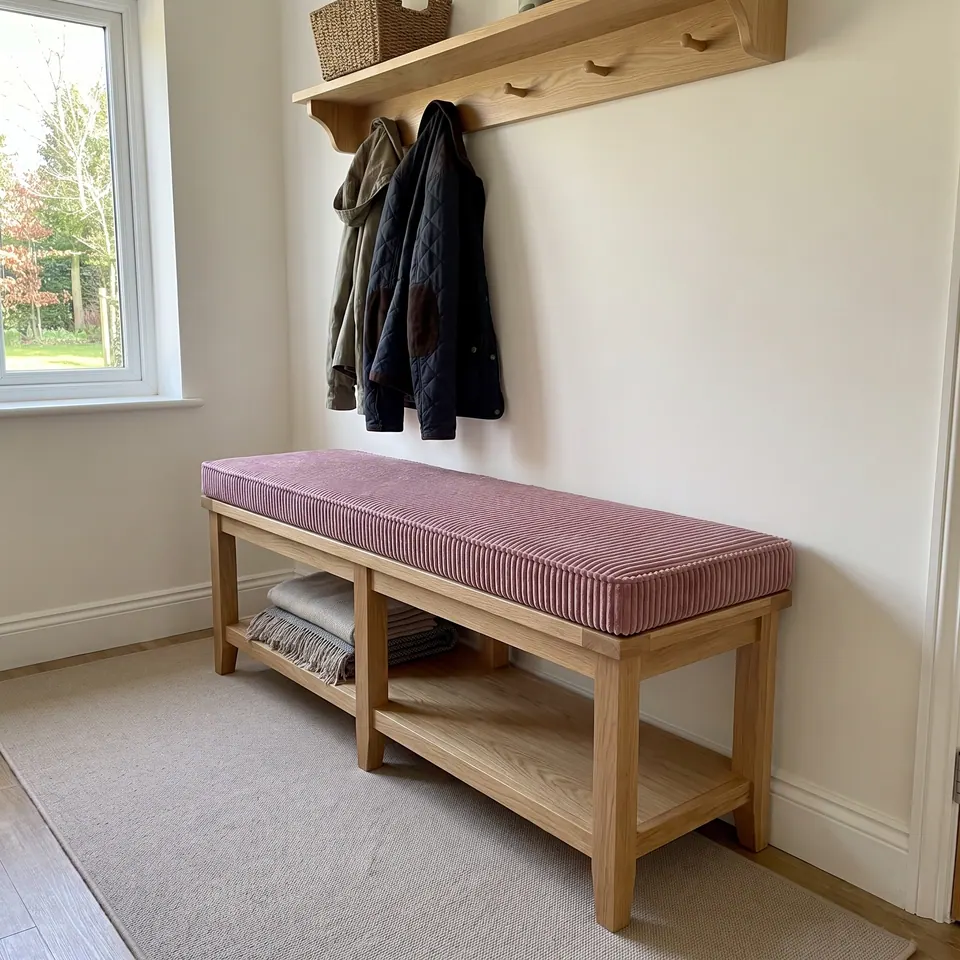
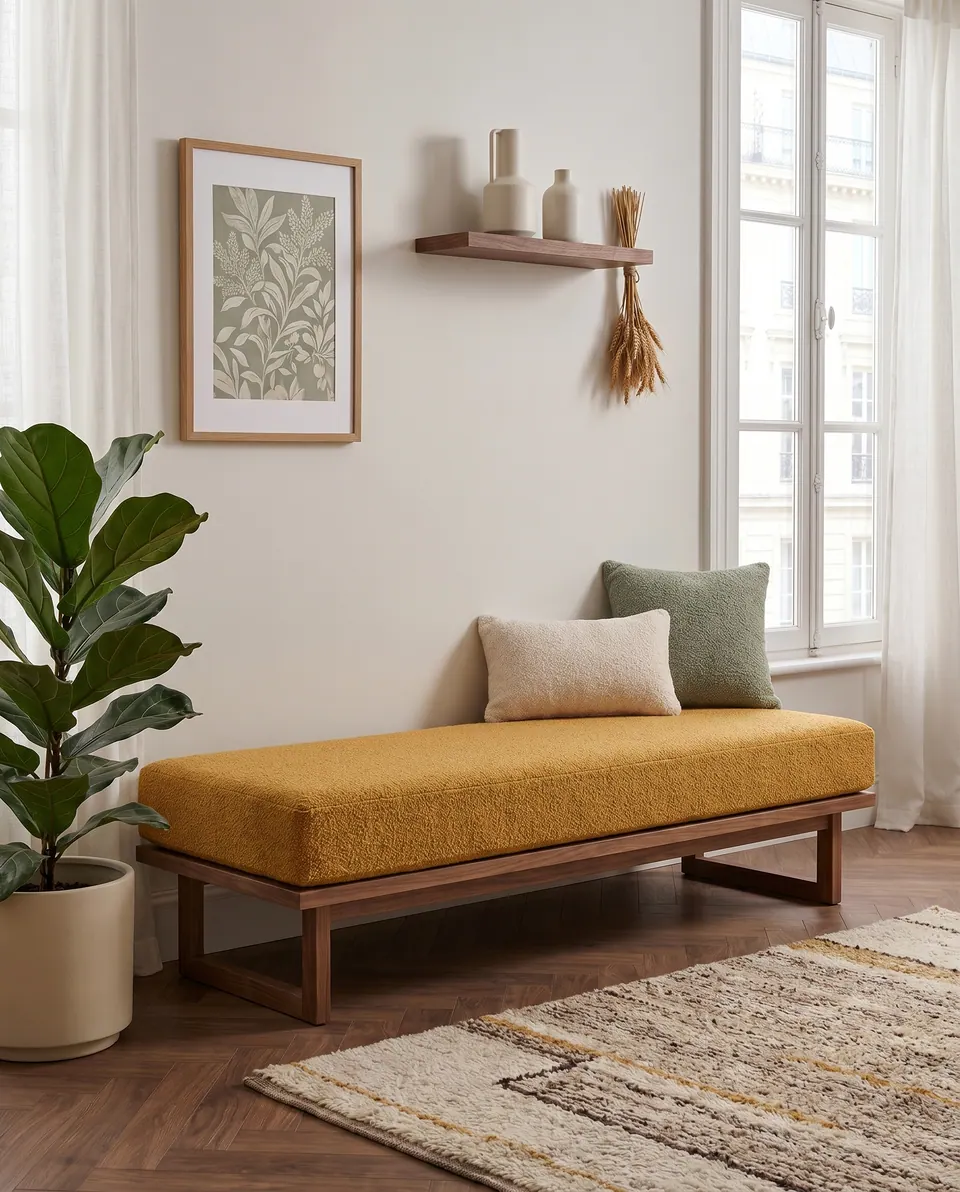
The Pattern Room · a side-by-side pattern
One long cushion or two? Splitting a long bench or window seat
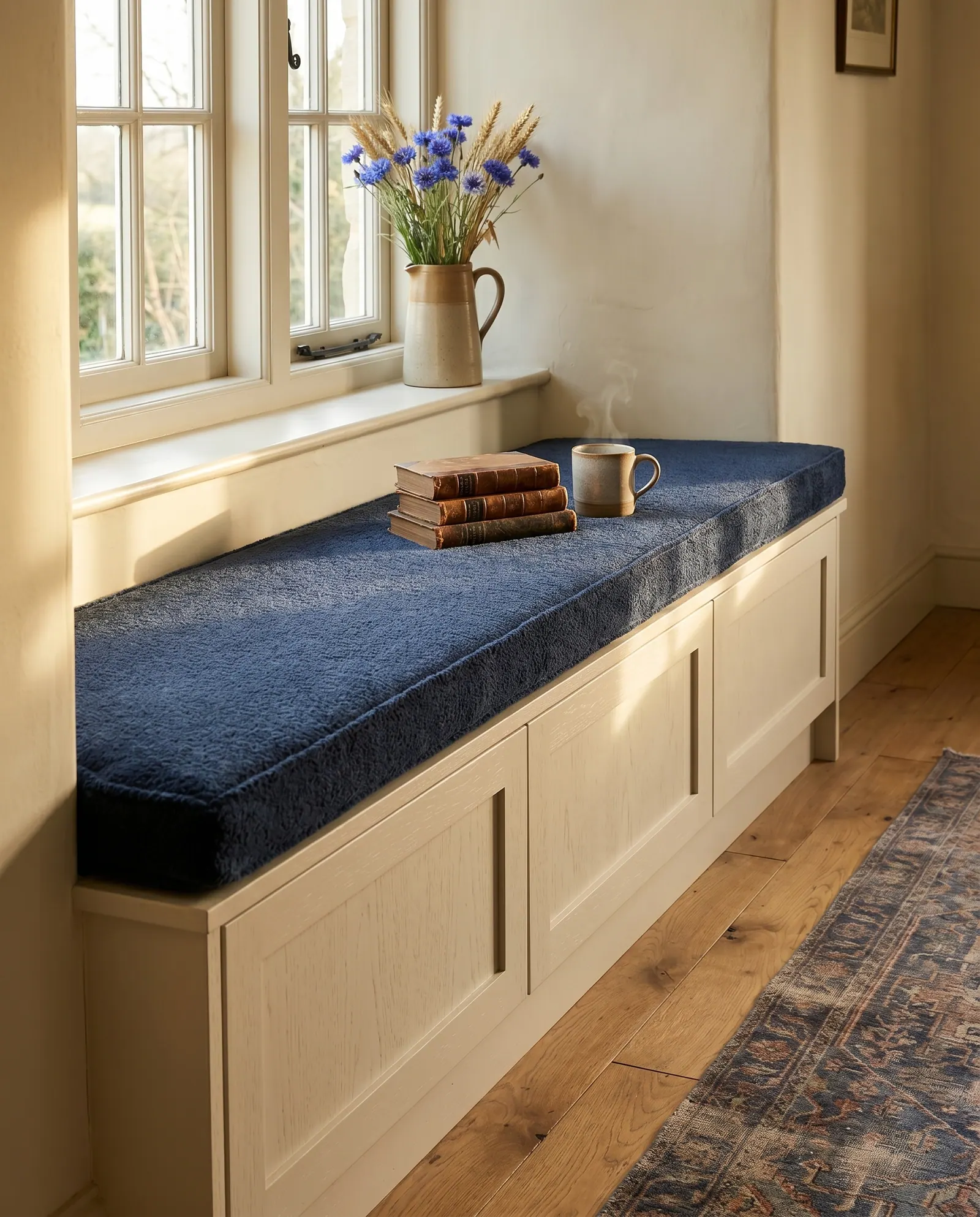
A long seat is a list of honest measurements with one extra decision on top: where, if anywhere, the cushion stops. Here are the numbers, the trade-offs and the 154 1/2 in window seat that settled it.

- One long cushion
- Two or more equal pieces
 Save
The quick answer
A long bench cushion is usually best split into equal pieces once the run passes about 79 to 90 in (200 to 230 cm). Two pieces are easier to lift, unzip, ship and fit, and the price mostly follows total area either way. One piece is still possible on request: write 'one piece' on the order and allow 1 to 2 in of size variation.
154 1/2 inches, and one question back
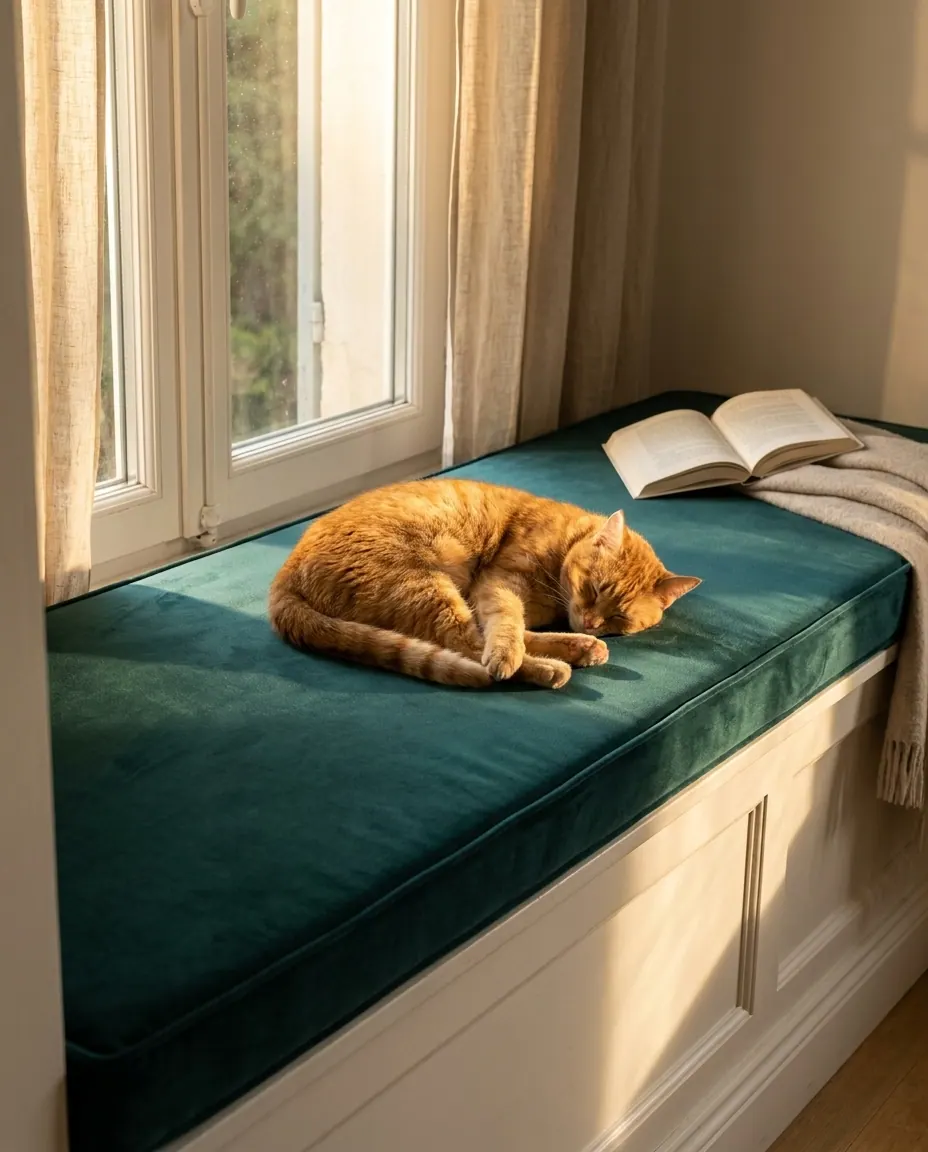
A window seat 154 1/2 in (392 cm) long came to the workshop with one request: corduroy cushions to fill it. The workshop's first reply was not a price. It was a question: what size is each piece?
That question is this whole Pattern. A long bench cushion can be one piece, two or three, and the right answer depends on how you lift it, how it ships, where the hardware sits and where you lie when you nap on it.
Past a certain length, two pieces win almost every row of the table below. Before it, one piece is the tidier look. Seat still a sketch? Start with the bench cushions hub, or window seat cushions if it sits under glass.
One piece or two, row by row
| One long cushion | Two or more equal pieces | |
|---|---|---|
| Lifting and turning | Partly Hard to lift and turn once it passes about 79 in (200 cm) | Yes Half the length in each hand |
| Unzipping and washing | Partly One long cover to work back over one long foam | Yes Shorter covers come off and go back on more easily |
| Shipping | Partly One oversize parcel | Yes Smaller pieces, made and shipped together |
| Fit over time | Partly Long foam can bend or shift, more so with angled ends | Yes The workshop's recommendation for durability and fit |
| Size variation | Partly Very long single pieces can vary 1 to 2 in (2.5 to 5 cm) | Yes About 1/2 to 1 in (1 to 2.5 cm) per piece |
| The join | Yes None; one clean run | Partly A visible line where two finished edges meet |
| Stripes side to side | No The roll is about 55 in (140 cm) wide, so a long top would need a seam | Partly Only on pieces shorter than the roll is wide |
| Price | Partly Follows total area | Partly Follows total area; real quotes moved slightly either way |
| Best for | Runs under about 79 in (200 cm), or a nap seat where a join would land under you | Runs past about 79 to 90 in (200 to 230 cm), lift-up lids, corners |
The limits are working guidance, not a wall. Single cushions of 104 1/2 in, 111 1/2 in and 138 in have been made on request.
Where one piece stops being the easy answer
On one piece or two, the workshop's advice lands in three bands:
- Up to about 79 in (200 cm): one piece, no discussion.
- About 79 to 90 in (200 to 230 cm) per piece: the recommended ceiling. Past it, two equal pieces get suggested; 92 in (234 cm) became two 46 in (117 cm) cushions.
- About 98 to 118 in (2.5 to 3 m) and up: equal pieces, recommended firmly. A 111 in (282 cm) seat went out as two 55 in (140 cm) cushions, and a 197 in (500 cm) nook in three.
Those are guidance, not law. Single cushions of 104 1/2 x 18 in (265 x 46 cm) and 40 x 138 x 3 in have been made when buyers asked, though the workshop once called a single 104 in (265 cm) piece not possible. Ask before you plan around it.
Two physical limits sit underneath. Foam blocks have a maximum length, and the fabric roll is about 55 in (140 cm) wide. A long cushion is cut with its length along the roll, which is why stripes on a long bench run front to back by default; see stripe direction on bench cushions. On oversized panels, seams go toward the back.
Backs follow their own rule. Soft back pillows sag when they run long, so an 88 in (224 cm) back works better as two 44 in (112 cm) pillows.
Placing the split in seven moves
Measure the whole run and label it
Measure wall to wall at the front and again at the back, to the nearest 1/8 in. Write total run next to that number. The most common long-seat mix-up is a total read as the length of each piece, or the other way round. Tolerance is kindness to your future self.
Find the hardware before you do arithmetic
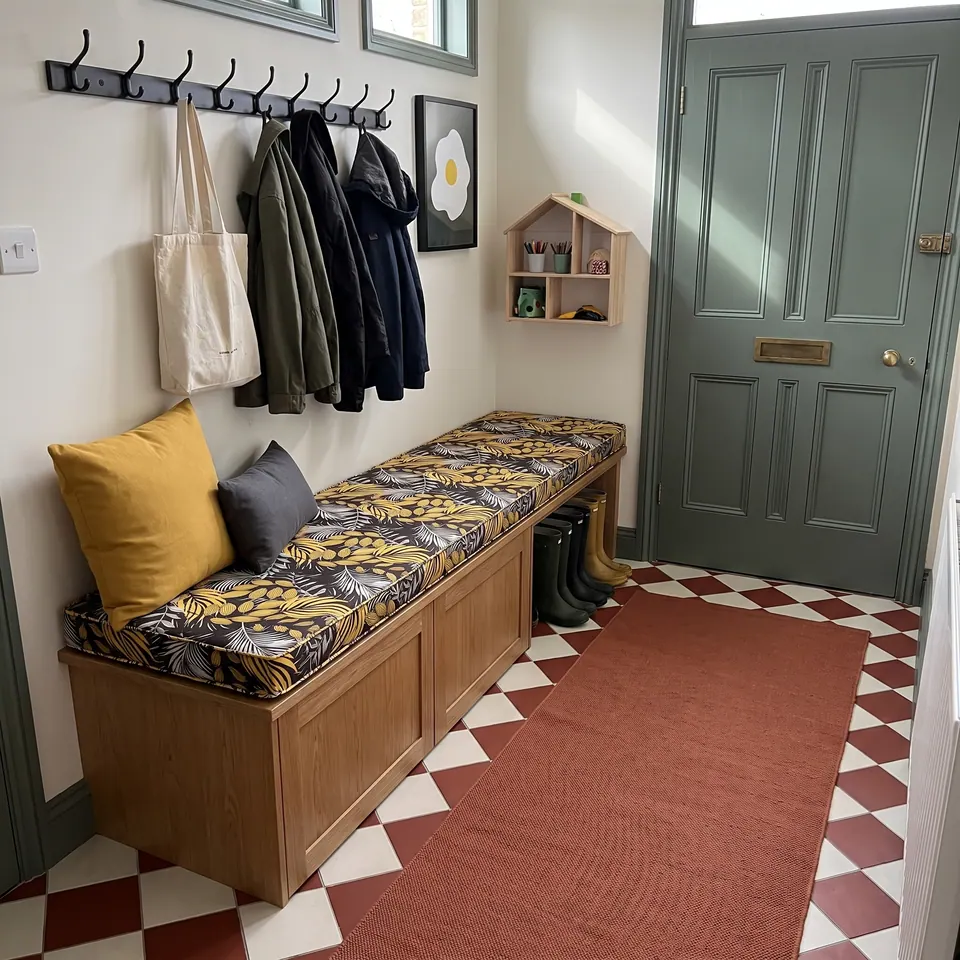
Hinges, lid breaks, window mullions and posts decide more than division does. On a lift-up storage bench, split at every lid break so each lid opens on its own. Under a window, a join below a mullion lines up with something already in the room.
No hardware? Cut equal halves
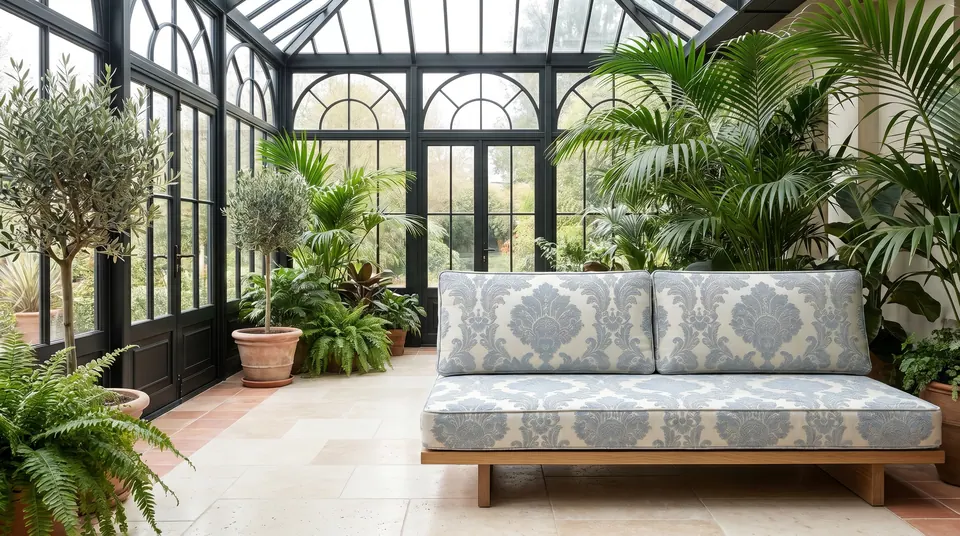
Divide by two. 154 1/2 in becomes two 77 1/4 in (196 cm) pieces; 92 in becomes two 46 in. Equal pieces can trade places, and one spare cover fits either.
Pattern sheet Plan: the cushion fills the inside of the frame, 77.25 by 22 in, measured wood to wood. Front view: 4 in thick. Go to thirds when halves are still too long
If half the run is still past about 90 in (230 cm), make it three. A 170 in (432 cm) run was made in three pieces, and so was that 197 in nook.
Think about where you lie
If the seat doubles as a nap spot, look at where the join lands under you before you settle on halves. A split at a hinge or a mullion may suit you better, or one piece with its extra size variation.
Order each piece as its own line
Each piece goes in the cart as its own cushion at its own size. Choose the closest menu size and type the exact dimensions, thickness and fabric code in the personalization box. Write per piece beside every length. If you want no seam at all, write one piece on the order instead.
Decide how the pieces stay put
Two shorter cushions on a smooth ledge can drift. Ask in writing for ties on the hinge side or a non-slip base; stopping a bench cushion sliding covers which one suits which surface.

Have it made
Measured it? Have Nate’s workshop make it
Precision starts on the phone. Give the workshop your measurements and they will read them back to you, edge by edge. — Nate
Leave your details and the workshop will call you to confirm measurements, fabric, foam and piping. No prices, dates or payment on this page: it is a request, not an order.
The 154 1/2 in corduroy window seat
A buyer in the US wrote in about a built-in window seat 154 1/2 in (392 cm) long and 22 in (56 cm) deep. The fabric was corduroy; velvet was quoted too.
The workshop asked for the size of each piece, and the seat was split into two identical cushions, 77 1/4 x 22 in (196 x 56 cm). Each was ordered through the closest menu size, with the exact dimensions typed into the personalization box.
The cushions fit. The unboxing went less well. They arrived tightly shrink-wrapped with no protective layer, and the knife that opened the plastic cut the covers. The workshop offered new covers at cost, the buyer kept the cushions, and later came back to order for other benches.
Two lessons, partner. Split a long seat into equal pieces. And when a vacuum pack arrives, cut only the outer plastic, then give the foam its first 72 hours to recover.
- What it taught
- Split very long seats into equal pieces and open vacuum packs with care, cutting only the outer plastic.
Long-seat mistakes that keep repeating
- Mixing up total run and piece length. '154 in' can mean the seat or each cushion. Write total run or per piece beside every number.
- Assuming one piece. Buyers expecting one seamless cushion sometimes open two. Ask up front if your length will be split.
- One cushion across two lids. A lid can't open under a cushion that runs past its break. Split at every lid break and add ties.
- Hinge positions with no starting point. A 77 in (196 cm) quilt box had hinges at 8 5/8, 29, 48 and 68 1/4 in, and the workshop still had to ask which end they were measured from. Name the end.
- One long soft back pillow. Long backs sag; 88 in works better as two 44 in pillows.
- A long blade on the vacuum pack. Cut only the outer plastic. A knife through shrink-wrap goes through a cover just as easily.
- Expecting a 136 in cushion to land to the 1/4 in. A single piece that long can differ by 1 to 2 in (2.5 to 5 cm), even though it is measured before it ships.
Lay it out both ways in the builder
Before you commit, draw it twice. The bench cushion builder takes length, depth and thickness, shows the cushion in 3D and writes a cutting ticket with every edge in inches and centimeters. Run it once at the full length and once at half, and look at where the join falls against your windows or lids.
Then send both layouts in one message and ask for a quote on each. Price mostly follows total surface, and real quotes went both ways: one window seat split in two cost exactly the same, a long piped banquette came out slightly cheaper in three, and three storage-bench pieces listed a little above one. Corner seats have their own logic in L-shaped cushion corner joints.
So, what does your run measure, wall to wall?
A bench cushion longer than about 90 in (230 cm) is usually better as two equal pieces: easier to lift, unzip and ship, at about the same price.
Nate
Buyer questions: long runs, corners and joins
- A common question
Our window seat is really long. Should the cushion be one piece, or split into sections?
The workshop's answerFor very long seats the workshop recommends equal pieces, for durability, fit and easier handling: 92 in (234 cm) as two 46 in (117 cm) cushions, or a 197 in (500 cm) nook in three. Each piece is ordered as its own cart item. It is still your choice; send a photo and measurements for advice, or ask for one piece.
- A common question
My bench turns a corner. Is an L-shaped cushion better as one piece or two?
The workshop's answerTwo pieces meeting flush at the corner is the recommendation: they fit more cleanly, ship more safely and are easier to unzip and wash. A common layout is a square corner cushion with a long cushion on each arm. A small L can still be one piece from a lettered template you confirm edge by edge, at a higher cost and with less margin for error.
- A common question
Could a long floor cushion double as a sleepover bed, and how long do they go?
The workshop's answerYes. The cushions are firm enough to sleep on, and lengths of 70 to 75 in (178 to 190 cm) are made routinely. For a child, 24 x 70 in or 27 x 70 in is typical; a twin is about 38 x 75 in (97 x 190 cm). A 6 or 8 in (15 or 20 cm) thickness sits higher off the floor, and longer custom sizes suit taller adults.
- A common question
Can you make a cushion longer than anything on your size menu?
The workshop's answerYes. Every cushion is made to order, so any length, width and thickness can be made, in inches, centimeters or millimeters, including lengths over 79 in (200 cm). Send the measurements and the workshop checks them and replies with a quote. You then order the nearest listed size with your exact size in the note, or pay through a custom order link.
- A common question
One end of my bench is rounded. How do I measure that part?
The workshop's answerThe shop won't read a curve from numbers alone. Sketch the total length and depth, the straight length of each edge before the curve starts, and how deep the curve runs, then photograph the sketch. Or lay paper on the seat, trace the curve, cut it out and photograph it flat beside a tape measure; that template method is recommended for tricky curves.
Long-seat questions, short answers
What is the longest cushion that can be made in one piece?
Single cushions of 104 1/2 in (265 cm), 111 1/2 in (283 cm) and 138 in (351 cm) have been made on request. The workshop still recommends about 79 to 90 in (200 to 230 cm) per piece, and a single piece that long can vary by 1 to 2 in.
Will I feel the join between two bench cushions?
Two cushions meet as two finished edges, so there is a visible line, and you may feel it if you lie across it. Buyers ask about this often. If the seat doubles as a bed, place the join where it bothers you least, or ask for one piece before ordering.
Does splitting a long cushion cost more?
Usually not by much, because price mainly follows total surface area. Separate pieces add cutting, sewing and zippers, but in real quotes a window seat split in two cost the same and a long banquette in three came out slightly cheaper. Ask for both options in one quote.
Why do stripes run front to back on a long bench cushion?
The fabric roll is about 55 in (140 cm) wide, and a long cushion is cut with its length along the roll. Running stripes side to side on a 57 1/2 in top would need a seam, so the default is a seamless top with stripes front to back.
Can two sections be joined so the cushion folds?
Sometimes. When a piece is too long to make or ship whole, the workshop has made equal sections joined so they fold. Ask in writing before ordering, and give both the total run and the length of each section so nobody has to guess.
Does a very deep or wide cushion need a seam?
It can. Upholstery fabric comes off a roll about 55 in (140 cm) wide, so a panel larger than that in both directions needs a join; one maker notes that widths or depths over about 52 in may need a center seam. The workshop places such seams toward the back, where they show least, and confirms the layout with you first.